Up to 37% in savings when you subscribe to hi-fi+
hifi-logo-footer

Begin typing your search above and press return to search. Press Esc to cancel.

Sugden Masterclass ANV-50 integrated amplifier

It was ‘Birdland’ that did it. I’d been listening to the Sugden Masterclass ANV-50 for a day or two. Not careful, reviewer type listening, you understand, just getting to know you listening, and it had been immediately obvious that Sugden had something a bit special on their hands, but it wasn’t until I happened upon that old Weather Report warhorse that I actually realised just how special.

Sugden decided to celebrate the 50th-anniversary of the A21, the world’s first production Class A transistor amplifier, by developing another pioneering design, but this time one with a distinctly 21st-century vibe. Two years on, the ANV-50 is that 50th-Anniversary product. It was designed with a few objectives: first, it needed to have a more robust power output than the 25-35 Watts of the A21; second, it needed to deal with the sometimes-unwelcome heat output of Class A designs; and finally, befitting the current era, its power consumption needed to be rather eco-friendlier. The 50‑Watt, cool-running, ANV-50 consumes 20 Watts when idling, compared to the A21’s constant 200 Watts.

So, job done then. Provided it doesn’t sound like all the musicians are texting their accountants while performing, obviously.

It doesn’t. The interesting thing for me, on first impressions, was how unlike the warm and easy Sugden sound the Masterclass ANV-50’s character seemed to be, but at the same time, how it retained that fundamental musical nous that Sugden products bring to bear. Sugden amplifiers, and particularly the A21, seem to manage an effortless facility with the important aspects that simply draws you in to the music. The ANV-50 does have that signature sweetness, though, and a kind of empathy with the music that can find beauty and meaning in all but the most raucous racket. So, actually, exactly like the Sugden house sound. But different, somehow.

The technology is different, too. Sugden, after a half-century of the ground-breaking A21 recognised that they needed another ground-breaking product to do it justice. So here it is, and it’s not Class A and, deep breath, it has a switched-mode power supply rather than a linear PSU. So, not just a development of the A21, which continues in production. But it’s not just any SMPS, you understand; it’s about twice as fast as conventional switched mode supplies, the better to replicate the speed and transient attack of Class A designs whose power delivery is instant, thanks to the ‘always on’ nature of the design. But Class A is a wasteful way to amplify a signal. Switched mode power supplies have come a long way since the likes of Linn and Chord first made them mainstream, and if you think you don’t like what they do, then perhaps it’s time to let the ANV-50 recalibrate your expectations like they did mine. The power amp section is itself a two-stage design, a small Class A stage drives a second Class A/B final output stage (the first 4 Watts or so are Class A) and the speed of the SMPS means pretty much instantaneous power delivery, all the time.

It’s an implementation Sugden think is unique. Trailblazing again.

DC-coupling keeps capacitors out of the signal path, and a new design of comparator circuit improves compensation for load (output doubles into a 4Ω load), making this a most flexible and fuss-free partner in a much wider variety of systems. It’s a very 21st-century solution, because it consumes so little energy except when it needs to. It’s also going to disappoint anybody who appraises amplifiers by weight: the Masterclass ANV-50 weighs barely more than half as much as the A21SE, largely due to the lack of need for a toroidal transformer, banks of capacitors, and hefty heatsinking. But don’t make the mistake of equating weight with quality. The usual unimpeachable Sugden build-quality, fit, and finish are there just as you’d expect. The switches and knobs are tactile and a pleasure to use. Take the top off and you don’t see machine-built surface-mount boards, just neatly laid out and constructed componentry in the time-honoured fashion.


So, that Weather Report track (from Heavy Weather on Columbia). In moments, I  was utterly gripped. Fast, detailed, and insightful, with explosive transients and that beautiful tonal colour and tunefulness that Sugden does so well. The bass was tight and melodic, the percussion fast and urgent, and the sax’s phrasing was absolutely on the money. I remember going to a Weather Report gig in my youth, not long after Heavy Weather came out, and this was as fresh and exciting an experience as I remember from that day. Good hi-fi is about evoking feelings, generating a visceral, emotional response to your music, and the Masterclass ANV-50 was absolutely delivering right at that very moment.

It’s not perfect, and while the 50-Watt output (doubling to 100 Watts into a 4 Ohm load, which is itself quite a rare capacity in the real world) gives it considerably more than twice the headroom and grunt of the A21, it can’t quite match the solid bottom end of my (twice as expensive) 110-Watt Albarry M1108s. So that famous opening bass riff of ‘Birdland’ has power, impact, and tunefulness, but just misses out on a degree of mass and solidity – Pastorius’ bass goes ‘boing’ not ‘Boing!’, but you’d only notice if you’d heard it differently elsewhere. In all other respects, the freshness and vitality of the piece just leapt out of the speakers, aided no doubt by the sort of natural timing and ‘rightness’ that just doesn’t draw attention to itself. This was the music speaking, not the system.

Setting to one side, for a moment, thoughts of lower bass, I turned to the more contemplative and thoughtful Tord Gustavsen Ensemble, specifically ‘Wrapped in a yielding air’ from Restored Returned [ECM] which, while seldom rising above a mezzo forte still manages a sinuous, compelling propulsion in the twists and turns of its phrasing and the understated percussion. Its textures, particularly Kristin Asbjørnsen’s characterful vocals, are a key part of the whole performance, and the ANV-50 delivered its complex layers and subtleties impeccably. And, as it happens, bass really isn’t an issue. Tord Gustavsen again, but this time with his trio on ‘At Home’ from Being There [ECM]; there is a skilful and oh so subtle build up of energy and urgency. Again, the volume seldom rises above moderate levels, and lesser amps struggle to portray the energy if there isn’t much of yer actual loudness, but the ANV-50 absolutely nailed it. It’s a clever trick, depicting energy without loudness, and it takes a very accomplished amp to pull it off. ‘Vesper’ from the same album showed that the amp is more than capable of giving a convincing account of the weight of a piano’s lower registers, with a solid, convincing, and above all, tuneful bass.

The Sugden Masterclass ANV-50 reminds me of another of my very favourite amplifiers, the Lavardin IS Reference. Both have a speed, delicacy, and subtlety, a way with textures, phrasing, and timing that simply elevates their performance above their peers. The Sugden, however, also has ample reserves of power and drive, despite its 50-Watt output not being far removed from the Lavardin’s nominal 45 Watts. The difference, I suspect, is how the Sugden deals with lower impedance or reactive loads, which neither the Lavardin, nor Sugden’s own A21 can even approach.

So, the on-paper power output means the ANV-50 isn’t a heavy-hitter, but the delivery is robust enough for it not to show under most circumstances. Billy Taylor’s piano on ‘I wish I knew how it would feel to be free’ from Music keeps us young (Arkadia) can indeed be as weighty and powerful as you expect, if you turn the wick up a bit, but sometimes that comes at the expense of a small degree of the piece’s signature bounce, and the subtlest phrasing touches.

These are very small trade-offs, however, and the truly remarkable thing is that I’m nit-picking because there’s very little else. And in truth, any small nits I’ve picked are largely I suspect down to the relatively modest power output, rather than any issues with the amp itself. Probably fair to say that 50 Watt, doubling into a 4Ω load, is going to be more than adequate for most applications.

I use Russell K Red 150 floorstanders for most of my reviewing; these are a fairly straightforward load, but not especially efficient at 87dB for 1 Watt at 1 metre. Thoroughly antisocial volume levels were entirely possible in my typical UK domestic-sized listening room, but a 50-Watt amp is never going to move as much air as a big ‘un, and it was when extended that the limits of the power did show. The Royal Concertgebouw Orchestra’s account of the Dvorˆák 9th Symphony [RCO Live, SACD] has huge reserves of energy, and dynamics to pin you in your seat. But it’s not lacking in subtlety. The Masterclass ANV-50 delivered nearly all the energy and drive you could wish for, for example in the Scherzo third movement and the finale, but if I drove it hard there was a slight trade off in resolution. The tone and pitch of timpani was perhaps a touch vague, compared to the Albarries, and there was a small reduction in the scale of the soundstage and depth. But the ANV-50 didn’t lose its composure or become congested, and this is a piece which has foxed many an amplifier in my system. Played at a slightly lower level, the spatial detail and texture was all there, so I conclude that any limitations are largely down to the ultimate reserves of power you have available. Some of it may be the preamp section (the Sugden has a pre-out option) which is a little leaner and a shade less emphatic than my Albarry, but the essential character of the amplifier as a whole was consistent, whether I used just the pre- or used it as an integrated design.

The amp uses its available power as effectively as any amplifier I’ve heard. As I mentioned before, it manages that neat trick of portraying the energy in the music without needing to be playing loud, so it’s an absolute wonder at creating tension and drama, and letting the musicians’ skills shine through in the subtlety of their playing and phrasing. All these little micro-dynamic details which lesser amps are apt to airbrush away can so often make the difference between an enjoyable performance, and a truly memorable one. The Sugden just owns it. Take Joanna MacGregor playing ‘Autumn in Warsaw’ from Play [Sound Circus]; this is a subtle, yet complex and hugely technically demanding piece, and MacGregor’s articulation and phrasing is finely wrought. It goes loud, but the musical forces are not massive; here the piano has very good weight, scale and solidity, and the build up of tension and drama is so skilfully managed that the apocalyptic climax to the piece is all the more effective in its impact. It’s about the way the power is delivered – just the right amount, at just the right moment.


So, timing is another particular strength; the late, and much missed Jacques Loussier’s ‘Pastorale’ from Plays Bach[Telarc] has lots of subtle inner detail and little delights – the interplay between the piano and the percussion with its peculiar ‘not quite off-beat’ counterpoint, or the way piano and bass work together and, in particular the melodic and tuneful nature of the acoustic bass. Marc Cohn’s ‘Ghost Train’ from Marc Cohn [Atlantic] showed off its inner detail and rhythmic structure, the tom toms and tambourine being particularly tactile and texturally rich; but it’s subtly done, not pushed into your face, and all the more effective for it.

The Sugden Masterclass ANV-50 is, by any standards, a remarkable achievement. As a spiritual, if not literal successor to the pioneering A21, the amp that made Sugden’s name, it has some big shoes to fill. On this experience, it does so magnificently. It is light on its feet, and has a deftness that eludes so many otherwise decent amplifiers. Coupled with a perfectly respectable and usable power output, and the reserves to double that output into difficult loads, it’s going to be quite a challenge to find anything at the price that will give you anything like the musical satisfaction and sheer joy this amplifier delivers. Here’s to the next fifty years.

TECHNICAL SPECIFICATIONS

  • Type: Solid-state two-channel integrated amplifier with switched mode power supply
  • Analogue inputs: 5, single-ended line level only via RCA jacks
  • Analogue outputs: One tape loop, one pre-amp (variable) output, one pair multi-way loudspeaker binding posts
  • Input sensitivity: 110mV @ zero attenuation for full output
  • Input impedance: 50kΩ
  • Signal to Noise Ratio:90dB
  • Frequency response: +/-1dB 12Hz–45kHz
  • Bandwidth: 8Hz–86kHz
  • Distortion: THD @1 Watt < 0.05%
  • THD: @35 Watts <0.05%
  • Rated power into 8Ω: 50 Watts, both channels working
  • Rated power into in 4Ω: 100 Watts, both channels working
  • Finishes: Brushed Black or aluminium
  • Dimensions (HxWxD): 143 × 430 × 370mm
  • Gross Weight (packed): 10kg
  • Price:£3,950

Manufacturer: J E Sugden & Co Ltd

Tel: +44 (0) 1924 404088

URL: sugdenaudio.com

https://hifiplus.com/reviews/

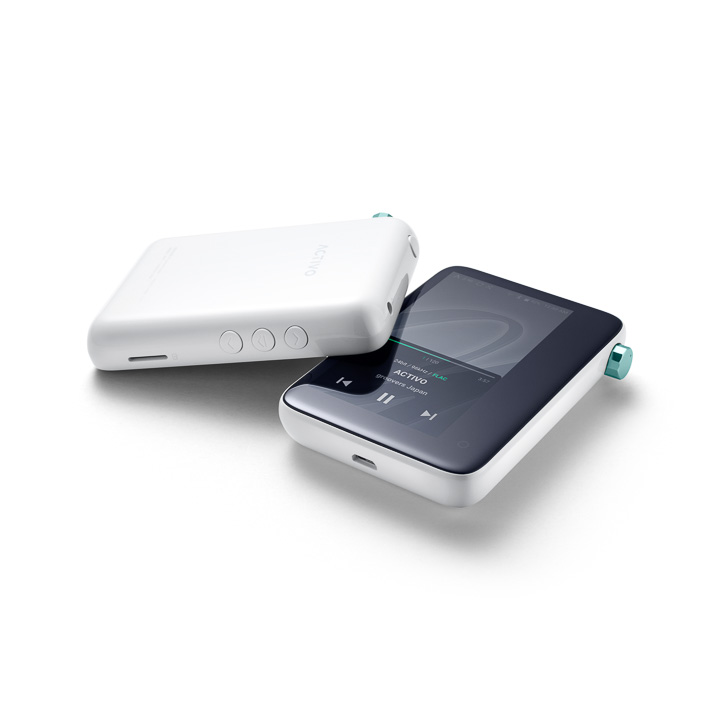
Astell&Kern ACTIVO CT10 portable digital audio player

When my review of the Astell&Kern A&Futura SE100 appeared on the website of our sister magazine The Absolute Sound, the first reader comment was, “Yet another DAP from A&K? Whoopee.” Snide, but I get it. Astell&Kern portable players have never been exactly pocket-book-friendly. But with their ACTIVO line, Astell&Kern looks to change that.

The ACTIVO CT10 has impressive specifications. It’s based around a Quad-Core CPU and was designed jointly by groovers Japan and IRIVER. It debuts Astell&Kern’s TERATON TM200 module, which combines a Cirrus Logic CS4398 DAC chip, analogue amplifier, independent power unit, and clock together on a single chip. It uses a 2500 mAh 3.7V Li-Polymer battery for a power source.

The CT10 has full DLNA networking, as well as Bluetooth connectivity, including aptX HD support for streaming up to 24-bit/48 kHz high-resolution audio over 4.1 Bluetooth. The CT10 can also be used as a portable amplifier/DAC via its USB connection. The ACTIVO CT10 includes 16GB of internal memory along with a microSD card slot that supports up to a 512GB microSD card. The CT10 can playback high-resolution audio up to 24-bit/192 kHz PCM and quad-rate DSD, which the CT10 converts to PCM. It is also MQA compatible. Tidal and Groovers+ streaming services apps are built in and you can add other services, including Qobuz, through the OpenAPP site. For those who like to custom-tailor their sound, the CT10 has an 10-band, eight preset adjustable EQ built-in. Is there anything the CT10 doesn’t have? With only one single-ended headphone output, the CT10 won’t power tough-to-drive headphones quite as well as Astell&Kern’s buff and beefy KANN or suave and sexy SE100.

The CT10’s form factor is a departure for Astell&Kern. Its round-cornered rectangular shape is nothing special, which is unusual for A&K, who are known for their unorthodox player body shapes. Instead the CT10 has a curved corner, one-piece design with its ‘cool white’ coloured back panel wrapping around to meet the touchscreen’s front panel. I would love to see that white back panel morph into dark grey or royal blue so the overall appearance would be less generic ‘white goods.’

Even though the CT10 only has a single-ended headphone output it successfully was able to drive a pair of Beyerdynamic DT-990 600 ohm headphones to adequate volume levels even with my own live concert recordings (although they did require its full output level to accomplish this.) While playing, the back of the CT10 could get quite warm, bordering on hot, especially when it was working at decoding and playing DSD recordings. The CT10 comes with a soft bag, but no travel case or armband, which would make the CT10 ready for gym use. You can get a nicely designed leather case from Amazon, however.


Sonically I found the CT10 was more than up to the task of delivering high-resolution music without any negative sonic issues. Your choice of earphones and EQ settings will have a far greater sonic influence of the final sound than the player itself. I also used the CT10 with several Bluetooth headphones. The inclusion of aptX HD made for a wireless headphone experience that was on par with what I heard from comparable wired headphones.

The only glitch I experienced during playback was on DSD DFF 5.6 files played from a 128GB card. Every 30 seconds (or so) there occurred an extremely short drop out. IRIVER could not duplicate the bug when I sent them the file, but it occurred on two different CT10 players, so I suspect it was something to do with the card since these same tracks played correctly when the card was loaded into a A&K A&futura SE100. Overall the operational efficacy of the CT10 was on par with Astell&Kern’s other players. Its touchscreen responded with alacrity, and its menu options were well laid out.

I suspect the ACTIVO CT10 will be a big hit. It delivers much of Astell&Kern’s ergonomic mojo in a small, value-packed player. For those music fans who don’t travel with difficult-to-drive headphones the ACTIVO CT10 could be a near-perfect travel and workout companion.

TECHNICAL SPECIFICATIONS

  • Astell&Kern ACTIVO CT10 portable digital audio player
  • Type: Portable digital music player
  • Formats Supported: WAV, FLAC, WMA, MP3, AIFF, DSD
  • Sample Rates: 8KHz to 192 KHz/24 PCM; DSD 64 to DSD 256
  • Power Output: 22 mW @ 8 ohms; 36 mW @ 16 ohms
  • THD+N: 0.0005%
  • Signal to Noise: 115 dB
  • Outputs: One 3.5mm mini-stereo headphone jack and Bluetooth 4.1.
  • Dimensions (HxWxD): 3.67” (93.2mm) × 2.57” (65.2mm) × 0.61” (15.5mm)
  • Weight: 3.95 oz; 112 g.
  • Price: $299 US, £249 UK

Manufactured by: IRIVER Inc. / Astell&Kern US

URL: us.activostyle.com/products/ct10

https://hifiplus.com/reviews/

Harman Kardon Citation Towers wireless floorstanding loudspeakers

It’s possible to reach all the way back to the mid-1950s and draw a straight line to these most 21st Century of loudspeakers. Well, a straightish line at least – there are one or two minor deviations involving a food conglomerate, an American president, South Korea, and several billion dollars.

In 1956 Bernard Kardon decided to retire from the company he and Sidney Harman had founded three years beforehand. Suddenly the sole boss of Harman Kardon, Sidney changed the company’s name to Harman International – but its products continued to be branded Harman Kardon. 

In 1959, Harman Kardon unveiled the Citation I preamplifier and a tube-driven power amp called Citation II. Citation II in particular, and the rest of Harman Kardon’s model range in general, was popular and successful enough to allow Harman International to begin acquiring other manufacturers – in 1969, for example, Harman International purchased the JBL loudspeaker brand.

Sidney sold his company to Beatrice Foods (yes, really) for $100m in 1976 – he was serving in Jimmy Carter’s government at this point and was allowed no other business interests. By the end of the Carter administration, Beatrice Foods had undermined the Harman Kardon brand to the extent that Sidney was able to buy it back in 1980 for $55m.

Sidney Harman was 88 years old by the time he retired in 2007 – by then Harman International was sitting on a significant portfolio of electronics brands, including the likes of AKG, Lexicon, and Revel. The company had the sort of profile and credibility in the stereo world a brand like Samsung would quite possibly kill for – but instead the South Korean giant settled for a takeover. It acquired Harman International in early 2017 for a reported $8bn. 

Harman International probably fancied itself a company of heft and importance – but, of course, its activities are dwarfed by the scale of Samsung’s operation. Yet it seems to have been granted enough autonomy for the first fruits of its labour under new management to be precisely the sort of products one imagines Sidney Harman would be demanding were he still at the helm. And, of course, the range is called Citation.

The Citation Towers are the biggest and boldest statement in the current Citation range. A floorstanding pair of beefily powered speakers (with 200 watts of amplification in each tower), they’re comfortably over a metre tall and are that special three-dimensional, flared-ovoid, vaguely triangular shape for which the world of geometry has (as far as I can tell) no word. Cone? They’re cone-shaped, sort of. The impression of bulk is mitigated somewhat by the way the Towers seem to float a little above the plinths they’re mounted on. 


The good people of Kvadrat must be working triple shifts at the moment. The Danish textile manufacturer seems to have cornered the ‘hard-wearing fabric with good acoustic properties no matter the colour it’s dyed’ market – every wireless speaker brand and their uncle has beaten a path to the town of Ebeltoft. The Citation Towers are covered by blended-wool Kvadrat from top to bottom, in either black or grey. Black is, well, black – the grey is the sort of shade one can imagine Don Johnson favouring for the suit jacket he intends to roll the sleeves up on.

Each Tower deploys four drivers. From the top it runs ‘10cm doped paper mid/bass driver, 25mm silk dome tweeter, 10cm doped paper mid/bass driver’ with a 20cm doped paper woofer firing upwards from the bottom of the enclosure. Between the woofer and the three-driver array there’s a sculpted bass reflex port that vents at the rear of the cabinet, just above where the mains cable plugs in. That’s if cones can be said to have a ‘rear’. Frequency response is given as 28Hz to 22kHz, and sensitivity as a manageable 103dB.

Unsurprisingly, Class D amplification gets the nod – each woofer enjoys 100 watts of power, while each three-driver array splits the other 100 watts. Processing of digital audio is done by a 24bit/96kHz Texas Instruments DAC – which, for most people’s real-world purposes, is probably fine. But it’ll disappoint those who like a 24bit/192kHz download and/or are Tidal Masters subscribers.

Digital audio can, at least, be accessed from literally hundreds of sources thanks to built-in Google Chromecast. The speakers can also access any music stored on a local network, and they’re equipped with Bluetooth 4.2 (which, again, is just slightly a suboptimal number). 

Control is via Google Assistant, which means you are – through no fault of Harman Kardon’s – subject to the typical Google Assistant catalogue of unpredictable misunderstandings and general slow-wittedness. There’s also a touch-screen on the top of the right-hand ‘master’ Tower (it’s the Control Tower! Boom! Tish! etc.) – it is small, bright and, high-resolution. It’s also rather leisurely in its responses, which is much more Harman Kardon’s fault.      

Set-up is achieved using the Google Home app, and it’s here you can arrange your numerous Citation speakers into a multi-room system. It’s very straightforward to do – the real trick is getting Google Assistant to do as you ask once your multi-room set-up is established.

If you’re the patient type, it’s now you enter negotiations with Google Assistant about getting some music playing. If you’re more like me, you open the Tidal app on your phone, select a ‘Masters’ file of Karen O & Danger Mouse’s Lux Prima [BMG] and press ‘play’. Then try to hide your disappointment as the track quality indicator on the app switches down from ‘Master’ to ‘HiFi’ as casting begins.

Despite the theoretical step down in quality, there’s much to like – even to admire – about the way the Citation Towers serve up ‘Turn the Light’. Standing out in some free space and toed in just a fraction towards the listening position, the Harman Kardon pair generate a fairly broad, fairly deep, and fairly convincing soundstage. There’s nice three-dimensionality to the way the speakers place the acoustic guitar towards the rear of the stage as it plays the root chord changes, and the close-mic’d vocal enjoys a pocket of space up front and centre. Danger Mouse (Brian to his Mum) has got the whole low-temperature disco insouciance thing down pat, and the Towers allow the tempo to simmer elegantly.

Tonally, the Citation Towers sit just on the cool side of neutral. There’s plenty of heat in Henry Mancini’s The Music from Peter Gunn [RCA], but the speakers take just a touch of the sting from the blaring brass. The result is an undoubtedly easy listen, but not the most forceful or assertive you’ve ever heard. This kind of approach suits Karen O and Danger Mouse just fine, but where Henry’s concerned a little more attack wouldn’t go amiss.

That’s not to suggest the Towers are an entirely passive proposition. They have sufficient vim to tackle Fela Kuti’s Colonial Mentality [Arista] head-on, and manage to keep control over a stage that’s crowded with quite forceful performers. This recording is a fine showcase of the speaker’s ability with timing and integration, too – keeping the gimpy rhythm rolling while it’s punctuated from all directions is a test many a speaker has crumbled in the face of.

Avoid Bluetooth if at all possible (here it drains much of the animation and excitement from music) and stick to casting from your preferred sources, and the Towers are an adaptable, generally engaging listen. 

They’re certainly impressive at the bottom of the frequency range – kick drums, bass guitars, and so on have real depth and texture. These instruments display great discipline with the attack and decay of bass sounds too, which helps reinforce their timing credentials.

There are a couple of unusual blind spots in the frequency range, though. For all the good work the Harman Kardons do when digging deep, a little higher up – towards the area the woofer hands over to the brace of mid/bass drivers, at around 120Hz – they become a little boneless and tentative. And it’s a similar story at the opposite end: the tweeter strikes a nice balance between bite and grind, but towards the bottom of the upper frequencies (at 2.8kHz, where the handover down to the mid/bass drivers happens) there’s vagueness rather than positivity.

Which makes it sound like the mid/bass drivers are somehow culpable, but that’s not the case. They do really admirable work with the unbearably vulnerable voice in Lotte Kestner’s Secret Longitude [Saint Marie], describing all the details of her vocal technique but maintaining a human, rather than analytical, quality to the sound. The problem is not with the drivers, which on an individual basis are doing everything they ought, but with the way the active crossovers are managed.


How fair it is to deal in absolutes when considering a product so squarely designed to offer as much convenience as much as performance is debatable. Consider the Citation Towers purely by the standards of £2k per pair floorstanders and you can do better in terms of frequency integration and dynamism. Consider them as a self-contained system, though, one that’s capable of functioning as an element of a multi-room or surround-sound set-up without any undue aggravation, and they become quite a bit more valid. And… Google Assistant’s low IQ is not Harman Kardon’s responsibility.

Like virtually everything in hi-fi that doesn’t carry a lottery-winner’s price tag, the Citation Towers are a compromise. A trade-off. But they do nothing to blacken the proud heritage of the Citation name, and they really ought to encourage Samsung that at least some of its money was well-spent.

TECHNICAL SPECIFICATIONS

Type: Three-way, four-driver floorstander with ported bass reflex enclosure

Driver complement: 1 × 25mm tweeter, 2 × 102mm mid/bass driver, 1 × 203mm woofer

Frequency response: 28Hz–22kHz

Crossover frequencies: 120Hz, 2.8kHz

Impedance (ohms): 6

Sensitivity (dB/w/m): 103 

Dimensions (hwd, cm): 116 × 34.7 × 34.7

Weight (kg): 19

Finishes: Grey, black

Price: £2,199 per pair

Manufacturer: Harman Kardon

URL: harman.com

Distributor: Harman Kardon

Tel: +44(0)161 222 3325

URL: harmankardon.co.uk

IsoTek EVO3 Syncro Uni DC offset blocking device

The IsoTek EVO3 Syncro Uni is a small, relatively light brushed aluminium box. It has an IEC output on one side and the plug socket of your country on the other. It is designed to counter the hum and dynamic constraining problems from DC offset plaguing the AC power fed to your system.

The standard version is designed to work with small-to-medium sized components and systems (it has a 10A, 2,300W maximum throughput as standard; owners of D’Agostino Relentless amps or similar should opt for the 16A, 3,680W version). Inside are silver-plated high-purity Ohno Continuous Cast copper conductors held in what IsoTek calls a ‘Virtual Air Dielectric’. It comes with a manual of sorts, which basically shows you how to plug it in (unplug existing power cable, attach that to one end of box, add another cable between wall and other end of box) and a series of ‘don’ts’ that could also apply to Gizmo from Gremlins (don’t get it wet, don’t cover it with curtains, don’t feed it after midnight… this last might be subject to some creative license on the part of the journalist). Otherwise, that’s it. No switches, no internal parts to mess with, not even a few DIP switches. Just a box. 

So what does it do again?

Let’s create a convenient set of numbers to best explain this. Imagine a perfect alternating current, which flips between +100V and -100V, crossing over at precisely 0V. An amplifier connected to such a current receives a mains power input that is entirely predictable. Now, introduce a constant direct current offset of 5V into the mix; you have an alternating current that goes from +105V to -95V, crossing over at +5V. That amplifier receives a mains power input that overloads by 5% half the time, and as that means either 25 or 30 times per second (depending on country), which causes mechanical hum. It can also damage the integrity of the audio that effectively modulates off that power input. This can mean pushing the amplifier into over-saturated distortion on the upswing and robbing the amplifier of its full dynamic range due to the limitations of the downswing. So, compared to the notional ideal, a mains power input with some form of DC offset can at best contribute to transformer hum, at worst simultaneously make your audio system sound more distorted and less dynamic.

“But,” cries the man reading the Boy’s Own Book of Audio Electronics, 1956 edition, “no one talked about DC offset in the before time, so it’s an invented ‘problem’ designed to separate the credulous from their money!” The difference is we have moved from a world of linear power supplies to a world of cheap-as-possible switch-mode power supplies. In the past, the two main sources of DC offset on the mains were the linear power supply in your TV and your fridge, and they introduced fractions of a volt at most. Today, at least one of those two sports a cheap SMPS that is more likely to introduce an order of magnitude more DC offset as a result, and things quickly multiply if you then add in computers, routers, DECT phone docking stations, anything with a plug-top power supply, and especially phone chargers (perhaps the perfect storm of ‘bad’ for an audio system, adding more than their fair share of radio frequency and electromagnetic distortion, as well as putting a DC offset into the mains). A quarter of a century ago, the typical DC offset load in a house was negligible enough to be ignored; now it’s a question of how much can your system tolerate.

DC offset blocking devices are not new; in fact, the EVO3 Syncro Uni is predated by the EVO3 Syncro, which still exists in the IsoTek catalogue. The main difference between the two is cable options; the EVO3 Syncro includes captive cords at both ends. While these captive cords are of excellent quality, the EVO3 Syncro Uni offers the option of picking your own power cords, whether inside the IsoTek ecosystem (as IsoTek would understandably recommend) or outside. We used it both with a pair of IsoTek EVO3 Premier power cords (to remain within IsoTekWorld) and a pair of Nordost Blue Heaven cords. The EVO3 Synchro Uni results were identical.

There are two kinds of transformer hum; the more subtle hum that raises the noise floor of a system and the obviously mechanical hum that comes from either poor quality control or having a transformer that isn’t working true to form (most commonly, this happens when using a product built and tested in a country with very different voltage and AC frequency). Fortunately, the EVO3 Syncro Uni is good at nailing both kinds of hum well. OK, so if you have a very wayward transformer, the best results come from a gentle tap or two from a rubber mallet and then a return to the manufacturer, but for the rest, it’s surprising just how much noise we put up with in audio, especially when the cure is so easy. You plug the EVO3 Syncro Uni in between the system and the wall, and the hum goes away. The noise floor gets lower almost every time. And the system gets very slightly cleaner sound and more dynamic most of the time. Unless you live in a cloistered house with a complete absence of 21st Century consumer electronics, these statements hold universally. The only times they won’t is if you have some form of power conditioner that blocks DC offset elsewhere in the system. Naturally, when talking about cleaner, more dynamic sound, we are talking about playing music through the system (it took less than a minute of listening to ‘Inertia Creeps’ from Massive Attack’s Mezzanine [Virgin] to hear the difference), but the hum differences apply from just listening to the system running quiescent.

The EVO3 Syncro Uni is a perfect introduction to IsoTek, as it offers almost no disruption in your existing system (except for the purchase of a single additional power cord) and offers a noticeable and repeatable performance boost. Who knows, it might be the stepping stone to a lot more IsoTek equipment to shore up your mains…

Price and contact details

IsoTek EVO3 Syncro Uni £595

Manufactured by: IsoTek Systems

URL: isoteksystems.com

Tel: +44(0)1279 647039 

Wilson Audio Sasha DAW floorstanding loudspeaker

There is almost a hint of sadness about the Wilson Audio Sasha DAW. The suffix is short for ‘David A Wilson’, the founder of Wilson Audio and father of Wilson Audio’s President and CEO, Daryl Wilson. Dave Wilson passed away in 2018, and the Sasha DAW acts both as tribute and legacy. 

The Sasha loudspeaker project was developed from the most successful high-end loudspeaker project in history; the Wilson Audio WATT/Puppy. First launched in 1985, the Wilson Audio Tiny Tot (WATT) was a two-way stand-mount monitor loudspeaker that set new standards in performance (and price; it was more than twice the cost of its closest rival) and was quickly joined by the Puppy subwoofer. This combination went through several iterations in its 24-year lifespan, becoming ever more a combination in name only until its replacement Sasha W/P in 2009. The Sasha W/P still relied on the separate mid-top and bass cabinets, and the familial resemblance could be seen, but this was a very different animal. The Series 2 replaced the original Sasha W/P five years later. And now, five years after that, the Series 2 gets replaced by the Sasha DAW. Looking at it from a distance, this is simply another churn of the product life cycle.

In fact, a surface check of the Sasha DAW might conclude it’s more ‘evolution’ than ‘revolution’, as that basic product roll-out (two-way top box sitting on a twin-driver bass cabinet) is the same and the dimensions appear ostensibly similar to what went before.

Looks can be deceptive. Apart from that familial resemblance, there is almost no point of contact between what went before and the Sasha DAW. Well, not entirely, but aside from the upper module that’s more than 13% larger than its predecessor, a new lower module that’s over 10% larger than its predecessor, a revisit of the materials that go into the cabinet, the way the group delay mechanism works, resistor access panel, and even the binding posts… it’s the same loudspeaker!  

Given the significance of the Sasha in the Wilson line, this is as close as it gets to a clean-sheet design; it retains the basic parameters that explain why a loudspeaker system can remain at the top of the tree for 35 years, but it looks at every aspect of the design to re-evaluate the concept from first principles. In the process, the loudspeaker needs to appeal both to potential newcomers who hear Wilson Audio for the first time, and to those who have been there from the get-go. It needs to fit into the Wilson Audio ecosystem (both in terms of physical placement and equipment compatibility – more on that later – and in hierarchy of product line). And most importantly, it needs to sound damn good.

The drive unit roll-out is always the Cliff Notes version of loudspeaker description, but here that almost says the least about the loudspeaker. Wilson has used a 25mm soft dome tweeter and a 178mm mid-woofer in the top box, and a pair of 200mm bass units in the cabinet for the longest time in this design. In fairness, these have been subject to a range of changes (a quick look at the original WATT shows an inverted metal dome where the fabric dome sits). And while we are staying on the ‘in fairness’ part of the review, those drive units saw some extremely profound revisions in the last iteration, so this isn’t the first place to go looking for changes.

The crossover, too, remains the subject of evolution rather than revolution, although the resistor changes used to help the speaker match the unique bass characteristics of different rooms are now accessed through an easier to open panel. This is not some form of tailoring or DSP, but instead a very slight change in loading to suit different sized rooms. This helps a lot; someone buying a pair of Sasha DAWs in a ranch in America has a very different room load to someone doing the same in an apartment in Hong Kong.


Each successive iteration of the Sasha improves on the group delay system, which is tuned in situ, both in terms of slight changes to the crossover network, but more importantly changes to the pitch of the front baffle of the top-box. This has gone from a relatively simple adjustment to a very precise micrometer, allowing the most precise set-up in room it’s possible to get at the price. This really is a trickle-down from higher-end models; what began at the MAXX level and beyond appeared in the last generation of Alexia, and now makes it to Sasha. It can’t go any lower than Sasha of course, because the Sasha is the first in the range that includes that kind of top-box adjustment.

There’s a misplaced feeling of voodoo about this tuning, in so far as saying it presupposes a fixed head position for the listener. Nod your head forward and the time-alignment is out of alignment. While this has some very raw credibility, it misses the point of all that careful installation made with electrostatic loudspeakers that also uses alignment that notionally presupposes pin-point head position. In fact, the time-alignment works for an optimal space for the listener relative to the room, and time-alignment takes that into account. Yes, it still focuses the best part of the sound into a very precise sweet-spot and those not sitting in that sweet spot don’t get anything like the same benefit, but it’s not the kind of sweet-spot that requires a head-clamp. Rather it is more like ‘a zone of sweetness’ that is focused on the listening position. Move a small amount and you’ll still be in that zone. A deft installer with time enough to fine tune could extend that zone out wide enough to accommodate two listeners sitting close to one another, a deeper zone in front and behind the best position, or focus that sweet spot in so tight that you might want to think about a neck brace.

One of the strangest parts to this review is writing up the sound quality, in that the words just sprinted onto the page. This is usually a sign of a very good or very bad speaker indeed. In this case it is a positive sign. There’s an aspect of good audio that is often forgotten in the path toward getting ‘better’ sound; it’s also got to be enjoyable. There are a number of loudspeakers that you listen to and find yourself full of respect for the sound, but musically unmoved. They aren’t ‘sterile’ or ‘harsh’ sounding… just ‘not for you’. And often you hear consensus among those who heard that speaker; great speaker, does everything right, but don’t like the sound. The absolute opposite applies to the Wilson Sasha DAW

There’s a bit of a buzz going around the audio world about the Sasha DAWs. It’s one of those ‘have you heard them?’ moments, not dissimilar to the buzz about the mighty WAMM Chronosonics, but with wider accessibility. It’s between those who haven’t heard them and wonder what all the hype is about, while those who have heard them are weighing up which formerly vital organ they have to sell to get a pair. Even people far farther up the loudspeaker food chain have been known to re-evaluate their position, wondering how they can get that performance from their typically larger and more expensive existing loudspeakers, and often concluding that the Sasha DAW is a feasible upgrade to more expensive loudspeakers. This isn’t just the usual hyperbole and self-aggrandisement from reviewers (we can be guilty of being a touch ‘carney barker’ about high-end at times), but the genuine ‘why I got into this business’ moments of interest that don’t come round too often. And that is precisely what the Sasha DAW offers.

This isn’t jaw-dropping, unless the music calls for a spot of jaw-dropping. If you want jaw-dropping, put on von Karajan’s 1969 recording of ‘Wellington’s Victory’ [DG]. It’s like the 1812’s louder brother with more cannons. Be prepared to sit back a bit or turn the music down. The Sasha DAW will do jaw-dropping like you are guzzling down radium milkshakes.

Like all good Wilsons, the Sasha DAWs go crazy loud and crazy clean too. I played Ernest Ranglin’s ‘Surfin’’ from his 1996 album Below the Bassline [Island], played at close to club levels. You need a powerful amplifier to keep up (Constellation helps), but your ears surrender long before these speakers begin to hit problems. In fact, in normal rooms, your eyes give in from the pressure before the drivers!

But, where it’s simple to dismiss loudspeakers that go after impressiveness, this is only the first stage in understanding what the Sasha DAW does. Move over to some more textured and subtle music – such as Jackie McLean’s ‘Bluesnik’ (from the album of the same name, Blue Note, XRCD) – and the level of texture and layering is excellent, but even this hardly scratches the surface. Yes, as you go deeper you get the outstanding levels of detail, articulation, and solidity of instruments in a rich and large soundstage. But these are just world class aspects of a world class performance… there’s much more.

There is a level of musical communication here that comes along so rarely it stops you in your tracks. The big WAMM Master Chronosonic has it, and so does the Sasha DAW, albeit writ smaller. It’s the uncanny ability to listen to the intent of a musician as well as their performance, that marks the Sasha DAW out as outside the audio norms.

It didn’t matter what genre of music you played, or no matter how tortured the sound in an attempt to slip up the Sasha DAW; it was so musically assured, so sure-footed in its performance, it was an exercise in futility. ‘Me and the Devil’ from the Cowboy Junkies 1986 Whites Off Earth Now album [Latent] was telling. Well recorded but ‘earthy’ in performance, this can easily fall one of three or four ways: too flat sounding, too exaggerated, too loud, or undynamic. All of which depends on how good your speakers are at dynamic shading, staging, and sheer headroom. Compromise is the only way for most speakers, and compromise ruins the album. With the Sasha DAW here was no need for compromise, just music; raw and fun and enjoyable.


In fact, the Sasha DAW’s only real weakness is possibly also its greatest strength. This is not a loudspeaker that ever sounds bad (its greatest strength), but it also has the potential to sound truly soul-shakingly good. There will be some pairs of Sasha DAWs where that potential remains untapped. This is a loudspeaker where going to the extra place is not simply an exercise in navel-gazing but returns the kind of performance that can stop you in your tracks. Here’s a perfect test of the Sasha DAW’s true power; play something evocative like Jacqueline du Pré’s remarkable rendition of the Elgar Cello Concerto [Barbirolli, LSO, EMI]. Unless the system has been set-up with a pick-axe, you will get goose-bumps. When the system is fully on song and at its very best, you find yourself in tears. It’s an uncontrollable, almost atavistic, reaction to the music that happens when the system pulls the music into focus. You can find this in very well set-up systems, but usually in very well set-up systems that cost so much they could depth-charge the economy of a small island nation.

There is a tendency to view any suffix after the name of a product as simply a new version of that product. There was a Sasha W/P and a Sasha Series 2 before this, so one might be forgiven for thinking the Sasha DAW to be a ‘Mk 3’ model. Except that, once you actually hear the Sasha DAW, thinking that way is unforgivable. The Sasha DAW is no Sasha Mk 3… it’s Sasha reborn, pure and simple. It’s also perhaps the best way to honour Dave Wilson in a way he would have loved… with one of the best loudspeakers you can own right now!

TECHNICAL SPECIFICATIONS

Type: Two chassis floorstanding three-way loudspeaker

Drivers:

            Woofers:Two – 8 inch (20.32 cm)

            Midrange:One – 7 inch (17.78 cm)

            Tweeter:One – 1 inch, Dome (2.54 cm)

Enclosure Type Upper Module:Rear Vented Midrange, X&S-Material

Enclosure Type Woofer Module:Rear Ported Woofer, X-Material

Sensitivity:91 dB (one watt at one meter at 1kHz)

Nominal Impedance:4 ohms / minimum 2.48 ohms @ 85 Hz

Minimum Amplifier Power:25 watts per channel

Frequency Response:20 Hz –30 kHz +/- 3 dB room average response [RAR]

Dimensions (HxWxD):113.67x 36.83x 58.26 cm  

Weight: 107.05kg per channel

Price: £39,998 per pair

Manufacturer: Wilson Audio

URL: www.wilsonaudio.com

Distributed by: Absolute Sounds

URL: www.absolutesounds.com

Tel: +44(0)208 971 3909 

Neat Acoustics Ekstra floorstanding loudspeakers

There is a lot of discussion about ‘price creep’ in audio. A lot of it is extremely understandable and, to no small amount, justified. Granted some of that comes from taking long hiatuses in audio (if you last bought a pair of loudspeakers in 1989, 30 years of inflation might come as a bit of a shock), but that doesn’t explain the whole situation. The Neat Acoustics Ekstra wasn’t necessarily created to address this problem – Neat designer Bob Surgeoner simply wanted to build a damn good loudspeaker that fitted between two ranges – but in the process built a loudspeaker that pulls much from the company’s top models, and the resultant design is very much a ‘punches above its weight’ model. 

Neat makes some extremely good high-end loudspeakers in its Ultimatum range (although even here, high-end is a relative term… high-end by UK standards not the ‘help yourself to my bank balance’ high five, six, or even seven-figure sums we sometimes see). It also makes several ranges that bring the price of admission down to the distinctly attainable or – in the case of the Iota series – affordable. They all share Neat’s distinctive take on product design. The Ekstra simply takes much of the design criteria found in models like the Ultimatum XL6 loudspeaker, puts it in a smaller, slimmer box (making it ideal for smaller rooms), and undercuts itself by several grand! OK, if only things were that simple, but that’s the core of the idea behind Ekstra. 

In a way, the popular Iota range was born out of the same mindset, making the company’s Motive sound more widely available. Ekstra does the same to Momentum and Ultimatum. The new design uses the same configuration first used by Neat in the Ultimatum XL6. The top section is sealed off from the lower, and incorporates two sealed chambers, operating as a two-way infinite baffle loudspeaker. A 50mm ribbon-type tweeter and 134mm bass/midrange unit (that has been used in both Motive and Iota Alpha designs) are both mounted on a specially profiled sub-baffle, attached to the main cabinet via a de-coupling polyethylene membrane.

Meanwhile, the lower, ported, section of the Ekstra houses two more of those 134mm bass drive units. One unit is located on the bottom panel, facing the floor, while the second is located internally, directly above the first, in a sealed isobaric arrangement, handling only low frequencies and acting as an integral subwoofer system. The low-Q port is specially tuned to enable close to wall placement of the speaker in most rooms.

The chambered design is relatively simple – at least compared to labyrinths used by companies like PMC – but very effective, as it essentially means the loudspeaker is a two-way stand-mount sitting on a subwoofer with minimal interaction between the two. 

This system also helps make the Ekstra a relatively benign load. An eight-ohm load with minimum impedance dipping to around five ohms and a realistic sensitivity of 88dB/w adds up to make a loudspeaker that could be run by the humblest of electronics. However, with a loudspeaker of the Ekstra’s calibre, it’s more about quality than quantity, and a good amplifier like the Hegel H390 and the Primare I25 both worked perfectly with the Ekstra.


Installation is easy, as the speaker is relatively unfussy about placement. Precise positioning nets the best sound, but ‘sub-milimetre precise’ isn’t necessary. More important, however, is the nature of the floor beneath the speaker. As there is a down-firing bass unit, which is the outer driver of an isobaric chamber, surrounding it in thick shag-pile carpet from the 1970s is unwise. OK, so that’s ‘unwise’ in terms of undermining sound quality (and taste… who has these kinds of things today?) rather than a potential fire hazard. But if your living room looks like it was used in some low grade porno movies from the mid-1970s, you might be advised to look elsewhere. 

Usually, the way of reviews typically goes good points, bad points. Occasionally it’s a sandwich of good-bad-good or bad-good-bad. This time, in honour of Neat’s convention-breaking design protocol, we’ll break with convention and get the bad out of the way first. There seem to be two results from listening to a Neat loudspeaker; either an almost immediate bonding to the way it sounds, or a tepid ‘hmm’. Occasionally, those who weren’t initially impressed warm to the sound of the Neat as they shake off years of listening to what ultimately was the wrong product for them. Many will never make that flip and come to consider Neat loudspeakers as little more than a brand to cross off the short-list. In the UK, such things are given the term ‘Marmite’ after the dark yeast spread that is either a salty-umami jar of heavenly deliciousness, or some form of food-grade rust protection you might use on the underside of a car. You can’t know your feelings about Marmite until you try it, and very few people are so-so about the stuff; it’s either ‘love it’ or ‘make it stop!’ Neat is a ‘Marmite’ loudspeaker and the Ekstra is perhaps the most Marmite-y of the lot.

OK, so in the pantheon of ‘different’ sounding loudspeakers, Neat is relatively mild next to things like the late ‘lamented’ Rehdeko designs or really quacky early Klipshorns (both of which have their followers, even today). However, in a world of increasing convergence of sound (due in part to everyone using the same group of measurements, often on the same suite of measuring instruments), the Neat does stand somewhat apart. That will mean some will listen and say ‘thanks, but no thanks’, usually recognising the good points of the design, but realising those good points do not apply to them. Others will be able to do that without even going within 10 miles of a pair of loudspeakers, because they define their musical options at one remove and rely on measurement to define one of the least measurement-defined parts of audio design.

To get an idea of what Neat is all about, let’s put a scenario together. You go to a small music venue, a folk singer turns up and plugs into a small, well-tuned PA system and sings a small set. He’s no Bob Dylan, but he’s very good, and backed by a small semi-acoustic band. If that is your idea of Hell (because it’s not bangin’ Techno played at eye-popping levels, or it isn’t a piece of classical music played without amplification in a natural acoustic), then the chances of you finding the charms of the Ekstra reaching you are remote at best. On the other hand, if the only thing missing from this scenario to make it perfect is ‘a pint and few mates’, this might well be your next loudspeaker. That may sound flippant, but the more you listen to the Ekstras, the more you realise that’s exactly what it does so well.

This means that what you get is a bass performance that defies all logic of loudspeakers of this size. It’s not overblown at all; if anything, the bass is taut to the point of dryness, but there’s a lot of bass energy in reserve. This makes for a very tidy and tuneful presentation and is particularly good at reproducing the sound of a bass guitar. As ever in such cases, Jaco is called for, and Pastorius’s fretless bass voice sings clear here, to the point where Jaco Pastorius [Epic] got played in its entirety and led to Joni Mitchell’s Hejira [Asylum]. That too spun on for the whole album, and led (through slightly less obvious steps) to listening to all of the eponymous Silly Sisters album [Chrysalis], then to Richard and Linda Thompson’s I Want To See The Bright Lights Tonight [Island], then to Richard Thompson’s solo career, then to other guitarists, and on, and on.

A pattern emerged here. You put on an album and you listen to the album, not a few tracks. However, that ‘on to other guitarists’ showed it’s not just a folk-lover’s loudspeaker, and not just a walk down memory lane (to the pub serving foaming pints of Scrummock’s Aulde Fetlock). Out came Vök and Little Simz and Stormzy (‘cos I is street) and it all worked. I didn’t find pen hitting paper too often though, because my attention was focused on the music rather than the sound it makes. A good thing for a listener, not so good for someone with pages to fill!

Strangely though, this lack of description of the sound a speaker makes is what the Neat is all about. You listen to music, then listen to more music, and never once give a damn about the performance of the loudspeaker. To discuss it in audiophile terms seems to be like dragging the conversation back to the prosaic, or worse, back to an entirely different conversation in which you have become thoroughly uninterested.

Nevertheless, a job is a job. The Ekstra is a very fast sounding loudspeaker with outstanding bass in terms of both depth and speed. It is exceptionally good at the presentation of musical coherence, and when listening to a piece of music (such as ‘Love in Vain’ by The Rolling Stones from the Stripped CD [Polydor]) the sense of interplay between musicians in this live cut from the rehearsal room really puts you in there with the Glimmer Twins.

Detail is good but only slightly above average in its class. That being said, upper register detail is very good, and free from aggression or brashness. Staying with the Stripped album, the live arena tracks are some of the least listenable tracks I own, even down to an occasional sense of the band ‘phoning it in’. Any hint of top end emphasis on tracks like ‘Street Fighting Man’ make the album descend into thin, nasty brightness, and the Ekstra managed to keep that top end in check while opening out the top end sound.

Ekstra is also a relatively forgiving loudspeaker, twice over. It needs a good, but not brute-force, amplifier, but more importantly it’s very forgiving on less than wonderful pieces of music that are swathed in compression. Muse’s ‘Invincible’ from Black Holes and Revelations [Helium-3] is an anthemic piece almost ruined by compression. While the Ekstra cannot undo the damage made by such compression, it can – and does – make it seem less bothersome.

You’ll notice that most of my recording callouts here have not gone too far down the classical rabbit hole. I noticed this several hours into the listening session. It’s an odd sensation; it’s not that the loudspeakers were bad on classical music – in fact, they played classical music pretty well on balance – but I found myself playing other music each time I thought about playing classical pieces. In later introspection, I can’t quite tell whether that was down to the loudspeaker gently moving me away from music it cannot do to the same degree of justice, or it exposes my own musical predilections to be less catholic than I would like them to be. In other words, it might have been ‘me’ rather than ‘it’ opting for the non-classical music. To date, I’m still not sure on this and where I run with it. Playing them to a true classical-loving friend (who also ‘got’ the speaker) they played a lot of Bach through them and were surprised by that (“I didn’t realise how much I like Bach” was the reply). I’ve come to the conclusion that the Ekstra isn’t a musical filter, but it engages with your own musical filters with a high degree of accuracy.

What I also found myself not putting down on page too often was imaging. This time, it was more a function of the loudspeaker than me. Imaging here is good, but very much not a priority. So that holographic soundstaging and the kind of presentation that makes a loudspeaker really attractive to some people is a little bit less obvious. It’s more a bolus of sound between the loudspeakers than a three-dimensional presentation of sounds around the room. In fairness to Neat, most concerts I’ve been to have a similar ‘soundstage’ to the Neats and no one has ever walked away from a concert saying ‘what great imaging!’ Nevertheless, if you define your musical presentation by a walk-in soundstage, the Neat may struggle to meet those demands as well as some other designs.

A lot of the rest of the performance is marked out by a very high degree of effortlessness in all things. Take its dynamic range, for example. This is not the kind of loudspeaker that presents a powerful dynamic range up front, but the more you listen to it, the more you realise it’s incredibly dynamic… it just hides that dynamic range in a kind of British sense of understatement. The same applies to its ability to portray the light and shade of microdynamics; there is no immediate sense of a microdynamic superstar, but all those subtle shades and textures are there in full effect.


Finally in the assessment phase, comes the pace, and it’s here that the Ekstra ekcells. It’s a beat-hound; put on a piece of music with even the merest sense of a beat and the Ekstra will sniff it out and play it for you. Not push it upfront or force you into a beat when listening to talk radio, but when you find yourself listening to the meter of the speaker instead of thinking about hand grenades when listening to one of the more pompous orators on Radio 4, you know there’s something special in the beat-reproduction of the Ekstra. It makes news sound like poetry, it makes a click track sound like Buddy Rich, and so it goes on. It’s an exceptionally good rhythmic performer, one of the best I’ve heard in a long time. Perhaps more so because its rhythmic properties fall under that whole ‘effortless’ part of the performance. Not only was it great at keeping a beat – even those crazy beats like Pink Floyd’s ‘Money’ or Dave Brubeck’s ‘Blue Rondo a la Turk’ – but because it does it without any kind of effort or difficulty.

In truth, I struggled with not struggling with the Neat Acoustics Ekstra. I felt the review process shouldn’t be this easy, and in truth I laboured over the writing more than normal, trying to find what it did so well. Then the speakers went away and then it hit me. I’d imprinted on them like a duckling to its mother. There was something so musically adept and enjoyable about the Ekstra that it made the playing of music a vital thing. That is the most obvious thing when you hear them and the sappiest thing you can write.

Attributed to everyone from Elvis Costello to Frank Zappa, the quote “Writing about music is like dancing about architecture” holds a lot of truth here. The loudspeaker is not one that opens itself to critical inspection, even though it passes muster in almost all aspects for many. It’s a loudspeaker that you either ‘get’ or ‘don’t’ and if you get it all those details about imaging, dynamics, rhythm, timing, and so on are all academic. It’s just a bloody good loudspeaker and all the other considerations melt away. It’s little wonder that I got the downsides out of the way first; if you really let the Ekstra get under your skin, it’s like insulting a family member.

The interesting thing with this is the last time a loudspeaker and I bonded in the same way, that was a Neat loudspeaker too. That time it was one of the most expensive ones in the group. This time it’s way more affordable. There’s clearly a lot of commonalities shared here between the Ekstra and the Ultimatum, and the difference in price and performance might be marked, but they have more in common than you might expect for the price.

Neat Acoustics Ekstra’s tagline is ‘Thinking Inside The Box’ and while that is absolutely correct, it’s so much more than that. Ekstra is a loudspeaker that does manage to squeeze a quart into a pint pot and does it perfectly. You need to be fairly well in lockstep with the sound of Neat (put another way, the sound Bob from Neat likes), but if that is the case, the Ekstra will melt your heart, extra fast. 

TECHNICAL SPECIFICATIONS

System: 2.5-way isobaric bass reflex, incorporating integral isobaric subwoofer

Drive units: 1× 134mm LF/Midrange unit; 1× Ribbon HF unit; 2× 134mm LF units

Impedance: 8 Ohms (minimum 5 Ohms)

Sensitivity: 88dB/1 watt

Finish: American walnut, black oak, satin white

Size (H×W×D): 110 × 17 × 25cm

Weight: 18Kg each

Price: £2,999 per pair

Manufactured by: Neat Acoustics

Tel: +44(0)1833 631021

URK: neatacoustics.com

The Truth About High‑Resolution Audio


Perhaps one of the more interesting developments we have seen in the world of audio in recent years is the rise in the availability of high-resolution recordings, together with the equipment necessary to play these files. The origins of this development lie in the dissatisfaction, among some, with the quality of sound coming from Compact Disc. To be fair, much of this criticism came from the fact that, in the early days of CD, every record label rushed to reissue their analogue catalogue on the new medium with little thought of audio quality. It was deemed sufficient to have pop and click free sound. Consequently, the promise of CD was not really exploited until much further down the line. The fact is, CDs can sound absolutely wonderful with a top quality recording and attention paid to mastering and production. However, in many aspiring audiophile minds, the damage had been done and CDs became the villain. 

So, we saw a move back to vinyl, which has been very good for the industry, and a parallel interest in high-resolution digital files. But are we in danger of falling into a similar trap as in the 1970s, where specifications alone were all-important? To answer this question, we need to give some serious thought to how we hear, and the reality of making high-resolution recordings. 

Let’s get technical for a moment. The CD format of 16bit dynamics and 44.1kHz sampling frequency provides for a frequency range from 0Hz to around 22kHz, i.e., beyond the accepted range of human hearing, together with a dynamic range of around 95dB. More than enough to cover the extremes of almost all available musical instruments and performances. The broadcast standard of 24bit at 48kHz extends the dynamic range to just short of 150dB and the uppermost frequency to 24kHz. This will cover just about everything coming from natural sources. However, audiophiles like to revel in 24bit 96kHz sampling, which extends the upper frequency to around 48kHz, or 24bit 192kHz sampling which extends the upper limit to around 96kHz, and we can even go further than this. These rarefied upper frequency ranges are, of course, well beyond the range of human hearing and one might well ask the simple question, why? (actually, that is a very good question to ask in many instances).

Those who passionately support Hi-Res will say that, while they cannot hear anything at these frequencies, they can ‘feel’ a difference in the music. Often this is suggested as an enhanced airiness. Oh yes? With what sensory organ do they hear this airiness? Certainly not their ears. While it is true that you can ‘feel’ very low frequencies, if applied at high amplitude and at close quarters, this is a different phenomenon as it is simply the large acoustic waves hitting our bodies at a wavelength that we interact with. It is more probable that what the Hi-Res fans hear is an additional smoothness to the sound as a result of the higher frequency sampling and, of course, the ADC components used in 192kHz recordings are probably going to be of good quality which, itself, will write its signature on the final sound. As someone who has recorded orchestras and folk ensembles at a variety of sampling rates, I can, even with my ageing hearing, notice a very slight difference in the smoothness of sound at 96kHz compared to 44.1kHz when listening to the original, first generation recordings, but it is a very small difference and other factors within the recording chain can make a larger difference to the overall quality of sound. 

An interesting test, let’s call it the BAT (Better Audio Technology) test, would be to get a friend to obtain a small number of high quality recordings at a variety of sample rates and place these, in random order, upon a high performance Digital Audio Player. Place a piece of electrical tape over the display of the player so that you have no idea of the resolution being played. Now, with a pad and paper, listen to all the recordings and make a note of what you hear and which examples sound better to you. If you can reliably determine the different sampling frequency rates, in the right order, then you may be blessed with extraordinary hearing. 

Most of us who fall in the ‘beyond middle age’ range will be lucky if we can hear a fundamental tone at 15kHz. By the time we reach 60 years of age, this may drop to around 12–13kHz for the average male, a little higher perhaps for females. So, a signal at 96kHz is going to mean little to us. But we probably will perceive that additional smoothness in the middle frequencies that Hi-Res can (sometimes) provide. There are many other factors to consider when evaluating the quality of recordings though, some of which have a far greater impact. One may also like to consider the frequency range present in a typical, orchestral recording, such as the supplied spectrogram of ‘Finlandia’ by Sibelius. 

As may be seen, there is some energy extending to 20kHz, in fact, there are some small harmonics at 22kHz, but most of the energy lies in a band extending from around 50Hz to about 9kHz, after which, it tapers of quite quickly. By 15kHz there is relatively little signal, so what would be the point of recording at 48kHz or above? There is nothing there, at least not with conventional instruments. 

We then have the question of how original recordings are made, and with what equipment. Most recording engineers have favourite microphones and mixing components. It is ironic that many of these condenser microphones from companies such as Sennheiser, Beyerdynamic, AKG, Neumann, Shure, Rode, and Audio Technica have frequency responses that drop off fairly sharply after 20kHz and, there are some often used favourites where this figure is closer to 18kHz. They will respond to nothing at 48 or 96kHz, and this is, for most purposes, a good thing, as one would not want to be injecting very high frequency noise into the mixing chain.

In order to actually record in high resolution, firstly, we need specialist microphones that can respond to these very high frequencies, without introducing too much self-noise. These are not common. Then we need microphone preamplifiers and mixers which also have this extended frequency response, together with ultra low noise capabilities and, of course, a similarly extended and clean analogue to digital converter. This sort of equipment is not something that you will find in your average recording shop. Let us suppose though, for the moment, that we have the perfect microphone, with a flat response extending from 20Hz to 96kHz and a noise floor approaching 150db, connected to a special microphone cable that can also cope with this performance criteria without mangling the sound too much. We shall feed this into an ultra low noise preamplifier and mixing section with similar specifications and then, on to our analogue to digital converter which, in turn, will output a beautiful Hi-Res sound into our digital recorder, or computer. This device, whatever it is, will need to have similarly extended specifications in order to produce our Hi-Res file.

Actually, yes, we can do all of this. But what are we to record? Which natural instruments produce identifiable sound energy at these frequencies? Recording a solo violin at 24bit 96kHz, with the musician playing the highest possible fundamental note, I noticed, on analysing the first-generation file, some feint energy (harmonics) reaching up to around 28kHz. A soprano flute may similarly produce harmonics in this area, but whether I can hear them or not is another matter. Most of the meaningful signal in my solo violin recordings may easily be contained within the CD specification of 16bit 44.1kHz sampling. 

I have also been surprised, when recording a full orchestra, that the electrifying dynamic range, heard at the podium position, may easily be captured in 16bits if you get your levels set properly. Note, that I do not use any limiters in the recording chain. One can generate electronic, synthesised sounds that extend beyond the range of human hearing and, possibly, a dynamic range extending beyond 100dB. But it surely all becomes academic at these levels.

In conclusion, the author is certainly not against Hi-Res, but we should get things in perspective. The slightly increased smoothness of a 24bit 96kHz recording in the middle ranges is worth having, provided, that everything else is of a suitable quality. It is interesting that, especially within the field of classical music, many audiophiles have favourite recordings that were made in the late 50s to early 60s. Music is not just about specifications. Musical performance is the defining factor and, often, the ability to capture this performance using minimalist microphone techniques and solid engineering skills, will make the difference. 

While writing this, I am listening to some jazz recordings made in the early 60s. They sound wonderful and immediate, with a great sound stage and highly musical. I don’t really care that they are not Hi-Res. The balance is good and they were obviously recorded and engineered by someone who knew what they were doing. Ahhhhh… 

Cyrus 82 DAC/QXR integrated amplifier

You can usually tell what a product is from its name, an LP12 plays LPs or ‘vinyls’ (spit), a CD17 played CDs and a NAP 300 is a (Naim) amplifier. Cyrus takes a different approach and puts ‘DAC’ in as a suffix to its range of integrated amps. I guess the company’s amps have never hinted at function; the Cyrus 2 could have been anything! The new suffix, QXR, doesn’t tell you much, but this turns out to be a DAC upgrade board that can be added to a whole raft of Cyrus products, most of which are pre- or integrated amplifiers up to ten years old. 

QXR is a DAC module, based on an unnamed ESS Sabre chip that’s bang up to the moment in terms of figures with the ability to process PCM up to 32-bit/768kHz and native DSD up to DSD512 via an asynchronous USB input. The 82 DAC in standard form is limited to 24/192 with no mention of DSD; an upgrade-worthy state of affairs for the spec enthusiast. The coax and optical inputs are a bit more limited but benefit from reclocking circuitry that’s designed to reduce noise on the incoming signal. It’s a £600 upgrade option for compatible products and adds the same premium to the 82 DAC amplifier.

This back panel is festooned with socketry; Cyrus couldn’t squeeze in another Toslink input even if it wanted to. There are 11 inputs in total, six of which are analogue and five digital. There are also fixed and variable outputs, a PSX-R upgrade port, and a bus connector for use with other Cyrus components. Oh and a headphone output. The speaker cable terminals are those irritating BFA types that don’t match banana plugs or spades, so I had to use adapters. Power output is given as a rather specific 88 Watts into six Ohms and despite its compact nature this is a Class A/B amplifier with a linear power supply. It seems expensive for something so compact but does provide nearly everything the contemporary music lover requires, the only omission being any form of Bluetooth or Airplay. Look to Cyrus’ One series to get that.

Inputs can be labelled using a wide selection of preset names including CD, DAB, USB, and Tape 3-Head, but the only one for a streamer is Stream X. There is the option of AV Direct for incorporating the amp into a multichannel system and you can choose ‘no source’ which means that a given input will not appear when scrolling through the options. You can also vary input sensitivity so that all the inputs come through at a similar volume level. Making these settings is pretty straightforward; you do need the manual to get started but thereafter it’s pretty intuitive, which is more than can be said for other similarly flexible systems. Once set up, the amp/DAC largely can be controlled with the remote handset; this has movement sensing backlighting for those late night sessions, but this sample proved hypervigilant, lighting up at the slightest shift on the sofa, so not quite as relaxing as it might be.

Listening commenced with a pair of Q-Acoustics new Concept 300 loudspeakers on the end of Townshend Fractal speaker cables, using a USB input from a Stack Audio Link streamer. This speaker proved a little bright in the 82 DAC/QXR’s hands, but also appealingly alive and vibrant with Joni Mitchell’s Miles of Aisles live recording [Asylum]. This is a high res mastering of what is clearly a good analogue original and contains lots of atmosphere in the fine details, and it proved engaging and enjoyable. As did another live album from a seventies concert, Nucleus with Leon Thomas [Live 1970, Gearbox] at the Montreux Jazz Festival. Here the immediacy worked really well but the slightly exposed nature of the amp/speaker pairing was evident. But it wasn’t so much so that listening was discouraged; I enjoyed a selection of tracks each of which had plenty of distinct character, suggesting that the Cyrus is highly transparent via the QXR input.


A switch of speaker to Dynaudio’s Evoke turned out to be a good move. This speaker’s relatively smooth and calm yet revealing demeanour proved a perfect match for the 82 DAC/QXR. It allowed the Cyrus to show off its image scaling capabilities with a strong sense of physical presence enhanced by solid – if not room-shaking – lows, but this isn’t a huge speaker by any means. It pulled lots of detail out of the music especially through the mid and top but avoided any sense of forwardness. I really enjoyed Conjure’s ‘Foolology’ [Music For The Texts Of Ishmael Reed, American Clavé] where the percussion popped out of the system with real vitality, and the bass line really drives the piece along. The Cyrus may not be hugely powerful, but it gets a grip on whatever you give it and keeps things tight. A contemporary track from Leifur James’ excellent A Louder Silence [Late Night Tales] filled the room with sound, and while the amp’s enthusiasm for higher frequencies brought out the ride cymbal more than average, it always sounded natural. It was also possible to play this at an entertaining volume without any edginess creeping in to suggest that the amp was struggling. Van Morrison’s Astral Weeks [Warner Bros] had a slightly distant feel and a light balance, which is somewhat different to its usual character but it was easy to hear all the elements in the mix albeit the bass line was less clear than it can be. Essentially it sounded lighter, but not in a bad way.

Acoustic guitar from Gwenifer Raymond was a lot more present and crisp with good pace and well defined notes, attack and decay being clear alongside the sheer intensity of the playing. It could perhaps have had a bit more ‘body’ but the timing was very strong.

I checked out the analogue side of the amplifier by playing some vinyl through an external phono stage. Here the balance was very similar with good separation of instruments and consistently clear definition of leading edges especially where percussive instruments were involved. Vinyl sounded a little more fluid than the digital sound and had a little more body and warmth as you’d expect but the difference is often more marked than the Cyrus revealed, suggesting that the QXR DAC is really rather good. I used a good external DAC, the iFi Pro iDSD, and found that the QXR outperformed it in many respects. It does of course have the advantage of much shorter signal paths but I was nonetheless surprised that it sounded warmer and was more rounded. The other explanation of course is that the analogue inputs on the Cyrus have a leaner sound than the internal DAC.

In a quest to find the best speaker match I also tried PMC’s twenty.22 stand-mount; this delivered tighter grooves and a larger soundstage with slightly drier bass than that of the ported Dynaudio. Which highlighted a Olu Dara trumpet solo that sounded particularly good. Switching to the bigger and more revealing PMC Fact.8 that I use as a reference improved dynamics but emphasised a slightly skeletal aspect of the Cyrus’ sound, its relatively lean balance not working well with the speaker’s less than fulsome balance. Clearly the 82 DAC was conceived with ported speakers like the Dynaudio in mind, which given the prevalence of this approach in speaker design makes perfect sense. That said it’s rare to find an amplifier that disagrees so strongly with the fact.8. It goes to show that the amp/speaker match is one of the most critical in system synergy.

The Cyrus DAC 82/QXR does an awful lot of things remarkably well; it has all the inputs most would need and even a headphone output with dedicated amplifier if you can reach round the back to find the minijack socket. The QXR DAC upgrade is clearly just that. It is very transparent and performed to a very high standard especially with a USB input, and that it is backwards compatible with the last decade of Cyrus is a strong point. The amplifier’s balance will be familiar to those who have heard Cyrus in the past; fast and detailed, but a little lean through the lower mid/upper bass. If you want a compact, fast, and flexible centre for your digital and analogue sources, it should be on the shortlist.

TECHNICAL SPECIFICATIONS

Type: Solid-state, 2-channel integrated amplifier with built-in DAC and headphone amplifier

Analogue inputs: Six single-ended line-level inputs (via RCA jacks)

Digital inputs: Four S/PDIF (two coaxial, two optical), one USB port

Analogue outputs: Two pre-outs (via RCA jacks), One fixed level (via RCA jacks), one headphone (via minijack). IR, MC-Bus, PSX-R upgrade port

Supported sample rates:

Coaxial and optical S/PDIF: 16-bit, 24-bit up to 192kHz

USB: 16-bit, 24-bit, 32-bit — up to 768kHz

Input impedance: Not specified

Output impedance (preamp): Not specified

Headphone Loads: Not specified

Power Output: 88Wpc @ 6 Ohms 

Bandwidth: Not specified

Distortion: THD </+ 0.005% with both channels driving from 250mW to rated power, 20Hz to 20kHz; IM </+ 0.005%

Signal to Noise Ratio: Not specified

Dimensions (H×W×D): 73 × 215 × 360mm

Weight: 6.9kg

Price: £2,295

Manufacturer: Cyrus Audio

Tel: +44 (0)1480 410 900

URL: cyrusaudio.com 

The Hi-Fi+ Top 100: Schitt to Zanden

Our final round of the best products from the finest brands of the last 20 years, covering products made from early 1999 to 2019. Please note, this feature was in celebration of Hi-Fi+ twenty years of high-quality audio reviews and accompanied our 170th printed issue. Audio is a fluid, dynamic market, and reviews published after Hi-Fi+ Issue 170 are also relevant!

Schitt Yggdrasil/Ragnarok

Reviewed in Issue 134

https://hifiplus.com/articles/schiit-audio-yggdrasil-dac-and-ragnarok-headphoneintegrated-amplifier/

The Schiit flagship personal audio rig comprises the ‘Yggy’ DAC with Ragnarok headphone amp; a formidable performer, capable of driving the most demanding headphones with ease and playing music with insight!

Reviewed by Chris Martens

Sennheiser HD800

Reviewed in Issue 65

https://hifiplus.com/articles/hi-fi-plus-sennheiser-hd-800-headphones/

With the HD800S and HD820 getting the attention today, never forget the HD800 is where it all started; this leading-edge detail-driven headphone is still one of the world’s best. 

Reviewed by Alan Sircom

Shunyata Research Denali D6000/T

Reviewed in Issue 162

https://hifiplus.com/articles/shunyata-research-denali-d6000t-power-distributor/

Shunyata’s excellent Denali power conditioner is designed to sit next to your rack; this can quell noise, smooth out the sound, and really open out the soundstage on any system! 

Reviewed by Alan Sircom

SME 20/12

Reviewed in Issue 50

The combination of SME’s no-compromise build quality and 12” arms is irresistible. The SME 20/12 turntable platform is large, heavy, and fantastic; the matching 312S arm delivers the goods too.

Reviewed by Roy Gregory

Warwick Acoustics Model One

Reviewed in Issue 148

https://hifiplus.com/articles/sonoma-acoustics-model-one-electrostatic-headphone/

An ambitious complete electrostatic headphone project based on Japanese high-resolution technology meets British university smarts. The result is a lean, mean detail-resolving machine (originally tested under the previous Sonoma Acoustics brand).

Reviewed by Chris Martens

Sonus faber Guarneri Homage Tradition

Reviewed in Issue 151

https://hifiplus.com/articles/sonus-faber-guarneri-homage-tradition-stand-mount-loudspeaker/

Named after one of the great Cremona violin makers, the Guarneri needs little introduction, but the latest Homage Tradition version brings the design sonically and stylistically bang up to date.

Reviewed by Alan Sircom

Soulution 520

Reviewed in Issue 136

https://hifiplus.com/articles/soulution-520-preamplifier/

The full-function line-and-phono preamp is rare today, but Soulution’s 520 preamplifier is a welcome exception to the rule. This minimalist middleweight (by Soulution’s standards) packs a hell of a punch!

Reviewed by Alan Sircom

Spendor D1

Reviewed in Issue 126

https://hifiplus.com/articles/spendor-d1-floorstanding-loudspeaker/

Designed to work close to the rear wall, the high-spec two-way stand-mount loudspeaker took the performance of the popular Spendor SA1 from the 2000s and transformed it in the process.

Reviewed by Roy Gregory


Stax SR-009/SRM-007tII Kimik

Reviewed in Issue 112

https://hifiplus.com/articles/stax-sr-009-srm-007tii-kimik/

Combine Stax’ flagship electrostatic ‘earspeaker’ with a cryo-treated and tuned high-grade energiser from the brand, and you get perhaps the most revealing sound you’ll ever hear from an audio system.

Reviewed by Alan Sircom

Sugden A21SE

Reviewed in Issue 39

The 30W pure Class A A21SE (now in Signature guise) is an evergreen product in the audio world, as it derives from the original A21 amplifier circuit designed by Jim Sugden more than 50 years ago. This minimalist masterpiece still sounds as good as it ever did.

Reviewed by Jason Kennedy

Totem Sky Tower

Reviewed in Issue 162

https://hifiplus.com/articles/totem-sky-tower-floorstanding-loudspeaker/

Montreal-based speaker manufacturer Totem Acoustic has always kept a keen focus on the nexus between value and performance, as evidenced by the remarkable performance of the Sky Tower floorstanding loudspeaker.

Reviewed by Buzz Hughes

Townshend Allegri

Reviewed in Issue 115

https://hifiplus.com/articles/townshend-audio-allegri-autotransformer-preamplifier/

The autoformer-based passive preamplifier is one of many audio products pouring out of Townshend Audio. The Allegri has a striking ability to get out of the way of the music.

Reviewed by Alan Sircom

Triangle Magellan Duetto

Reviewed in Issue 95

https://hifiplus.com/articles/triangle-magellan-duetto/

As the baby of Triangle’s flagship Magellan range, it would be easy to dismiss the Duetto as being just another ported two-way stand-mount loudspeaker design, but it’s so much more.

Reviewed by Alan Sircom

Vertere MG-1, SG-1, PHONO-1

Reviewed in Issue 146

https://hifiplus.com/articles/vertere-acoustics-mg-1-turntable-sg-1-arm-and-phono-1-phono-stage/

The MG-1 and SG-1 are a wholly successful attempt to make a more affordable version of Vertere’s Acoustics top deck and arm. The PHONO-1 phono stage is a star too.

Reviewed by Alan Sircom

Vertex AQ Kinabalu

Reviewed in Issue 25

The labyrinthine Kinabalu equipment platform combines with its couplers and decouplers acted to steer mechanical energy out of a component. The ideas still hold even if the product has gone.

Reviewed by Paul Messenger

Vienna The Kiss

Reviewed in Issue 80

https://hifiplus.com/articles/vienna-acoustics-the-kiss-loudspeaker-hi-fi-80/

Vienna Acoustics’ top Klimt series features this distinctive stand-mount that allows an extraordinary degree of fine-tuning, making for an enigmatic yet wonderful loudspeaker, for those who prefer tone over bandwidth!

Reviewed by Roy Gregory

Vitus RI-101

Reviewed in Issue 165

https://hifiplus.com/articles/vitus-ri-101-integrated-amplifier/

Replacing the RI-100 of 2010, this 300W solid-state integrated powerhouse amp can be supplied with a built-in DAC or streamer, is built like a tank, and sings like an angel.

Reviewed by Chris Thomas


Vivid Audio Loudspeakers Giya G3

Reviewed in Issue 114

https://hifiplus.com/articles/vivids-giya-g3/

If the vast Vivid Giya G1 is too large for you, the Giya G3 is the waist-high room-friendly alternative. This four-way, five-driver design has recently received a Series 2 update. 

Reviewed by Jason Kennedy

VPI Prime Signature

Reviewed in Issue 146

https://hifiplus.com/articles/vpi-industries-prime-signature-turntable/

The top of VPI’s popular Prime range, the Signature builds on the strengths of the Prime, with the added mass and isolating feet making a big difference to the performance.

Reviewed by Alan Sircom

VTL TL7.5 SIII/MB450 SIII

Reviewed in Issue 97

https://hifiplus.com/articles/vtl-tl75-series-iii-line-stage-preamplifier-and-mb450-series-iii-mono-bloc-amps-hi-fi/

In the upper-middle of VTL’s range of valve electronics, this combination of line preamp and mono power amplifiers is a subtle, graceful, detailed, and dynamic powerhouse that delivers excellent imaging.

Reviewed by Roy Gregory

WBT 0110 Cu Next Gen

Reviewed in Issue 37

Yes, it’s a RCA plug! WBT helped champion the notion that the ubiquitous phono plug can make a difference to the sound and this locking plug sets a high bar!

Reviewed by Roy Gregory

Westone W80

Reviewed in Issue 144

https://hifiplus.com/articles/westone-laboratories-w80-universal-fit-earphone/

Top of Westone’s impressive range, this eight-driver in-ear monitor earphone with detachable cable is a subtle yet impressive performer, which combines pace and sonic honesty with midrange and treble air.

Reviewed by Chris Martens

Wilson WAMM Master Chronosonic

Reviewed in Issue 145

https://hifiplus.com/articles/wilson-audio-wamm-master-chronosonic-loudspeaker/

A loudspeaker that truly redefines what is possible from audio, the last audio statement from Dave Wilson and the design skills of his son Daryl make the WAMM a triumph.

Reviewed by Alan Sircom

Wilson Benesch Cardinal

Reviewed in Issue 96

https://hifiplus.com/articles/wilson-benesch-cardinal-hi-fi/

https://hifiplus.com/articles/wilson-benesch-cardinal-hi-fi-part-2-of-2/

Wilson Benesch’s Geometry Series combines sophisticated product design with next-generation materials science, and the Cardinal is the flagship design for those with real-world rooms. Set-up and ancillary equipment are crucial.

Reviewed by Roy Gregory

YG Acoustics Sonja XV

Reviewed in Issue 145

https://hifiplus.com/articles/yg-acoustics-sonja-xv-multi-cabinet-loudspeaker-system/

The flagship of the YG Acoustics range, the four-enclosure XV is a tribute to the art of the loudspeaker maker, and one of the best loudspeakers you will ever hear.

Reviewed by Chris Martens

Zanden Model 3000 mk 2 and 9600 mk 2

Reviewed in Issue 161 and 163

https://hifiplus.com/articles/zanden-model-3000mk2-line-preamplifier/

https://hifiplus.com/articles/zanden-audio-systems-model-9600mk2-mono-power-amplifier/

The Japanese valve amplifier specialist has two outstanding pre-power systems; this pair being the best. They are some of the best amplifiers we’ve heard, redefining grace, imaging, and effortless dynamics

Reviewed by Alan Sircom

The Hi-Fi+ Top 100: Lyra to Roon

The third 25 of our round-up of the best products from the finest brands of the last 20 years, covering products made from early 1999 to 2019. Please note, this feature was in celebration of Hi-Fi+ twenty years of high-quality audio reviews and accompanied our 170th printed issue. Audio is a fluid, dynamic market, and reviews published after Hi-Fi+ Issue 170 are also relevant!

Lyra Lydian Beta

Reviewed in Issue 1

Lyra’s original moving coil cartridges were musical milestones, but it’s the second-generation nude Lydian Beta – first tested in issue 1 – that showed Lyra the way for its 21st Century successes. 

Reviewed by Roy Gregory

Magico M-Project

Reviewed in Issue 123

https://hifiplus.com/articles/magico-m-project-loudspeakers/

A limited-run ‘thank you’ to Magico’s strongest supporters, this high-end floorstanding speaker was the launch-pad for Magico’s most recent innovations. The Rosetta Stone of Magico is a stellar performer, too.

Reviewed by Alan Sircom

Magnepan 30.7

Reviewed in Issue 163

https://hifiplus.com/articles/magnepan-307-fourpanel-dipolar-planar-loudspeaker-system/

This four-panel planar magnetic floorstanding loudspeaker has had a long gestation period, but the results speak for themselves. The Magnepan 30.7 is the affordable flat-panel face of super high‑end audio.

Reviewed by Chris Martens

Mark Levinson No 39

Reviewed in Issue 1

Mark Levinson’s digital arm made its name from huge separates players with enormous price tags. The No 39 showed how close you could get with an attainably-priced one-box CD player.

Reviewed by Chris Thomas

Marten Coltrane

Reviewed in Issue 35

Packing a lot of loudspeaker into a comparatively small and beautifully-finished (if expensive) floorstanding cabinet, the refined Marten Coltrane is one of the most effortlessly musical sounding loudspeakers we’ve heard.

Reviewed by Roy Gregory

MartinLogan CLX

Reviewed in Issue 61

Although concentrating on hybrid designs, the all-electrostatic CLX showed MartinLogan at its best, and the curved electrostatic full-range panel threw down the gauntlet to its rivals in outright performance terms.

Reviewed by Roy Gregory

Merging NADAC 

Reviewed in Issue 129

https://hifiplus.com/articles/merging-nadac-digital-converter/

Merging is a Swiss digital pro-audio brand, and the robust NADAC has a belt-and-braces approach to music making. It also delivers one of the most accurate and enticing sounds around.

Reviewed by Alan Sircom

Merrill Element 118

Reviewed in Issue 169

https://hifiplus.com/articles/merrill-audio-element-118-mono-power-amplifiers/

People associate Class D amplifier operation with small, relatively low-powered, and affordable amplifiers, none of which apply to the uncompromisingly excellent balanced only Merrill Audio Element 118 mono power amplifiers. 

Reviewed by Alan Sircom

Moon 390

Reviewed in Issue 165

https://hifiplus.com/articles/moon-390-network-playerpreamplifier/

Moon’s latest version of its MiND network architecture will cope with practically everything you can throw at this multi-faceted source-meets-controller, and best of all it sounds insightful and extremely musical.

Reviewed by Rafael Todes


Music First Audio Baby Reference V2

Reviewed in Issue 124

https://hifiplus.com/articles/music-first-audio-baby-reference-v2/

The passive preamplifier took on a new lease of life with Music First Audio, and the Baby Reference V2 is the brand’s top model. No active preamp sounds this transparent.

Reviewed by Jason Kennedy

Nagra HD DAC

Reviewed in Issue 122

https://hifiplus.com/articles/nagra-hd-dac/

This two-box DAC from the well-loved Swiss brand is one of the most important digital audio components of recent years, because it’s one of the least ‘digital’ sounding of all.

Reviewed by Alan Sircom

Naim Statement

Reviewed in Issue 130

https://hifiplus.com/articles/naim-audio-statement-amplifiers/

This three-chassis amplifier showed the high-end what Naim Audio could do when unfettered by price constraints. The price was a shock, but so was the extraordinary ‘PRaT done right’ sound!

Reviewed by Alan Sircom

Neat Ultimatum XL6

Reviewed in Issue 165

https://hifiplus.com/articles/neat-acoustics-ultimatum-xl6-loudspeaker/

Neat’s top stand-mount loudspeaker features forward and up-firing tweeters and an internal isobaric bass chamber, all of which makes a huge and rhythmic-sounding speaker larger than its size would suggest.

Reviewed by Alan Sircom

Nordost Odin 2

Reviewed in Issue 128

https://hifiplus.com/articles/nordost-odin-2-cables/

Nordost has been a popular choice at Hi-Fi+ since the beginning, but we were unprepared for the sonic game-raiser – in terms of speed and detail resolution – that is Odin 2.

Reviewed by Alan Sircom

Pass Labs XP-25

Reviewed in Issue 94

https://hifiplus.com/articles/pass-labs-xp-25-phono-preamp-hi-fi/

This two-box RIAA-only solid-state phono stage allows extreme flexibility in set-up and cartridge loading, which means if you put the effort in, you get an outstanding performance out of the XP-25.

Reviewed by Alan Sircom

PMC fact.12

Reviewed in Issue 107

https://hifiplus.com/articles/pmc-fact12-loudspeakers/

These elegant towers were the product of PMC and the National Physical Laboratory in London, creating a loudspeaker with innovative dispersion properties for a narrow baffle. The result sounds fantastic!

Reviewed by Jason Kennedy

Primare I35

Reviewed in Issue 163

https://hifiplus.com/articles/primare-i35-integrated-amplifier/

The latest Primare platform is a highly modular amplifier system, but even as just an amplifier the I35 integrated is one of those products that you just love to enjoy!

Reviewed by Alan Sircom


ProAc Response D20R

Reviewed in Issue 128

https://hifiplus.com/articles/lindemannproac-system/

Taking ProAc’s popular D18 floorstanding loudspeaker and adding a ribbon tweeter would be good enough, but the company also improved the bass loading and made a sweet-sounding speaker with oomph!

Reviewed by Alan Sircom

PS Audio DirectStream

Reviewed in Issue 125

https://hifiplus.com/articles/first-listen-ps-audio-directstream-dac-with-pikes-peak-operating-system/

This impressive DAC just keeps getting more impressive with each iteration of its operating system. It’s like getting a new and better-quality DAC for free each time you upgrade.

Reviewed by Chris Martens

PSB M4U 8

Reviewed in Issue 160

https://hifiplus.com/articles/psb-m4u-8-wireless-noise-cancelling-headphones/

These clever yet affordable wireless headphones combine very good sound quality in passive mode, even better sound in active mode, and musically sensitive noise cancellation for music on the move. 

Reviewed by Chris Martens

Questyle QP2R

Reviewed in Issue 154

https://hifiplus.com/articles/questyle-audio-qp2r-highresolution-portable-digital-audio-player/

Questyle’s second portable Digital Audio Player is a solid, refined, and powerful performer that hooks into the brand’s digital architecture. Its current-mode amplification means the DAP can drive difficult headphones.

Reviewed by Chris Martens

Raidho TD-4.8

Reviewed in Issue 161

https://hifiplus.com/articles/raidho-td-48-floorstanding-loudspeakers/

The narrow, wing shaped TD-4.8 is an imposing, if slim, structure, but its 5-layer ceramic-tantalum Diamond drivers give the Raidho tower loudspeaker uncanny speed and precision that sets a new standard.

Reviewed by Alan Sircom

Rega Osiris

Reviewed in Issue 72

https://hifiplus.com/articles/rega-isis-osiris-hifi-plus-72/

Rega was best known for making affordable turntables, so the high-end integrated Osiris came as a shock. The detailed, inherently musical, deceptively powerful amp is still the one to beat.

Reviewed by Jason Kennedy

REL 212/SE

Reviewed in Issue 145

https://hifiplus.com/articles/rel-acoustics-212se-subwoofer/

Arguably REL’s most musical subwoofer in the range (without spending a fortune), the powerful 212/SE, when correctly installed makes your speakers do less work, and the soundstage blossoms and expands.

Reviewed by Alan Sircom

Roon Nucleus +

Reviewed in Issue 159

https://hifiplus.com/articles/roon-nucleus-music-server/

The Nucleus + is a grab-and-go music server capable of storing up to 120,000 tracks and makes them sound good while incorporating all the track-wrangling joys of Roon.

Reviewed by Chris Thomas

The Hi-Fi+ Top 100: dCS to Linn Products

The second 25 of our round-up of the best products from the finest brands of the last 20 years, covering products made from early 1999 to 2019. Please note, this feature was in celebration of Hi-Fi+ twenty years of high-quality audio reviews and accompanied our 170th printed issue. Audio is a fluid, dynamic market, and reviews published after Hi-Fi+ Issue 170 are also relevant!

dCS Vivaldi 2.0

Reviewed in Issue 141

https://hifiplus.com/articles/dcs-vivaldi-20-digital-playback-system/

dCS is the best of British digital audio and the four-box Vivaldi is the best of that best. Imagine our surprise when it was transformed by its v2.0 firmware upgrades!

Reviewed by Chris Thomas

Devialet D-Premier

Reviewed in Issue 75

https://hifiplus.com/articles/the-devialet-d-premier-integrated-ampdac-hifi-75/

This shiny chrome pizza box-sized amplifier came packed with the highest of high-tech audio electronics, and the hi-fi industry sat up and took notice. The ultimate in disruptive audio technology!

Reviewed by Alan Sircom

Dynaudio Special Forty

Reviewed in Issue 153

https://hifiplus.com/articles/dynaudio-special-forty-standmount-loudspeaker/

The Special Forty sports a treated Esotar tweeter, magnesium-silicate polymer bass driver, first order crossover, and subtly trapezoid thin-ply birch cabinet, which adds up to something sounding a bit special.

Reviewed by Chris Martens

Eclipse TD508MK3/TD725swMk2

Reviewed in Issues 106 and 116

https://hifiplus.com/articles/eclipse-td508mk3-loudspeakers/

https://hifiplus.com/articles/eclipse-td-td725swmk2/

Eclipse’s distinctive full-range, crossoverless TD508MK3 is a phase correct point source favoured by recording engineers and audio enthusiasts alike, and the TD725swMk2 is the only subwoofer that can keep up!

Reviewed by Alan Sircom

ELAC Adante AS-61

Reviewed in Issue 158

https://hifiplus.com/articles/elac-adante-as-61-standmount-loudspeaker/

Visionary loudspeaker designer Andrew Jones developed these excellent three-way loudspeakers as one of his first projects with ELAC, featuring a dual concentric driver and an aluminium cone bass driver. Wow!

Reviewed by Alan Sircom

Ensemble Natura

Reviewed in Issue 89

https://hifiplus.com/articles/ensemble-natura-loudspeakers-hi-fi-89/

Swiss-made Ensemble builds systems, but if you want to typify what the brand stands for, look no further than the Natura floorstanding loudspeaker; its extremely natural sound is ideal for classical music.

Reviewed by Alan Sircom

Final D8000

Reviewed in Issue 157

https://hifiplus.com/articles/final-d8000-planar-magnetic-headphone-with-air-film-damping-system/

A unique planar magnetic headphone system that incorporates Final’s own air film damping system, the D8000 doesn’t just look good; it has the sonic performance and the technology to match.

Reviewed by Chris Martens


Focal Diablo Utopia

Reviewed in Issue 63

Now replaced by the similar-looking Diablo Utopia III Evo, the original Diablo Utopia remains one of Chris Thomas reference loudspeakers today, as it delves deep and delivers the detailed goods!

Reviewed by Chris Thomas

German Physiks Borderland Mk IV

Reviewed in Issue 141

https://hifiplus.com/articles/german-physiks-borderland-mk-iv-floorstanding-loudspeaker/

German Physiks builds and develops omnidirectional loudspeaker designs, and the Borderland Mk IV is a perfect example of why that exceedingly rare approach really is a good thing!  

Reviewed by Alan Sircom

GoldenEar Technology Triton Reference

Reviewed in Issue 151

https://hifiplus.com/articles/goldenear-technology-triton-reference-floorstanding-loudspeaker/

GoldenEar combines outstanding AMT ribbon tweeter refinement with oodles of active sub-bass power in a conventional looking and extremely affordable tower loudspeaker. High-end audio and video speakers better watch out!

Reviewed by Chris Martens

Gryphon Diablo 120 and Mojo S

Reviewed in Issue 147

https://hifiplus.com/articles/munich-preview-exclusive-gryphon-diablo-120-amplifier-and-mojo-s-loudspeaker-system/

This is the first rung on the ladder to greatness from the grandmasters of Scandinavian high-end audio systems, Gryphon. Both phenomenally well-made and exceptionally well-matched, this power duo work beautifully. 

Reviewed by Roy Gregory

Hegel H590

Reviewed in Issue 163

https://hifiplus.com/articles/hegel-music-systems-h590-integrated-amplifier/

Hegel makes giant killer amplifiers, so making its own giant in the H590 could have gone wrong. Instead, it shows what can be done when the price constraints are removed. 

Reviewed by Alan Sircom

HiFiMAN Shangri-La Jr

Reviewed in Issue 168

https://hifiplus.com/articles/hifiman-shangri-la-junior-electrostatic-headphone-and-valve-driven-amplifier/

HiFiMAN shocked the personal audio world with its very high-end Shangri-La system, but in the Shangri-La Jr it produces similar levels of performance for a fraction of the original price.

Reviewed by Jim Hannon

iFi Pro iDSD

Reviewed in Issue 164

https://hifiplus.com/articles/ifi-audio-pro-idsd-dacheadphone-amppreampstreamer/

We review a lot of iFi Audio, but the Pro iDSD Streamer/DAC/headphone-amp/preamp is the best yet, thanks to it covering a lot of ground and sounding great in the process.

Reviewed by Chris Martens

Innuos Statement

Reviewed in Issue 168

https://hifiplus.com/articles/innuos-statement-music-server/

Taking the already excellent ZENith SE platform to its conclusion, the two-box music server from Innuos is proving to be a tough act to beat in today’s music server world. 

Reviewed by Jason Kennedy

IsoTek EVO3 Mosaic Genesis

Reviewed in Issue 123

https://hifiplus.com/articles/isotek-evo3-mosaic-genesis/

IsoTek’s skills in making power conditioners and power cables extend to making power regenerators. With indicators for voltage and distortion, the benefits of clean power are both visible and audible. 

Reviewed by Nicholas Ripley

Jeff Rowland Continuum S2

Reviewed in Issue 120

https://hifiplus.com/articles/jeff-rowland-design-group-continuum-s2-integrated-amplifier/

Jeff Rowland Design Group products always look great, but this 400W Class D integrated amplifier with optional DAC or phono modules sounds holographically transparent and detailed too. Best used balanced.

Reviewed by Alan Sircom


KEF Blade

Reviewed in Issue 91

https://hifiplus.com/articles/kef-blade-loudspeaker-hi-fi/

The distinctive Blade is a high-tech tour-de-force. Using KEF’s UniQ driver set in among four equidistant side-firing bass units in a blade-shaped cabinet, the Blade is a detail-retrieving high-end superstar.

Reviewed by Roy Gregory

Kii Audio Three

Reviewed in Issue 162

https://hifiplus.com/articles/kii-three-active-loudspeaker-system/

One of the few active loudspeakers that even the most curmudgeonly audiophiles approve of, the Kii Three is a complete Class D, DSP-driven, great-sounding streaming system inside a speaker cabinet!

Reviewed by Jason Kennedy

Kimber Kable Axios

Reviewed in Issue 149

https://hifiplus.com/articles/kimber-axios-headphone-cable/

Years of making great cable for conventional two-channel audio does not automatically transfer to good personal audio sounds, but Kimber Kable’a Axios is different, and is a true in-ear revelation!

Reviewed by Chris Martens

Koetsu Blue Onyx

Reviewed in Issue 116

https://hifiplus.com/articles/koetsu-blue-onyx/

Everything about this remarkable moving coil cartridge is the stuff of legend, from the hand-fashioned blue Onyx body shell to the platinum sheathed copper wires used in the coil windings. 

Reviewed by Jimmy Hughes

Kronos Sparta and Helena

Reviewed in Issue 131

https://hifiplus.com/articles/kronos-sparta-turntable-and-helena-tonearm/

The Sparta is the more attainable turntable from Kronos. This can start as a single platter deck, with a counter-rotating underplatter upgrade. And the Helena arm is a magical counterpart.

Reviewed by Alan Sircom

Kuzma Stabi R

Reviewed in Issue 164

https://hifiplus.com/articles/kuzma-stabi-r-turntable/

The latest turntable from Kuzma is solid aluminium with a built-in power supply. It can support up to four tonearms and can be finished in a range of wooden frames.

Reviewed by Alan Sircom

Linn Selekt DSM

Reviewed in Issue 164

https://hifiplus.com/articles/linn-selekt-dsm-digital-streaming-platform/

Linn has long trod its own path, but things are changing. The new Selekt DSM streamer/amplifier is designed specifically to play nice with other people’s speakers, and it does so brilliantly!

Reviewed by Alan Sircom

The Hi-Fi+ Top 100: 1More to Dan Clark Audio

Over the last 20 years, Hi-Fi+ has amassed a significant number of product reviews. More than 2,800 in fact, which at a rough guess works out at almost three million words of reviews about some of the best products in audio. Looking through that archive gives one a unique perspective on audio in the dying embers of the 20th Century and the first years of the 21st. Fascinatingly, although some brands have changed hands (sometimes more than once), surprisingly few companies have entirely disappeared; of the 22 different brands featured in that first issue, 19 of them are still going strong.

Perhaps even more remarkably, you don’t need to look much further to find products that remain in production; the Digital Stylus Force gauge made by The Cartridge Man is still made to this day, and a metal version of Clearaudio’s acrylic cartridge alignment tool is also available. The VPI HW16.5 record cleaning machine is also in production but is no longer sold in the UK. To find the first product in the signal chain that is in production to this day, you need to fast forward to issue three (Oct/Nov 1999) and the Shahinian Starter loudspeaker, followed closely by that evergreen amplifier, the Naim NAP 250 in issue four (Dec 1999/Jan 2000). That last amplifier may have been boosted by DR (Discrete Regulator) upgrades in recent years, but at the time we reviewed it, the NAP 250 was already approaching 25 years old, and shows no signs of slowing down as it reaches its 45th birthday. There are few other branches of consumer electronics that can lay claim to such product life cycles. 

What follows is a round-up of some of the best products from some of the best brands we have seen in the last 20 years. We have set a couple of criteria: that the company should still be in business and – whenever possible – we select products that are still in production, or at least a variant of the product is still in production. Each brand stands on the shoulders of dozens of other companies that could just as easily make the cut, and out of the 300 or so initially selected, we thinned the pack out by selecting brands that featured regularly enough to suggest success was not a one-off. In addition, almost every product from these 100 names was picked from a number of very positive reviews for that brand in Hi-Fi+. In that case, we have gone for what we feel is the most significant product in the line-up. That’s not to say products or brands not in our top 100 are inferior; in fact, we had something like an embarrassment of riches. 

In this line-up, we have highlighted where possible review and/or the relevant issue in which that review is published. Of course, with an archive that runs right back to the last days of the 20th Century, not all our original reviews are available online, and some of our issues are now completely sold out. But just as we were surprised by how many products from our early years are still in production, you might be surprised by just how many back issues we still have!

First published in issue 170

https://hifiplus.com/publications/hi-fi-plus/issues/170/

1MORE Quad Driver 

Reviewed in Issue 147 

https://hifiplus.com/articles/1more-quad-driver-universal-fit-earphones/

Of the brands in Hi-Fi+, few have combined high performance with value for money as successfully as 1MORE. The company’s excellent Quad Driver in-ear universal-fit earphone is a perfect example.

Reviewed by Chris Martens

Abyss AB-1266 Phi CC 

Reviewed in Issue 166

https://hifiplus.com/articles/abyss-ab-1266-phi-cc-edition-planar-magnetic-headphones/

The distinctive looking Abyss design is a continual search for the best headphone sound and the AB‑1266 Phi CC planar magnetic is our resident personal audio guru’s reference standard model. 

Reviewed by Chris Martens

AKG N5005 

Reviewed in Issue 164

https://hifiplus.com/articles/akg-n5005-earphones/

AKG’s current in-ear flagship is an ambitious design for both wired and wireless listening. Spend some time getting the right ear tips and the result is a wonderfully balanced sound.

Reviewed by Alan Sircom

Astell & Kern AK380

Reviewed in Issue 126

https://hifiplus.com/articles/astell-kern-ak380-high-res-digital-audio-player/

The company that revitalised the portable Digital Audio Player, and the product that best typifies what A&K does best – a no-compromise powerhouse performer for the home and on the move.

Reviewed by Chris Martens

Audeze iSINE 20 

Reviewed in Issue 152

https://hifiplus.com/articles/audeze-isine20-planar-magnetic-universal-fit-earphone/

Audeze squeezed a planar magnetic quart into a universal-fit earphone pint pot, all with a TIE fighter aesthetic. Designed to be driven by smartphones on the go, these sound amazing!

Reviewed by Chris Martens

Audio Research REF 160M 

Reviewed in Issue 163

https://hifiplus.com/articles/audio-research-ref-160m-mono-power-amplifiers/

Audio Research is on a roll at the moment, but that didn’t prepare us for what might just be the best hybrid power amplifier ever made from this high-end titan.

Reviewed by Alan Sircom

AudioQuest Niagara 7000 

Reviewed in Issue 168

https://hifiplus.com/articles/audiouest-niagra-7000-power-conditioner/

AudioQuest makes everything from small DACs to giant power cords, but it’s the super-heavy Niagara 7000 flagship of its conditioner range that really caught our eye. Perfect power properly produced!

Reviewed by Roy Gregory

AURALiC VEGA G2 

Reviewed in Issue 156

https://hifiplus.com/articles/auralic-vega-g2-streaming-dacpreamp/

AURALiC makes some of the best streaming systems we’ve ever heard. The VEGA G2 is the core platform for its highest range to date. It’s a great sounding digital multitool!

Reviewed by Chris Martens


Avalon Isis

Reviewed in Issue 46

We struggled to choose between the Eidelon Diamond and the Isis, but the flagship Avalon’s refinement so impressed Roy Gregory at the time it’s almost impossible to beat. Even today. 

Reviewed by Roy Gregory

Ayre KX-R 

Reviewed in Issue 62

Using Ayre’s sophisticated Variable Gain Transconductance volume control, the original KX-R line preamplifier so impressed Chris Thomas that he used it as his reference. Now replaced by the KX-R Twenty.

Reviewed by Chris Thomas

Benchmark HPA4 

Reviewed in Issue 167

https://hifiplus.com/articles/benchmark-media-systems-hpa4-headphone-amplifier-1/

Benchmark is perhaps best known for its range of DACs, but the new HPA4 shows just what the brand can do with a take-no-prisoners headphone amplifier design. A real game-changer!

Reviewed by Tom Martin

Benz-Micro SLR Gullwing 

Reviewed in Issue 79

https://hifiplus.com/articles/benz-micro-slr-gullwing-mc-phono-cartridge-hi-fi-79/

Until a cat took a swipe at the cantilever, the nude SLR Gullwing was the Editor’s reference moving coil thanks to its crisp, rhythmic, detailed yet inviting, and dynamic presentation.

Reviewed by Alan Sircom

Bowers & Wilkins 802 Diamond

Reviewed in Issue 81

The 802 Diamond featured an innovative diamond tweeter with one of the last iterations of B&W’s one-time signature Kevlar midrange. A powerful, yet domestically-acceptable, statement. Replaced by the 802 D3.

Reviewed by Jason Kennedy

Burmester 151 Musiccenter 

Reviewed in Issue 121

https://hifiplus.com/articles/burmester-151-musiccenter-media-player/

Burmester famously keeps products in production for decades, so a media server needs to get things very right. Fortunately, in the 151 Burmester made a truly world-class CD-ripping music server.

Reviewed by Alan Sircom

Computer Audio Design 1543 Mk II 

Reviewed in Issue 121

https://hifiplus.com/articles/computer-audio-design-cad-1543-mkii-digital-converter/

The austere CAD DAC has just one USB input and uses a ladder array of vintage Philips chips to deliver perhaps the best non-oversampling 16-bit PCM sound you’ll ever hear! Now in Mk III guise.

Reviewed by Jason Kennedy

Cardas Audio Clear 

Reviewed in Issue 66

Starting with the original Clear, Cardas has replaced many of its long-standing cables throughout the range with Clear-related versions. Clear is always neutral yet entertaining, and it can revolutionise systems!

Reviewed by Alan Sircom


Cayin HA-300 

Reviewed in Issue 161

Cayin’s 300B powered headphone amplifier with an external power supply can also act as a single-ended triode or push-pull stereo integrated amp in its own right. A very fine all-rounder.

 Reviewed by Chris Martens

CH Precision L1, P1, X1, M1

Reviewed in Issue 159

https://hifiplus.com/articles/ch-precision-wilson-benesch-and-nordost-system/

A complete line preamp, phono stage, power supply, and mono power amp system from Switzerland. The line and phono stage can each be upgraded to full four-box dual mono, too!

Reviewed by Roy Gregory

Chord Company Sarum Super ARAY

Reviewed in Issue 135

Taking Chord’s Tuned ARAY geometry to the max, Sarum represented the pinnacle of Chord’s performance until its Taylon insulation raised the game. Existing owners can upgrade to the latest Sarum!

Reviewed by Roy Gregory

Chord Electronics DAVE 

Reviewed in Issue 141

https://hifiplus.com/articles/chord-electronics-dave-dacheadphone-amp/

Short for ‘Digital to Analogue Veritas in Extremis’, DAVE is the pinnacle of Chord’s sophisticated FPGA-based digital conversion systems delivering a whopping 1000x the processing power of conventional DAC chips.

Reviewed by Alan Sircom

Clearaudio Goldfinger Statement 

Reviewed in Issue 104

https://hifiplus.com/articles/clearaudio-goldfinger-statement/

At the very top of Clearaudio’s extensive range of moving magnet and moving coil cartridges, the distinctive-looking Goldfinger Statement is one of the most insightful LP components money can buy.

Reviewed by Roy Gregory

conrad-johnson GAT Mk II 

Reviewed in Issue 137

https://hifiplus.com/articles/conrad-johnson-gat-series-2-preamplifier/

Using just one double-triode per channel, this hybrid line-only design relies on a minimalist circuit to make one of the best preamplifiers we’ve ever heard. Original owners can upgrade too.

Reviewed by Roy Gregory

Constellation Hercules II Stereo

Reviewed in Issue 125

https://hifiplus.com/articles/constellation-audio-hercules-ii-stereo-power-amplifier/

Available in mono or – as we tested, stereo – form, the mighty Hercules II is the mainstay of Constellation’s top Reference series thanks to an incredibly detailed, musical, and dynamic sound.

Reviewed by Alan Sircom

Crystal Cable Absolute Dream

Reviewed in Issues 95 and 96

https://hifiplus.com/articles/crystal-cable-absolute-dream-part-one/

https://hifiplus.com/articles/crystal-cable-absolute-dream-signal-power-cables-hi-fi/

Absolute Dream was Crystal Cable’s first design to feature a monocrystal silver solid-core conductor wrapped in twin sheaths of Kapton and PEEK and then wrapped in a braid of both silver-plated monocrystal copper and gold-plated monocrystal silver. It’s not cheap, but the best never is!

Reviewed by Alan Sircom

Dan Clark Audio VOCE

Reviewed in Issue 170

https://hifiplus.com/articles/mrspeakers-voce-electrostatic-headphones/

Electrostatic headphones are rare, and it’s a sign of Dan Clark Audio’s (née MrSpeakers) commitment to personal audio that it has produced the Voce. It helps that it’s one of the best headphones around.

Reviewed by Chris Martens