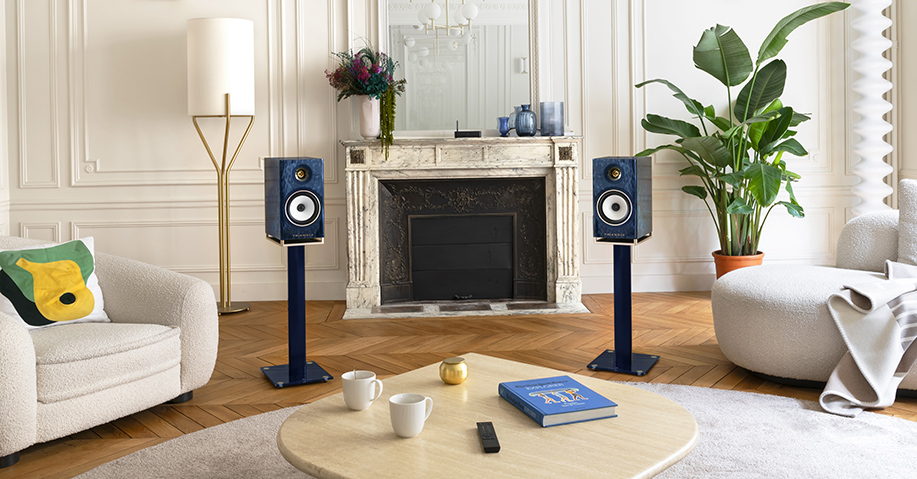
The Triangle Capella is an active loudspeaker. Recent years have seen the active speaker transcend its ‘respected but fundamentally niche’ perception and become a more significant part of the broader market. The key development that has prompted this shift is the advancement of wireless communications and compact streaming modules, which enable active speakers to become self-contained systems with streamlined wiring arrangements. Suddenly, speaker companies have seen the scope to become the sole provider of the only piece of equipment needed, and they are not going to let this opportunity slip away.
Triangle has done rather well for itself with powered versions of the Borea speakers that form its entry-level range. The Capella represents a move to the next segment up, and it is a true active speaker with powered line-level crossovers and an amplifier per driver. These amplifiers are 50-watt class D units, a figure that leaves the Capella notionally down in power compared to some similarly priced rivals, such as the KEF LS50 Wireless II, but has been entirely sufficient during testing.
Spirit of Esprit
The drivers themselves have been taken wholesale from the Esprit range of speakers. The 160mm treated cellulose midbass unit is also used in the Borea models, but the tweeter —a magnesium, horn-loaded device — is specific to the Esprit models. This combination of high sensitivity and good dispersion characteristics makes it a notable feature of the Triangle Capella. Combining it with an amplifier of Triangle’s choosing also ensures that it should avoid sounding in any way forward, which it has a (slightly undeserved) reputation for in some cases.
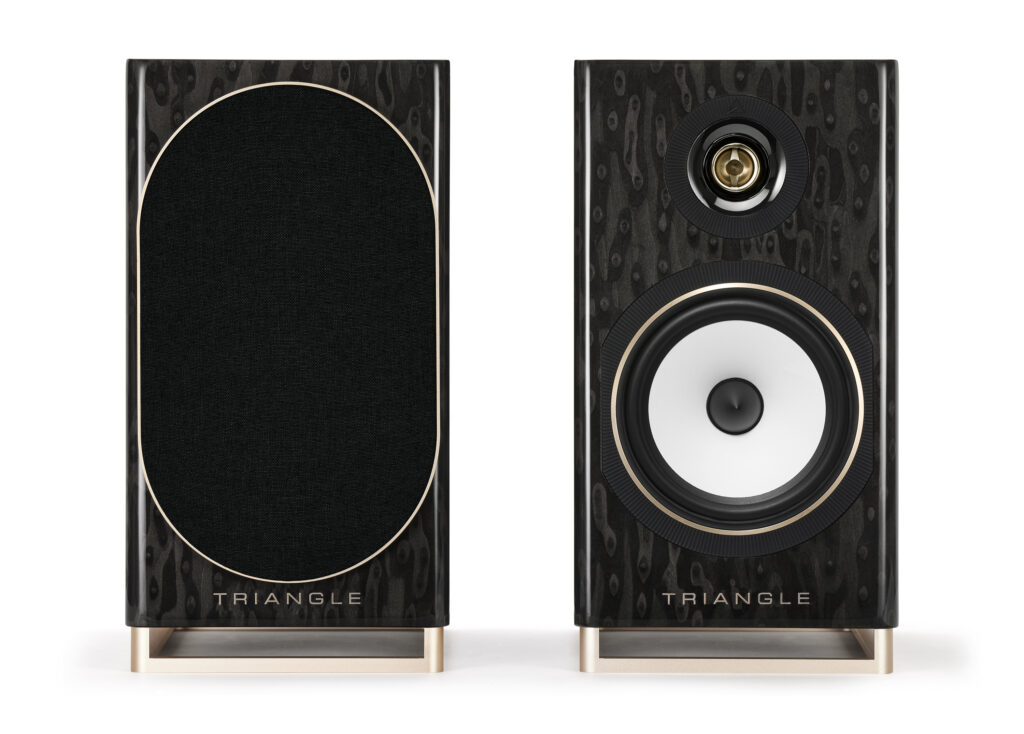
The Triangle Capella augments the midbass with a lower firing port, which gains the required clearance from the surface it is placed on via a metal frame at the bottom of the cabinet. This works well and ensures the speakers work well on shelves and sideboards, but also gives each speaker a significant footprint that is likely to need a dedicated stand to accommodate. As I didn’t request this, I used a pair of stands supplied for the Mission 700, which are fractionally low but have a suitably large top plate.
Separate box
Triangle has decided to place Capella’s inputs in a separate media box. This means that space (and a third mains socket) will be required, but it also means that cabling doesn’t need to drape off to one speaker and that more inputs are supported than would likely be the case if the input board were located in a speaker cabinet. The box offers Chromecast and Bluetooth, supported by HDMI ARC, one USB-B, one coax, three optical, one analogue RCA, and one 3.5mm connection. This is supported by UPnP streaming as well, but now, at least, the Triangle has no app and interface of its own. Third-party apps have generally performed as well as they do in these situations, but Capella is also Roon-certified, and this works brilliantly if you have it.
The Capella also offers another interesting option. The Triangle offers an optional microphone that can be used in conjunction with the control app to measure the in-room response of the speakers and allow for manual adjustments to be made for optimal performance. Compared to automated systems like Dirac, it’s more labour-intensive, but it’s potentially beneficial and gives scope to get the Capella sounding good in spaces where rivals might struggle.
Basic styling
The basic styling of the Triangle is similar to that of the passive Esprit models, but not identical, featuring rounded edges and different proportions. There are four available finishes, one of which is a relatively conventional gloss white. From here, things get rather wackier. The other three finishes all have a print in them, which is somewhere between wood burl and big cat markings. It’s subtle in black, but when combined with the blue and brown options, the result is rather more striking. On the understanding that I’m rarely looked to as a style icon, I love it, but I suspect it won’t appeal to everyone. Cloth grilles with magnetic trim tabs are supplied but weren’t used during testing. Overall fit and finish are perfect. The media box is less appealing, but there is little real need to have a line of sight to it.
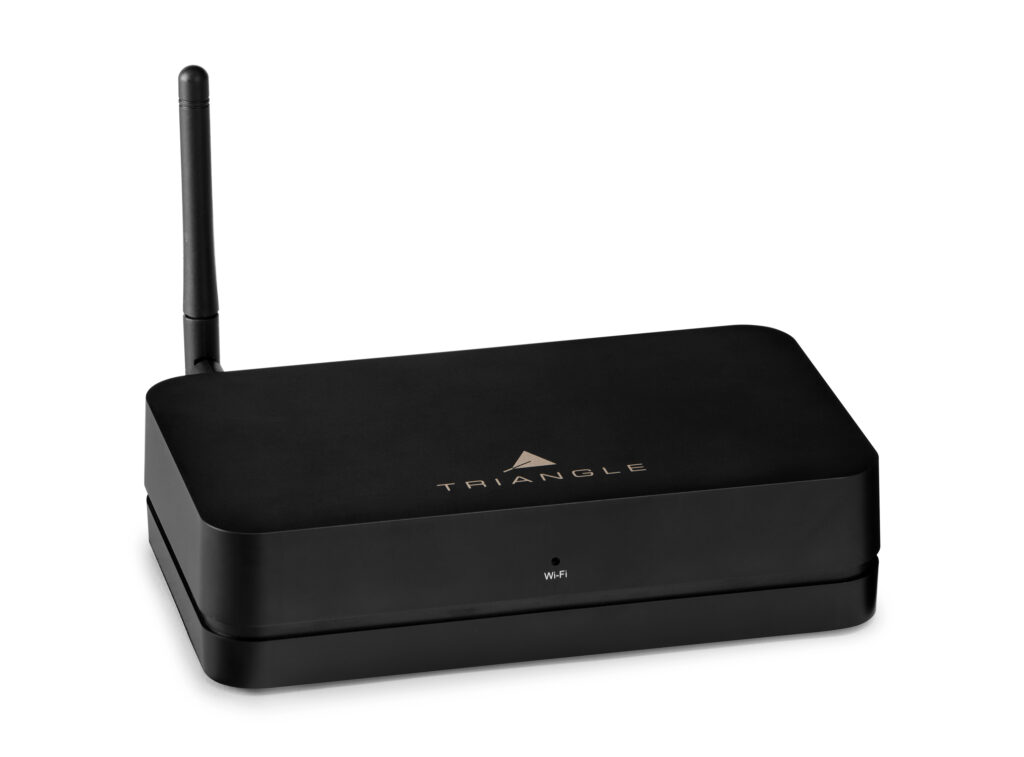
What is arguably even more impressive is the stability that the Triangle Capella has demonstrated under test. The system utilises the WiSA standard for communication and features Triangle pairs of boxes and speakers before sale. In use, the review samples have been consistently stable, reconnecting each time they’ve been unplugged and moved, with a reliability that some rivals haven’t achieved in the same test space. Barring some instances where the volume adjusted via HDMI ARC has been at odds with the volume set in Roon, and an audible hum when the amps are powered up but not in use, the Triangle has been flawless.
A good listen
Moreover, it has been a very enjoyable listen. One thing that Triangle has done very effectively is to keep the character of their passive designs intact with the move to active. Listening to Blues Funeral by the Mark Lanegan Band [4AD] reveals Capella to have an immediacy and agility that I’ve long associated with the brand. The Triangle Capella sets about ‘Ode to Sad Disco’ in a way that captures the driving intensity of the track while doing justice to its dark and brooding tonality.
Here, that horn-loaded tweeter comes into its own. Lanegan was captured in all his gravel-eating intensity, but it’s the space and airiness around him that are genuinely impressive for a relatively small cabinet. The Triangle Capella can image in a way that will have Triangle aficionados welcoming it to the fold. Without ever feeling diffuse or artificially expanded, the Triangle Capella consistently makes music in large, believable images.
Impressive bass
I’ve also been impressed by the bass response on offer (something that is perhaps well-suited, given that the media box has no means of adding a wired sub). The low end that it manages to create is deep, impressively so for a relatively small cabinet, but it never assumes that synthetic ‘pumped full of DSP’ quality that can bedevil designs like this. The lower port has remained silent throughout testing, and the combination of low-end heft and the standard Triangle articulation has meant that even fairly demanding pieces, like Sunda Arc’s Night Lands [Gondwana], are still highly entertaining, visceral experiences that you feel as much as hear.
The most critical element of the Triangle Capella’s performance, though, is that you quickly stop paying attention to the absence of signal cables and listen to the performance for what it is. Neither is this the preserve of the digital inputs. I used the RCA input connected to a Rega Planar 10 turntable and Cyrus Classic Phono phono stage, and when I sat and listened to Remain in Light by Talking Heads [Sire], the effect was still very much one of listening to vinyl. As ‘Houses in Motion’ reached its crescendo, I wasn’t thinking ‘That’s not bad for a re-digitised wireless signal’, I was enjoying it for what it was. While there has been a notable step change in the capabilities of wireless transmission systems in recent years, the Capella remains one of the most fuss-free and affordable devices to own.
Enjoyment agnostic
It’s this enjoyment and how seemingly agnostic it is regarding your input choices that have marked the Triangle Capella out as rather special. Using it via the HDMI ARC connection sees it handle standard TV duties with the same sort of ‘it just works’ reliability as a soundbar, but when you turn it off and decide on an evening of music, it is utterly convincing used as one. Moreover, it has achieved this while maintaining its identity as a Triangle.
The result is compelling. The Triangle Capella isn’t perfect; it needs an in-house way of accessing stored network content (or for you to accept that one of those optical connections could benefit from having one of the WiiM family attached to it). Still, everything else Triangle has set out to do with it has been done with an assurance and adroitness that makes this a very compelling offering indeed. The Capella is a fine example of how, with a bit of lateral thinking, speaker companies can make a convincing grab for the complete system market, and I suspect that many rivals will be watching its arrival with considerable interest.
Technical specifications
- Type: Active loudspeaker, WiSA wireless transmitter / Preamplifier / Streamer
- Drive units: 24mm horn-loaded magnesium alloy dome tweeter, 160mm paper cone mid-bass
- Inputs: 3 x Optical, 1x Coaxial S/PDIF digital, 1x USB-B, 1x stereo pair RCA line input, 1x Aux/optical 3.5mm input, 1x ARC, Wi-Fi (WiSA, Bluetooth)
- Power: 2x50W per speaker, biamplified (2x100W total)
- Max file resolution: 24-bit/192kHz
- Streaming features: AirPlay, Chromecast built-in, Bluetooth
- Frequency Response: 42 Hz – 22 kHz (± 3db )
- Finish: Black Star, Astral Blue, Space White, Brown Nebula
- Dimensions (WxHxD): Speaker, 20x38x31.5cm. Stereo Hub, 7×4.5x10cm
- Weight: Speaker, 8.5 kg. Hub 0.5kg
- System Price: £2,499, $2,999, €2,499
Manufacturer
Triangle
UK distributor
SCV Distribution
+44(0)330 122 2500
Trending Articles
See all
By Ed Selley
More articles from this author
Read Next From Review
See all
Eversolo T8
- Oct 13, 2026
Acoustic Energy AE Active
- Oct 13, 2026
Reiki Audio SuperSwitch X/Pro X PSU
- Oct 06, 2026
Audiobyte SuperVOX
- Oct 06, 2026