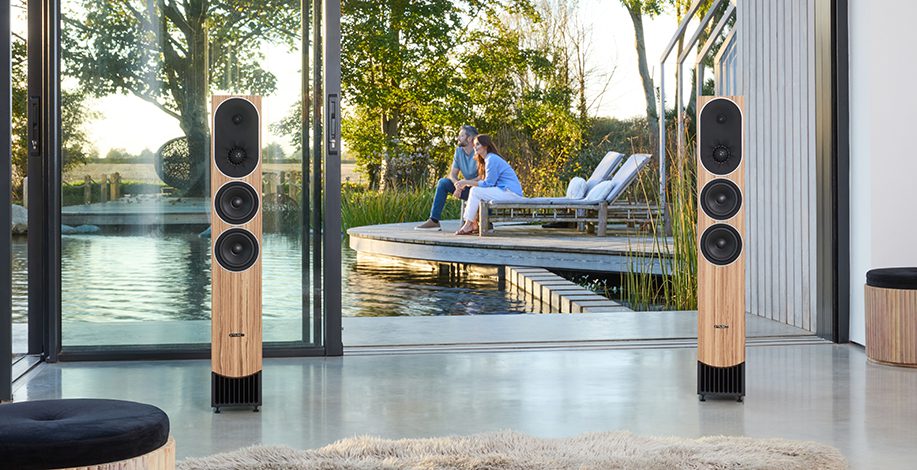
The tallest and most elegant member of PMC’s prophecy range, the prophecy9 encompasses all the developments that have been made for the transmission line speaker specialist’s core product range. The aluminium LaminairX plinth supports it and incorporates new tweeter, midrange and bass drivers in its slim form. Surprisingly, in this day and age, PMC has managed to do this while reducing the price of the top model in its outgoing range. The twentyfive.26i retailed, in fact continues to retail, for £9,975; the prophecy9 is a thousand pounds less at £8,975. PMC say that this has been achieved with more efficient cabinet manufacture (the twenty5i models sloped backwards), increased economies of scale with a shared woofer across the range, and lower cost packaging. That they have done this whilst increasing sound quality is impressive to say the least.
Oval faceplate
The prophecy9 is distinguished by an oval faceplate behind the mid and treble drivers; this isn’t mere styling as it incorporates two of the more critical developments created for this range. These waveguides, positioned around the two drivers, are designed to enhance the speaker’s performance. Like the drive units themselves, they are derived from research conducted for PMC’s professional models, which are widely used in top studios worldwide. The waveguide on the 27mm soft dome tweeter resembles a horn but is described as a shallow oblate spheroid profile. This is likely a fancy term for a horn, but it serves a purpose beyond just increasing sensitivity; it also controls off-axis dispersion. The purpose of which is to integrate its output with that of the midrange dome beneath.
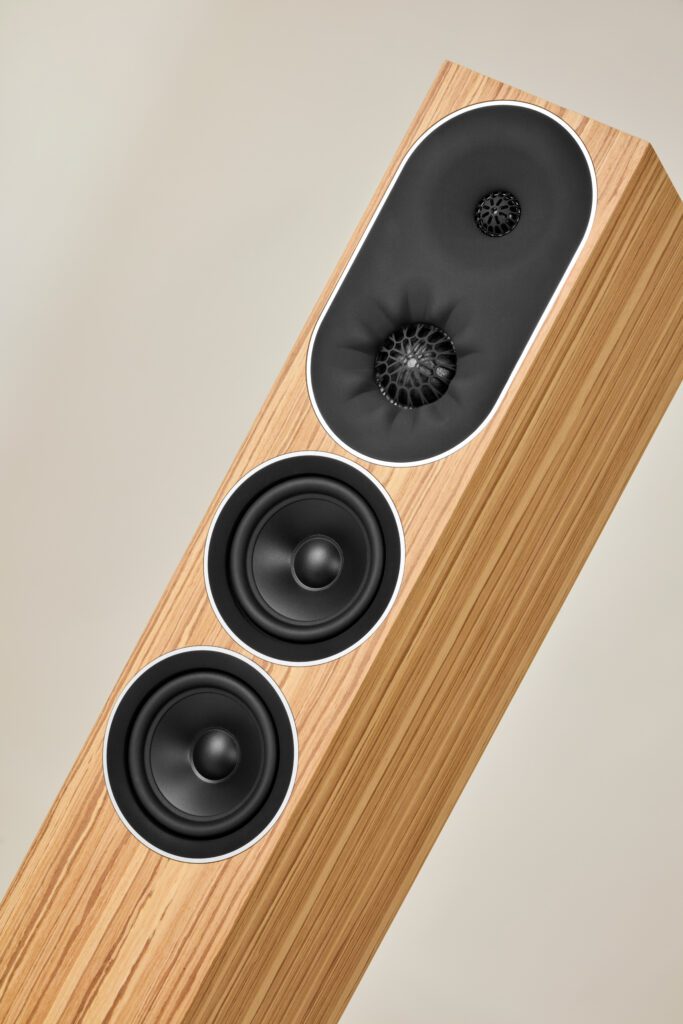
The problem with multi-driver speakers is that different-sized domes and cones produce different-shaped radiation patterns. A 25mm tweeter will have a narrower beam than a 50mm midrange, and a 150mm bass driver will be wider than both by quite a large margin. The waveguides on both tweeter and midrange help to reduce the difference in radiation pattern from one driver to the next, which makes for a more seamless overall presentation. You can probably see that the waveguide on the 55mm midrange dubbed n-compass is more complex than that on the tweeter; it combines both a shallow exponential element and a steep hyperbolic one. The hyperbolic allows the driver to work down to lower frequencies without compromising power, while the exponential provides the off-axis dispersion control as seen with the tweeter. PMC claim that this gives the midrange a smooth, extended response and extensive and even dispersion.
Extra long
At 125mm the bass drivers are relatively small given the prophecy9’s specified 35Hz low frequency extension but there are two of them and they are extra-long throw types. The mica filled polypropylene cones are very light and propelled by an extended voice coil in a suitably large magnetic gap. This means that they have considerable power handling, and when combined with the transmission line loading, provide deep yet controlled bass according to their maker.
Oliver Thomas explains the workings of the LaminairX venting system of the prophecy9 elsewhere in this issue. Still, it’s worth pointing out the practical advantages of having a heavy lump of extruded aluminium as a plinth. Namely, that the weight obviates the need for outrigger legs as found on the previous range, in this model, the spikes thread directly into the metalwork, and there is sufficient bulk for it to pass tilt testing. Another clever move is that the cable terminals are fixed to the back of the plinth, putting them usefully close to the ground with a firm mounting point.
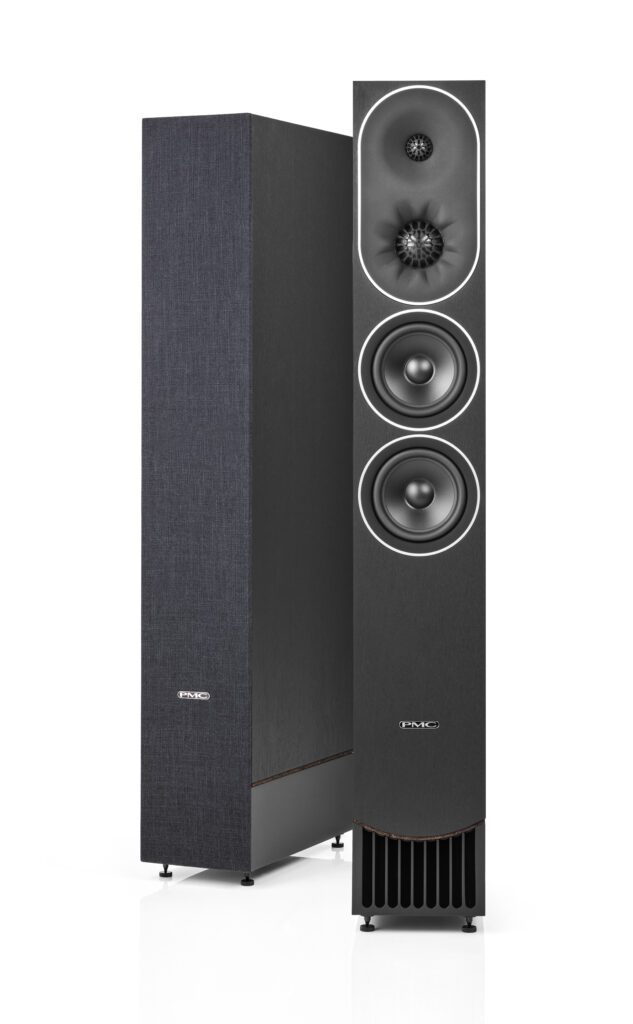
You couldn’t achieve the degree of integration that PMC has with the prophecy9 without a decent crossover. This model has a three-way 24dB/octave (fourth order) crossover built on a military grade 2.5mm thick circuit board that carries double-thickness copper tracks. It uses air core and steel laminate inductors, chosen by extensive listening, and oriented to minimise electromagnetic interaction. PMC have chosen crossover points of 600Hz between bass and midrange, and 3.2kHz for the transition to the tweeter, keeping the midrange clear of any driver changes.
Green credentials
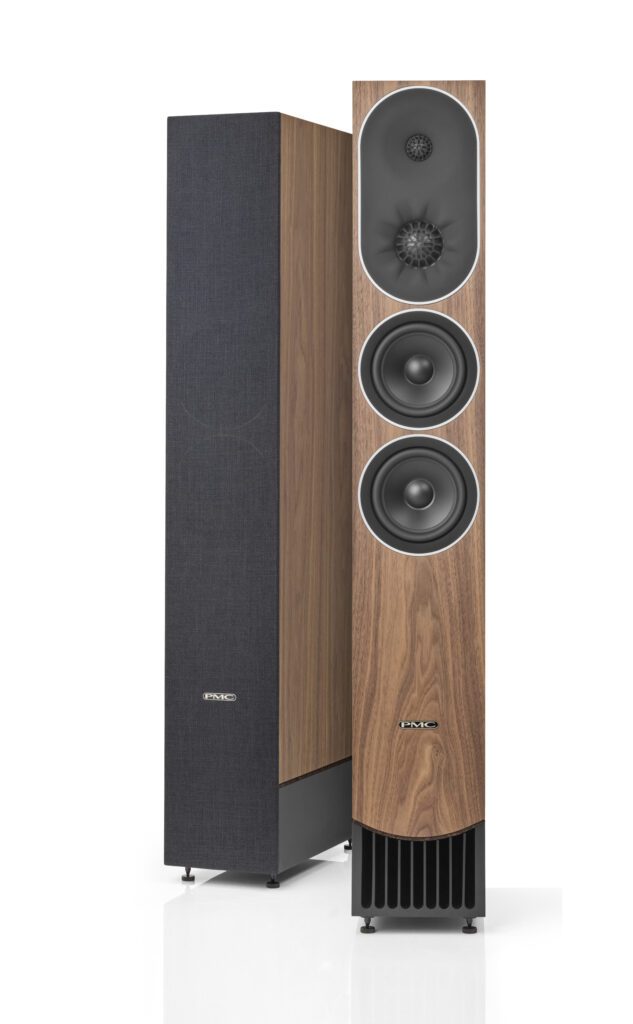
The prophecy9 has a single pair of cable terminals. It is supplied in all cardboard packaging to minimise the environmental impact associated with the foam packing usually found with loudspeakers. Each speaker is provided with a full length grille in an attractive black weave. The cabinet is available in three finishes all of which have been chosen to keep the new range green from an eco perspective, the Mediterranean oak for instance is an artificial veneer made up of multiple small pieces of veneer rather than a single sheet as is usually the case.
This is the third prophecy speaker I have reviewed, and as the most expensive option, it’s naturally the best. That said, I was blown away by the prophecy7 and achieved a great result with the prophecy5. However, since my room doesn’t have a bass reinforcement system, the prophecy9’s extra low frequency capability and the ease of use provided by two bass drivers gave it the edge and then some.
Unusually exacting
This is an unusually exacting and precise loudspeaker, one where the bass is highly capable but never overblown or thick; in fact, it makes many conventionally ported speakers sound that way, as if the port is subtly warming the presentation to compensate for less pristine recordings. Here the bass stops and starts as quickly as the mid and treble, and has equally low perceived distortion.
Clean bass is the key to transparency in loudspeakers; it’s not all that hard to make the mid and treble sound fast and clear, but doing the same at low frequencies is a real challenge that few speakers manage. This, combined with the efforts that PMC has put into integrating the output of the various drivers, has resulted in a speaker that has the clarity of a full-range panel with the power of a dynamic design.
Even with unusual recordings like Arab Strap’s ‘Packs of Three’, which is raw in some respects but sounds less compressed than many of its ilk, you can hear into the studio to a rare extent. I don’t recall the keyboards having such a clear shine to them, or the drums having such well-defined reverb. But then the bass guitar comes in with its deep, rounded, juicy but hard-edged sound, then it’s joined by metallic guitar strings and the yearning of a fiddle, and before you know it, the music is in your veins and you can’t turn away.
The drop
On some tracks it can seem as if the bass is light and lean, ‘Babylon Sisters’ (Steely Dan) being a good example. Still, then the syncopation of guitar and drums gets to you thanks to the clarity with which both are delineated, and you’re no longer concerned about tonal balance but gripped by the brilliance of the musicianship.
Kraftwerk’s Radioactivity (Minimum-Maximum), on the other hand, is produced with uncannily deep bass resonances on the vocal, something that has not been made clear on many occasions in the past, and which is reinforced when the beat drops. I played plenty of vinyl through the prophecy9s as well, and it proved very satisfying, not least Djrum’s Under Tangled Silence, where the piano’s high notes glistened and the bass went down in such controlled and clean fashion.
Tweak time
Being an inveterate tweaker, I tried a better power cable on the Tom Evans Groove+ phono stage and was greeted with more three-dimensional imaging, lower noise and better timing. Laura Marling’s ‘Soothing’ really shone, sounding as if a veil had been removed by the prophecy9s which played down the bass line that often dominates this track and put the spotlight on the vocal where you would expect it.
Pieces like that make it clear that the prophecy9 delivers higher fidelity to the source than most speakers, which often overblow the bass to create a richer sound. I suspect that by basing this design on their studio monitors, PMC has produced a more accurate and revealing result than one usually encounters.
Most speakers are tuned by ear in their final stages at least, yet few engineers have access to the sort of reference that PMC has in the studio world. This has allowed them to deliver a speaker that is both highly transparent to detail and uncannily coherent, but also one that genuinely reflects what the artist/producer/engineer heard in the recording’s final stages.
This means that prophecy9 owners get pretty dam close to the real thing and a lot closer than most can achieve at the price. The prophecy9 is not inexpensive, but you’ll be hard pressed to match it at the price.
Discover more about Laminair+ here.
Technical specifications
- Type: 3-way, four-driver, floorstanding speaker with PMC ATL (Advanced Transmission Line) enclosure.
- Driver complement: One 27mm soft dome tweeter; one 55mm soft dome midrange driver; two 125mm super long throw bass drivers with polypropylene cones.
- Crossover frequencies: 500Hz, 4kHz
- Frequency response: 35Hz – 20kHz (-3dB)
- Impedance: 4 Ohms
- Sensitivity: 91.5dB/W/m
- Dimensions (HxWxD): 1030 (plus spikes) x 165 x 360mm (+23mm with terminals)
- Weight: 28.1kg/each
- Finishes: Mediterranean oak, natural walnut, blackened walnut.
- Price: £8,975, €10,945, $12,499 per pair
Manufacturer
The Professional Monitor Company
+44 (0)870 444 1044
Trending Articles
See all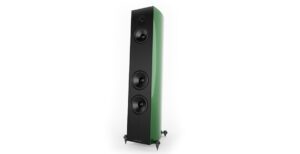
Acoustic Energy Corinium floorstanding loudspeaker
- Dec 23, 2024
Trending Articles

By Jason Kennedy
More articles from this author

Read Next From Review
See all
Reiki Audio SuperSwitch X/Pro X PSU
- Oct 06, 2026

Audiobyte SuperVOX
- Oct 06, 2026
Unitra WSH-805
- Sep 29, 2026

Wilson Audio Sabrina V
- Sep 29, 2026