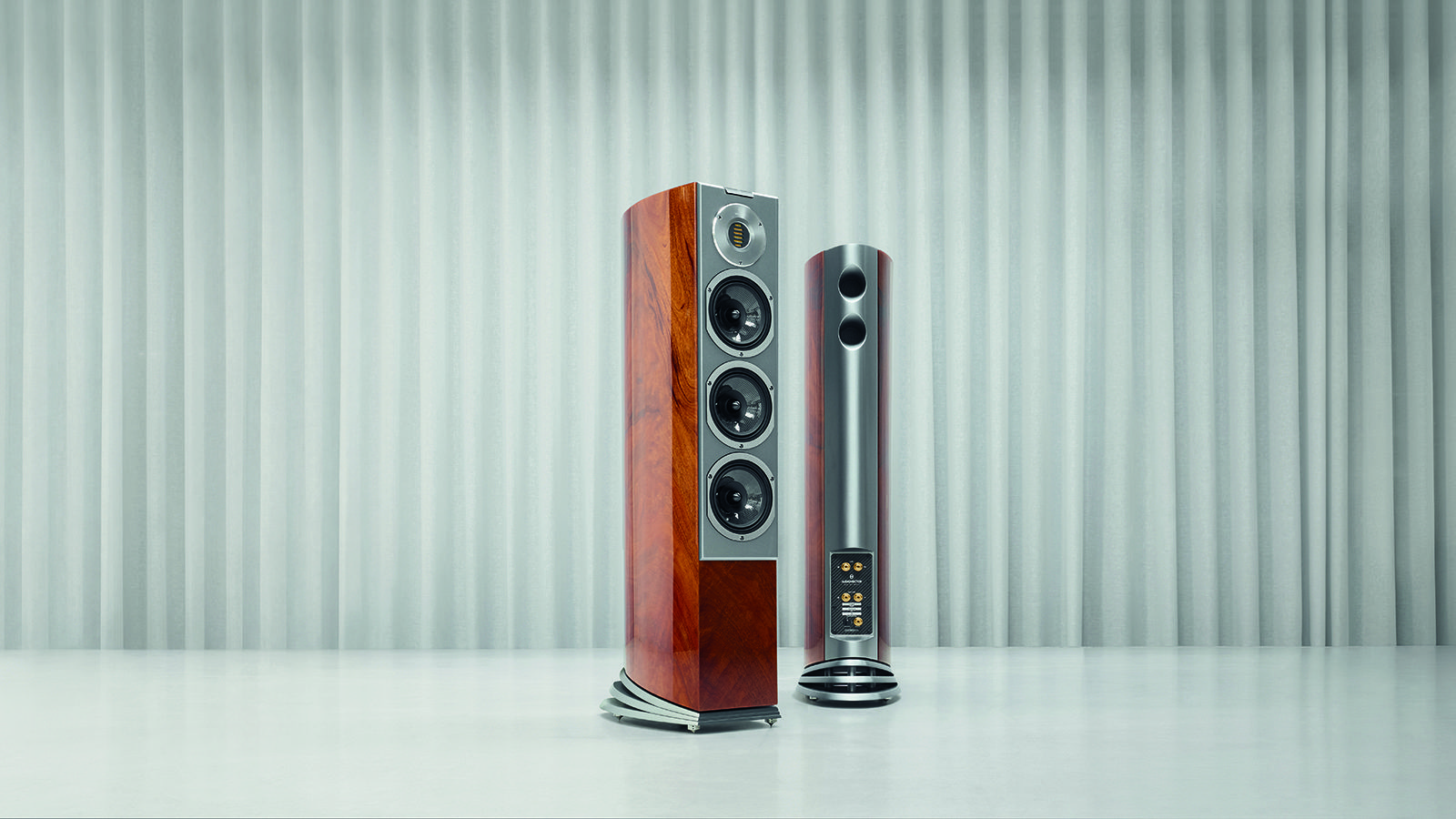
Audiovector has been making speakers big and small for 45 years. So, the Audiovector R 5 floorstanding loudspeaker draws on extensive design history. And not just the distant past. The new R 5 draws heavily on the company’s current R 10 flagship (which we tested in Issue 243). It sits between the R 3 Arreté (tested in Issue 253) and the R 6 (tested in Issue 191). It’s in the same price range as the Trapeze Reimagined (tested in Issue 231). In the world beyond Audiovectorland, it joins a very contested sector of the market.
That means a tough job, and it likely goes one of three ways. It could be a ‘bitza’ product that dumpster-dives through the parts bin to deliver so-so performance. It could be the ‘superstar’ product that’s so good it cannibalises half the products in the catalogue. Or, it could be that finely balanced ‘tweener’ model that fits perfectly into the line-up. The R 5 is somewhere between ‘superstar’ and ‘tweener.’ It offers a real upgrade for R 3 Arreté owners and doesn’t tread on the Trapeze Ri’s sonic toes. It also offers more than a taste of what the R 6 and beyond can do. However, it does this without undermining or diminishing the R 5’s bigger brothers.
No halfway measures
The R 5 is a three-and-a-half-way loudspeaker with a down-firing bass reflex system. That additional halfway section allows one bass driver to operate higher into the lower midrange. Meanwhile, the second bass driver focuses on deep bass extension. This improves dynamic headroom, reduces intermodulation and increases overall clarity. In addition, by venting low-frequency energy towards the floor, bass integration becomes smoother and more consistent across different placements.
These two elements help give the R 5 a weighty, deep bass extension while retaining the slim, svelte lines of the R series floorstanders. This is more important than it might seem at first. There seems to be an unspoken – and often unnecessary – inflexion point in loudspeaker design. The clean, domestically-friendly lines of the company’s first models give way to something a little more ‘statementy’. The R 5 sits in that danger zone, where ‘aesthetically pleasing’ can flip into exaggerated lines that border on the grotesque. Fortunately, Audiovector remains firmly Scandinavian in its design criteria… in all the right ways. It is large enough to offer a substantial improvement in performance over the R 3 without being a challenging ‘ask’ for those who also share that listening space.
No ice forming
I’ll be honest here; you aren’t immune to such pressures even when reviewing audio equipment is your job. A frosty reception—“How long are those going to stay?”—is a sure sign that a product crossed the aesthetic Rubicon. In some cases, ice forms on the wife’s upper slopes within moments. Audiovector, on the other hand, has remained mercifully free from arctic blasts. The R 5 is no exception.
Similarly, that down-firing port means the Audiovector R 5 is comparatively easy to install in most listening rooms. It needs a bit of space and ultimately benefits from being further into the room than the brand’s smaller models. However, it doesn’t include the rear-firing drivers of the R 6 and beyond that require deeper placement in the room.
It also demands high-quality equipment partnerships and an installation commensurate with its performance. But that doesn’t mean a complete re-think of the system or speaker position. A three-position damping control makes the R 5 uniquely adaptable, as it can match the damping factor of medium and high-damping-factor amplifiers, as well as the low-damping-factor of valve amps. It’s worth a spot of experimentation to see what setting works best for you. In short, the R 5 gives a good performance under most conditions, but going the extra mile in care and feeding delivers some truly first-rate performance; the sort of sound that trickle-down from the R 10 flagship.
Drawing inspiration
It’s easy to say a loudspeaker draws inspiration from a flagship design. It’s quite another to actually do it. The R 5 calls upon the R 10 range-topper in places like its midrange driver. The R 5 is the first model outside that flagship to feature the second generation of the company’s Freedom Grounding system. It is also the first outside the R 10 to feature Audiovector’s Accelerated Force Concept (AFC), developed to minimise inertia during the critical first millimetres of diaphragm movement. Instead of a conventional heavy half-roll surround, the driver uses a lightweight concertina suspension formed from a carefully developed rubber compound. This reduces mechanical resistance.
Additionally, the motor structure has been redesigned to improve magnetic symmetry, resulting in a more balanced magnetic field around the motor. This enhances control of the drive unit (the part of the speaker responsible for converting electrical signals into sound) throughout its excursion (the movement of the speaker cone back and forth) and improves its initial acceleration.
Low Compression Concept
This design works in tandem with Audiovector’s Low Compression Concept (LCC), which reduces air pressure build-up behind the driver (the moving part that creates sound), improving transient response (how quickly the speaker responds to changes in input) and giving it greater freedom under dynamic loads (changes in sound intensity).
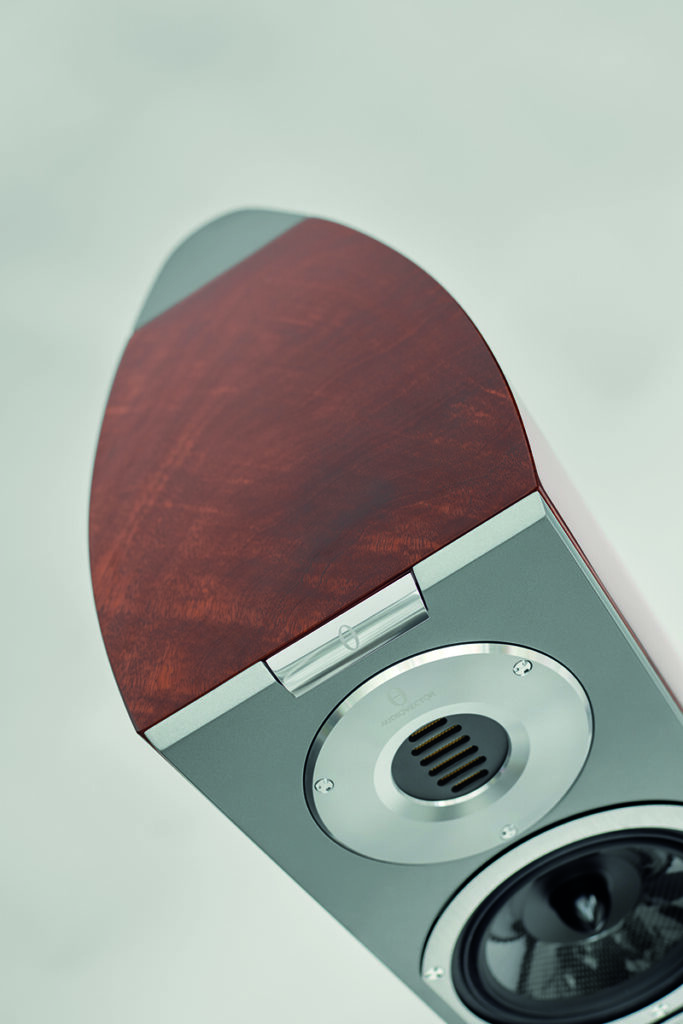
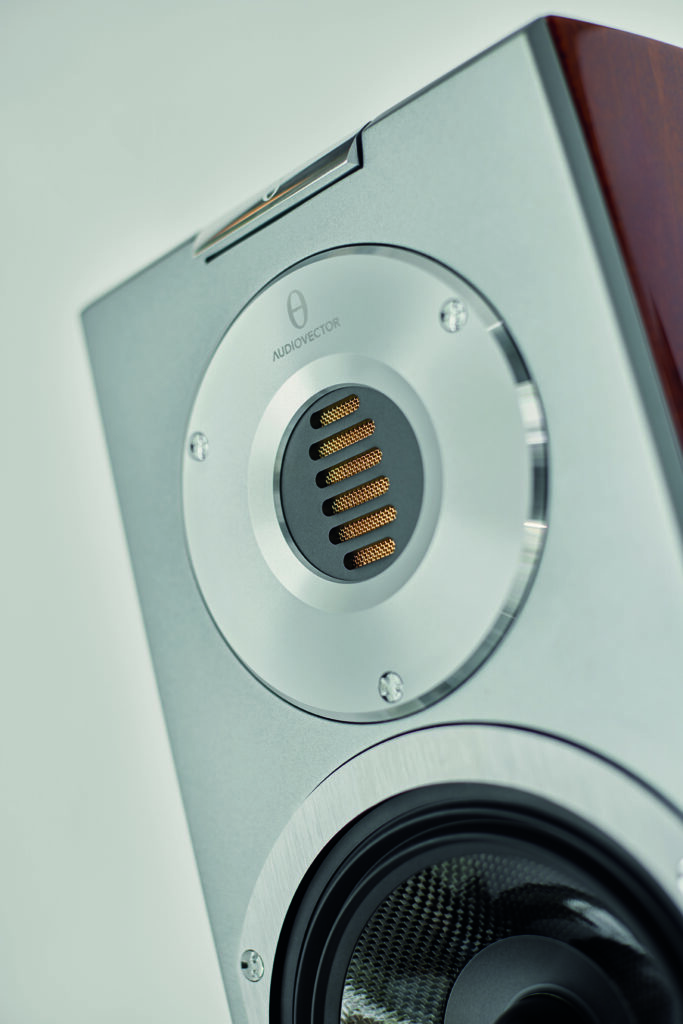
The R 5 also uses the latest version of the company’s Air-Motion Transformer (AMT) tweeter—a high-frequency driver that moves air rapidly using a folded diaphragm, rather than a dome or cone. This tweeter was first introduced with the R 10 model. The updates here are refinements of previous technology, rather than completely new developments.
Several features distinguish the R 5 as a unique model. Most notably, the Arreté plinth has a larger footprint and an open-slot design. The wider base enhances energy distribution, improves floor coupling, and lowers the speaker’s centre of gravity. The open-slot design also benefits the reflex port by reducing turbulence and compression. The Arreté-level crossover network features carefully selected components that are twice cryogenically treated.
No signature required
These last improvements imply that the R 5 is an Arreté-grade product. That could do with some explanation. Models like the R 1 and R 3 come in two grades. The ‘Signature’ models are best recognised by their use of a soft-dome tweeter, a dome-shaped component that produces high-pitched sounds by moving air with a soft diaphragm. Meanwhile, ‘Arreté’ replaces that driver with the company’s own AMT (Air Motion Transformer) folded ribbon high-frequency unit, a device that moves air using a pleated membrane for clearer treble. ‘Arreté’ also adds cryogenic component treatment (a process exposing parts to extremely low temperatures to potentially enhance performance), Freedom Grounding (a grounding method to reduce electrical noise), a carbon terminal plate, and the company’s internal damping and shock absorption techniques (design features to reduce unwanted vibrations within the product).
There is no ‘Signature’ version of the R 5. So, the need to give it the ‘Arreté’ suffix goes away, as with the larger models in the range. However, that also invites a philosophical discussion that extends to the rest of the R range: should every model just be at Arreté level performance? Looking at current trends (and the vibrant Audiovector owners group on Facebook), most buyers today choose the QR or the Arreté level loudspeaker at any given size. I would not be too surprised to see future models that replace the R 1 and R 3 to have just one performance grade.
Covers ground
The Audiovector R 5 is one of those products that covers a lot of ground. It’s a loudspeaker that just fits in. It fits in most rooms and with most systems. If you like a particular musical genre or love a bit of everything, it fits your taste. Prefer polite or club-level volume? Once again, the R 5 fits in. To answer the question that started the review, it fits perfectly into the Audiovector line. It contrasts and complements the Trapeze Ri well. It’s a perfect upgrade from the R 3 Arreté, but there’s more in the R 6 and beyond. Far from being ‘filler’ in an established range, it completes the line-up.
As you might expect from an Audiovector loudspeaker, the R 5 delivers clean, clear sound with a fine sense of rhythm. The treble is delicate, sweet yet extended, fast, and focused. The midrange is articulate and communicative. The bass is deep, yet taut and tidy. The R 5 produces an excellent, three-dimensional image. Its dynamic range—both broad and nuanced—is expressive and powerful. There is less distortion from the drivers, less coloration from the cabinet, and—especially with Freedom Grounding—less noise from the crossover. Whether you are familiar with Audiovector or experiencing it for the first time, the R 5 sound is sure to impress and uplift.
More than terms
I’ve placed the usual audio terms together because that’s just the start of the
R 5 experience. Beyond those elements is how the Audiovector R 5 brings everything together to make music. It does not differentiate at all. You can be as musically eclectic as you want with these loudspeakers; nothing fazes them. I went from the symphonic bombast of Mahler’s Second Symphony to the Unthanks singing acapella in a tiny pub back room, and everything in between. In each case, the R 5s brought out the information and the enjoyment equally.
Of course, a part of that is because the Audiovector R 5 can go loud, but they are not simply boomboxes. There are trends in high-end audio demonstration, and Audiovector brought Danish DJ and producer Hedegaard into the mix. Hard techno recordings like ‘Rachets’ and ‘Inferno’ are used by many high-end brands in demonstrations to show that their products aren’t just for plinky-plonky audiophile music, but Audiovector got there first. And in the R 5, it shows many of those rivals still have a way to go to catch up.
Visceral ablomb
The R 5 plays these recordings with aplomb: a visceral, pounding beat, lots of fast-attacking synth sounds, and a vocal transparency that allows you to hear what’s being spoken with clarity even within such an onslaught of a recording. They make sense of this fast-paced track, whether it’s played at a whisper or at organ-liquefying levels. The tight rhythmic properties of the R 5 are best expressed at the drop mid-way through ‘Rachets’ by Hedegaard; when the beat comes back, it comes back with all the pace and excitement you would even need. This might be a double-edged sword in the wrong hands; a lively loudspeaker can sound too forward and edgy. But the R 5 stays just the right side of ‘bright’ for all but the most ‘pipe and slippers’ of listeners.
But, beyond the bass energy and drive, there’s a deceptively subtle and lithe loudspeaker beyond that. That midrange unit from the R 10, coupled with the latest version of the AMT tweeter, helps make for a vocal presentation that is extremely articulate and transparent. You hear every scintilla of information, be it the finger noises on an acoustic guitar or even the quality of a singer’s embouchure and its impact on their tone and articulation; it all just makes more sense. Those ‘surprising’ recordings – such as Nick Cave singing Leonard Cohen’s ‘Suzanne’ – are less of a surprise because you recognise the voice faster. That doesn’t detract, though. As your brain spends less time thinking ‘who is that?’, you flip into just enjoying the performance.
A red thread
That ‘enjoying the performance’ line ran through my listening notes like a red thread. It put everything else into a distant second place. Yes, imaging is great. OK, the bass is fast, deep and very tuneful. Sure, vocals are clear and distinct. But, underpinning all of that is a sound that never, ever forgets that people like listening to music. It’s a speaker that puts a smile on your face even before it sets your foot tapping.
The Audiovector R 5 hits the ground running. It joins the Trapeze Ri as one of the loudspeakers you should hear at this price. But even more importantly, like the Trapeze Ri, it puts music – rather than polite hi-fi sounds – at the centre of your life. This R 5 is Audiovector at its finest!
Technical specifications
- Type: trear ported, three-and-a-half-way loudspeaker
- Drive units: 3800 AMT N 51 tweeter, 6.5” AFC carbon sandwich midrange, lower-midrange and bass drivers
- Frequency Response: 23Hz-53kHz
- Sensitivity: 90dB
- Nominal Impedance: 8Ω
- Minimum Impedance: 3.6Ω
- Crossover frequencies: 200Hz, 600Hz, 3kHz
- Finishes: Black Piano, White Silk Matte, African Mahogany Piano, Italian Walnut Matte. Custom paint finishes available on request.
- Size (WxHxD): 111cm x 22cm x 41cm (with plinth width and depth 26cm x 48cm
- Weight: 32.1kg per pair
- Price: £17,950, €19,950, $24,500 per pair
Manufacturer
Audiovector
Home Page: audiovector.com
R5 Product Page: audiovector.com/r-5/
Where to buy: audiovector.com/where-to-buy/
UK distributor
Renaissance Audio
+44(0)131 555 3922
Trending Articles
See all
Acoustic Energy Corinium floorstanding loudspeaker
- Dec 23, 2024
Trending Articles

By Alan Sircom
More articles from this author
Read Next From Review
See all
Eversolo T8
- Oct 13, 2026
Acoustic Energy AE Active
- Oct 13, 2026
Reiki Audio SuperSwitch X/Pro X PSU
- Oct 06, 2026
Audiobyte SuperVOX
- Oct 06, 2026