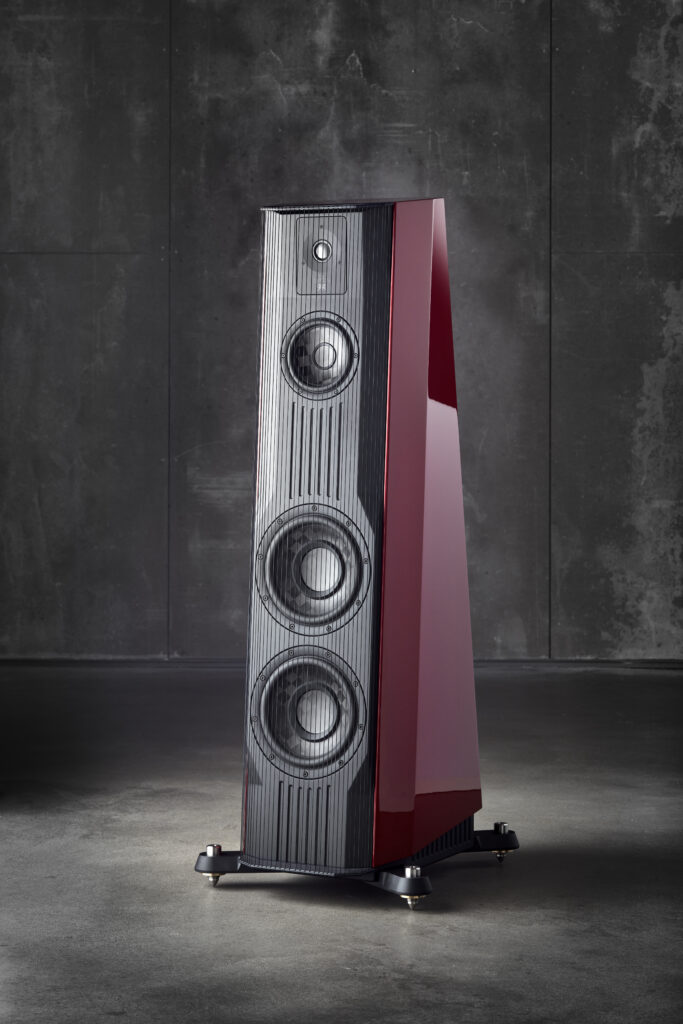
Loudspeakers are everywhere. You can find good loudspeakers from a range of companies in every hi-fi shop on the planet. However, outstanding loudspeakers are scarce. What’s more, extraordinary loudspeakers from companies best known for audio electronics are as rare as hen’s teeth. The Gryphon Audio EOS 5 floorstander is one of the rare exceptions.
Gryphon has made loudspeakers for years. The three-way, four-driver EOS 5 stands 1.3m tall, weighs over 50kg, and costs more than £40,000 per pair. It’s no lightweight. Still, compared to the mighty Kodo, the EOS 5 is a more realistic prospect. Kodo costs around £400,000, weighs 1,354kg and stands over 2.3m tall. It comes packed in eight huge wooden crates.
Go almost everywhere
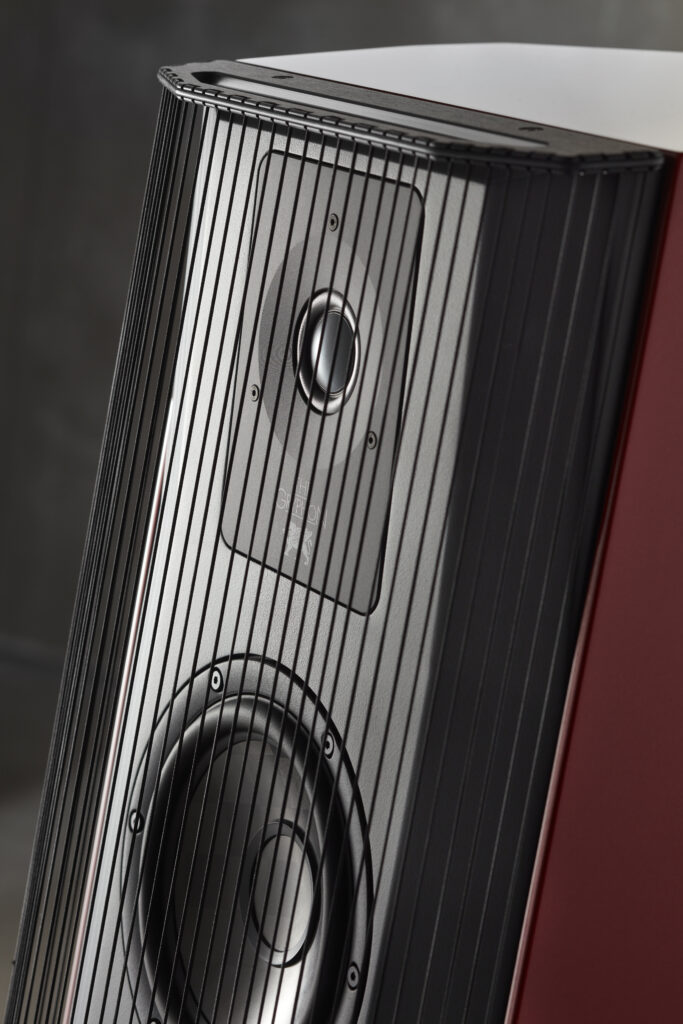
The EOS 5 builds on the strengths of Gryphon’s ‘go-everywhere’ EOS 2. Munich High-End 2023 saw the launch of that two-way floorstander. It features front and rear ports, one of which is sealed depending on the room acoustics and size. The ‘go-almost-everywhere’ EOS 5 is more physically imposing and less accommodating of smaller rooms. However, the scaled-up similarities are impossible to ignore. Both use the company’s ‘Stealth’ enclosure. ‘Stealth’ features a front baffle sculpted to act as a diffuser for in-room standing waves. It is also engineered to ensure good dispersion and uniform energy output. In some loudspeaker systems, that means less of a ‘sweet spot.’ Gryphon claims ‘Stealth’ improves soundstaging. I suspect it probably does both.
Stealth is a deceptively complex design element. It is not simply a set of grooves etched into the front baffle for aesthetic reasons. And yes, that’s where I went when first looking at the EOS 5. Those curves and grooves resemble design cues from Gryphon’s electronics. However, the closer you look, the more you notice this isn’t the case at all. From a sonic standpoint, that rigid baffle could efficiently act as a reflective surface. The grooves help break that up.
Although there is no provision to direct the port to the front baffle, the EOS 5 shares the EOS 2’s advanced (and proprietary) ‘Line porting’, a special method of ‘tunnel-damping’ the rear sound of the bass driver towards the ports. This ensures a direct path for the low frequencies to reach the port while providing an efficient damping of frequencies above the 60-80Hz region, without creating artefacts in the upper frequencies.
A good box
A good enclosure is only as successful as the drivers and crossovers within. The reverse is also true: poor drivers in an excellent cabinet will never amount to much more than a mediocre performance. The EOS 5’s drivers are all unique to the design, made specifically for the task. These are once again based on the designs developed for the EOS 2. The Gryphon Audio EOS 5 features a 29mm beryllium dome tweeter; this is smaller than the 34mm design from the EOS 2 because the EOS 5 is a three-way design and therefore has a higher mid-treble crossover point.
The tweeter is joined at the midrange to a 165mm driver, featuring the company’s TPCDTM (Thin-Ply Carbon-fibre Diaphragm), which is also used for the diaphragms in the twin 240mm bass units. Some make these woven carbon-fibre cones from the best people in the business —the teams that fabricate the carbon fibre used in Formula 1.
We’re accustomed to seeing bass and mid-bass units equipped with either a phase plug or a simple dust cap to keep the pole piece and voice coil free from contamination. The best phase plugs improve the upper registers of a driver on-axis, while the best dust caps improve the structural integrity of the cone.
Acting on impulse
However, by introducing what Gryphon calls an ‘impulse optimiser ring’ placed directly above the voice coil, the Gryphon gets very close to achieving both at once; it strengthens the bond between cone and voice coil, improves impulse response (as the name suggests) and makes the driver act closer to being purely pistonic, enhancing its performance outside its normal crossover point.
Speaking of the crossover, Gryphon once again pulls from the EOS 2 with its Progressive Rounded Slope network. This creates a slope with a very soft initial roll-off – for optimum overlap and blending between drivers – but becomes progressively steeper to remove the out-of-band distortion from both drivers in that network. Perhaps most importantly for Gryphon, this crossover also preserves and aligns the phase.
Gryphon has long been concerned with accurate phase response in its audio equipment, and having a crossover network that aligns the phase and impulse response across the frequency range should be the ideal blend of pace and space in a loudspeaker.
This crossover network and driver combination delivers an actual full-range performance (20Hz-40kHz, ±2dB) in a room, which is almost unheard of in a loudspeaker of the EOS 5 size and driver complement. This is achieved at an efficient 90dB sensitivity. However, this is countered by a nominal impedance of four ohms, which dips to a minimum of 2.9 ohms, so using the EOS 5 with a flea-powered single-ended triode amplifier design is not feasible. Given that I suspect many EOS 5s will be paired with an all-Gryphon system, which likely means the Diablo 333 integrated amplifier or the Class A Essence power amplifiers, power will not be a problem.
A quiet place
Finding the correct position for the loudspeakers is more demanding than finding the right amplifier in the Gryphon catalogue. The loudspeakers have adjustable spikes and dampers, but spike shoes are also provided, making it easy to move the loudspeakers into position and fine-tune their placement. However, these loudspeakers require precise interaction with the room and the listener’s position. In particular, the centre image is pinpoint accurate. Get one of the speakers a few millimetres off in any direction, and any central instrument moves to the left or right. Toe-in and height adjustment are similarly demanding but rewarding.
Moving the loudspeakers also highlights something almost like an audiophile optical illusion to the Gryphon Audio EOS 5. While not as backswept as the EOS 2, the front baffle does tilt back slightly. As a result, we naturally assume that the weight distribution of the loudspeaker is toward the rear of the loudspeaker. It isn’t. As you might discover when unpacking the loudspeakers and suddenly finding the drive units experiencing a spot of gravity-related potential entropy, the polite, less sweary way of saying I took the speaker out of the crate, and it almost fell forward. Consider this a warning.
Ready to roll
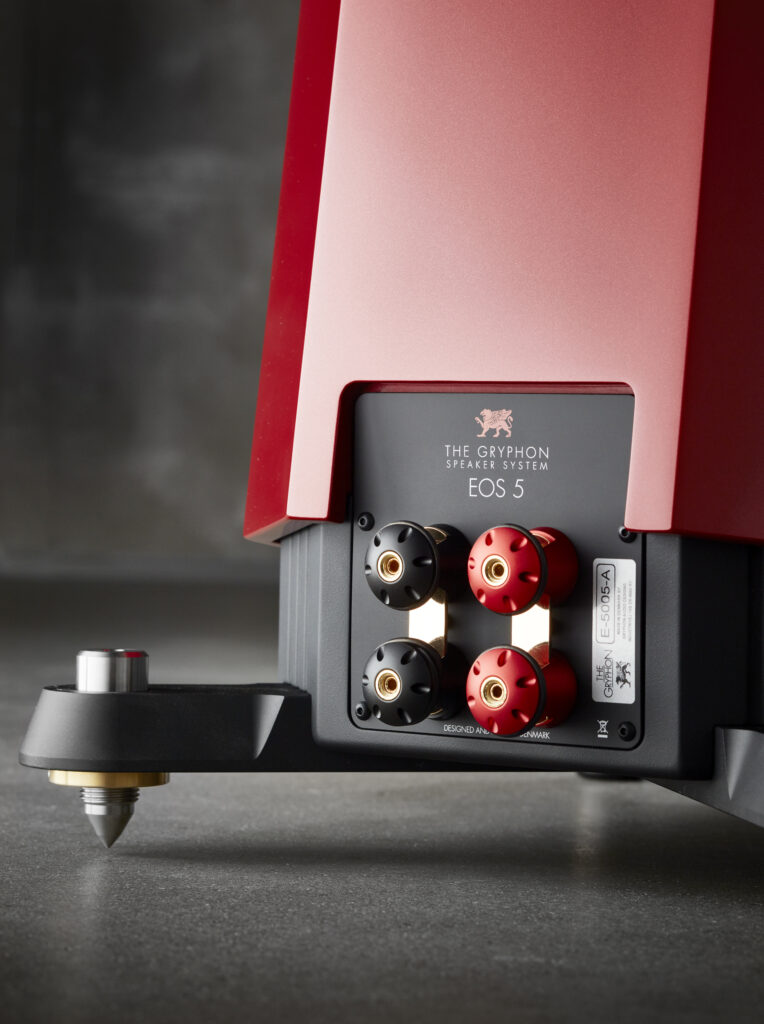
The Gryphon comes extremely well-packed and ready to roll. A set of jumper cables is provided in the crate. Even the grille strings come pre-fitted. There is a set of Gryphon-designed, chunky bi-wire links located at the bottom of the rear of its cabinet. The combination of ‘Soul Red Crystal’ or gloss black enclosure with the contrasting matt black front baffle, or the ‘S-Mat Black’ matt black paint finish used for the first time here, looks even better in the flesh. Sure, they are large loudspeakers for those of us without man-caves, but they aren’t imposing in the flesh.
The sound quality of the Gryphon EOS 5 ticks so many boxes. The obvious one is the bass; this is a full-range design for a real-world room, and deep, powerful bass is usually rare in such environments. Here, it has both punch and precision. It doesn’t matter if you sidle up to deep bass by being surprised at the depth of a kick drum or throw yourself in at the deep end with organ music, Mahler’s ‘Symphony of a Thousand’ or some wubby electronica. The result is always the same: a half-second realisation that you are in the presence of classy, powerful bass notes, followed by a slightly dumb-looking smile as you revel in all that bottom end.
Phase obsession
Deep bass on its own is fun, but the EOS 5 brims over with dynamic range and headroom. That obsession Gryphon has over phase pays off when you play the same piece of music at a whisper or a scream. You get the same frequency response and dynamic range, all set against a very still background. And yet, the music tracks with a fine sense of scale. That Mahler recording is given a big space, but switching over to Dylan singing ‘Masters of War’ [The Freewheelin’ Bob Dylan, Columbia] and the sound shrinks to just a young man with a guitar, a harmonica, and lots of talent.
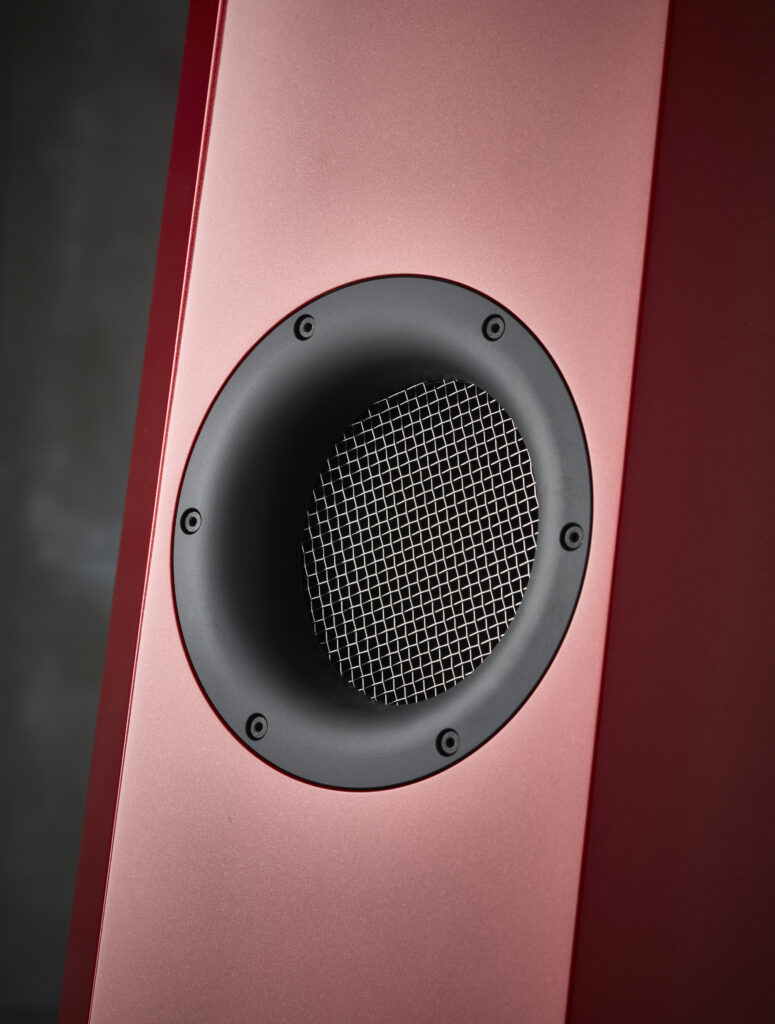
Whichever aspect of musical performance you pick, the Gryphon Audio EOS 5 leads the field at its price. Soundstaging is holographic, detail is little short of magnificent, and coherence (both in musical terms and from driver to driver) is excellent. Even vocal articulation is first-rate to the point where you feel like you are peering at some of the best vocalists in the music business. And yet, for all that, the Gryphons never lose sight of the task. You end up playing a lot of music through the EOS 5 purely for the pleasure of it.
Subtlety and elegance
The EOS 5 is a speaker of subtlety and elegance. It can do gusto – and do it well. But when you’ve exhausted those show-off albums, the Gryphon Audio EOS 5 keeps coming back. It makes a sound that’s never fatiguing and always exceptionally musically communicative. It combines the precision and speed of a small monitor with the power and depth of a giant loudspeaker. It’s on the warm side of neutral, but not so warm that it holds back the music being played.
I should find something negative to say about the Gryphon Audio EOS 5. However, I was too busy listening to music. Sure, it requires careful feeding and positioning. You get that right, and the floorstander rewards you. It creates a truly beguiling sound that draws you into the music and keeps you there. This might be a heavyweight loudspeaker, but it still punches up. This is ultra high-end audio for real-world listening rooms.
Technical specifications
- Type: Three-way, Linear phase, floorstanding loudspeaker
- Drivers: Tweeter: 1x 29mm, Beryllium Dome, Midrange: 1x 165mm, TPCDTM cone (With Gryphon proprietary impulse optimiser ring). Woofer: 2x 240mm, TPCDTM cone (With Gryphon proprietary impulse optimiser ring)
- Principle: Rear reflex-ported (Line-dampened, Linear Impulse)
- Frequency response: 20Hz – 40kHz (±2dB)
- Sensitivity: 90dB @2.83V
- Impedance: 4Ω (2.9Ω min. @ 80Hz)
- Crossover: 500Hz 2nd order, 2.5kHz 4th order, progressive rising slope
- Adjustment: Switch at 12kHz: 0dB, +2dB, +3dB (off-axis dispersion)
- Feet: Adjustable spikes with integrated dampers (Removable)
- Finish: Soul Red Crystal, High Gloss Black and Stealth Grey
- Dimensions (W x D x H): 46.8×47.2x130cm
- Weight: 50.6kg per loudspeaker
- Price: £41,500, $49,800, €42,800 per pair
Manufacturer
Gryphon Audio
UK distributor
Harmony HiFi
+44(0)1707 629345
Trending Articles
See all
Acoustic Energy Corinium floorstanding loudspeaker
- Dec 23, 2024
Trending Articles

By Alan Sircom
More articles from this author
Read Next From Review
See all
Eversolo T8
- Oct 13, 2026
Acoustic Energy AE Active
- Oct 13, 2026
Reiki Audio SuperSwitch X/Pro X PSU
- Oct 06, 2026
Audiobyte SuperVOX
- Oct 06, 2026