Marantz is far from alone among audio companies in having undergone several changes in ownership over the last decade or two. But Marantz is a company that, in nine years, has been acquired by Sound United, which was itself acquired by Masimo in 2022, and, as of 2025, is now in the hands of Harman. Change of ownership is the sort of upheaval and uncertainty that might have provoked a lesser company, perfectly understandably, to take its eye off the ball just a little.
Marantz, though, is not a lesser company—it has forged ahead regardless. And if ever a product indicated that while a brand may not be sure of exactly where it’s heading, it most certainly knows where it’s coming from, it’s this 60n.
All present and correct
The 60n is the correct product and at the correct price. £1,299 put Marantz’s way buys a well-specified, good-looking, beautifully built integrated network streamer equipped to do everything a mainstream customer might realistically expect. The control options are good. The finish is just about interesting enough to make it stand out. As long as the 60n can compete where performance is concerned, the Marantz will seem to be an attractive prospect for any presumptive new owner.
‘The correct product’, in this instance, means ‘an integrated Class A/B stereo amplifier with network streaming smarts, an accessible ESS Sabre ES9018K2M DAC of 32bit/384kHz and DSD256 native resolution, and that can easily become part of a multi-room system’. You’re good to go if you have a pair of speakers and a smartphone with a music-streaming app.
The Marantz 60n can twist out 60 watts of Class A/B power into an 8-ohm load, rising to 80 watts per side into 4 ohms. Its DAC is accessible via digital optical, digital coaxial, USB-A and Ethernet inputs and wirelessly via Bluetooth 5.4 dual-band wi-fi. The wireless aspect of its specification allows it to be Roon Ready and can support the ‘Connect’ versions of both Spotify and TIDAL music streaming services, too. Install the ‘HEOS’ (‘home entertainment operating system’) control app that’s free for iOS and Android, and as well as the ability to access further music streaming services and internet radio providers, the 60n can form part of a multiroom audio system with appropriate Denon and/or Marantz equipment.
Side with analogue
The analogue side of things has not been neglected, either. Three line-level inputs (on unbalanced stereo RCA sockets) are joined by a moving magnet phono stage, and there are pre-outs for use with a subwoofer and with a power amp. Sturdy SPKT-1 binding posts for a single pair of speakers complete the back-panel line-up.
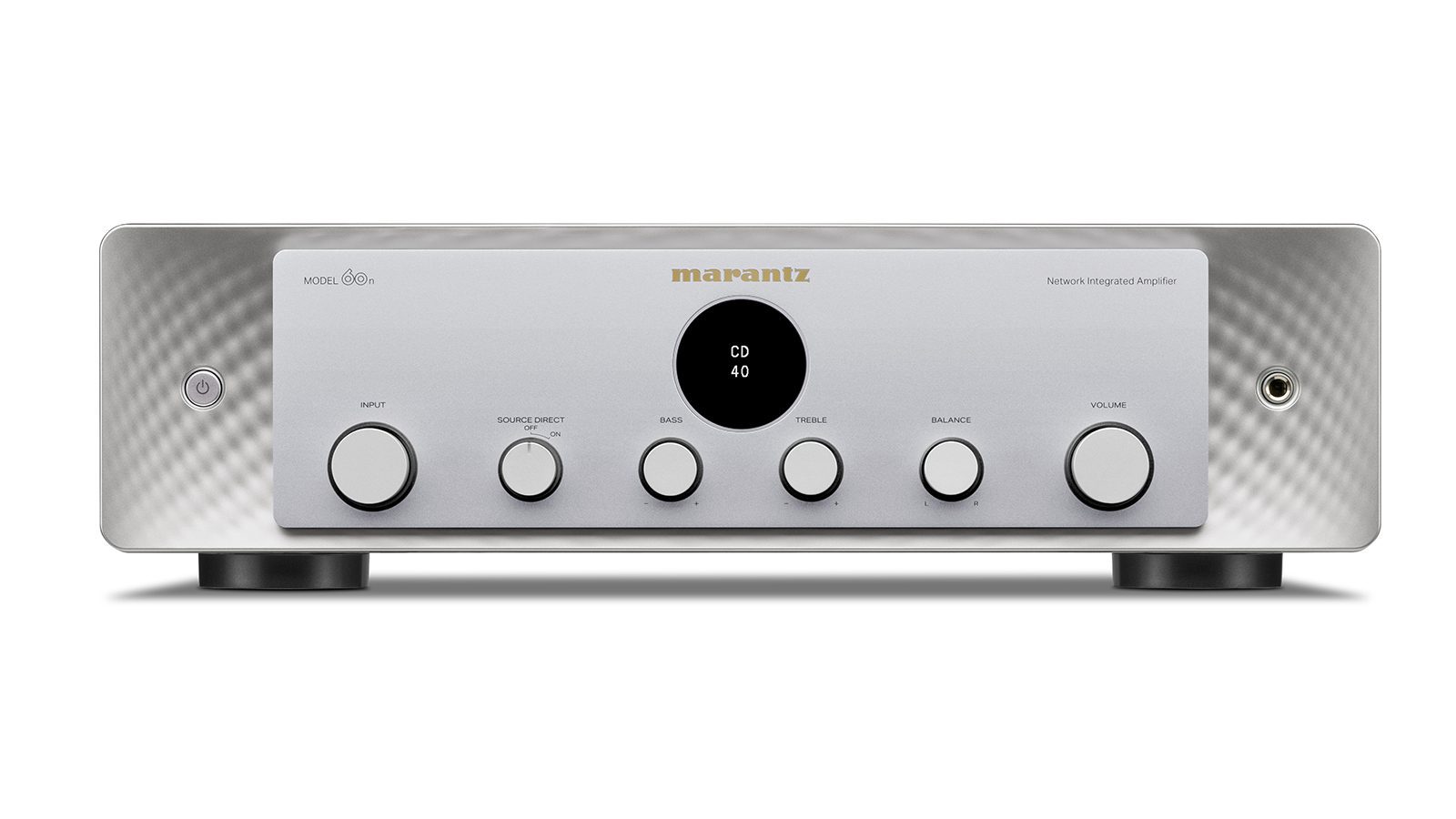
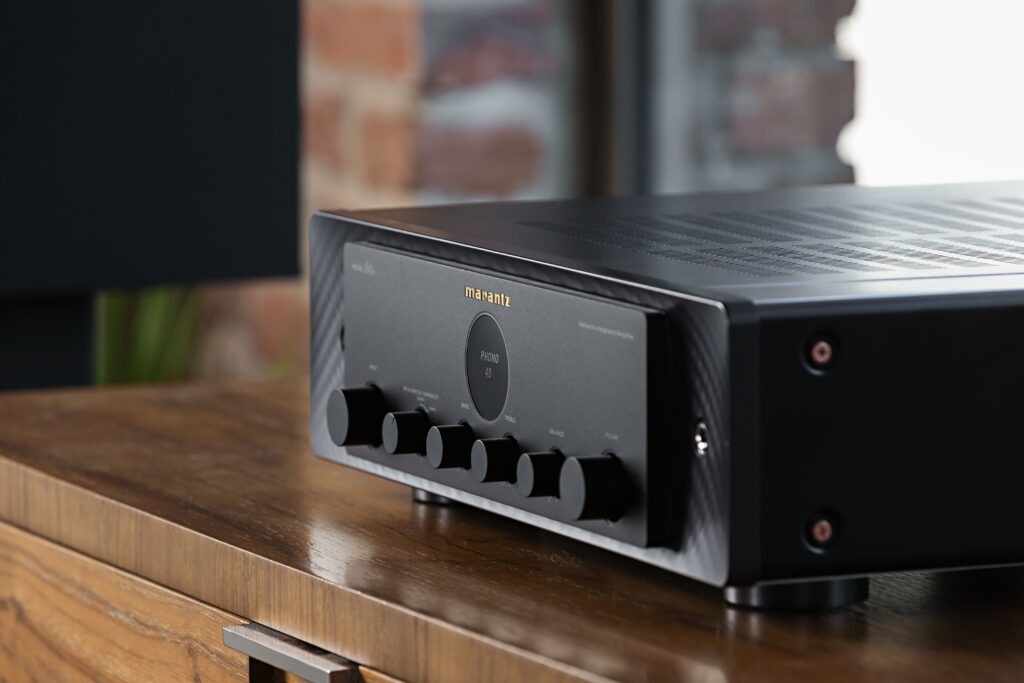
The 60n has a floating section ahead of a slightly contoured, slightly patterned metal front panel that changes appearance a little depending on how the light catches it. A relatively small ‘porthole’ display keeps the ‘traditional Marantz’ flag flying, and there are controls for volume, balance, bass and treble along with a ‘source direct’ control that bypasses those last three. A power on/off button and a 6.3mm headphone socket complete the front panel. Build quality and the finish standard are well up to the standard the asking price demands.
In addition to the control app (which is comprehensive enough but rather slapdash in its layout), the 60n can be controlled using a large and logical remote control handset. Getting what you want from the device and positioning it within a multi-room system is very straightforward.
Able driving
The Marantz 60n ably drives a pair of Bowers & Wilkins 705 S3 Signature loudspeakers on their bespoke FS-700 S3 stands for the test. Sources consist of a Clearaudio Concept turntable connected to the MM phono input, a Rega Apollo CD player connected to both the digital coaxial and one of the line-level analogue inputs (to make a straight A/B comparison between the Rega’s DAC and the equivalent in the Marantz), a FiiO M15S digital audio player loaded with hi-res digital audio files of various types, and an Apple iPhone 14 Pro housing Presto and TIDAL music streaming apps. The Marantz can also access a Buffalo Terastation NAS device thanks to its Roon compatibility.
The 60n sounds fuller, more complete and more convincing if given the proper stuff to work with. But it’s well worth noting that the Marantz doesn’t throw in the towel if ‘the proper stuff’ is not forthcoming.
Don’t sweat the lesser stuff
So while a heavyweight 180g vinyl pressing of The Hold Steady’s Stay Positive [Vagrant] is preferable to a 320kbps MP3 of the same album streamed via Bluetooth, and while a 24bit/96kHz FLAC file of Arvo Pärt’s Cantus in Memoriam Benjamin Britten performed by Staatsorchester Stuttgart and Dennis Russell Davies [ECM] proves a better bet than its 16bit/44.1kHz CD-borne equivalent, the 60n doesn’t turn its nose up at the lesser stuff. Instead, it treats it with a degree of care that’s by no means a given in products similarly specified and priced.
There’s a smooth unfussiness to the overall sound of the 60n that makes it a) an adaptable device, and b) appropriate for use with any number of price-appropriate loudspeakers. Its low-frequency presence is decently robust and just fractionally forward where the entire frequency response is concerned – with carefully controlled bass attack, allowing for cogent rhythmic expression. Detail levels regarding tone and texture are impressive, too, and there’s slightly more low-end variation available here than the norm.
Shine scintilla
The top of the frequency range is a little circumspect when it comes to outright extension, and that last scintilla of shine and brilliance is missing from the treble response, too. But the high-end activity is substantial rather than hard, and it’s just as detailed and informative here as it is at the opposite end. But it’s in the midrange that the Marantz is at its most adept and most impressive – and not only because of those powers of detail retrieval that make every singer sound characterful and direct. It’s open and revealing, sure – but its tonal balance is carefully neutral and its facility with the minor harmonic variations apparent in every voice makes for a naturalistic and convincing listen.
The whole frequency range hangs together quite nicely, that little hint of low-end overconfidence notwithstanding, and there’s a fair amount of dynamic headroom available when the intensity (or straightforward volume) of a recording ramps up. The Arvo Pärt recording makes it apparent that even the most minor, most transient dynamic shifts in harmonic response aren’t overlooked, either.
The soundstage the 60n creates is coherently organised and quite spacious, too – so even a massed orchestra can find space for every participant to operate. The left-to-right layout is broad, and there’s a mild but definite suggestion of front-to-back and even top-to-bottom. The Marantz is unified in its presentation, knitting even the most complex recordings into a single occurrence rather than presenting them as a series of individual events.
Just the facts
The Marantz 60n isn’t the most vigorous or assertive listen. For all of its dynamic potency, it’s a slightly matter-of-fact listen: “The facts, just the facts” would seem to be its mantra. And for those who value a calm and judicious presentation of their music, this attitude is approaching ideal – but those for whom music is, first and foremost, entertainment could find the 60n a little lacking in animation. Its ‘fact-led’ trait can be mitigated just as easily as it can be compounded by the choice of partnering loudspeakers, of course – and, to a lesser extent, by the source equipment the Marantz is amplifying. But even though some judicious system-matching is definitely in order, there’s no way to refute the attitude of the 60n ultimately. You either like it or you don’t.
Like it or not, though, there’s no denying the 60n is an admirable device in many ways. There’s the way it presents itself, of course, and how it makes your music sound – no matter where it originates. But, there’s the way it’s a Marantz product, the likes of which yet another change of ownership seems extremely unlikely to undermine.
Technical specifications
- Type: network streamer/Class AB amplifier/DAC
- Analogue inputs: 3 x line-level unbalanced RCA; MM phono
- Digital inputs: digital coaxial; digital optical; HDMI ARC; USB-A; Ethernet; dual-band wi-fi; Bluetooth 5.4; Roon Ready; Spotify Connect; TIDAL Connect
- DAC resolution and supported digital formats: 32bit/384kHz PCM; DSD256 (inc. DSF). AAC; ALAC; FLAC; MP3; WAV; WMA
- Music services and wi-fi inputs (country dependent): Amazon Music HD; AWA; Deezer; iHeartRadio; Mood:Mix; Pandora; Qplay; SiriusXM; SoundCloud; Sony HiRes; TIDAL; TuneIn
- Analogue outputs: unbalanced RCA stereo pre-out; subwoofer pre-out; Marantz SPKT-1 speaker outputs
- Digital outputs: none
- Frequency response: 5Hz – 100kHz
- Distortion (THD + noise): 113dB
- User interface: ‘HEOS’ app; RC006PM remote control
- Dimensions (H×W×D): 139 x 442 x 431mm
- Weight: 7.2kg
- Price: £1,299, $1,500, €1,500
Manufacturer
Marantz
Trending Articles
See all
Krell Vanguard integrated amplifier
- Apr 07, 2015
Trending Articles

By Simon Lucas
More articles from this author
Read Next From Review
See all
Eversolo T8
- Oct 13, 2026
Acoustic Energy AE Active
- Oct 13, 2026
Reiki Audio SuperSwitch X/Pro X PSU
- Oct 06, 2026
Audiobyte SuperVOX
- Oct 06, 2026