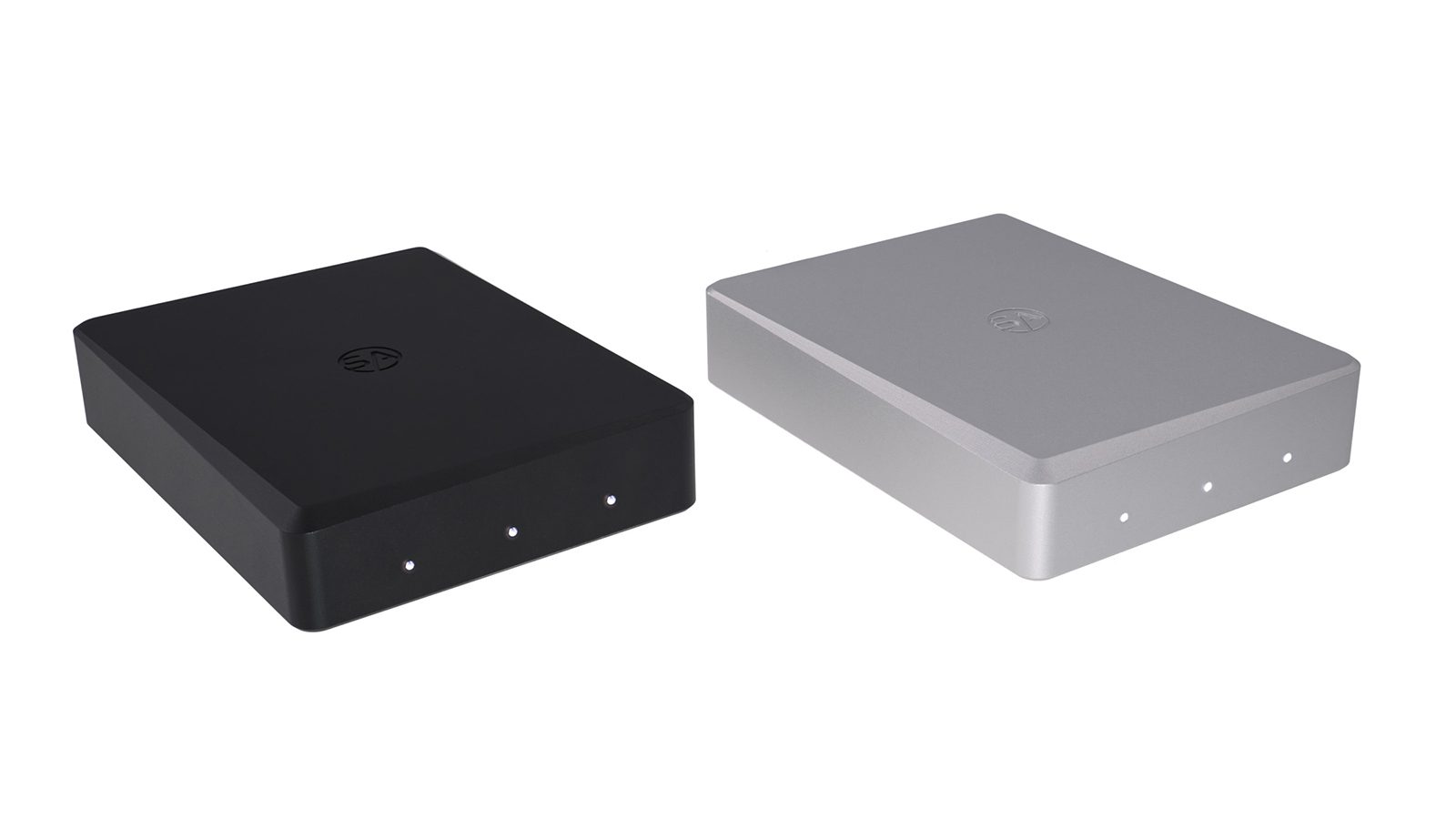
I’m not sure how Theo Stack does it. All the network filters on the market at around the £750 price point of the latest Stack Audio SmoothLAN Regenerator are passive devices in plastic boxes. The Stack unit has a machined aluminium case and a separate power supply, which makes it look like remarkable value in material terms alone.
Stack Audio has always used machined aluminium casework for its electronics, keeping costs down. When I asked how Stack achieves this, Theo explained that it has smaller margins than other brands and sells directly rather than through retailers.
Not big, clever
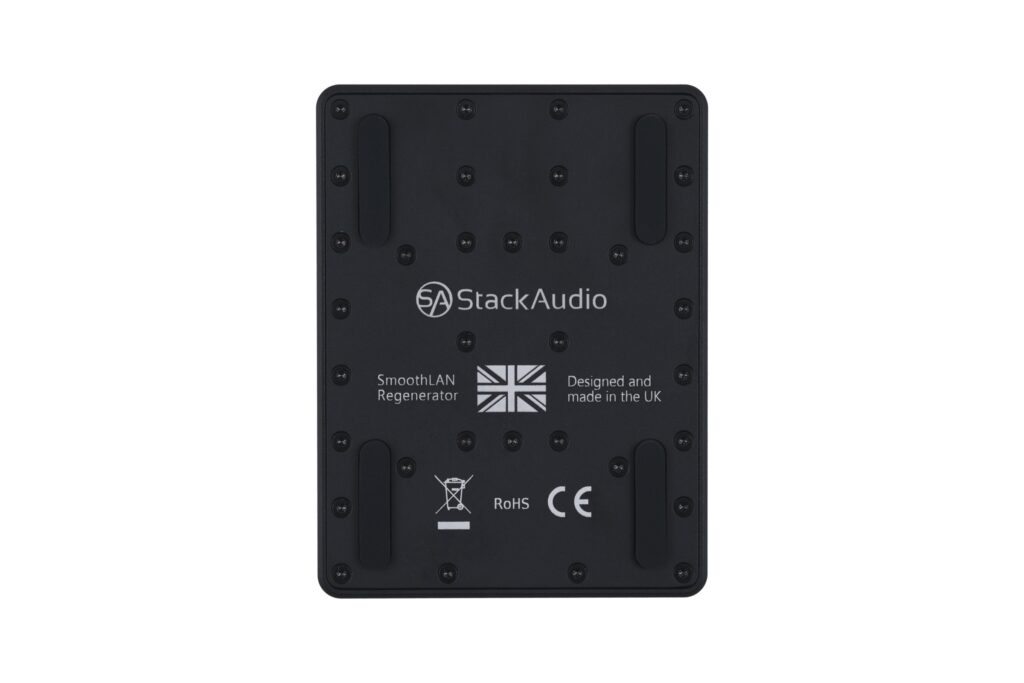
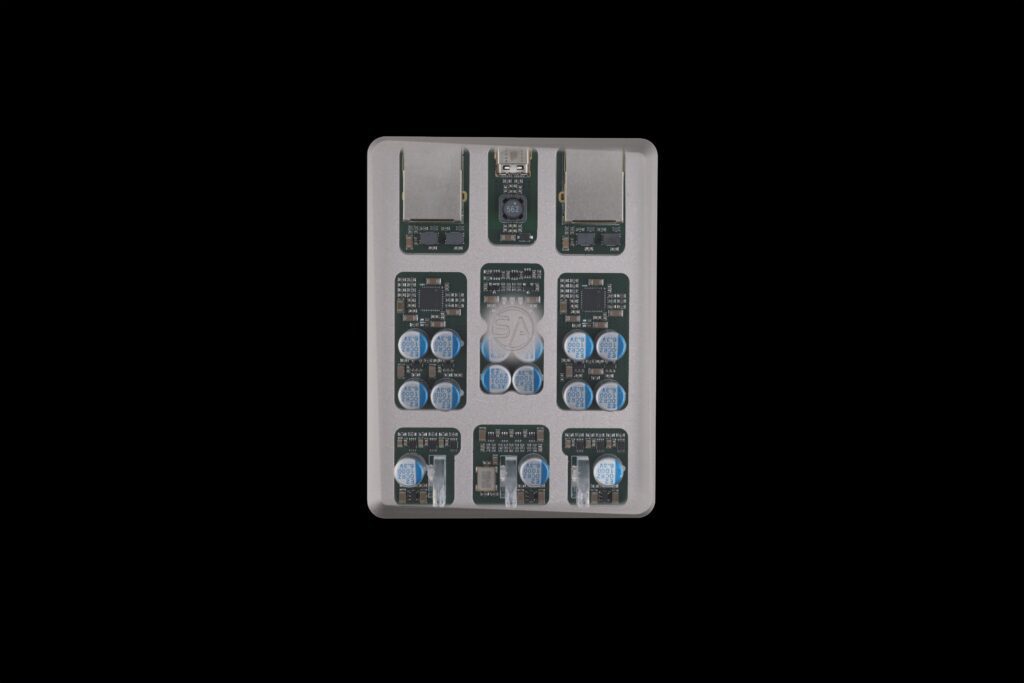
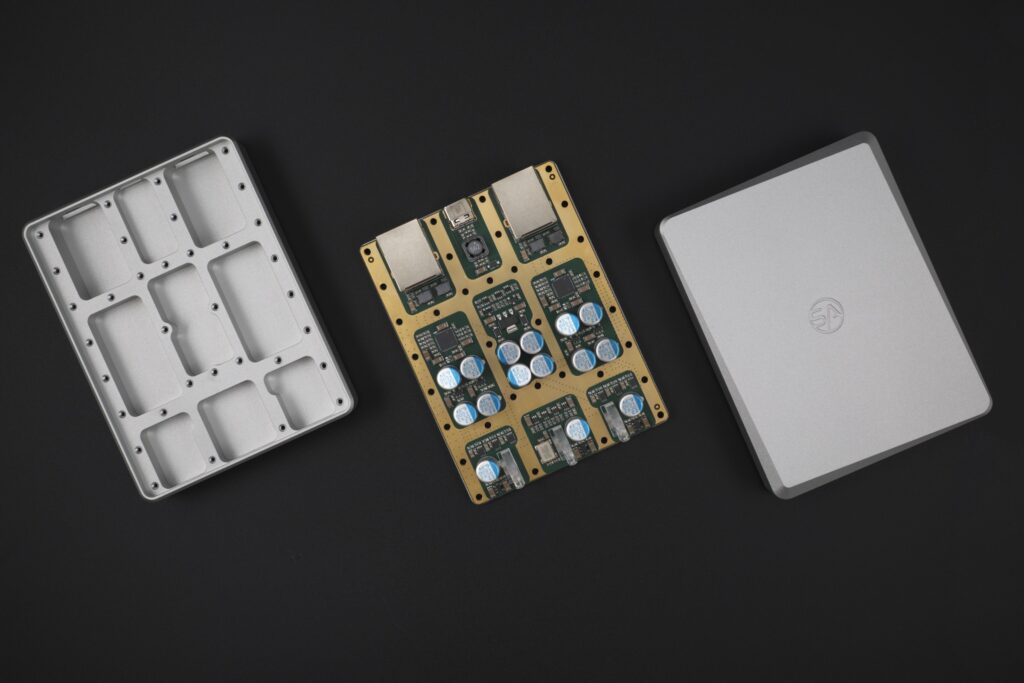
The SmoothLAN Regenerator is not a huge device at 10.5cm (four inches) long, but if you look at the underside, you can see no fewer than 36 bolts holding it together. These give some indication of the nature of what goes on inside, where there are nine separate compartments containing three stages of reclocking and filtering to clean up the incoming network signal.
The separation of the filtering stages blocks external and internal EMI, which is emitted by pretty well all electronics and can get through the smallest of gaps, hence the need for so many fixings in the Regenerator. The standard SmoothLAN is a smaller, passive filtering unit, as the suffix indicates the SmoothLAN Regenerator does not merely filter but regenerates the network signal to strip out the noise that typically pollutes network connections.
There don’t appear to be many network regenerators on the market. The known one is the Uptone EtherRegen from the US, but a quick search didn’t reveal any others. I wanted to know whether the SmoothLAN Regenerator works as a single input switch, but Theo says it doesn’t operate similarly.
Uncompromising
It uses two stages of passive filtering and three active reclocking stages to produce a 100mb output that is “noise-free for uncompromised music streaming.” Stack provides a short (50cm) unbranded ethernet for connecting the filter and streamer, which I used for this review. Results would likely improve if this were upgraded.
The reclocking stages require power; a 5V low-noise switch mode plug-top supply connects to the SmoothLAN Regenerator via a USB C socket between the in- and output ports. The connecting cable plugs into the power supply rather than being fixed, as is usually the case.
I discovered this when it was accidentally pulled out. Each circuit block within the SmoothLAN Regenerator has its power supply, while the clock supply is further isolated to minimise phase noise and jitter.
I assessed the Stack SmoothLAN Regenerator by trying it with various streaming devices with and without a fancy Network Acoustics Tempus switch, which provided a fair degree of isolation. The first set-up consisted of a Melco N10 server/streamer with its USB output connected to a CAD 1543 MkIII DAC (also featured in this issue).
I played Bob Dylan’s ‘Tangled Up In Blue’ from the library on the Melco and then put the SmoothLAN Regenerator between the incoming network connection and the server. The Stack Audio’s inclusion resulted in a distinct relaxation of the sound but not a smoothing of detail. In fact, leading edges became better defined, and it was easier to appreciate the kick drum and the guitar playing. At the same time, the track gained more drive and emotional impact. The combination of impetus and ease made for a significant overall improvement.
Making it easy
Using a track from Qobuz, Ike White’s ‘Changin’ Times’, and switching from ‘regular feed’ to ‘Stack filtered and clocked’ produced a larger improvement. Streaming service sound quality has greater potential for noise gathering and never sounds as good as locally stored material, but the SmoothLAN Regenerator tried to balance this out. There was more power in the bass line, more space in the sound overall, and a better definition of leading edges.
This last quality gave the tune a more precise sense of timing whilst bringing ease to the presentation, which was very welcome. The song really got into its groove with the Stack in line, with greater separation of the percussion, guitar, drums and bass line. I also contrasted the Stack Audio SmoothLAN Regenerator with another network filter at a similar price. This comparison was a closer run, as you might expect. Still, there were things the SmoothLAN Regenerator could do that the alternative did not—notably, depth of image, a general increase in detail resolution and all-important relaxation.
Analogue beats digital?
Analogue sources always beat their digital counterparts on the sense of ease; digital can do detail, dynamics, and even bandwidth, but it’s rare to find one that sounds as relaxed as a good turntable. The fact that the Stack brings some analogue-style ease to the result is most welcome.
The second source I combined with the SmoothLAN Regenerator was an Electrocompaniet ECM1 MkII streamer (reviewed in Issue 242). I started with June Tabor’s rendition of ‘Love Will Tear Us Apart’ from Qobuz. This filter’s cleaning up of the sound and enhanced image projection gave the singer’s voice a more subtle expression in a tonally richer and refined soundstage.
The SmoothLAN Regenerator seems to deburr the sound and remove roughness by reducing noise; it brings out the purity of a voice like this and delivers greater definition. Overall, this positive result encourages further listening and makes this streaming service more appealing in a revealing system.
Someone recommended Camille Bigeault to me recently, this French drummer plays with a degree of temporal precision that would impress Steve ‘The Metronome’ Gadd and the track ‘Mental Web’ certainly lives up to its name. Here, the Stack regenerator helped to make the piece more accessible by opening up the space and dynamics while adding shape to the kick drum. The drums took on a presence in the room that was not there before, essentially turning an almost flat presentation into a three-dimensional one thanks to greater clarity across the board, which is most apparent in the midrange where the guitar and leading edges reside.
What surprised me was that this piece of math rock took on an emotional weight inaccessible without the SmoothLAN Regenerator. Presumably, because everything was more transparent, it was easier to appreciate the subtleties and virtuosity of the musicianship.
Open wide
With a more familiar track in ‘Straight No Chaser’ by Keith Jarrett, Gary Peacock and Paul Motian [The Old Country (More from the Deer Head Inn)] the addition of the Stack filter opened up the soundstage, expanding it from between the speakers to outsides of both. More exciting is the way that it allows the life in this live performance to become palpable, expanding the space where the performance took place so that you can hear the musicians playing more clearly and the way that the venue’s acoustics react, essentially letting more detail through in a coherent manner.
The last piece of hardware I set up to try the SmoothLAN Regenerator with was an Innuos Zenith SE server/streamer. Initially, I played a song from the drive, ‘So Begins the Task’ by Stephen Stills, and left the Tempus switch between the network and the Innuos. Adding the Stack to this chain was nonetheless beneficial, with a sense of grain reduction, making for greater flow and a smoother, more analogue sound with greater vocal projection once again. It went from being a beautiful track to a sublime one. I also tried the Ginger Baker Trio piece ‘Ramblin” from Qobuz, while rolling back to a generic network switch. The result was consistent with earlier tests; an apparent increase in energy but also speed. The playing went from being good to absolutely thrilling and made for far stronger listener engagement.
Congratulations!
Stack Audio deserves congratulations for bringing this build, finish, and sound-quality product to the market at such a competitive price. The SmoothLAN Regenerator’s solidity inspires confidence in longevity, and its weight means that it won’t be pulled off the shelf by heavy ethernet cables. If you fancy hearing what your streamer can do when freed of the many nasties that beset most networks, I would encourage you to give it a thorough spin; it will not take long to appreciate what it can do.
Technical specifications
- Type: Active Ethernet regenerator
- Input: RJ45 Ethernet.
- Output: RJ45 Ethernet.
- Power supply: 5V plug-top.
- Supplied cable: 0.5m Ethernet.
- Size HxWxD: 23x80x105mm
- Weight: 333 grams
- Price: £750 (EU and US price calculated at purchase)
Manufacturer
Stack Audio
+44(0)1626 24 9005
Trending Articles
See all
By Editor
More articles from this author

Read Next From Review
See all
Eversolo T8
- Oct 13, 2026
Acoustic Energy AE Active
- Oct 13, 2026
Reiki Audio SuperSwitch X/Pro X PSU
- Oct 06, 2026

Audiobyte SuperVOX
- Oct 06, 2026