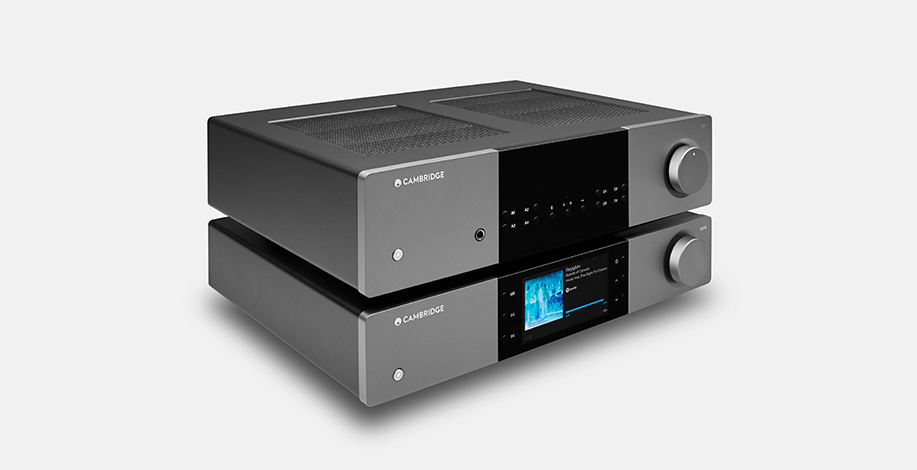
Sometimes, the arrival of a review product can trigger a keen feeling of déjà vu. I was treated to an incredibly potent dose when unboxing the Cambridge Audio EXA100 amp and EXN100 streamer from their boxes. In relatively recent history, I have reviewed both the CXN100 streamer and the CXA81 MkII amplifier from the company and confronted with the EX-devices, it is hard not to jump to the immediate conclusion that the company has sprayed the centre section black and doubled the price of each box.
Naturally, Cambridge Audio is reasonably insistent that this is not the case. The EX models are best seen as gently enhancing the functionality of the CX devices while adding some of the engineering found in the range-topping Edge models. As the complex and elegant casework of the Edge models accounts for a significant part of their cost, it is logical that Cambridge Audio has elected to beef up the more affordable casework instead of trying to simplify an Edge.
Similarities
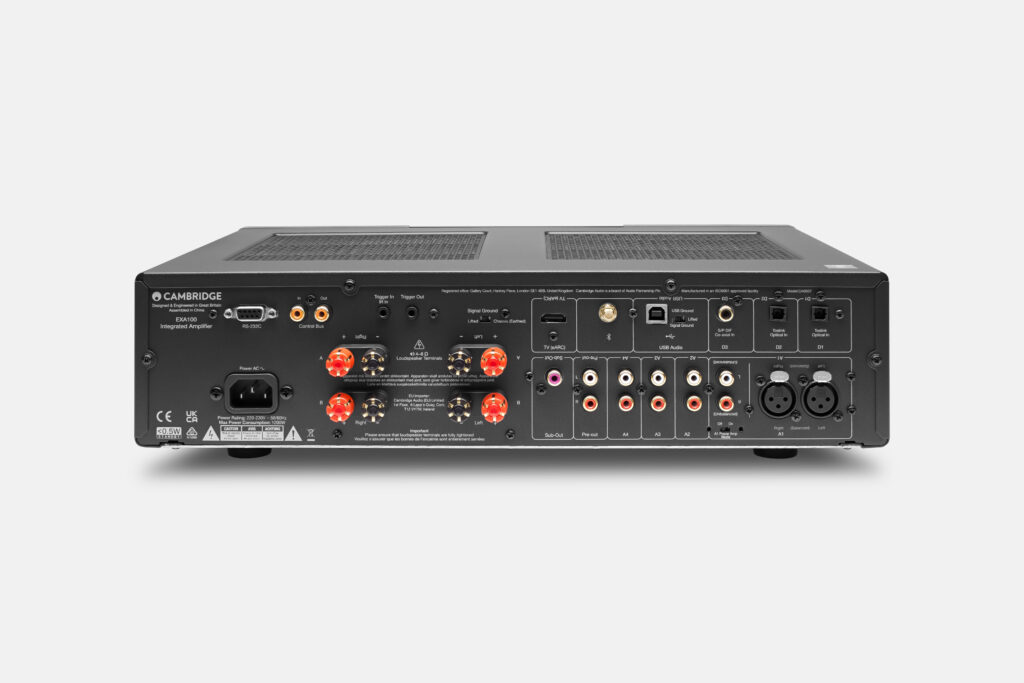
Even allowing for this, the similarities between the EXA100 amp and the CXA81 MkII are more than skin-deep. The significant spread of inputs are identical. You get a single XLR input supported by three RCA inputs and another RCA input shared over input 1 with the XLR connection. There are separate stereo pre-outs and a mono subwoofer out. This is partnered with a digital board built around an ES9018K2M DAC. This further boosts connectivity with two optical, coaxial, and USB B inputs, and it supports Apt X HD Bluetooth. Maximum sample rate handling is via USB and extends to 384kHz PCM and DSD 256.
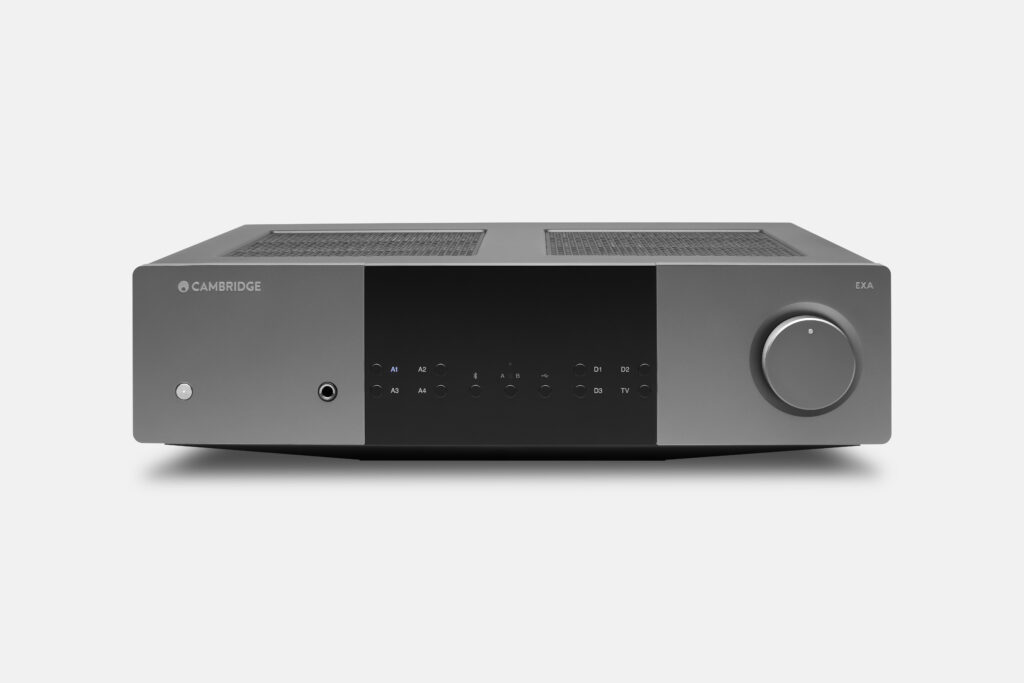
The only alteration that the EXA100 makes over the cheaper amp is a good one. An HDMI eARC connection joins the digital board, making integrating it with a TV much more manageable. Moreover, this is an excellent implementation of HDMI ARC too. The EXA100 has fired up every time the TV has synced perfectly, regardless of the input it was powered down in, and then returned to standby when the screen was powered down.
This might sound trivial, but you would be surprised how many devices cannot do it. I also genuinely appreciate that the front panel has a direct input selection for every input mirrored on the remote handset, which controls the streamer. The trend for amps to rely on an input cycle at the point where they are gaining more inputs is a genuinely frustrating one, and this little detail makes the Cambridge Audio much more pleasant to use daily.
Differences
The differences in the amplifier section itself are not night and day, but they are more apparent. The circuit still adapts the CXA81 MkII, but the power rises to 100 watts into eight ohms and 155 watts into four. This is a similar output to the Edge A integrated but uses an elaborate arrangement of counterwound transformers and can double its output into 4 ohms. Cambridge Audio has gone through the circuit from front to back and improved components where appropriate. Peer through the top panel, and you can see that the internals are altogether burlier than the CXA81 MkII.
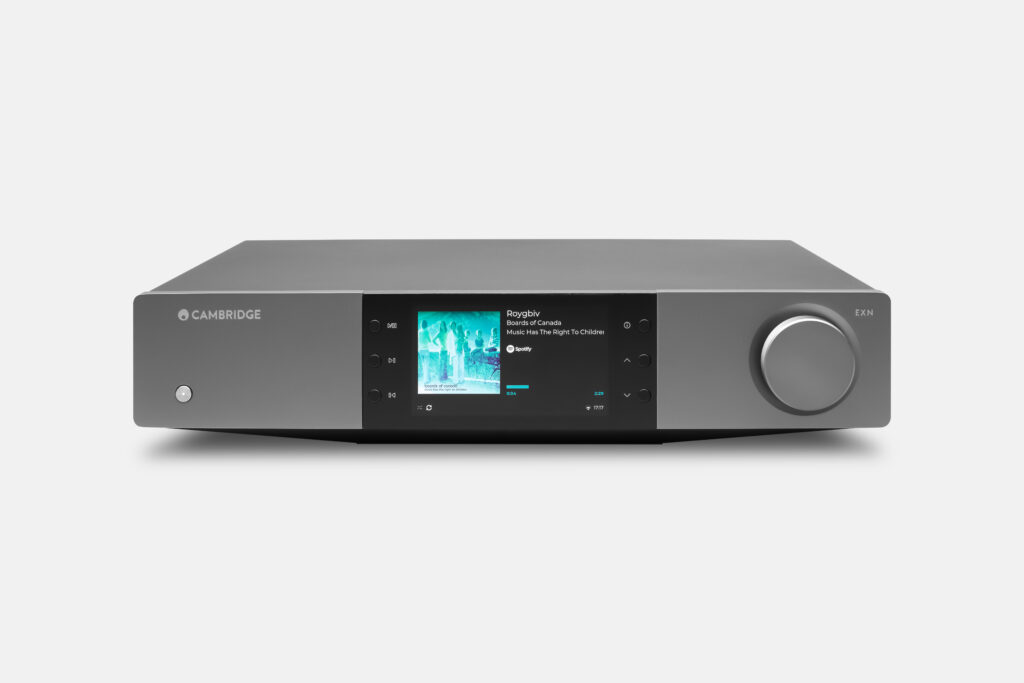
The EXN100 follows a similar process. It is an evolved CXN100 and takes the form of a streaming preamp with 100-step volume control that acts in the digital domain instead of the analogue unit in the Edge NQ. Cambridge Audio has a strong track record with this type of streamer, dating back to the original Stream Magic 6 released over a decade ago. Like the CXN100, this uses an ESS ES9028Q2M DAC and, as well as wired and wireless networking, it can connect to external devices via a USB-B, optical and coaxial digital input sample rate handling is 768kHz PCM and DSD512. The sole addition to the connectivity is another HDMI ARC input. This works as well as the one on the amp but instead exemplifies how much connectivity overlap these two devices have.
Unchanged Magic
Something else that is unchanged is the 4th generation Stream Magic control app, but this is rather more of a good thing. Stream Magic eschews widgets for a level of carefully refined real-world usability that makes many other amps feel a bit broken. In addition to rendering a local library, you get Tidal, Qobuz, Spotify, and Deezer support, an excellent internet radio implementation and AirPlay2 and Chromecast support to cover getting other content to the streamer. The EXN100 is also fully compatible with Roon as well should you wish.
The EXN100 does a very reasonable job of justifying its existence as a standalone streamer, and it is perfectly specified to partner up with an entirely analogue integrated amp or connect directly to a power amp or pair of active speakers. What is slightly harder to justify is pairing it with the ‘matching’ amp. The EXA100 only needs a streaming interface to become a completely self-contained device, and I can see a few people baulking at the amount of doubled-up hardware in the matching streamer and choosing something more uncomplicated for the task.
Looking good together
The two units do look very good together, though. While I will stand by my comments that the EX models look very similar to the CX units, crucially, they feel somewhat different. The casework is rather more substantial, and the points of contact, like the control knobs, have been beefed up and feel nicer as a result. The larger display of the EXN also makes more difference than I thought it might. The black strake on each unit has the unexpected benefit of making the EX models sit more happily with black devices than with the exclusively grey CX and Edge models. The build standard is also entirely in keeping with the competition at the asking price.
I initially connected the EX devices up as a pair. I employed a pair of DALI Rubikore 2 speakers that I was thoroughly acclimatised to in the listening space and represented a price equivalent option. It didn’t take much time to realise that, in spite of their physical similarity to the CX line, there is rather more Edge in the sound of the new models. I’ve lived with an Edge A as a test amp for many years now, and it has a presentational style that I’d become very fond of at that time. EXA100 brings a significant chunk of it into its performance, too.
Lively neutrality
This identity might best be summarised as ‘lively neutrality.’ As a duo, the EX units will not immediately grab you with the rhythmic urgency that some other devices at the price can… but no less importantly, you won’t sit there thinking they sound slow or confused. Then, after an hour or so, you can ask them to get stuck into A Certain Ratio’s ACR Loco [Mute], and there isn’t a single rhythm, beat or time signature on the album; and this being ACR, there are plenty, that the Cambridge Audio doesn’t get exactly right.
The phrase that pops up in my notes is ‘unforced intensity’; it is the closest summation I can get to what these two units do. They are perfectly content to go like the clappers. They simply avoid sounding frenetic as they do it.
Rhythmic brilliance
This rhythmic brilliance is partnered with a genuinely excellent tonal balance. When you ask for something that genuinely warrants the term ‘Audiophile’ like Ray LaMontagne’s Monovision [RCA], the experience is as gratifying as you would hope. The EX Duo opens the recordings into a gorgeous, three-dimensional experience anchored by LaMontagne’s lovely vocals, which sound believable and tangible. That same unforced feeling is manifested in the absence of emphasis on any part of the frequency response, which means you can focus on the performance as a whole.
The clever bit is that when you are done playing nice, you can dig out A Happy Medium by Sheafs [Modern Sky], and the result is still tremendously enjoyable. This is a congested, shouty mess of an album (although it still would be even if it were immaculately recorded). Still, the Cambridge Audios apply enough of their ability to soften and open out recordings to make the experience easier to listen to. Crucially, they don’t use so much that the intensity of the music is lost. If your collection is ‘a bit of everything’, there is an ability to make it all sound right that even some costly devices I’ve tested cannot match. With any given corner of that collection, there will always be a rival device that will play it slightly better, but pretty much everything will wilt against the sheer all-around ability of the EX units.
The catch
The catch is that you can dispense with the EXN100 altogether, select a USB transport for the USB input of the EXA100 and experience much the same thing. Is the EXN better than the digital board in the EXA? Yes… but probably not enough to distract me from the vast amount of money I had just saved in ‘making do’ with the amp on its own. I brought the amp downstairs for another testing phase, connected the USB output from a Roon Nucleus, and ran the duo with a pair of Neat Petite Classics. The sound retained the same easy-going joyfulness that was present in both units. It’s very hard to look past how good the EXA100 is on its own.
This would be bad news for the EXN100 if precisely the same thing didn’t apply to its solo performance. Shorn of the integrated, I connected up a Chord Electronics TToby power amplifier, and the resulting system was no less satisfying to listen to. The completeness of the digital inputs on the EXN100 that leave it feeling somewhat doubled up when placed with the amplifier is also its saving grace when used on its own. Suppose you have treated yourself to something like a Musical Fidelity A1. In that case, the EXN100 will supply you with every modern connection that the amp lacks while ensuring that nothing of the addictive presentation of the amp is in any way impinged by the Cambridge Audio. The EXN100 is nigh on a perfect digital source… only not perhaps for the ‘matching’ amplifier.
No accident
The more time I have spent with them, the less I am inclined to believe this is an accident. I’m sure Cambridge Audio and its dealers are aware that amplifiers specified, like the EXA100 do not generally have much in the way of digital sources connected to them. Indeed, not using the EXN via the balanced input freed it up to be tested with the absurdly talented iFI ZEN Phono 3 using that connection with a Technics SL-1300G, and perfect the combination was, too. By specifying the EXN100 as they have, though, they’ve ensured that it is likely to be as successful as a standalone device as the amp. Whether a transport version of the EXN, keeping the aesthetics and interface but only having digital outputs, might be a worthwhile addition is one for Cambridge Audio to mull over in due course.
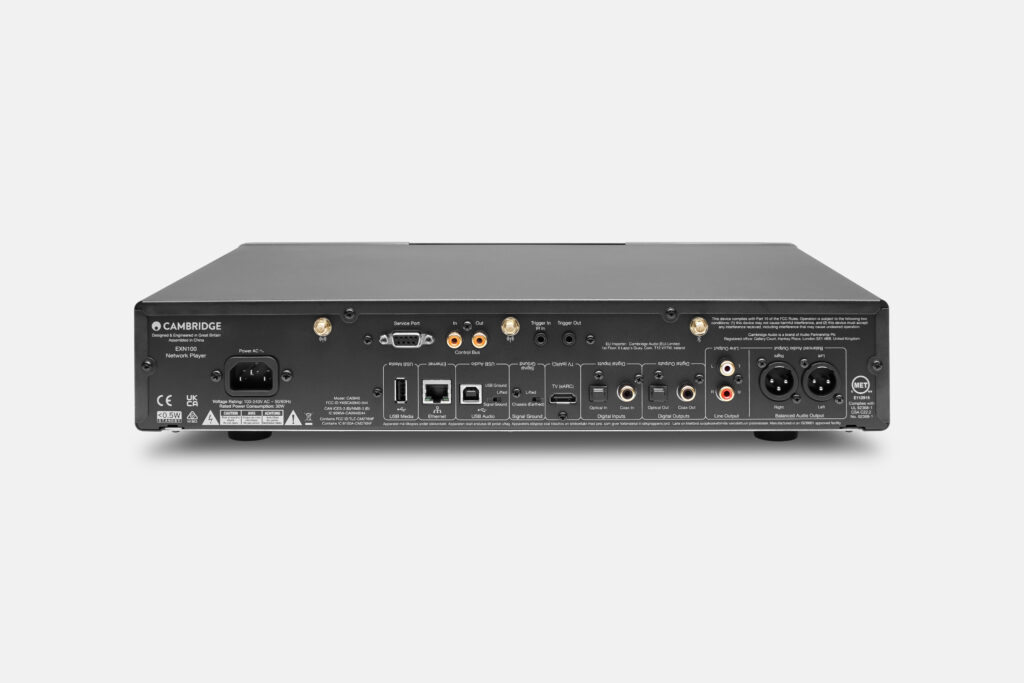
They don’t need to rush to decide though because whatever my slight reservations about the overlap in functionality, it doesn’t prevent these two products being absolutely phenomenal devices in their respective categories. However much they might look like their more affordable CX brethren, the EX models bring enough of the brilliance of the Edge devices down to a more affordable price as to be very special indeed. The Cambridge Audio EXA100 and EXN100 might still result in a feeling of déjà vu but when you have spent some time with them you might be surprised that feeling comes from above rather than below.
Technical specifications
EXA100
- Power Output 100W RMS into 8 Ohms @ <1%THD+N, 155W RMS into 4 Ohms @ 1kHz <1%THD+N
- DAC ES9018K2M
- Frequency Response <3Hz – >40kHz +/-1dB
- Analogue Inputs 4x RCA 1x XLR
- Digital Inputs 2x optical, 1 x coax, 1x USB-B, 1x HDMI eARC
- Bluetooth 5.0 aptX HD
- Headphone Output
- Subwoofer Output
- THD (Unweighted) <0.002% 1kHz at 80% of rated power (8 Ohms) | <0.02% 20Hz – 20kHz at 80% of rated power
- S/N Ratio (REF 1W) >91 dB
- Crosstalk @1kHz >90
- Dimensions (W x H x D): 115 x 430 x 341mm
- Weight: 12.8kg
- Price: £1,999, £2,199, €2,199
EXN100
- DAC ESS ES9028Q2M
- Display Screen 4.76” IPS TFT – 1280 x 569
- Digital inputs 1x optical, 1x coaxial, 1x USB-B 1x HDMI eARC
- Bluetooth 5.0 with aptX HD
- Analogue Outputs 1x RCA 1x XLR
- Digital outputs 1x coax 1x optical
- PCM up to 32-bit 768kHz, DSD up to x512 File system support FAT32, NTFS, Ext2/3/4,
- Roon Ready
- Audio Formats ALAC, WAV, FLAC, AIFF, DSD (x512), WMA, MP3, AAC, HE AAC, AAC+, OGG Vorbis
- THD @ 1kHz 0dBFs < 0.0005 %
- Frequency Response 20Hz-20kHz +/- 0.1dB
- Crosstalk @1kHz < -120dB
- Signal to Noise Ratio (Ref 1W) > 120dBr
- Dimensions (W x H x D) 430 x 90 x 305mm
- Weight 4.1kg
- Price: £1,599, $1,799, €1,799
Manufacturer
Cambridge Audio
+44(0)207 940 2200
Tags: CAMBRIDGE AUDIO EXA100 EXN100 INTEGRATED AMPLIIFIER STREAMER
Trending Articles
See all
By Ed Selley
More articles from this author
Read Next From Review
See all
Eversolo T8
- Oct 13, 2026
Acoustic Energy AE Active
- Oct 13, 2026
Reiki Audio SuperSwitch X/Pro X PSU
- Oct 06, 2026
Audiobyte SuperVOX
- Oct 06, 2026