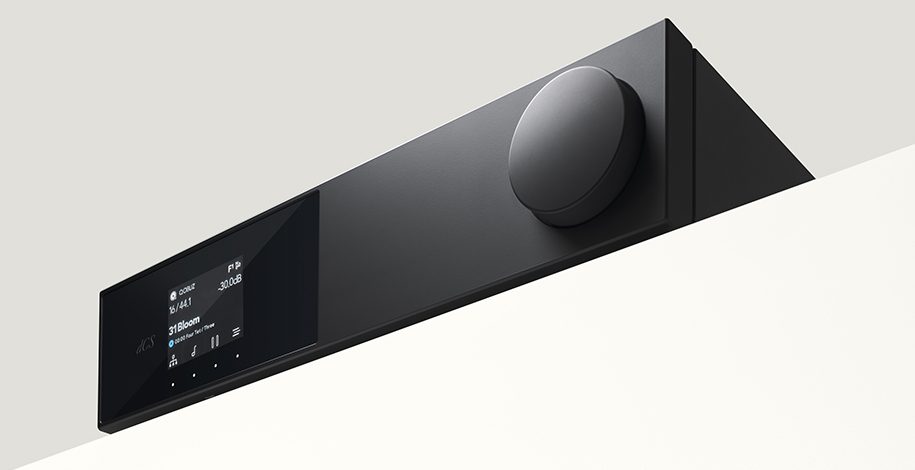
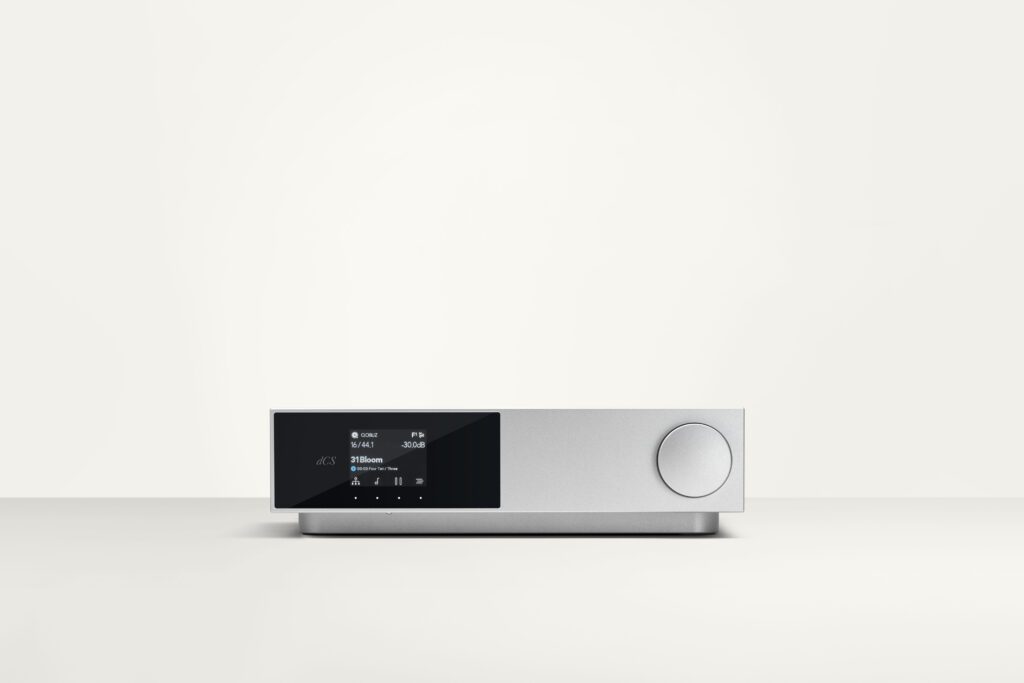
By dCS standards, Lina DAC X’s £13,500 price tag is quite modest compared to their offerings that cost significantly more. The Bartók with APEX is £19,000 and is a staple in my system. It delivers an exceptional high-end digital performance that extracts every bit of detail from a well-recorded piece. The Lina DAC X builds upon the basic Lina, increasing the unit’s size. The Lina is 22cm wide, while the X measures 44cm. Essentially, the standard Lina was designed for a headphone-based system. In contrast, the DAC X is probably better suited for a speaker-based system.
The other notable differences include the large volume knob for quick volume adjustments and infrared control. The unit is crafted from solid aluminium billet and is available in an aluminium or black finish. It is reassuringly heavy, weighing 14kg. The remote is made from alloy. Aside from servicing the usual functions, it also manages the setup menu, upsampling, phase, and filters.
Driving amps
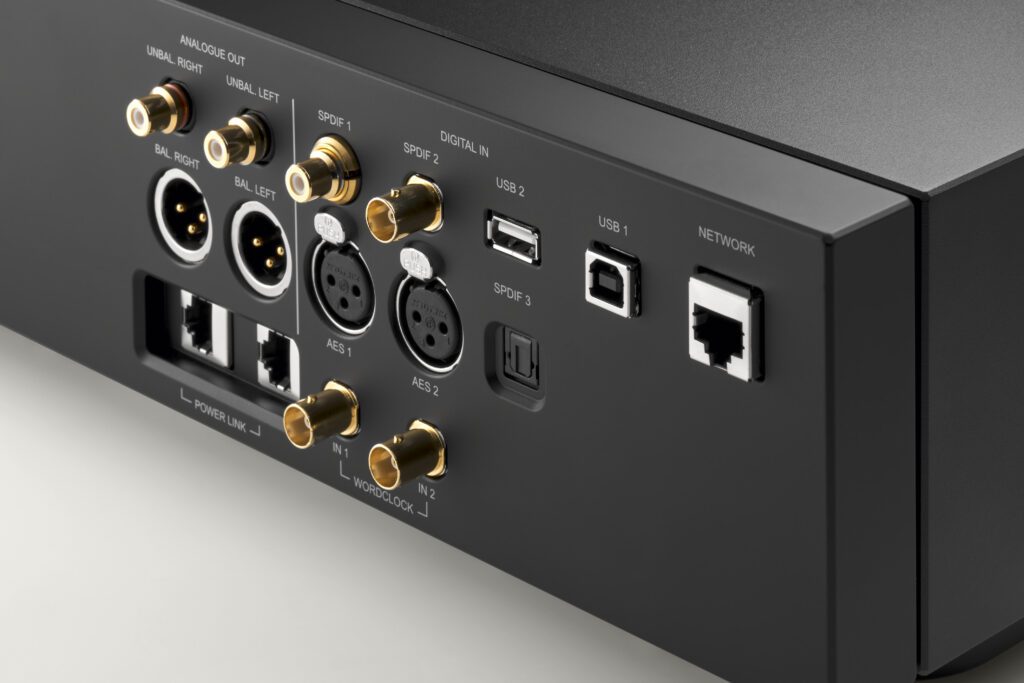
The Lina DAC X can drive a power amplifier directly, with both XLR and single-ended outputs. It has two AES/EBU inputs, which can be used as a pair to support incoming sample rates of up to 384kHz. There’s also one S/PDIF BNC coax, an S/PDIF RCA, a Toslink, a USB PCM, DSD, DSDx2 in asynchronous mode, and a USB connector which can attach to a storage unit. There is also a USB-B port for PC or Mac connectivity.
The other feature of dCS systems, which I very much value, is the ability to adjust output voltages directly from within the Mosaic app. This can range from 0.2V to 6V. I discovered that the optimal setting for the Bartók was achieved by using the highest voltage available. An external passive preamp manages the overall volume. The unit doesn’t operate wirelessly, so it must be connected via a network cable. If a wired connection is problematic, it can be resolved by using a mesh system with a wired link to a satellite mesh receiver.
Within the Mosaic
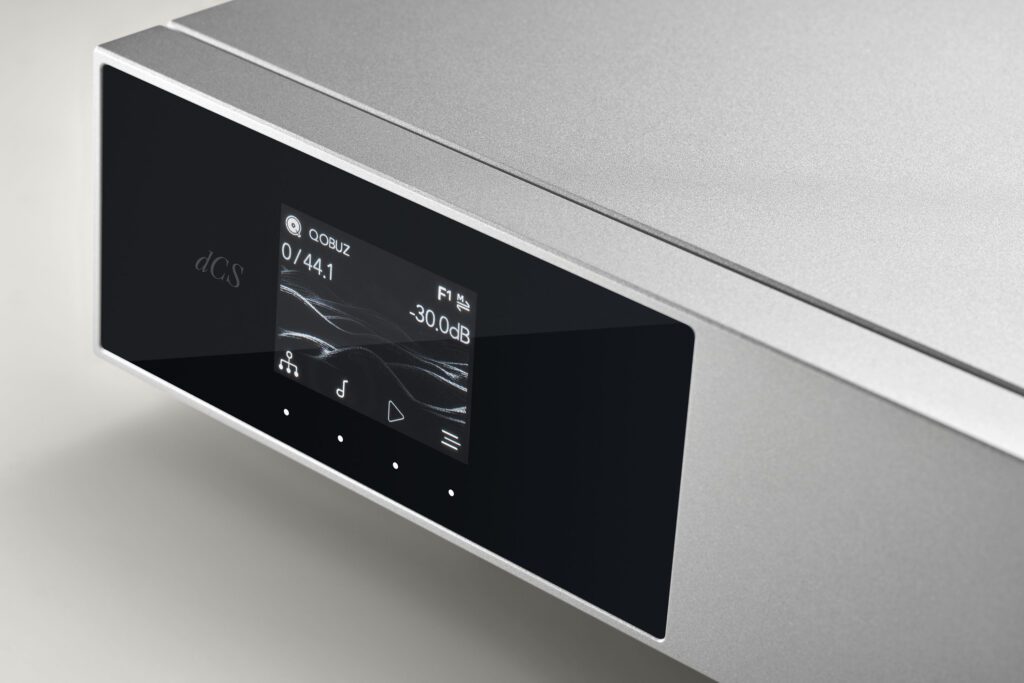
Within the well-designed Mosaic App, there are a variety of filters that apply at different sample rates. A particularly impressive feature is the ability to upsample to DSDx2. Based on my experiments with the Bartók, this is the smoothest and most airy option. The display is a departure from most dCS designs, except Varèse. The screen features four lights that you press to make a selection. In contrast, the Bartók has buttons on the side.
dCS is excellent about its firmware updates. The Bartók now is a different beast from the original Bartók, both in terms of hardware and firmware. The APEX modification made a night-and-day difference. Meanwhile, the Mosaic updates brought new filters and functionality. This is a clear sign of a company that takes its corporate responsibilities seriously. It gives users the confidence that their investment in digital electronics is safe. Expect Lina DAC X to be the same.
Listening
I did my listening using a Lina Clock. It gave additional spatial information that I found highly worthwhile. I fed the Lina DAC X into a Townshend Allegri Reference preamplifier. Then into a pair of VAC Signature 200iq power amplifiers driving a pair of B&W 802D4s. I used a PS Audio PS10 power regenerator and Townshend Audio cabling throughout.
First listening is a trusty favourite, Bach Brandenburg No 4, conducted by Raymond Leppard with the ECO. It was initially recorded by Philips in analogue in 1974. It remains a fabulous recording and something of a classic! There is a lovely sense of an orchestra in front of me, with considerable spatial detail. Also, it gives the sense that it portrays musicians interacting and enjoying themselves in 1974.
The colours and textures of the instruments are all beautifully portrayed. Perhaps a little short of the mighty Bartók at over £10,000 more, but utterly credible and highly communicative and enjoyable from a listener’s point of view. There is a precision to the attack of the bows on strings. Notes start and stop with an accuracy I have come to expect from dCS.
Different textures
The different textures of the strings, harpsichord and two recorders are kept sanitarily separate. Thus, the sonic picture is a highly detailed one.
Next up, a superb Decca recording of the Scherzo from Mahler’s 7th Symphony, with the Chicago Symphony Orchestra. Recorded in 1971 and brilliantly transcribed to digital. My first reaction to what I’m hearing is like I’m listening back “in the box” from a master tape source.
The sound is ultra clean and detailed. There are some difficult-to-reproduce mutterings from the bass drum, which the dCS Lina DAC X does with consummate ease. The double basses are earthy and gritty, the violin section is extensive and weighty, and the neurosis of Mahler’s score translates brilliantly. The violins are a little brighter than Bartók’s version, I note in passing, but they are superbly clear. Rhythmically, the Lina is stunning with exemplary timing of the orchestra’s forces. All extraordinary from a recording that is 54 years old!
Jazz-time
Moving on to jazz, We Get Requests, Oscar Peterson and his trio, with ‘You Look Good to Me’, of course. The trio’s performance is immaculate, swift, and precise. The swing of the music is also beautifully conveyed through the Lina DAC X’s flawless timing. This makes it toe-tapping. The piano is nuanced, the percussion is tight, and the bowed bass rasps. You can feel the lower strings vibrating in a close-miked recording. Altogether this exemplifies what great audio does, making the listener believe they are right there!
Listening to Antonio Forcione’s Tears of Joy, the opening track shows how superb an acoustic guitar can sound. This happens when digital is properly implemented. The attack on the pizzicato is precise and swift. Spatially, the supporting instruments are layered holographically in space.
Incredibly lifelike
The cello’s texture is incredibly lifelike, the overall presentation is immensely dynamic, and I have rarely heard this sound better. It’s like viewing the performance through a freshly cleaned window. Nothing seems to obstruct the speakers and performers. I haven’t heard a network DAC at this price point sound as convincing as this.
‘Chitlins Con Carne’ is a track from one of Kenny Burrell’s Blue Note sessions, and was recorded in 1963. I have the original release on vinyl, and for my money, the digital version on the dCS Lina DAC X just sounds better. It’s more dynamic, more communicative, and quieter on the noise front. Without wishing to step into the digital/analogue standoff, there are recordings which, when transferred at high resolution from the master tape, have so many fewer processes going on. Therefore, it is not difficult for them to sound better, and in this case, it does. Texture, space, and attack – with the dCS, this recording is in a different league compared to the original analogue vinyl pressing, now streamed on Qobuz.
Hall of fame
So the dCS Lina DAC X rightly earns its place in the dCS Hall of Fame. It embodies the dCS house philosophy, characterised by meticulous, no-compromise engineering. Lina DAC X lacks a sonic signature in the best sense, and fits seamlessly into the illustrious line-up of Bartók, Vivaldi, and Varèse. It is attractive, very easy to operate, and is certain to become a timeless classic!
Read more about the technology that went into making the dCS Lina DAC X here.
Technical specifications
- Type: Digital converter with streaming and preamp functionality
- Digital Inputs: 2 x AES/EBU Used as a Dual AES pair (1+2), supports sample rates up to 384kHz, 1 x S/PDIF BNC Coax 44.1-192kHz, 1 x S/PDIF on RCA 44.1-192kHz, 1 x Toslink 44.1-96kHz, 1 x USB Type B 44.1-384kHz PCM and DSD, DSDx2 in Asynchronous Mode
- Network connection: 1x RJ45 (Ethernet), 2x RJ45 (Power Link connection)
- Mass Storage: 1 x USB Type A connector (navigated using Mosaic)
- Analogue Outputs: 1 stereo balanced pair on 2x 3-pin male XLR connectors, 1 stereo unbalanced pair on 2x RCA Phono connectors.
- Formats supported: PCM 44.1-384kHz, up to 24-bit, DSD/64, DSD/128. Native DSD + DoP, FLAC, WAV, AIFF, MQA
- Streaming supports the following platforms and services: UPnP, Internet Radio, Qobuz, Spotify, Deezer, Tidal, Roon Ready; QQ Music
- Upsampling: Multi-stage DXD oversampling with switchable DSD Upsampling
- Dinemsions (WxHxD) 44.4×12.2×35.6cm
- Weight: 14kg
- Price: £13,500
Manufacturer
Data Conversion Systems Ltd
UK distributor
Absolute Sounds
+44(0)208 971 3909
Trending Articles
See all
By Rafael Todes
More articles from this author
Read Next From Review
See all
Eversolo T8
- Oct 13, 2026
Acoustic Energy AE Active
- Oct 13, 2026
Reiki Audio SuperSwitch X/Pro X PSU
- Oct 06, 2026
Audiobyte SuperVOX
- Oct 06, 2026