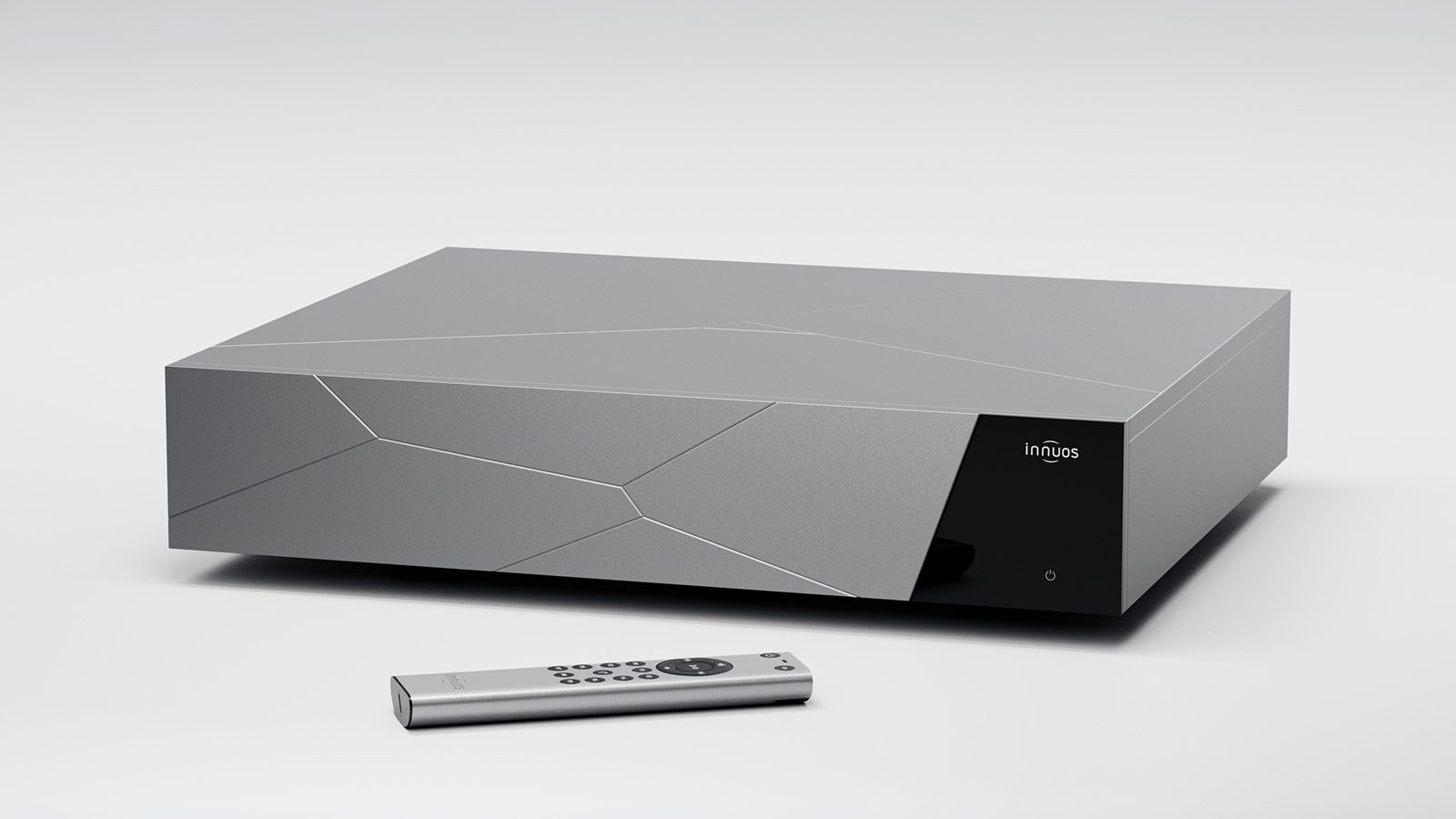
In many audio circles, particularly in the UK and Europe, Innuos ‘owns’ the server market. This harks back to the original ZEN products. These provided an affordable, ready-to-use audio server solution at a time when such devices were still quite new and somewhat intimidating for audio enthusiasts. Times have evolved, and Innuos STREAM3 recognises these changes and the challenges they present.
Innuos STREAM3 is more of a versatile, configurable, complete digital front-end platform than a typical server. You can set it up as a one-box server, a server with an integrated DAC, or a streamer that combines locally stored and online music. You can use the company’s own app, opt for Roon, stream Qobuz or Tidal natively. It’s even possible to rip your own music if you add a USB CD drive. It provides as much, or as little, of a digital front-end as you require.
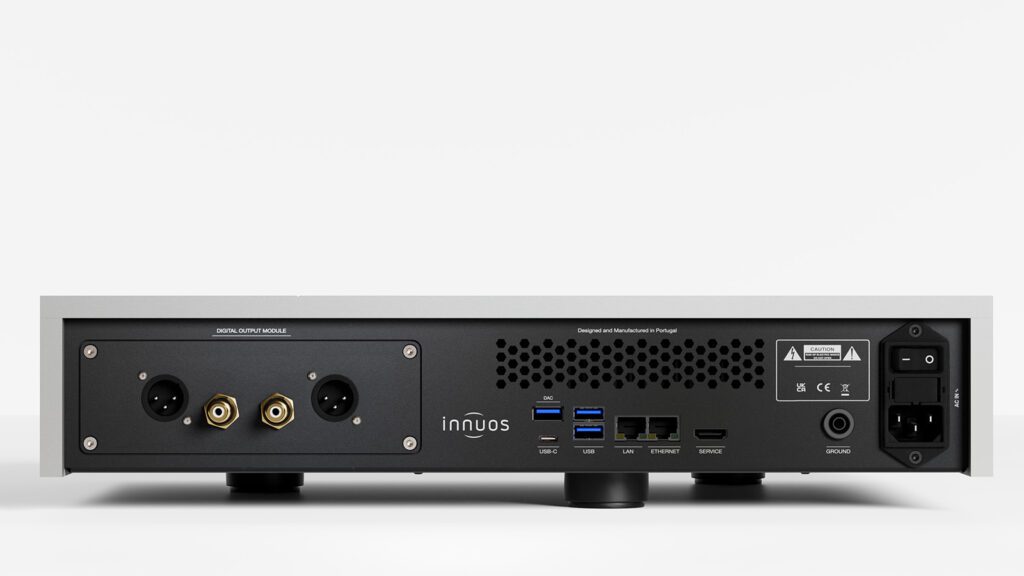
The core aspect of the STREAM3’s configurability is its Digital Output Module options. At its simplest, you can run the STREAM3 without any output board, using only the USB output marked ‘DAC’ on the rear panel. Alternatively, you can fill that vacant slot with one of five different options in the Module Bay: an S/PDIF board (with optical, coaxial, and AES outputs), a Performance DAC (RCA only), a Phoenix DAC (with RCA and XLR, as we used), as well as Phoenix USB and Phoenix I2S boards for more specialised connections. You can also choose the STREAM3 with 2TB, 4TB, or 8TB of internal SSD storage. All these options are available separately or pre-installed.
Phoenix rising
The reason we chose the Phoenix DAC option is simple. It’s the one we (and, for that matter, Innuos) believe most people opt for today. As mentioned earlier, the nature of streaming and stored music is changing. Many people are abandoning the server altogether, while others want a ‘one-stop shop’ that includes a built-in DAC.
In the STREAM3, Innuos offers a compelling sonic performance and easy usability, helping servers stay relevant. It also makes a strong case for using it as your sole digital front-end. However, if you already have infrastructure such as a DAC that you wish to keep using, that’s perfectly fine; simply choose a different module.
This is acceptable, but even the strongest argument for a product quickly diminishes when faced with poor overall performance. Fortunately, that’s not the Innuos approach. Setting aside inputs, outputs, and storage options, the STREAM3 addresses key concerns about streamed and stored music. These concerns distinguish an audio enthusiast from someone using a standard computer for their music needs.
Noise, noise… and noise
Servers are naturally noisy: processors, RAM, storage, and network interfaces all generate electrical noise. Innuos doesn’t pretend those components aren’t present but ensures their noise does not affect the output interface or pollute downstream parts. Innuos places strong emphasis on regulation stages and a power supply architecture that isolates ‘dirty’ computing rails from ‘clean’ audio rails.
Next, Innuos focuses on transmitting audio signals. In theory, packetised data from USB or Ethernet sources should be unaffected by timing issues; however, in practice, these are not so much ‘problem solved’ as ‘problem moved’. The sharper, less spatially coherent sound of streamed music, often dismissed by CD-loving audiophiles as ‘noise’ or ‘hash’, results from this. By implementing better timing discipline throughout STREAM3, these issues are mitigated.
Theoretical?
It can be argued that these two forms of noise are more theoretical than directly heard. However, when combined, the most noticeable audible effect of using STREAM3 is the reduction in noise it provides. Lower noise isn’t just about ‘blacker backgrounds’ (though that phrase remains because it is often accurate). It also appears as more believable instrumental textures, more precise instrument decay and reverb tails, and less of that subtle ‘glaze’ that can make streaming sound impressive but emotionally distant.
If you’ve ever compared a competent budget streamer to a genuinely well-designed digital front end, you’ll recognise the pattern: initially, the cheaper unit sounds ‘detailed’. After a few hours, it begins to sound as if it’s describing music rather than producing it. A good server or streamer does less describing and more allowing you to forget it’s there. The STREAM3 is that ‘good server’; it’s not a component you just slot into any system and instantly experience a ‘wow’ moment, but spend a few minutes with it, and the end result is compelling.
It is also a component that scales with resolution. In a modest system—say, an integrated amplifier and a capable DAC – the Innuos may appear to have ‘more smoothness’ and ‘a bit more space’. In a revealing system (high-resolution DAC, low-noise amplification, speakers capable of reproducing microdynamics), it behaviour changes: the music becomes less insistent, more continuous, and more dynamically nuanced. If the STREAM3 has a signature, it is not an obvious tonal coloration. Instead, it is a kind of reduction of insistence.
Explicit and dense
Start with something rhythmically clear but texturally rich. Massive Attack’s Mezzanine album [Virgin] serves as a prime stress test: ‘Angel’ or ‘Teardrop’ for instance; it’s about the bass line’s grip, the gradual build-up of pressure, and the layering of gritty detail without turning everything into a grey slab. Through the STREAM3, the bass doesn’t just get louder; it becomes more intelligible. The leading edge is cleaner, yes, but more importantly, the sustain is steadier—less wobble, less one-note bloom. When the track swells, the system is less likely to become harsh. You experience impact without harshness, and the sense of menace arises from dynamic control rather than overly bright treble.
Switch to voice and space. Joni Mitchell’s Blue {Reprise} is harsh on digital front ends because her voice can shift from intimate to steely depending on the chain. The STREAM3 tends to keep that steel in check without dulling the truth. Sibilants are better integrated into the harmonic envelope; you hear articulation, not harshness. And the guitar’s transients—those quick, bright picks—arrive swiftly but with body. The overall effect is that you lean in for the phrasing rather than brace for the peaks.
Arising benefits
Regarding orchestral material, the benefits arise from scaling through organisation. Large works can sound ‘big’ on almost anything; maintaining clarity while sounding big is more challenging. The STREAM3 helps to distinguish lines without turning separation into dissection. Woodwinds stay on a stable plane, strings don’t blend into a silvery sheet, and brass crescendos don’t develop a glassy overlay.
Play a well-recorded jazz trio—say, Bill Evans’ Sunday at the Village Vanguard [Riverside]—and pay attention to the drummer’s cymbal work and the piano’s decay. The STREAM3 doesn’t just reproduce the initial strike; it follows the bloom and fade with greater continuity. That makes the venue sound more realistic and the musicians more present. The bass is easier to follow not because it’s louder, but because the pitch centre is clearer and the rhythm tighter.
Ex-statement
As a former Statement user now employing a ZENith NG, I find the comparisons quite intriguing. While the ZENith NG outputs to a DAC and the built-in PhoenixDAC gives the STREAM3 a convenient advantage, in direct USB comparisons, the STREAM3 performed excellently. The more premium ZENith NG has little to worry about – its USB output sounded more natural, as well as more spacious and rhythmically precise. However, it’s quite remarkable how much the STREAM3 has advanced; if I still owned my Statement, its continued relevance would mainly be for stage width and sunk costs.
The Innuos STREAM3 must be more than just a server; it carries a significant responsibility. If it falls short, a music enthusiast might never experience the delights of locally stored music or the sonic advantages of server-curated streaming. However, by assuming both server and DAC roles (with PhoenixDAC installed), the STREAM3 convincingly demonstrates the server’s potential.
For those familiar with what a good Innuos server can do thanks to a previous model, the STREAM3 is an obvious choice. Well, almost… you just need to figure out which combination of modules best fits your existing system. That’s all. The Innuos STREAM3 is your next system upgrade… guaranteed.
Find out more about Innuos STREAM here
Technical specifications
- Type: Modular server
- File formats: WAV, AIFF, FLAC, ALAC, AAC, MP3, DSF, DFF, MQA supported
- Sample Rates: PCM: Up to 32bit/768kHz
- DSP: Up to DSD256 via DoP, up to DSD512 via Native DSD.(24bit/192kHz maximum output on S/PDIF and BaseDAC modules)
- Streaming Sources: Qobuz (+Connect), TIDAL (+Connect), Spotify Connect, Deezer, HighResAudio, IDAGIO, Internet Radio & Podcasts, Radio Paradise FLAC and interactive services
- Local Music: Internal M2 NVMe SSD, NAS Drives/Servers, USB Drive. CD ripping via USB optical Drive
- Connectivity: USB (DACs, imports, backups, USB Drive playback); 3x USB 3.2, 1x USB-C. Network 2x 2.5gb Ethernet, bridged (wired only). Other 1x Digital Output Module Bay, 1x Storage Expansion Bay (1x M2 nVME SSD), 1x HDMI (service only), 1x 4mm chassis grounding port, 1x AC Power Inlet
- Dimensions (WxDxH): 42 x 33 x 8.5cm
- Weight: 12.8kg
- Price: From £5,400, €5,800, $8,000
- As tested (2TB SSD/Phoenix DAC module): £9,500, €10,500, $14,500
Manufacturer
Innuos
STREAM3
Where to buy
https://innuos.com/where-to-buy/
+351 308 800 826
UK Sales: +44(0)2475 200 210
Trending Articles
See all
By Alan Sircom
More articles from this author

Read Next From Review
See all
Reiki Audio SuperSwitch X/Pro X PSU
- Oct 06, 2026
Audiobyte SuperVOX
- Oct 06, 2026
Unitra WSH-805
- Sep 29, 2026

Wilson Audio Sabrina V
- Sep 29, 2026