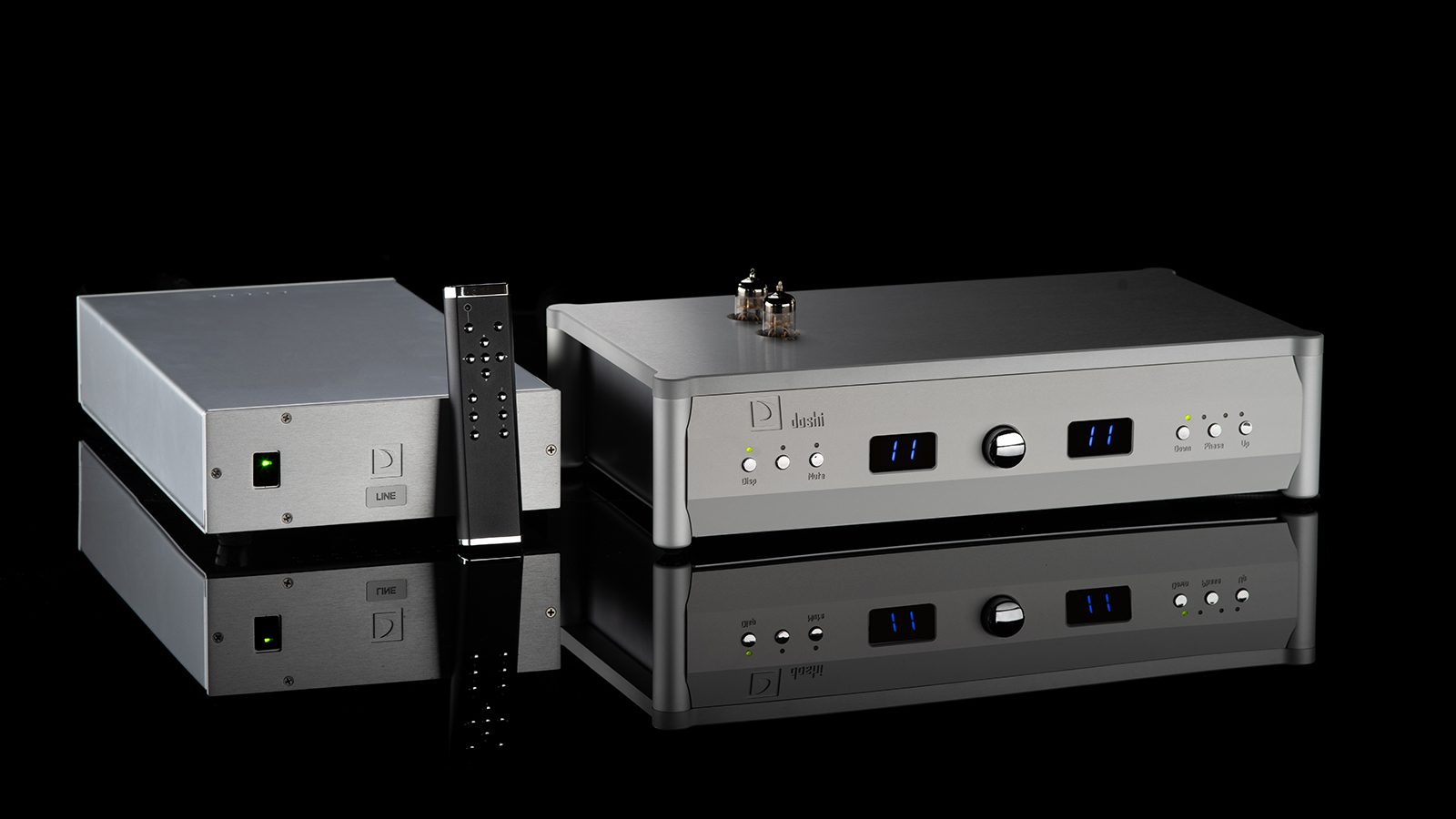
Preamplifiers possess the peculiar tendency to be slightly more than the sum of their engineering. Two designs with appreciably similar engineering can yield radically different performance. Some specific models may prove to be considerably more than the sum of their theoretical components. Doshi Audio has established a strong reputation in this field since its founding nineteen years ago. The Evolution Line Preamplifier is part of a small range of components produced by the company.
At first glance, the recipe for the Evolution Line Preamplifier appears straightforward. However, like those deceptively simple dishes encountered in high-end restaurants, it is both more complex than it initially seems. Similarly, it’s composed of exceptionally high-quality ingredients. It utilises a single ECC99 valve per channel, with no negative feedback employed at any point. As such, it maintains a low output impedance in all use cases. Adventurous users can experiment with NOS/NS 12BH7 types for subtle tonal balance changes. The tubes are run conservatively and are expected to provide years of service.
Transformer-coupled
The volume control for the Doshi is transformer-coupled and manufactured by the venerable UK firm of Sowter/Carnhill. It features 31 steps, ranging from ‘mute’ to ‘max’. At first glance, this appears to be a relatively small number of increments. However, when used in conjunction with various partnering equipment, it has proven entirely sufficient. So sufficient, in fact, that it forces me to reconsider how many increments are truly necessary. The emphasis of this system lies in isolation; it effectively buffers both the input and the output, mechanically, galvanically isolating them from one another. This ensures that common-mode noise at the input does not affect the output. The differential design ensures that source equipment grounds are always isolated from the outputs.
This theme extends to the power supply arrangements. The power supply is external and housed in a smaller chassis, featuring a power switch on the front. Inside, there is a large toroid combined with extensive current filtration and capacitance. Every aspect of the PSU is over-specified relative to the preamp’s nominal requirements to ensure it is never momentarily inconvenienced.
Custom umbilical
The power supply and preamp connect via a custom-made umbilical cable designed and built to Doshi’s specifications. While the two units have been given a shelf of separation for most of their testing, they were initially positioned somewhat closer together, with the power supply situated behind the preamp. Even under these less-than-ideal conditions, they have remained entirely silent.
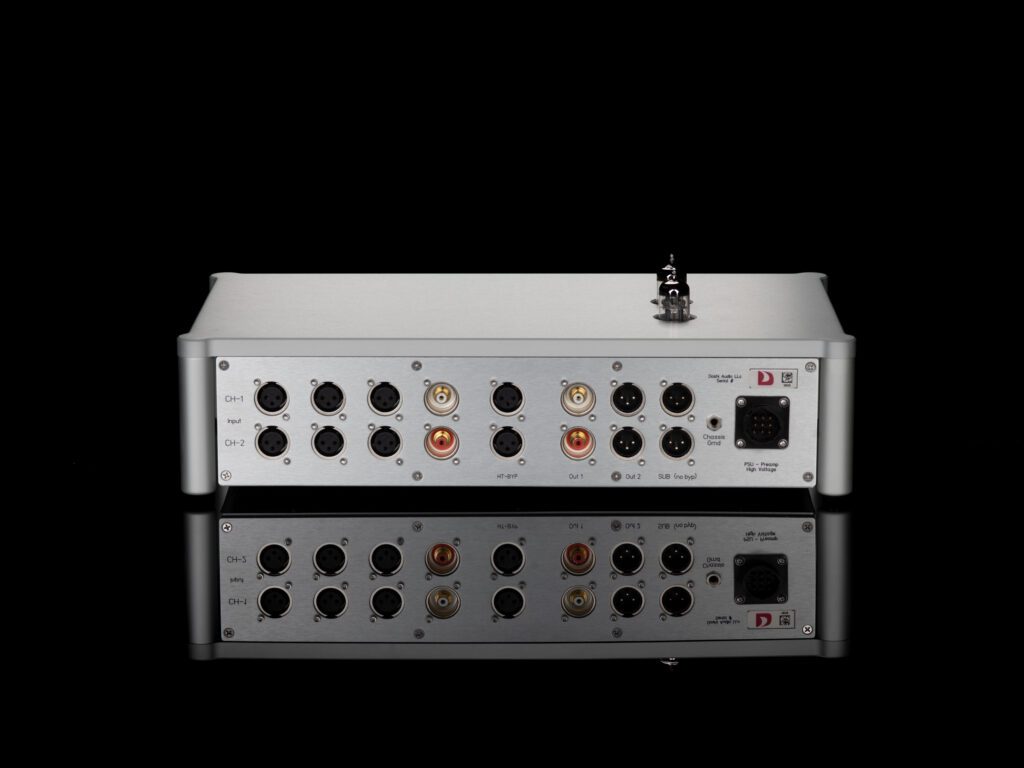
The connectivity is solid rather than truly spectacular, with four line inputs feeding into two outputs. One commendable aspect of this arrangement is that you can order your own Evolution line preamplifier with any combination of input and output in either XLR or RCA. This is highly convenient, as it allows you to select all connections in a way that suits you, rather than settling for a standard configuration. The transformer volume control of the Doshi acts as a balanced device. Nevertheless, company owner Nick Doshi emphasised during a brief chat in Munich that the preamp itself is entirely indifferent to whether the input or output is balanced or single-ended.
Twofold exertions
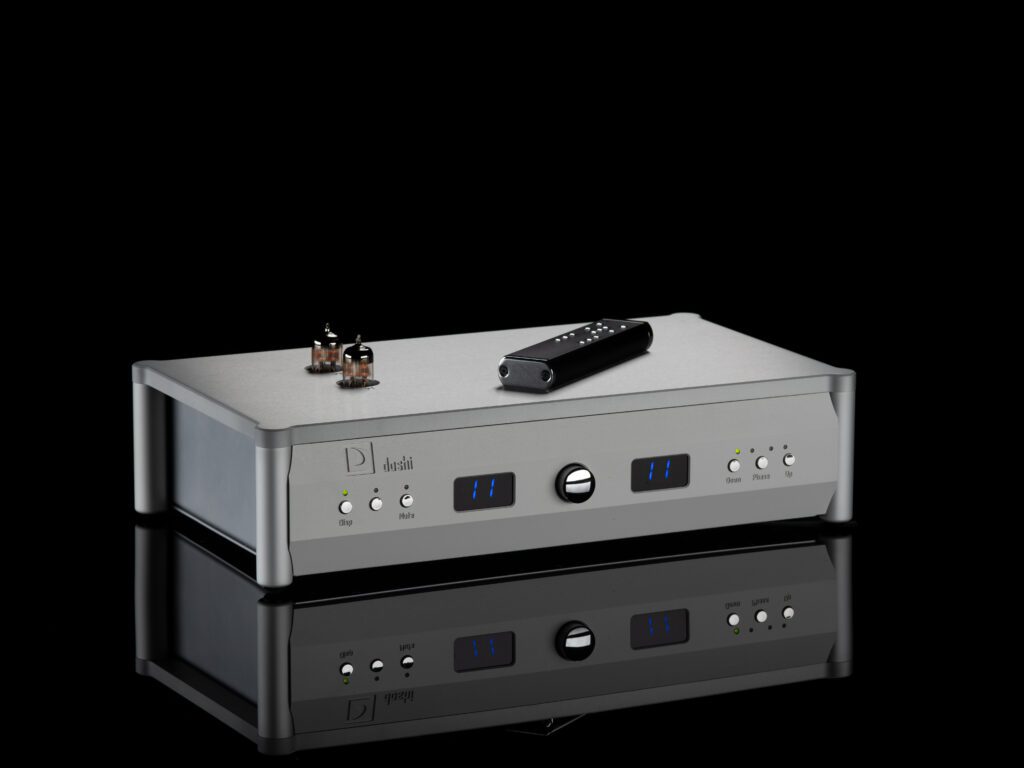
The final element of the design is the physical construction of the unit itself. The preamp and power supply chassis feature 14ga stainless steel. Doshi chose stainless steel for its strength and non-magnetic properties, which prevent eddy current propagation. It features an isolated sub-chassis to which all components are mounted and connected by point-to-point wiring. A constrained-layer-damped aluminium top plate suspends the sub-chassis, which, in turn, is decoupled from the main chassis.
The result of these efforts is twofold. Firstly, the Doshi feels solid and distinct from some of the other devices in this price range. Evolution isn’t the ostentatious sort of ‘well-built’ preamp that emphasises creating a unit that feels solid and overengineered. Instead, it is equipment required to function reliably without fanfare, on which crucial outcomes depend. Secondly, the Doshi appears entirely unaffected by placement, which is relatively uncommon for a preamp, particularly one featuring valves.
Straightforward
In the black finish of the review sample (a silver finish is also available that looks a touch less utilitarian), the Doshi is understated to the point of dullness; however, it is entirely straightforward to use and live with, thanks to a pair of displays that show volume and input (oddly, both display the same information rather than one indicating input and the other showing volume) the two displays indicate volume levels for each channel and should you decide to adjust the balance, the displays will show each channel. (They also make a four-channel unit) and a well-made remote control that allows access to all functionality from the seating position. It is completely drama-free, and this total absence of—to be blunt for a moment—strangeness has increasingly appealed to me as I have used it.
Undoubtedly, the true source of Doshi’s appeal lies in its auditory experience. This product stands out in a select group that begins strongly and only gets stronger from there. It has also shown remarkable consistency. It works well with the hARt Lab Tune Three, which I reviewed in issue 243. However, I later connected my resident Chord Electronics TToby power amplifier and then changed direction entirely, pairing it with a pair of Linn Klimax Solo 500 monoblocks. These amplifiers have varying impedances and other characteristics. The Doshi has proven to be an impeccable partner for all of them.
Reliability
What Evolution achieves, with the reliability of a Japanese rail network, is balancing the reflection of its qualities in the connected equipment upstream and downstream, while gently imparting a touch of sonic magic—all the effort expended on the power supply results in a preamp that is entirely free of constraint. Listening to Kessoncoda’s startlingly vivid Outerstate [Gondwana] with the Doshi in the replay chain led me to realise that what has been considered an uncompressed take on the drum strikes in ‘KTO’ has been gently constrained.
The Doshi produces serious bass; not large dollops of uncontrolled low-end wobble, but an invigorating degree of borderline subsonic force that gives those drum strikes a visceral, room-filling presence. With every power amplifier I’ve used with it, into the same pair of Kudos Titan 505s, it has consistently generated more bass and integrated beautifully into the broader frequency response.
That frequency response is, as you might expect from a piece of kit designed by someone with a background in professional audio, exceptionally balanced. Within this fundamental accuracy, the Doshi still possesses some tricks up its sleeve. The combination of TToby and Titan works well but is slightly unforgiving. Listen to the title track of Rival Sons Pressure & Time [Earache], and you will find the experience pleasingly intense yet a bit edgy. Insert the Evolution between the TT2 DAC and the TToby, and suddenly, there is a sweetness and cohesion that wasn’t there before. The Doshi opens up this dense recording and introduces a small but noticeable level of forgiveness to the top end, making for a considerably more enjoyable listen.
No FX
Crucially, the Doshi never feels like an effects box or indeed anything other than a fantastically accurate device. Instead, it’s simply one that can take my periodically less-than-magnificently mastered music library and ensure it is always listenable. Buried at the end of The Tipping Point by The Roots [Island] is a one-take jam session. It is as dense and chaotic as anything I can remember hearing. The Doshi never undermines the spontaneity, energy, and rawness of the track. Instead, it utilises the enormous bandwidth it possesses to allow it to flow better and then, for good measure, delivers some frankly absurd low-end shove to underpin it. You can then put on Talk Talk’s Spirit of Eden [Parlophone], and the result is every bit as audiophile as you’d expect.
The Doshi Audio Evolution is one of those rare preamplifiers that possess a degree of magic in their operation. It goes beyond the unquestionably excellent engineering they feature. What has captivated me about the Doshi is that this magic isn’t a constant, attention-grabbing aspect of its function. It’s transparent, utterly tractable, and built like a lorry. Still, when your equipment might typically struggle to resolve everything as logically as you would hope, it steps in quietly and unobtrusively to enhance the experience. Evolution is a truly magnificent preamplifier that delivers outstanding results across a wide range of systems.
Technical specifications
- Stereo Inputs: Four in total, which can be specified in any combination of RCA and XLR
- Stereo Outputs: Two in total, which can be specified with either RCA or XLR connections
- Home Theatre Bypass: XLR Balanced or RCA
- Tube/Valve complement: 2x ECC99/12BH7
- Gain: Maximum Gain 12 dB, internally adjustable for lower gain
- Signal to Noise Ratio: At least 100 dB below 1V, unweighted
- Finish: Natural Anodised Aluminium or Black Anodised Aluminium
- Dimensions (WxHxD, preamp only): 44x14x46cm
- Weight: 17.7kg (Preamplifier + PSU)
- Price: £26,000, €29,950, $29,950
Manufacturer
Doshi Audio
UK distributor
Airt Audio
+44(0)1223 344053
Trending Articles
See all
By Ed Selley
More articles from this author
Read Next From Review
See all
Reiki Audio SuperSwitch X/Pro X PSU
- Oct 06, 2026
Audiobyte SuperVOX
- Oct 06, 2026
Unitra WSH-805
- Sep 29, 2026

Wilson Audio Sabrina V
- Sep 29, 2026