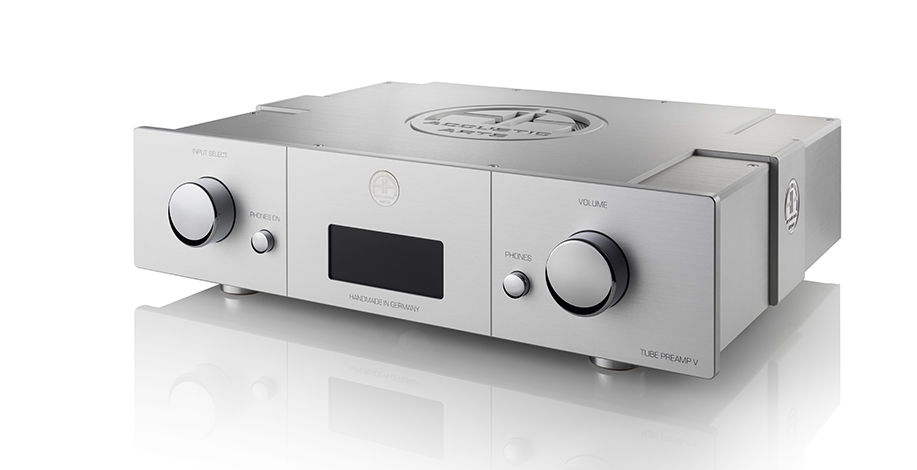
For those unfamiliar with Accustic Arts, it is a German audio manufacturer based in Lauffen am Neckar, close to Stuttgart. Lauffen am Neckar is commonly regarded as the birthplace of alternating current electrical transmission. It’s a fitting home, then, for a maker of power amps. Accustic Arts was founded in 1997 and has its roots in Professional Audio, encompassing both recording studios and P.A. systems. This heritage lends the equipment a robust quality in the build of its products. Alongside the TUBE PREAMP V preamplifier and AMP IV power amplifier tested here, Acoustic Arts also makes CD players, transports and DACs.
The TUBE PREAMP V comes either as a line stage preamp or, if needed, with a Phono stage. The sample I was sent is the former. I am curious to hear what the Phono stage does, having spent time with the line stage version.
Goo-free
While the power amp is transistor-based, the preamp is a hybrid design, utilising four ECC83S tubes. I usually use a passive preamplifier with a valve power amplifier. I have obtained some of the best audio results when valves are used in one stage of the playback process. However, I find that when two or more parts of the chain use valves, the sound can be too rich and gooey for my taste. This combination keeps to my observed rule!
The TUBE PREAMP V is constructed with solid aluminium and weighs 16kg. The front panel features two knobs to meet the amp’s requirements. The left knob controls the input, as indicated on the Hi-Res screen. Pressing it switches the input off, selects the active input, or navigates the menu. The right-hand knob controls volume, the mute function, or the ability to switch off the tubes to extend their lifetime.
Two minutes
In everyday practice, it takes two minutes to warm up the unit. A solid bar shows the progress of the warmup. Switching off the tubes throws you back into a two-minute wait. A button on the front panel activates the headphone amplifier section and cuts off the speakers. As I learned later, the headphone section is no afterthought: it’s genuinely excellent.
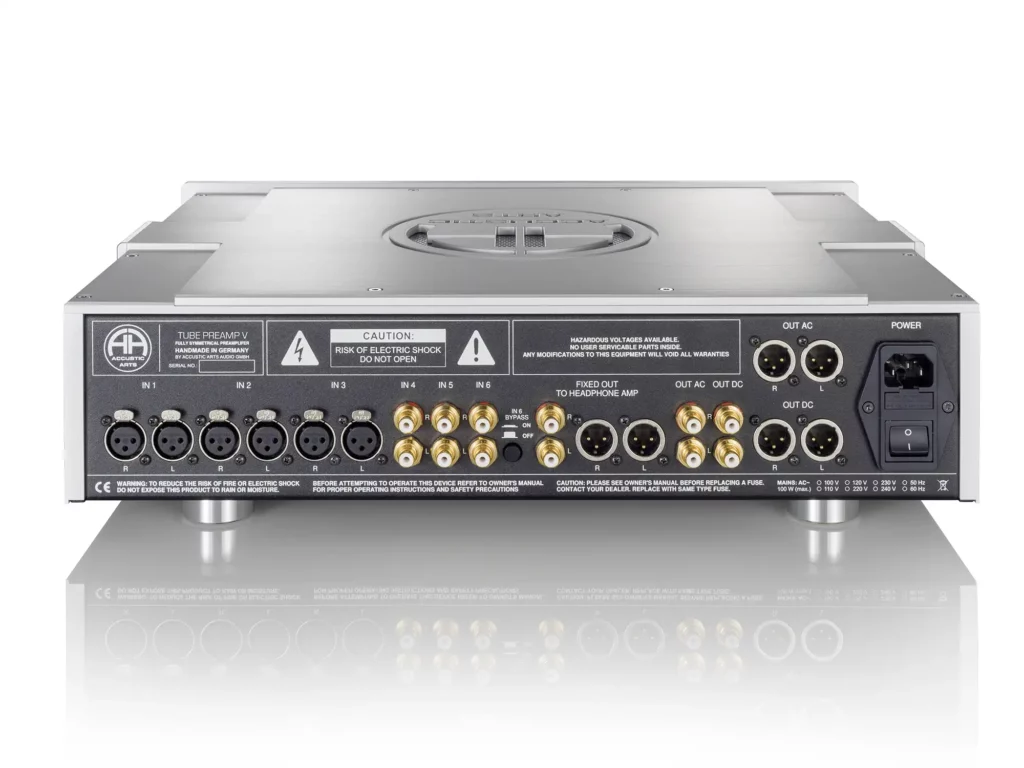
The circuit design is fully balanced, with a Class A output stage. There are three balanced XLR inputs, three unbalanced RCA inputs, a surround bypass input, two fully balanced outputs, and two unbalanced outputs. These last can be configured to be AC or DC coupled. Importantly, the AC coupling prevents the possibility of sending DC down the speakers and the damage that can be caused.
Rather massive
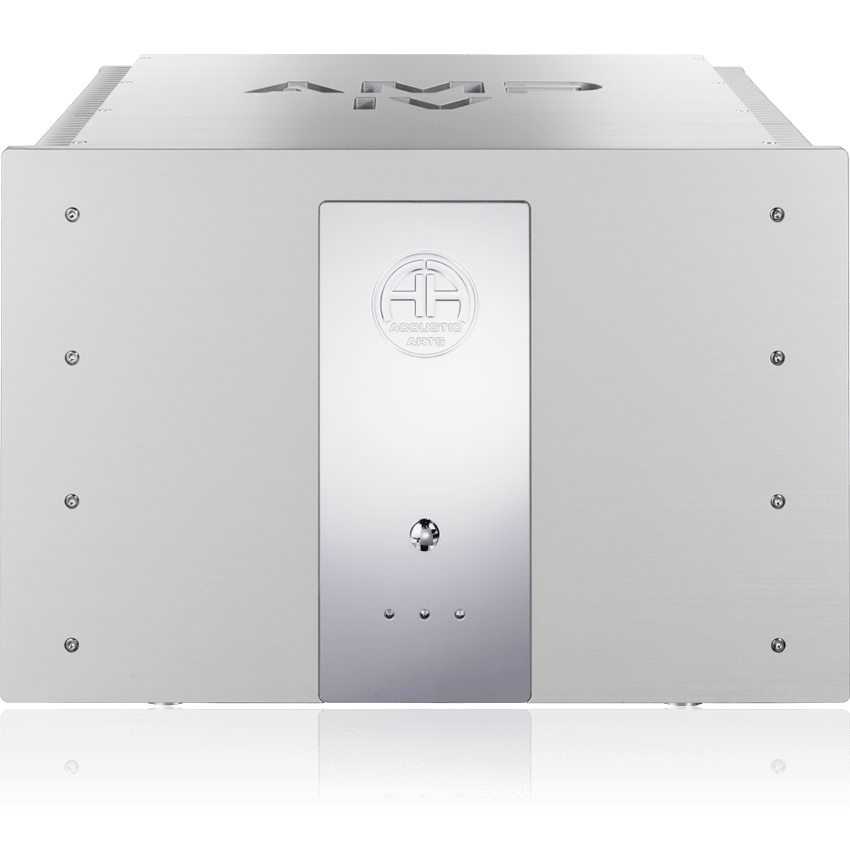
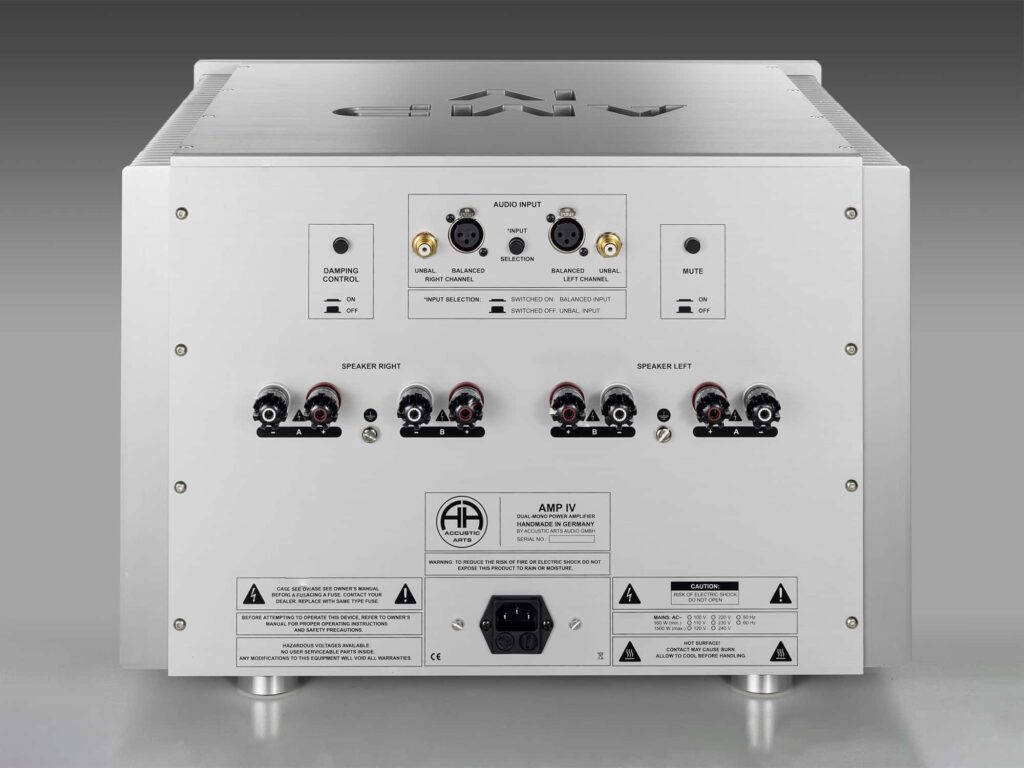
The AMP IV is a rather massive affair, weighing in at 44 kg, so it is not my greatest friend, having just had a hernia operation! It stands 34cm high, almost triple the height of a standard piece of audio gear. It is a dual-mono construction and features both balanced and single-ended inputs. Notably, there is a double set of speaker terminals for biwiring.
An exciting and novel feature is the ability to select the type of damping control. When switched on, the amplifier’s damping factor is lowered and linearised over a wide frequency range. I appreciated this function in practice, and it provided a greater grip on the bass.
On the front panel, a blue light shows operation, and two red LEDs show protection during warm-up. The power rating is a massive 2×610 Watts at 4 Ohms and 2×400 Watts at 8 Ohms.
Connecting up
Connecting the two amps to my Bowers & Wilkins 802d4 speakers (with a dCS Bartók APEX DAC and a classic Naim Audio NAT01 Tuner, together with a PS Audio PS10 Power regenerator and Townshend cables throughout) and listening to Sir Simon Rattle conducting the Berlin Philharmonic in Beethoven’s ‘Fidelio’, I’m immediately impressed by the amp’s ability to do scale. The bass is punchy, and the presentation is colossal sounding. It has real weight to the textures in the orchestra. However, this is combined with a light, airy, sweet, and highly detailed treble.
The amps are fast, too, and the transients are razor-sharp and highly dynamic. When the texture gets thick in the Fidelio Overture, lesser amps will err on the side of confusion. To use that contemporaneously overused phrase, I sense ‘clean power’ here. There is an absence of distortion, and the amps enable the dCS Bartók APEX to shine.
Honest combination
I am accustomed to some high-end valve power amps, which tend to overdo it to a greater degree. There is something very honest about what the combination is doing. It is very accurate and provides more stygian bass than I usually hear. I also hear a great line in the singer’s voice. The soprano possesses bell-like clarity, is free from artificial additives, and exhibits genuine power.
Next, Wynton Marsalis and his new album Louis Armstrong’s Hot Fives and Hot Sevens and the track ‘Skid-Dat-De-Dat’ beautifully reproduces this tribute to the great Louis Armstrong. Marsalis’ trumpet is bell-like, tight and powerful. When he comes to the Skat, there is a real sense of Marsalis in the room. The space of the performances is fabulously etched, and the backing ragtime band is stunningly portrayed. I note that the dCS output needs to be cut to the recommended 2V from my usual 6V, which I use with my passive preamplifier, the Townshend Allegri.
Percussion test
A great test of percussion, one of the great dividers in the audio world, is the Varèse Ionisation piece for solo percussion, conducted by Zubin Mehta on Decca. It’s a bizarre piece, all about sonic textures and plenty of struck percussion. There is a cleanness of attack to the whole track that the Accustic Arts combination achieves; the notes start and stop on a dime. It is remarkable to hear the sheer tautness of the snare drums and the amount of sonic information. I haven’t listened to this track more convincingly reproduced. The piece’s sheer humour, with its police sirens, is also notable.
Barenboim’s cycle of Mozart Piano Concert playing and conducting the Berlin Philharmonic on the Elatus label contains many moments of pure chamber music joy. Listening to the Rondo K382, I am struck by just how well the colours of the Steinway are portrayed: a piano is not just a piano; it can be played to produce many different colours, moods and textures, and these are in abundance. Because these amps aren’t getting in the way, they serve as a conduit between Mozart, the performers, and me, the listener. The orchestra sounds crisp and superbly defined.
Curveball
I like to throw capable power amps a curveball sometimes, in the form of a pair of Quad 63 electrostatic speakers, which are notoriously tricky loads to drive. I use some Trilogy Valve amps for these, and sometimes I find the sound is too muffled and lacks bass grip. Hooking them up to the AMP IV yields some spectacular results. Using the Oscar Peterson Trio audiophile favourite, We Get Requests and the song ‘You Look Good to Me’, the track starts with the piano and a double bass playing long notes with a triangle in the background. The quality of the double bass is breathtaking.
On the valve amps, the bass sounds muted and out of control. The AMP IV grips the bass to make my Quad 63’s sound better than I’ve heard them before. And that’s quite apart from the quality of the sound of brushes on the snare drum: drop-dead realistic!
Premier league
The amplifier has transformed the 63’s into the league of the best contemporary speakers. The piano has lost its old-world sound, which I hear on most systems, and the Amp is digging deep down into the piano’s sonorities to create a much more detailed sonic scape. The sound I am hearing is far beyond the capabilities of the Quad 405 amplifier, with which the 63s are often paired.
Turning now to the headphone output of the TUBE PREAMP V, which is pure Class A, and listening to the ‘Dance of the Ethiopians’ from Delibes’ ballet ‘Sylvia’, the sound is crisp, detailed and spacious on my Sennheiser HD800S. It ranks up there with the best headphone amps I have heard. The timing of the bass is excellent, the colours warm and generous, and it is clear that the headphone section is no afterthought. It has been designed and built with the same care as the rest of the preamp.
Goat Rodeo Jazz
Finally, I donned a pair of headphones to listen to ‘Your Coffee is a Disaster’ from Yo-yo Ma’s Not Our First Goat Rodeo, a bizarre but rather wonderful collection of jazz musicians seemingly improvising. It’s beautifully recorded, and with the inclusion of a dCS Lina clock, the sheer presence of the musicians in the space is incredible. It feels like being in the booth of a recording studio. The tightness of the double bass and the clucking of the string’s pizzicato, fast and furiously accurate, demonstrate what high-end audio is all about for me!
The Accustic Arts TUBE PREAMP V and the AMP IV pack a punch as a combination. Superbly conceived and engineered without compromise, I have hugely enjoyed my time with these products. They uncovered layers of the mix I had not heard before, proving quite an education. They also excel at handling difficult-to-drive loads, such as electrostatics, and by extension, planar magnetic speakers. For those looking for audio through rose-tinted spectacles, this may not be for you. However, for those seeking superbly accurate and true high-end audio, this is the ideal choice. I would like you to please give it a listen. You may be in for a surprise! I certainly will miss them when they go back.
Technical specifications
PREAMP V Audiophile reference preamplifier
- Class A output stage
- 3 x fully balanced high level inputs (XLR) and 2 x unbalanced high level inputs (RCA)
- 1 x unbalanced input (RCA) configured as “SURROUND-BYPASS”
- 2 x fully balanced outputs (XLR) – 1 x AC coupled, 1 x DC coupled
- 2 x unbalanced outputs (RCA) – 1 x AC coupled, 1 x DC coupled
- 1 x headphone output, switchable (1/4″ stereo female jack)
- 2 x unregulated, switchable output for the connection of an external headphone amplifier (1 x RCA/ Chinch), 1 x (XLR) Phase switch for 0° and 180°
- Front panel, cover are made solid aluminium; turning knobs are made of chromed brass
- Dimensions (WxHxD): 48.2×12.8×39.3cm
- Weight: 16kg
- Price: £25,500, $28,500, €25,500
AMP IV power amplifier
- Dual-mono reference power amplifier with completely isolated power supply for each amplifier channel
- 2 magnetically shielded and encapsulated toroidal core transformer of premium quality for highest output reserves
- High damping factor for perfect speaker control
- ACCUSTIC ARTS® damping factor linearization (switchable)
- Professional protective circuit against clipping, HF oscillations and excess DC offset
- Integrated switch-on current limitation for highest operational safety
- Balanced Input (XLR) and unbalanced input (RCA) – the inputs are switchable
- WBT loudspeaker terminals
- Massive aluminium housing; inlay made of massive, high gloss polished and chromed brass
- Minimum impedance: 2 Ω
- Voltage gain: 25,0 dB
- Power consumption without load: approx 120 watts
- Power supply capacity: approx. 160,000 µF
- Input impedance: balanced (XLR): 2 x 16 kΩ
- unbalanced (RCA): 15 kΩ
- max. 2 x 810 Watt at 2 Ω
- max. 2 x 620 Watt at 4 Ω
- max. 2 x 400 watts at 8 Ω
- Dimensions (WxHxD): 47x34x44cm
- Weight: 44kg
- Price: £29,700, $35,000, €29,700
Manufacturer
ACCUSTIC ARTS Audio GmbH
UK distributor
Audio Emotion
+44(0)1592 407700
Tags: ACCUSTIC ARTS TUBE PREAMP V AMP IV POWER AMPLIFIER PREAMPLIFIER
Trending Articles
See all
By Rafael Todes
More articles from this author

Read Next From Review
See all
Eversolo T8
- Oct 13, 2026
Acoustic Energy AE Active
- Oct 13, 2026
Reiki Audio SuperSwitch X/Pro X PSU
- Oct 06, 2026
Audiobyte SuperVOX
- Oct 06, 2026