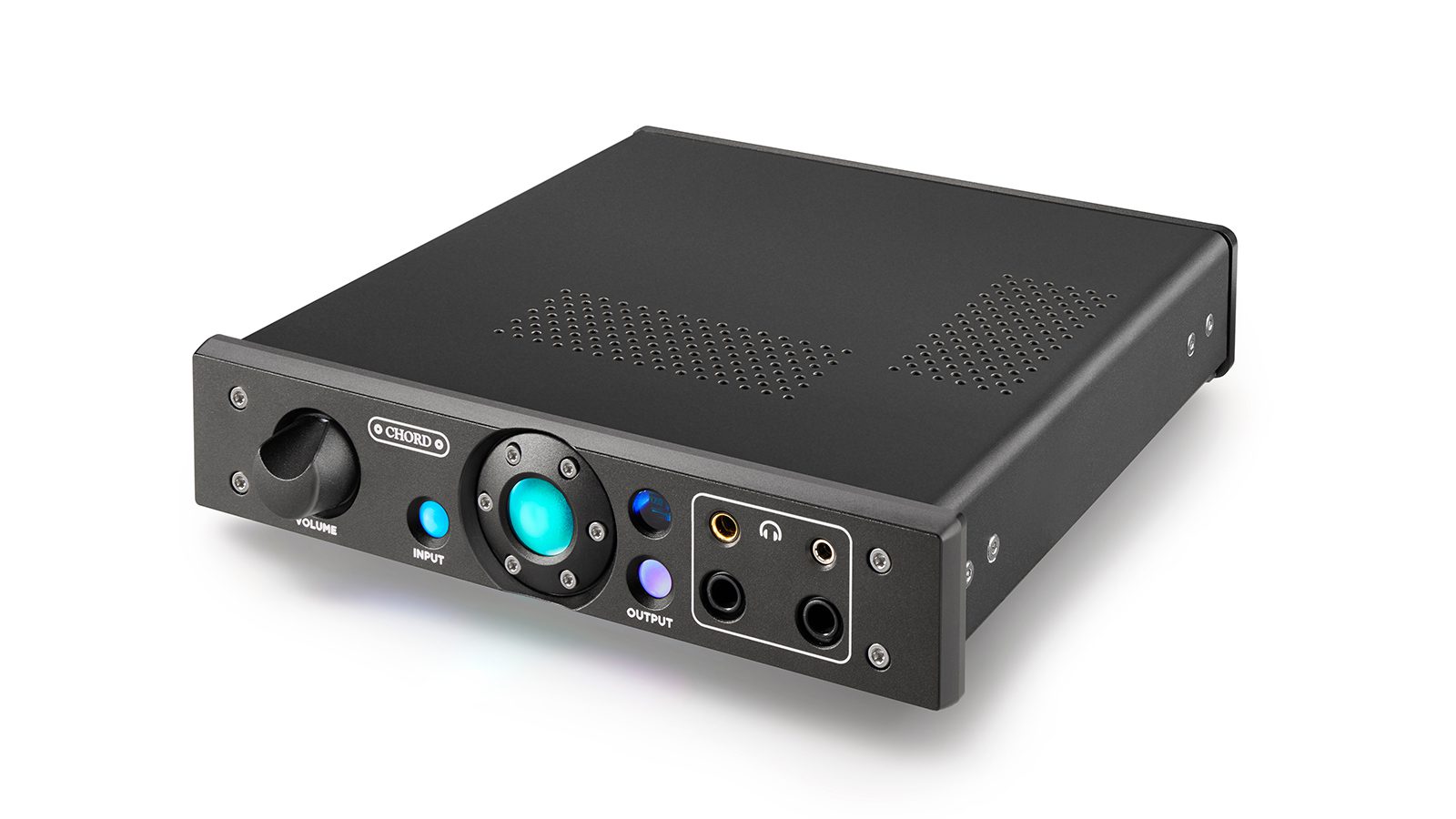
The Chord Electronics Alto occupies that dimly lit nether region between the Pro Audio and Domestic Hi-Fi realms. It is designed as a headphone amplifier for studio use. Moreover, it can also drive studio monitors. The Alto features banana plugs on the rear panel and delivers 50 watts per channel into a four-ohm load. It also delivers 25 watts into an eight-ohm load. Additionally, it caters to audiophiles seeking to achieve the best possible results from their headphones.
The technology in the Alto is a simplified version of that found in Chord’s Ultima Range of power and pre-amps. They utilise the same dual feed-forward error correction and ultra-high frequency switching power supplies. This technology originated from a paper written by Malcolm Hawksford at the University of Essex. Bob Cordell developed it at Bell Labs, with the responsibility being passed to Chord Electronics.
Essentially, Ultima uses two additional amplifier circuits to monitor and correct the difference between the output of the reference input. Both inputs are fed to the MOSFETs, and the output of the power MOSFETs is also considered. If there is a difference between the two, the circuit adds a “difference signal” to the input of the MOSFETs to correct the error. This is then returned as part of the amplifier’s global feedback.
Uncompromising
It is an uncompromising approach to making an amplifier. However, Chord’s founder, John Franks, came from an avionics background (Raytheon, AT&T and Marconi), where exacting standards are crucial to safety. Therefore, ‘uncompromising’ has long been integral to Chord Electronics’ fundamental product design ethos.
I am aware of a few studios that use the Chord DAVE as a DAC. However, as a regular user of the DAVE, I must admit that the built-in headphone amplifier seems somewhat less impressive than the DAC section. Thus, the Alto serves as a great companion for the DAVE in terms of headphones. It is also useful for any other DAC, while providing a studio with a high-quality power amplifier for small to medium-sized studio monitors. With dimensions roughly equivalent to an A5 piece of paper (20 x 5.7 x 21.5cm WxHxD), it qualifies for the ‘portable’ category. Moreover, the Alto enables a recording engineer to master ‘on the fly’ and allows a home user to achieve excellent sound from a DAC alongside this headphone amplifier.
Socket set
On the front panel, the Alto features four different headphone sockets: a 3.5mm jack, two 6.35mm sockets, and – a new addition for Chord – a 4.4mm Pentaconn connection for balanced high-end headphones. However, the Alto itself is not a balanced design, so the Pentaconn connection is pseudo-balanced. The rear panel features balanced XLR outputs. These can connect to a power amplifier or additional Alto headphone amps in ‘joint output mode’. However, you cannot drive headphones and speakers simultaneously.
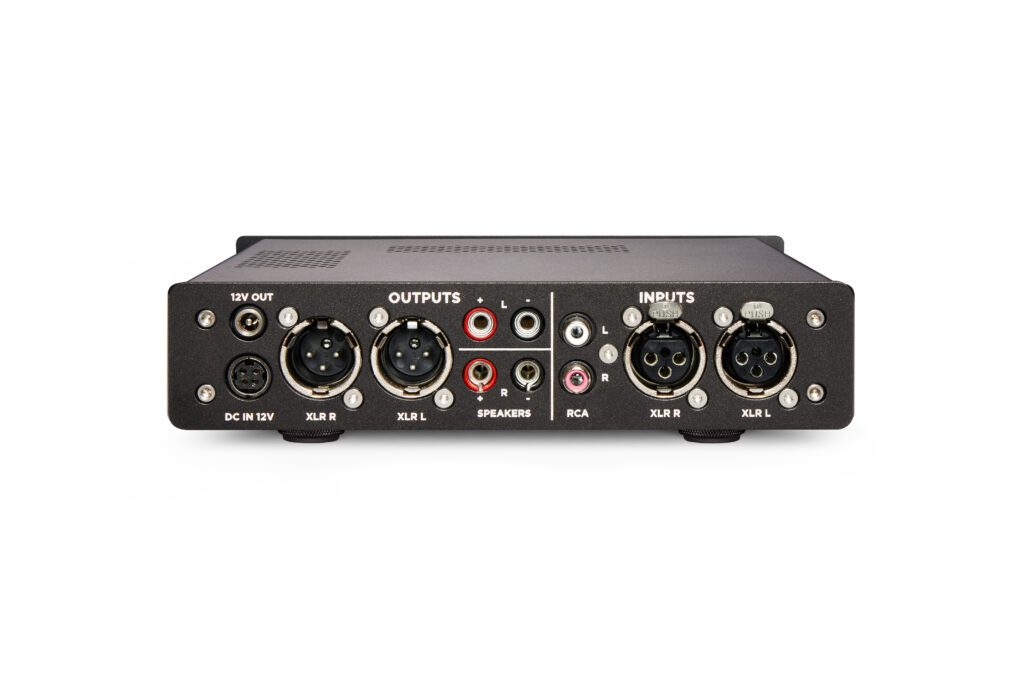
A robust 12-volt, 12.5-amp switch-mode external power supply powers the unit. It also features a high-quality metal remote control unit that provides general functionality.
I am a great fan of what Chord have been doing over the last few decades. The company’s contribution to DAC technology puts the brand right to the top of world-leaders in the field. The Alto is a product which sits comfortably with what Chord has already achieved. It is a useful adjunct to someone hoping to squeeze out some extra performance from their existing Chord DAC.
Sound quality
I used the Alto in my current system. This system includes a dCS Bartók DAC, a classic Naim Audio NAT01 tuner, a Townshend Allegri Reference preamplifier, a VAC Signature 200 iQ power amplifier, and Bowers & Wilkins 802 D4 loudspeakers. It also features a pair of Sennheiser HD800 headphones, which are my go-to models.
First impressions of listening to the Naim Tuner on live Radio 3 through the Alto with Sennheiser headphones yield an immaculate, punchy, and dynamic sound. The results are more detailed than I am used to. There is a distinct hint of Pro-Audio influence. It’s not a valve-family sound; it’s close to the polar opposite – taut and gritty in the best sense.
I make recordings of the concerts in which I participate, and I find that live un-tampered (unmastered) recordings highlight the differences between equipment to a greater extent than mastered ‘finished’ recordings. Consequently, using the Alto has been a significant revelation for these recordings.
Beyond the usual
I can discern a level of detail far beyond my usual fare, which makes the mastering process considerably more straightforward. There is greater texture to instruments and more weight to the sound. Furthermore, there is a sense of being closer to the action. It is not difficult to understand why the Alto has been such a hit among the recording community. It is truly transparent and provides a recording engineer exactly what they need to develop the recording.
Using the Alto with the Sennheiser headphones—wired with the balanced connection that the Alto provides—and listening to Tears of Joy by Antonio Forcione on the Naim Label results in a truly immersive and rhythmically etched rendition. The textures of the guitar and cello are both highly detailed and beautifully presented in space. Indeed, I don’t think I’ve heard the Sennheiser’s sound better. There is genuine layering to the sound. Moreover, the timing and pace are immaculate and brimming with energy. As a headphone amplifier, this is a win!
Preamp alter ego
Turning now to the Alto’s alter ego, I must emphasise that the Alto driving my B&W 802d4 produces some remarkable results. First up, an old favourite—Mozart’s Rondo for Piano and Orchestra K382, performed by Barenboim and the Berlin Philharmonic, yields noteworthy outcomes. The presentation possesses energy and vitality and brims with detail. In addition, the timbre of the orchestra is distinct and precise. The solid-state onboard amplifiers excel and sound like amplifiers I have reviewed that cost many multiples of the Chord Electronics Alto’s price.
There is a smoothness to the sound; the piano positively glows and resembles a Steinway nearby. The transients are quick, and the strings display a genuine weight that I do not expect from a 50-Watt amplifier. There is a slight reduction in front-to-back depth compared to my VAC amplification. However, given its price, it offers significant value for money! The frequency response appears even to me; I feel confident that I could record and master with the Alto driving a pair of studio monitors based on what I am hearing.
Next up is something more bombastic: Andris Nelson and Shostakovich’s First Symphony, performed by the Boston Symphony Orchestra on Deutsche Grammophon. This was the composer’s graduation piece from college, written in 1924-5 when he was just 19. It features a wide range of woodwind solos and includes music he would later reuse in his celebrated 8th Quartet. The Alto rolls up its sleeves and truly demonstrates how accurately it can portray woodwind colour. When things heat up, it shows just how tightly and realistically low frequencies emerge as the bass drum kicks in.
Taut weight
There is no shortage of string weight with this amplifier, which is quite an achievement. The brass sounds taut, and the double basses are more credible than what most valve amps can manage. The only two factors differentiating the Alto from products ten times the price are the space between the players and the front-to-back depth, along with the ultimate ‘slam’. For everything else, it’s all there.
I haven’t heard the more illustrious Ultimas (Ultimae?), but this has certainly piqued my curiosity.
The Alto is a veritable Trojan Horse, in the best sense of the phrase. Masquerading as a headphone amp, at which it truly excels, it is also an extremely capable power amplifier. It is able to drive not just small studio monitors but, as I found out, some fairly substantial speakers. The audio quality is ridiculously greater than what one would expect at the retail price. Moreover, I discovered that it comes into its own when placed in a high-end system. It exemplifies trickle-down technology at its finest. Bravo Chord!
Technical specifications
- Inputs: 1x RCA stereo pair, 1x XLR stereo pair
- Outputs: 4x headphone (1×3.5mm, 1x 4.4mm balanced jack, 2×1/4”), 4mm banana loudspeaker sockets, 1x XLR stereo pair, 1x 12V jack
- Frequency response 6 Hz-60 kHz
- Output power (Speakers) 50 W into 4 Ω
- Output power (Headphones) 2250 mW into 100 Ω
- Signal-to-noise ratio 119.6 dB
- THD (Speakers) 0.003 % into 4 Ω
- THD (Headphones) 0.001 % into 100 Ω
- Input maximum voltage 6V RMS
- Output maximum voltage 15V RMS
- Operation voltage 80-250V AC auto-switching
- Crosstalk -95 dB
- Dimensions (WxHxD): 20×5.7×21.5cm
- Weight. 1.95kg
- Price: £3,000, €3,999, $4,320
Manufacturer
Chord Electronics
+44(0)1622 721444
Trending Articles
See all
By Rafael Todes
More articles from this author
Read Next From Review
See all
Eversolo T8
- Oct 13, 2026
Acoustic Energy AE Active
- Oct 13, 2026
Reiki Audio SuperSwitch X/Pro X PSU
- Oct 06, 2026
Audiobyte SuperVOX
- Oct 06, 2026