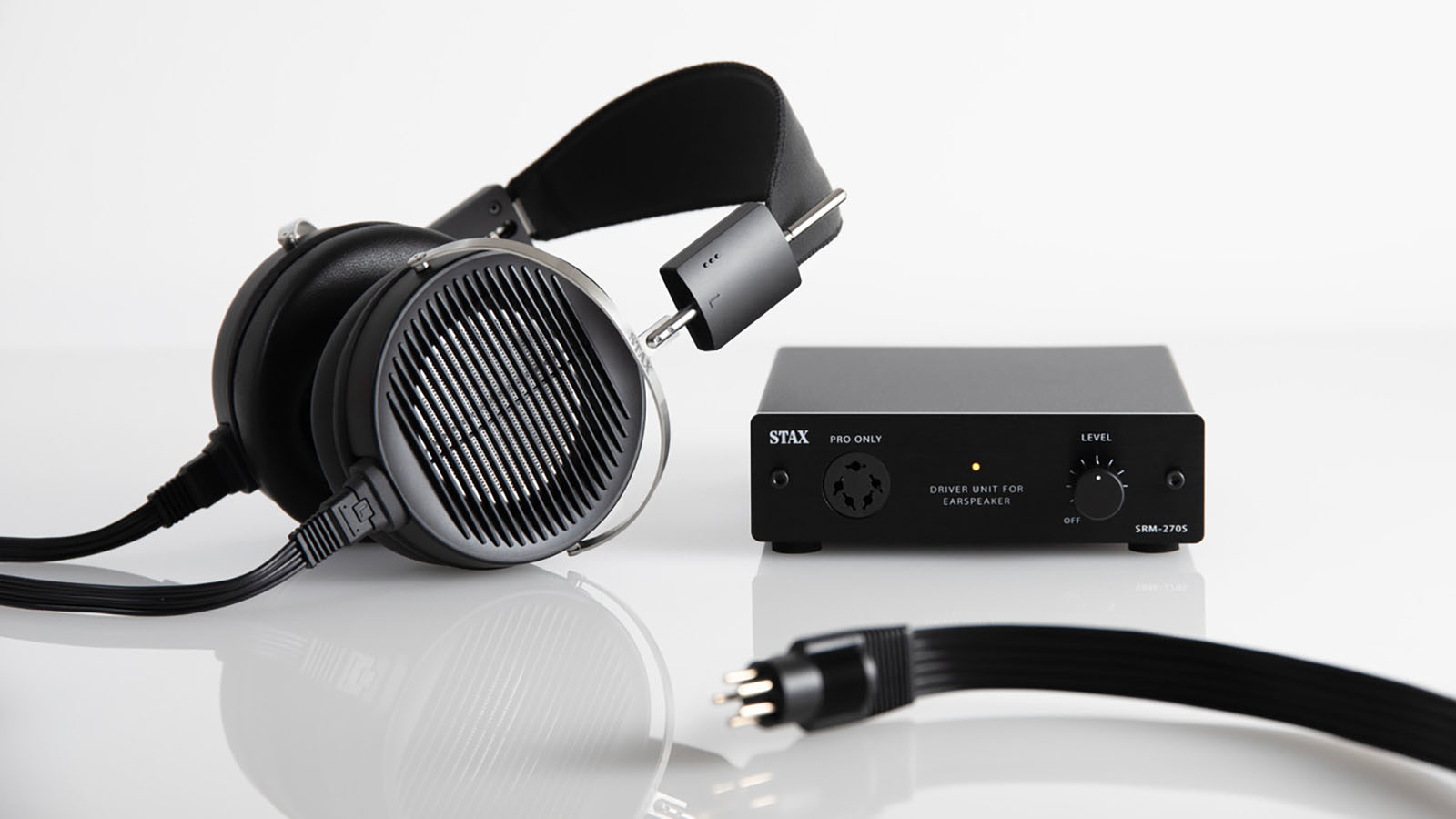
To be fair to Stax, it’s not as if the company has only just begun insisting on the word ‘earspeaker’ to describe what looks very much like a pair of headphones.
The company has been in business since 1938 and has specialised in ‘earspeakers’ since the launch of the SR-1 electrostatic in 1960. Its acquisition by Beijing Edifier Technology Company, Ltd. in 2011 appears to have had no noticeable impact on its priorities. If anything, Stax seems to have become Even More Stax in the period since becoming 100 per cent Chinese-owned. And if there’s a more Stax product than this new SRS-X1000 ‘earspeaker’ system, well, I’ve yet to see or hear it.
Nod to history
The ‘earspeaker’ itself is the SR-X1, a model number that’s a significant and somewhat self-conscious nod to Stax history. It uses what the company calls a ‘medium-sized’ (which means ‘30mm’) push/pull electrostatic circular sounding body with two parallel high-precision fixed electrodes sandwiching a high-polymer film diaphragm. It’s a setup that Stax suggests is good for a frequency response of 7Hz-41kHz.
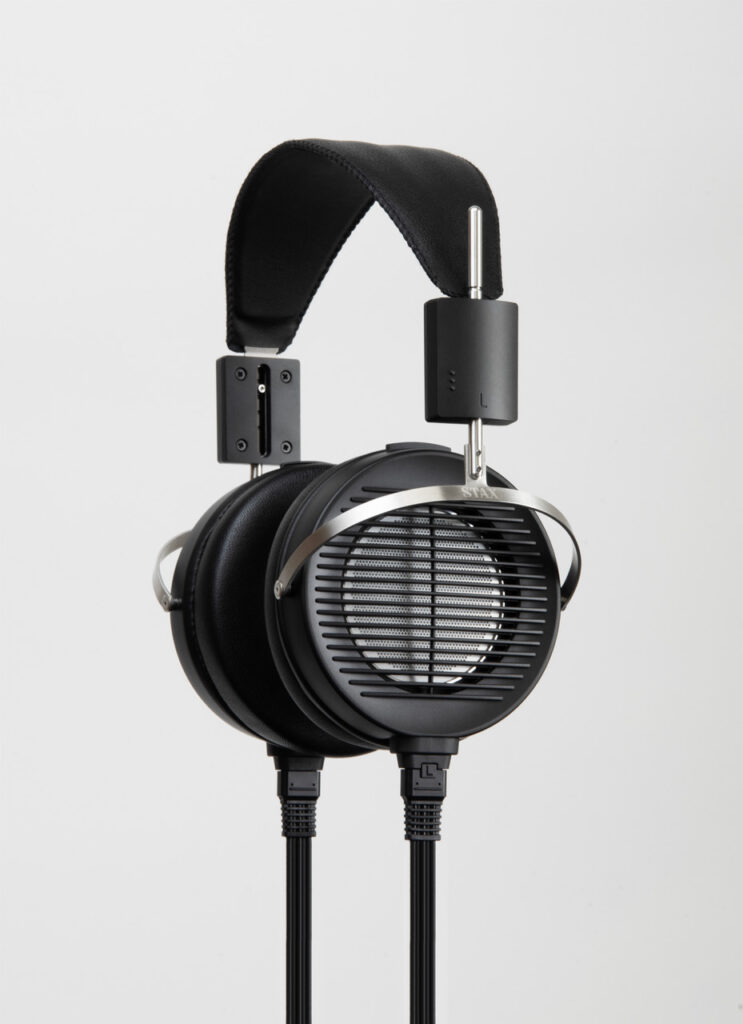
Naturally, the construction of the SR-X1 is intended to suspend a driver above each ear while ensuring reasonable comfort. However, ‘design’ does not appear to have unduly concerned Stax.
‘Old-school’ is a fitting description of the SR-X1’s appearance. Weighing 234g without cables, this pair of ‘earspeakers’ is among the lightest designs I’ve come across – largely because most of the exterior is made from lightweight but otherwise ordinary plastic. The slatted rear of the earcups offers a clear view of the circular driver. The covers for the basic and quite primitive ‘friction pole’ headband adjustment mechanism? Both are made from that hard, inexpensive-feeling plastic you might more readily associate with the dashboard of an Eastern European car built in the early 1980s.
Frame structure
The frame of the SR-X1 is constructed from metal. The headband adjustment mechanism, the headband itself, the yoke, and the arc are all integrated – according to Stax, this design offers optimal resonance suppression while keeping the weight light. The wafer-thin headband is covered with faux leather. Meanwhile, the earpads are made from memory foam and covered with genuine leather (which still seems an odd choice, as if vegetarianism automatically disqualifies someone from caring about audio equipment). The clamping force is well balanced, and combined with its light weight, it ensures the SR-X1 remains comfortable for quite some time. Certainly, longer than it takes for that sheepskin to return your body heat to your ears.
The SRM-270S driver unit, which supplies the electrical impetus to the ‘earspeakers,’ is similarly utilitarian and modest. Internally, it employs a low-noise FET in the first-stage amplifier, paired with a refined (or ‘white’) emitter follower circuit in the output stage.
Absolute clarity
Stax aims for absolute sonic clarity with this setup, and the measurable harmonic distortion of less than 0.01% indicates that the design is effective.
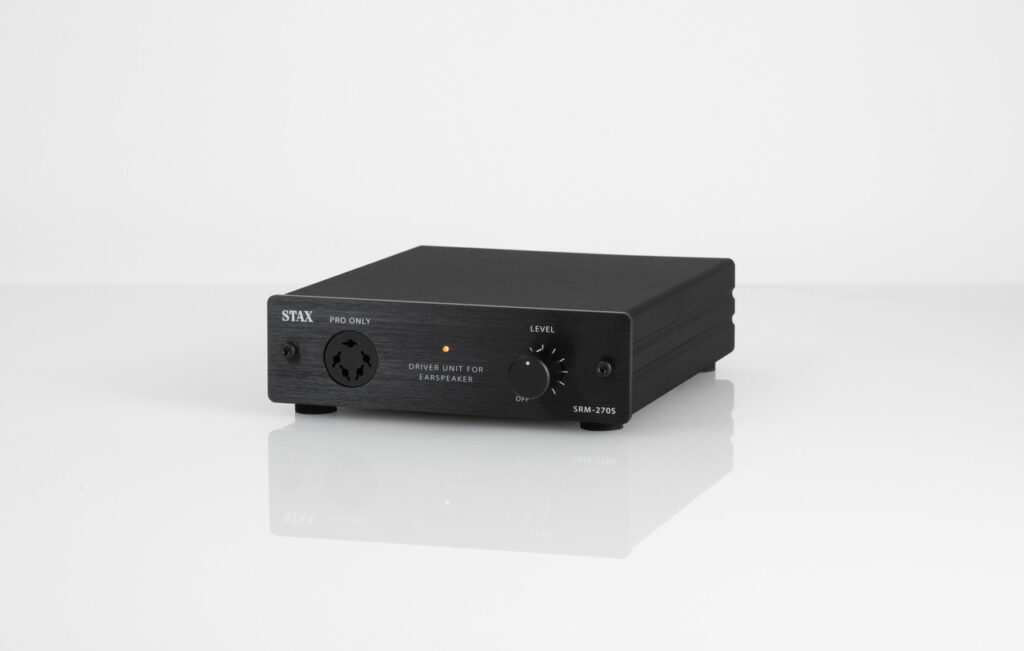
The case of the SRM-270S is mainly made of aluminium extrusion, meaning the entire chassis acts as a heat sink. At the rear of the enclosure, there are unbalanced stereo RCA inputs and outputs (oddly, they’re labelled ‘L’ and ‘R’ rather than ‘in’ and ‘out’), along with a socket for connection to mains power – it might have been preferable to see balanced XLRs as an alternative input, but unfortunately, that’s not the case. The front of the driver unit features a 3mm thick aluminium fascia with a central LED indicating power status, and on the right, a small rotary dial that controls ‘power on/off’ and also functions as a gain control. On the left is a proprietary five-pin ‘Pro’ output for connection to the SR-X1.
Long, broad and flat
The SRS-X1000 features a 2.5m long, broad, flat, low-capacitance OFC cable with six parallel cores – it’s awkward and cumbersome. One end has a matching ‘male’ five-pin ‘PRO’ connector for linking to
the SRM-270S, while the other end branches into two.
Each earcup needs wiring and includes a click-to-fit input for connection.
For this test, the SRM-270S is connected to a FiiO M15S digital audio player (using a 3.5mm/stereo RCA cable) loaded with Presto, Qobuz, and TIDAL music streaming apps. It also features a large amount of high-resolution content stored locally. Additionally, it is connected to a Naim Uniti Star network streamer (using a stereo RCA-to-stereo RCA cable) that supports various music streaming services and access to music stored on devices connected to a shared network. This setup means the SRS-X1000 always has two gain controls, although it’s hard to imagine a situation where a source device wouldn’t provide a volume control.
Once an acceptable balance has been achieved between the output level of the source device and that of the SRM-270S, they find a pleasing balance between ‘brio’ and ‘analysis’, making each listening session feel somewhat special.
Carefully neutral
Their overall tone is quite carefully neutral, which means that the tonal character of the recording and the source player delivering it has a much greater impact than the Stax themselves. The frequency response, from the profoundly deep lowest frequencies to the shining, substantial top end, is remarkably even – no part of the frequency range is given undue prominence, and none is underplayed. At every point, the Stax retrieve, deliver, and painstakingly contextualise an enormous amount of detail, both broad and fine.
This is the most lasting impressive aspect of the entire SRS-X1000 experience. Even if you’re listening to music you know very well (and I’ve long lost count of how many times I’ve heard Talk Talk’s Spirit of Eden [Parlophone] or Exile on Main Street by The Rolling Stones [Rolling Stones Records], both here as DSD64 files), the Stax system will detect some small transient event or harmonic irregularity that you weren’t previously aware of. Or, more accurately, that hadn’t been brought to your attention before.
Coherent
The system creates a large, coherent, and meticulously controlled soundstage, paying equal attention to spaces and silences as it does to the actual events. Even when the Talk Talk recording becomes dense and busy, there is ample room for each individual to express themselves without bumping into other elements of the performance. And when it reduces to near-silence, there is a directness and positivity in how the recording is presented that makes it sound immediate and almost urgent, despite its relative lack of animation.
Dynamic headroom is substantial, and the SR-X1 has no problem tracking significant shifts in volume or intensity. They confidently control low-frequency activity, and the straight-edged attack of bass sounds ensures rhythmic expression feels natural – and the system is just as attentive to their decay. The momentum built on this solid low-end resolution is sustained across the entire frequency range – even if an instrument drones or blares, the SR-X1 never allows it to fall behind or diminish their overall ‘up and at ‘em’ attitude.
Don’t touch me!
In fact, the only thing that might potentially spoil your listening experience is not related to the sound the SRS-X1000 produces – or at least, it has nothing to do with how the system reproduces music. The SR-X1 doesn’t respond well to being touched when it’s in position. Even if the SRM-270S isn’t powered on, touching the earcups of the ‘earspeakers’ can cause some faint rodent-like squeaking and chirping. When the driver unit is plugged in and operational, this noise becomes slightly louder and more easily triggered.
There’s a simple answer to that, of course: don’t touch the earcups once you have them positioned comfortably. However, it is equally valid to note that no other headphones (or ‘earspeakers’) suffer from a quirk like this, and it does somewhat undermine the Stax experience. So, I suppose it’s an indication of just how thrillingly enjoyable the SRS-X1000 is that I’m able to overlook it.
Technical specifications
SR-X1
- Type: Circumaural, open-back, electrostatic earspeaker
- Drivers: Full-range, low-mass, electrostatic drivers
- Frequency response: 7Hz – 41kHz
- Impedance: 62 Ohms nominal
- Sensitivity: 100dB/wM
- Distortion: 0.01%
- Accessories: low capacitance, wide OFC cable
- Weight: 234g without cable
- Price: £595, €770, $535
SRM-270S
- Type: solid-state ear speaker driver
- Inputs: unbalanced stereo RCA
- Outputs: unbalanced stereo RCA; proprietary five-pin ‘PRO’
- Frequency response: DC to 35kHz
- Dynamic Range: not quoted
- Power Output: not quoted
- Dimensions (HxWxD): 38 x 132 x 153mm
- Weight: 540g
- Price: £595, €549, $445
- SRS-X1000 package price £1,095, €1,089, $980
Manufacturer
Stax Electrostatic Audio Products
UK distributor
Symmetry
+44(0)1727 865488
Trending Articles
See all
By Simon Lucas
More articles from this author


Read Next From Review
See all
Reiki Audio SuperSwitch X/Pro X PSU
- Oct 06, 2026

Audiobyte SuperVOX
- Oct 06, 2026
Unitra WSH-805
- Sep 29, 2026

Wilson Audio Sabrina V
- Sep 29, 2026