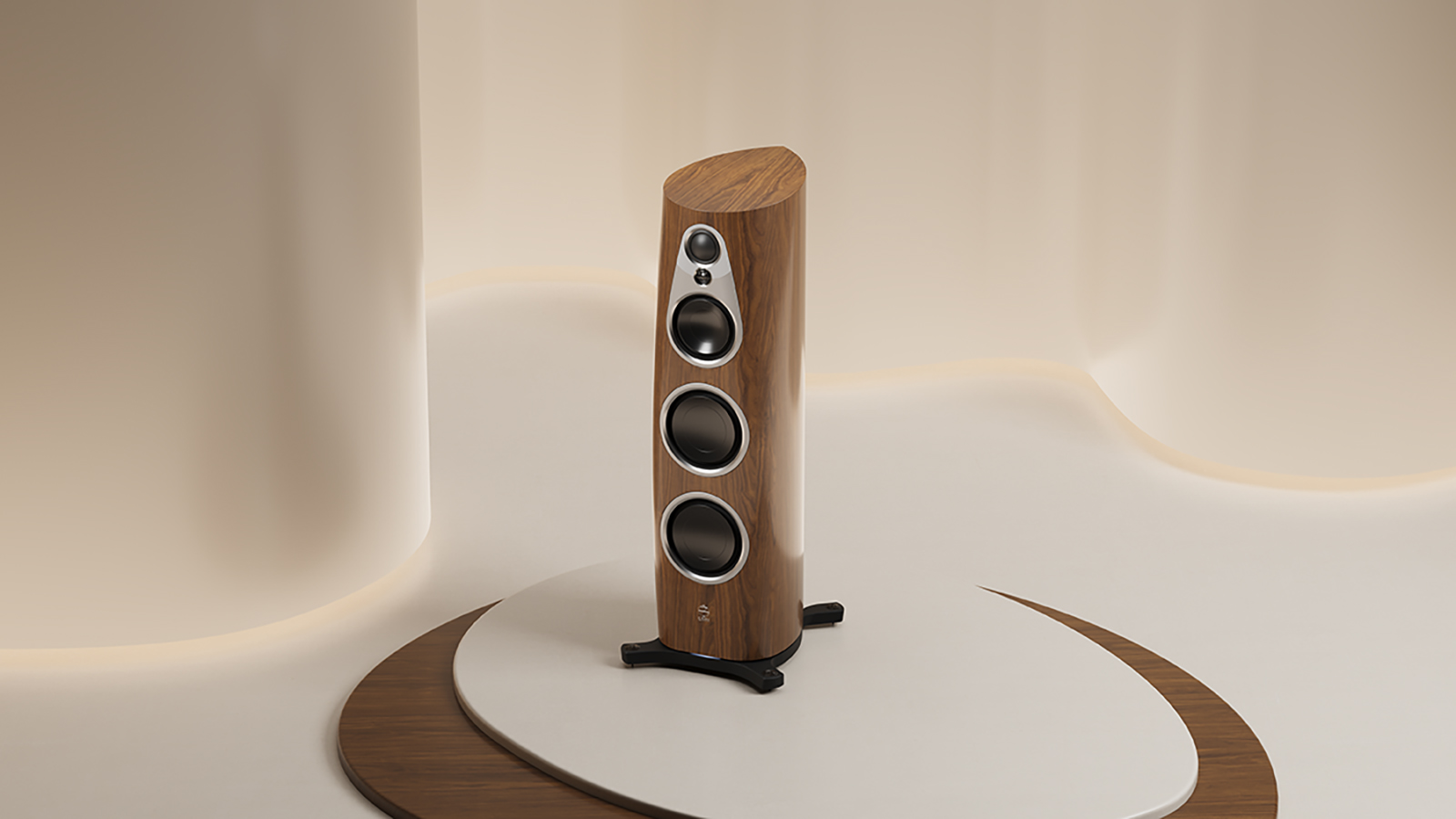
Linn’s 360 flagship is no stranger to hi-fi+. We first reviewed the active or part-active flagship floorstander from the Glasgow-based company back in Issue 220 (see review here). It’s more than just another top-tier Linn loudspeaker; it’s a genuine high-end loudspeaker, more than capable of outperforming some of the best speakers in production today. And now, with bass drivers featuring Linn’s new Pistonik motor system, the bar gets raised still further.
Pistonik is a reworking of the 6” and 8” drivers used in the original Linn 360. These are made to be driven actively; either active or ‘PWAB’ – Passive with Active Bass… there is no version of the 360 that doesn’t have active power for the two bass units. That sentence carries a lot more weight than it might seem at first.
Driver limitations
The life of a bass driver is hard, and the only way most loudspeaker driver designers can prevent it from being a death sentence is to place some significant limitations on its performance. This is entirely understandable because the driver’s destination is unpredictable. The manufacturer can’t know the enclosure’s design and volume, whether it’s ported or sealed, the crossover design, the intended drivers above and below it, and the range of amplifiers that might be used. Each of those parameters is a potential problem that can, at best, undermine a driver’s performance. Worst case… the listener burns through drivers at an alarming rate. In fairness, this last is rare, but using the wrong amplifier (often, an underpowered amp driven into clipping) is one of the main causes of drive unit failure.
Overused analogy alert
While car analogies are massively overused, they work here. Most drive units are a little like production saloons. They are perfectly designed for broad-spectrum motoring skills. That means a suspension and drivetrain that let you take your eyes off the wheel long enough to sneeze without finding yourself in a ditch. Compare this to the British Touring Car Championship, or NASCAR. Now, you have a car with a suspension and drivetrain that reacts to every twitch and movement of the person behind the wheel.
By controlling those parameters, Linn can make a set of drive units with the gloves off. Linn can design the drivers knowing the behaviour of the cabinet, the other drivers going into that box and the characteristics of the crossover and amplifiers. The result approaches the ideal, with outstanding linearity and cone excursion. Note that the midrange and tweeter don’t receive the same custom treatment, in no small part because they don’t need to move as much air.
This is no simple undertaking. Modern drive unit design (as distinct from tailoring an OEM drive unit to meet your needs) requires some serious mathematical modelling to make the concept even remotely viable. But this is where Linn excels.
Science: the Bedrok of good sound
Although no stranger to a neatly-turned marketing tagline (and an obsession with the letter ‘k’), Linn has always been built on a foundation – bedrok, if you will – of good, solid science-led engineering. The original Linn LP12 became a mainstay of so many systems, not just because of the sheer force of Ivor Tiefenbrun’s personality, but also because it was built to a standard few achieved at the time. Whether you liked the LP12 or not, few disputed that it was – and still is – extremely well made. This ultimately caused other manufacturers to raise their respective games.
Sure, that science and engineering-first approach didn’t always spell greatness. I’m looking at you, Linn Intek! But, on balance, the combination of hard science, good engineering and critical listening has scored many more hits than misses. However, even with that solid foundation, making your own drivers from scratch is a bit of an ask.
Linn is one of the few companies in the audio world that uses COMSOL Multiphysics software in its product design, starting with the analysis of current, heat, and vibration in the Dynamik switch-mode power supply. That analysis became central to the design and development of the recent Klimax Solo 800 and Solo 500 power amplifiers (reviewed in Issues 236 and 247, respectively). Switch that to the magnetic, mechanical, and thermal properties of a loudspeaker motor system, and you set the company on a path to making drivers with linearity orders of magnitude higher.
Long stroke
Improved linearity alone gets you a lower-distortion loudspeaker. But you need more. Typically, it’s relatively easy to create a very linear bass driver, so long as you are prepared to listen at whisper-quiet levels. Linearity at levels where people enjoy their music gets a lot harder and in playing music with ‘gusto’ while maintaining that linearity is almost impossible. Linn’s Pistonik motors include a super-long stroke (or throw) driver, thanks to a huge magnet for the drive unit size. This means the voice coil gets to spend almost all of its travel in the motor’s magnetic field.
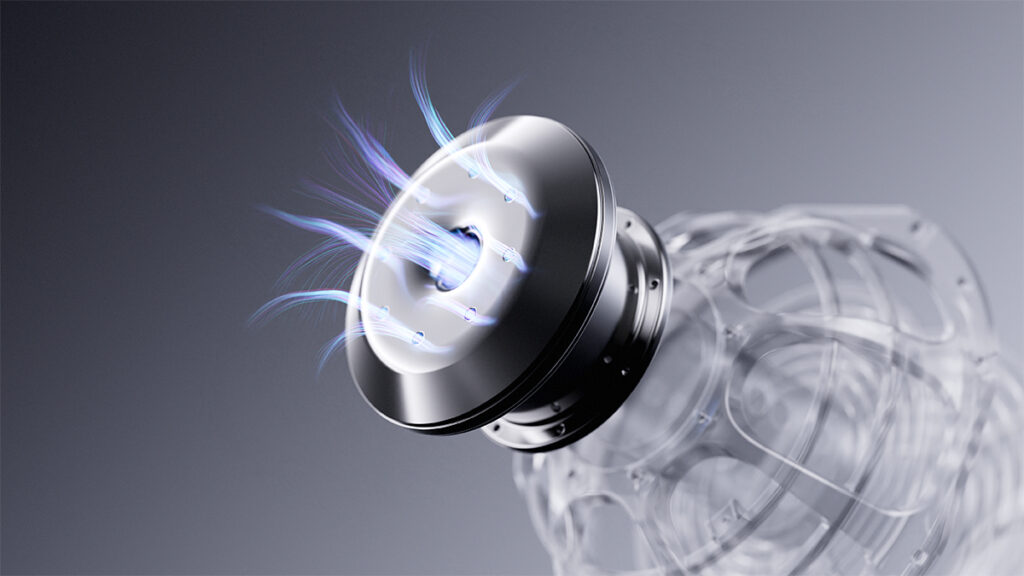
However, a big magnet means big eddy currents (I went to school with his cousin, Lil’ Joey Rasins), but Linn shields the voice coil in a copper sleeve to limit that effect. A long voice coil travel also means risks of air pressure build-up, performing a similar draggy effect as eddy currents, so Linn ventilated both the rear of the magnet housing and the coil former. The copper acts as a kind of heatsink and the ventilation also helps cool the voice coil at higher volumes, so we’re talking multiple ‘wins’.
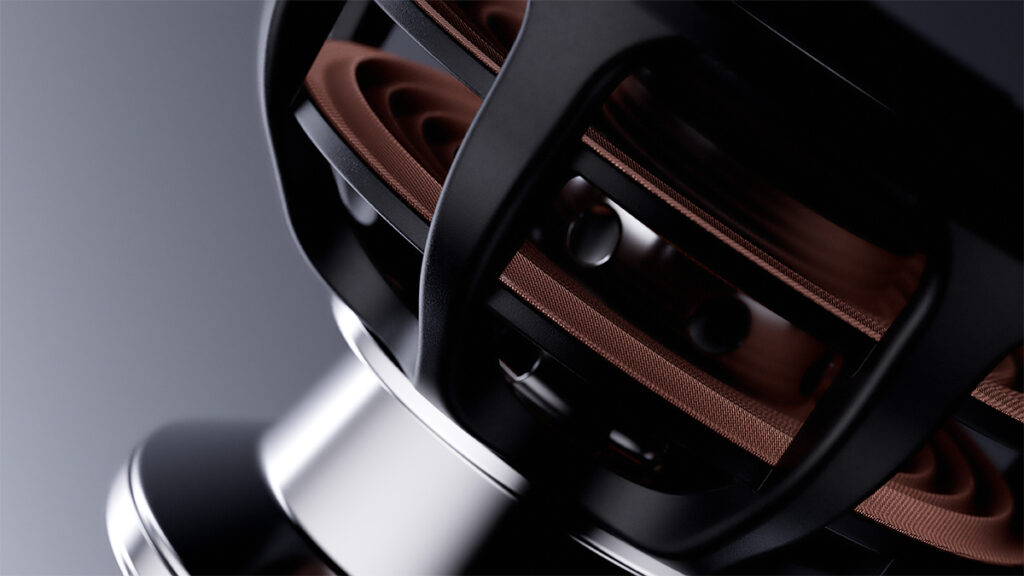
The suspension system of these drivers has been completely rethought, too; this is perhaps the most direct benefit of these drivers always being in a known ‘ecosystem’; there’s no need to overcompensate in a suspension system where the acoustic loading and the amplifiers powering the drivers are known quantities. And that makes the suspension effectively not there… until it is. Perhaps the most identifiable part of this truly bespoke way of designing a drive unit is the twin spiders inside the 8” unit. They are there to provide just the right amount of breaking force needed in context.
Happy puppy
Linn’s YouTube presence has interviews with Phil Budd, the company’s Head of Mechanical and Acoustic Engineering. These are well worth watching because he’s remarkably plain speaking and open about what goes into – and what went into – designing the Pistonik motor technology, but it doesn’t tell the full story. Speaking to Budd off camera is like chatting to a cross between a proud father and a puppy experiencing snow for the first time. He nerds out hard to the tech that goes into the drivers and the 9th Dan COMSOL skills needed to get there. Like most in this business, he’s a passionate music lover, but it’s clear that this isn’t just some project he signed off.
I’ve consciously avoided going over old 360 ground and focused instead on the new drivers. However, all the elements that went into the original 360 cross over to the 360 with drivers with Pistonik. Existing 360 owners can get the upgrade performed in situ, with the dealer performing both the driver change and the software refresh. It should take a couple of hours to switch drivers. New 360 owners get Pistonik as standard, and this has incurred an increase in the basic cost of the loudspeaker system.
Furious!
It’s a big change. Playing some traditional ‘fat lady sings’ opera, in the already very good 360, she sounds angry; with the new drivers, she sounds furious! It wasn’t a magnifier on the sound, just laser-focused on the music. More importantly, that focus means nothing is off the table. Pick some music not known for its audiophile quality – ‘Know How’ by Young MC for example. That’s old school rap from 1989, complete with janky 80s-era samples. That’s not the kind of thing that ever gets played in audio shows or demonstrations, because it rarely sounds good. Here, it rocks! You have the pumping backbeat reproduced in all its glory.
Yes, you can play all the usual audiophile records to your heart’s content, but that was never the point of the 360, and it really isn’t the point now. By removing all those limitations on linearity and improving the loudspeaker’s ability to play at a range of volume levels, those ‘play to impress’ audiophile recordings just stop being so important.
As Linn is all about the streaming, what tends to happen in playing the new 360 is you get lost for hours as you just have fun with your music. The end result isn’t just ‘that’s a great sound’ but ‘that’s a great playlist’. You find yourself making those Roon-esque musical connections, even if you are in an entirely Roon-free environment, simply because that’s where the sound takes you. Also, that you can play louder doesn’t mean you have to!
Beethoven to Skrillex
I moved from Beethoven piano to ‘Rumble’ by Skrillex and everything in between, and in all cases the drivers start and stop with blistering speed, powerful depth and excellent dynamics. It’s fast when you need it, full and rich when you don’t. But, breaking the music down into its audiophile components seems wrong; it’s all about playing music more.
That’s the point, here. The science doesn’t need some granular overview of how the music sounds; it just sounds better. Yes, given that bass drivers are the change, bass is tauter and faster… but more importantly the space and clarity of the midrange and treble get cleaner and more detailed thanks to those bass units. It is a genuine game-changer, as you feel like there’s a step-change in distortion levels. You can hear there’s less between you and the music.
Distortion logjam
Given that the loudspeaker is the distortion logjam in most modern audio systems, finding a way to cut through that distortion is maybe one of the most important things Linn has done in its 50+ years of business. And yes, that does include the LP12. Because the less the system gets in the way of the music, the more music you play. That was true with the LP12 more than half a century ago; it’s just as true now.
In writing this review, I looked back at my notes on the 360. There wasn’t much to criticise even with the first version, and listening to the original 360 means you are sitting in front of a damn good pair of loudspeakers. That doesn’t leave you when you listen to the Pistonik-equipped 360, but you also know within a few seconds that there is no going back. That absence of driver coloration, that removal of distortion, that ability to play bass so clean at every level that it gets you deeper into the midrange… that is not something you would ever want to leave behind once experienced. It’s so far removed from what you might expect given the nature of the new drive units; you know there’s less distortion, but at any volume level? Heady stuff!
The ecosystem
Pistonik can only happen because every part of the Linn ecosystem is a known entity, but there’s more to that ecosystem than flagships! Imagine what Pistonik’s driver-disappearing act would do in a small two-way like the 119 stand-mount (tested in Issue 242), for example.
If you are reading this while staring at a pair of existing 360s, there’s no debate. This is your next upgrade. Spend ten minutes comparing the two, and you spend two minutes comparing the two and eight minutes arranging and paying for the upgrade. For new buyers, the 360 is a little more expensive and a lot better… and now with a real-walnut finish. Either way, once you hear it, you won’t want Pistonik to be separated from your speakers for too long.
Technical specifications
- Type: Four-way floorstanding fully integrated active loudspeaker (part active version also available but not tested)
- Drivers: 19mm Beryllium dome tweeter, 64mm thin-ply woven carbon fibre dome midrange, 190mm aluminium upper bass, 2× 220mm long-throw aluminium lower bass
- 360 Array: lass AB amps with Adaptive Bias Control
- Bass System: Power DAC
- Cabinet volume: 60l
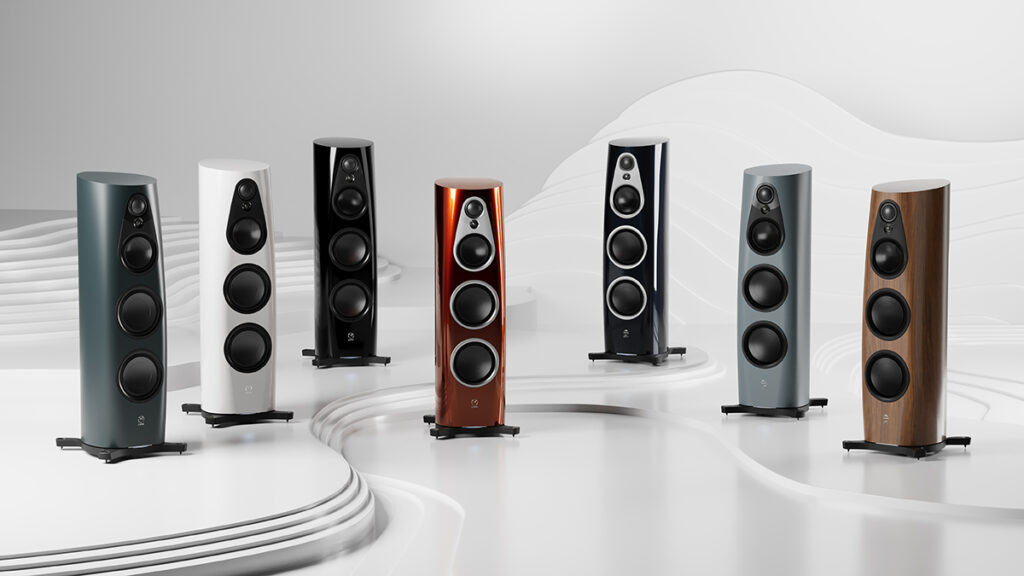
- Finishes: Piano Black, Alpine White, Clyde Built, Linn Heritage, Single Malt, Triton, Walnut, or custom RAL at no charge
- Dimensions (HxWxD, with stand): 114.1 × 41.1 × 48.4cm
- Weight: 70kg
- Price: From £67,000, €79,930, $71,500 (360 Passive with Aktiv Bass), £99,500, €104,130, $142,500 (360 Exakt Integrated) per pair. Pistonik drive unit upgrade for 360: £16,500, €19,640, $23,620.
Manufacturer
Linn
homepage: linn.co.uk
Linn 360 product page: https://www.linn.co.uk/uk/speakers/360
Where to buy Linn: https://www.linn.co.uk/uk/try-linn
+44(0)141 307 7777
Trending Articles
See all
Acoustic Energy Corinium floorstanding loudspeaker
- Dec 23, 2024
Trending Articles

By Editor
More articles from this author

Read Next From Review
See all
Reiki Audio SuperSwitch X/Pro X PSU
- Oct 06, 2026
Audiobyte SuperVOX
- Oct 06, 2026
Unitra WSH-805
- Sep 29, 2026
Wilson Audio Sabrina V
- Sep 29, 2026