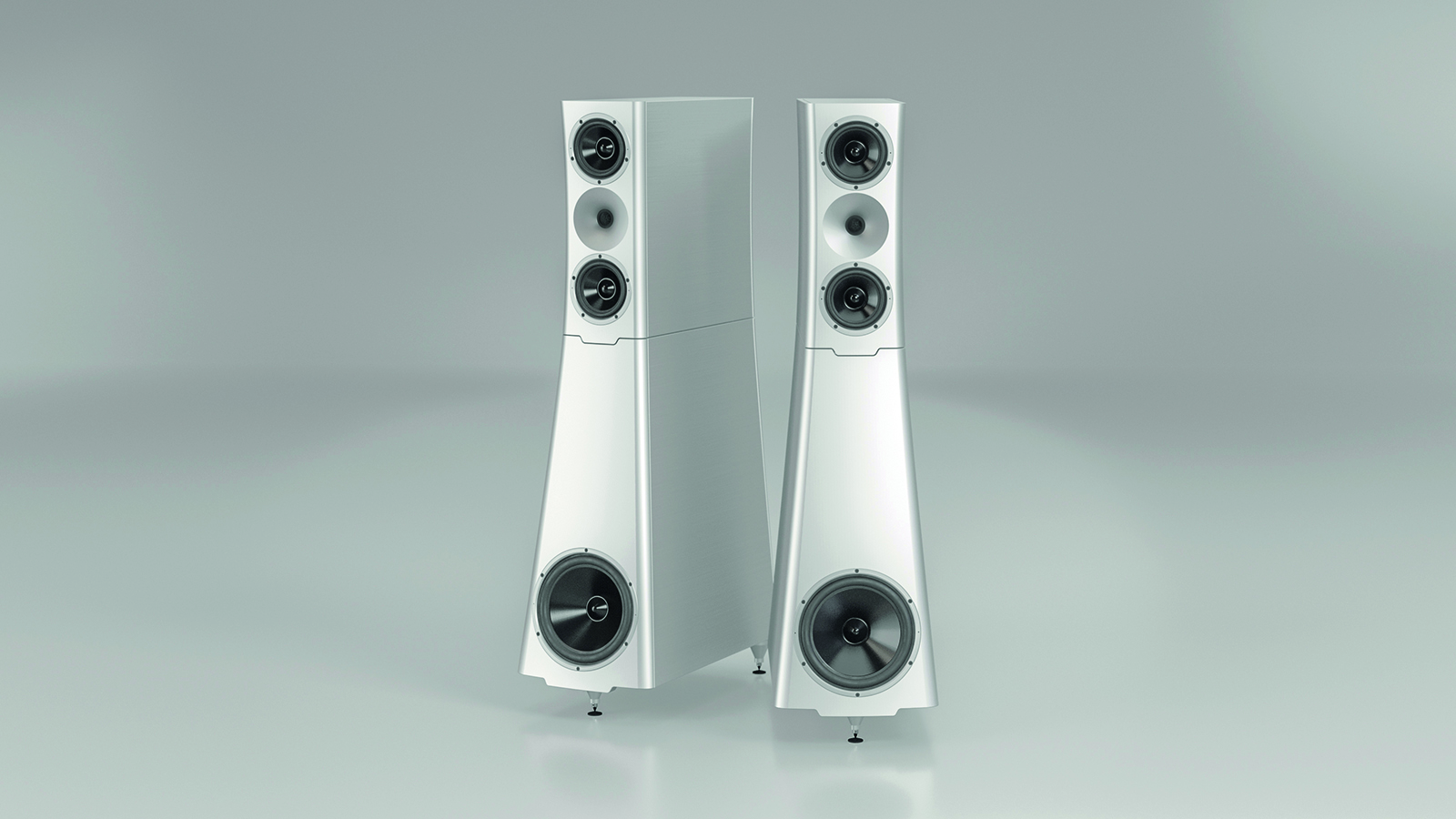
One of my consistent equipment references for several years has been a YG Acoustics Sonja speaker. What I find compelling about the YG speakers I have evaluated is their clean, articulate, uncolored sound. All speakers have a sonic signature—a personality, if you will—but the Sonja models have always struck me as keeping their own editorial overlay to the music to a fairly low level. They have proven themselves to be straight-forward conduits of the signal they receive from upstream gear. And, crucially, they do this without scrubbing the ‘soul’ from the music.
Sonja speakers have never sounded musically dry or analytical in my system, rather, they have sounded musically affirming and engaging. They have also checked off a list of analytical listening criteria with aplomb: excellent resolution of fine details, wide frequency range, macro- and micro-dynamic facility, and peer-into soundstaging. With each update over the years, the overall sound quality of the Sonja has improved. The 3.2 under review here follows suit.
Since its founding in 2002, YG’s principal distinguishing technology was called DualCoherent—now updated to Ultracoherent. To simplify matters a bit, both refer to YG crossovers’ ability to simultaneously optimise frequency response and relative phase. Most other designs apparently sacrifice either frequency response or phase coherence for better outcomes in the other. The crossovers in Sonja models have been updated and refined over the years and the resulting sonic improvements have been readily audible. Other enhancements like better cabinet damping techniques and updated tweeters have also contributed to better performance over the years, but Ultracoherence remains a core technology.
Aluminium everywhere!
Upper-level Reference line speakers, which includes the Sonja 3.2, all have YG-made aluminium cabinets and driver cones. The driver diaphragms are machined from solid blocks of aluminium. The company also makes its own custom toroidal inductors, internal braces, joiners, and other components, all manufactured in Arvada, Colorado, near Denver. YG uses high-quality materials for the parts it manufactures and top-quality components, such as Mundorf capacitors, for the parts it sources from others. This emphasis on manufacturing as much as possible in-house and sourcing the remaining specialty components from high-end vendors contribute to the speaker’s price.
The Sonja 3.2 has a main cabinet module attached atop a larger bass module. The upper module has two YG 150mm BilletCore drivers, with “advanced neodymium magnet motors,” and one waveguide-mounted YG Lattice hybrid tweeter positioned vertically in a mid-tweeter-mid configuration. The bottom module has one 260mm BilletCore woofer with a “ultra-high field strength motor.” Together, the two stacked modules weigh a hefty 145kg per speaker and stand 1.3m tall. The cones are milled from aluminium billet and have radial and concentric ribs on the back for low mass and high rigidity.
The Sonja, and all models above it, have cabinet modules with an inner cabinet—complete with its own joined corners—that is carefully inserted into the outer cabinet to form cabinet-within-cabinet modules. This increases rigidity and reduces resonances more than one equally thick-walled or double-walled cabinet would.
Airframe
YG’s new Lattice hybrid tweeter has an ‘airframe’ also milled from aluminum billet, composed of arms that form five, strong, light-weight pentagonal-like support structures. A custom silk-dome membrane is attached over the airframe to form a silk-dome-over-metal-frame hybrid tweeter. The previous version (called BilletDome) used three arms that connected to a triangular support structure. The new Lattice hybrid tweeter dome is presumably more robustly supported and therefore less prone to flexing under extreme conditions like highly dynamic music passages at elevated sound pressure levels. This hybrid tweeter apparently withstands higher acceleration forces—and therefore maintains pistonic motion without deformation—than typical silk-dome tweeters and avoids the ‘metallic harshness’ that is associated with some all-metal tweeters.
If you are a low-bass hound and you find the regular two-module 3.2 to sound a bit soft on bass-heavy music, or you have a large listening room that requires more bass reinforcement, the Sonja can be fitted with a subwoofer module bolted to the bottom of the speaker. (When configured as a three-module speaker, it becomes a Sonja 3.3.) I think most listeners will find the two-module 3.2 to be ‘big’ enough with no need to upgrade to the three-module version. The two-module 3.2 performs its best in a system with at least 100 watts of high-current amplification on tap and situated in a medium/small to medium/large listening room.
Placement
The Sonja 3.2 is easier than most speakers its size to place in an average room. In my 3.8 x 5.2m room, no other speaker near its size has been less fussy about placement. I have heard various Sonjas sound very good in other rooms as well, larger and smaller. All YG Reference speakers are sealed-cabinet designs. There is no port that can add to bass bloat if the speaker placement is not just right. Of course, if you put in the effort to optimise placement for frequency response smoothness, image precision, and soundstage expansion, the Sonja 3.2 will reward you with even better performance than a perfunctory placement process—a ‘start in a reasonable spot, adjust a bit, and start listening’ approach.
The optimal listening area is also large enough to allow you to relax about your head position in the listening chair. Some of my listening room guests have commented on how a reasonable soundstage is still portrayed even when they are seated off the optimal listening axis.
Pride
YG takes great pride not only in its ability to manufacture its products to very tight tolerances but also its ability to use extensive computer power to model multiple performance domains simultaneously. From YG’s white paper: “Since 2020 YG has benefitted from industry-leading computational modeling to support technology development. This includes multi-domain models and large-scale parallel computing. Multi-domain models simply mean modeling several different ‘domains’ in parallel.” Further: “Each part of the loudspeaker is modeled in detail: inside each driver, the cone, surround, suspension, the complex interaction of the magnet and voice coil; each part of the cabinet and the enclosed air volume….”
YG has access to the computing power and knowledge necessary to do this kind of computational modeling through Dr. Matthew Webster, an astrophysicist and co-founder of Cambridge Acoustic Sciences in the UK. Dr. Webster is now the CEO of YG and brings his expertise in multi-domain modeling to technology development and manufacturing techniques at YG.
All-rounder
Turning to sonic performance, I think the Sonja 3.2 will appeal to many music lovers as a high-performing all-around speaker. It is not a specialist. It doesn’t lean in with blazing leading edges or bombard you with overly heavy bass lines. The Sonja 3.2 doesn’t dazzle you with some initially impressive trait like hyper-resolution, only to wear poorly over extended listening. It simply plays music with a verisimilitude that is as close to live music as can be expected in a domestic setting and at its price. As alluded to briefly above, the Sonja 3.2 has excellent articulation of fine details, wide dynamic range, delicate dynamic shading, and nearly full-range frequency response. It doesn’t necessarily draw one’s attention to any one of those elements, though. Music sounds integrated and of a ‘complete whole,’ not a set of listening test criteria.
Soundstaging and imaging are excellent. The entire front of my listing room was filled with a large, focused, realistically proportioned soundfield. Depth was portrayed on a continuum instead of a few layers of partially fleshed-out figures. Individual images had refined boundaries, not fuzzy outlines, and carried a considerable level of solidity and ‘physical presence.’ Imaging, by itself, isn’t all that interesting to me if there is little artistic life in the music. Without enough “musical interest” included with all that spatial accuracy, my mind will wander away from the music content after the second or third return listening—with days in between—of a given music selection. That did not happen with the Sonja 3.2. I got lost in the ebb and flow, the sorrow, the joy, the grand sweep, the unfolding progression—the human element—as evoked by the music tracks.
All kinds of music
All kinds of music are served well by the Sonja 3.2. I spent hours reveling in grand organ pieces by Bach or the Poulenc Concerto for Organ, Stings, and Tympani [Martinon, Erato LP], for example. Music from folks like Radiohead and Beyoncé had wonderful bass support, which lent a sense of power underpinning everything. Thankfully, much of the tizzy quality in the upper frequencies of some recordings were not distracting through the 3.2.
The ability to convey delicate details while at the same time not shouting recording flaws at you is a trait that seems to come from excellent gear: Constellation Audio, Hegel Music Systems, Raidho Acoustics come to mind, among gear I have reviewed in recent years. YG falls right in line here. Small, intimate music from Bobo Stensen on the ECM label was sometimes achingly beautiful through the YG. Hard-driving rock, large symphonic works, small jazz combos, massive electronica, choral music, male and female vocalists…the Sonja 3.2 did it all.
New vs old
So, how does the current 3.2 compare to the preceding 2.2i? In broad terms, the newer model sounds more liquid, more coherent, and more resolving of fine details. These distinctions are not overwhelming, but the sum of the new version’s sonic differences is significant enough to merit mention. The new Sonja has the same perceived bass extension, but it sounds more robust in the bass in a general sense—fuller, if you will. This greater bass heft and the new hybrid tweeter’s smoother response lends a feeling of a more relaxed presentation.
The neat thing about what YG has done here is subtle details in the music are not sacrificed to deliver all the enjoyable, musically affirming qualities I have been carrying on about. The newer Sonja seems to calm down a layer of underlying noise so that more subtle details are allowed to emerge more intact.
Calmer
It is possible that some listeners might miss some of the perceived transient snap of the previous 2.2i. I hear the newer 3.2 as simply having more precise upper-frequency behavior, and this helps to make everything sound a bit calmer and clearer overall. Sometimes, less precise can sound a little more exciting because it adds a bit of extra ‘zing’ to things.
I identify with YG’s apparent emphasis on technology, science, and manufacturing acumen in service to music listening in the home rather than audiophile brinkmanship. At the end of the day, producing a speaker that delivers so much realism without sounding stilted in an audiophile way is a great accomplishment. It is not easy to ‘simply play music.’ My listening experience with the Sonja has been one of musical immersion and exploration. I respect the Sonja 3.2 for its realism and thoroughly enjoy it for its ability to communicate the human element in recordings. Highly recommended.
Review first published in Issue 361 of The Absolute Sound.
Technical specifications
- Driver complement: One 25mm YG Lattice hybrid tweeter, two 150mm YG BilletCore mid/woofers (main module), one 260mm YG BilletCore woofer (bass module)
- Frequency response: 20Hz to 40kHz
- Sensitivity: 88dB
- Impedance: 4 ohms average, 2.8 ohms minimum
- Recommended amplifier power: Minimum, 60 high-current watts
- Crossover points: 90Hz and 1.85kHz
- Cabinet: Aircraft-grade milled aluminium
- Finish options: black or silver finish as standard; custom color matching available for an extra charge
- Dimensions (WxHxD): 33 x 130 x 64cm
- Weight: 145kg
- Price: £110,000, €135,000, $99,000 per pair
Manufacturer
YG Acoustics
UK distributor
Cambridge Acoustic Sciences
+44(0)1223 398600
Trending Articles
See all
Acoustic Energy Corinium floorstanding loudspeaker
- Dec 23, 2024
Trending Articles

By Kirk Midtskog
More articles from this author
Read Next From Review
See all
Eversolo T8
- Oct 13, 2026
Acoustic Energy AE Active
- Oct 13, 2026
Reiki Audio SuperSwitch X/Pro X PSU
- Oct 06, 2026
Audiobyte SuperVOX
- Oct 06, 2026