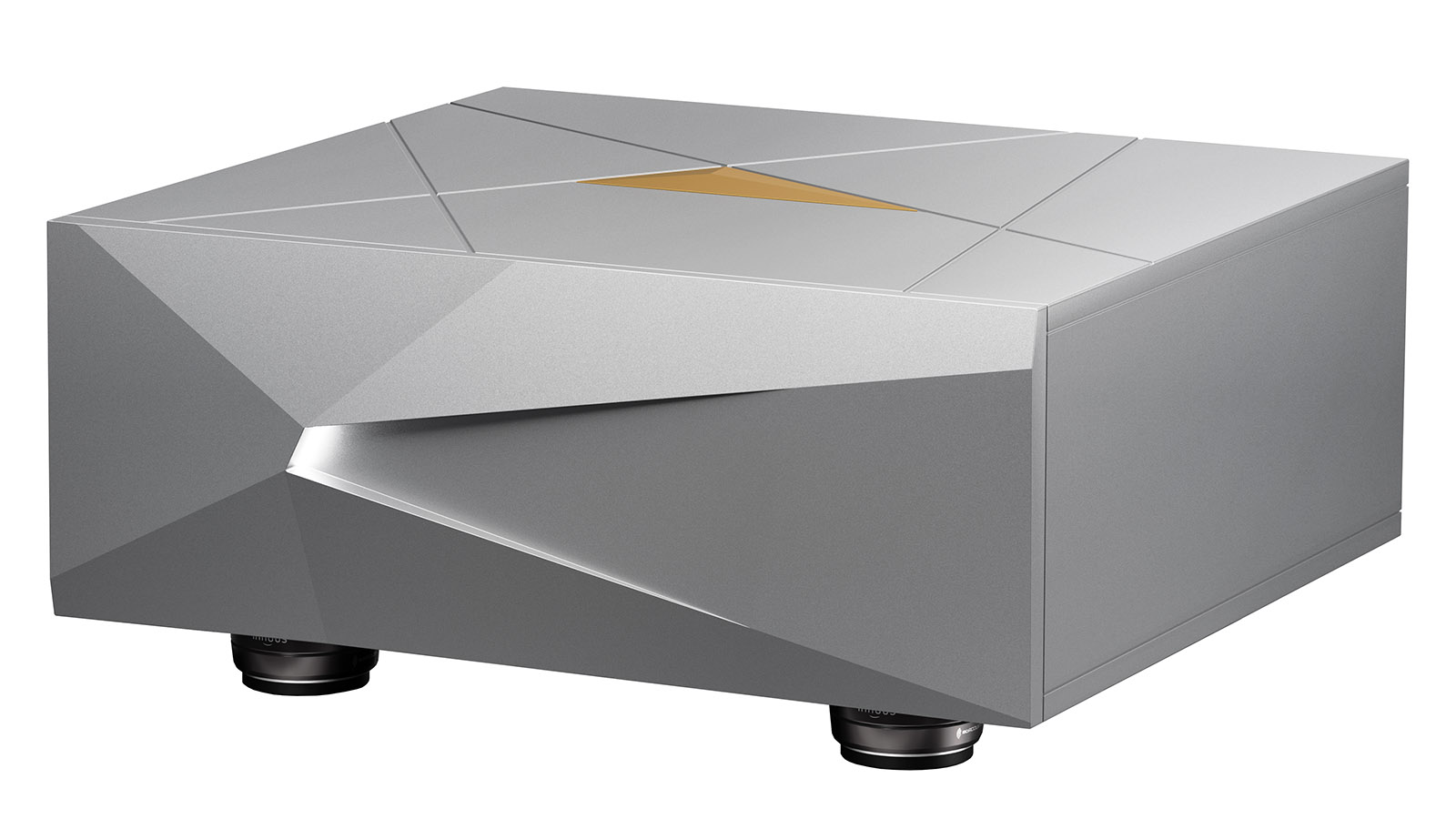
We have looked at many Innuos servers, streamers, and network-side devices over the years. Precisely none of which prepares you for the power of the Innuos Nazaré music server. The new flagship from Innuos sees the brand shift into high gear. In the process, Nazaré takes one of the brands with the longest experience in producing servers and places it at the forefront of the high-end revolution. A revolution that has finally moved away from physical discs.
Anyone following the fortunes of super- and ultra-high-end audio will note that it’s only been in the last few years that CD and SACD discs have finally been challenged for their digital top spot. Spinning polycarbonate is still a force to be reckoned with in this select group. However, it’s now more as a one-time carrier to be ripped and stored rather than a disc to be played. This contrasts with music lovers, for whom the air is less thin. They have long since adopted stored and streamed audio as their digital mainstays.
It’s more than just snobbery and one-upmanship that prevented the top tier from fully grasping the digital nettle. It was an understanding that everything matters. Every high-end turntable enthusiast can hold down a week-long conversation about cartridge compliance. All owners of a multi-box CD/SACD player have tried dozens of cable, platform, grounding and even aftermarket fuse options. But in networked systems, the jury was still out. Can the choice of cable affect packetised data? Is there something else at play? Or is it all just nonsense on stilts? Do we need a server anymore? Isn’t it just a computer… why not just buy an off-the-shelf PC?
It all matters
As it turns out, it all matters! And that’s where Nazaré comes in. Innuos started the Nazaré project from the position that ‘it all matters’. The company then applied that thinking to every component, system, and subsystem of an Innuos server. The result is big and heavy because anything else meant compromise.
We first saw the Innuos Nazaré music server as a prototype at the last Munich High-End. It took almost a year to get here. That’s not strictly true; Nazaré has been in regular production for several months, but Innuos can’t build them quickly enough to meet demand. The name comes from Portugal’s Nazaré Canyon. The story goes that Innuos Director of Research and Development, Nuno Vitorino, and the design team wanted the new server to reflect the company’s Portuguese heritage and make that integral to the industrial design.
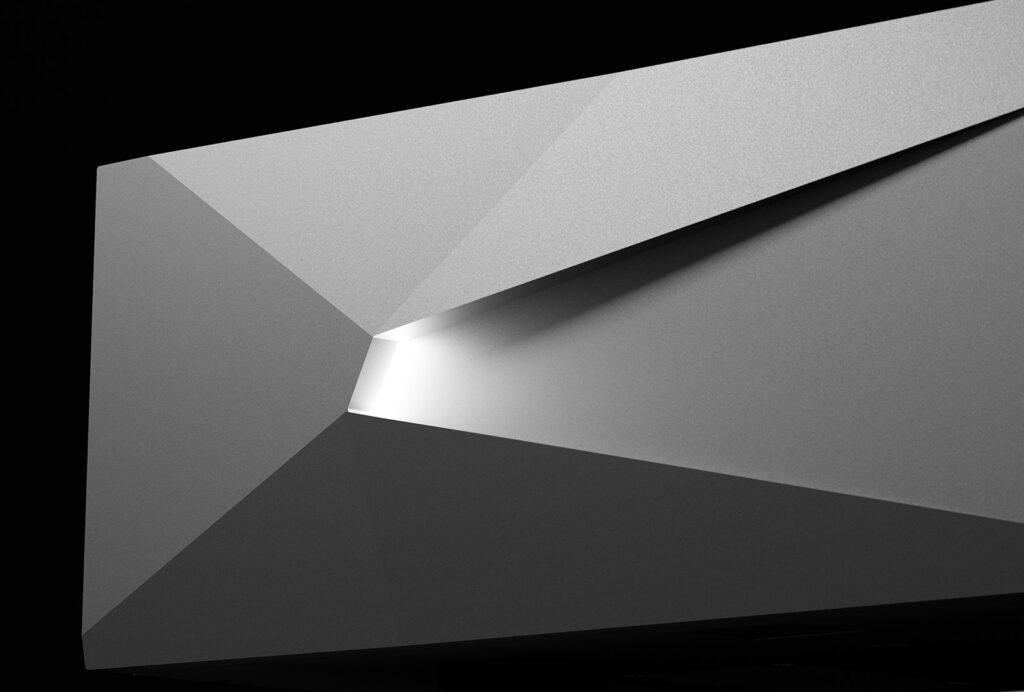
The front panel represents that canyon, and the side-mounted vertical light represents Farol da Nazaré atop the cliffs at the Forte de São Miguel Arcanjo. Farol da Nazaré is the lighthouse that stands resolute against that elemental force. Innuos also adds that, “Just as the lighthouse stands firm against the spray of the Atlantic, the Nazaré’s internal components are shielded from the ‘spray’ of electromagnetic interference (EMI) and vibration by this massive, fortress-like construction.” That might sound a touch pretentious at one remove. However, after trying to lift a Nazaré and hearing what it can do… maybe Innuos has got a point.
Specific asymmetry
In the spirit of ‘everything matters’, that front panel isn’t just there as a spot of topographic industrial design. It’s designed asymmetrically specifically to help mitigate standing waves and internal structural resonance. As are the asymmetrical panels that form the sides and top panels of the outer shell of the Nazaré. No two panels are the same shape on the Nazaré top plate. This asymmetry prevents resonances in one panel from contributing to those in another. Everything is CNC-machined aerospace-grade aluminium of varying thicknesses. The whole chassis sits on special IsoAcoustics decoupling feet. Put simply, the Innuos Nazaré music server’s entire outer shell creates a ‘mechanical ground.’ And we’re not done with the Nazaré Canyon parallels. There is a ‘wave’ motif subtly integrated into the heat-sinking and the metalwork’s contouring.
Behind that metalwork is a very different server than anything Innuos has made before. Also, directly behind the outer case is a lot of TONEO damping material. In addition, all previous and current Innuos models have the Ethernet connector and USB subsystem on the same main board. Now, the main board is stripped down to just the processor, memory and storage. Innuos make everything else to perform with as little compromise or intrusion as possible.
Turn it off!
The methodology here is to minimise noise—by turning off noisy components, keeping the path as direct as possible, and regenerating the signal in cleaner, step-by-step stages. It is an architectural approach to electronics. Each section resides in its own ‘room’ within the fortress. So, the CPU’s heavy lifting never corrupts the delicate digital pulse. That fortress approach extends to the main board’s power supply and to separate power supplies for the inputs and outputs. These use two 400VA toroidal transformers, which goes some way to explaining why a server looks as big and feels as heavy as a power amplifier. Each power supply has four separate rails, and everything from the plug socket outwards runs from its own power supply.
Naturally, the same approach used in the Innuos Nazaré music server’s architecture also extends to mitigating jitter. This is why the Nazaré employs a proprietary Oven-Controlled Crystal Oscillator (OCXO) clocking system. These clocks are kept at a constant temperature to prevent frequency drift, ensuring precision measured in parts per billion. In the Nazaré, this clock is located mere millimetres from the Ethernet and USB outputs. This ‘short-path’ methodology minimises the opportunity for the signal to pick up noise between the clock and the exit point.
Supremely easy
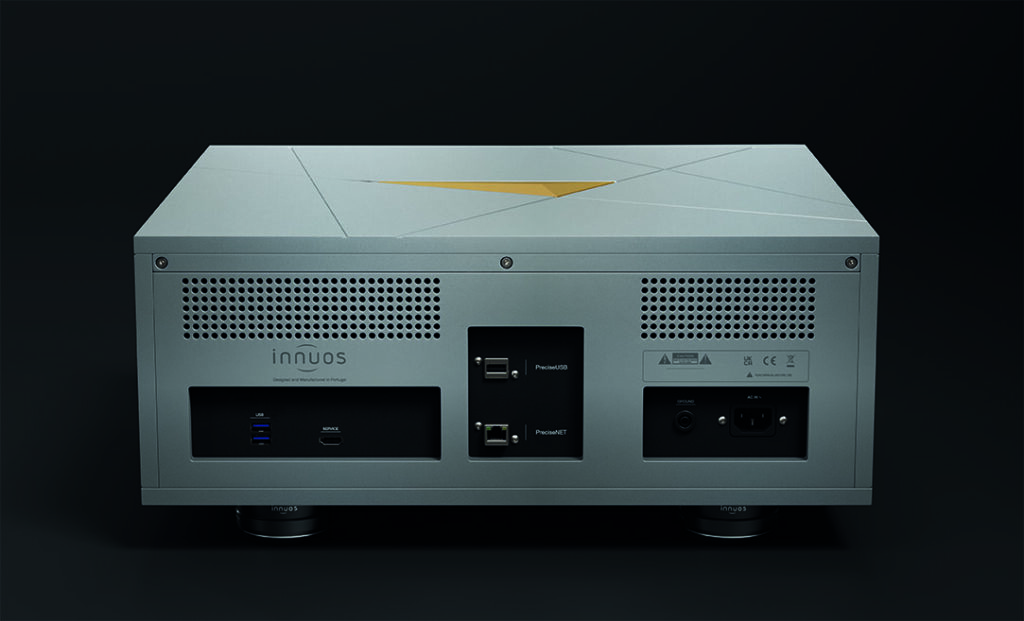
It’s supremely easy to hook the Nazaré up, as there aren’t many options to play with. Just add a power cord, an Ethernet cable connecting the Nazaré to the outside world and a USB to a DAC of sufficient quality. You turn it on and off by pressing a touch-sensitive panel beneath the centre of the front panel. If you’ve used an Innuos device, you already have the Sense app. So, once the Nazaré is in the system, a network search will find it. That’s it. Job done… for now. Of course, NazaréNET may well do the same to an Ethernet connection as Nazaré does to the server, and NazaréFLOW will likely reclock your USB signal much better than Nazaré on its own. Still, they are for another day, as they weren’t available at the time of the review.
The Sense app is not simply a throwaway part of the Innuos Nazaré. It’s more like the app-shaped front-end of Innuos’ Sense operating system. Why this matters is that Sense actively creates a quiet environment, avoiding all the background checks and balances that undermine performance. This is no small problem, even if modern computers have sufficient processing speed to make such heavy lifting easy; tying up the CPU with thousands of little background tasks while the app is constantly interrogating the server often profoundly affects the result: the sound quality.
Instead, Innuos creates a ‘quiet’ computing environment within the Nazaré. Because the processor isn’t working as hard, it generates less heat and, more importantly, less electrical noise. This results in a ‘darker’ background—a silence between the notes that makes the natural decay of a piano string or the faint echo in a recording studio audible.
Didn’t matter
I worried that the absence of NazaréNET and NazaréFLOW would mean I was listening to half a Nazaré. Well, if that’s the case, half a Nazaré is twice as good as many of its rivals. I wouldn’t have been able to focus on the extra boxes anyway, as I was too busy having my standards reset by the main Nazaré. As someone who regularly uses an Innuos ZENith NG server (reviewed in Issue 247) and has used Innuos products for some time, I thought I was prepared for the change to Nazaré. After all, the move to ZENith NG from Statement NG (and to Statement NG from the original Statement) was sufficiently wide to make a clear difference. How large can the difference be? Huge!
Listening to the Innuos Nazaré almost immediately highlights the flawed assumption that you need a really top-notch system to hear the nuanced differences between two server products. Nothing could be further from the truth.
Stark differences
I could have made the comparison on even the most humble one-box system and entry-level loudspeakers and still heard the differences between ZENith NG and Nazaré. It’s the kind of difference that is so stark, it would take you longer to read this sentence than to hear what the Nazaré does.
A couple of bars into ‘Stoneyman’ by Craven Faults [Sidings, Leaf] was all it took. That metronomic beat had created depth, shape and drive. The British synthesist of mystery is keeping the Berlin School flame alive with bleak, hypnotic arpeggios and doom-laden basslines that move forward and back in the soundstage. It’s close to 1970s Kosmische Musik, but it’s how the server deals with the synthesised sounds that is key. Even the ZENith NG makes it seem a little spacey and Tangerine Dream-like, whereas the Nazaré evokes images of bleak Northern British landscapes, as it should. This is, in part, how the bass and those phasey sounds play out on both servers, but there’s more to it than that; Nazaré sounds more ‘real’… and yes, saying that about purely electronic instruments sounds like a contradiction in terms. On the Nazaré, it isn’t.
Stream better
I also found that the quality of streamed music from online sources was better through the Nazaré. That came as something of a surprise. I expected the music playing from the Innuos Nazaré music server’s hard drive to sound better, and it did: more space and solidity, more air, clarity, vocal articulation, dynamic range, and a tighter sense of rhythmic precision… the works. But what I didn’t expect was the difference in streaming to be equally profound. I played ‘God Gave Me Feet For Dancing (feat. Yazmin Lacey)’ by Ezra Collective [Dance, No One’s Watching, Partisan], and the Afrobeat-jazz mix is a masterclass in 21st-century British jazz.
As the title suggests, it has to groove and groove hard. You should feel an almost impossible-to-ignore need to move, but beyond that is the drive to walk around the music and focus on different instruments. The guitar part is particularly telling. It can be lost as just a part of the rhythmic backline of the band, but here that neo-Sebene guitar style jumps out at you.
Mere mortals
Once again, this doesn’t need a highly resolving system to show how good the Innuos Nazaré music server is, but the further up the audio food chain you go, the better it sounds and the greater the divide between Nazaré and ‘mere mortals.’
Track after track confirmed the impact of those first two bars of music. Everything was more ‘right’: the music was more focused, the bass was fuller, deeper, and yet tighter. Lyrics were more communicative and evocative. I played ‘Una furtiva lagrima’ by Donizetti (sung by Plácido Domingo, with the LA Philharmonic, conducted by Giulini), and I could feel the hairs on the back of my neck standing up. If you can then play ‘Terminus, The Creator’ from the Psychedelic Porn Crumpets’ Night Gnomes album [What Reality?] you know the Nazaré can take absolutely anything you throw at it. And yes, I did go looking for the oddest band name I could find!
I tried to find fault with the Nazaré. I really did. But aside from the ongoing ‘WTF!’ factor of facing down a server that is the size and weight of a power amp, I failed. It’s that good.
You get what you pay for
The price of admission to Nazaré-world is fairly steep. However, you get what you pay for, in technology, execution, and performance. Much of what makes Nazaré so good will always be expensive. But, we all benefit from improved streaming, and I hope there’s some trickle-down effect.
Innuos’ Nazaré sets a new high standard for the brand, one that eclipses all that has gone before. It’s not that the ZENith NG that I use daily has become obsolete. However, you can hear the difference on any system. There is so much more bass and energy in the mix with the Innuos Nazaré music server. It joins that select list of ultra-high-performance servers that are so good that they really make you wonder just what all the fuss was about CD and SACD.
Technical specifications
- Type: Music Server
- File Formats: WAV, AIFF, FLAC, ALAC, AAC, MP3, DSF, DFF, MQA Supported
- Sample Rates: PCM: Up to 32bit/768KHz. DSD: Up to DSD256 via DoP, up to DSD512 via Native DSD to compatible DACs
- Connectivity: USB (for DACs, Imports, Backups, USB Drive playback), 2 x USB 3.2, 1 x PreciseUSB (USB 2.0)
- Network: 1 x PreciseNET (1Gbps RJ45)
- Other, 1 x Storage Expansion Bay (2 x M.2 NVME SSD), 1 x HDMI (service only), 1 x AC Power Inlet, 1 x 4mm Chassis Ground Port
- Streaming Sources
- Streaming Services: Qobuz, TIDAL, Deezer, HighResAudio, IDAGIO, Spotify Connect, TIDAL Connect, Qobuz Connect, Internet Radio & Podcasts, Radio Paradise FLAC and Interactive services,
- Local Music Files; Internal M2 NVMe SSD, NAS Drives/Servers, USB Drives (’Folder View’ only, full library integration unavailable)
- CD Ripping: Available via external USB Optical Drive + installed SSD storage
- Metadata Sources: Discogs, FreeDB, GD3, Musicbrainz
- Ripping format options: FLAC or WAV
- Control Software & Integrations: Innuos Sense App for iPadOS/iOS v16.6 (or later), Android 7 (or later), Amazon Fire OS 7 (or later)
- Any web browser via my.innuos.com or IP address.
- Optional: Roon (Core and Endpoint modes supported), HQPlayer (NAA Endpoint mode only), AssetUPnP (UPnP Server mode only)
- Dimensions (WxHxD): 48 x 42 x 22cm
- Weight: 42kg
- Price: From £38,000, €40,000, $55,000 (no storage option)
Manufacturer
Innuos
+351 308 800 826
UK Sales +44(0)2475 200 210
Tags: INNUOS NAZARé MUSIC SERVER
Trending Articles
See all
By Alan Sircom
More articles from this author

Read Next From Review
See all
Eversolo T8
- Oct 13, 2026
Acoustic Energy AE Active
- Oct 13, 2026
Reiki Audio SuperSwitch X/Pro X PSU
- Oct 06, 2026
Audiobyte SuperVOX
- Oct 06, 2026