Older readers might agree that life is full of happenstance and coincidence, not to mention compromise. It wasn’t as if I needed reminding of these realities, but along came Euphony Audio’s Summus servers anyway. That they landed in the household reference system came about because of a trail that led from Vancouver in Canada to a village 25km south of Utrecht in the Netherlands and then to Zagreb in Croatia. The trigger for this virtual journey was Master Fidelity’s NADAC DAC and Clock, reviewed in issue 239.
Arresting even when upsampling 44.1/16 material to true 1-bit DSD, the made-in-Canada NADAC truly comes into a league of its own when fed DSD and DXD files. This initiated a hunt for suitable material; not so-called ‘audiophile recordings’ but recordings of high art that happen to be captured with great care in hi-rez. The search led me to Haaften in the Netherlands, where musician and recording engineer Bert van der Wolf-Oude Avenhuis – anyone else have name envy? – runs Edison Productions, the company behind the Northstar recording label and a web shop called Spirit of Turtle.
Enlightened wallet
With my wallet considerably lighter after purchasing several of Mr BvdW-OA’s recordings from DXD, I exchanged emails with him about music playback software, wondering if he had a preference among the many alternatives to Roon, from JPlay to Audirvana. “None of them. I use Euphony Stylus,” was the response.
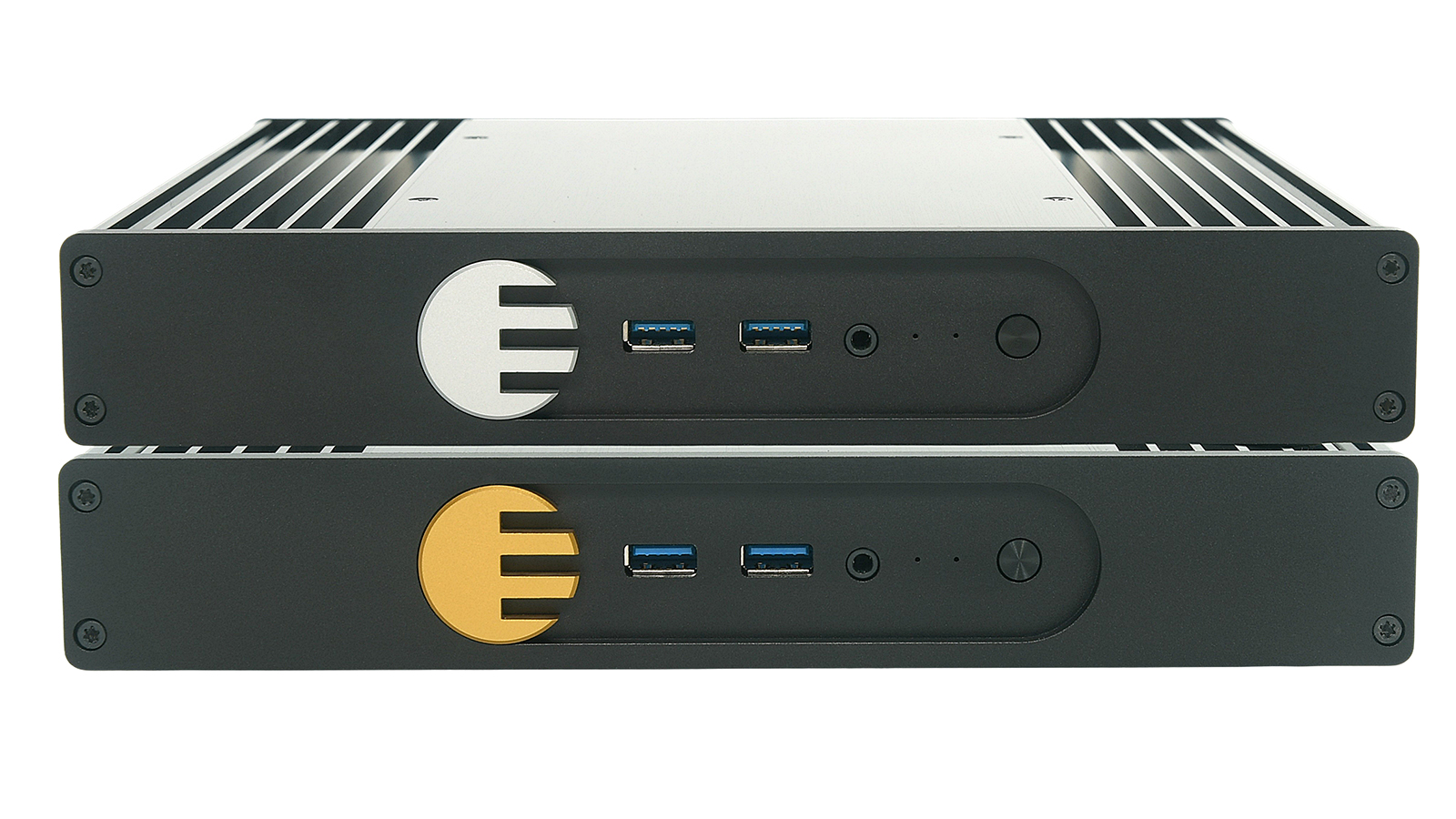
If we regard the man’s recordings under the Northstar label as being primus inter-pares in the hi-rez world, then his preferred music playing software surely deserves some investigation. Turns out that not only does the Zagreb-based software developer Euphony license Stylus for installation by users on hardware platforms of their choice, but it also offers Stylus as what might be called a turn-key package, pre-loaded onto an AMD Ryzen NUC, installed in a slim and passively cooled OEM chassis.
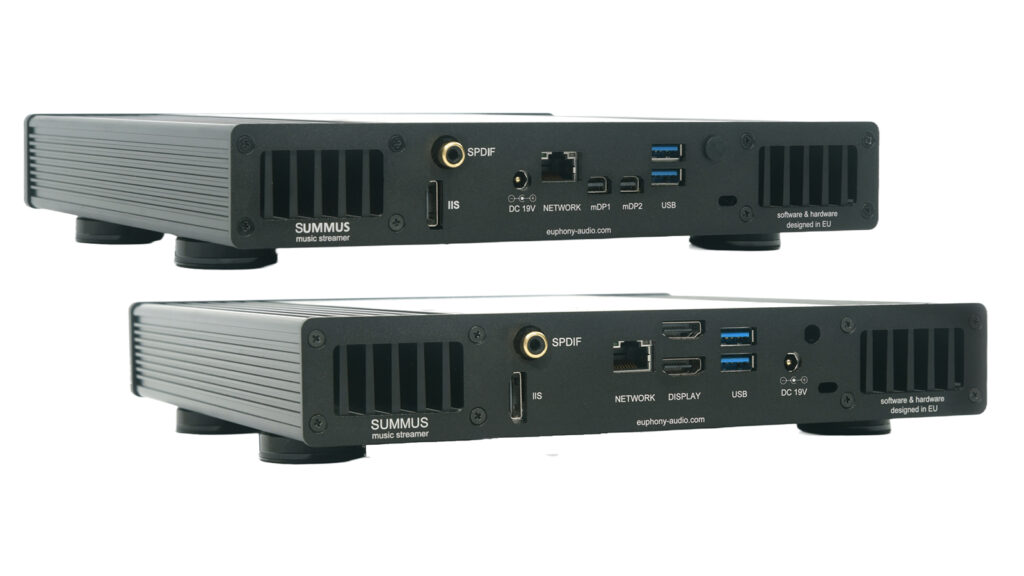
Euphony calls the server package Summus. It comes with a quality power supply and we can have it in two guises: the 2C and the 4C. The latter is a four-core i7 device designed to function as a one-box network player. It can run both the core Stylus application and the Stylus endpoint, loading both into RAM during boot-up. The 2C is a 2-core i3-based device intended primarily to work in partnership with a 4C in a dual-server set-up, in which case the 4C is designated to handle what might be termed the processor-intensive housekeeping while the 2C runs Stylus Endpoint and acts as a streamer-only. Separating the two functions like this liberates additional sound quality, says Euphony.
Euphony provided a dual-server Summus package for evaluation, at a currency-adjusted (at time of writing) retail price of around £7,200 plus carriage. That buys not just the servers and their accompanying iFi iPower Elite power supplies, but also a two-year license for Euphony Stylus. Thereafter, the Stylus subscription is €119 per year.
Indignity
Suppose we had to submit Stylus to the indignity of sweeping generalisation. In that case, we might characterise it as being towards the other end of the spectrum from the big gorilla in the field, Roon. Where Roon’s primary strength is its frankly unbeatably rich search and archive environment, Stylus declines to compete on terms. Still, it concentrates instead on extracting the best possible sound quality from music files.
Therein lies the compromise. The Stylus user interface is not as slick and certainly lacks the functional richness in its utilisation of metadata. Still, it does a perfectly acceptable job of providing access to a chosen streaming service account and any files stored on the Summus 4C’s SSD, a NAS, or a USB stick. Unlike some alternatives, it doesn’t group remotely accessed and locally stored music into a single holistic view; instead, we have to switch screen tags between ‘stored’ and, in the review system, ‘Qobuz’ (there are tags for Tidal and other providers as well).
Euphony’s assertion that Stylus is focused primarily on sound quality might sound like mere marketing spin. However, the review pair of Summus servers did indeed sound superior, with levels of dynamic, tonal and spatial detail beyond that achieved by alternatives that I have heard, including the big gorilla running on some seriously costly proprietary hardware – what we might call regular one-button players for the sake of differentiation.
Software
Whereas more expensive dedicated platforms seek to mitigate unwanted noise that obscures the music through the application of sophisticated power supplies, mechanical suspension, damping, clocking, EMI screening, and so forth, the Summus servers offer a complete contrast, addressing noise simply through the use of elegantly written software. Yes, they each come with a £300 external switching power supply, and Euphony has specified the makes and types of RAM and SSDs it regards as the best-sounding, but in most other respects, the servers are plain-Jane NUCs, the same as used for gaming and a multitude of commercial distributed computing tasks. Just over £7,000 might be thought rather a lot to pay for two NUCs pre-loaded with memory, 4TB of SSD storage, and a music player, but that’s fine; as buyers, we have a choice.
There are multiple technical reasons for the sound quality achieved by Euphony from such relatively workmanlike hardware, but in essence they boil down to software author Robert Devcic having made some very clever and informed choices about what the processors and memory in the servers are asked to do, when they do it, and the speed with which they do it. Just one example: cue up a file to play – and it’s the same whether it’s streamed from a remote location or a NAS or the internal SSD – the entire album is loaded into and played from RAM. There’s no unnecessary processor activity, drive-lashing or back-and-forth between the servers and the remote streaming service while the track is playing.
Plug and play?
Although the Summus servers are marketed by Euphony as essentially plug-and-play devices, they do require a bit more from the user than any dedicated network player. Euphony wishes us to understand that Stylus was created for the computer-literate user, perhaps in a semi-professional or professional environment, who desires to install it on their preferred computing platform and have access to a broad array of configuration options. Someone like Bert van der Wolf-Oude Avenhuis, for instance.
The user interface presents multiple levels. Remain at level one, and there’s nothing daunting. However, dig deeper…and a world of trouble awaits the ignorant with idle fingers. Fortunately, there’s a software remote control toggle that allows Euphony to intervene from Zagreb to resolve most issues. It’s probably best not to disclose how I know this.
Devcic’s colleague Dalibor Kasac observed that because self-install is the by far the bulk of the market for Stylus, Euphony hasn’t developed what we might call a ‘lite’ version. “We built a Swiss Army knife that gives customers all the tools to get the absolute best sound quality out of digital. None of the alternatives sound like it or are as flexible, but customers need to know that they are in charge of two Linux servers. We are not trying to compete with dedicated network players.”
The Summus servers come pre-loaded with Euphony Stylus, of course, but include Roon Core, HQ Player, several alternative end-points, and can be used as a renderer for any UPnP client. Also included is upsampling by Croatian developer Mozzaik that takes any DSD file to 256 and PCM to 768kHz. Short on functionality they are not.
Isolated
In the review system, the two Summus servers were configured to run Stylus. They took the place previously occupied by a Grimm MU1 running Roon, pulling, as the Grimm had, remote files from Qobuz, and local files from storage. Later, some files were moved to the Summus internal SSD. The rear panel of the Stylus player features isolated I2S, S/PDIF, and USB outputs, with the latter used to connect the server to the NADAC DAC.
Kasac had earlier volunteered that he abhors remote streaming from any of the providers. When I phoned him to say that the servers had arrived, he reminded me not to ‘waste my time’ with Qobuz, but go straight to playing hi-rez files from local storage if I wanted to evaluate Summus sound quality.
Devilment?
Naturally, I ignored his advice and went to my Qobuz account. Devilment? No. Familiarity. I wanted first to make a comparison with fresh audio memory. I’d chosen ‘Air’, the opening track on Paris Sketches (2008) by the under-appreciated French pianist Franck Avitabile.
On the well-recorded Paris Sketches, Avitabile’s partners are Manu Katche on drums and Pino Palladino on bass. Streamed from Qobuz for the first time via the Summus servers it sounded at once familiar yet unfamiliar, in the way that recordings can when rendered with more clarity than we are used to. There was considerably more spatial, textural and dynamic detail to heard. Katche’s brushes and snare rim clicks sounded better defined and more naturally energetic, Palladino’s restrained aesthetic and distinctive flat-wound string tone were rendered with richer tonal density, and Avitabile’s piano tone had greater dynamic weight and tonal and textural shading. It is a 16/44.1 recording, yet via the Summus pair the spatial qualities and transfer of detailed energy were seemingly at much higher resolution. The detail had been there all the time, it just took the Summus servers and Stylus to reveal it.
Supper time
So much for the entree. The main course was to be a feasting on Northstar’s series of Beethoven Symphonies recorded by Bert van der Wolf-Oude Avenhuis in DXD. He adopted DXD as his recording format in 2005, initially using custom dCS beta-firmware, and more recently Merging Technologies platforms and what he describes as ‘basically, Gaussian open filtering.’ Pyramix DSD and CD transfers of his recordings are available from his website, but if our DAC will accept DXD files then he’d much rather we listened in DXD because, as he says, we are then listening directly to the master.
For the Northstar Beethoven Symphony series, he collaborated with conductor Jos van Immerseel and the Bruges-based period instrument orchestra Anima Eterna. I queued up the 5th Symphony and noticed the rate field in the NADAC’s display change to glow in vibrant magenta, displaying the magic number 352.8kHz. Thoroughly familiar with this recording, having previously purchased a download to install on the Grimm MU1’s internal SSD, I was now confronted with a vivid realism and level of resolution far beyond the usual experience. Transient gradients were notably more subtle and nuanced, the dynamic range appeared to have widened, tonal detail became richer and more complex, dynamic weight felt more natural and expressive, and the soundstage had transformed into something cavernous, with strikingly precise placement of musicians.
Three elements
There are three new elements at play here: the Euphony operating system, the Summus servers themselves, and, of course, the Stylus music-playing software. Is it possible, or even helpful, to hazard a guess as to which makes the greatest contribution to what we are hearing? I think not.
As a reviewer who has the luxury of selecting my subjects, I base my choices on whether the specification or provenance suggests that the product warrants attention. I’ve made some mistakes over the years, but the Euphony Summus servers running Stylus are not among them. At a third of the cost, they outperform network players priced over £20,000. If we are willing to accept the accompanying compromises – a music player interface that is less sophisticated than some alternatives, and the exposure of deep technical settings to both the informed and the uninformed – then they merit the highest sonic recommendation.
Technical specifications
- Type: Euphony Audio Summus 2C and 4C
- Stylus music player license (first 2 years included with servers) €119
- Price: Server 2C €2,980, Server 4C €3,980; Dual PC €6,860
- US and UK prices calculated from Euros at time of purchase
Manufacturer
Euphony Audio
UK retailer
Winters Audio
+44(0)1328 878313
Trending Articles
See all
Computer Audio Design CAT computer audio transport
- Oct 13, 2014
Trending Articles

By Kevin Fiske
More articles from this author
Read Next From Review
See all
Reiki Audio SuperSwitch X/Pro X PSU
- Oct 06, 2026
Audiobyte SuperVOX
- Oct 06, 2026
Unitra WSH-805
- Sep 29, 2026
Wilson Audio Sabrina V
- Sep 29, 2026