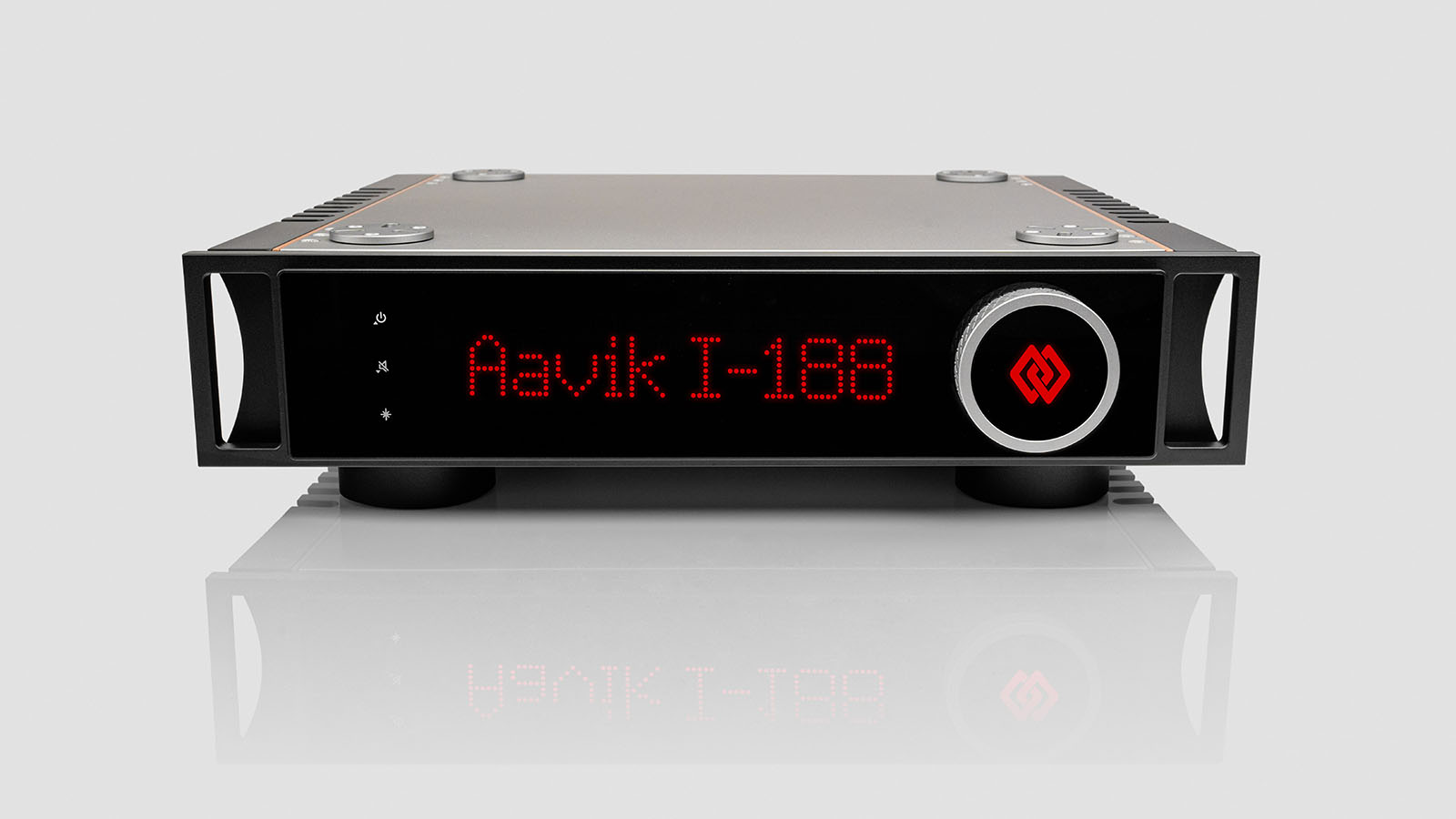
Part of the I-x88 series, the Aavik I-188 is an integrated Class D amplifier delivering 300 watts into 8 ohms, priced at £15,000. It lacks a streamer, DAC, tone controls, and any distracting features. Instead, it focuses solely on being a high-quality amplifier. Above it is the I-288 at £20,000 and the I-588 at £25,000. Both are 300-watt Class D models. Importantly, the top of the range is the I-880. That model is a 200-watt Class A amplifier costing £67,000. There are also U- (Unity) variants featuring a built-in streamer and DAC. Additionally, Aavik also produces pre- and power amplifiers. They also offer standalone DACs, streamers, and phono stages.
It’s worth setting the scene, but apologies, Hamlet fans… nothing is rotten in the state of Denmark. There have never been so many European hi-fi brands imported into the UK. In particular, Denmark contributes more than its fair share. There are well-known names such as Audiovector, Dynaudio, Raidho, Gryphon, Peak, DALI, Jamo, and, indeed, B&O.
The Fab Four
You can add four more names to that list – Aavik, Børresen, Ansuz, and Axxess. These are all brands of Audio Group Denmark, which was founded at the end of 2020 by Lars Kristensen and Michael Børresen. The son of one of Denmark’s first high-end audio retailers, Kristensen went on to manage his store. He also worked for Nordost.
It was in his hi-fi shop that he first met Børresen, who was studying to become an engineer, and the two hit it off. Soon they developed amplifiers under the name Aavik and cables under the name Ansuz. Kristensen and Børresen concentrated on these brands starting in 2017. Later they added the speaker brand Børresen. The Axxess brand was launched as an entry-level range into two-channel stereo.
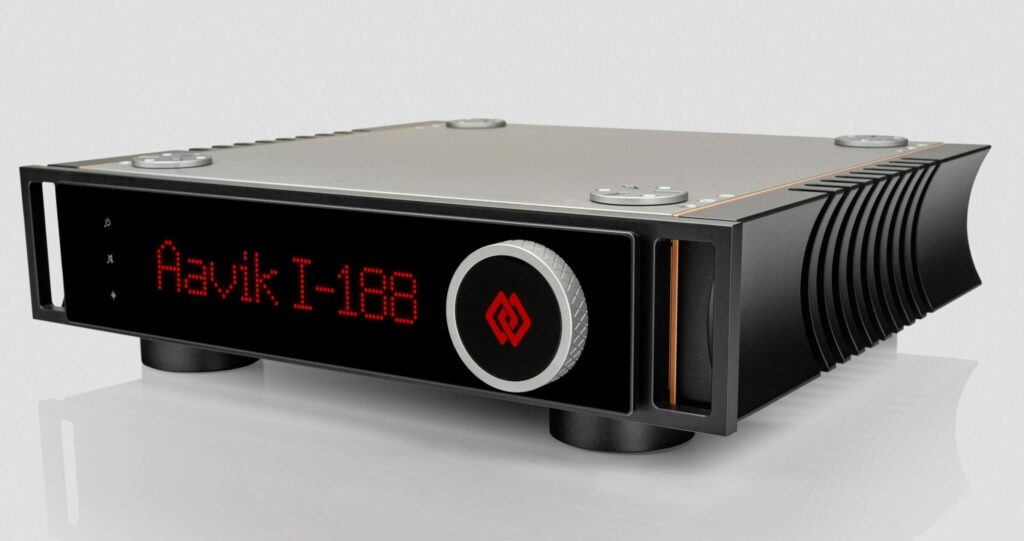
In 2021, Flemming Rasmussen, the former owner of the Danish high-end hi-fi brand Gryphon, joined the team, and the Aavik I-188 reviewed here is the direct result of his collaboration with Børresen.
Noise attention
Aavik has paid particular attention to the various types of noise that can affect the performance of their amplifiers. As a Class D design that utilises modules purchased from Pascal, the transistors operate as switches rather than linear gain devices. The analogue signal is converted into a stream of pulses using pulse width modulation (PWM). After amplification, it is then reconverted to analogue with a low-pass filter. These designs are generally more efficient than Class AB or Class A amps. Furthermore, Aavik told me they use Class D in the I-188 as it would have been impossible to fit a 300-watt Class AB amp in the case. They added that they believe using Class AB “would most likely provide no benefits to audio quality”.
The I-188 uses what Aavik calls a resonant mode power supply. Class D amplifiers typically have switch-mode power supplies, which can generate high-frequency noise. However, Aavik says their supply “adjusts its frequency to increase power density, ensuring high peak currents without distortion” and is much quieter than a conventional switch-mode power supply.
It’s Tesla time
Any high-frequency noise from the power supply and the PWM conversion circuits is managed by what Aavik calls Tesla coils, strategically placed at key points in the circuitry. They are also employed to filter out noise picked up by the wiring.
These Tesla coils comprise two spirals. The idea is that any noise component that creates a magnetic field in one coil will also produce one in the opposite direction in the counter-wound coil, which they claim cancels out. Some Tesla coils are active, generating pulsating signals at specific frequencies that are sent in anti-phase and are said to “significantly amplify the music signal and eliminate the background noise floor.” The I-188 has 132 Tesla coils. Moreover, more advanced models use even more Tesla coils.
The materials used in the amplifier case are also selected to help isolate the internal circuitry from both electrical and physical interference. In the I-188, the chassis is a laminate construction of stainless steel, MDF, and copper. The copper layers on the inside create a 360-degree internal shield. These materials were chosen for their ability to “prevent magnetic, resonant and microphonic impacts.”
As you move up the range, models begin to use some more exotic materials, such as titanium, tungsten, and zirconium. Aavik also cryogenically treats specific components and parts. This process is known to improve the crystalline structure of metals, but not in the I-188.
Grip and gusto
So much for the technology inside the Aavik I-188, but will it pay off in terms of sound quality? To test this, I connected the I-188 to a pair of Russell K Red 150Se floorstanding speakers. I also used an Audio Note CDT-Five CD transport and DAC 5 Special as my source. Moreover, I used an Audio Note TT3/PSU3/Arm Two/Io1 front end, connected through an S9 transformer. I also used a Gold Note PH-5/PSU-5 phono stage.
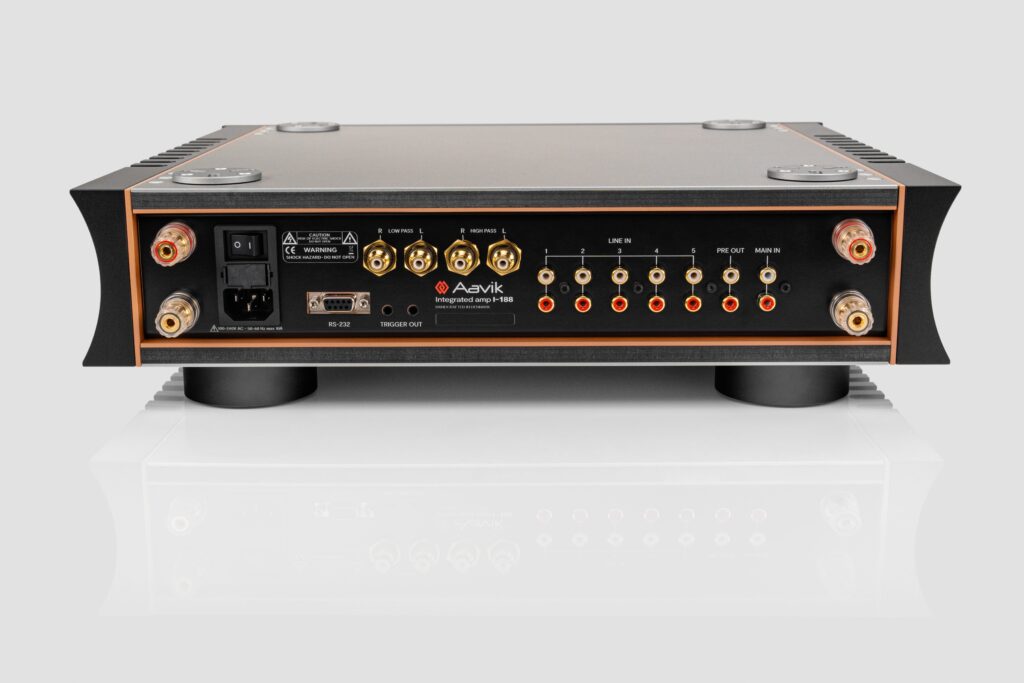
The Aavik was a pleasure to use. It has only a volume control and input selector on the front panel, and the display is bright and clear, though you can dim it or turn it off if you prefer. The volume control turns smoothly and freely, inspiring confidence. The build quality and finish are excellent. On the back, there are five line-level RCA inputs, an RCA pre-out that can be used for a separate subwoofer or power amplifier. There is also a primary input that allows you to operate just the power amplifier section with a separate preamplifier.
To familiarise myself with the I-188, I started with the instrumental ‘Being With You’ from George Benson’s In Your Eyes album. Here, I was struck by the presence, sharpness, and clarity of the Fender Rhodes piano in the intro. Benson’s guitar was also well-voiced, and his melodic, soulful tone and quick-fingered technique were well captured.
Beautiful bass
Next up was ‘Sunny Side of the Street’ from singer/songwriter/piano player Ben Sidran’s Enivré d’Amour CD. This track features a beautiful bass line that exudes a distinct swagger, and Aavik conveyed that with control and poise. Meanwhile, Sidran’s DX7 synth had great leading-edge bite and presence. His vocals were expressive and articulate, and the percussion had good detail and syncopation. The track moved well, and the Aavik sounded clean, detailed, dynamic and rhythmically sharp.
I am a big fan of guitarist Peter White and love his signature sound. So I was eager to listen to his cover of Johnny Nash’s ‘I Can See Clearly Now’ from his Groovin’ album. From the outset, the keyboards and percussion were sharp and syncopated, and White’s acoustic guitar was rich in subtle nuances that highlighted his technique. Furthermore, the lilting, reggae-style bass line that supports and propels it was also tight, tuneful and controlled on the Aavik. Overall, it was an excellent performance.
Diction and enunciation
Randy Crawford has a superb voice, and I just had to listen to the beautiful ballad ‘You Bring the Sun Out’ from her Secret Combination album. The strings in the introduction were very well presented with plenty of space around them; the piano was open and detailed. However, it was her voice I wanted to focus on – her excellent diction and enunciation, where you can hear the final ‘t’ on ‘you bring the sun out’ and the final ‘p’ on ‘to warm my life up’. The Aavik captured that well.
Returning to the jazz genre, I listened to guitarist Larry Carlton’s superb instrumental cover of the Doobie Brothers’ ‘Minute by Minute’ from his Discovery album. This track features a wonderful, sinuous bass line that propels the piece forward, and Aavik conveyed that with excellent grip and enthusiasm. Carlton’s impressive guitar technique was also effectively captured; the saxophone solo was well voiced. As a result, the track flowed smoothly and made musical sense.
Syncopation
I then played the track ‘Westward’ from the Eric Marienthal/Chuck Loeb Bridges CD. It features one of the most wonderfully complex, syncopated, and delicate percussion parts you could ever hope to hear, and this was well conveyed by the Aavik – delicate, detailed and dynamic. Marienthal’s saxophone was well-voiced, and his remarkable technique was effectively captured. The same goes for Loeb’s skilled guitar playing.
The Aavik I-188 impressed me from the first few bars of the initial track I played. It has a clean, detailed, dynamic and highly musical sound. At no point during my listening did it detract from my enjoyment of the music. The I-188 offers excellent insights into what each musician is playing and how. Additionally, it brings them all together as a musically coherent whole. It is beautifully made, easy to operate, and has more than enough power for any room or speaker setup. I wholeheartedly recommend it.
Technical specifications
- Type: Class D integrated amplifier
- Inputs: Five RCA unbalanced line inputs, RCA power amp in
- Outputs: Unbalanced preamp/subwoofer output, one pair of speaker binding posts
- Power output: 300W into 8 ohms, 600W into 4 ohms
- Frequency response: not quoted
- THD: 0.0028% (1W, 1kHz, 8 ohms)
- Total intermodulation distortion: 0.002% (10W, 8 ohms)
- Dimensions (WxHxD): 440mm x 117.8mm x 393.5mm
- Weight: 23.3kg
- Price: £15,000, €15,000, $20,000
Manufacturer
Audio Group Denmark
UK distributor
Signature Audio Systems
+44(0)1959 569842
Trending Articles
See all
Krell Vanguard integrated amplifier
- Apr 07, 2015
Trending Articles

By Chris Frankland
More articles from this author
Read Next From Review
See all
Eversolo T8
- Oct 13, 2026
Acoustic Energy AE Active
- Oct 13, 2026
Reiki Audio SuperSwitch X/Pro X PSU
- Oct 06, 2026
Audiobyte SuperVOX
- Oct 06, 2026