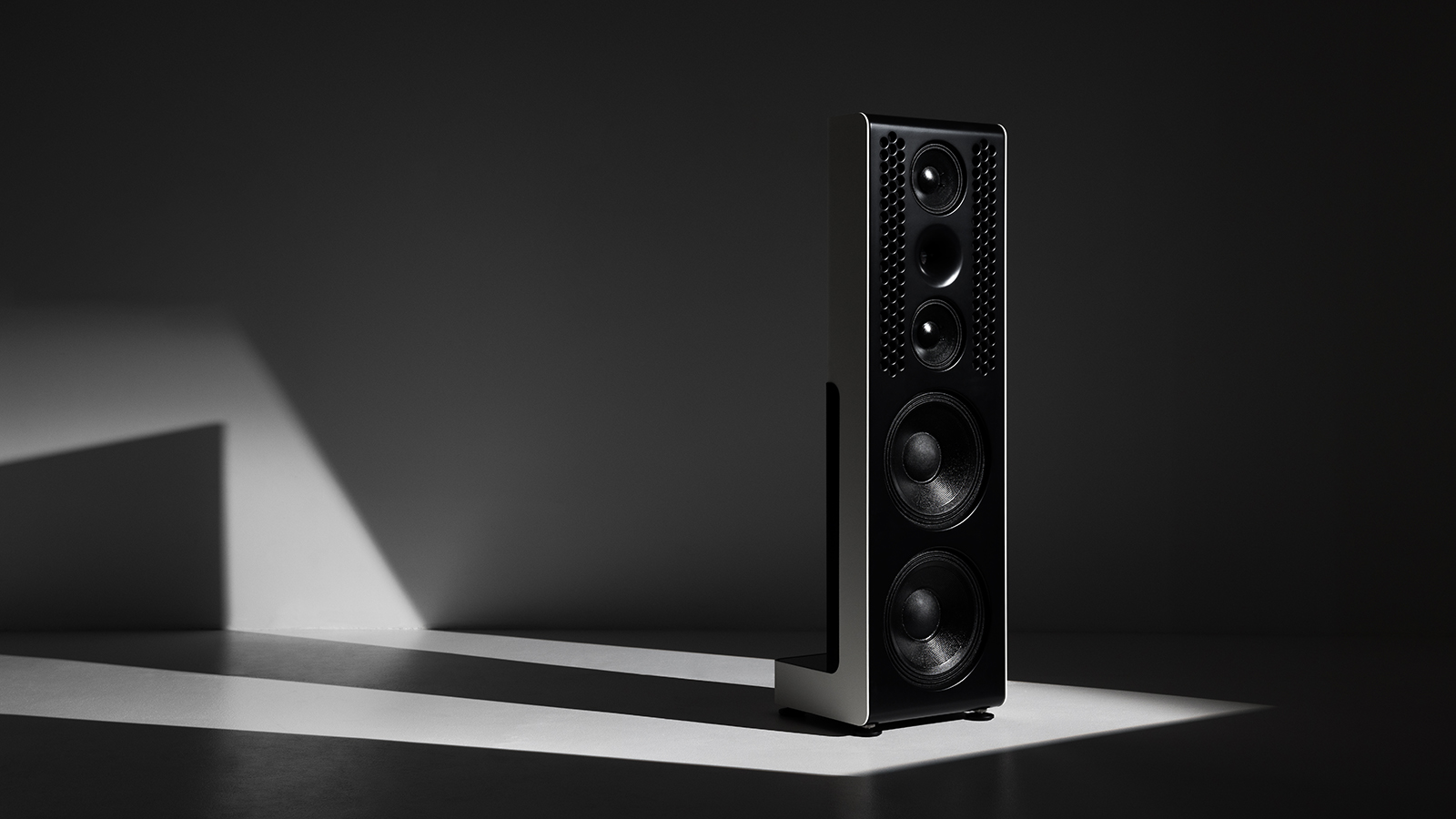
Silent Pound is one of the quietly spoken heroes of the Warsaw audio show. The Lithuanian company has been showcasing its constant-directivity loudspeaker designs in prototype form and beyond for several years. However, at the 2024 show, the company revealed its Challenger II floorstander and Bloom stand-mount in such a striking way that I had to learn more. Both are fascinating, but the Challenger II arguably represents a more profound proof of concept.
Let’s start by mentioning the name first. As a child of the Carry Ons (my mother starred in nine of the films), I sometimes get to use the ‘1960s euphemism’ card. And the name ‘Silent Pound’ embodies that spirit. The name has a playful, cheeky quality that nearly every British reader will think of Barbara Windsor’s giggle or Sid James’s cackle. Still, there’s nothing wrong with getting your pair of Silent Pounds out, matron!
Constant directivity
With titter mode now switched to ‘off’, the most immediate and noticeable part of the Silent Pound Challenger II’s design is its ‘constant-directivity’ section for midrange and high frequencies. Constant directivity means that the loudspeaker’s ability to radiate sound at a specific frequency remains steady. It also implies a consistent frequency response regardless of the listener’s position, so even those significantly off-axis can enjoy good sound. However, it also benefits the solo listener sitting in the centre, as it can help reduce room reflections and minimise the room’s effect on sound quality.
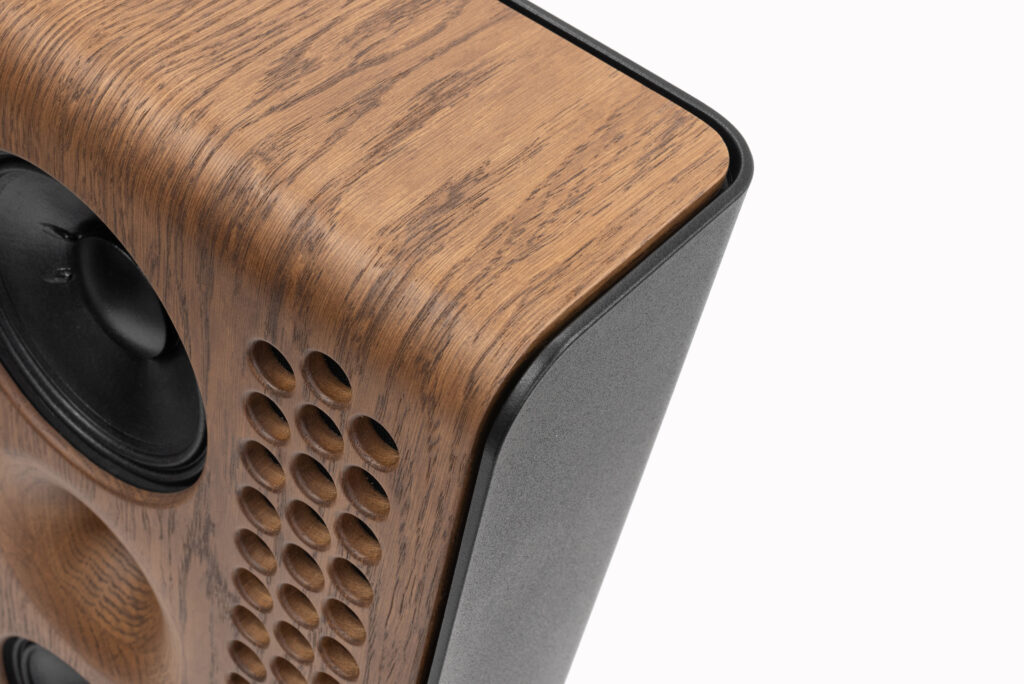
To achieve this constant directivity, Silent Pound uses a 25mm compression driver tweeter flanked by two 160mm midrange units in their own enclosure. This meshes perfectly with the drivers below. From the front, everything appears normal, and you might mistake it for a regular floorstander. Then you notice that the Challenger II loudspeaker is barely deeper than the magnet assembly behind the driver basket. That’s because the company’s specially made 300mm bass drivers operate in an open baffle.
Say that again?
Let’s run that again because it’s so extraordinary. The front baffle features two 300mm bass units, two 160mm midrange drivers, and a one-inch compression tweeter with a CNC-milled horn arranged in an MTM configuration. At the rear, while this MTM section remains in its own cabinet, the bass enclosure is open at the back. The baseboard houses the crossover, with a clear tempered glass cover on display, much like many mid-engined supercars. This is not a delicate setup; the entire loudspeaker weighs a hefty 60kg and is built on a steel chassis, bonded with an internal MDF frame, finished with a front panel of either MDF or real oak.
Nor is this design the result of either ‘loudspeaker cookbook syndrome’ (“We’ve never tried that before, let’s give it a go!”) or attempting to combine two contradictory designs, like a poor engine swap in a Vin Diesel film.
Instead, this is the result of extensive experimentation, mathematical calculations, and modelling. The purpose of these is to minimise room interaction. After prolonged testing, the Silent Pound team found that an open-back configuration maintains directivity and reduces room interaction in the bass.
Predictable interactions
Higher frequencies in any loudspeaker have more predictable interactions that can be addressed by room treatment or DSP, but balancing bass weight and accuracy without significant room adjustments (and usually additional bass systems) proved difficult with conventional box designs. The company ultimately concluded that an open-back configuration for the low frequencies maintains directivity, thereby reducing room interaction. It also provides precise control over low frequencies without occupying much space.
Many assume that a cabinet-less design involves creating a dipole model, but this is a mistake. According to Silent Pound, such a change would distort the soundstage due to rear reflections. Instead, the Challenger II features an enclosure that opens to the front and aligns the midrange directivity with the low frequencies. This helps balance internal and external pressures, reducing ‘acoustic loading’ effects that can compress driver movement and cause distortion. By enabling the driver to operate freely, it improves impulse response, lowers harmonic distortion, and enhances dynamic range.
Untroublesome
Silent Pound claims the frequency response is flat from 30Hz to 18kHz, they have a nominal impedance of 4 ohms, and are 88dB sensitive. While this suggests an untroublesome load for almost any modern amplifier design, as ever, it’s more about quality than quantity in amp choices. There is a common trope among modern high-end loudspeaker designs: produce a loudspeaker with good on-paper figures that mask an amp-crushing low-impedance load. That’s not the case here – the 3.2Ω minimum impedance suggests an overall mostly amp-friendly load – but it is the kind of loudspeaker that benefits from some additional bottom-end heft and refinement. There’s also a rule of thumb that says the bigger and more complicated the crossover, the harder the loudspeaker is to drive.
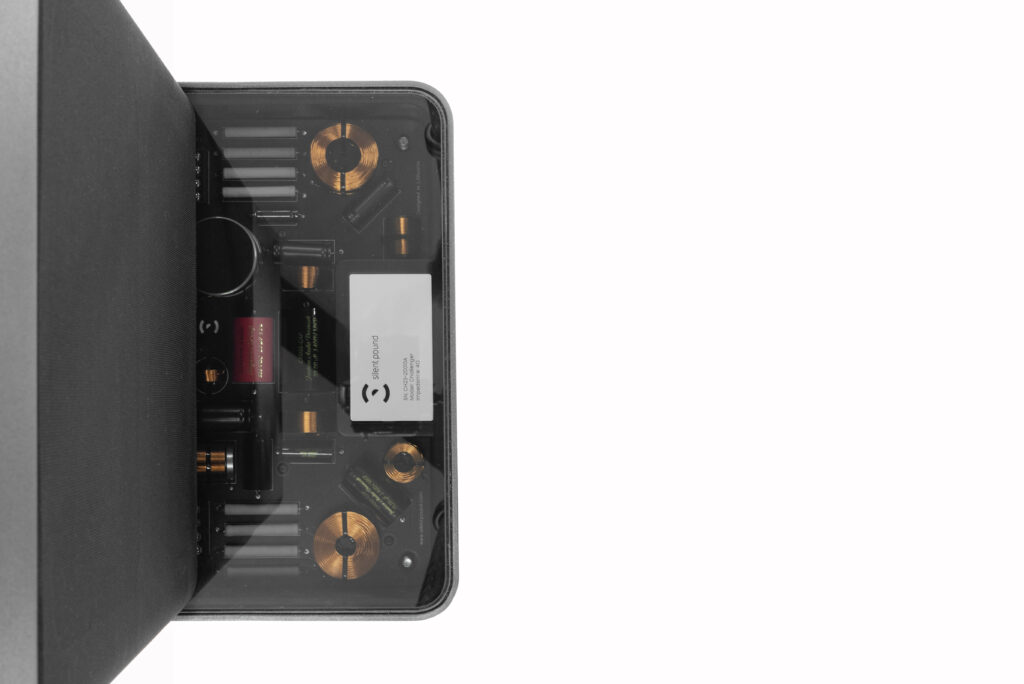
While that seems to have as much credibility as checking a car’s performance by kicking its tyres, it does hold that some of the most demanding loudspeaker loads have the most elaborate crossover networks. In particular, its use of high-order (third and fourth order) slopes in the crossover to filter unwanted frequencies and prevent driver operation in the ranges where cone break-up occurs. That puts it in top-end integrated or pre/power amp territory.
Just one sentence
The Silent Pound Challenger IIs’ place in loudspeaker design can be summed up in a single sentence. There’s never been anything quite like it before. Even if there has been a lot of development since Rice met Kellogg, given that their basic parameters of the dynamic loudspeaker were established in 1924, that’s impressive. But novelty means nothing if it doesn’t sound good.
There are two sides to this: the direct observational and the emotional. The observational side notes that the dispersion properties of the loudspeaker mean that, while it performs best in the sweet spot, the sound throughout the room remains highly consistent. Then there’s the coherence from deep bass to high treble, both in terms of frequency response and tonal quality. Bass, in particular, is praised for its precision, depth, and accuracy, making many conventional dynamic designs sound ‘bloomy’ or ‘flabby’ and less communicative and coherent. It also highlights how poorly most bass integrates with the upper registers.
As you go through the list of observational parameters (vocal articulation, timbral accuracy, soundstaging and solidity), the Silent Pound Challenger II performs well in nearly every category. There’s a slight – and I mean very slight – reduction in dynamic range at quiet listening levels, but if you listen at normal to ‘healthy’ volume levels in typical European-sized listening rooms, it provides all you need.
Profound music
Then there’s the musical aspect, which is profound. Once again, that extra insight into the bass it provides underpins everything, but surprisingly, the first time you notice this is with music that doesn’t feature a notable bass performance. Loyle Carner’s ‘Homerton’ [hugo, EMI] is a perfect example; it has a chill, trip-hop backbeat, but not one with a deep, powerful bass line. However, the Silent Pound Challenger II opens up the track, better separating vocals from backing vocals, while maintaining the all-important sense of ‘vibe’ throughout. It offers more detailed bass than many loudspeakers, yet that information doesn’t detract from the music. Playing something truly unconventional with an almost dubstep-like bass (‘Hollow’ by Björk, remixed by 16 Bit on her 2012 Bastards album, One Little Indian Records) highlights this additional deep-bass detail and demonstrates just how capable these speakers are at handling complex and abstract music.
Moving from the ridiculous to the sublime, playing Bach’s Goldberg Variations [Gould, Sony] and something else shines through; although the loudspeaker does not hide Gould’s noisy sing-along, it sits better in the music, suggesting these speakers are doing something very, very right.
Extreme times
We live in a time of extremes. A loudspeaker like the Silent Pound Challenger II doesn’t have the infrasonic depth or scale of a behemoth that costs as much as a house, but in real-world rooms, it delivers a full-range sound as good as it gets. They need some driving to really show what they are made of, but that’s just what you need to give your music a Silent Pounding!
Technical specifications
- Type: 3.5-way loudspeaker
- Speaker drivers: 25mm compression driver tweeter, 2x 160mm mid-woofers, 2x300mm woofers made for Silent Pound
- Sensitivity: 88dB
- Impedance: 4Ω, Minimum Impedance: 3.2Ω
- Price: £27,995, €27,999, $34,999
Manufacturer
Silent Pound
UK distributor
RAD UK
+44(0)2895 575090
Trending Articles
See all
Acoustic Energy Corinium floorstanding loudspeaker
- Dec 23, 2024
Trending Articles

By Alan Sircom
More articles from this author
Read Next From Review
See all
Reiki Audio SuperSwitch X/Pro X PSU
- Oct 06, 2026
Audiobyte SuperVOX
- Oct 06, 2026
Unitra WSH-805
- Sep 29, 2026
Wilson Audio Sabrina V
- Sep 29, 2026