The Autobiography by Wilson Audio is the Autobiography of Wilson Audio. It’s also the Autobiography of the listener. Those three elements intersect instantly, but it takes time to put that into words.
That doesn’t mean an excuse to wax lyrical, although that’s something of an inevitability. No, it’s that your first reaction when sitting in front of the Autobiography is quiet, intense processing. I sat in front of the Autobiography with three other audio reviewers. At least three of us are known for being loquacious. If there’s a witty or sarcastic comment to be made, at least two of us will try to make it with the slightest provocation. And all four were silent, just drinking in what the Autobiography could do. It took a good ten minutes before anyone could say anything; not just about the loudspeaker… anything.
This is not a review. A handful of dealers and reviewers flew to Utah in late April to see the new Autobiography launched at the nearby Springville Museum of Art, learn more about it at the Wilson Audio factory, and listen to it in the Provo listening room, built by Sheryl Lee and the late Dave Wilson. The listening session ran for a couple of hours, with a small group of four or five in the room taking it in turns to sit in the hot seat.
Jet lag advantage
I’ve turned severe jet lag to my advantage here. The embargo on discussions about Wilson Audio’s Autobiography lifted while I was somewhere above the Labrador Sea. By the time I landed, all I had were a few brief notes, the start of a nasty cold, and a burning desire to sleep for a week. Rather than simply deliver the same as everyone else, just a few hours late, I decided to check the comment sections and address some of the many ‘observations’ that are inevitable when a company releases a $780,000 loudspeaker.
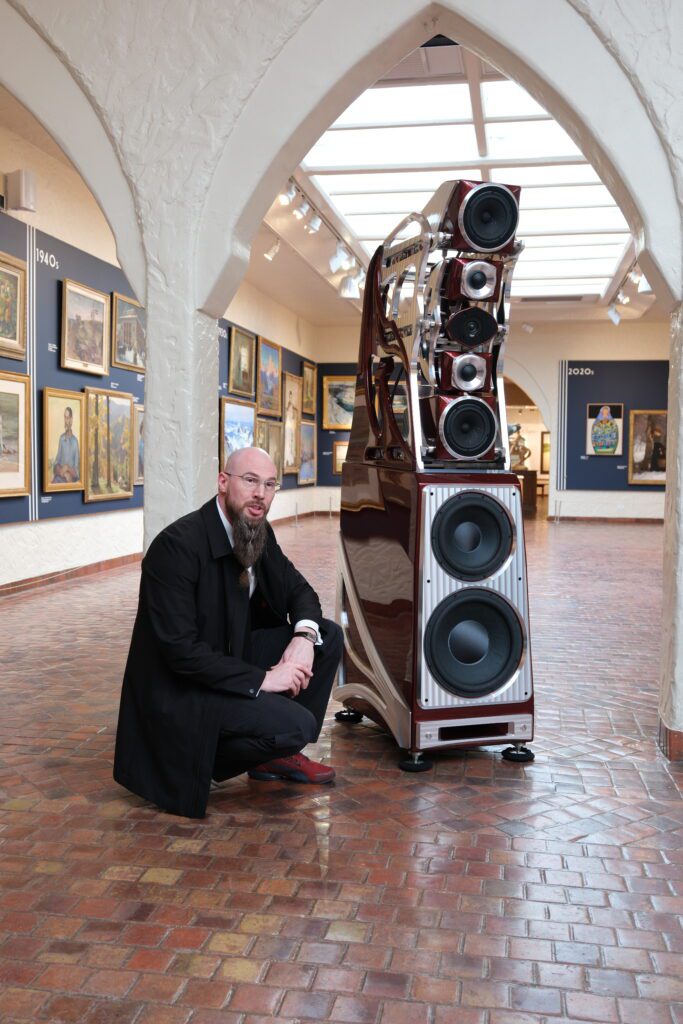
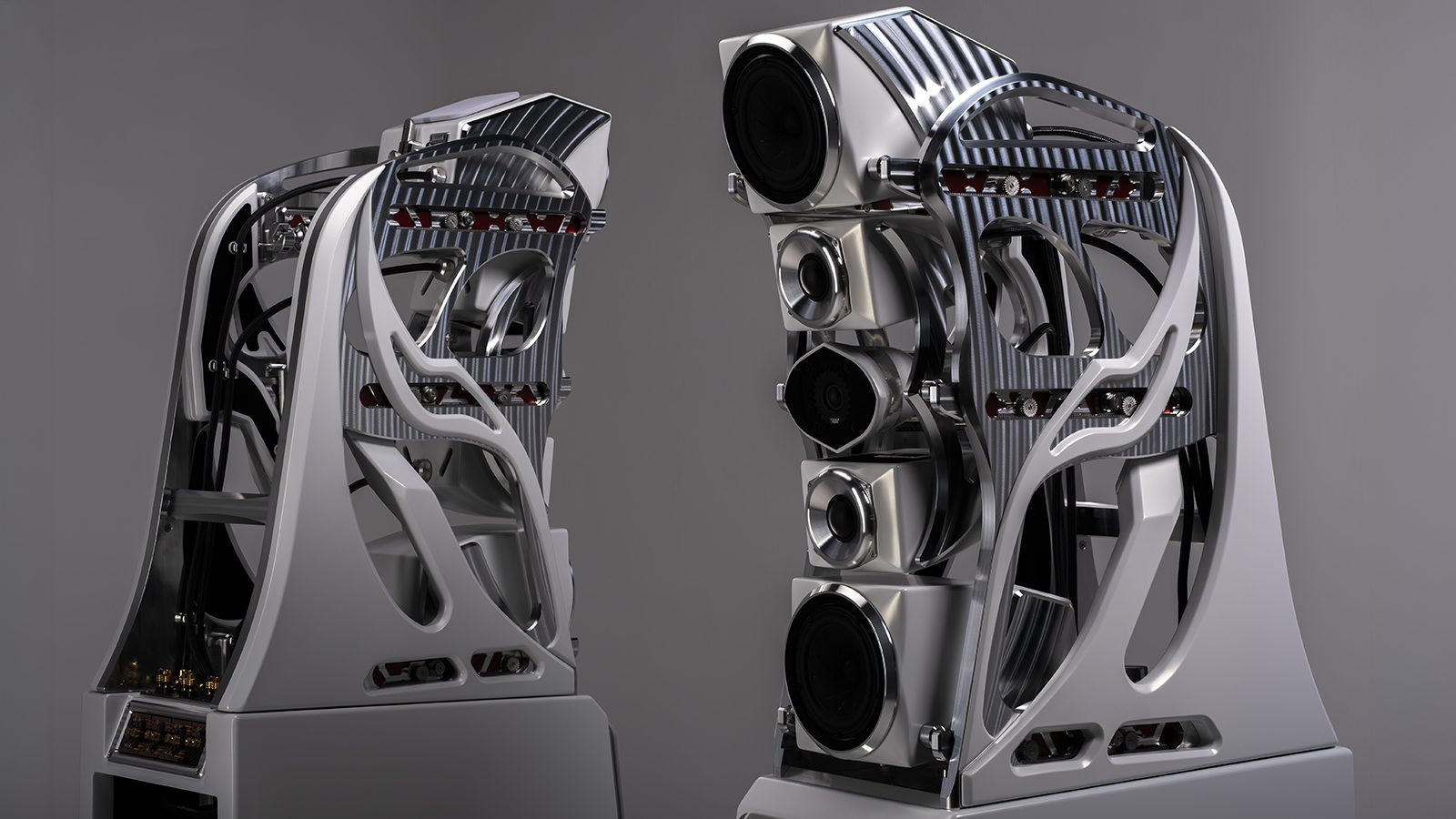
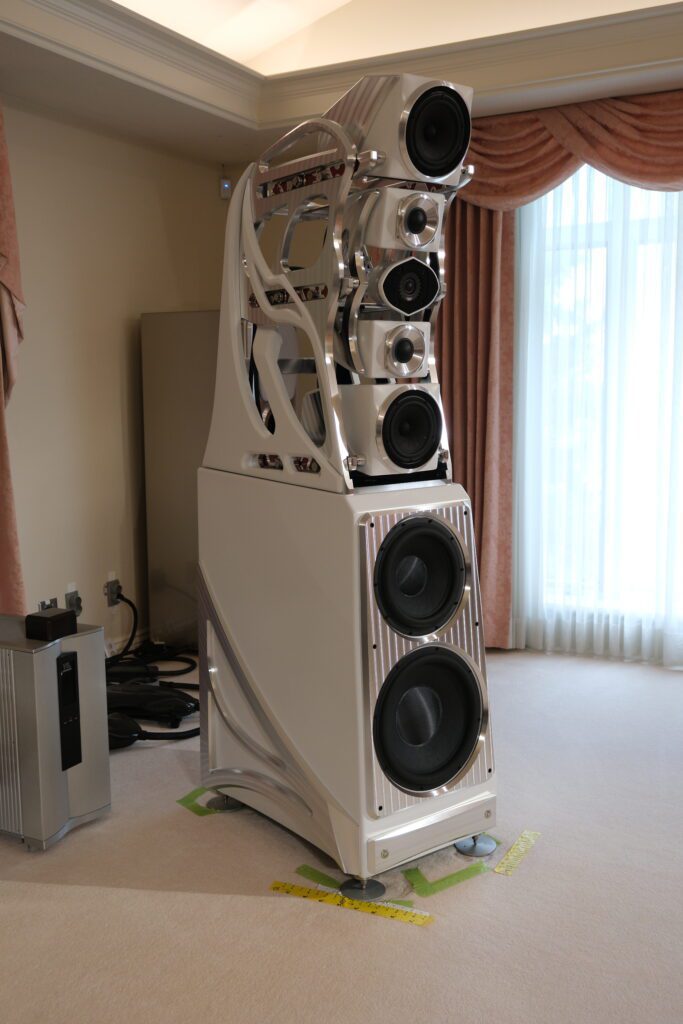
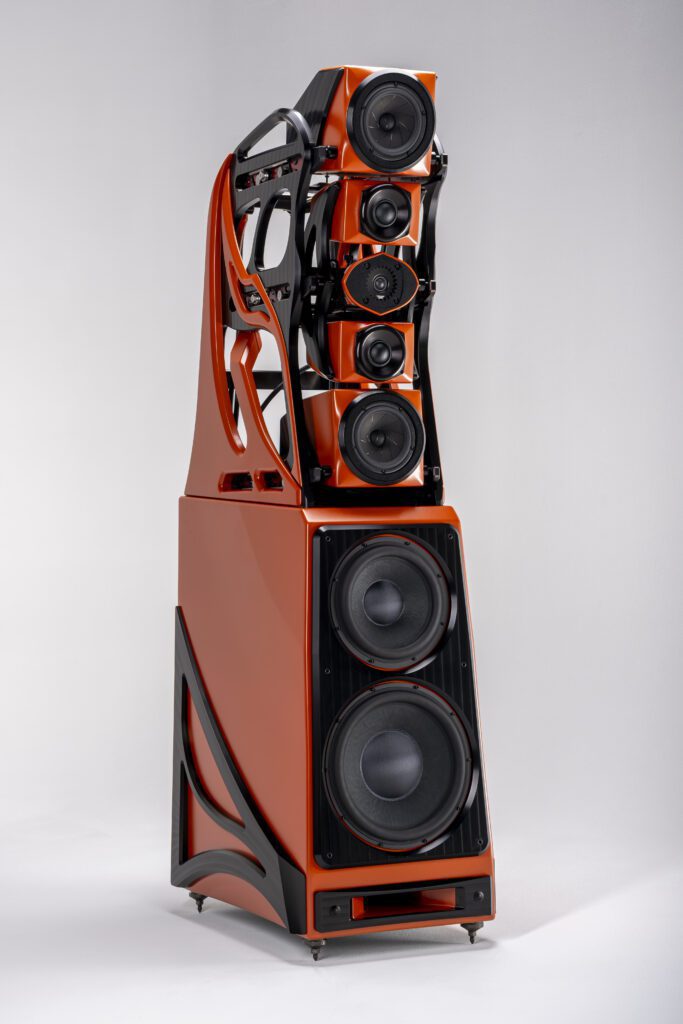
By now, Wilson Audio’s Autobiography itself is something of a ‘known unknown’. The design, architecture, and basic specifications are the ‘known’ part, already discussed at length. So, I’ll keep it brief; it’s a six-way (ish) design with a vertical midrange-tweeter-midrange array flanked by two 7” ‘Pentamag’ lower-midrange drivers, and an inverted-dome rear-firing tweeter in the upper lower-midrange cabinet (read that again; it does make sense… honest).
The upper gantry
These drivers all sit in an upper gantry with an exceptional amount of adjustment for time-alignment. The lower cabinet, on which this intricate array of cabinets and verniers sits, holds 12” and 15” bass drivers and features a refined version of the clever front-or-rear vent found in the Chrononsonic XVX.
Each driver has its own ‘firsts’, but the Convergent Synergy Laser Sintered tweeter and the twin 2” MID (Midband Integration Driver) dome designs are particularly interesting. The tweeter sits in a clever 3D-printed housing with a rear wave chamber that acts almost like a tiny anechoic space, improving energy dissipation and reducing internal reflections. Meanwhile, the upper-midrange dome sits in a waveguide that makes it look like the dustcap of a larger midrange cone. It’s only when you see it on models with metal trim details that you realise the ‘cone’ is the driver’s faceplate, and you begin to see it for what it is.
Five alive
That said, the five-ALNICO-magnet arrangement at the rear of the lower-midrange units is also an exciting new development, improving on the QuadraMag drivers used elsewhere in the Wilson Audio line-up.
All these drivers are made to Wilson’s exacting specifications, and none has been used in any previous Wilson Audio loudspeaker. With the company’s trickle-up/trickle-down ethos, in which the technology and drivers of previous models filter through to the next, there has never been an ‘all-new’ Wilson driver complement since the company’s first WAMM. So, ‘off-the-shelf drivers’ or ‘mid-range Scanspeak units’… yeah, riiiight!
Autobiography sits at the top of the Wilson Audio range, yet it stands 8 cm/3.15” shorter than the WAMM Master Chronosonic. Don’t get too complacent. Even without spikes, the Autobiography still stands at 206 cm, which is a little over 6’ 9” or 0.954 standard Shaqs. Much of this weight is borne by the enclosure, with the gantry uprights and midrange front baffles made from Wilson’s own H-Material, vibrationally sensitive components made from its V-Material, and the cabinets made from X-Material. These combine to deliver optimal damping, structural integrity, vibration control, and stiffness in the right parts of the loudspeaker.
The dimensions and driver complement are just the start of the story, however.
Just look at it
Let’s be clear about the Autobiography. With a finish that places it in the same class as Patek Philippe and Rolls-Royce, the prospective purchaser will spend a long time simply looking at the loudspeaker. It’s a voyage of discovery, and each time you look at the loudspeaker, you find something new. The different kinds of guilloche (engine turning) on the metalwork are inspired, sometimes in straight lines, sometimes curved around a point. And in the metal band that joins the two sides of the 3D-printed tweeter housing, there is an almost prismatic geometric pattern.
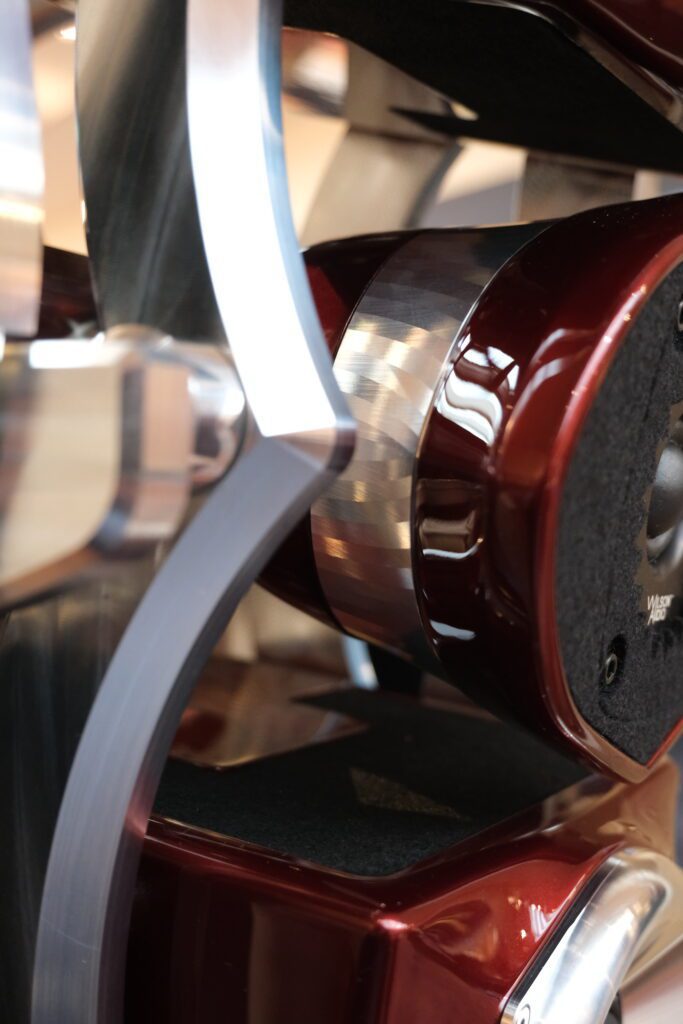
Then there are unheard-of levels of adjustment, and it’s here that horology sort of steps aside; there are gear wheels, bridges and verniers, but no train of wheels or parts that need maintenance and lubricated jewels to keep it running. There’s also no need for a desk full of watchmakers’ tools to adjust the Autobiography. All of it can be done by hand, eye, and ear. And, at 372 kg/821 lbs/2.53 Shaqs per speaker, quite a few elves trained in piano moving and loudspeaker installation.
Easy unlocking
Wilson Audio has made its adjustments easy to lock and unlock. Take the rear MTM alignment cam. It is adjusted by turning a metal cylinder with a small, fold-out lever. Fold the lever back, and the toothed rear of the cylinder locks into place. The action of that alignment system is ‘buttery’ smooth… and irresistible. I will lay bets that every Autobiography owner will unlock the cylinder and give it a few turns. Fortunately, Wilson thought of this, and the setup comes with two sets of data sheets for each customer, so both they – and their dealer – know the correct alignment points for the loudspeakers.
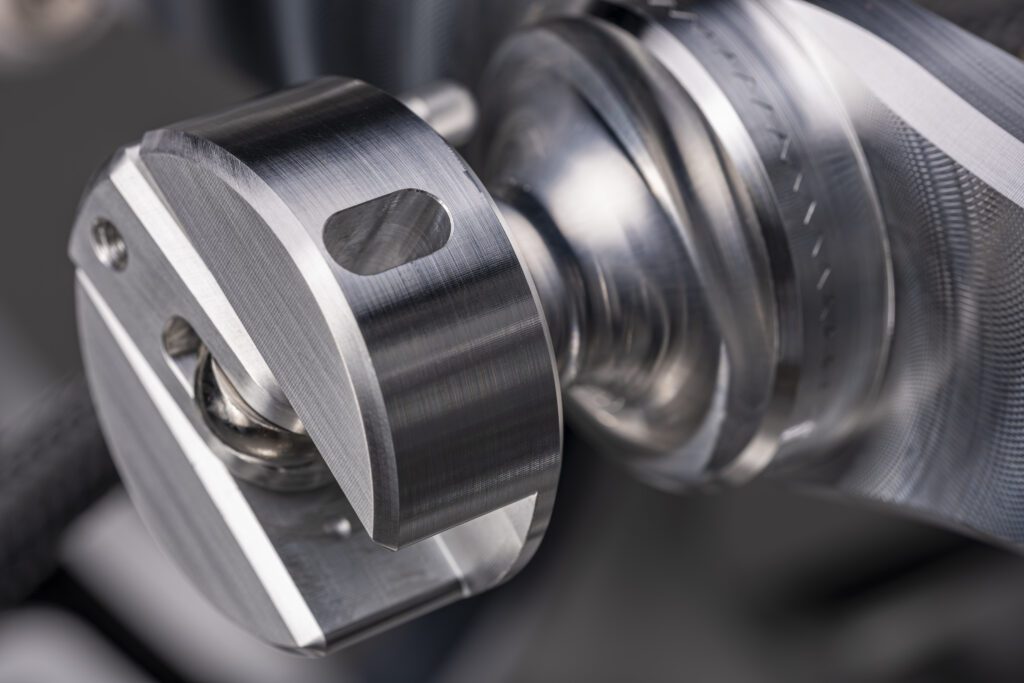
But what’s the point? Our hearing system is highly temporally sensitive. We can detect time-domain errors of just a few microseconds, and this is one of the key components of hearing that doesn’t degrade with age. Most fixed-baffle loudspeakers can achieve in-room time-domain coherence of about 100µS, but our hearing can resolve coherence errors at around 10µS. The Autobiography improves on the WAMM’s 2µS. When everything arrives at the listener’s ears at the same time, our brains do less heavy lifting in interpreting the sound and have an easier time listening to the music. So, ‘what’s the point of all the metalwork?’ To get you closer to the music.
Smaller footprint
Despite having larger bass drivers, the loudspeakers have a slightly smaller overall footprint than the WAMM, making them suitable for installation in any room where the Master Chronosonic XVX can be used. While room size is rarely a consideration at this level, there are people for whom the WAMM was a step too far. Similarly, the Autobiography presents a slightly less demanding load than the WAMM, although, once again at this level, finding a partnering amplifier is never going to be a problem.
This loudspeaker stands as tall as most basketball players, weighs slightly less than a new Harley-Davidson Road Glide, and costs as much as a very nice 3,000 sq ft family home in the town where it was built. Bespoke is included in the package. Five standard, 15 upgrade, 11 premium pearl, and seven premium ‘Colors of the World’ cabinet finishes, with chrome or black-chromed hardware, offer at least 76 possible combinations; factor in different grille finishes and there are hundreds of permutations.
An introduction
The photographed finishes are merely an introduction; of the four built examples, I thought the white-with-chrome hardware version in the Wilson home was the nicest-looking. In particular, the white had an almost pearl-like iridescence. Regardless, this isn’t a shrinking violet of a loudspeaker; it’s a bold statement of intent, both on Wilson Audio’s part and that of the owner. No apologies are demanded, no quarter given. Which is probably the only reason why Mr “I’ve seen more attractive Daleks” won’t be buying a pair.
We live in an age where ‘megacars’ (cars delivering more than 1,360 horsepower, or 1 megawatt), sit above ‘hypercars’ (with around 800 horsepower) and both sit above ‘supercars’ (with around 600 horsepower). As you move further into this ultra-high-performance realm, the cars themselves become more uncompromising in design, and that is reflected in the price.
The same applies to almost every discretionary purchase today; everything from Vertu phones with a concierge service, hand-made Namiki fountain pens that cost as much as a car, women’s handbags that cost as much as a fleet of cars and watches with price tags so large, the mainspring will wind down before you’ve finished counting that high.
The Autobiography isn’t the first loudspeaker to enter this ‘ultra’ stream, nor will it be the last. Technologies developed in this loudspeaker will end up in the next series of ‘My First Wilson’ speakers, and that development is amortised here.
Dancing
I’m dancing around the big topic; how does it sound? That’s the ‘unknown’ part for all but a select few right now. I’m dancing around it in part because the terms are beyond us. We tend to define sound reproduction in terms of its limits, putting those limits into siloed parameters – the soundstage was wide and deep, the vocals detailed and articulate, and so on. But as we get further up the mountain, those limitations shrink, and we begin to describe the sound as a musical event. Maybe that explains The Silence of the Wordsmiths.
The demonstration itself was designed to take the listener from the soundstage through the bass in stages, then to the expressiveness and personal nature of Autobiography listening. At each step, there wasn’t much to reference against in absolute terms, leaving almost all other loudspeakers wanting.
Letters
Soundstage, for example. The use of ‘Letter’ by Yosi Horikawa (which begins with someone dipping a pen in ink and scribbling from the far left through the centre of the image to the right, before it develops into a percussive rhythm piece) is a difficult test for any loudspeaker, as there’s a strong chance of a clearly recognisable tonal or staging ‘dip’ between the speakers; nothing of the sort happened, and you’re left with the sound of a close-mic’d scribbler at their desk… rendered perfectly. For a big loudspeaker, it gets out of the way almost completely.
So it was with each successive track. You were ‘in’ the music and the mix, not just in terms of soundstage, detail or dynamics; you had an emotional connection with the sounds being made on a level that only seems to happen rarely. It’s why people are still bonded to their electrostatic designs and why others have their loudspeaker ‘forever home’ in horn loudspeakers. The two do things very differently, but I always maintained that if you could mix the transparency of a panel with the energy of a horn – without taking on the downsides of both types of design – you’d have a loudspeaker that gets tantalisingly close to the real deal. Or at least, it gets us all out of Base Camp on our climb up the mountain.
Something different
The Autobiography does just that. And in the process, pushing the sonic envelope does something different for the listener; it bypasses the audiophile-noodling part and reconnects with the music on a very deep level. Sure, being able to feel at least some of that 32’ organ pipe in Westminster Abbey pumping out 16 Hz is a remarkable experience (and not one you get from a CD; you need someone who was there with recording equipment that can process sub-20 Hz sounds). But once you get past the impressive, you start to unpack the personal, the music with meaning. And for once, that meaning jumps out at you immediately.
I found myself drawn to playing intensely personal tracks. I chose to play ‘I Loved a Man’ from the 1958 West End production of Valmouth, not because it’s a good recording – it isn’t. Not even because I knew the voice well – although I did. I chose to play it because some know the singer as Patsy Rowlands, but I knew her as ‘mum.’ Some atavistic part of my brain knew I’d be able to hear her voice in a way I hadn’t since she died 21 years ago.
Memorable moments
The Autobiography does that for you… The clue is in the name. Had I had more time with the loudspeaker, I would have been drawn to those memorable moment tracks; the one that was playing when you met your better half. That music that was playing in the background when you heard something life-changing.
Maybe it was the jet lag talking, but that night, around 4am, I found myself wide awake, crying over the loss of my mother, something I hadn’t done in years. That’s the impact these speakers can have on you. It’s more than a humbling musical experience. It’s something far deeper that gets you more in tune with the music than you might ever expect.
Three kinds of Autobiographers
There are three types of music lovers for whom the Wilson Audio Autobiography will resonate: owners of the WAMM Master Chronosonic, owners of the Master Chronosonic XVX, and those seeking the ultimate in loudspeaker performance.
The first of those is perhaps the most interesting of the three; I suspect those hoping for second-hand WAMM Master Chronosonics to appear may be disappointed. That’s not because of the performance; it’s for the same reason Ferrari owners who have an F40 will never part with it. The F40 was Enzo Ferrari’s last project before he passed, and the WAMM Master Chronosonic was Dave Wilson’s last, great project. I think it’s more likely that many WAMM Master Chronosonic owners will ‘second home’ that loudspeaker but will place the Autobiography in their main system.
With the two other groups, things get a lot easier. The only qualifiers to the Autobiography discussion in both cases are “how soon can I get a pair?” and “which colour scheme do I choose?” That last might prove long-winded.
This is as far as I go with the Wilson Audio Autobiography. I couldn’t fit a pair into my listening room and even if I could, for me it would be less of a ‘purchase’ and more of a ‘mortgage.’ But there will be buyers, and those lucky few will have one of the best musical experiences they can get this side of the real thing. And last time I looked, neither Jimi Hendrix nor Bill Evans is touring these days. Should the rest of us be jealous? A bit, but we should also hope that what makes the Wilson Audio Autobiography so good can filter down to our orbits.
Technical Specifications
- Drivers: Forward firing 25.4mm dome tweeter, rear firing 25.4mm inverted dome tweeter, two 50mm upper midrange domes, two 178mm lower midrange cones, 1x 305mm woofer, 1x 381mm woofer:
- Enclosures & Materials: Sealed cabinet forward-firing tweeter, rear-vented upper-midrange units, bottom vented lower midrange units, front-or-rear ported bass cabinet
- Sensitivity: 89.5 dB @ 1W @ 1m @ 1kHz
- Impedance: 4 ohms / minimum 2.1 ohms @ 293 Hz
- Frequency Response: 18 Hz – 36 kHz ±2dB : Room Average Response [RAR]
- Dimensions (WxDxH): 55x206x55cm
- Weight: 372.4 kg per speaker
Manufacturer
Wilson Audio
UK Distributor
Absolute Sounds
+44(0)208 971 3903
Tags: AUTOBIOGRAPHY FLOORSTANDING LOUDSPEAKER PREVIEW WILSON AUDIO
Trending Articles
See all
Acoustic Energy Corinium floorstanding loudspeaker
- Dec 23, 2024
Trending Articles

By Alan Sircom
More articles from this author
Read Next From Review
See all
Eversolo T8
- Oct 13, 2026
Acoustic Energy AE Active
- Oct 13, 2026
Reiki Audio SuperSwitch X/Pro X PSU
- Oct 06, 2026
Audiobyte SuperVOX
- Oct 06, 2026