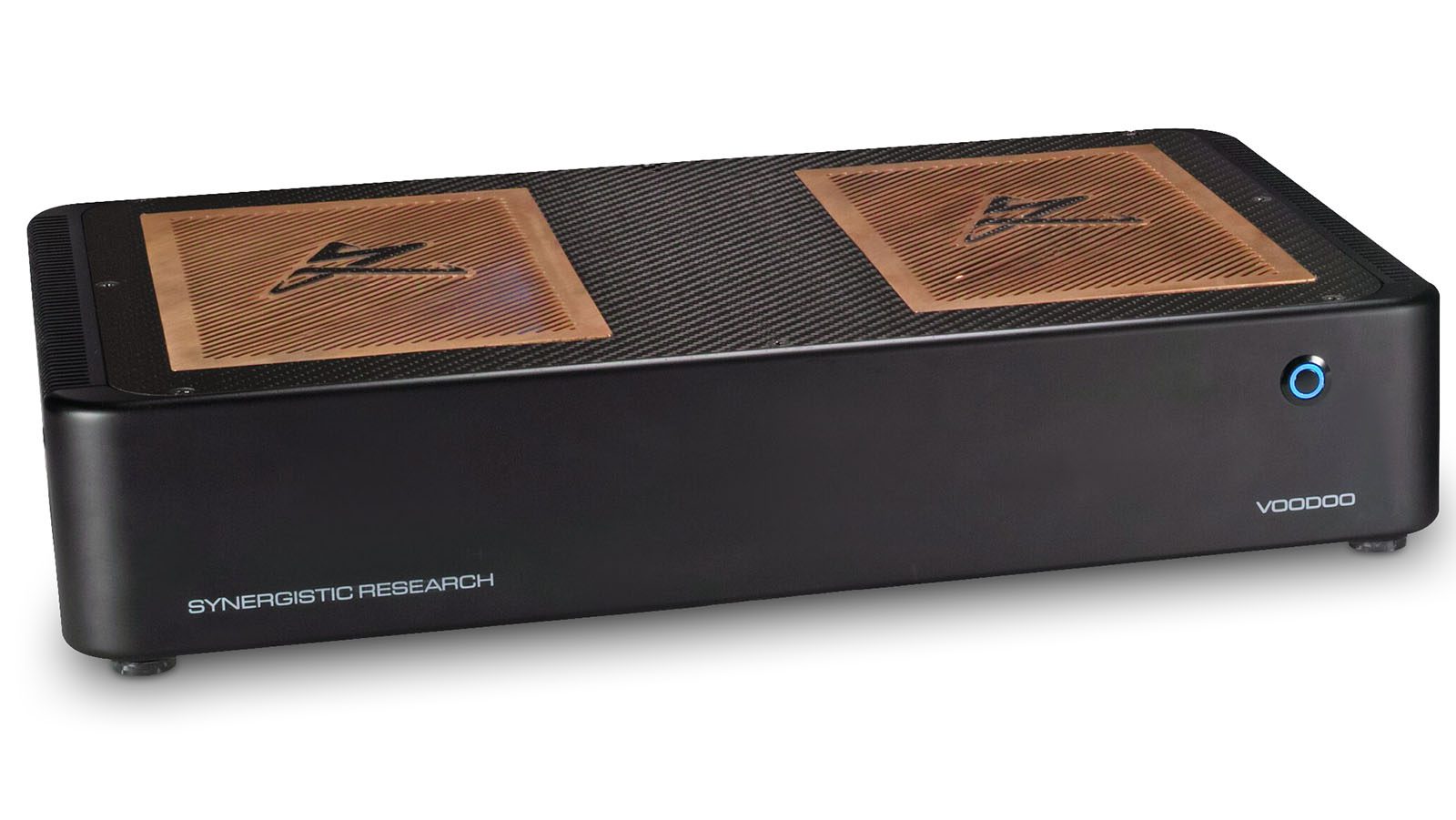
 It’s a bold move. In the argot of English football commentators, Synergistic Research is “a game of two halves.” On one side, it offers a range of well-regarded cables, power conditioners, and platforms. On the other hand, many of its products take an unconventional route, even by audiophile standards. So, naming your streaming music server ‘Voodoo’ is quite the flex. That name alone should evoke a wry smile from most, except perhaps the most stubborn of audio’s self-appointed gatekeepers.
In fact, scratch the surface of any of Synergistic Research’s products and that ‘unconventional route’ is baked into every product.
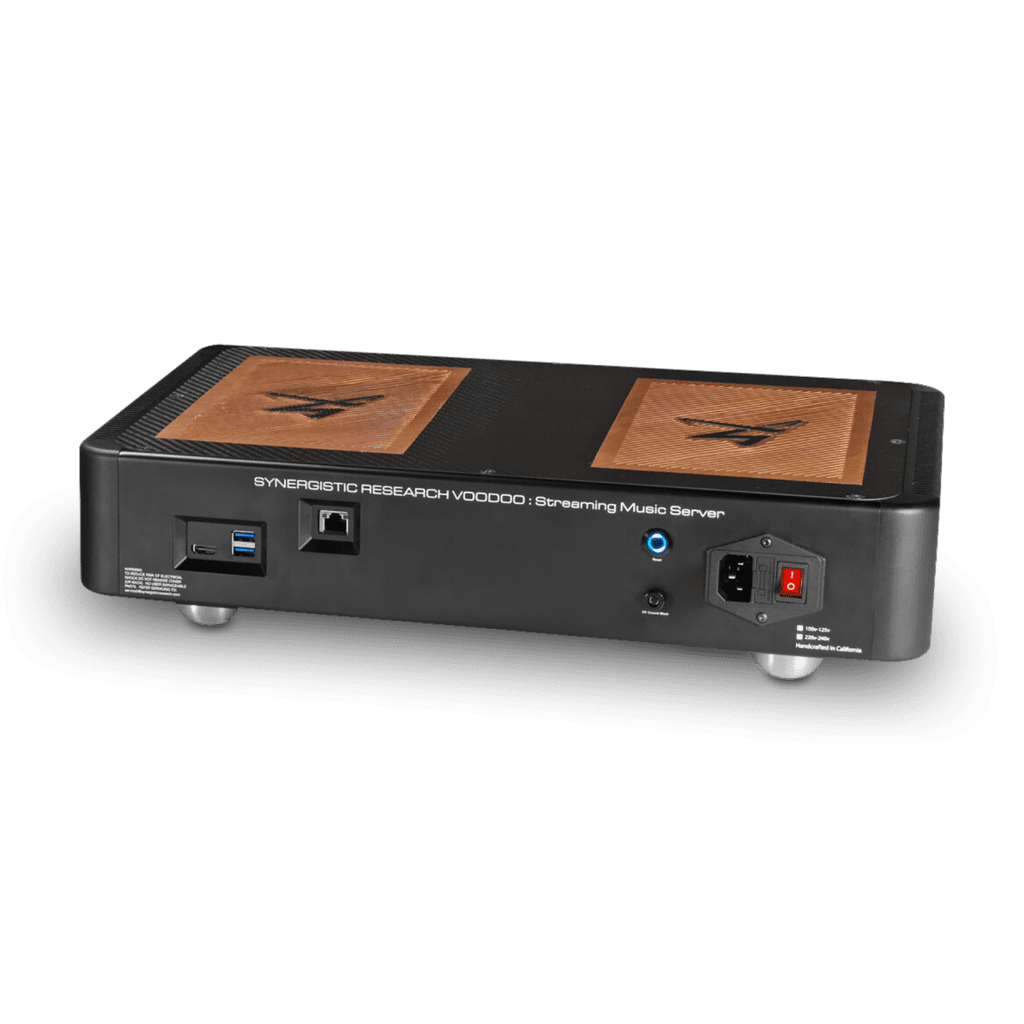
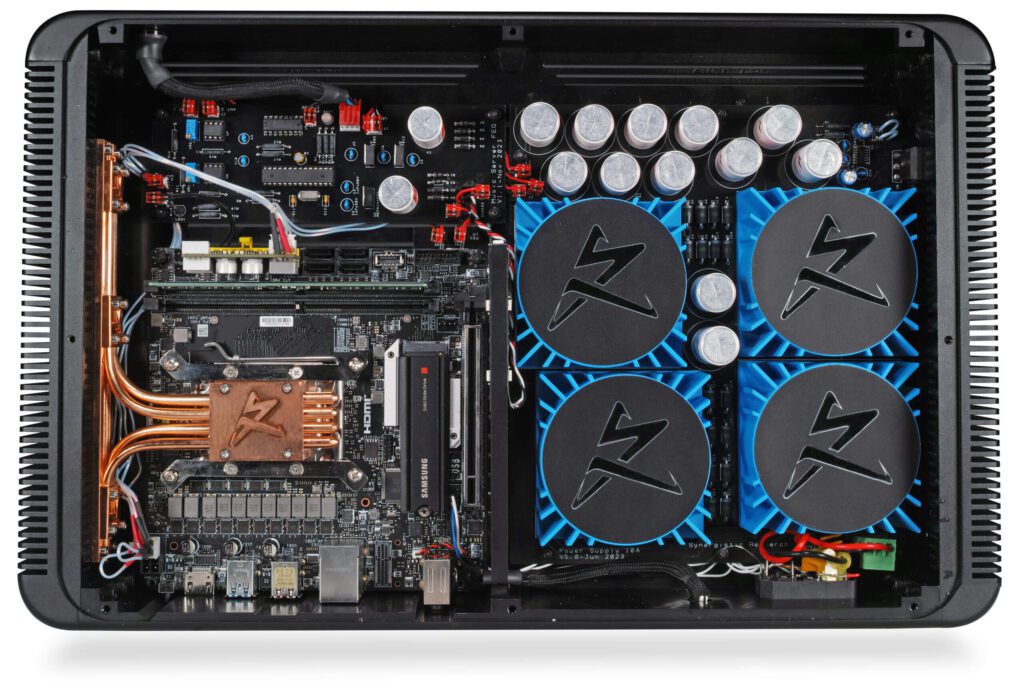
So, on the face of it, the Voodoo is just a good Roon-based server in a well-made case with a couple of top screens set in bronze to improve cooling and let you see into its internal gubbins. It feeds a DAC either through USB or Ethernet like any good server of its type. But, the closer you look, the more this brings to the party.
Gateway
Furthermore, in the tradition of all things Synergistic Research, the Voodoo often serves as the gateway to many more products within the company’s philosophy. We’ve taken our time to examine the Voodoo. As a result, there’s a whole array of products that are likely to follow once it captures your interest. Consider this the first part of a two-part feature. Once the Voodoo wins you over and you find yourself under its spell, much more will follow.
A Roon-based server is a fine ‘proof of concept’ for a company like Synergistic Research. Roon’s own Nucleus One means that any audible improvements have a well-established baseline. And, if the product ticks the ‘damn good server’ box, the ‘introduction to Synergistic Research’s concepts’ follows afterwards.
However, the issue Synergistic Research faced is that a computer-based product uses a computer. That sounds fairly obvious, but an off-the-shelf computer in a nice box will not achieve that ‘damn good server’ goal.
So, in developing the Voodoo, Synergistic Research went back to basics. The team applied the sort of listening tests it uses for every product it produces, but this time to every component and subsystem that goes into making a computer-based server. Eventually, you know you’ve crossed over into a world of obsessive-compulsiveness when you can recall the sonic plusses and minuses of a dozen Ethernet connectors. This might seem, well… nuts to most people. Still, if your company’s core is to try to reduce the effects of the electromagnetic field environment, you better make damn sure that your source component isn’t acting like a ham radio on the sly.
In making an electromagnetic field-generating product that produces as little electromagnetic field effects as possible, Synergistic Research found it had made a good-sounding music server. But that was just the start.
ELF care
From here, Synergistic Research began carefully applying its ULF/ELF biasing and electromagnetic cell technology into the architecture of the server computer itself. Before Voodoo, these only appeared in the company’s ground blocks and power conditioners. This wasn’t as easy to transfer as it sounds. Primarily, this is because the inside of a power conditioner is a relatively controlled EM and RF environment, at least when compared to what’s going on inside most computers. It wasn’t impossible, and the improvements these technologies brought justified their inclusion. However, the application was slow work, and the project took longer than expected to come to market. The question now is ‘was it worth the effort?’
I’ve deliberately excised all other Synergistic Research products from this test, both for its ‘proof of concept’ demands and to prevent jumping to conclusions. If something is said to work by Ultra Low Frequency, EM and RF interference reduction, if you have other devices in the chain that do a similar thing, you risk reviewing the wrong thing by mistake. The downside to this is you are showing off the Voodoo in the worst possible light.
Not more detail
The first impression of the Voodoo server is not ‘more detail’. If your system is already resolving, detail is the one thing you probably have in abundance. The more telling change is a reduction in a subtle kind of glare—an electronic insistence that makes music sound like it’s being lit by an LED rather than by daylight.
With the Voodoo server in place, there is typically an increased sense of ease. That word is overused, but it’s appropriate. Music feels less like a set of discrete events and more like a continuous performance. The system becomes more tolerant of volume; you can turn it up without the top end turning into a stress test.
Well-recorded vocals have more ‘chest’ and less ‘edge’, not because the server is warming them up, but because the electronic hash that undermines sibilants and consonants is reduced. The result is that articulation improves while aggression decreases—a rare and welcome combination.
Fizz-free
Take a close-miked female vocal with plenty of air and potential for sibilance. With many servers, the ‘air’ comes packaged with a faint fizz, a kind of ultrasonic glitter that impresses in a quick demo and fatigues over an evening. The Voodoo Server’s trick is to preserve the openness without the fizz. You still hear breath and space, but you also hear tone.
Acoustic instruments show the same pattern. A steel-string guitar is a particularly good test: it has transients, harmonic complexity, and a long decay. Through the Voodoo server the leading edge is still crisp, but the body of the instrument becomes more obvious. There’s a stronger sense of the wooden cavity behind the strings. Additionally, the decay trails off more smoothly. That smoothness is not softness; it’s continuity.
Piano—often the killer of any romance with streamed digital—benefits in a way that is difficult to un-hear once you’ve heard it. The instrument has both percussive strike and harmonic bloom. With a noisier or less stable digital front end, you tend to get the strike and a suggestion of bloom. With a better one, the bloom occupies the room and the decay becomes a narrative in itself. The Voodoo server leans toward the latter. It allows the DAC to draw the instrument in longer strokes rather than pointillist dots.
Locating performers
One of the paradoxes of high-end streaming is that some setups deliver spectacular imaging by exaggerating edges. You get pin-sharp outlines, but the people inside the outlines are oddly flat. The Voodoo server produces more believable images. Performers occupy space rather than merely being located in it.
Depth is often the most obvious beneficiary. A lowered noise floor and reduced RF contamination frequently yield greater depth perspective: the rear of the stage is easier to see into, and reverberant cues have more gradation. This is the kind of improvement that doesn’t necessarily jump out in a short audition. However, it becomes obvious when you return to the old configuration and find the stage has collapsed a little toward the speakers.
Voodoo doesn’t give you ‘more bass’, but improved bass quality: pitch definition, start/stop control, and the sense that bass lines are played by fingers rather than by an algorithm. On electric bass, the Voodoo server helps you follow the line through dense mixes. On acoustic bass, it brings out the wood and string textures and makes the relationship between note and resonance clearer. The effect is that rhythm sections lock in more convincingly. Drums and bass feel like they are sharing the same time grid.
That last phrase—time grid—is important. This is where noise and timing intersect. It’s not that the server is “changing the bits.” It’s that by reducing electrical interference and improving the conditions at the DAC input, the conversion process behaves more predictably. Also, the system reproduces rhythmic relationships with greater certainty.
More than a filing
The Synergistic Research Voodoo server is a purpose-built music server for listeners who have accepted that digital playback quality is not just about file format or streaming service. It’s about the electrical and temporal conditions under which the DAC is asked to do its work.
It is also, unavoidably, a product that asks you to buy into a worldview. If you’re comfortable with the idea that noise management and system synergy can yield audible gains even in the digital domain, the Voodoo server can be a musically satisfying step forward. If you want a server whose story is purely about CPU load and storage size, there are other options.
For those already deep into high-performance streaming, though, the Synergistic Research Voodoo server makes a strong case for the server as a genuine source component—one that belongs on the rack not because it’s convenient, but because it’s consequential.
Read more about the genesis of the Voodoo here.
Technical specifications
- Type: Roon server
- Inputs: 2x USB (Type B for DAC connection); Ethernet, Ground Plane connection (to Synergistic Research Ground Conditioner), IEC socket
- Onboard controls: ULF bias setting (front panel), manual reset (rear panel)
- Onboard storage: 500GB (external NAS drive recommended for file storage)
- Dimensions (WxHxD): 8.5 x 46 x 29cm
- Weight: 12.25kg
- Price: £15,995 (230V version), €16,995 (230V version), $14,995 (110V version), $15,995 (230V version)
Manufacturer
Synergistic Research
Homepage: synergisticresearch.com
Product page: synergisticresearch.com/digital/voodoo/
Where to buy: synergisticresearch.com/dealer-list/
UK distributor
Harmony Hi-Fi
+44(0)1701 629345
Trending Articles
See all
Computer Audio Design CAT computer audio transport
- Oct 13, 2014
Trending Articles

By Alan Sircom
More articles from this author

Read Next From Review
See all
Reiki Audio SuperSwitch X/Pro X PSU
- Oct 06, 2026
Audiobyte SuperVOX
- Oct 06, 2026
Unitra WSH-805
- Sep 29, 2026

Wilson Audio Sabrina V
- Sep 29, 2026