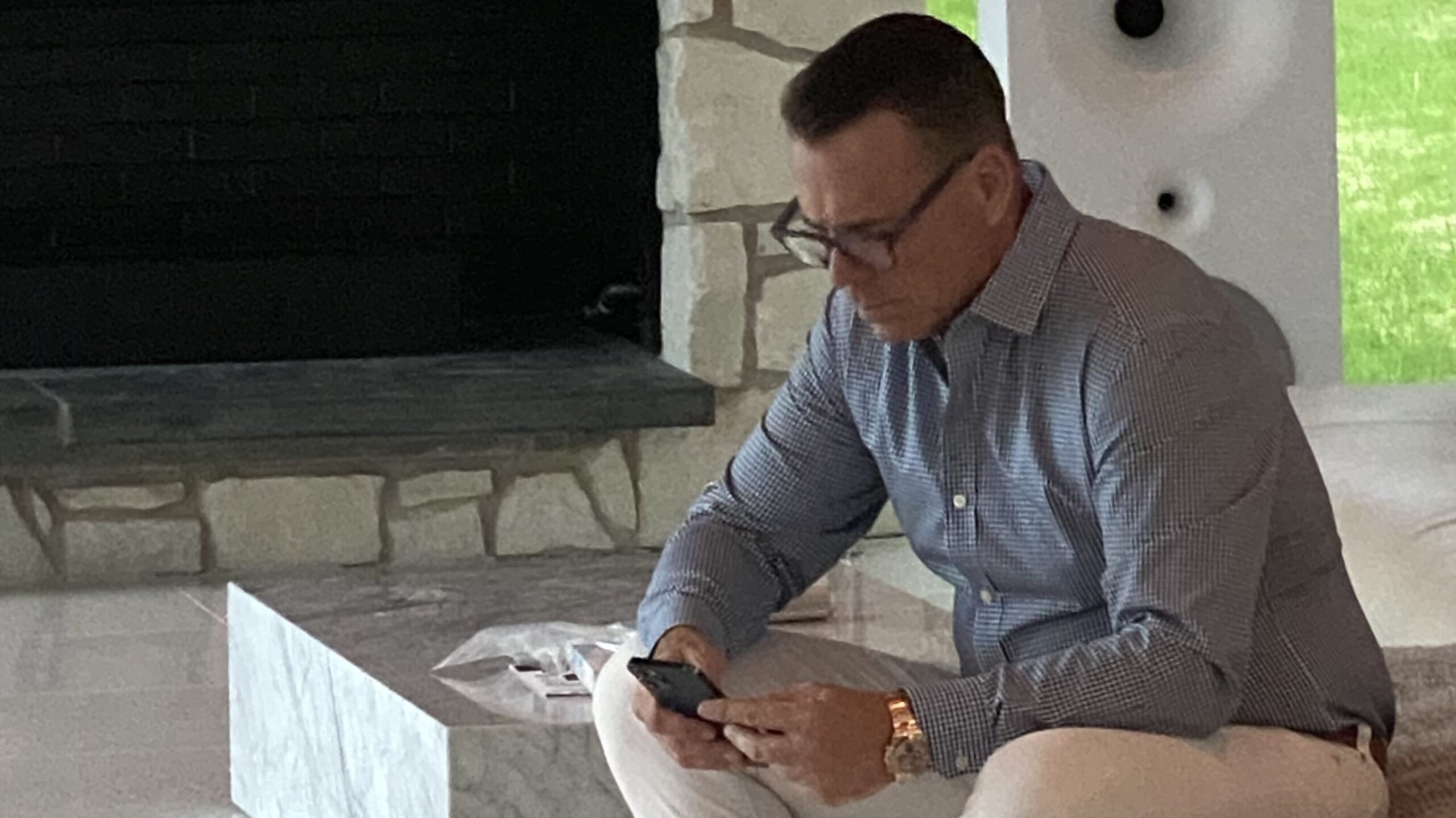
Ted Denney needs no introduction to many of our American readers. However, he might not be quite so well-known on this side of ‘The Pond’. However, his company – Synergistic Research – is well-known for making system-transforming components that throw down a gauntlet to audio’s many traditionalists.
Now, the company has produced its first music server, Voodoo. Is there more to it than the supernatural, and is it where the magic happens? We speak to Ted Denney to learn more…
Tell us a little about yourself…
I’m Theodore Walton Denney III — Founder, Lead Designer & CEO, Synergistic Research. I founded Synergistic Research in 1992 from the humblest of starting points — a 1,200-square-foot industrial space, a $100 IKEA futon, and an income under $10,000 a year for the first three years. What I had instead of money was a clear-eyed understanding of something the entire audio industry had, in my view, fundamentally misunderstood. Specifically, where the music actually lives in an audio system.
Today, SR operates from a 13,000-square-foot factory in Southern California. The product range spans cables, power conditioning, active shielding, grounding systems, network infrastructure, acoustic field control, and now streaming servers — all built around a single coherent physics framework. This approach is different. Rather than a collection of independent product categories, it unifies all elements under one system.
How do you do that Voodoo that you do so well?
A Cole Porter quote… nice!
At its core, Voodoo addresses a problem that, to my knowledge, the rest of the streaming server market is not attempting to solve. The industry’s focus on improving digital audio quality — with better DAC chips, lower-jitter clocks, enhanced power supplies, and USB isolation — is valid and produces genuine results. However, it tackles the well-known adversary in digital audio. At the same time, it leaves the hidden one unchallenged.
The unseen threat is the electromagnetic field environment created by computation itself. Every CPU, RAM chip, and integrated circuit in a streaming server produces high-frequency switching noise as a direct result of its operation. That noise does not exist in the digital signal itself. Instead, it exists in the electromagnetic field surrounding and carrying the digital signal — and because energy in a conductor system travels through the field around the conductor, not within it, this contamination cannot be removed by any downstream filtering or isolation method.
Improve the field
The only solution is to improve the field environment at the point of generation — within the architecture itself. That is what Voodoo’s built-in ULF/ELF biasing and electromagnetic cells do. They do not suppress noise after it occurs. Instead, they continuously maintain a corrected field environment, preventing contamination from forming in the first place.
The results, once the high-frequency RF contamination was eliminated, did not just narrow the gap with analogue. They surpassed it — particularly in the aspects where analogue had always excelled. Soundstage depth, height, and width all exceeded our reference turntable. The music projected into the room and enveloped the listening position in a way that even the finest vinyl playback had not managed. High frequencies featured more air and transparency. Bass was tighter and more defined — not the rounded, forgiving bass of digital, but genuinely more resolved and present.
Then something unexpected occurred. Freed from the layer of high-frequency noise we had always assumed was simply characteristic of digital sound, we started to perceive our turntable differently. Mechanical noises we had previously ignored — bearings, motor artifacts, the physical contact between stylus and groove — became audible in ways they hadn’t been before. We had tolerated these sounds unconsciously because we were so captivated by how the turntable reproduced spatial and timbral qualities. However, with Voodoo surpassing it in those same aspects, the mechanical noise had nowhere left to hide.
When did development for Voodoo begin?
Development commenced in 2023. The catalyst was a particular and exasperating realisation that emerged gradually through our earlier work on network infrastructure.
The development of Voodoo started with a careful, systematic year-long process: we aimed to build the best-sounding computer we could before making it uniquely ours. Every variable that could be altered was changed. Different CPUs, motherboards, RAM chips, internal buses, and linear power supplies — literally every component and pathway inside the machine — were considered open questions. We tested dozens of configurations over hundreds of hours of double-blind listening tests. Importantly, during tests, we used chassis that looked identical from the outside. This was so no visual cues could influence the results. No assumptions, no shortcuts. The methodology was the same as we use for every SR development. We determine the performance ceiling through a thorough controlled comparison. Then we progress from there.
The second phase was when Voodoo truly became Voodoo. We started integrating our ULF/ELF biasing technology and electromagnetic cell architecture — previously developed for our ground blocks and power conditioners — directly into the computer’s infrastructure. This involved taking field measurements with probes inside a live computing environment. We looked for electromagnetic signatures we already knew linked to improved sound quality. Next, we confirmed those measurements through further double-blind listening tests.
How did prototyping move from here?
All critical listening decisions were made in our reference system at the SR factory in Southern California — the same controlled environment we use for every product development. When prototype performance stabilised, advanced units went out to a network of beta testers across different systems and listening rooms. Their feedback informed subsequent refinements.
The power supply architecture for the PC environment was initially developed in collaboration with engineers who specialise in that domain — we were not, and are not, a computer company, and we had no desire to reinvent expertise that already existed. Once those foundations were in place, we integrated our own UEF technology and electromagnetic cell designs into those supplies. In this way, we made them genuinely and distinctly ours. The starting point was borrowed. Everything that makes Voodoo sound the way it does is not.
How easy was the move from ‘lab’ to ‘listening room’?
The shift from a unit that excelled in our reference room to a product that performs consistently in the real world was, frankly, more challenging than the core engineering. Our reference system offers an ideal environment, but the market does not.
When Voodoo was launched, several units were returned. The issues were traced to voltage variations across different markets—something we had not fully anticipated—and to BIOS settings that behaved differently under real-world conditions than they had in our laboratory. As a result, each returned unit was examined, the failure point identified, transformer headroom in the power supply adjusted, and firmware settings refined. The final production Voodoo now performs reliably across the wide range of conditions found in the open market. In addition, it sounds better — even under the ideal conditions of our own reference system — than its predecessors.
Where does Voodoo sit in the Synergistic Research product line?
Voodoo sits at the top of SR’s network infrastructure hierarchy and represents the logical culmination of a chain that begins with our earliest cable designs, extends through our ground blocks and power conditioners, and continues to our Ethernet switches and routers. Each of those products addresses the field environment at different points within the signal chain. Voodoo manages it at the source.
Manufacturer
Synergistic Research
Trending Articles
See all
By hi-fi+ Staff
More articles from this author
Read Next From Blog
See all
Tech Talk: Nigel Bell of Reiki Audio
- Oct 06, 2026
Tech Talk: Nicolae Jitariu of Audiobyte
- Oct 06, 2026
Tech Talk: Wiktor Schulfer of Unitra
- Sep 29, 2026
Tech Talk: Daryl Wilson of Wilson Audio
- Sep 29, 2026