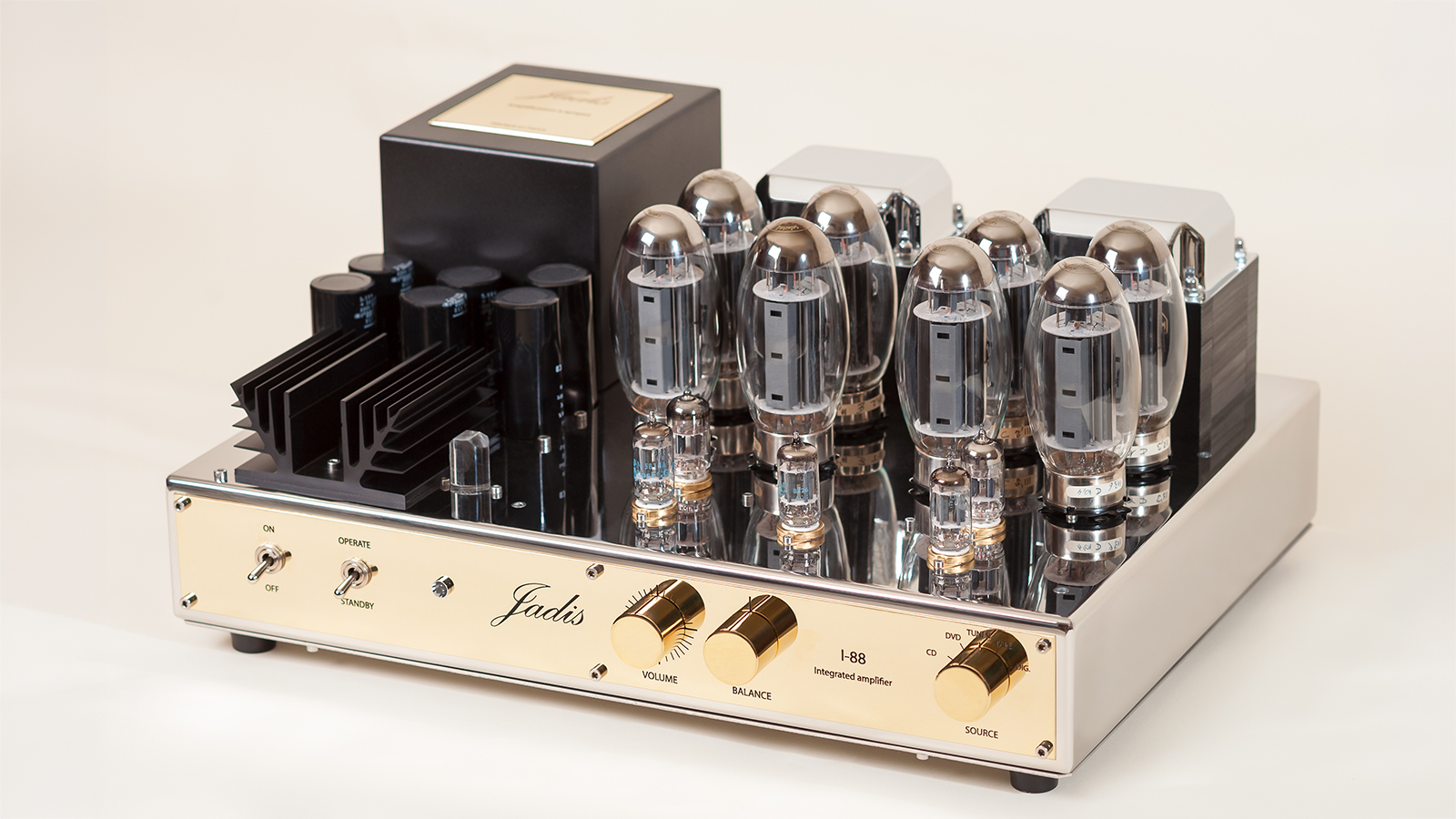
If ever there was a company that exemplified the phrase ‘sticking to its guns’, it’s Jadis. For a small French tube amplifier firm, it offers a surprisingly broad range of products, including the I-88 integrated amplifier. At a time when much larger brands are simplifying their lines, Jadis still features both digital and analogue sources, along with multiple preamps, phono stages, integrated amplifiers, and stereo and mono power amplifiers. What is Jadis’ secret?
The company excels in three areas. First, it develops its products without a relentless urge to constantly change them. Some products still appear in the Jadis catalogue that were originally made when Michael Jackson was singing about Billie Jean. Next, it manufactures many of these products to order, which means longer lead times; however, it also allows timeless models to stay in production for longer.
I’ve saved Jadis’ greatest advantage until last: it manufactures its own output transformers and has done so for decades. This enables Jadis to receive early versions of the latest output tubes, allowing them to design their transformers and set the standards for other transformer manufacturers. Although Jadis hand-winds their transformers and seals the final product in resin to ensure thermal stability and eliminate hum, you can’t simply inspect and clone their transformers. However, when it comes to producing an amplifier that features the latest KT150 output tube, Jadis was the first to develop output transformers for their line.
Combine the three elements, and you get products like the I-88, an integrated amplifier delivering 90W per channel in pure Class A, using a double push-pull circuit inspired by the earlier—and still current—I-50. This amplifier also employs KT150s in a push-pull layout, but with two tubes per channel instead of four.
‘Thoroughly’ modern
The fact Jadis has been making amplifiers (and more) since 1983 doesn’t mean its models are throwbacks to an earlier time. The I-88 not only includes an autobias circuit (so the tubes will never go out of true) but also an unspecified USB DAC. This last is more an emergency DAC than something you would actively use (I couldn’t get anything higher resolution than 16-bit, 44.1kHz out of it), but it’s better than nothing.
The I-88 also features a remote eye, along with volume, balance, and source selection controls managed via a Philips-style handset. The operation of the I-50 is fully replicated in the I-88, but this model has nearly twice the power, thanks to it having double the number of power output tubes.
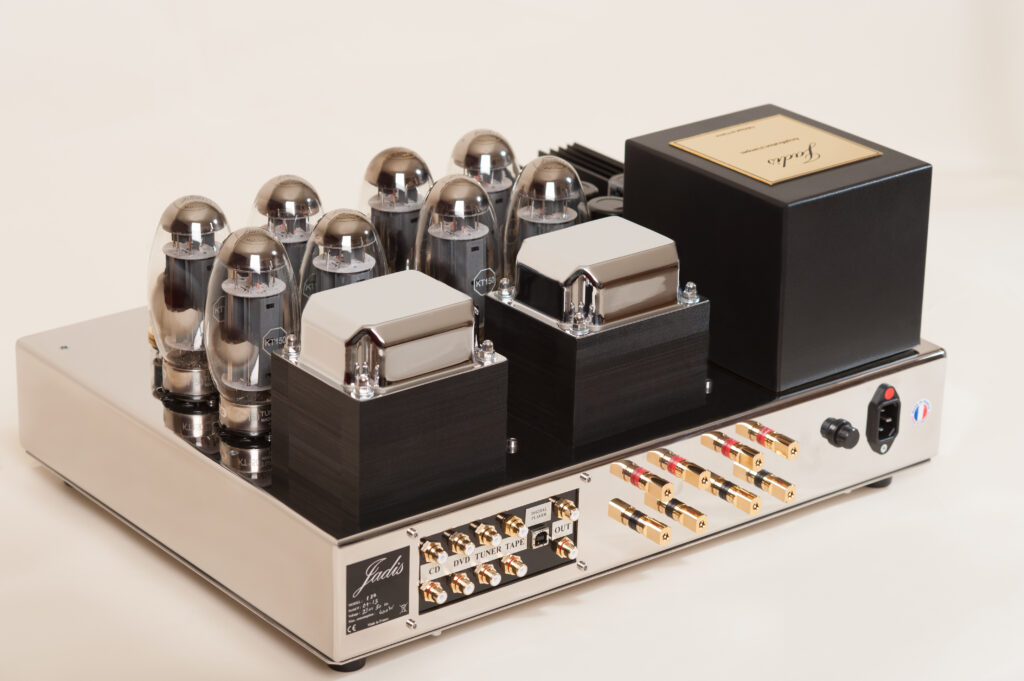
It’s the simplest amp in terms of connections; aside from that USB input, there are four single-ended RCA inputs and two pairs of speaker terminals (for bi-wiring, not different tapped outputs from the transformer). Onboard phono stages, XLR inputs, and theatre or tape loops… nope!
Returning to the extensive range of products in the Jadis catalogue, the commonality between I-50 and I-88 offers another clue about how Jadis manages this; many of the amplifiers share similarities. The question then is ‘why’? Why does a small French company produce nine different integrated amplifiers? Aside from building to order and its reluctance to phase out product lines, Jadis has a distinctly international following, and not every product sells – or sells well – in every country. So, where the Orchestra integrated might perform exceptionally in one country, the very similar DA50S could perform better elsewhere. It’s an old-fashioned approach, compared to the ‘world amp’ concept adopted by most audio brands. But most audio brands are not Jadis.
There is one consistent feature across every market in the world, though: the Jadis style. That chromed chassis and transformer caps, with a contrasting gold front and exposed heatsinks and capacitors on the top plate, have been a hallmark of Jadis’ design since André Calmettes founded the company in a village just outside Carcassonne in 1983. Sadly, the founder of Jadis passed away in January 2025, but the baton was passed to his son, Jean-Christophe, several years ago.
Although not everyone agrees, any design language that has remained unchanged for over 40 years is on the right track. Even the cursive ‘Jadis’ name badge has stayed the same for decades. Whether or not it suits your taste, one thing remains clear: if you own any Jadis product – including the I-88 – invest in plenty of microfibre cloths. Not only does the chrome top tend to attract dust, but the design also invites people to touch it and leave fingerprints.
Well made
The amplifier is exceptionally well crafted. It uses a carefully designed point-to-point wiring loom, with minimal use of circuit boards throughout the entire design. The layout of the point-to-point wiring is less like a bird’s nest (have you seen inside an amplifier from the 1950s? Even the finest look ‘organic’ at best) and more like the circuit diagram it was based on. Larger components are attached to the underside of the top plate, but this point-to-point layout is very different from a surface-mount PCB sitting on shock-mounted standoffs. While attaching smaller components in free space on the internal wiring loom offers significant sonic advantages, it also means you shouldn’t subject your electronics to too harsh treatment.
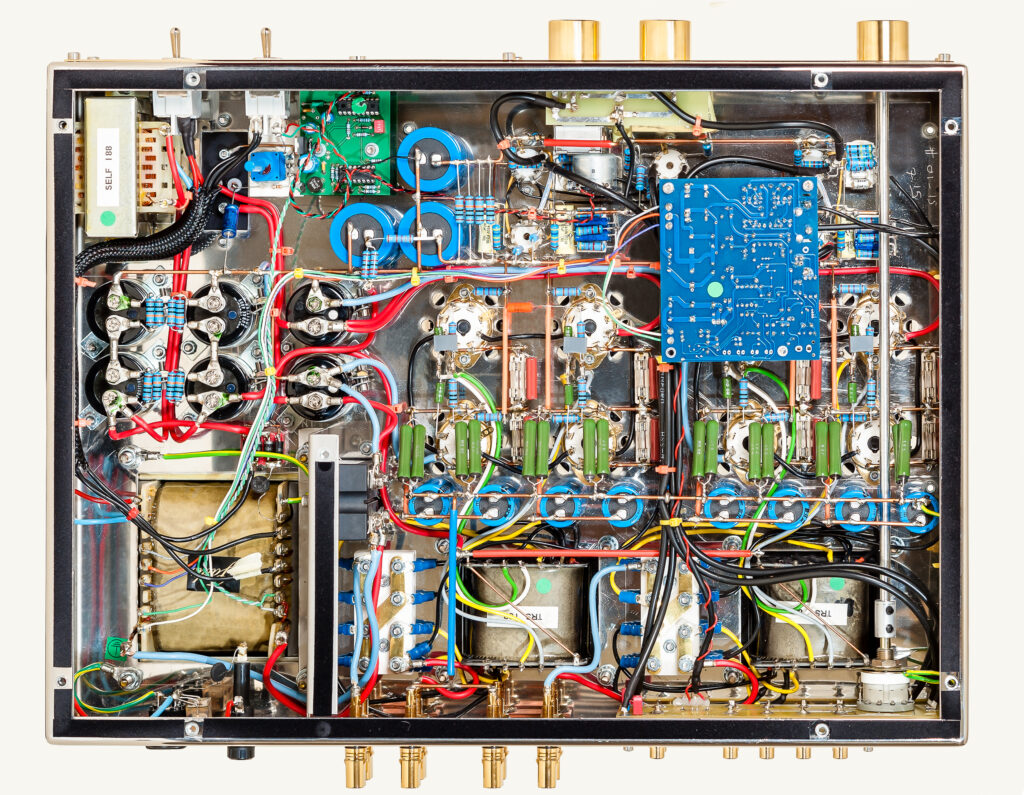
Manhandling shouldn’t be on any amplifier’s radar. However, an amp weighing just over 40kg – with an uneven load – demands careful handling when moving in and out of its packaging, for both backs and resistors alike.
However, once taken out of the box, it’s time to load the two ECC83s and three ECC82s into the preamp stage, as well as the four KT150s on each side. There is a cage to keep little hands and paws away from parts that can burn, cut, or electrocute the unwary. It looks better without the cage, although the heat output is significant, and even touching the chrome plate near the tubes can cause a burn.
An important consideration is to ensure that each tube is properly seated and that the loudspeaker cables are connected to the amplifier and speakers before turning it on. This is good practice in general, and especially so for tube or valve amplifiers. Besides choosing from a variety of ECC83/12AX7 and ECC82/12AU7 tubes from different new, old, and NOS (new old stock) suppliers, there isn’t much tube rolling happening, mainly because there are few suppliers of the recently launched KT150.
Regardless of which input tube maker you choose, after you flick that toggle switch and the green LED begins to glow, you’ll hear the gentle tinkling of valves coming to life. After a few minutes, it’s time to enjoy the music. There isn’t a soft-start or automute circuit, but try to resist the temptation to play a track while the amplifier is warming up.
Ritual enjoyment
If all this sounds a little like it’s some rite of passage or a ritual to appease the hollow-state gods, you are well rewarded for your observance. Because this amplifier sounds exceptionally wonderful; it sounded superb with complex music, simple tunes, music old and new. The excellent sound quality extends to everything, from the most basic folk singing in a pub (The Unthanks) to small halls hosting jazz (Bill Evans), studios (Trentemøller), and stadiums (Queen), as well as concert halls (Georg Solti). Not a single track during the entire listen sounded anything less than thoroughly enjoyable.
However, if you think this sounds like some rose-tinted reproduction with the edges blurred, think again. Out came the heavy stuff – Grinderman’s eponymous debut album [Mute] – and we encountered plenty of 21st-century punk grunge. Then, moving on to the glitchy ‘Mekrev Bass’ by Squarepusher [Be Up a Hello, Warp], everything had its shape, space, detail, speed, and texture. This last track is almost unlistenable at its best (it sounds like someone’s torturing a Nintendo Game Boy, while a drum machine explodes and a digital delay melts down). Still, it reveals everything, and any attempt at cloaking or colouring by the system is laid bare. The Jadis has all the power, detail, and clarity to leave you twitching in a corner somewhere, and rose-tinted it is not. But the music still sounded wonderful, like an eight-bit soundtrack to six horror movies playing simultaneously. Despite all the descriptions, it’s because it makes sense of the music. And if it can make as much sense from Squarepusher as it does with Bill Evans, the I-88 is achieving great things.
It’s easy to get carried away with the hi-fi-like descriptions of this amplifier’s sound, especially because it excels at all of that. It offers a great soundstage, with impressive width and particularly depth, and the kind of grounded-in-space instrument solidity that makes you reach for the ‘holographic’ clichés. It has a broad dynamic range, both large-scale and small-scale, allowing you to hear the valves clicking in that tuba while the orchestra performs with enthusiasm. Then, there’s its vocal projection and articulation, combined with such detail that you can tell what brand of toothpaste the singer uses. It also delivers the sublime coherence and detail that make Porn at the Jazzshop, ‘Temptation’ by Diana Krall, and Cantate Domino sound better than ever. If all you ever want to play is that, the Jadis I-88 will do it superbly. But there is so much more to music than just that.
The audiophile test rarely includes that vital ‘x’ factor that makes you want to play music more and more, but the Jadis I-88 has that ‘x’ factor in spades. It’s a blend of sounding inviting, musically effortless, and informative in a completely non-invasive way. Some systems feel like you are spending time with a music professor on transmit; this feels more like a charming night with a musically skilful guest who hates mansplaining but genuinely loves their music. It’s an abstract concept to convey, but you find yourself drawn to play more music through the Jadis’ sheer innate charm, rather than feeling compelled to do so. Some of the best systems are musical ‘enablers’ – go on, just one more wafer-thin album – but this is a musical friend with whom you want to share the experience.
Grip and grin
Tube or valve amplifiers are known for having relatively poor damping factors compared to their solid-state equivalents. This means an amplifier like the Jadis I-88 will never grip loudspeakers as tightly as a similarly powered transistor amplifier. However, in real-world conditions, Jadis offers excellent control over a loudspeaker’s bass drivers. Although it’s not a kilowatt powerhouse, it more than holds its own. That extra control will put a smile on anyone’s face.
It’s a testament to how exceptional this amplifier sounds that I couldn’t resist using it during the brief but notably muggy heatwave that the UK experienced in summer 2025. Playing a 90W Class A valve amp in an already blistering listening room seems madness. But I felt driven to do so because my time with the I-88 would be limited. When you find yourself playing Boards of Canada albums at 3am while cooling yourself with ice, you know the Jadis I-88 has truly taken hold of you.
Yes, the built-in USB DAC is a bit of an afterthought, although it sounds quite decent. But that’s the only real downside to the Jadis I-88. While opinions vary, I think it looks fantastic. And everyone agrees that it sounds pretty damn impressive as well. I’ll ignore those ‘going-commando’ heatwave listening sessions, but they show that when the sound is that enjoyable, you’ll do almost anything to keep listening. This isn’t just a delightfully sounding amplifier; it revives the joy of listening to even the sweatiest ears.
Technical specifications
- Type: Integrated Amplifier with remote control
- Inputs: 4x RCA line inputs, 1x USB input
- Outputs: 2x loudspeaker outputs (for bi wiring)
- Frequency Response: 10Hz-19kHz ±3dB
- Tube Compliment: 8x KT150, 2x ECC83/12AX7, 3x ECC82/12AU7
- Bias: Automatic
- Input Sensitivity: 190mB
- Dimensions: 50x40x22cm
- Weight: 41kg
- Price: £18,998
Manufacturer
Jadis
UK distributor
Absolute Sounds
+44(0)208 971 3909
Trending Articles
See all
Krell Vanguard integrated amplifier
- Apr 07, 2015
Trending Articles

By Alan Sircom
More articles from this author

Read Next From Review
See all
Eversolo T8
- Oct 13, 2026
Acoustic Energy AE Active
- Oct 13, 2026
Reiki Audio SuperSwitch X/Pro X PSU
- Oct 06, 2026
Audiobyte SuperVOX
- Oct 06, 2026