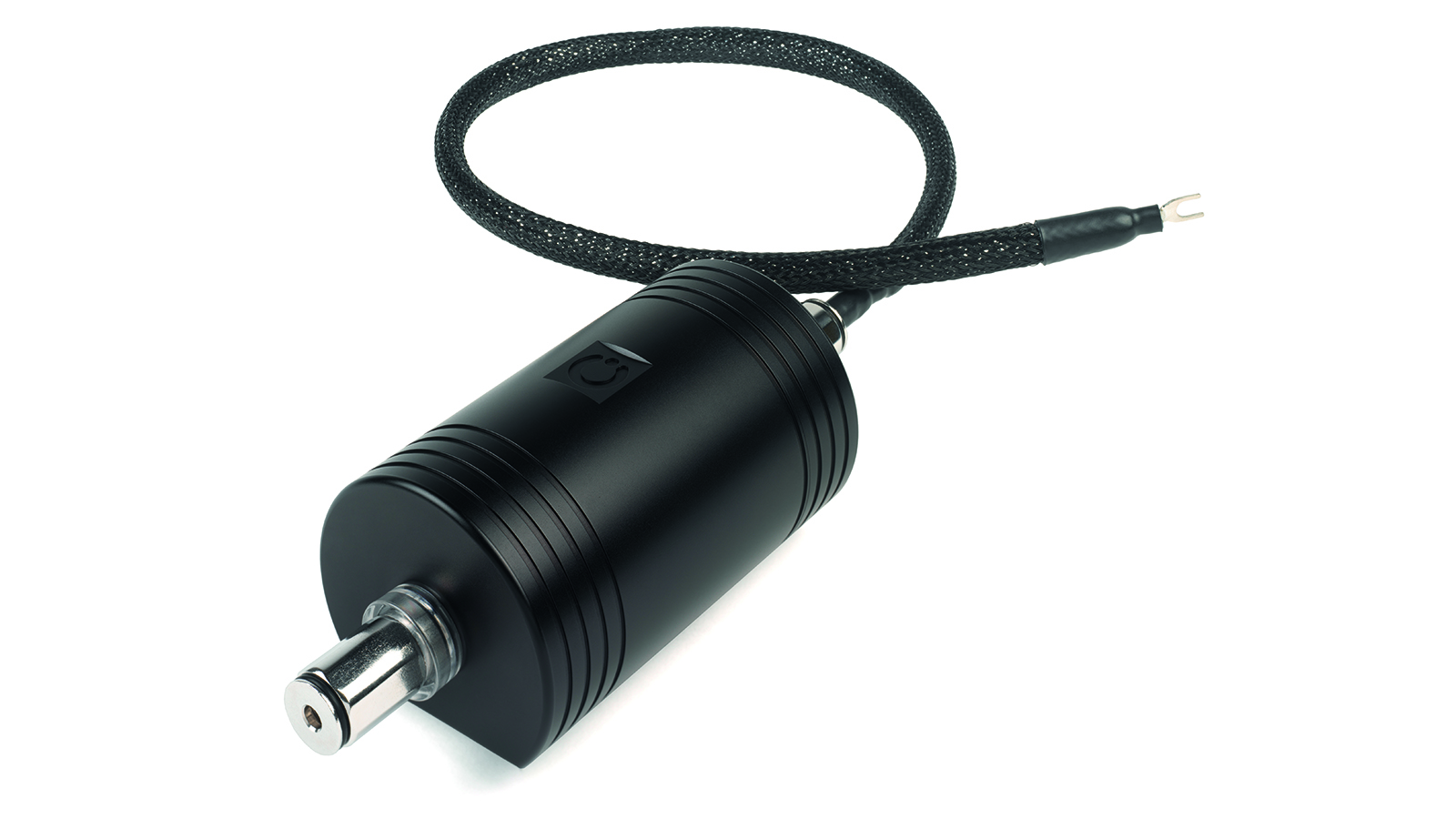
Chord Company of Amesbury demonstrated its newly launched PhonoARAY turntable grounding system at the Bristol HiFi Show in early 2025. This was an impressive demonstration and it needed to be; convincing enough despite the exceptionally noisy neighbours in the demo room next door, is no mean feat. Nevertheless, a small room just a partition screen away from six big, active subwoofers pumping out deep electronic bass at high volume is no place for a careful evaluation of a component that may be as nuanced in performance as a turntable’s grounding system. Naturally it proved better still when later deployed in the much quieter listening room at home.
You could be forgiven in thinking that – for all the recent hoo-hah about component grounding in audio – a turntable is the one thing that resolved grounding decades ago. With a few notable exceptions (such as Rega), tonearms have been supplied with separate grounding cables between deck and phono stage for decades. Therefore, anything that adds a grounding component to an already-grounded system is, at best, gilding the lily.
However, as Chord Company’s Alan Gibb notes, we need to ground our tonearms and turntables to avoid hum. But that very act of grounding has a downside. Conventionally it’s done with a thin wire, captive at the tonearm but with a spade termination at the other end for attachment to the grounding post on our phono stage or integrated amplifier.
Ground as antenna
Grounding silences the hum, but has anyone else spotted that the grounding wire acts as an antenna? Along with metal in the tonearm it picks up localised high frequency radiation from switch-mode power supplies, LED lumens, wi-fi and so on, then injects it into the ground-plane of our audio system where it obscures musical detail. Well, Chord Company has, and if we have any doubt that the company is on to a real issue it’s simple to test; just borrow a PhonoARAY from a Chord Company dealer and try it at home. The PhonoARAY is a rather stout £1,000, but I can’t imagine many are going to be returned to dealers, it’s that much of a sticky enhancement.
The PhonoARAY is a surprisingly weighty CNCd aluminium cylinder, 10cm long and five in diameter, with a single banana/cinch speaker-type terminal at each end. It comes with a screened lead, banana connector at one end and small spade connector at the other. This lead goes between the PhonoARAY and our phono stage while the terminal at the other end takes the thin grounding lead from our tonearm.
The ARAY moniker is applied by the company to more than one technology. Here, it refers to a compound that absorbs high frequency energy. This sandwiches an inductor that acts as a series filter and is potted in resin, says Gibb, to help mitigate any propensity for microphony. He declined to number the frequency range addressed, but did venture that it’s kHz to MHz, in other words most likely concentrating on the fundamental frequencies of the noise generated by the primary radio frequency polluters mentioned earlier rather than much higher frequencies.
Wired into the review system between an Origin Live Agile tonearm and Sovereign S turntable and a Mola Mola Lupe phono stage, the PhonoARAY left zero room for equivocation. The sonic uplift was noted by multiple listeners, most of whom were not audiophiles and thereby not prone to expectation bias. The consensus was that musical energy had notched up a tad (“…it’s got louder….”), bass tune playing was tonally richer and more textured, vocals had been stripped of a degree of grain and now sounded more natural and relaxed, and sound-staging sounded more crisply defined, less blurred.
No surprises
None of these observations will come as a particular surprise to readers who have already deployed grounding elsewhere in their own systems, whether with unitary devices or with a garden grounding rod or array (with two RRs!). They are the to-be-expected outcomes when systemic high frequency noise is mitigated.
What may surprise some is that such thinking in the context of grounding of turntables and tonearms is not more common. The PhonoARAY’s RRP of £1,000 makes it unlikely that many will be paired with low-end turntables and that’s rather a shame because the sonic uplift it delivers would undoubtedly be just as notable. Is Chord Company missing a big chunk of potential market? I think so.
However, in the high-end of turntable design, Chord Company currently has planted its flag in terra incognita and created that great thing; a product that demonstrably makes a difference that no one else can provide. I’d argue that it will not occupy that land alone for long, because as soon as companies get wise to what the PhonoARAY does to record replay, they’ll all want a piece of the action!
This might just be the Next Big Thing in turntable replay systems; the step high-end vinylistas never knew they needed, but will immediately understand. Put it this way; if you are an inveterate cartridge swapper and have an ever-growing collection of almost-new moving coils, the Chord Company PhonoARAY is more likely to be your next vinyl-based purchase than a cartridge. It’s that good!
Price and Contact details
- Chord PhonoARAY: £1,000, €1,299, US price to be confirmed
Manufacturer
Chord Company
+44(0)1980 625700
Trending Articles
See all
By Kevin Fiske
More articles from this author
Read Next From Review
See all
Reiki Audio SuperSwitch X/Pro X PSU
- Oct 06, 2026
Audiobyte SuperVOX
- Oct 06, 2026
Unitra WSH-805
- Sep 29, 2026

Wilson Audio Sabrina V
- Sep 29, 2026