Accuphase has an impressive track record in Class A and Class AB amplifiers. The company was started in 1972 in Japan by brothers Nakaichi and Jiro Kasuga as Kensonic and, 10 years later, changed its name to Accuphase, which is derived from ACCUrate and PHASE. Over the intervening years, it introduced more than 240 different models and currently produces mainly amplifiers and CD players.
Class A amplifiers have long been praised for their sound quality. My very first proper hi-fi amplifier was the original Sugden A48, and it was a sweet-sounding amp, too—one reason I was keen to try out a modern-day Class A design.
Uncommon
Class A amps are less common than Class AB as they are less efficient (typically less than 30% compared with 50 to 70% for Class AB) and run hot, so their power output is often limited. They get hot because the power output transistors run at higher bias levels than in Class AB and are always on, drawing constant current even when idle. However, because they are always on, they avoid the crossover and other distortions that occur when the transistors in a Class AB design come close to the zero point as the waveform ‘crosses over’ from the positive to the negative swing of the signal. This zero-point crossover gives Class A amplifiers a superior sound.
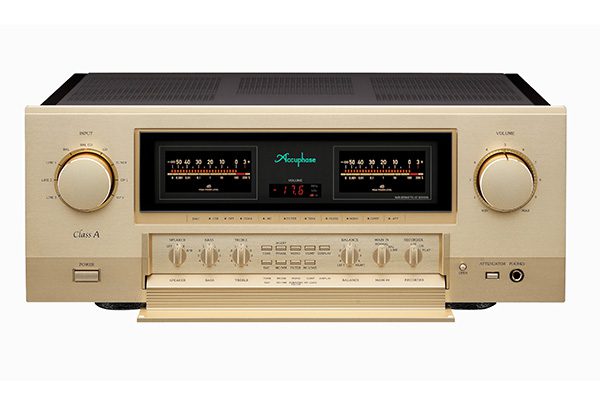
The E-700 (35W) is the latest Accuphase Class A integrated amplifier, launched last year. At £10,500, it sits below the Class A E-800S (50W) at £14,000 and replaces the old E-650. Accuphase also has two Class AB amps in the range—the E-5000 (240W) at £12,500 and the E-4000 (180W) at £8,500, with a model below that expected later this year.
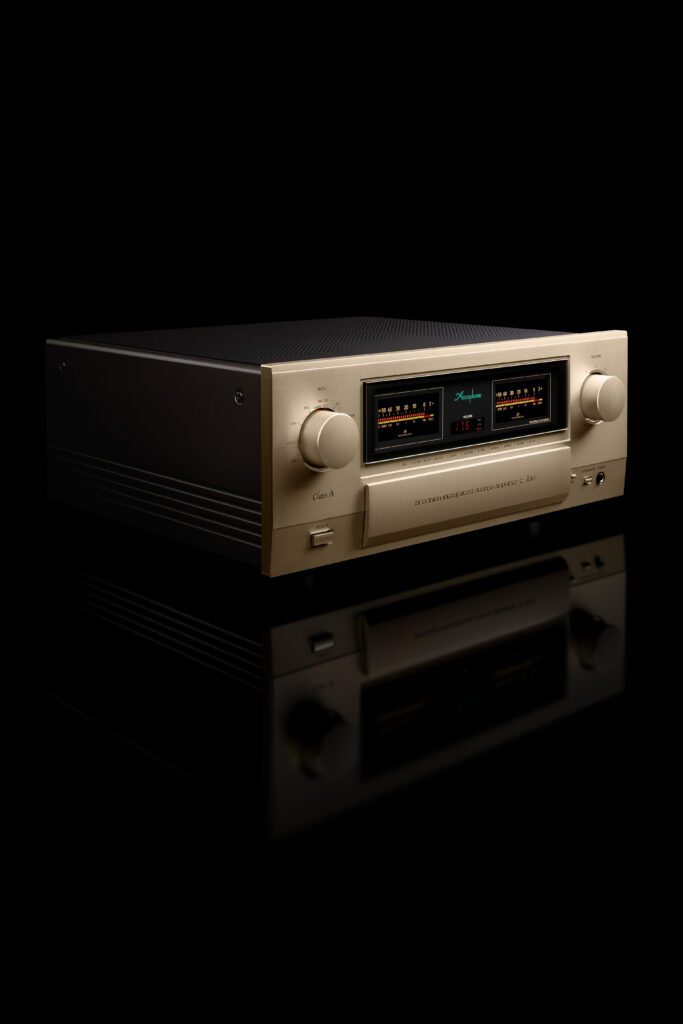
The E-700 is a Class A monoblock design rated at 35W into 8 ohms (the E-650 was 30W), 70W into 4 ohms (E650 – 60W), 140W into 2 ohms (E650 – 120W), and 160W into 1 ohm.
Flagship configuration
The power amplifier sections use the same configuration as the flagship E-800S, but with four sets of MOSFETs in a push-pull configuration as opposed to three in the E-650, with a beefy power supply using a sizeable toroidal transformer and large 56,000uF 50V filtering capacitors.
Accuphase quotes a high damping factor of 1,000 for the E-700 (up 25% on the E-650) thanks to the lower output impedance of the four-fold output stage, its negative feedback circuitry and the use of a MOSFET switch for speaker protection as opposed to mechanical relays.
In the preamp section, Accuphase has introduced a totally new AAVA volume control circuit that does away with the conventional variable resistor approach, which, it says, has an adverse effect on sound because of changes in impedance, especially at settings that correspond to normal listening levels. Instead, it feeds the input signal to a voltage/current converting amplifier, where 16 switches provide more than 65,000 possible volume steps. The signal then passes through the ANCC noise-cancelling circuit, which is said to improve noise performance drastically.
Action-packed
Being a Japanese product, you will not be surprised to hear that the E-700 bristles with facilities. The front panel looks minimalist at first glance, with two large knobs to select input and adjust the volume on either side of the central VU meters. Flip down the hinged flap under the meters, however, and you will find rotary switches for speaker selection and tone controls, balance, a power amp in selector (balanced or line) and monitor loop, plus buttons for DAC (optional extra board), MM/MC and MC load (if using optional phono board), subsonic filter and phase inverter (when using a separate preamp) and one to take the tone controls out of circuit. Next to that flap is a headphone jack and an attenuator button that cuts the volume by 20 dB.
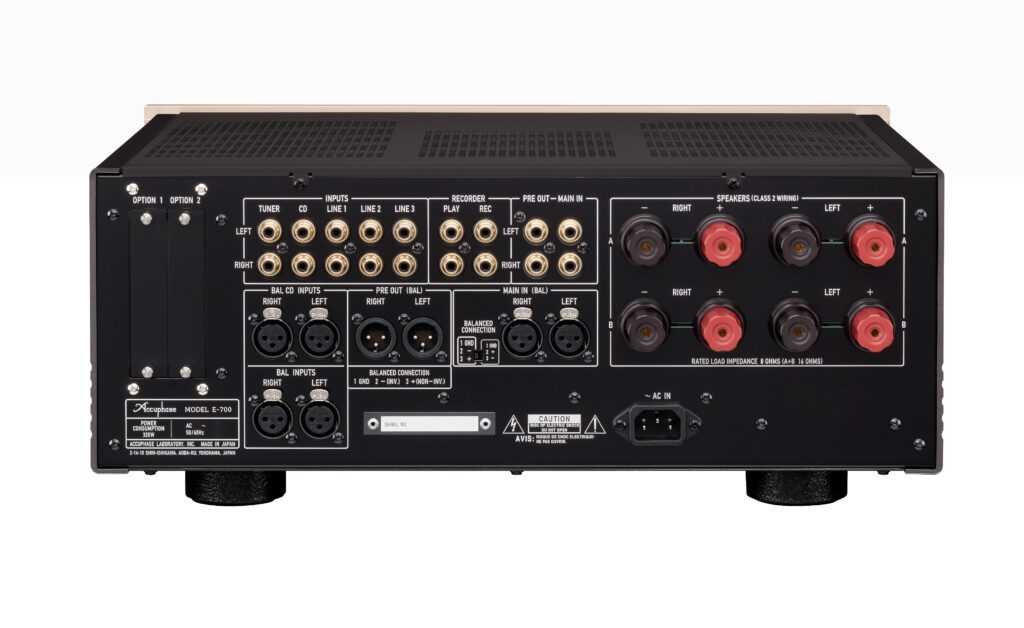
On the rear panel, the E-700 provides five line-level RCA inputs, two sets of balanced XLR inputs, a monitor loop for a recorder or equaliser/signal processor, preamp out and in – balanced and unbalanced – plus two sets of speaker binding posts for either two sets of speakers or one pair bi-amped or bi-wired. There is no built-in DAC or phono input, but these are available as optional plug-in boards.
A Class A act
I was lucky enough to get to listen to the E-700 not only in my home system, using an Audio Note CD-T Five transport and Audio Note DAC Five Special through Russell K Red 150Se speakers, but also in the listening room at retailer Signals near Felixstowe – I’d just dropped in for a day’s visit while visiting a friend in the area – where it joined an Accuphase DP-770 CD player and Dynaudio Contour Legacy speakers. My listening comments encompass both sessions but suffice it to say that my impressions of the E-700 were identical in both locations.
UK distributor MusicWorks also supplied me with their own ReFlex Ultra G5 mains distribution block with ReVive Ultra II mains leads, which made quite a remarkable and worthwhile improvement to the performance of my home system compared with a standard mains block and leads.
When I settled down to listen, it was clear from the first few bars of Ben Sidran’s ‘Shine a Light on Me’ from his Enivré d’Amour CD that the E-700 was a class act. The bass line that drives this superb track along is tight, deep and melodic, and the drumkit has excellent dynamics and punch, while delicate cymbal detail was well separated and presented. Sidran’s vocals were open, well focused and articulate, and his play on the DX7 synth was easy to follow. The track really moved well, and its quirky rhythms were well portrayed.
All wheat, no chaff
Another track that sorts the wheat from the chaff is guitar legend Larry Carlton’s fantastic version of the Doobies’ ‘Minute by Minute’ on his Discovery album. This track has a wonderfully sinuous bass line with some great twists and turns, and the E-700 conveys it with great control, weight, and movement. Carlton’s guitar was well-voiced, and I could hear how each note was shaped and played. Drumkit also had a great snap and syncopation with good dynamics.
My favourite Bruce Springsteen track is ‘Racing in the Streets’ from his Darkness on the Edge of Town album. I played it on the E-700 as it is an excellent test of a system thanks to its superbly open vocal and piano on the intro and a bass line that will blow your socks off. The E-700 passed with flying colours – his voice was open and expressive, the piano had weight, presence and space around it, and when that superb bass line kicked in, it was deep, tight, agile and easy to follow. And when the bass guitar and kick drum played together, it was tight and rock solid. It conveys the sheer energy and dynamics of the track well, and the powerfully emotive vocals make this track unique.
Although I enjoyed playing many more tracks during my time with the E-700, the last track I will share with you is ‘No One Emotion’ from George Benson’s superb 20/20 album. This track flies along at a breakneck pace and has fantastic energy, driven by a compelling and gorgeous bass synth line. The E-700 conveyed the sheer drive of this track, while Benson’s vocals were open and delivered with great emotion and the panache that makes Benson special.
During my time with the E-700, I also had another well-respected rival that cost a little less than the E-700, which I greatly liked. What struck me about the E-700 compared with that amp was how much more dynamic and exciting it was without fatigue. The E-700 had a dynamic energy that the cheaper rival lacked and more significant insights into musicianship and vocal delivery.
Authority
No matter what I threw at the E-700, whether vocals from Randy Crawford, Luther Vandross, or John Mellencamp, rock from ZZ Top, or jazz from Miles Davis or Lee Ritenour, the amp took it all in its stride. ZZ Top rocked, while the subtle, understated, yet equally successful at those powerful nuances that make Miles Davis’s trumpet play a sublime experience.
The Accuphase E-700 is an exceptional performer. It has authority, power, dynamics, rhythmic energy, and grip while offering subtlety and inner detail where it is needed. When someone really hits a tom or snare, the E-700 conveys its impact and delights the listener with subtle insights into a delicate cymbal line or the technique and style of a skilled guitarist or sax player.
I truly enjoyed my time with the E-700. It offers superb performance at the price and you’d be very unwise not to consider it if you have around £10k burning a hole in your pocket.
Technical specifications
- Type: Class A integrated amplifier
- Inputs: Five RCA line inputs, RCA unbalanced and XLR balanced preamp in. Plug-in DAC and Phono boards available as optional extras
- Outputs: Unbalanced and balanced preamp output, monitor loop, headphone jack, two pairs of speaker binding posts
- Power output: 35W into 8 ohms, 70W into 4 ohms, 140W into 2 ohms, 160W into 1 ohm
- Frequency response: 20Hz – 20kHz +0, -0.5dB (at rated output)
- THD: 0.05% (2-4 ohm load), 0.03% (8-16 ohm load) (20-20kHz at rated output)
- Signal-to-noise ratio: 103dB
- Damping factor: 1,000
- Dimensions (WxHxD): 465mm x 191mm x 428mm
- Weight: 24.9kg
- Price: £10,500, $16,975, €11,490
Manufacturer
Accuphase Laboratory Inc
UK distributor
MusicWorks
+44(0)161 491 2932
Trending Articles
See all
Krell Vanguard integrated amplifier
- Apr 07, 2015
Trending Articles

By Chris Frankland
More articles from this author


Read Next From Review
See all
Reiki Audio SuperSwitch X/Pro X PSU
- Oct 06, 2026
Audiobyte SuperVOX
- Oct 06, 2026
Unitra WSH-805
- Sep 29, 2026
Wilson Audio Sabrina V
- Sep 29, 2026