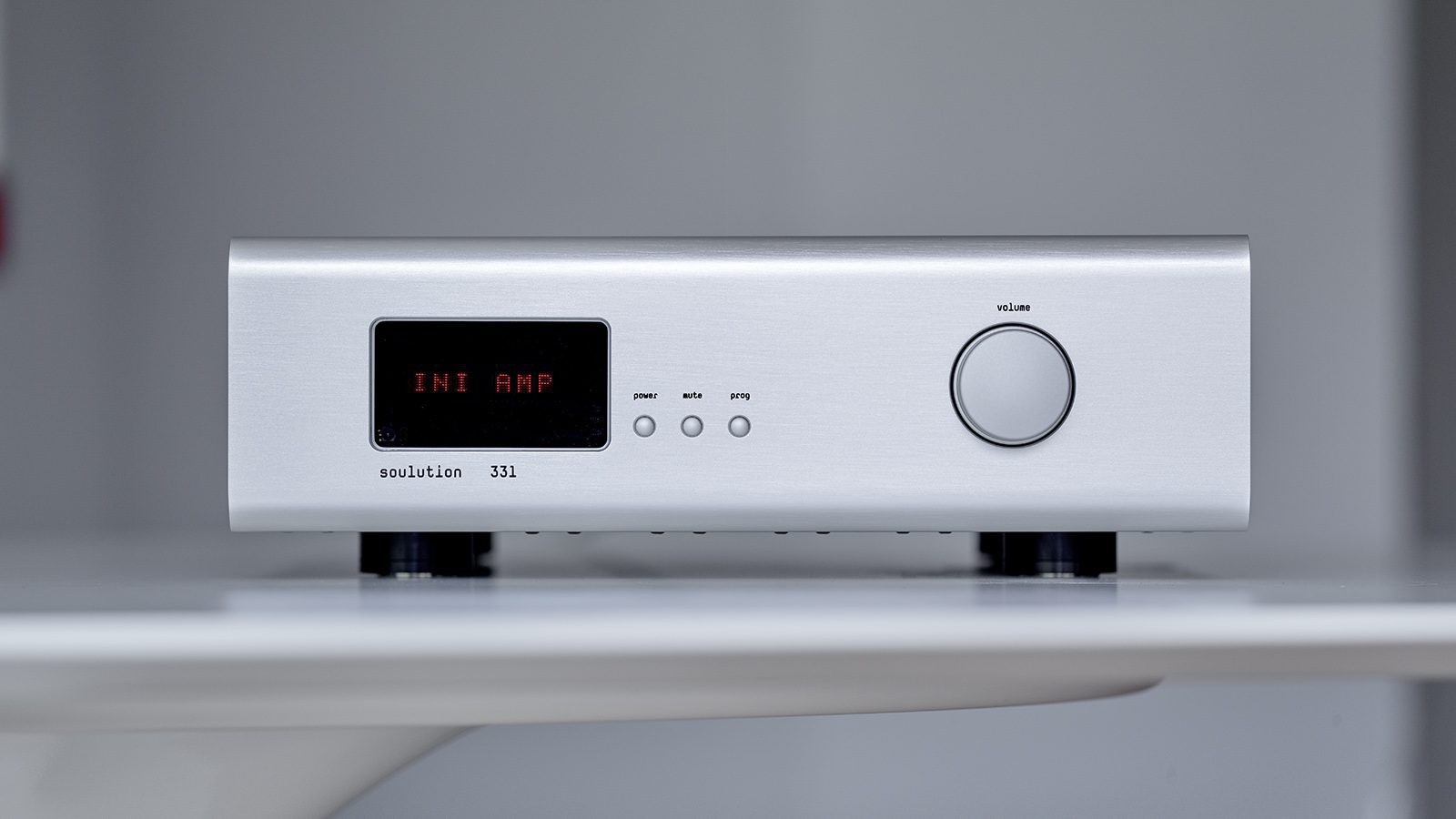
For most brands, the 331 integrated would be at the peak of their product performance abilities. For Swiss audio experts Soulution Audio, it’s still on the nursery slopes. There is the entire Series 5 and Series 7 above this elegant and powerful performer.
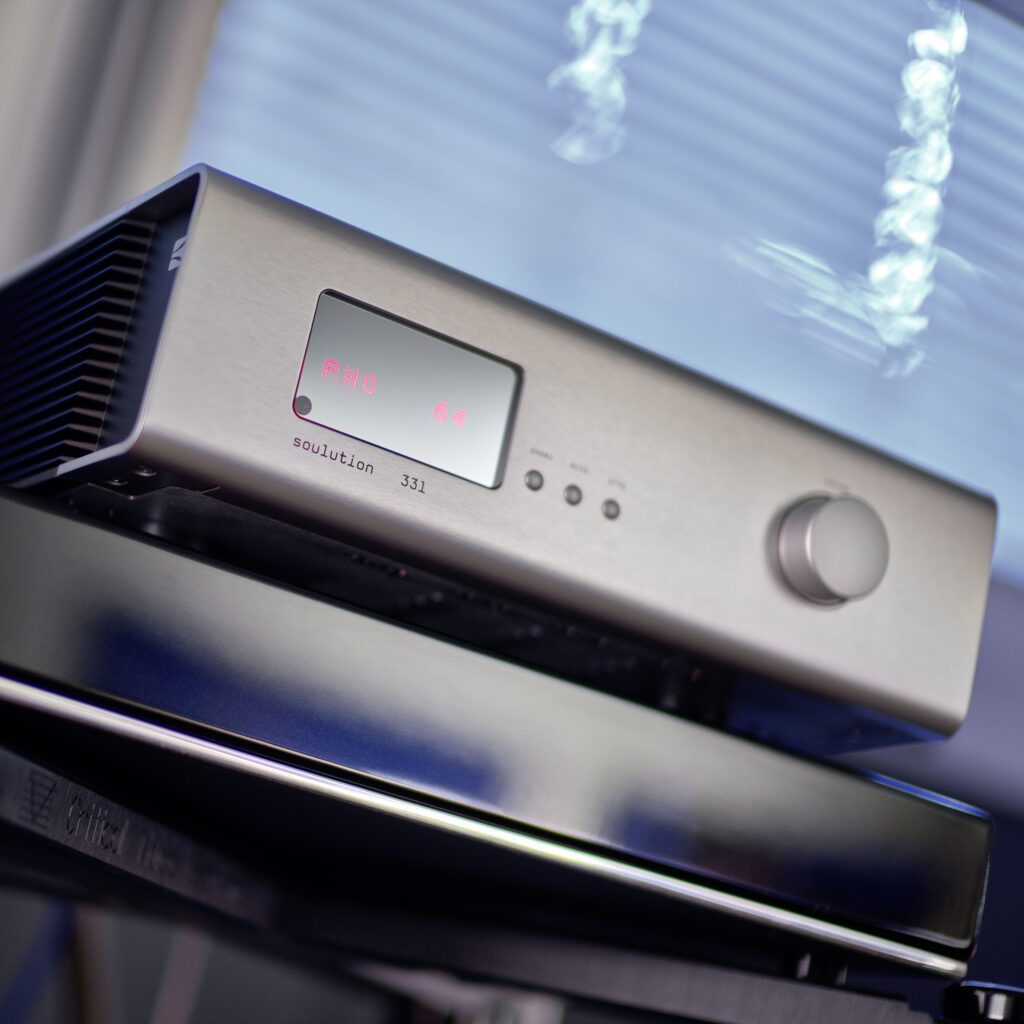
The 331 replaces the popular 330 integrated amplifier from Soulution. From the exterior, you can easily spot the difference because of the number ‘1’ in the product name. Seriously, that’s it. The front, rear, remote, display, and placement of buttons, knobs and connectors is all identical to its predecessor. This is no bad thing; it’s a simple yet elegant design that doesn’t need to change. Mungling about with timeless style for the sake of a revamp might work in the Bumper Book of Industrial Design. However, Soulution doesn’t work that way. It knows its aficionados are more concerned with what goes on inside the case than the case itself.
Changes
So, what’s changed? As Soulution itself puts it, “more power reserves and less phase shift in the audio band.” This is realised by four new SMPS (switch-mode power supplies) out of six in total, which Soulution labels as “cutting-edge.” Like their predecessors, these power supplies deliver 1.2 kVA of continuous power, feature high-performance filtering at the input and output. They also sport custom-made high-speed voltage regulators. However, these new power supplies can provide up to 4 kVA of peak current for more than five seconds. This improves an already impressively stable power delivery that it eschews reservoir capacitance. It widens the gap between this technology and transformer-based amplifiers even further.
The change has resulted in a net reduction in output power. The Soulution Audio 331 delivers 100 watts into eight ohms. That’s more than the 120 watts into eight ohms of its predecessor. However, this is not due to alterations in the amplifier circuitry but rather a reflection of the design’s enhanced refinement. Given that most of us seldom, if ever, listen to an amplifier at its maximum output, the reduction in power is extremely unlikely to present an audible issue.
The rest of the integrated amplifier remains identical to the 330 it replaces. It retains the amplifier technology used in the company’s Series 5 amplifiers. This relies on a three-stage current amplification system, with each stage having a narrow, almost linear operating range. It has a high-precision idle current management circuit. This keeps the amplifier in optimal high Class A operation under all conditions. There’s RF and DC protection at the input and short circuit protection at the output.
Volume, two ways
The volume control is relay-switched and features high-precision metal film resistors, forming an 80, 1dB step volume control. Unlike most relay-switching circuits, the 331 features a second signal path that is only active during volume adjustment. This Programmable Gain Amplifier chip acts like a conventional potentiometer during volume adjustment. The amplifier reverting to precision resistors when the volume level is set. Notionally, switching between resistor array volume and integrated circuit volume pathways should slow down operation. In the real world, any delay was extremely short.
Inside the chassis, the audio signal path, power supply and digital circuitry are all shielded from one another. Meanwhile the power amplifiers and their supplies are physically separated in a dual-mono layout. This results in exceptional channel separation (>105dB) for an integrated amplifier.
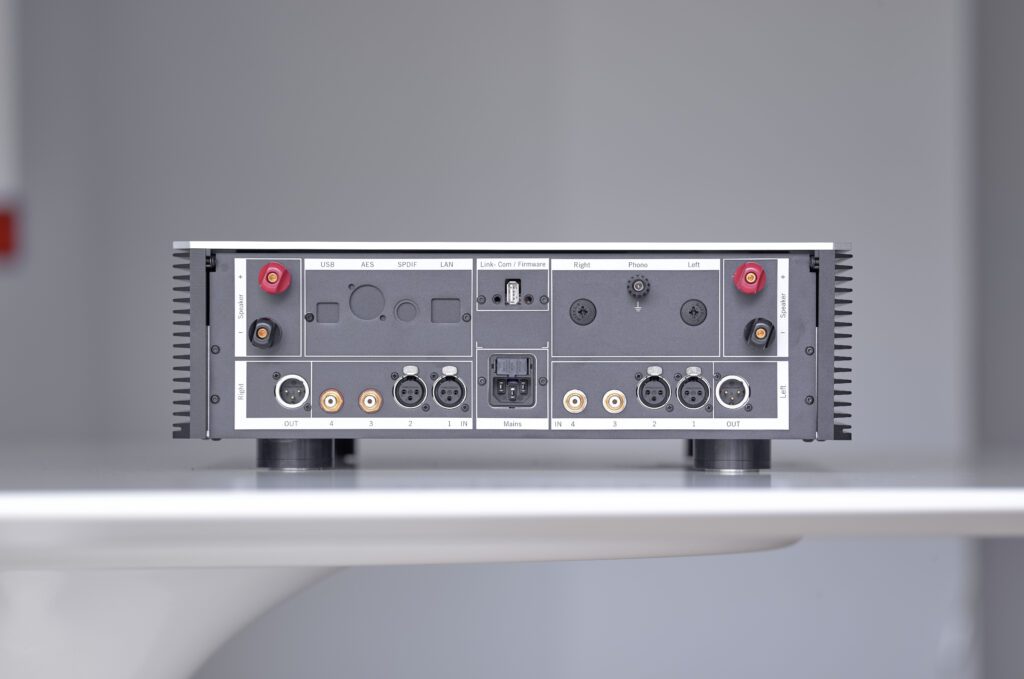
In its standard form, the amplifier features a line-only design with two XLR and two RCA inputs. However, there are also optional modules available for a phono stage and DAC. You can add these later, but it’s probably best to buy the 331 to your requirements at purchase. The phono stage comprises a two-stage, active Moving Coil design, exclusively incorporating passive RIAA equalisation, and offers a useful 60dB of gain with adjustable impedance.
LEEDH of the pack
The DAC includes inputs for S/PDIF, AES, USB, and Ethernet; it up-converts music to DXD, performs zeroPhase DSP processing, and boasts a LEEDH volume control. With one PCM1792 per channel and passive reconstruction filtering, this – much like the phono stage – is more than just an afterthought. Both can be used in the same amplifier, and they fit into otherwise blanked-out spaces on the rear panel.
The Series 3 range also includes the 326 preamplifier and the 312 stereo power amplifier. Additionally, there is a separate 360 DAC along with the 350 MC phono stage. All models in Series 3 share the same design (the 312 features just the display and one button), the same functionality and specifications, and generally utilise the same architecture. So, it’s not too far of a stretch to say the 331 has the functions and features of the 326 preamp and 312 power amplifier in one chassis. The differences in each case lie in the enhanced physical isolation and improved power supply delivery that brings.
Guy in a cape
Operationally, then, the Series 3 all perform very similarly. Most people will drive their Soulution 331 they way they do with all 300 series products; through the remote handset, which is cleverly weighted so that it sits upright on a table… like a Weeble. The remote’s functions are mirrored by the volume control on the right-hand side and the three small buttons—power, mute, and prog—near the centre line of the amp’s front panel. While the button marked ‘prog’ switches sources, I want it to add a MiniMoog riff by a guy in a cape.
There’s a common thread running through all things Soulution, from the top Series 7 products to the optional MC and DAC boards on the Soulution Audio 331; a dedication to wide-bandwidth, low-noise musical replay, adding or omitting as little as possible to the received musical signal. The wide-bandwidth part is a tough nut to crack in a range like Series 3.
Ship-to-shore
Absent the engineering and technology that make the Series 7 models true heavyweights, achieving a frequency response that runs to within 3dB limits from 0-800kHz shows just how much goes into building the 331. It’s difficult because it demands a lot of rejection of the outside world (you are firmly into radio frequency territories, with AM radio, ship-to-ship, ship-to-shore, aircraft voice communications, and some phone signals all in the 331’s ambit). However, in rejecting the outside world, you also risk undermining the performance. Soulution Audio has managed to keep the world at arm’s length while sounding great in the process.
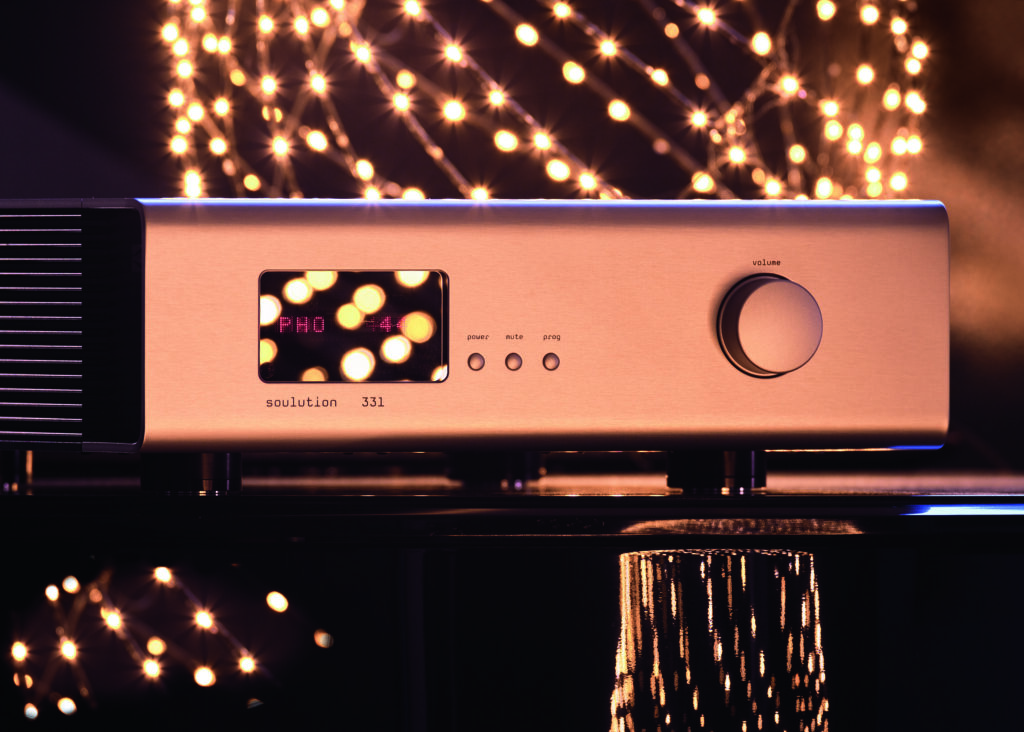
I mentioned the ‘timeless’ design earlier, but the Soulution 331 highlights a dilemma that runs through the audio business. Many consumer electronics industries update their industrial design when they change a model line; for the audio world, this is not as crucial. Some apply the ‘Porsche’ method of design, with subtle changes to each generation, retaining the brand’s identity while subtly keeping it up to date. Others prefer the ‘36mm Rolex Datejust’ method, where the external difference between a 2025 model and one from 1975 are minimal in the extreme, and the changes are all under the skin. It’s this latter approach that Soulution has taken in the 331.
Top Trumps
While there are distinctions between the 330 and 331, if you view them from a ‘Top Trumps’ perspective of specification matching, aside from the difference in power output, the two models look as identical on paper as they do on the surface. However, the fundamental differences between this model and its predecessor are entirely performance-based. It’s only when you sit down and listen to the two in comparison that the differences become apparent. If you make that comparison and own a 330, you become the proud owner of a 331, and your dealer will have a second-hand 330 to sell.
That’s all fine for existing Soulution owners, but the 331 is also the gateway into the brand’s products and ethos. Parking the 330 vs 331 question, how does the 331 perform in its own right? Impressively well.
Unthanks a lot
I’ve returned to listening to The Unthanks recently, and ‘Bread and Roses’ performed live [Diversions Volume 5 – Live and Unaccompanied, Rabble Rouser] and found the three solo voices (Rachael and Becky Unthank are joined by Niopha Keegan here) are powerful, passionate and the sense of being in the room with three folk singers in close harmony is palpable. The enigmatic ‘Magpie’ is on the same album, but this early Suffragette ballad was so moving I wanted to run out and chain myself to a railing.
This proved to be a common theme for the 331. I played ‘The Pirates of Penzance’ and found myself wanting to raid a clipper in very well-spoken prose. Then, I played ‘Clara’ by Jarvis Cocker and Chilly Gonzales and felt the need to sink a bottle of bourbon. Next, I played the overture to Tannhäuser and found myself sweeping majestically eastwards. It’s that kind of amplifier; evocative as well as informative.
I played many women’s voices during my time with the 331. Not because it skewed my listening, but because the sense of presence and power in those voices shone through. Vocal articulation was first-rate when listening to someone like Lady Blackbird’s ‘It’ll Never Happen Again’ [Black Acid Soul, BMG], and the power and dynamics of her voice come across brilliantly, too.
Terrifying synths
A track I don’t discuss very often is ‘Chocolate Chip Trip’ by Tool [Fear Inoculum, RCA]. The reason I don’t mention it frequently is that it can tear apart a flawed system. However, in this instance, it merely made you crave more razor-sharp percussion and terrifying synth bass lines. This also demonstrates just how precise the soundstaging is through the 331, as there is a considerable amount of extremely accurate panning across the stage.
Nothing I played through the Soulution Audio 331 challenged it, and everything remained thoroughly musical. I didn’t find myself drawn to particular aspects of the performance as being exceptional, as they were all exceptional. To say it ticked all the boxes is reductive, as it delivered an effortless and outstanding performance throughout.
The Soulution Audio 331 possesses an astounding ability to stay in its lane, and in a positive way. This is a crucial consideration for a company that offers far higher-end products in its lineup, as it provides more than just a taste of the impressive Series 5 and Series 7. At no point does it reveal limitations in the types of systems that might feature the 331. Pair it with a good digital or analogue front-end and loudspeakers at a similar price point, and it will truly shine. In fact, apart from needing large floorstanders speakers to fill an expansive room, the 331 occupies a sweet spot of enjoyment where ‘gear acquisition syndrome’ levels out. You can acquire ‘more’ than the 331, but not necessarily ‘better’.
Listenability
Perhaps the big thing about the Soulution Audio 331 is its sheer ‘listenability’. I found myself getting irritable at any distractions from listening to music, including taking notes to write up how it performs. You just want to listen to music on this amplifier because the musical experience is so enjoyable. That doesn’t seem to be limited to any genre or musical style. I would happily play music of all sorts and at almost all levels on the 331 thanks to that listenability.
Paradoxically, I often find this trait in more affordable audio equipment. It seems that, at times, high-end audio adopts an almost dour, soulless approach to sound. Music is exceptionally well organised spatially, and the presentation is highly detailed and informative, yet Lady Day singing ‘I’m a Fool to Want You’ [Lady in Satin, Columbia] is lauded for its detail and staging, while her impossibly broken voice is nearly overlooked. With the Soulution, you receive all the detail and analysis, but you also hear the sound of a woman on the edge, making the record the difficult listen it was always intended to be.
Tarkus
The interface is the closest this gets to a downside. The single line of red LEDs is informative, dimmable, and on the cusp between ‘classic’ and ‘slightly old-fashioned’. Moreover, the remote eye relies heavily on line-of-sight; unless you point the handset at the left side of the front panel, changing sources and adjusting the volume is often more honoured in the breach than in the observance. That said, I prefer the more physical approach to oversensitive handsets that max out the volume just by picking up the damn thing. And, I want ‘Prog’ to immediately start playing Tarkus by Emerson, Lake and Palmer… but that’s just me.
My time with the Soulution Audio 331 integrated amplifier was all too short, but I suspect I could have spent the whole of the last year listening to it every day and still make that claim. Products like this make my job obsolete because, if you listen to this amplifier, you might never want or need to buy anything else again. It really is that good.
Our thanks go to Sebastian at KJ West One
(www.kjwestone.co.uk) for his assistance in this review.
Technical specifications
- Type: Integrated amplifier
- Inputs: 2x balanced XLR pair, 2x unbalanced RCA pair, 1x unbalanced RCA for Phono MC (optional), 1x AES/EBU, 1x S/PDIF, 1x USB, 1x Ethernet for DAC (optional)
- Outputs: 1x balanced XLR pair, 2x pairs loudspeaker terminals
- Power output: 100W @ 8Ω, 200W @ 4Ω, 400W @ 2Ω (<5 sec.)
- Output current max: 30A
- Frequency Response: 0-800kHz (-3dB)
- Phase shift @ 20kHz: <-3°
- THD: <0.0005%
- Damping factor: >5,000
- Dimensions (WxHxD): 43x49x14.2cm
- Weight: 18kg
- Price: From £25,000, €30,000, $44,475
Manufacturer
Soulution Audio
UK distributor
Select Audio
+44(0)1900 601954
Trending Articles
See all
Krell Vanguard integrated amplifier
- Apr 07, 2015
Trending Articles

By Alan Sircom
More articles from this author
Read Next From Review
See all
Eversolo T8
- Oct 13, 2026
Acoustic Energy AE Active
- Oct 13, 2026
Reiki Audio SuperSwitch X/Pro X PSU
- Oct 06, 2026
Audiobyte SuperVOX
- Oct 06, 2026