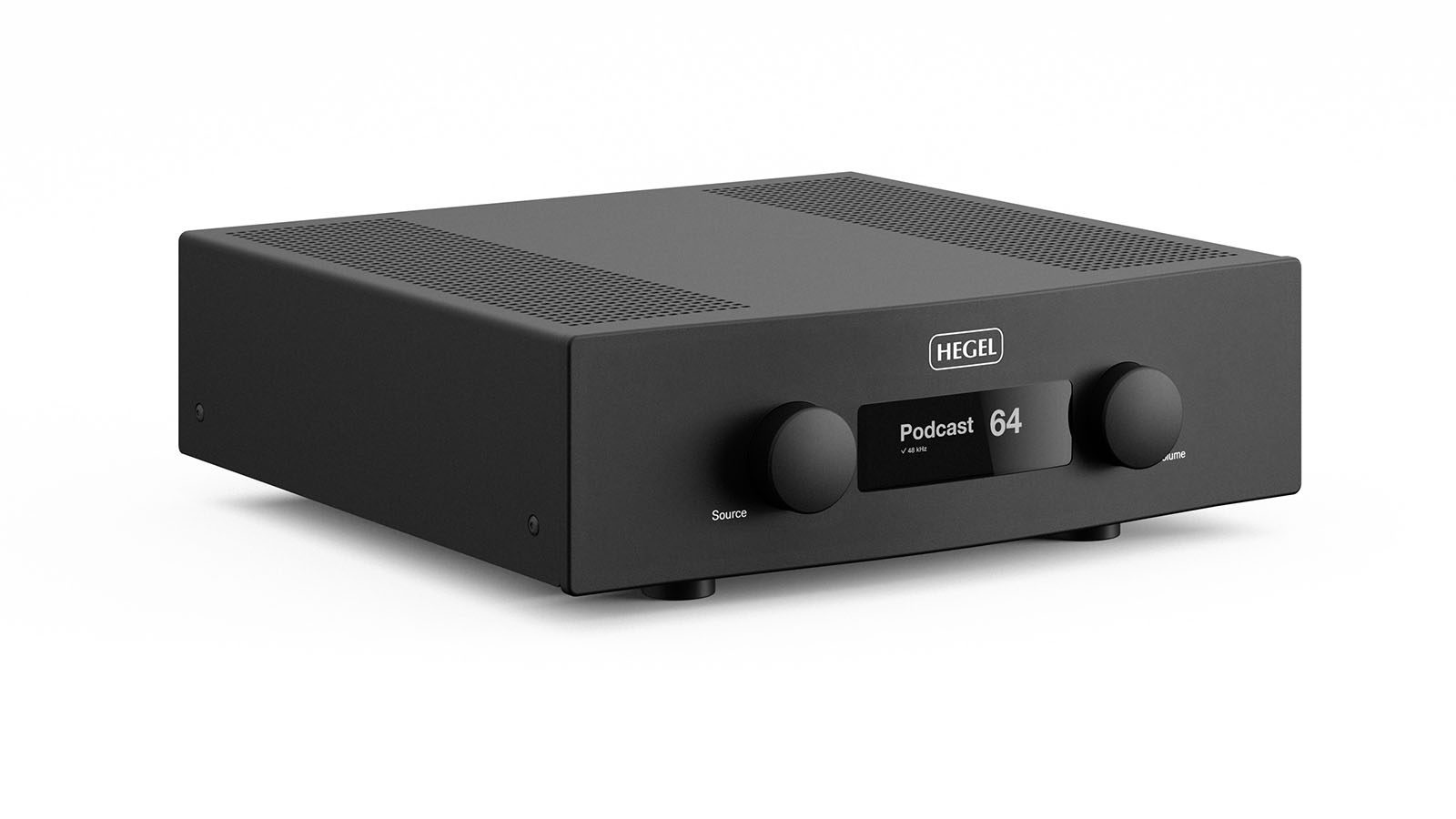
With a 30-year track record, the Norwegian Hegel brand has established itself as a significant player. It offers a range of well-regarded integrated and pre/power amps, plus a CD player and phono stage. I’ve had good experiences with their integrated amps/DACs/streamers in the past. Therefore, I was particularly keen to get my hands on the Hegel H400 streaming integrated amp, which replaces the old H390.
Although the external changes to the £5,900 H400 integrated amp with built-in streamer and DAC may be subtle – new knobs and slightly revised casework – there are significant changes beneath the surface. The main updates include a brand-new streamer with enhanced functionality and a completely new DAC, both based on those used in its larger counterpart, the H600. It also features an improved power supply and enhancements to the preamp section. Additionally, it comes with a new app. When I unpacked it, the unit was impressively heavy and felt well-made and finished, which is always the case with Hegel products.
Control freak
This dual-mono Hegel H400 amplifier packs 250 watts of Class AB power into 8 ohms. It also boasts a high damping factor of 4,000. Hegel says this ensures tight control over the drive units in your speakers.
Like all Hegel integrated amps, the H400 features a dual-mono layout. This provides separate voltage- and current-gain stages for each channel. It also has completely separate power supplies for the input, voltage gain, and current stages. The custom-designed Hegel transformer features dual power windings. These feed independent high-speed rectifiers and high-capacity power supply capacitors, all intended to reduce distortion and increase dynamic range.
Like its other integrated amps, the Hegel H400 includes Sound Engine technology, which uses adaptive feed-forward error correction. Feedback corrects the errors and distortions that occur at each stage of amplification. However, rather than applying global feedback by simply comparing output to input, Hegel uses local. This involves adaptive feed-forward error cancellation, which it says preserves the original detail and dynamics.
The streaming platform and DAC in the H400 are based on those in the H600. The DAC features the highly respected ESS 9038Q2M chipset. It also employs a new digital-to-analogue conversion technology known as synchronised upsampling. This, along with its Direct Master Clock technology, is said to minimise jitter and conversion errors. Hegel has also carefully considered its circuit board design to reduce noise.
Keeping it simple
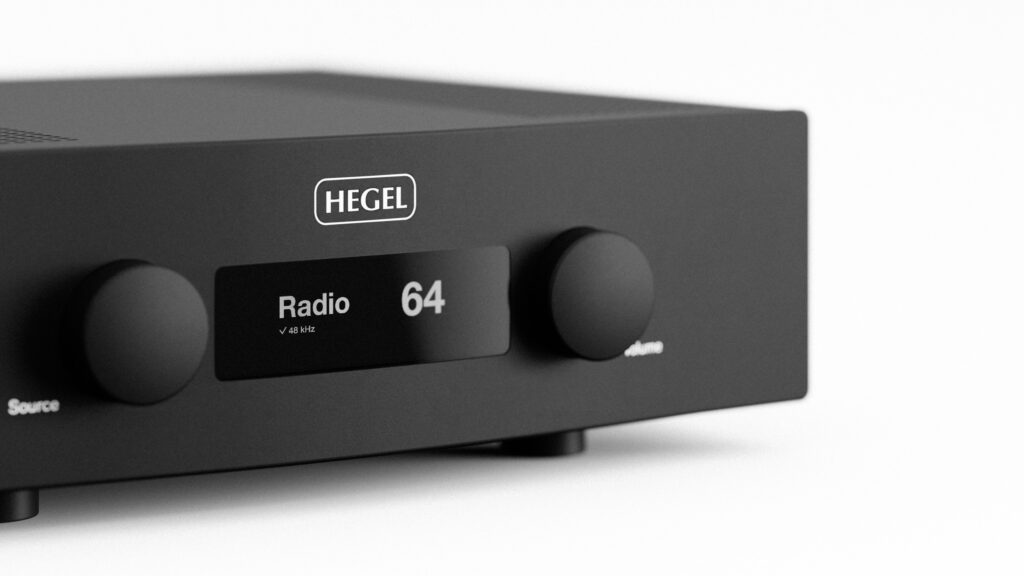
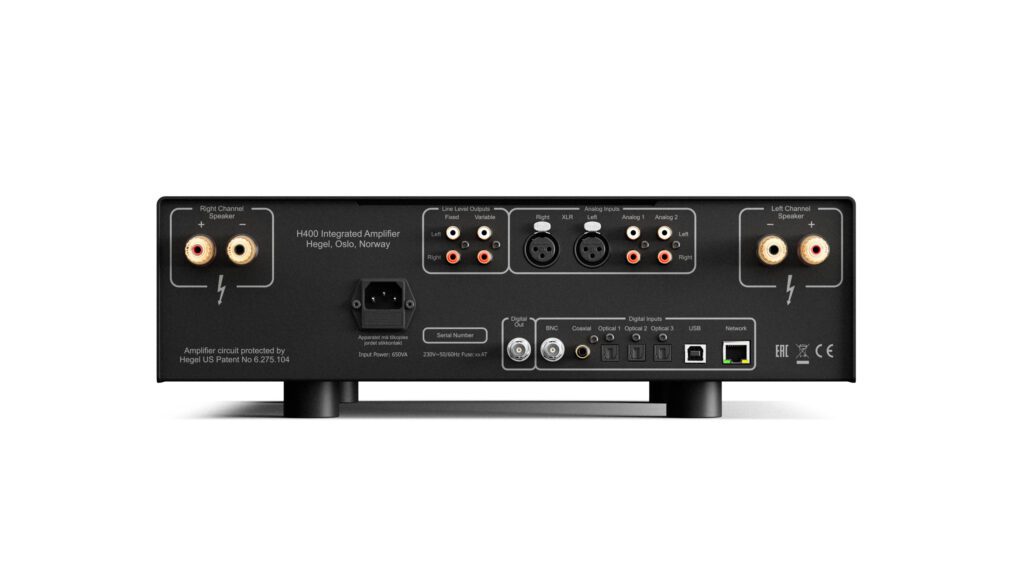
The best description of the Hegel H400’s front panel is ‘minimalist’. The central display screen, which shows input and volume, is flanked by a rotary knob on the left for selecting your chosen input. Meanwhile, the right-hand knob adjusts the volume. Naturally, the remote control duplicates these functions. The rear panel includes one set of speaker connections, variable and fixed line-level outputs. It also has one balanced line-level analogue input (XLR), and two unbalanced line-level analogue inputs (RCA).
The H400 does not have a phono input so that that vinyl fans will need a separate external phono stage. The built-in DAC has digital inputs via three optical Toslink sockets, one coaxial S/PDIF socket, and one USB port. Hegel also provides a BNC DAC loop, allowing users to upgrade to a higher-quality external DAC at a later date.
Unusually, Hegel has intentionally excluded Wi-Fi from the H400. The unit connects to your network solely via Ethernet. As Hegel’s Sales and Marketing Vice-President, Anders Ertzeid, confirmed to me, this decision was made to prevent any chance of RF interference and noise from entering the audio circuits. This preserves the sound quality.
The Hegel H400 streamer supports popular streaming platforms, including AirPlay, Spotify Connect, Tidal Connect, Roon Ready, Google Cast, and UPnP. Users can control the amplifier directly through these services. The Hegel Control App also enables users to adjust playback volume and select a specific input. Furthermore, it provides access to internet radio and podcasts. However, it does not offer access to the Qobuz streaming platform, which is my preferred source of high-quality streaming music.
The H400 also supports multi-room operation through Roon, AirPlay, and Google Cast.
Oh so easy
I, for one, found the H400 easy to set up, and it was a pleasure to use. Rear panel connections have clear labels. Additionally, the front panel doesn’t overwhelm the user with information. It displays only volume and the selected input, and, under that, much smaller, the resolution of the chosen digital source material. Additionally, the Hegel H400 automatically recognises connected digital audio sources and switches to the correct input. Therefore, you don’t have to select the input manually.
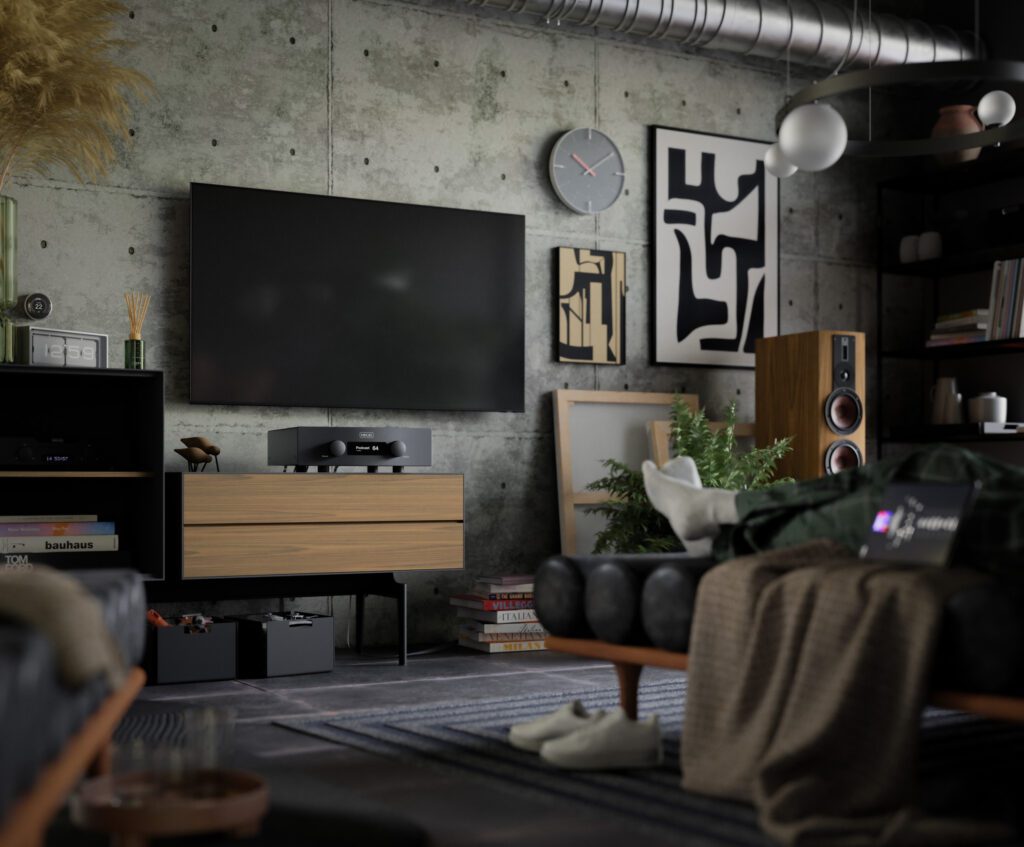
I installed the Hegel Control App to see what it offered for internet radio and podcasts. However, if those are not of interest to you, you could certainly limit yourself to third-party control apps such as mConnect. I used mConnect because it allowed me to access Qobuz, which is not available on the Hegel app.
Sound quality
Eager to test it thoroughly, I inserted the H400 into my usual setup. The CD source was the excellent Audio Note CDT Five transport, paired with the company’s DAC Five Special. It drove either the Russell K Red150 Se or Audio Note AN-J LX Hemp speakers. The speaker cables were QED Supremus Zr, and all other interconnects were from Audio Note. I provided the streamer with an Ethernet signal through an English Electric switch box and a Network Acoustics eno2 network filter.
Another good integrated amp/streamer stood on standby. This served as a benchmark for assessing the H400’s competitiveness at its asking price.
I began by searching for some of my favourite tracks on Qobuz, using the mConnect app. First up was ‘Broad Daylight’ by jazz singer/songwriter/pianist Ben Sidran. I was immediately impressed by Hegel’s balanced presentation, grip, and effortless power. Sidran’s vocals were crystal clear and expressive, while his piano playing was effectively conveyed. Fast runs of notes were nimbly captured by the H400. The track flowed well, and the bass line was well-defined and tight. It was also rhythmically strong. The competitor amp/streamer had a warmer balance, was a little more ponderous in rhythm, and was not as open in the vocals or piano.
Stay jazzy
Continuing with jazz, I then played the title track from the Harlequin album by keyboard legend Dave Grusin and guitar virtuoso Lee Ritenour. Ivan Lins’s vocals in the intro were clear and open on the Hegel H400, while Grusin’s piano had excellent definition and space surrounding it. Ritenour’s guitar was fluid and well-defined in terms of voicing and note shape. The percussion and drums were snappy, tight and detailed. The H400 effectively conveyed the delightfully quirky rhythm of this track. I felt Hegel provided more insight into what each instrument was doing than my benchmark competitor.
Switching to CD as a source, I played a track from one of my favourite guitarists, ‘I Can See Clearly Now’ from Peter White’s Groovin’. Hegel conveyed White’s guitar sound very well, offering excellent insights into how he crafted each note. The percussion was crisper and easier to follow. Additionally, the reggae-style, lilting bass line was weighty and tuneful. I felt the H400 once again delivered a more detailed, clean, and open sound.
Open and expressive
I was keen to hear what it could do with female vocals, so I spun up ‘Get Here’ from Oleta Adams’s Circle of Life album. Her voice was very well conveyed on the Hegel—open and expressive—while the piano had excellent presence and definition. The bass line was well controlled and seemed a bit weightier and more purposeful than on its rival. The drums also had exceptional power and snap.
I briefly compared the H400’s built-in DAC to that of a well-respected mid-priced CD player. Its performance is impressive. In fact, if you have a CD player priced below £2,000 with a digital output, it is worth checking whether the H400’s built-in DAC might deliver better sound.
I also used the Hegel Control App to enjoy internet radio and podcasts, which alone makes the app worth downloading.
Compelling
I really liked the new Hegel H400. It is well-made, easy to use, and robust. It offers a clean, detailed, and musically compelling sound that lets you hear what’s happening in the music. Additionally, it conveys its emotional and rhythmic impact with remarkable ease. It features an excellent streamer and delivers impressive performance from CD sources. It’s a fantastic purchase at this price, and not including it on your shortlist would be a mistake if you have between £5,000 and £6,000 to spend on a streaming integrated amp.
Technical specifications
- Type: Dual-mono class AB integrated amplifier with built-in streamer and DAC
- Power output: 250 watts into 8 ohms
- Analogue inputs: One balanced XLR, two unbalanced RCA
- Digital inputs: One coaxial BNC, one coaxial RCA, three optical, one USB, one Ethernet
- Digital outputs: One BNC
- Line level outputs: One unbalanced fixed, one unbalanced variable
- Streaming: Spotify Connect, Roon Ready, Tidal Connect, Google Cast
- Streaming formats: MP3, WAV, FLAC, ALAC, AIFF, DSF, DFF, AAC, PCM, MQA, Ogg
- Frequency response: 5Hz – 180kHz
- Signal-to-noise ratio: >100dB
- Crosstalk: <-100dB
- Distortion: <0.005% @50W, 8ohms, 1kHz
- Intermodulation distortion: <0.01% (19kHz + 20kHz)
- Damping factor: >4000
- Dimensions (HxWxD): 150mm x 430mm x 440mm
- Weight: 20kg
- Price: £5,900, $6,995, €6,995
Manufacturer
Hegel Music Systems
hegel.com
UK distributor
Auden Distribution
+44(0)7917 685759
Trending Articles
See all
By Chris Frankland
More articles from this author

Read Next From Review
See all
Unitra WSH-805
- Sep 29, 2026
Wilson Audio Sabrina V
- Sep 29, 2026
Meze Audio 99 Classics (2nd Generation)
- Sep 22, 2026
MOON 371
- Sep 22, 2026