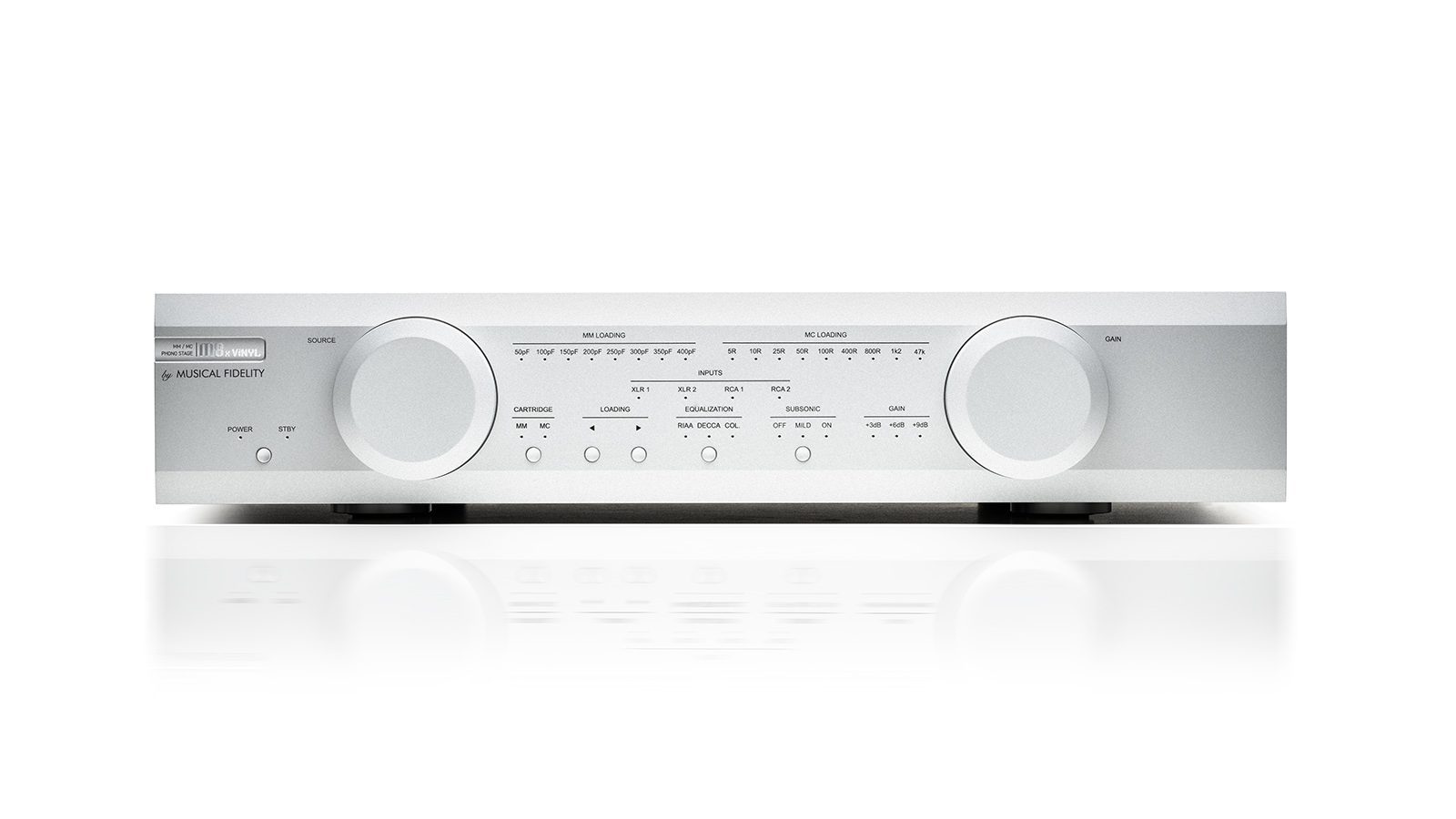
There is something faintly indulgent about multiple-input phono stages. I’ve long argued I ‘need’ one (as if anything to do with this occupation represents a necessity) because it allows for a test unit to run at the same time as a resident reference and allows for a moving coil and moving magnet cartridge to be on the go at the same time but, the increase in designs that support more than one input does suggest that the fundamentally moreish nature of turntables means that they are finding owners in typical systems too.
Musical Fidelity has been active in the multi-input movement for a few years now. Viewed in the context of the existing lineup of models, the M8x Vinyl is an entirely logical creation that bridges the gap between the M6x Phono and the more expensive NuVista Vinyl 2 models. It does this while expanding on another increasingly popular idea in phono stages: balanced operation.
Individual configuration
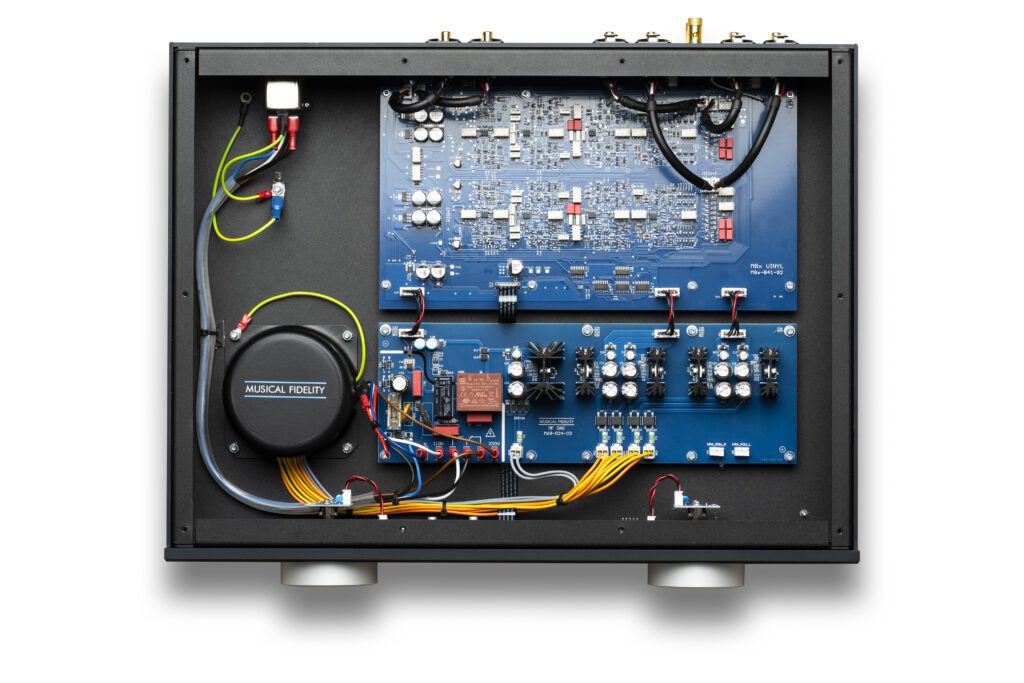
The M8x Vinyl has four inputs, each of which can be individually configured and will remember its settings. Two of the inputs are standard RCA, but two have balanced XLR connections front to back. This balancing process extends to doubling the relevant components throughout and avoiding using integrated circuits at any point.
The EQ stage all these inputs use is a split-passive design, which Musical Fidelity says offers an accurate representation of the EQ curve in use (and the M8 allows three: RIAA, Decca, and Columbia) with better impedance matching. An encapsulated power transformer, designed to generate as little noise as possible, powers the circuit. Musical Fidelity’s M8x Vinyl sports ‘enthusiastic’ use of EMI filters and DC blockers to stop interferences and eliminate transformer hum. The preamplifier stage is powered by two passively filtered and regulated, symmetrical low-noise power supplies, one for each channel.
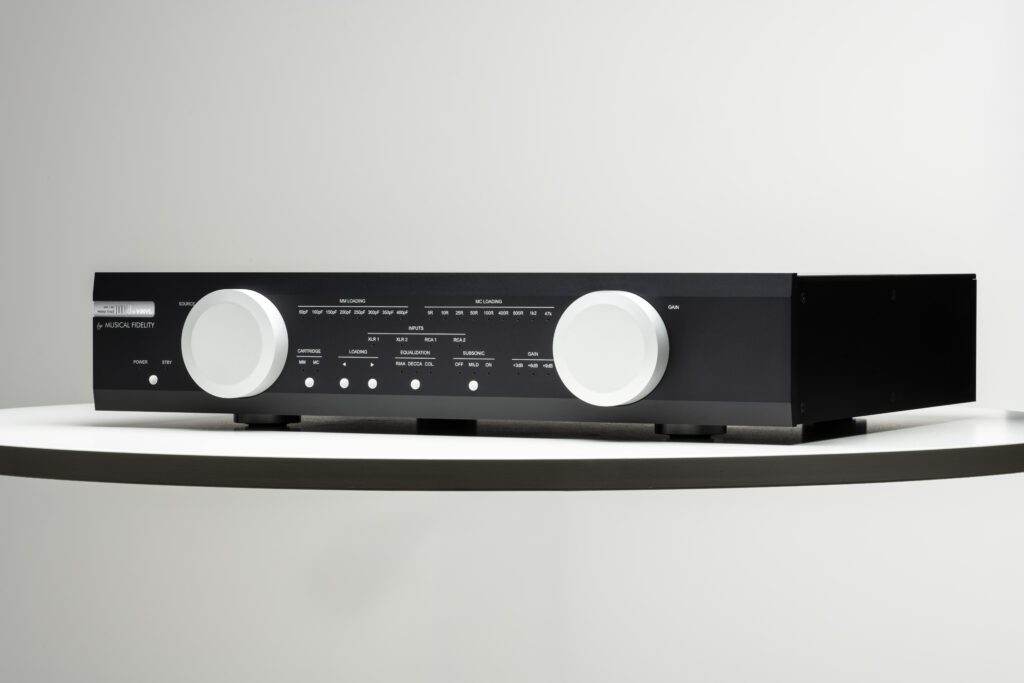
The adjustment range for each input is helpful, if not groundbreaking. The M8x Vinyl allows capacitance adjustment from 50 to 400 µF and impedance adjustment between 5 ohms and 1 kOhm, with a 47 kOhm fixed for moving magnet operation. Like other Musical Fidelity phono stages I’ve tested over the years, these adjustments are ‘either/or’; moving magnet allows capacitance adjustment but not impedance, while the reverse is true for moving coil. Some users may find this restrictive. On the plus side, with a maximum potential gain of 69dB, there won’t be many real-world instances where you find yourself low on gain.
Input arrangement
Something else that Musical Fidelity has done well is arranging the inputs so that it is mechanically possible to connect all four at once. The spacing between the XLR and RCA connections is deliberate to avoid interference. While I’m not delighted with a single ground connection for all four inputs, as it can get busy when you have a few connections on the go, the M8x Vinyl can at least support a few different connections simultaneously. Another nice touch is that the RCA and XLR options each have their own power stages, allowing them to be used simultaneously during playback.
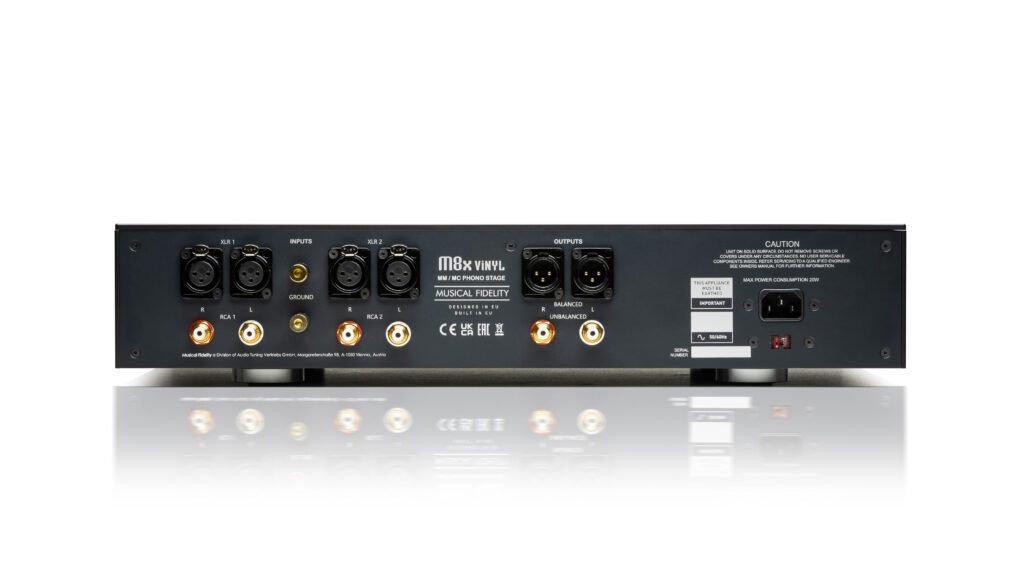
Musical Fidelity may have little trouble putting the connections on the back in an orderly manner, given that it has plenty of back panel to play with. The M8x Vinyl is a girthy bit of kit that is nearly half a metre wide, and, like most offerings from the company, I would describe it as ‘distinctive’ rather than ‘attractive’.
Substantial knobbage
The two substantial knobs control input and gain, while the row of buttons between them allows adjustment of the other functionality. Small blue LEDs indicate settings. These LEDs can become hard to spot in strong sunlight. I think the M8x Vinyl is easy to use, though, and I can’t argue with how it is bolted together, with the all-metal casework feeling sturdy and well-finished. Black and silver finishes are available.
I connected the M8x Vinyl to the resident Cambridge Audio Edge A integrated via the XLR output and, to begin with, used the RCA inputs from a Vertere MG-1 MkII turntable with Mystic cartridge and an AVID Ingenium Twin with SME M2-9 arm and Gold Note Vasari Shibata MM cartridge as known quantities. Even running the M8x Vinyl with a comparatively affordable moving magnet cartridge demonstrates this is a genuinely accomplished phono stage. All the basics are covered nicely; noise levels are low enough to be considered non-existent, ensuring that everything the cartridge sends to the M8x becomes a signal.
Good signal
And a very good signal it is, too. The way Musical Fidelity sets about the dense, challenging Rogues Gospel by Duke Garwood [God Unknown] is an impressive balance of the M8x, which prises things open and reveals nuances and details in these shifting, loose tracks, without making the result sound like forensic reconstruction. The tonal balance is genuinely good, too. Garwood’s vocals and the shimmering instrumentation beneath it all sound compellingly real and impressively immediate.
Switching over to the Vertere, still via the RCA inputs of the M8x Vinyl, shows that the Musical Fidelity can effectively transmit the character of the connected turntable. Where the AVID’s potent and forceful presentation is at the forefront of what it does, it also brings Vertere’s more effortless and expansive sound to the fore. Listening to Talking Heads Remain in Light [Sire] through this combination keeps the same superb tonality and detail, but the Vertere adds extra scale and flows effortlessly into the performance.
Also imposing
The bass on offer is also imposing. Without sounding overblown or dominating, there is more low end to those polyrhythmic basslines than you generally associate with a recording of this era. Running the Vertere’s input at the full 69dB of available gain does nothing to change the fundamental lack of unwanted noise.
As changing the arm-lead on the Vertere is not a matter of moments, and the AVID is resolutely single-ended, it fell to the resident Michell GyroDec, SME309, and Van den Hul DDT II Special to go balanced. Having ‘sighted’ it over RCA, I changed the lead to an XLR one and let the M8x Vinyl do its thing. Significantly, the differences that resulted were not night-and-day, ‘my neighbour phoned up and asked what I’d changed’ sort of thing. Still, it lends weight to the idea that well-implemented balanced phono stages have considerable merit.
Listening to Hidden Orchestra’s To Dream is to Forget [Lone Figures], the Musical Fidelity takes the Gyro’s characterful yet hugely engaging presentation and adds depth and an immersive quality that makes you feel like the soundstage has expanded around you. Given how quiet the M8x Vinyl is on all of its inputs, there isn’t the scope to make the balanced connections significantly quieter. Still, I feel comfortable saying that this is the quietest I can recall the Gyro ever sounding, keeping that indefinable ‘maybe not the last word in accuracy, but I’m not sure I care’ quality of the Van den Hul that I have loved from the moment I first heard it.
All-rounder
One last element of the M8x Vinyl’s performance that is truly worthy of note is that this is a genuine all-rounder in handling a varied music library. With the Gyro on playback duties, one multi-hour session kicked off with Motion by The Cinematic Orchestra [Ninja Tune]. It culminated in Orbital’s Optical Delusion [London Music]. There wasn’t a point where I thought I found the ‘sweet spot’ of what the Musical Fidelity offered, and nothing was rendered unlistenable despite the level of detail on offer.
What results is unquestionably a superb ‘tool’ phono stage; more than once during the time it has been here, I have found myself willing the numbers in my business account to look a little healthier, but it’s something that should appeal to people with one turntable every bit as much as people with a couple on the go. The Musical Fidelity M8x Vinyl’s flexibility is never at the expense of how good it sounds, and, for people with the means to go balanced in particular, it is a must-audition.
Technical specifications
- Frequency Response: ± 0.2dB (MM) ± 0.2dB (MC)
- Input Sensitivity: 5mV in for 500mV out (at 40dB, 1 kHz) 500μV in for 500mV out (at 1 kHz) (MC)
- Input Impedance: 47kΩ (MM) 5Ω – 47kΩ, selectable (MC)
- Input Capacitance: 50 – 400pF, selectable (MM)
400pF (MC) - Gain: 40, 43, 46, 49dB (MM) 60, 63, 66, 69dB (MC)
- THD @ 1kHz: < 0.005% (MM) < 0.008% (MC)
- Signal to Noise Ratio: > 102dB (MM) (“A” Weighted @ 40dB) > 90dB (MC) (“A” Weighted @ 60dB)
- Overload Margin: 32dB
- EQ Curves: RIAA, Decca, Columbia (selectable)
- Subsonic Filter: Off / Mild (IEC) / Standard (@ 20Hz, 18dB/octave)
- Inputs: 2 x RCA Pair / 2 x XLR Pair
- Outputs: 1 x RCA Pair / 1 x XLR Pair
- Power Consumption: 20W Max. (0W in standby)
- Dimensions (w x h x d): 483 x 102 x 381mm
- Weight: 10.6kg (net)
- Price: £3,599, $4,399, €3,999
Manufacturer
Musical Fidelity
musicalfidelity.com
UK distributor
Henley Audio
+44(0)1235 511166
Trending Articles
See all
By Ed Selley
More articles from this author

Read Next From Review
See all
Eversolo T8
- Oct 13, 2026
Acoustic Energy AE Active
- Oct 13, 2026
Reiki Audio SuperSwitch X/Pro X PSU
- Oct 06, 2026
Audiobyte SuperVOX
- Oct 06, 2026