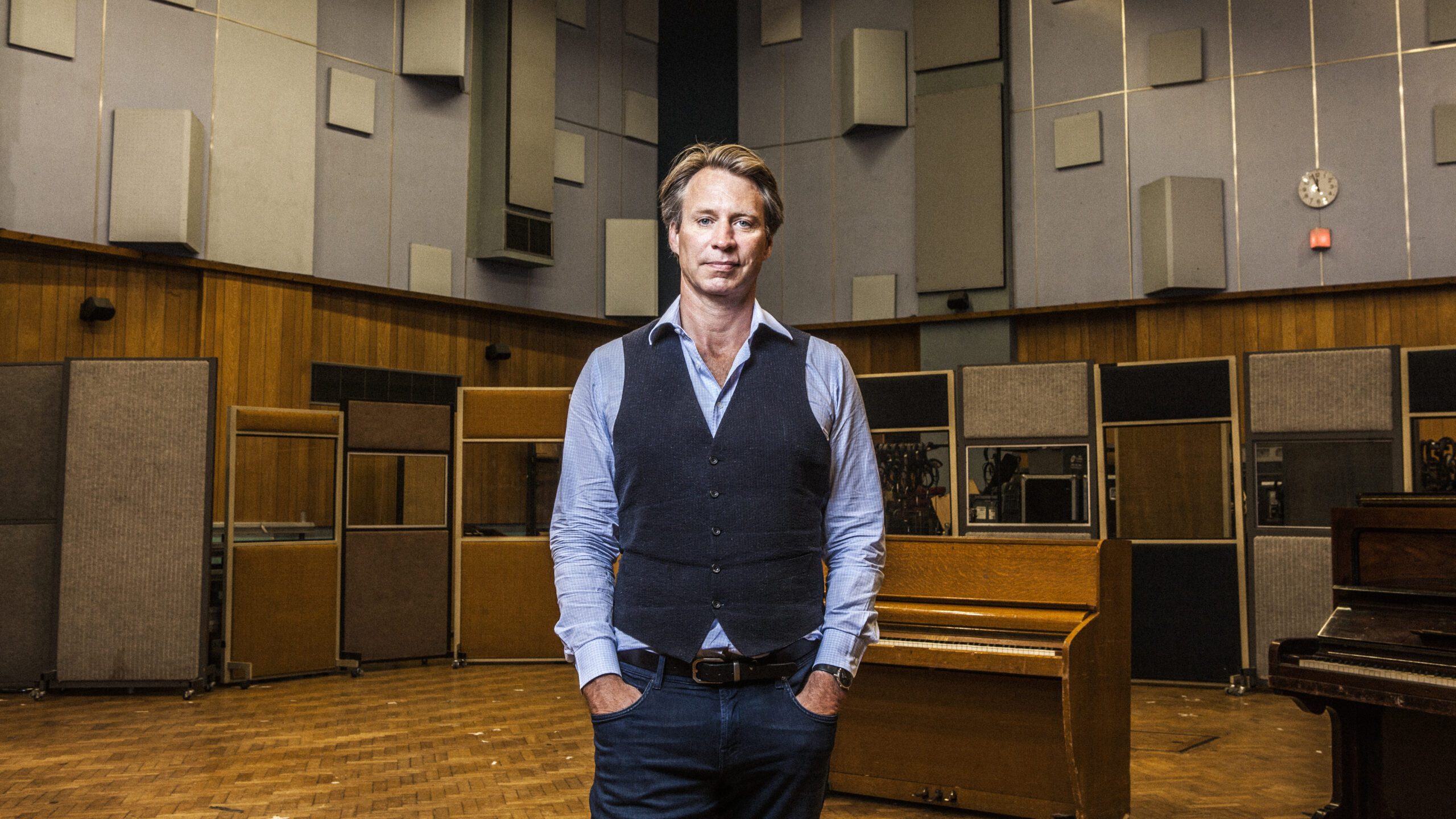
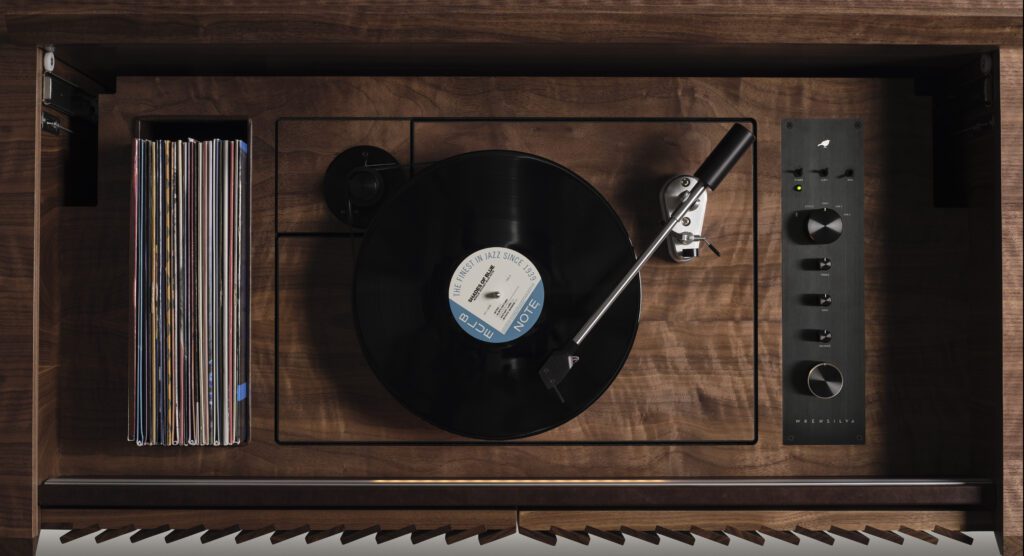
It’s early spring 2025 and hi-fi+ is sat in Giles Martin’s office in Abbey Road Studios, where he’s showing us how he uses his walnut Wrensilva M1 hi-fi console – the flagship record player by the high-end, Californian manufacturer – to listen to test pressings of albums he’s remixed.
To demonstrate the unit, which comes in a wooden cabinet and looks more like a piece of luxury furniture than a hi-fi, he’s chosen to play us a test pressing of this year’s 40th anniversary deluxe edition of INXS’s breakthrough 1985 album, Listen Like Thieves – this is no coincidence, as this is the record we’re here to talk about.
Alongside audio engineer, Paul Hicks, Martin, who is INXS’s executive music producer and the son of the legendary George Martin, has created a brand-new stereo mix of the album, which was originally produced by Chris Thomas, in collaboration with the band.
Shortly before playing the record, Martin tells us: “I’ll take a test pressing, and I’ll import it into Pro Tools, and listen to it through the Wrensilva console and the studio speakers to see whether the record sounds like the mix – it’s going to sound different, because it’s vinyl, but I want to see if it has any imperfections on it.
“On the first test pressing of this record, the guitars sounded a bit crunchy and distorted halfway through one of the songs, so we had it pressed again.
“There are instances with test pressings where the whole record might sound fantastic, but there might be a little click on one song. If you approved that, every single record made would have that click on it. That’s why it’s important for us to have a great playback system that we can trust – we’re making decisions in here that could affect every single record sold.”
After the demonstration, Martin sits down for an exclusive chat with hi-fi+ about the new stereo mix of Listen Like Thieves, his take on Dolby Atmos, working with The Beatles, and the threat of AI.
SH: You’ve been working with INXS for a long time – you first met them in 1994. How did you approach the new stereo mix of Listen Like Thieves? What did you want to achieve with it?
GM: That’s hard to answer – you’re sort of presuming I thought there was something wrong with the old mix… I guess, if anything, there was a style where records in those days… it’s funny, because it’s a criticism now… were quite limited and compressed. I tried to open the album out a little bit more and make it more live.
I’m still respecting Chris Thomas’s choice of drum sounds, like gated snares and all that sort of stuff.
Listen Like Thieves was an important record for INXS – it was the album that broke them internationally…
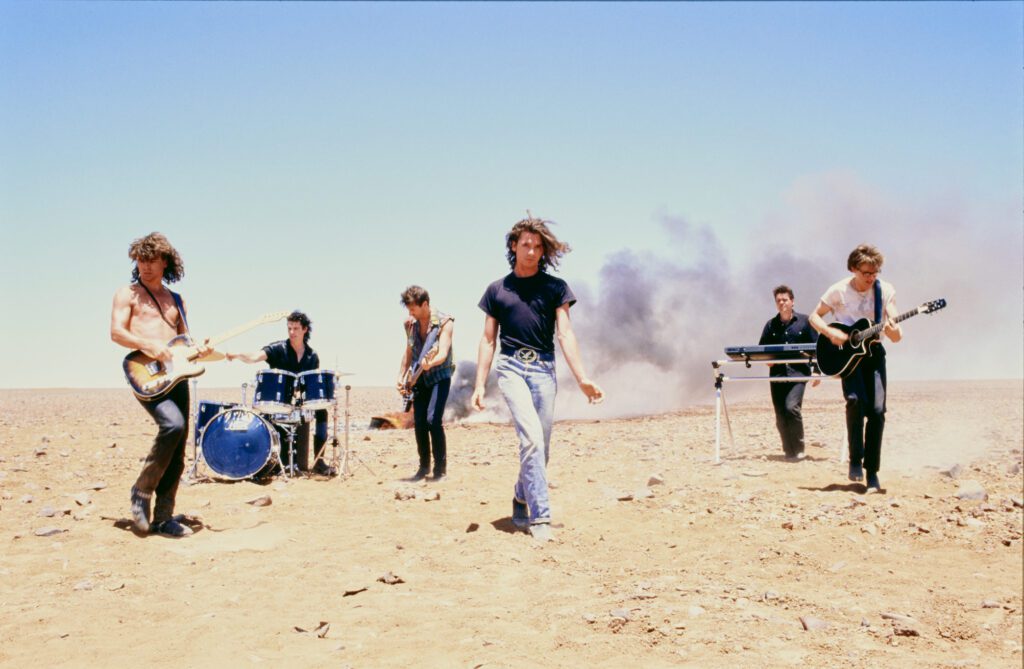
Yeah – it was the first time I’d heard of them, as a 14 or 15-year-old. I heard it at school – my best mate had moved to Australia, and he sent me a cassette.
For Listen Like Thieves, a lot of the songs were written during rehearsals, and it was an attempt to capture the live sound and energy of INXS. The studio where it was recorded, Rhinoceros in Sydney, was known for its big drum sound – it had an all-wood live room…
Exactly. I just took each song as it came and tried to give it as much impact and soul as possible.
Originally, I was going to do an Atmos mix of it and keep the stereo as it was – that happened with Goats Head Soup by The Stones as well – but to do an Atmos mix, you have to do a stereo mix. So, I was asked to do a [new] stereo mix as well, because they really liked what I was doing.
I try and intensify the feeling of a record – I don’t drastically change it. I try and use technology to bring you closer to the artist by taking out layers.
I remember when we did The Greatest Hits [INXS] in the ‘90s, there was a process where I think Bob Clearmountain mixed it, but it went to Chris Thomas, who then EQed it, and then Bob Ludwig, who mastered it. There was a lot of layers going on – I’m trying to strip out the layers of process on the record, so you just get a little bit closer to the live performance.
The song ‘What You Need’, from the album, was their first US hit, and it has that funk-rock sound, which became INXS’s trademark…
Exactly.
‘Same Direction’ has choppy, funky guitar, but it’s also quite electronic, with an ‘80s sequencer running through it…
Andrew Farriss used sequencers quite a lot – he was a keyboard player and the main songwriter in the band. Kick [the follow-up album] has a lot of sequencers on it. I think Jon Farriss’s drumming plays around the sequencers very well – there are certain drummers that play like a sequencer, but he played like a rock drummer.
Were there any challenges remixing Listen Like Thieves?
There were a couple of missing parts – we had to look at the strings on ‘Shine Like It Does.’
The challenge is that the record has an iconic sound from that time, and you have to respect old and new – especially with that era.
It’s much harder with that era than The Beatles or The Stones because you’re having to use the big ‘80s studio equipment that doesn’t exist anymore – like a Roland Dimension D chorus unit or an AMS delay on the drums – whereas the older equipment does exist…
This mix took quite a lot of time because we had to get the sounds right, but, generally, I work quite quickly while I’m mixing.
Did you do the mix at Abbey Road?
I did some of it at my studio in The Cotswolds, and Paul [Hicks] works in L.A, so we bounced things back and forth.
I also did a lot of it at Abbey Road – it depends…
Technology now is very different from when the record was first mixed – you can work on a mix now and instantly recall it.
A lot of it is ‘in the box,’ but, in the old days, you’d do a mix, come in in the morning and change it.
If you wanted to recall a mix, it would take a day, and, even then, it wouldn’t sound like the mix you’d done before… You were turning knobs on a desk, you’d look at a screen to tell you where the knobs were, and you’d forget to patch something through. Mixing is different now – for better or for worse.
I’m lucky because I’m fairly slapdash and work very quickly – I work in an old style – but there are people who spend [a long time] trying to get a mix perfect… Of course, there’s no such thing. We live in a world of anodyne perfection, and I quite like the idea that there may be some quirks in mixing.
When you’re mixing in Atmos, you still want the sound to be quite natural, don’t you? You don’t like whistles and bells…
As a rule, I don’t think people should ever listen to a mix – they should listen to a song. You shouldn’t really hear technology. What I like about Atmos is that it’s not a question of where you put things in speakers in a room – it’s about having a three-dimensional depth to what you’re listening to. I have a vested interest in it because I build Atmos speakers [for Sonos].
So, when it comes to Atmos mixing, I like the fact that I can feel like I’m in the same room as Jon Farriss, who is playing the drums, or when Michael Hutchence is singing intimately, or he’s on a big stage – I can have that flexibility.
I don’t treat Atmos in respect of going, ‘Wouldn’t it be cool to have everything flying around me?’ because that would be boring. It can work well… I did a Def Leppard album in Atmos, where one of the tracks started with a helicopter – that was perfect for Atmos.
When I did Pet Sounds, the song ‘Caroline, No’ had a train going round at the end – that was great for Atmos, but, generally, you want to be as close as you can to the things you love.
When you first got the opportunity to revisit classic albums and do new mixes of them, were you daunted by it? Obviously, when it came to doing Beatles material, you were stepping into your dad’s shoes, too…
It’s a funny thing… The first thing I did was Love [the soundtrack remix of The Beatles’ music for the Cirque du Soleil show]. It was ridiculous – in Abbey Road, there was a ‘golden vault’, which no one was allowed to touch. Suddenly, George Martin’s son comes in, with not a clue, and starts rehashing and chopping everything up! I was vilified at Abbey Road to a certain degree – one of the engineers said, ‘I work on the serious stuff, and you do the stupid things…’
With Love, my job for The Beatles, who employed me, was to make a different version of something, which I did. I couldn’t get anyone else to mix it, because no one else was allowed to hear it, so I learnt to mix from doing the Love show and then the record. No one was there to help me, and I thought I was going to get fired, so I did what I thought… I might as well go down in flames!
I remember when I got the tape box of ‘Here Comes The Sun,’ I thought, ‘My God – how can I work on this?’
After a while, you have to do a job… When it came to do Sgt. Pepper, which was the first existing album that I was asked to remix, I said, ‘Really? It sounds pretty good to me – why do you want to remix it?’ It was for the 50th anniversary and fans had asked for it… I said I would do three songs and then we could decide if it was worth doing.
It worked out all right, didn’t it?
People liked it. It’s a bit like someone changing their hairstyle – they’re the same person but you maybe look at them differently. Maybe you fall in love with them again…
So, that’s my process. Yes, it’s daunting, but it would be more daunting if, while it was happening, the tapes went through a machine that destroyed them…
There’s a lot of current debate in the music industry about the threat of AI. You’ve used AI-powered technology, like audio separation, with great success on projects like the new mix of Revolver and The Beatles’ ‘final’ song ‘Now and Then.’ Are you a champion of AI?
It’s like asking me if I’m a champion of drinking! I quite like a glass of wine, and I like to go to the pub with my friends, but would I endorse that everyone goes and gets hammered? No, it creates huge amounts of health problems…
Am I a champion of AI? No, I’m not actually – I think it’s dangerous for society. With generative AI, it’s even more of an issue. My partner was married to a great musician called Toby Smith – he was a keyboard player and songwriter for Jamiroquai, and he died of cancer.
With my technology, I could take his playing off the internet and create an AI plug-in that gives you Toby Smith, but his family would have nothing to do with that.
There are so many different tiers as to why it’s wrong. I have spoken to American Congress about why people should own their own voice, but it goes beyond that.
The cat’s out of the bag, but there should be legislation on it. It’s so important that artists have control of what they do. We use technology in all sorts of ways, as The Beatles did, but the differentiator is when it replaces creative thought, which is the one thing left that keeps us being human.

The 40th anniversary deluxe edition of INXS’s Listen Like Thieves, including a new stereo mix by Giles Martin and Paul Hicks, is out now (Universal / Petrol).
For more information on
Wrensilva hi-fi record consoles, visit www.wrensilva.com
Trending Articles
See all
By Sean Hannam
More articles from this author

Read Next From Music
See all
The Teskey Brothers: Half Mile Harvest
- Oct 13, 2026
Emma-Jean Thackray: Weirdo
- Oct 06, 2026

Klaus Mäkelä: Stravinsky; Debussy
- Sep 29, 2026
Sting: All This Time (Live)
- Sep 08, 2026