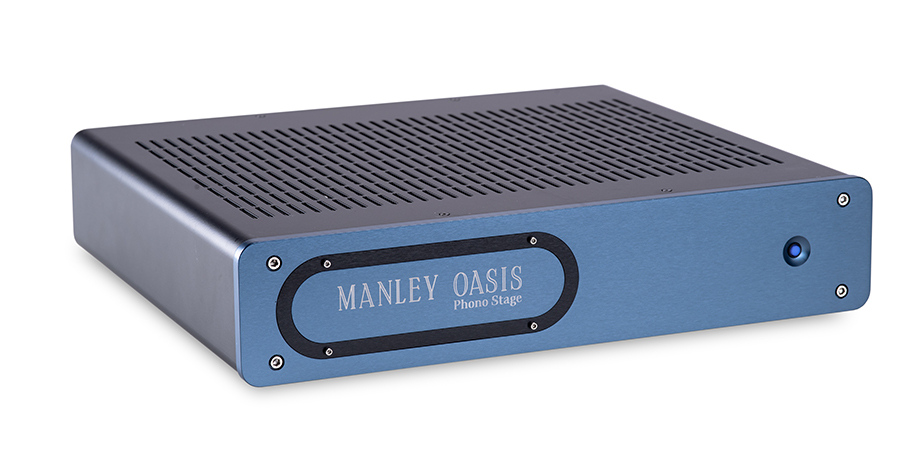
American tube specialist Manley Labs has been producing products that glow in the dark since the mid-1980s. I have had good experiences with its preamps and power amps so far. I spotted a brand-new Manley Labs Oasis phono stage at the Bristol show earlier this year. So, I put my order in for a review sample without hesitation.
Charismatic and outspoken CEO EveAnna Manley heads up Manley. She is a passionate advocate of tubes, and her father owned the guitar amplifier company Ampeg. In 1989, EveAnna began working for a company called Vacuum Tube Logic. There she met David Manley, whom she married. The two founded Manley Labs in 1993. When David Manley left the company in 1996, she took over the reins as CEO.
The company produces a wide range of professional studios and home-use products. These include limiters/compressors, valve microphones, preamps, power amps, and phono stages. It proudly boasts that all its products are designed and manufactured in-house in its 11,000-square-foot factory in California. It even winds its transformers.
Not a fish
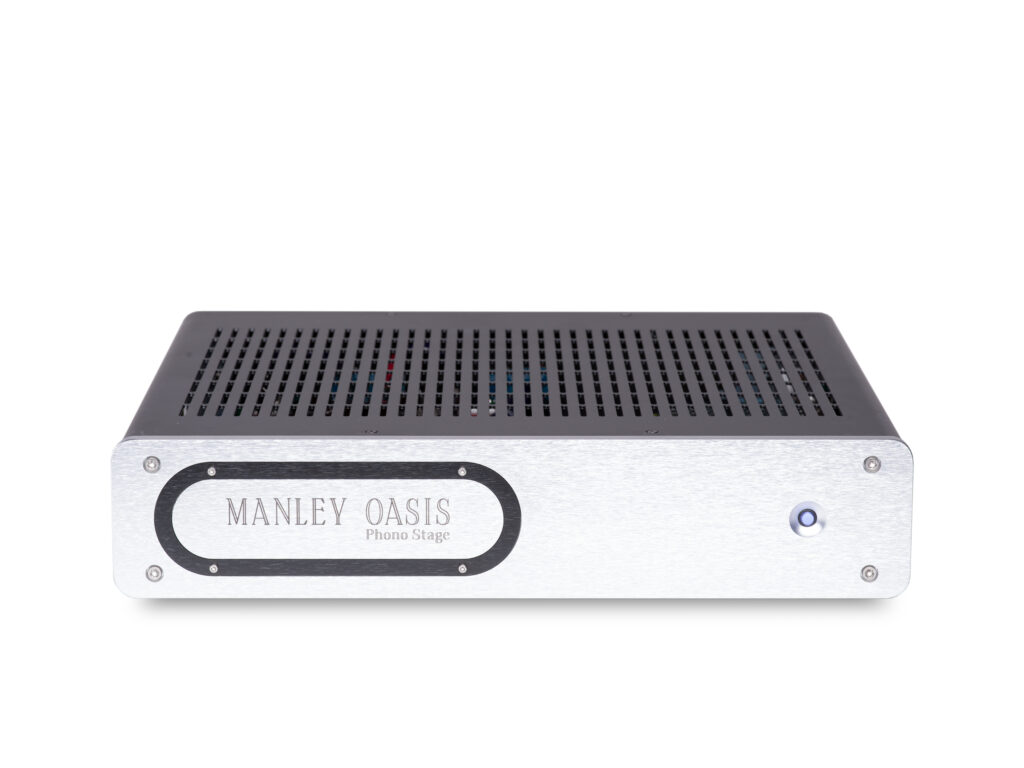
The new Manley Labs Oasis phono stage, priced at £4,249, replaces the previous Chinook model. Above is the flagship Steelhead model, priced at £11,599. Manley names most of its products after types of fish. So, Chinook is a type of salmon and not a helicopter. However, the Oasis takes its name from a mastering studio with which the company has worked for some time.
One of the main differences between the Oasis and the Chinook is that the new phono stage uses the company’s Manley Power switch-mode power supply.
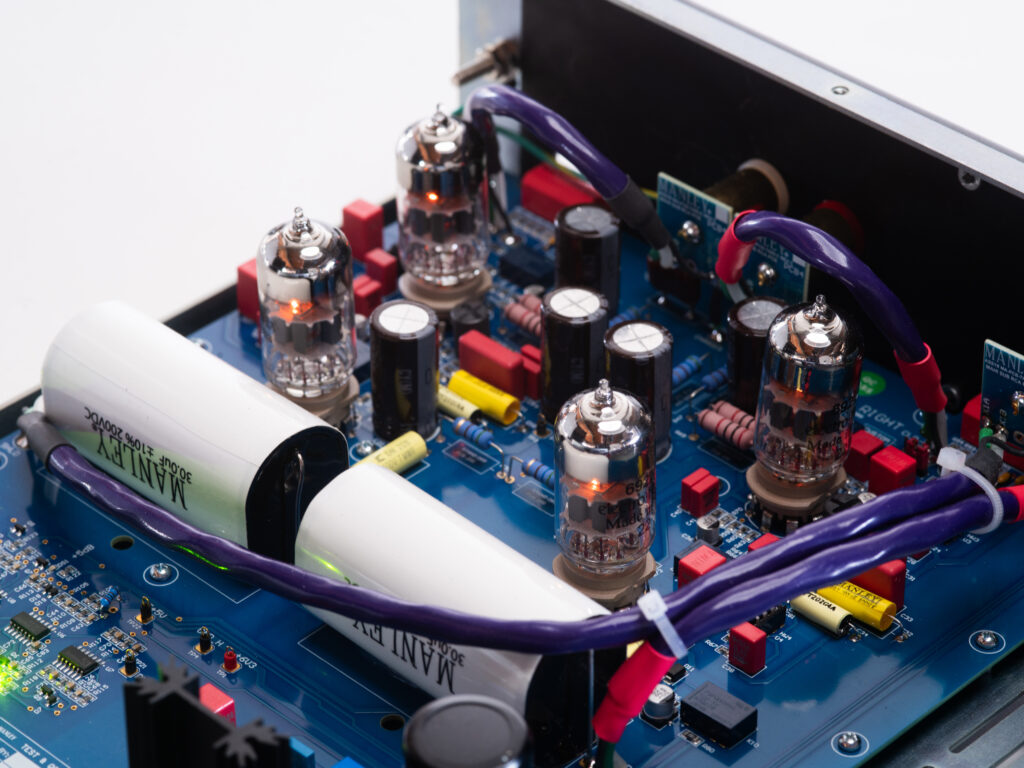
The company states that it conducted careful blind listening tests comparing the Manley Power to its conventional linear power supply. Manley found that the new power supply was quieter, gave better sonic clarity, and produced faster transients. It has used the switch-mode power supply in its pro audio products since 2014. The power supply uses 300volt DC rails to run the valves and 6V lines to power them up. It sports other voltage rails for phantom power and solid-state control. Manley claims that the power supply is extremely quiet and emits low levels of high-frequency radiation.
Old money valves
Oasis uses a 6922 triode tube (‘valve’ in old money) for each channel of the gain stage. There is another pair for the output stage, supplemented by low-noise FETs. The output follower runs in ‘White Follower’ mode, which Manley says provides super-low impedance and “beefy current driving capabilities. “Manley has also used hand-selected or 1% tolerance components throughout its RIAA equalisation circuits, and no ICs are used anywhere in the signal path.
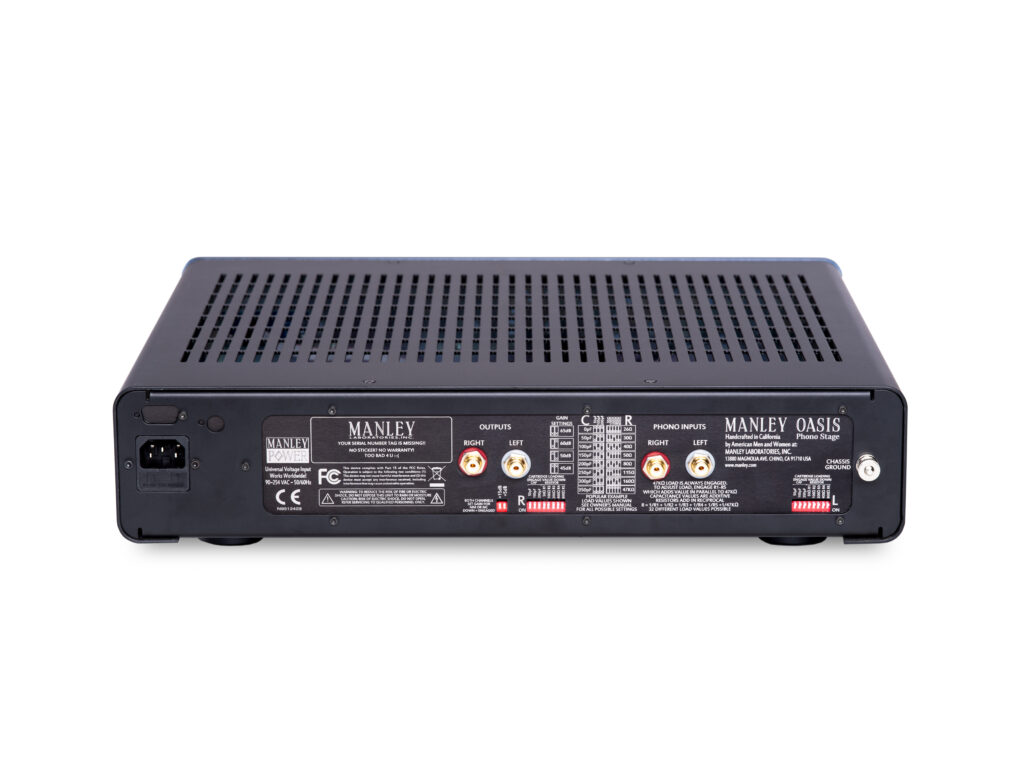
As well as an improved powder-coated, zinc-passivated, solid steel case with a 3/8in thick front panel that comes in silver, black or blue, the other main difference is that the switches that select the required gain level move from inside to the rear panel. They join the DIP switch array, allowing users to adjust the load capacitance and resistance to suit their cartridge.
Joie de vivre
Of course, with their usual joie de vivre and sense of fun, Manley says: “Stop worrying about the settings! Find solace in our Oasis, sit back and enjoy your records!” But they are important and give the Manley Labs Oasis great versatility, allowing it to offer the best load for virtually any cartridge, whether moving magnet or coil.
You can set gain to 45dB or 50dB for moving magnet cartridges and for moving coils 60dB or 65dB. My audio Note Io1 has a meagre output of 0.04mV – a tenth of what a typical moving coil puts out – so I naturally chose 65dB gain when feeding the cartridge straight in rather than through the AN-S9 step-up transformer.
Moving coil cartridges generally prefer low impedances, and the Oasis offers eight settings from 26 to 160 ohms plus 47k ohms for moving magnets. Capacitance settings are in 50pF steps from 0pF to 350pF. The Io1 works best with the lowest load impedance possible, so I set the Manley Oasis to 26ohms, whereas a Goldring Eroica, for example, likes 100ohms and a Hana Umami Blue 80ohms. Moving coils also routinely prefer low capacitance settings, so I kept this at 100pF. Manley recommends that if you are unsure, 150pF is a good default. If in doubt, use your ears to determine which works best.
What can it do?
Keen to find out what the Oasis could do, I connected it to a system comprising an Audio Note TT3/Arm Two/Io1 turntable front end, with either an AN-S9 transformer into the Manley’s MM input or the Io1 directly feeding the Oasis on the highest gain setting. The amplifier was Audio Note’s Meishu Tonmeister, and the speakers were Russell K’s Red 120Se.
I started using the transformer into the Manley Labs Oasis on the ‘MM’ or low gain (45dB) setting. To get a flavour of its ability to separate the complex strands of a multi-instrumental jazz piece, I spun up Earl Klugh’s Life Stories album and his great version of Luther Vandross’s ‘Just for Your Love’. Immediately, I was impressed by the Oasis’s sense of timing and sheer openness and dynamics. Snares and rimshots were crisp and tight, keyboards were well defined and voiced, and Klugh’s laid-back, yet eloquent, guitar play was well conveyed with a good sense of note shape, leading-edge attack and how each note started and stopped. The whole track hung together well rhythmically, and that deep, tuneful bass line was tight and agile.
A good workout
Well-recorded vocals always give any product a good workout, and you’ll not find better than Stephen Fearing’s The Secret of Climbing album from Rega. It was recorded very simply with two mics, live, in one take, in one room, with no compression. On this, the Oasis was not found lacking and conveyed the emotion, power and intricacies of Fearing’s vocals and the body, power and attack of his wonderful custom-made Manzer Cowpoke acoustic guitar. You hear his fingers slide on the strings, the bloom in the lower registers of his guitar, the nuances of his singing. The Manley Labs Oasis lays bare the emotional power of the track.
One of my favourite guitarists is Larry Carlton. After hearing the Manley Labs Oasis on Stephen Fearing’s guitar, I wanted to hear what it could do on ‘Hello Tomorrow’ from Carlton’s excellent Discovery album. This album is not only musically exceptional but is also one of the best recordings of any album I own. And the Manley did not disappoint.
Well-voiced
Carlton’s acoustic guitar was beautifully open and well-voiced; the nuances of his play and how he shaped each note were there to savour. The drumkit was snappy and explosive, and the saxophone was raunchy and expressive. The delicate details of the percussion line were also nicely handled and articulated.
I could not consider my evaluation complete if I did not try something from my favourite jazz singer/songwriter/piano player Ben Sidran, and next on the platter was Old Songs for the New Depression. On his gorgeous version of ‘Easy Street’, the Oasis was open and detailed in his piano play, conveying its body, fluidity, and attack. At the same time, the weighty bass line moved well, with excellent control and timing. Anyone expecting a valve product to be woolly and soggy in the bottom end would only have to listen to the Oasis to see that notion shot down in flames. Overall, its performance on this track was tight, tuneful, and packed with detail, which helped make the music make sense.
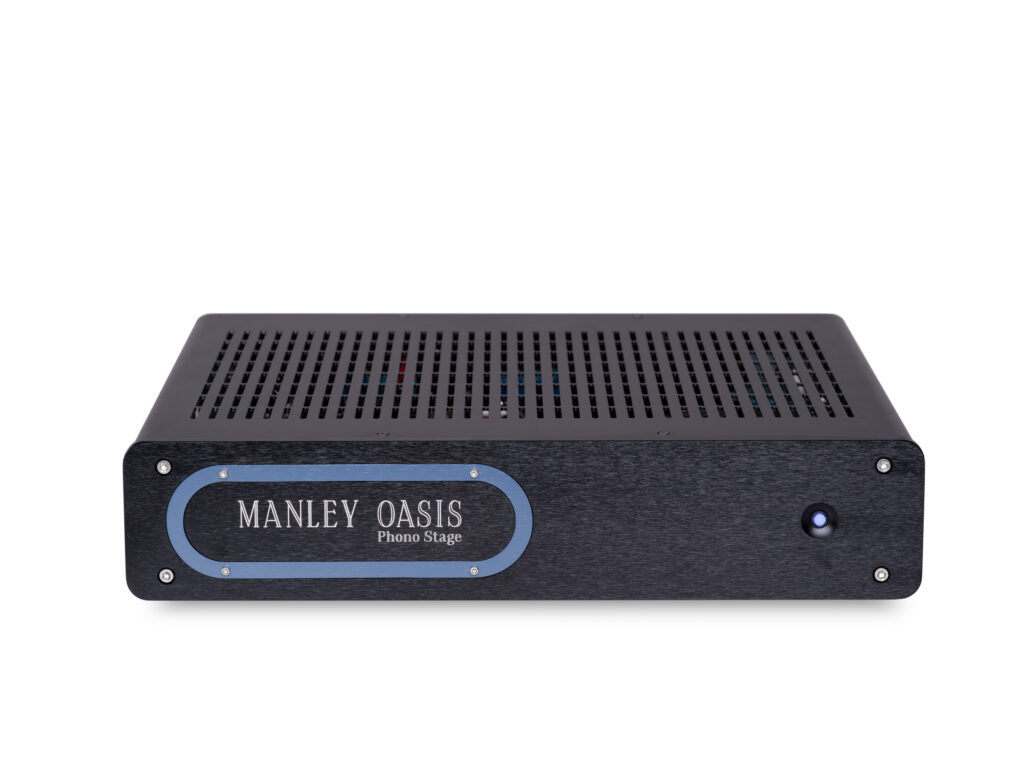
I briefly tried the Io1 directly into the Manley Labs Oasis set to 65dB gain, and it performed extremely well, with detail, dynamics and panache, and no trace of hiss or noise. Users, therefore, do not necessarily have to invest in the expense of a separate step-up transformer, and the Oasis should cope with any cartridge you throw at it.
Thorough enjoyment
I thoroughly enjoyed my time with the Manley Oasis phono stage. I was impressed at how easily it handled the extremely low output of the Io1 cartridge. Its performance was confident, musical, dynamic, and compelling too. It simply made music, and what more can you ask for?
I briefly compared it to a well-respected competitor, which costs slightly more. The Manley Labs Oasis more than held its own, and in most ways, I preferred it. I confidently recommend it for its excellent value for money and for delivering a deeply profound musical performance. Many amplifiers these days still have only line-level input. Make sure the Oasis is on your shortlist if you need an excellent phono stage to make the most of your cherished vinyl.
Technical specifications
- Type: Moving magnet and moving coil valve phono stage
- Tubes/Valves: 1 x 6922 for the gain stage and 1 x 6922 for the output stage
- Inputs: 1 x RCA phono unbalanced
- Outputs: 1 x RCA phono unbalanced
- Gain: 45dB, 50dB, 60dB, 65dB
- Input impedance: 26Ω, 30Ω, 40Ω, 50Ω, 80Ω, 115Ω, 160Ω, 47kΩ
- Input capacitance: 0pF, 50pF, 100pF, 150pF, 200pF, 250pF, 300pF, 350pF
- RIAA accuracy: ±0.5dB from 20Hz-20kHz
- Distortion (THD+N): Typically 0.01% with 47kΩ input termination, 45dB gain, 1kHz, 0dBu output, into 100kΩ load. BW=100Hz-22kHz
- Dynamic range: 91dB at 1kHz with 45dB gain and 200Ω source for 0.1% THD; 107dB for 1% THD. BW=22Hz-22kHz
- Noise floor: -84dBu, A-weighted, at 45dB gain and input shorted; -75dBu at 60dB gain
- Dimensions (HxWxD): 8.9x43x36cm
- Weight: 9.07kg
- Price: £4,249, $3,999, €5,150
Manufacturer
Manley Labs
UK distributor
SCV Distribution
+44(0)330 122 2500
Tags: MANLEY LABS OASIS PHONO STAGE
Trending Articles
See all
By Chris Frankland
More articles from this author
Read Next From Review
See all
Reiki Audio SuperSwitch X/Pro X PSU
- Oct 06, 2026
Audiobyte SuperVOX
- Oct 06, 2026
Unitra WSH-805
- Sep 29, 2026
Wilson Audio Sabrina V
- Sep 29, 2026