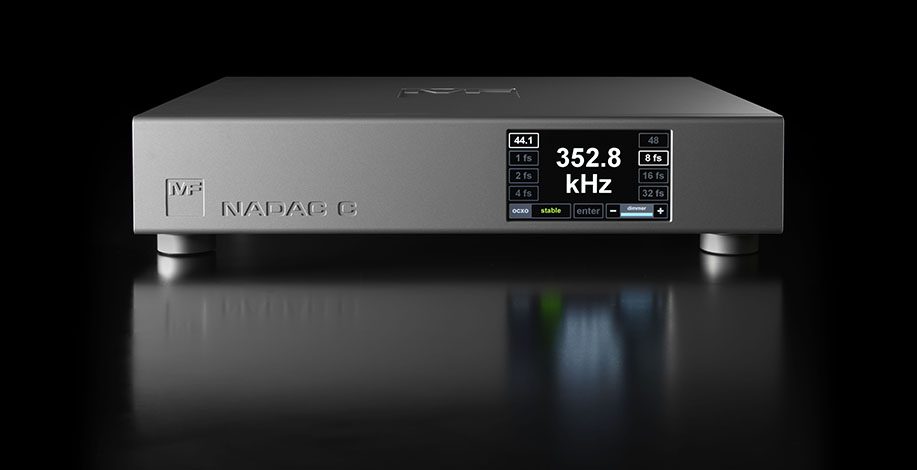
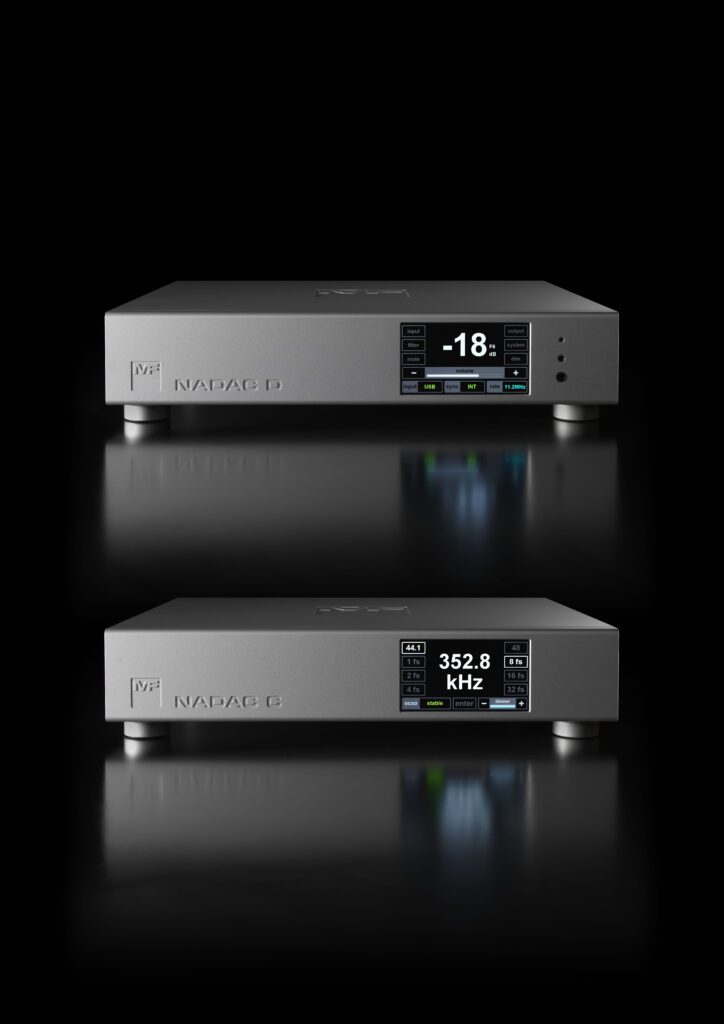
We ran a review of the remarkable combination of Master Fidelity NADAC D DAC and NADAC C clock in Issue 239. Why a reprise so soon? Because the DAC, only a handful of months into production, has been given an upgrade by its maker. Was the original design flawed? Was the launch overly rushed? Master Fidelity will have to take such questions on the chin.
In my original review, I judged the NADAC pair to be ground-breaking. From a technology viewpoint, the DAC (NADAC D) and clock (NADAC C) were, by turns, a return to the past and a leap forward. At their price point, the pair was considered disruptive to the market. Because of the sonic quality they revealed to be locked inside digital files of all bit-depths and frequencies, I suggested they posed a profound challenge to the supposed sonic superiority of vinyl replay.
Profound discovery
Following the review, Master Fidelity’s design head, Weishen Xu and his team continued to work on their proprietary digital clocking scheme. What they discovered turned out to be so profound that they decided to bite the bullet, apply the revisions immediately to NADACs on the production line, and issue the upgrade recall for units already with customers.
Unaware of this having gone on behind the scenes, I did not expect the upgrade to result in anything but inconvenience while the DAC was away. Xu, it turns out mischievously, had not promised any specific sonic improvements, only saying that ‘we’ve made some changes.’ When the DAC returned, I was staggered at the sonic uplift, and told Xu so. He replied, “Now you understand the reason for the upgrade. Your subjective listening impressions align very closely with our objective technical measurements.”
As highlighted in my original review, the NADAC is worthy of examination for its technology alone, let alone the sonic result it achieves. It is built around the first one-bit application-specific integrated circuit (ASIC) to be designed and manufactured since the Philips TDA1547 in 1988. Xu contends that the theoretical superiority of one-bit D-to-A conversion that Philips and others were pursuing back then is now within reach – and that makes the price of revisiting the technology worthwhile.
Top trumps
Xu believes that one-bit conversion trumps all other techniques because it is the most linear and, thereby, the most natural. Other designers express alternative preferences, but we need to recognise that it’s not simply a matter of pushing and shoving between competing technical ideologies. A significant factor in the conversion debate is the comparative cost of implementation.
If we design a DAC around one or more of the ubiquitous delta-sigma chips, our key component costs can be very low indeed. If we choose the discrete resistor ladder route, the price will be higher because high-accuracy resistors are expensive. We might write our decoding software and flash it onto a programmable logic device or two, and if we do, we will face even higher expenses. Talented software engineers don’t come cheap.
The one-bit ASIC route is the most expensive of all – and by a considerable margin. To justify the huge front-loaded cost, the designer needs a compelling sonic argument, deep pockets, and, please excuse me, large cojones. Xu won’t say precisely how much the development has cost Master Fidelity. Still, he notes that payback will be a long time coming, given the relatively small production runs typical at this level of the market. To accelerate return on investment, Master Fidelity may eventually allow other vendors to purchase the ASIC and integrate it into their DACs.
One bit at a time
A one-bit DAC is a clock whose duty cycle varies with the audio signal. The digital stream is a high-frequency series of pulses in which the precise timing and ratio of high-to-low bits directly represent the analogue signal. That is why timing accuracy—particularly edge consistency and jitter performance—is critical. It was the foremost challenge faced by designers in the era of the Philips chip, and it remains a serious impediment even today. Xu says that one-bit conversion implemented on generic programmable logic devices, such as FPGAs, is inescapably compromised for this very reason. He speaks about the criticality of timing in the accompanying TechTalk.
The upgraded NADAC features an unchanged one-bit conversion stage. It upsamples PCM to 96kHz to DSD 128 and PCM from 176.4kHz to 384kHz to DSD 256. The upgrade has seen minor tweaks to the user interface, but it’s in the DAC’s clock recovery module that things now look very different. It might be assumed that the NADAC C 10 MHz master clock (which is also a Word clock) provides an accurate time reference; however, it is more accurate to say it provides a precise time reference.
Master Fidelity’s new learnings have led to a refined cascaded clocking scheme in which the NADAC C is focused on minimising what are considered in this context long-term timing variations, such as wander and drift. The clock data recovery module locks onto this 10 MHz baseline and further refines it, focusing on removing residual jitter, aligning timing between clock domains, and generating the exact multi-channel clock signals required by the one-bit ASIC. The resulting level of precision wasn’t possible in the 80s, and that is one reason why the pioneers of one-bit decoding never achieved the sonic results they knew were theoretically possible.
Subjectivist trigger alert
Master Fidelity won’t be the first DAC developer to claim that listening tests played a key part in the development of a product. Still, Xu’s previous life as a recording engineer lends the assertion more credibility than usual. In an admission that will likely trigger objectivists into scornful fingers-on-keyboard action, he notes: “In early prototype designs we achieved THD+N as low as -122 dB, virtually eliminating distortion, yet the sound felt somewhat bland and lacking musical tension and emotional engagement. We therefore placed equal, if not greater, emphasis on real-world musicality, listening in particular for accurate imaging, a rich and well-layered musical texture, along with controlled harmonic content that enhances musicality without stepping over the line into artificial coloration.”
There’s a rarefied stratum of digital audio currently populated by only a handful of DACs. While ‘spendy’, the NADAC is very far from being the costliest of the bunch, yet even before the upgrade, it set a challenging sonic benchmark. The upgrade has taken the delivery of all four musical pillars to an even higher level. There’s more tonal density and texture, more micro-dynamic detail, more dynamic expression, and more solid, convincing musical timing, all delivered from a blacker background and an arrestingly precise soundstage. So far, so hi-fi.
Further still
What sets the NADAC further apart still is the way it dissolves the plaques between the music and our brain wiring. If we are expecting digital hardness, a mechanistic gloss that telegraphs ‘this is digital’, then the NADAC comes as a revelation because it sounds so uncannily natural. Xu wants us to understand that the hardness is not on the recording (well, mostly) but is created in the conversion chain, where wander and jitter cause frequency drift and near-end phase noise. These effects distort the entire audio spectrum—especially its phase integrity—resulting in degraded sound quality and listening fatigue.
Xu points out that analogue tape machines exhibit low-frequency wander in the form of mechanical wow and flutter. Still, because tape playback is a physical process and the medium is continuous, this mechanical modulation does not compromise the full audio bandwidth in the same way that digital timing errors can. Optimising the NADAC’s revised clocking architecture meant designing yet another dedicated ASIC. Still, by now the Master Fidelity team had had enough practice to rattle off the new chip relatively quickly.
Underlined
I don’t think I’ve ever used the word ‘substance’ in a review before. Still, listening via the NADAC to Max Bab’s album Wild Pitch, I was captivated by how Max von Mosch’s saxophone now sounded more vividly present, more extant than I’d heard it before. It wasn’t a matter of simple clarity, but such a level of tonality and controlled energy that a 3D-ness, a seemingly physically present completeness, was created in the listening room. In capital letters, I wrote the word ‘SUBSTANCE’ in my listening notes and then, just for good measure, repeated it and underlined it.
Readers who have heard a tenor saxophone played up close in an intimate space may recognise the qualities I was trying to give a name to with that word. I’d not heard digital do that before, but there it was, and the intriguing part was that in so much of what else I played – simple vocals, orchestral symphonic, folk – I heard the same effect. The NADAC changed it from being a once-in-a-blue-moon exception into an ‘oh, there is again’ common event.
I’ll offer two hostages to ridicule here and suggest that, taken in the round, the improvements make the NADAC some 25% better still. It also enables the NADAC to emphatically overturn the analogue/digital hierarchy by lifting the replay of even well-recorded 16/44.1 files to a level beyond what the best of vinyl can regularly achieve—files with more bit depth and higher frequency tip the balance even further.
Evolutionary revolutionary
As I noted in my first NADAC review, if we are recording digitally (most studios are), then playing back digitally should be better than adding three lossy electromechanical stages (lacquer cutting, pressing, replay) between the performance and our ears. The NADAC is the first DAC I have heard of that makes that theory a reality. Suppose we are building a system from scratch and have the money for a NADAC.
In that case, we can make a perfectly rational decision on the grounds of sonic quality alone to simply side-step analogue completely. That’s not to suggest that the NADAC drives a stake through the heart of vinyl. If we already have a treasured record collection, then there remain plenty of reasons to keep it and the means to play it. However, what digital does at the level of the NADAC is render vinyl an evolutionary dead-end. Sorry to be so blunt, but that’s just the way it is.
As a related and highly relevant aside here, some readers may be as shocked as I was to learn that many of today’s digital recordings are made by studios using analogue-to-digital converters (ADCs) costing just a few thousand pounds and with poor linearity and phase performance. Imagine then what a one-bit ADC, in simplistic terms, a NADAC in reverse, would do for the recording industry. Xu confirms that such a product is already in the works, a project that Master Fidelity’s considers as a logical step for bringing an ultimate analogue-feeling digital sound along the whole production chain. Is your mouth watering at the prospect? Mine too.
More than twice
Some of the competition to the NADAC costs twice as much or more. I haven’t heard all of it, so I am not equipped to suggest even a tentative hierarchy. I am also not suggesting that the alternatives don’t have technical merit. They deploy some seriously complex supporting electronics to make the best of their alternative decoding schemes.
As a trophy purchase, the NADAC, with its understated two-box form-factor, hardly competes with a six-figure multi-box behemoth DAC. However, there’s no doubt in my mind that the elegance of one-bit conversion so painstakingly implemented enables the NADAC, at the very least, to live sonically in the very top tier. Weishen Xu and his colleagues deserve respect for a truly formidable display of quality audio engineering and for exhibiting no small measure of commercial bravery, too.
Discover more about what goes into the NADAC C and D here.
Technical specifications
NADAC D
- Type: Digital to Analogue converter
- Inputs: USB Type C, AES3 (XLR), S/PDIF RCAx1, TosLink optical x1 (RAVENNA RJ45 to follow), Clock BNCx1
- Outputs: Analogue balanced line 2x XLR, single-ended, 2x RCA, 4.4mm balanced mini headphone jack, 6.35mm single-ended headphone jack
- Formats supported 44.1-384kHz, 16bit-true 32-bit. Native DSD64-DSD512 true 1bit (USB) 44.1-192kHz, 16-96bit, DoP64 (AES and S/PDIF), 44.1-384kHz, 16-32-bit. Native DSD64-DSD256, true 1bit (RAVENNA to follow).
- Analogue volume control: 3dB/step attenuation,
- total 20 steps
- Dimensions (WxHxD): 43.5×9.5x39cm
- Weight: 9.2kg
- Price: £25,000, €25,000, $27,500
NADAC C
- Type: Master Clock
- Crystal type: Selected high-stability pre-aged, SC-cut crystal
- Clock output options: 10MHz, 625Hz, Word Clock
- Word Clock output frequencies (in kHz): 44.1, 48, 88.2, 96, 176.4, 192, 352.8, 384, 705.6, 768,1141.2, 1536.
- Frequency accuracy: <10ppb
- Nominal Impedance: 50Ω (10MHz clock, 75Ω supported), 75Ω (Word Clock, 625Hz)
- Dimensions (WxHxD): 43.5×9.5x39cm
- Weight: 9.2kg
- Price: £25,000, €25,000, $27,500
Manufacturer
Master Fidelity
+1 604 266-5067
UK distributor
Swiss Sound
Trending Articles
See all
By Kevin Fiske
More articles from this author

Read Next From Review
See all
Reiki Audio SuperSwitch X/Pro X PSU
- Oct 06, 2026
Audiobyte SuperVOX
- Oct 06, 2026
Unitra WSH-805
- Sep 29, 2026
Wilson Audio Sabrina V
- Sep 29, 2026