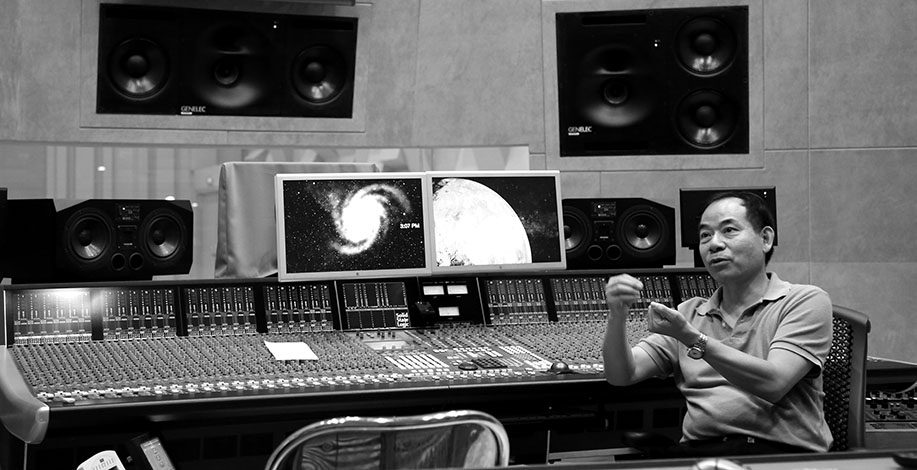
Master Fidelity’s design lead, Shanghai-born Weishen Xu, has had something of an obsession with digital audio since he first encountered it in 1985.
Then chief sound engineer and recording director at China’s premier performance venue in Beijing, he collaborated with Philips/Polygram engineers Roddy de Hilster and Dick van Schuppen to record the very first CDs of Chinese music. It was his first experience with digital recording, and it left him conflicted. He was impressed by the 96dB dynamic range and the efficiency of nonlinear editing, but less so by the sonic comparison with analogue. Thus began a personal quest as an engineer to create a new digital environment which combined the upsides of the old and the new.
In 1988, Xu emigrated to Canada, joining the Canadian Broadcasting Corporation just as its radio system was undergoing a complete digital transformation. He relished the flexibility that digital brought to the production and mastering process, but still missed ‘the beauty of analogue sound.’
Pivotal Moment
Then came a pivotal invitation. Swiss company Merging Technologies, the co-pioneer with Philips of DXD, asked Xu to collaborate with Merging’s Dominique Brulhart on the development of new digital studio platforms, including the first-generation NADAC (it’s an acronym for Network Attached DAC) in 2015. Multiple delta-sigma DAC chips were the decoding technology choice at the time. Still, the work, at Merging’s Vancouver development site, subsequently spun off as a new company, Master Fidelity, enabled Xu to learn a lot about the strengths and weaknesses of all the contending decoding schemes.
He notes: “Dom and I got close to the essence of analogue master tape with the gen 1 NADAC, but I later learned enough to know that if there was ever a gen 2, only true 1-bit decoding on an ASIC would do.”
Not bespoke code on a programmable logic device such as an FPGA? “No. The fixed layout of logic blocks and tracks on a PLD means that there can be no control over block-to-block propagation delay. In addition, delays within the logic blocks themselves vary with voltage and temperature. All that combines to produce an environment in which jitter cannot be eliminated. Many applications don’t care, but 1-bit decoding does. It is ultra-sensitive to even minuscule variations in timing.
“Designing our own ASIC gives complete control over the layout. Logic blocks and tracks can be arranged for precise control of clock edge timing and pulse widths. Jitter and phase distortion can be mitigated through the use of optimised internal clock trees, and timing uniformity can be made predictable and thermally stable. We’ve also implemented some functions conventionally hosted on co-located PLDs on the ASIC. Here again, having complete control over routing and logic delays meant inter-chip clock domain transition delays could be eliminated.”
The revisions to the NADAC’s clocking scheme are responsible for the sonic uplift noted in the accompanying review, and Xu is relatively forthcoming about what he and his team have done. It surprises him that there appears to be a sizeable cohort in the audio engineering community that still believes anything going on out of the nominally 20Hz to 20kHz audio band is irrelevant to sonic quality. The NADAC’s overall design pays close attention to minimising EMI emissions in the high kHz to low GHz range. Still, Xu regards that as unexceptional, simply tidy housekeeping and just one hallmark of quality engineering. It’s in the clocking scheme that the attention to detail becomes, shall we say, somewhat obsessive?
Controlling time
Xu and his colleagues found that, in conjunction with 1-bit decoding, it is in the accurate control of time that lies the key to making digital sound just as natural as analogue. The NADAC therefore employs several advanced ideas, including edge entanglement technology (look it up, it isn’t very easy). Xu and his colleagues have also paid particular attention to digital wander, especially phase noise below 5 Hz. “Our measurements even extend down to 0.1 Hz, says Xu. “While these frequencies are well below the threshold of human hearing, their higher-order harmonics can intrude into the audible band, influencing the sense of realism and physicality in reproduced music.
“No single clock can be flawless across all performance dimensions. We are interested in frequency accuracy, although the influence on audio quality is relatively minor. What matters is short-term stability, which directly impacts sonic qualities such as how solid and controlled the low end is, and phase noise, which has a significant influence on SNR and THD+N. Lower phase noise translates into greater clarity, darker backgrounds and more natural retrieval of musical detail. That’s why we use multi-stage processing to harness the strengths of different clock circuits and components, ultimately producing a clock signal as close to perfect as possible.
“The rise time of the NADAC clock system has improved from 1.2 nanoseconds (1200ps) to 600 picoseconds, and it achieves a stability floor of approximately 7 × 10–¹³, with optimisation applied to any deviations above roughly 0.7 Hz. What we do is similar to practices in crystal oscillator phase noise analysis systems, where multiple specialised circuits are cascaded to achieve the best performance. The NADAC C has multiple outputs that allow sources with 10MHz clock inputs to be included in this clock cascade, and if that’s taken advantage of then the sonic results can be even better, but even without clocking the source the results we have achieved surpass what we hear from an analogue master tape, so I’m happy that we can say we got there in the end.”
What are Xu’s listening preferences away from the development laboratory? “I play the harmonica, but as a listener and a recording engineer, I’ve always been drawn to the piano and the cello—two instruments that, in very different ways, challenge both musicians and audio engineers alike. But the human voice is the most intimate and expressive instrument we have. As moving as visual art can be, it’s the human voice that has the power to bring me to tears.”
Manufacturer
Master Fidelity
+1 604 266-5067
UK distributor
Swiss Sound
Trending Articles
See all
By hi-fi+ Staff
More articles from this author
Read Next From Blog
See all
Tech Talk: Nigel Bell of Reiki Audio
- Oct 06, 2026
Tech Talk: Nicolae Jitariu of Audiobyte
- Oct 06, 2026
Tech Talk: Wiktor Schulfer of Unitra
- Sep 29, 2026

Tech Talk: Daryl Wilson of Wilson Audio
- Sep 29, 2026