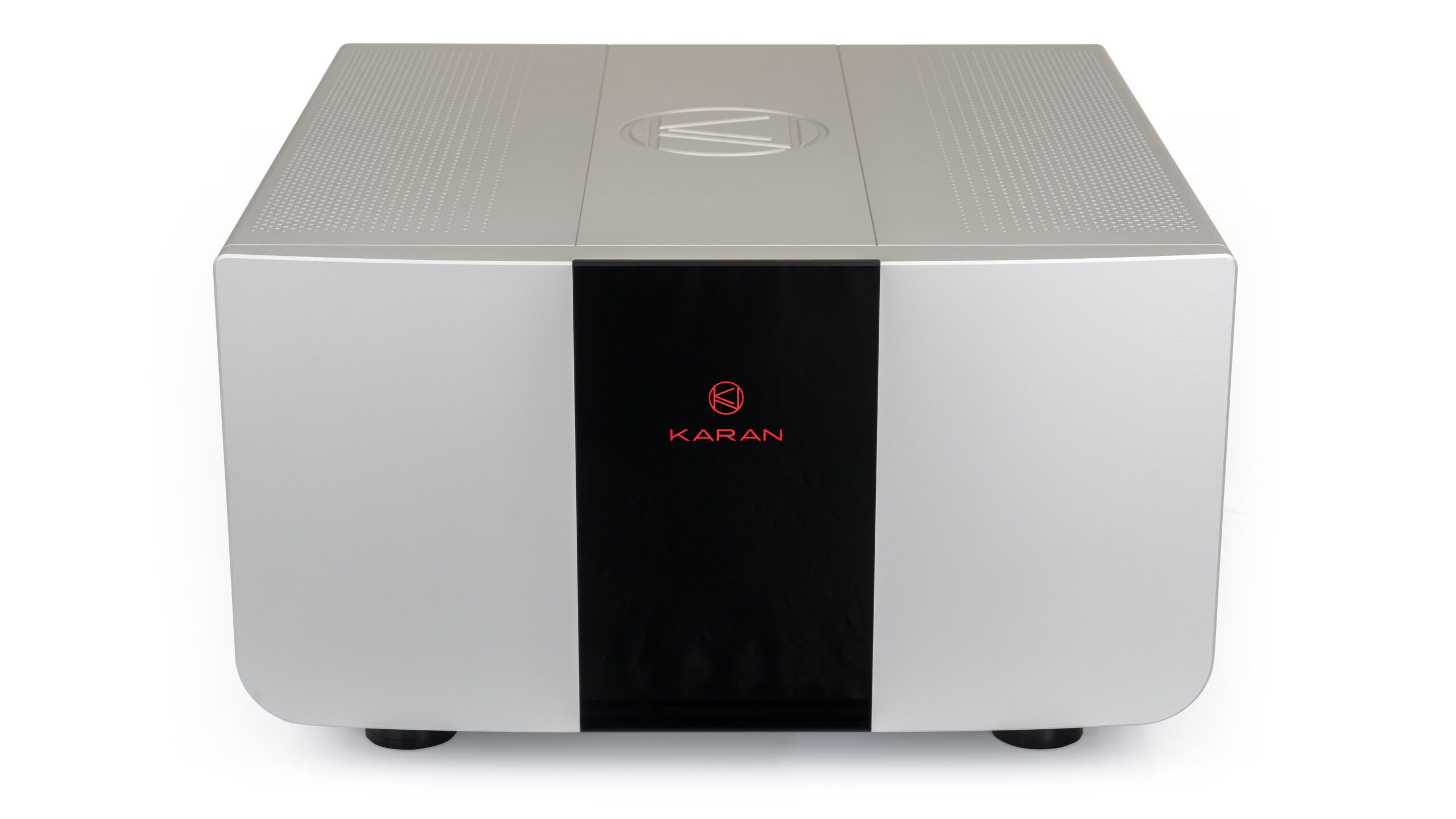
Karan Acoustics’ range comprises entirely of Master Collection products today. There’s a preamplifier, phono stage, stereo and mono power amplifiers. These all stay in the entirely uncompromising, cost-no-object ’a’ range or the slightly trimmed down ‘b’ form. In this case, ‘trimmed down’ means a one-box preamp and phono stage and slightly smaller stereo and mono amps. Until now, we tested every product in the range except for the Karan Acoustics Master Collection POWERb MONO amps. This review brings a sense of closure to the review cycle.
That closure feels deeper in this review. Sadly, Milan Karan, chief designer and the man behind Karan Acoustics, died in 2024 at the age of just 58. Some time before his passing, Karan expressed a desire for the Master Collection to be his swansong. However, I don’t think anyone expected it to be his valediction. He considered these amplifiers to be the best products he knew how to make. The company continues in the capable hands of the Karan family. International recognition of Milan Karan’s crowning amplifier achievement has only increased with his passing.
One of the cleverest parts of the Master Collection range is that there is a lot of shared design. This means there are no great changes in technology – or tonal shifts – as you move between ‘a’ and ‘b’. The POWERb MONO uses the same differential circuit design found across all four amplifiers in the line-up. They all implement the very best Sanken bipolar output devices, the power supplies and their accompanying audio infrastructure have been extensively reworked. The same applies to the input (driver) stages with both high-grade Audyn and superior, proprietary Karan Acoustics capacitors being used throughout.
Quality components
The component list of greats also includes Vishay and Roederstein resistors as well as Cardas Audio’s highest quality chassis wire. That, however, is not all. As with all Karan mono amplifiers, each ‘polarity half’ of each audio channel (ie. amplifier) has its own independent mains transformer and accompanying power supply. Which also means you need two mains cables for each amplifier.
For the POWERa amplifiers, Karan worked with its suppliers. The companies developing completely new, much larger, more powerful, and mechanically quieter toroidal transformers. This led to a proportionally enlarged bank of power supply reservoir capacitors of equally high-grade specifications. In the process, this provides the circuits with an even greater reserve of power and current that is always ultra-quickly available. The POWERb STEREO and MONO follow suit, with only slightly reduced power delivery and capacity. Although ‘reduced’ is inaccurate for an amplifier boasting twin 2,100VA toroidal transformers and a custom 180,000µF reservoir capacitance bank. As before, speaker terminals and RCA inputs originate from WBT, while Neutrik provides the XLR input interface.
Remarkable
This amplifier’s power output is remarkable. It delivers a robust 1,200W into an eight-ohm load, with peaks reaching 1.5kW. It can even provide up to an impressive 3.6kW into a two-ohm load. Like its larger POWERa MONO counterpart, it requires two power cables per chassis. This arrangement enables the amplifiers to transmit the signal’s full bandwidth and dynamic headroom into any loudspeaker load. Meanwhile, this also allows for excellent transient speed and extremely quiet circuit operation.
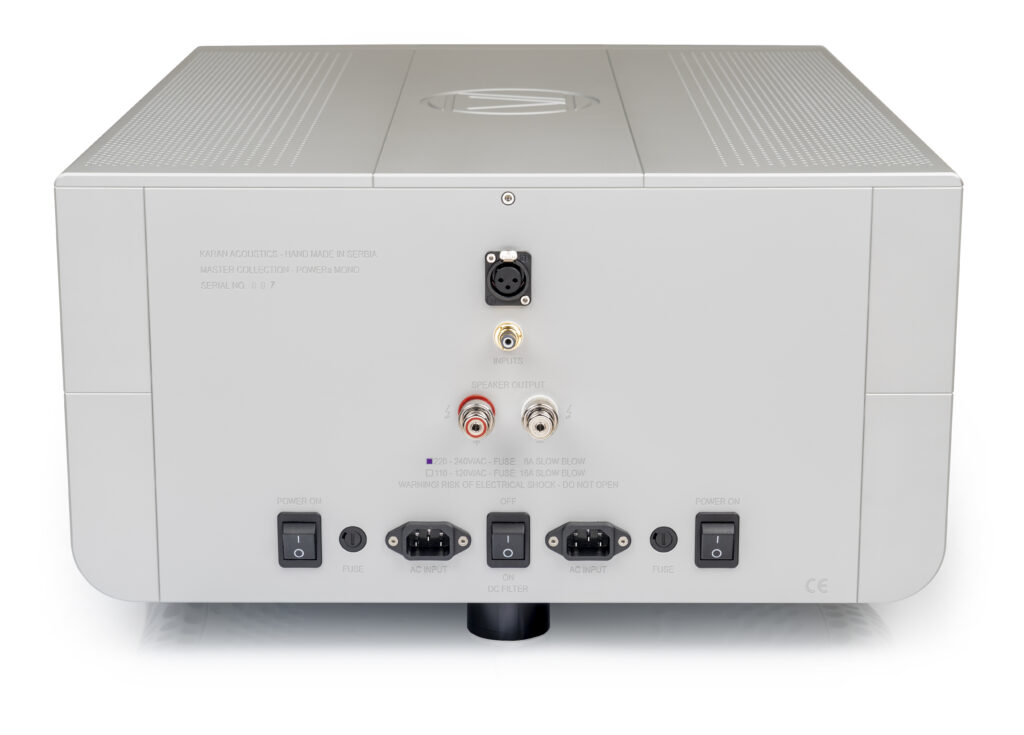
Similar to the other POWER models in the range, the Karan Acoustics Master Collection POWERb MONO features an advanced mains (line) conditioner. This conditioner addresses and eliminates unwanted DC-related by-products from our electricity supply. The amplifier includes a switch on the back panel that allows you to choose whether to hear the sound with or without the conditioner/DC filter, regardless of whether the amplifier is powered on and playing music. While there are few aspects of audio that are as contentious as the line conditioner/DC filter market, I would still like to see this offered as a separate, universal product within the Karan Acoustics product range.
Circuit resonance damping
The chassis also functions as an effective circuit resonance-damping system. Increasing the mass is the most obvious solution for achieving superior overall damping. However, the issue arises that using too much of the wrong type of metal can do more harm than good. Additionally, employing a large lump of aluminium to mass-load the amplifier may create its own source of resonance. To address both concerns, Karan Acoustics designed the main chassis as a single-piece unibody made from a solid CNC-machined block of high-grade aluminium. This serves as a heatsink for the output devices while establishing a highly non-resonant environment for the entire amplifier. This design also contributes to lowering the amplifier’s noise floor. Continuing with the impressive specifications, all 81kg (per amplifier) sits on three Critical Mass Systems CS2 1.5 supporting feet. It has proper wooden crates for shipping, too.
Externally, there is little to differentiate POWERa and POWERb designs. This MONO amplifier is slightly shorter than its bigger brother, weighs just over 20kg lighter and it has ‘POWERb’ instead of ‘POWERa’ on the rear panel.
Do well
The Karan Acoustics Master Collection POWERb MONO has several shoes to fill. As part of the ‘b’ Series, it should be resolving enough to deal with Karan’s matching LINEb preamplifier (tested in Issue 191) and shine with the company’s LINEa two-box flagship preamplifier (tested in Issue 181). It needs to stand slightly above the POWERb STEREO (tested in Issue 223). It also needs to reach, yet not exceed the levels of the mighty POWERa MONO (tested in Issue 203). And above all this, it needs to stand on its own as a very high-grade power amplifier. This demand is for those who might not have caught the Karan bug, or are upgrading from Karan’s previous KA line. So, it needs to be better than the likes of the KA-M1200 (tested back in Issue 50) and on a par with the likes of Constellation, Gryphon, and Vitus.
If that sounds like a big ask, you haven’t been keeping up with Karan’s Master Collection. These are the sort of power amplifiers that answer questions before they are asked. It gives effortless power with way more in the tank. Also, given the almost limitless power of the POWERa MONO, the POWERb MONO is not far behind, the POWERa MONO’s reserves in the tank are more than enough for all except the most challenging of loudspeakers. In fact, there’s a good case to make that the POWERa MONO is gilding the lily in the majority of systems today.
More than just power
The Karan sound is one of effortlessness in more than just power delivery. Every Karan amplifier has a sound that is as easy on the ear as it is detailed and informative. It’s supremely dynamic and is possessed of stentorian bass that controls your loudspeakers with absolute authority. However, that precision and power does not come at the expense of a roller-coaster ride through music. The Karan Acoustics Master Collection POWERb MONO never bombards the listener with sound.
It’s presentation is as refined as it is effortless. The high-frequency energy and zing is there, but only when called for. The rest of the playing time, the amplifier simply swings. There’s nothing out of place, in spatial, dynamic and detail terms. The amp’s sense of rhythm is good for a large power amplifier; not ‘pacey’ and ‘lithe’ in the way British ‘PRaT’ obsessed designs excel, more of a sense of complete musical control.
Karan’s POWERb MONO’s main characteristic is to play the music it’s fed without favouritism. That sounds over-simplistic, but it’s at the heart of what this amplifier delivers. I went back and looked at my notes and reviews of other Karan power amplifiers, and this is a strong family trait. You get the whole story; whatever signal is sent to the amplifier is reproduced with as little as possible between preamplifier and loudspeakers.
Straight wire with gain
This has long been a goal of power amplifiers – Peter Walker of Quad coined the phrase ‘a straight wire with gain’ to describe the ultimate in amplifier performance – but we are still far from achieving that aim. The Karan amps get closer than most, especially if you prioritise detail, dynamics, soundstaging and sheer control over the loudspeakers as important considerations. And yet, beyond this, the Karan amplifiers have a sense of refined musicality to their performance, which makes you focus on the ‘end’ (the music itself) rather than ‘the means whereby’ (the equipment).
I’ve found with Karan equipment that despite the call to use numerous musical examples to highlight what the amplifier can do, everything is encapsulated in a single recording. This is a sign of true quality, as all the aspects of an amplifier are presented evenly and equally at the outset. While further listening only reinforces that initial opinion, the strength of its balance of sonic properties is telling from the outset.
Everything, everywhere, all at once
In fairness, Karan Acoustics is not alone in this ‘Everything, Everywhere, All At Once’ approach (great movie, by the way!). However, most amps that have such an even spread of qualities come with a considerably more lofty price tag.
The track that showcased what the Karan Acoustics Master Collection POWERb MONO does so well was perhaps the simplest. It was The Unthanks (and Niopha Keegan) singing ‘Bread and Roses’ [Diversions Vol 5 – Live and Unaccompanied, Rabble Rouser]. You get a sense of a small hall with a low ceiling, the intimacy of the recording, and the pitch-perfect articulation of their voices. You also get the energy and passion of their voices, and the gentle, respectful interaction between singers and audience. Then, there is the dynamic range of a capella singing. Finally, you get a sensational coherence across the range and the feeling of being there in the place thanks to powerful solidity and speaker control.
Not a foot wrong
Accepting that those Critical Mass Systems feet take a few days to transform the sound, the Karan Acoustics Master Collection POWERb MONO doesn’t put a foot wrong. Yes, arguably balanced outperforms single-ended input, but that’s more to do with XLRs taking full advantage of the circuit design. In fairness, single-ended is no slouch, so if your preamp is single-ended only, don’t count these amps out just yet. In fact, my only gripe is about the name; Karan Acoustics Master Collection POWERb MONO is a real mouthful. If your biggest criticism is the length of the name, you know the amp is good.
Good enough that I’d say the Karan Acoustics Master Collection POWERb MONO is among the high-end’s best balancing acts. It perfectly balances sheer power output and the quality of that power. If you don’t need the pile-driving power of the POWERa MONO, and love that refined effortlessness that these amplifiers bring, it’s hard to find something better this side of six figures.
Karan Acoustics’ Master Collection range is a true testament to the late Milan Karan’s skills as an amplifier designer. Whether the last designs from his drawing board are the last models Karan Acoustics make is a moot point. ‘What have you done for me lately?’ drives the pace of most product life cycles. But the Karan Acoustics Master Collection POWERb MONO is built for the long game; nothing is going to outperform this any time soon.
Technical specifications
- Type: Mono solid-state power amplifiers
- Power output: 1.2kW into 8Ω, 2.1kW into 4Ω, 3.6kW into 2Ω
- Peak power output: 1.5kW at 8Ω
- Inputs: 1 balanced (XLR) and 1 unbalanced (RCA)
- Input impedance: 30kΩ (balanced/unbalanced)
- Input sensitivity: 2.0V/RMS (for max output)
- Frequency Response: 20Hz-20kHz ±0dB, DC-300kHz, -3dB
- Gain: +36dB
- Distortion THD/IMD: 0.03%
- Signal to noise ratio: >120dB unweighted
- Dimensions (W×H×D): 50.4 × 29.2 × 52.1cm per amplifier
- Weight: 81kg per amplifier
- Price: £69,995, €66,900, $77,000 per pair (UK price incl. VAT)
Manufacturer
Karan Acoustics
UK distributor
Audiofreaks
+(0)208 948 4153
Tags: KARAN ACOUSTICS MASTER COLLECTION POWERB MONO POWER AMPLIFIER
Trending Articles
See all
By Alan Sircom
More articles from this author

Read Next From Review
See all
Reiki Audio SuperSwitch X/Pro X PSU
- Oct 06, 2026
Audiobyte SuperVOX
- Oct 06, 2026
Unitra WSH-805
- Sep 29, 2026
Wilson Audio Sabrina V
- Sep 29, 2026