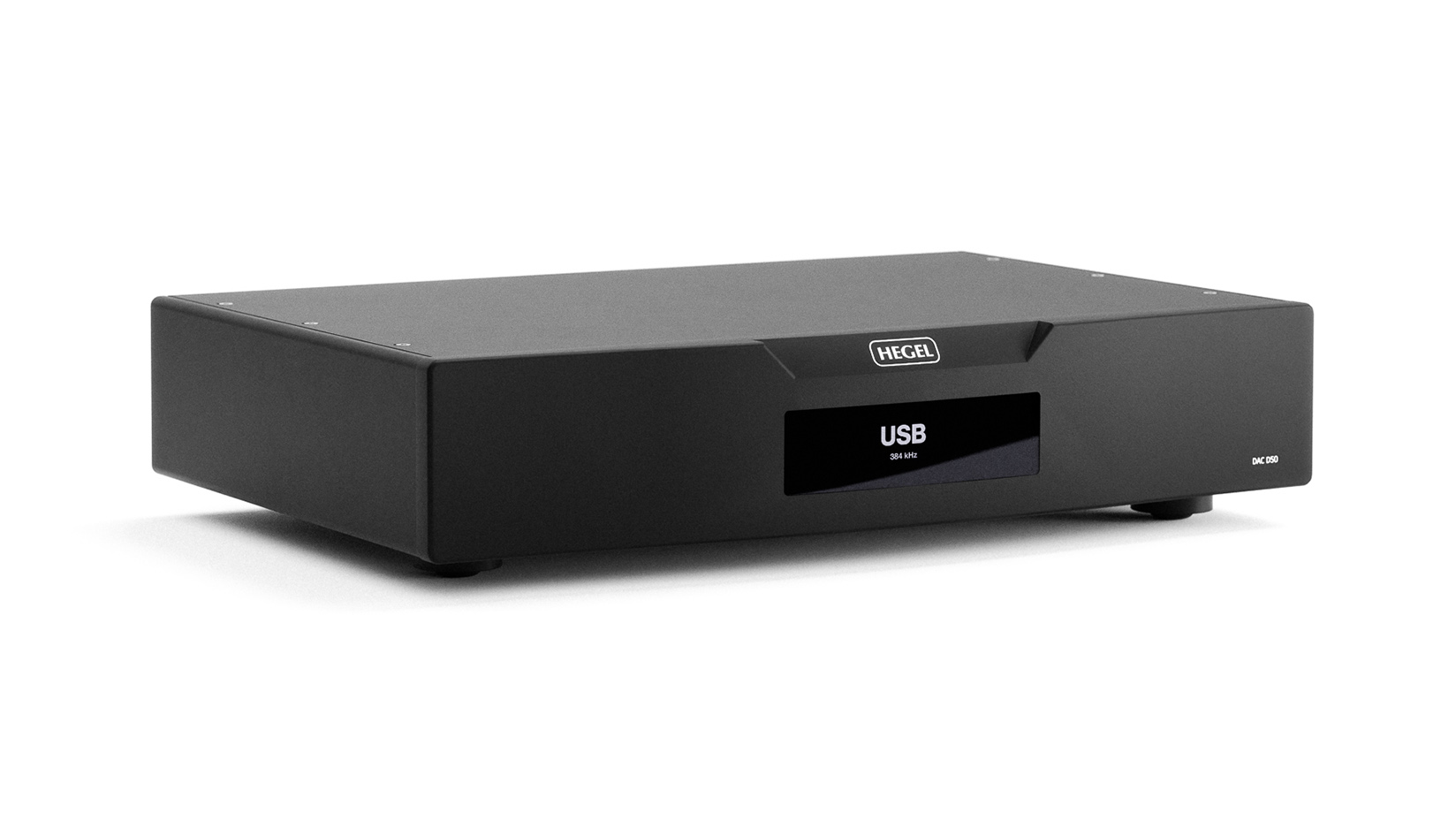
Hegel is no stranger to this magazine. The company garners great respect for its digital expertise. DACs have played a central role in many of Hegel’s products over the years, whether in CD players, amplifiers, or standalone DACs. The built-in DAC in many Hegel amplifiers often outperforms the DACs in other digital sources from its many peers and rivals. Therefore, when a company with this extensive history launches a new flagship DAC like the Hegel D50, it’s worth taking note.
Features
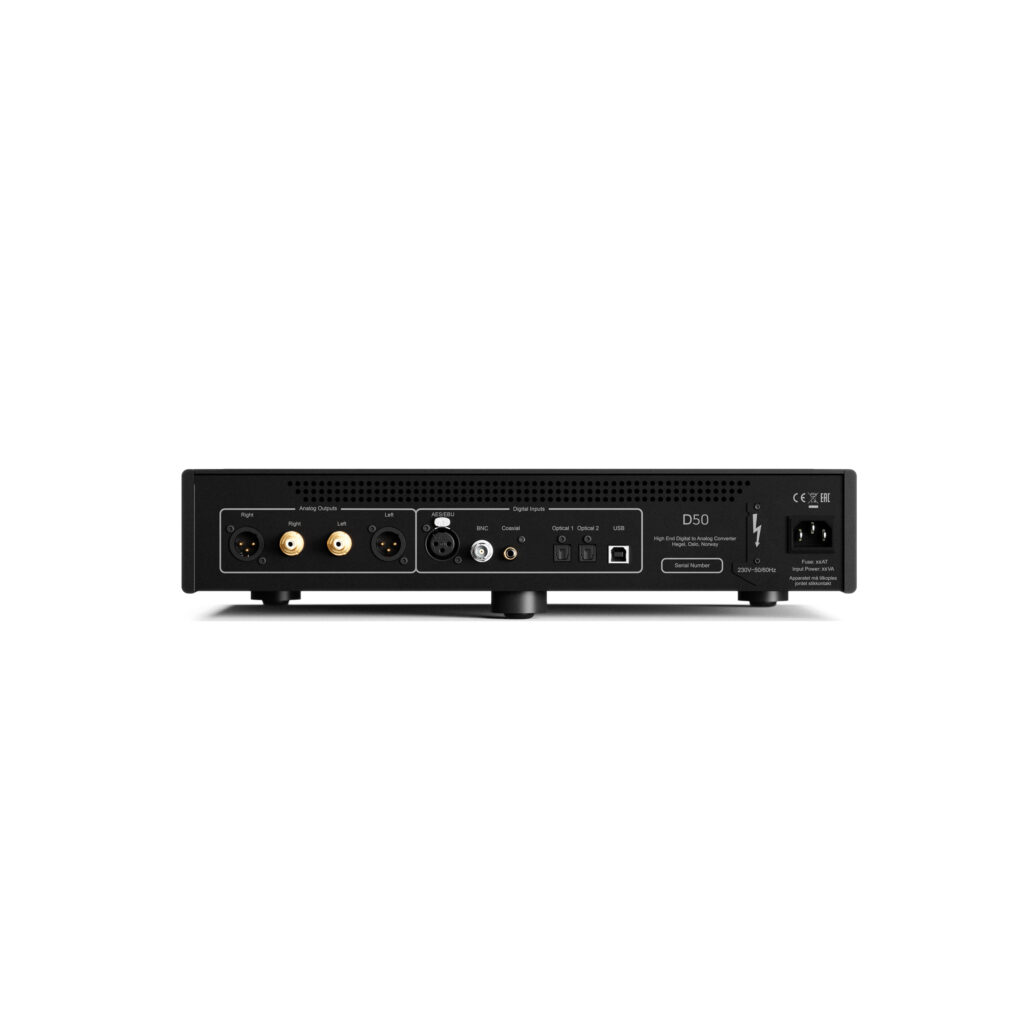
The Hegel D50 is a versatile and adaptable unit, albeit not overloaded with inputs. If you require a DAC with a back panel resembling a server farm’s patch board, then you might need to look elsewhere. However, it is as well-equipped as most will need. The available digital inputs are more than sufficient for most needs: one each of AES/EBU, BNC, RCA coaxial, and USB, plus a pair of Toslink/EIAJ optical inputs, feeding either balanced or unbalanced analogue outputs. The D50 also offers several user-configurable features, including input sensing, automatic standby, and display dimming. The familiar, minimalist Hegel remote control can operate functions and navigate menus, but a manual option is available via three discreetly hidden buttons beneath the front display.
It’s clear from the outset that Hegel intends the D50 to showcase everything it has learned about digital technology, and in doing so, it stands on the shoulders of the commendable products that came before it. However, the Hegel D50 also introduces some new and intriguing features of its own, which distinguish it. This review followed quickly after the workup for issue 244, the Audio Essentials issue. One of the emerging themes of system setup is the importance of paying proper attention to reducing and managing electromagnetic noise.
Noise annoys
Hegel has taken extensive measures in this regard within the D50, designing the internal power management to contain and reduce internally generated EM noise. All the power supplies are analogue—no switch-mode supplies here—using two separate low-noise toroidal transformers, carefully positioned and shielded to keep the noisy digital and standby functions apart from the sensitive digital and analogue components. However, Hegel also tackles noise entering the system from external sources, especially the mains power, which also offers interesting side benefits for the rest of the system.
The incoming mains power is filtered to remove electromagnetic interference (EMI), and, interestingly, this filtering can also affect other equipment connected to the same power circuit. When the unit arrived, the UK distributor and I set up the D50 on my MusicWorks rack, but we had not yet connected it. We played a CD track, and only then did we plug the D50 into my Nordost QB6 power block. Playing the same track again, there was a noticeable improvement in spaciousness and dynamic expression—precisely the kind of effect I’ve heard and associate with a reduction in mains-borne EM noise.
Improves before switch on
Remarkably, here we have a DAC that improves your system’s sound even before you switch it on, let alone use it to decode your music. In its quest to reduce EM noise, Hegel has also focused carefully on circuit board design and layout. The board for the single ESS 9039Q2M Sabre DAC chip is positioned above the other electronics, reducing noise and interference, shortening signal paths, and allowing it to be placed as close as possible to the master clock.
Additionally, the D50 features three master clocks: one for the S/PDIF feed and two for USB — one for 44.1 kHz and another for 48 kHz sample rates — strategically positioned to minimise noise and optimise timing data. There is also further innovation in how incoming digital signals are processed, enabling better handling of both weak and strong signals, free from jitter and time delays. It reads like a masterclass in tackling the menace of EM noise.
The distributor also brought a partnering Hegel H400 amplifier, which features its own excellent internal DAC and streamer, making it a one-box streaming system. However, an interesting feature of recent Hegel amps is that they can bypass the internal DAC via a ‘DAC loop’ function to a BNC digital output. Using this to feed the D50, then taking the analogue output from the D50 back into the H400’s inputs, resulted in a significant improvement in the H400’s performance, making the D50 a viable upgrade option for any H400 user. I spent part of this review with the system configured this way, but my Accuphase CD player and amplifier did most of the work, connected via an optical cable to the D50.
Space, finally in front of my ears
Musically, the first impression is of a clear, spacious, highly resolved, and detailed presentation. That’s a good start, and it just continues from there. Michael Torke’s suite Miami Grands [Ecstatic Records] is scored for ten pianos. That’s not a typo. The music is at times dense, lyrical, and, above all, beautiful, and often reminds you that the piano is a percussion instrument. The D50 provides a substantial performance space (you wouldn’t fit ten pianos in a salon) with a clear sense of the acoustic environment. It’s possible to discern, if not all ten, then certainly quite a few of the instruments at any given time, to the extent that different instruments’ timbres and even performers’ playing techniques are noticeable.
There is also space between and around the instruments, making their contributions easy to distinguish at will. ‘South Beach, midnight’ is rhythmically assertive, with interleaved and interwoven threads, and the potential to sound like a complete mess in inexperienced hands. Here, it is simply and undeniably compelling and captivating. ‘Everglades, under the stars’ twinkles softly but percussively, with a clear attack on the notes, tightly timed edges, and a well-developed note envelope. The colours and timbres of the individual instruments contribute to the diverse landscape the piece evokes. There is skill in how the D50 resolves and presents complex, layered, and nuanced music without dissecting or deconstructing it. It makes experiencing it naturally easier, closer to how we do at a live performance; no strain, no subconscious struggle to suspend disbelief.
A third of a millennium
Backtracking a third of a millennium for a spot of Purcell, ‘When I am Laid in Earth’ from Dido and Aeneas [English Chamber Orch/Leppard, Warner Classics apex], there’s tension right from the opening bass line in the strings, the better to melt into pathos as the contralto sings; her fluid phrasing, subtle inflections and emphases are utterly impeccable but if the system doesn’t deliver, that pathos quickly dissolves into schmaltz. Not here. Yet again, this is a riveting and very affecting performance.
From the sublime to, well, a different kind of sublime: Sting, live, performing ‘Roxanne’ from All This Time [A&M]. Once again, there is a strong sense of the spatial arrangement, not only of the band and soloists but also of the audience. When they start clapping in time as the groove kicks in, it becomes a clear part of the event, not just something absorbed into the overall rhythm and percussion.
The tabla on ‘Peshwari’ from Andy Sheppard’s Learning to Wave [Provocateur] is tactile, textured, and melodious, contrasting beautifully with Sheppard’s lilting, lyrical saxophone phrases and John Parricelli’s gentle guitar counter-melodies. It’s a genuine performance, and the musicianship and skill are unexpectedly more apparent when they don’t call attention to themselves. None of this detail is flaunted; it’s not cynically designed to impress in a quick, ten-minute A/B demo. It simply exists within the music.
Robust
A digital signal is inherently robust, but converting it to an analogue signal, especially for music, presents challenges due to the noisy electromagnetic environment in which it often operates. Much depends on the quality of the analogue components, the power supplies, and the internal housekeeping. Hegel has gone to great lengths to protect and maintain that process, resulting in crystal-clear precision.
Sometimes a product provides all the information you could want, but, like a photorealistic portrait, you may feel you’re appreciating the talent and skill yet missing the art. The market is full of products that offer ‘transparency’ and all sorts of hyper-detailed presentations, but the Hegel pulls off that trick of presenting detail in the service of the music. The Hegel D50 offers steady competence and natural musicality that could embarrass some much more expensive rivals.
Technical specifications
- Type: Solid-state high-resolution PCM, MQA and DSD-capable digital-to-analogue converter.
- Digital Inputs (max data rates): 1 x AES/EBU S/PDIF (24/192, DSD64(DoP), MQA 8x), 1 x Coaxial (BNC) S/PDIF (24/192, DSD64(DoP), MQA 8x), 1 x Coaxial (RCA) S/PDIF (24/192, DSD64(DoP), MQA 8x), 2 x Optical S/PDIF (24/96, MQA 8x), 1 x USB 32/384 (DSD256(DoP), MQA 8x)
- Analogue Outputs: 1 x Unbalanced fixed (RCA), 2.5 V, 1 x Balanced fixed (XLR), 2.5
- Frequency Response: Better than 0Hz-100kHz
- Distortion: <0.0002%
- Noise Floor: Typically -150dB
- Power consumption: in use <20W; standby <0.5W
- Dimensions (WxHxD): 430 x 99 x 305mm
- Weight: 6.6kg
- Price: £4,250, €4,895, $4,900
Manufacturer
Hegel Music Systems
UK distributor
Auden Distribution
+44(0)7917 685 759
Trending Articles
See all
By Steve Dickinson
More articles from this author
Read Next From Review
See all
Eversolo T8
- Oct 13, 2026
Acoustic Energy AE Active
- Oct 13, 2026
Reiki Audio SuperSwitch X/Pro X PSU
- Oct 06, 2026
Audiobyte SuperVOX
- Oct 06, 2026