*Edit – 1st July 2025, Melco Audio changed name to DELA Audio*
Melco – the Japanese maker of some excellent servers – is also no slouch when producing network infrastructure products. That’s hardly surprising given that the computer peripheral giant Buffalo Technology is a part of the same company. And having Buffalo on the same team means Melco’s audio-grade switches have credibility beyond that of a company modifying third-party network products. None of this prepares you for the Melco S1 network switch. Nevertheless, it remains impressive.
Let’s be honest: Part of that unpreparedness is related to the price tag. The very concept of an audio-grade network switch is comparatively new. Some still use a low-cost Netgear or TP-Link switch to connect their streamers to their servers and the outside world. The Melco S1 is about 300 times as expensive as those mainstream devices. So, the S1 has some pretty big and expensive shoes to fill.
Not the first
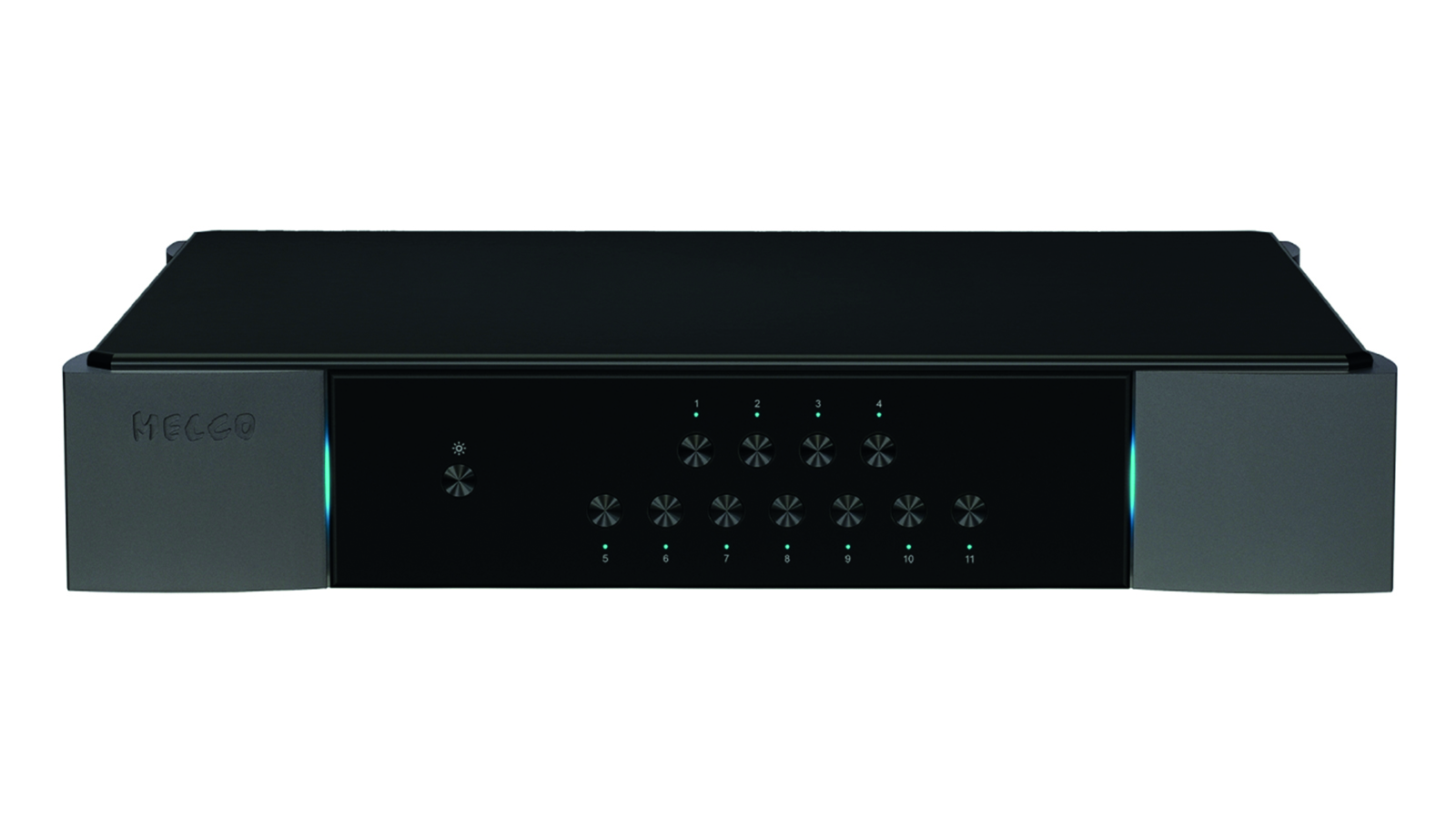
The Melco S1 is not the company’s first switch. It draws on lessons learned from making the company’s S100 switch and its matching S10 linear power supply. However, with the S1, the audio-only dedication and precision shift into higher gear. The S1 distils the two-box technology of the S100 and its external S10 power supply into a single chassis. However, that alone would not make a world-class audio switch. That single chassis looks like the company’s N1 server without a central display. It has the exact dimensions of 440x82x353mm and weighs 14kg, like the server.
Melco’s S1 has 11 network connections in total. However, the first four are SFP+ (Small Form Pluggable) connectors, which replace conventional copper Ethernet cabling with fibre-optic connections. While you can use SFP-RJ45 converter modules in any product with an Ethernet connection, having native SFP+ fibre optic connections, such as in Melco’s N1 and N5 servers, is a boon. It helps keep noise levels extremely low.
Seven ports
The seven RJ45 ports are professional-grade Neutrik connectors, typically found in recording studios (and top-end Melco servers). Behind those sockets sits a dedicated, audio-optimised internal NDK clock and a capacitor bank to ensure exceptionally smooth power delivery. There is also a BNC input for an external clock and a USB for charging only.
These 11 connections have an unprecedented degree of user control. You can select the speed of each Ethernet link or turn it off altogether by pressing its corresponding front-panel button. The colour of the illumination surrounding that front panel button determines the status of each link. For the SFP+ links, you can choose 10 Gbps or 1 Gbps. The RJ45 can run at 1 Gbps, 100 Mbps, or 10 Mbps. These lower speeds invite the question, ‘Why bother? Isn’t faster always better?’ In listening tests, many prefer the performance of a system running at lower bit rates. These rates introduce less radio-frequency noise. Once again, SFP+ has an edge here. Yet the Melco S1 offers greater flexibility in connections throughout the entire Local Area Network.
Extreme thoroughness
The level of thoroughness is extreme. There is a tiny potential risk of noise from the two ‘link’ and ‘activity’ LEDs accompanying an RJ45 socket. You can turn off these LEDs by pressing from the rear panel. And if you go deep, determining the optimal use of LEDs for each active RJ45 socket is an audio obsessive’s dream. In truth, whether the LEDs were ‘on’ or ‘off’ was too nuanced for me. However, you do you!
This review must test the quality of SFP+ and RJ45. However, you need to resolve an important side quest first: Which is better, RJ45 or SFP+? There is no simple answer, as it depends on your hardware. For example, those using Network Attached Storage will probably find staying with RJ45 the best—and best-sounding—option. Meanwhile, those with RJ45 servers and streamers with SFP-RJ45 adaptors in place get mixed results. For those with Melco N1 servers and similarly native SFP+ connected streamers (such as the HiFi Rose RS130 Network Transport), why are you even considering RJ45? If RJ45 through the S1 reduces noise to as low as it gets for Ethernet, SFP+ is the noise-free option. Indeed, this comes across as a full ‘rounding and grounding’ of the sound.
Hard to return
It’s odd; you don’t necessarily notice this ‘rounding and grounding’ until you hear it. And then it’s hard to return to a copper-based Ethernet. Music is free from that background ‘electronicky’ hash that comes across as slight grain and a filling in of ‘the spaces between the notes.’ Naturally, this comes over best with piano, where the individual notes seem to emerge organically. They emerge with a sense of solidity and ‘thereness’ that is outstanding. This doesn’t need to be some dusty classical piece or jazz noodling. For example, the opening bars to ‘Laura’ by Bat For Lashes [The Haunted Man, Parlophone] are a great example.
Don’t downplay the quality of the RJ45 performance, though. While many S1 switches will likely accompany Melco N1 and N5 servers, where SFP+ is usually the best option, the RJ45 connections are equally top-notch. As before, the S1 grants you closer access to the music. It eliminates a significant proportion of what we dismiss as negative in ‘digital’ or especially ‘streaming’ sound.
The right contradictions
The S1 doesn’t change the fundamentals of a recording, but it does give its sound effortless finesse and sophistication. That might sound contradictory; something as harsh and angular as Miss Kittin’s ‘Frank Sinatra’ [First Album, International DeeJay Gigolo] shouldn’t benefit from a more refined presentation. However, that precision and clean, undistorted delivery even benefits this slice of trashy electroclash. It makes the cheap-sounding synth sounds better delineated, with razor-sharp attack and decay. Staying with the ‘seemingly contradictory’, the S1 makes that fatiguing music sound less fatiguing, without undermining it. Of course, once you move to something more audiophile-adjacent (Rachmaninoff: Symphonic Dances, Zinman, Baltimore SO, Telarc), the S1 frees up the music’s dynamic range. It also improves staging and detail.
Dialling in the optimum link speed is the icing on the cake. Yet the Melco S1 is one hell of a cake!
There’s a three-question story arc to the Melco S1; you begin by asking, “How can they justify that much for a switch?” After listening, you ask yourself, “How can a switch make that big a difference?” Shortly after, you ask, “Which credit cards do you prefer?” The Melco S1 network switch is a remarkable achievement. It shows us how much musical information can be lost to the network infrastructure. It also shows how effortless our music can sound when you address that infrastructure correctly.
Price and Contact Details
- Melco S1 Switch: £12,999, $14,999, €15,999
Manufacturer
Melco Audio
UK distributor
ADMM
Tags: MELCO S1 NETWORK SWITCH
Trending Articles
See all
Computer Audio Design CAT computer audio transport
- Oct 13, 2014
Trending Articles

By Alan Sircom
More articles from this author


Read Next From Review
See all
Reiki Audio SuperSwitch X/Pro X PSU
- Oct 06, 2026
Audiobyte SuperVOX
- Oct 06, 2026
Unitra WSH-805
- Sep 29, 2026

Wilson Audio Sabrina V
- Sep 29, 2026