In the dim and distant past that we call ‘the nineties,’ a charming Scotsman named John Carrick distributed a Japanese cable brand, Furukawa. He had a degree of success with these cables, which were made using a technique called Ohno continuous casting (OCC), which involves using heated moulds to draw long single-crystal copper (or silver) conductors. I used some of these cables for a while, but they were inevitably replaced by something better or something that sounded better in the system than it was at that time.
Last year, I was looking for a cable for a friend and came across a Furukawa interconnect. I went to check that it worked and see how it sounded today. The result was surprisingly appealing; this 25-year-old plus cable had a depth of tone and warmth that is uncommon among many of today’s offerings. The Furukawa didn’t have the detail and speed of modern interconnects but did enough to make me wonder about the technology.
Enter Atlas
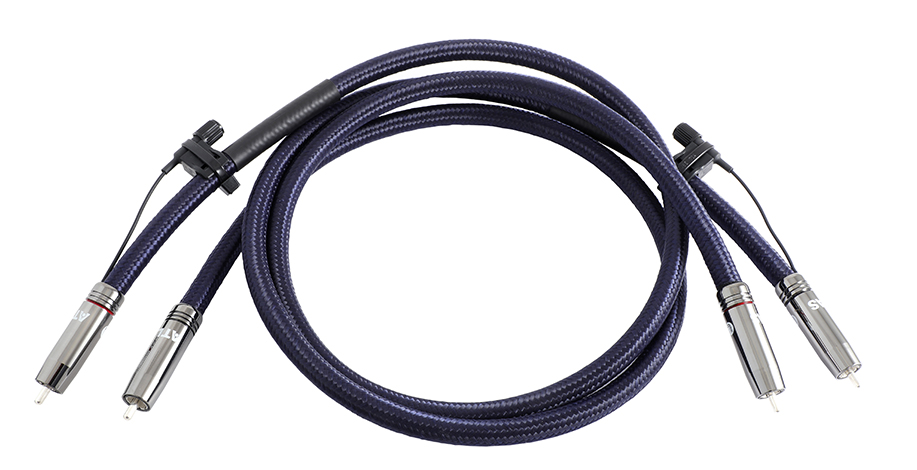
When I recalled that John Carrick went on to found Atlas Cables and that this company uses OCC in its cables today, I contacted Kevin Kelly, who runs Atlas, and asked if I could try a modern example of the breed. He sent two pairs of Arran Ultra L RCA Grun interconnects, which have 6N purity (99.9999%) OCC copper conductors. These have a microporous PTFE dielectric, which means the insulation is wrapped rather than extruded to get some air around the conductor. The construction is defined as a twin multi-core, dual drain, which means that it has four cores in two twisted pairs and that two drain wires spiral at 180 degrees to one another beneath the screen, a technique that significantly increases screening efficiency and keeps RFI at bay very effectively.
The Arran Ultra L RCA Grun cables are the penultimate model in Atlas’ extensive range, sitting below the leather-clad Asimi Ultra L RCA Luxe, which also has the Grun earthing system. This element consists of flying leads connected to the shield at one end of the cable and has a silver-plated threaded coupling that you can earth in various ways. Atlas includes a spade-terminated connector in the box with the Arran cables, which can be connected to an earth point or chassis fixing on the component being hooked up. Alternatively, Atlas offers a power adaptor, which is a 13A mains plug (alternative plugs are available for different countries) with three flying leads that can be joined to the Grun earth leads on the Arran cables.
Tangle teasing
Unusually, these interconnects are not marked for directionality; rather, the end with the Grun connection should be at the preamplifier or integrated amp. So, in a pre/power situation, the connection from a source would have the Grun at the pre-end, and the cable to the power amp would likewise be earthed at the same end. This can be slightly impractical if you change components a lot as avoiding cable tangles gets tricky. However, this is more likely to be an issue for reviewers and dealers than end users.
The ‘L’ in the name of Atlas Arran Ultra L RCA Grun relates to the Latik insulation inside the phono plugs on these cables. Latik is a polypropylene sleeve that replaces the usual PTFE found in high-end RCAs; it has two advantages over that material. By 3D printing this part, Atlas can minimise the amount of plastic and maximise air insulation. The other relates to thermal behaviour; PTFE expands when it is heated up, and this changes the resistance of the insulation and, thus, the performance of the cable. Power amplifiers can get warm enough to do this. Latik plugs are far more thermally stable and do not expand or contract with temperature changes, so the impedance remains constant.
Atlas further increases cable consistency by using a solder-free connection between the conductor and pin. This is achieved by cold welding, which achieves a smooth signal path at this critical junction. The RCA plugs are shiny on the outside but silver-plated on the pin and collar for optimal contact with the socket. In a perfect world, the RCA socket would also be silver-plated, but such things are rare even amongst high-end components.
Golden tone
Did the Atlas Arran live up to the promise of the vintage Furukawa cable, or was that just a case of age annealing that brought a golden tone to an otherwise average cable? I am happy to say that the Atlas cable not only lived up to expectations but greatly exceeded them. I was hoping for a richer sound; Instead, I got a dramatic increase in detail resolution presented in an entirely fluid and distinctly three-dimensional fashion. Moving over from the interconnects that I have been using for over a decade felt like going from a flat to a three-dimensional soundstage, even though the older cable is no slouch when it comes to imaging. I was, frankly, gobsmacked.
Atlas supplied a 13A plug with only an earth pin to connect the ground wires on two pairs of Arran Ultra L interconnects, which may work better than grounding to component casework. But I couldn’t put the sound down to the Grun factor alone; this is an exceptional cable, and the result made me wonder just how much it cost for the first time. The answer is ‘quite a lot’ but not excessive in the context of high-end cables. High-end cables rarely deliver such a night and day result as the one that hit me.
Dropped Arran
I had some rather nice electronics from Bricasti in the system at the time (tested in issue 228) and dropped the Arran in between the M1S2 DAC and M20 preamplifier and was frankly astonished at how much was going on, how much tonal colour, dynamic shading, image depth etc came through. The intro to ‘Wish You Were Here’ is usually excellent; it became truly cosmic with a rich tapestry of sound that is rarely hinted at.
The beautiful blues playing of David Gilmour was savage yet not piercing. The backing vocals were perfectly rendered and totally in proportion, while the saxophone felt like it was in the room.
Juicy
What I particularly like about the Atlas Arran cables is that they deliver mountains of detail in a warm, grain-free fashion. They make a lot of cables sound dry and thin, which is a balance that can be good for delivering immediacy but doesn’t get you the full picture in the way these cables prove can be done. They do immediacy superbly as well, richness of tone does not preclude speed or excitement, far from it. Ali Farka Toure and Ry Cooder’s Talking Timbuktu is a great recording, but it doesn’t usually sound this rich and juicy, this fluent and vibrant. It’s a better recording than I thought.
I also used the Arran cables between a Tom Evans Groove+ phono stage and Townshend Allegri Reference preamplifier, then from there onto a Moor Amps Angel 6 power amp, and to be honest, they have remained there ever since. Once you have heard what has been missing from a Rega Naia with Aphelion 2’s amplified and equalised signal, there is no going back. It’s a taste of real sound that is very hard to get in any other way once you have the requisite hardware. What is shocking is that so many cables fail to deliver what sounds like the doubling in data you get with Arran. Everything you play opens up and reveals its riches in a ’never going back’ way.
Odyssey
In the end, I had to request a third Arran Ultra L RCA Grun cable from Atlas, as having two meant switching cables every time I switched sources, hence the tangle of ground wires. I also want to connect the Grun cables to a CAD GC3 Ground Control. There are no 4mm banana options in the Atlas catalogue, but I have requested a couple made up for this purpose.
What started out as intrigue became an odyssey into unheard realms of my music collection with the Atlas Arran Ultra L RCA Grun cables. If you want to get a better idea of just how much musical detail your equipment can resolve, I suggest you try them. Be warned, however, there may be no going back.
Technical specifications
- Type: Analogue interconnect with RCA jack terminations
- Length: 1m pair
- Conductor: OCC copper
- Dielectric: Microporous PTFE
- Shielding: Braid & Mylar, 100%
- Capacitance: 71.17 pF/m
- Resistance: 0.0197 Ohm/m
- Inductance: 0.332 µH/m
- Price: £2,450, $3,500, €2,950 per 1m pair
Manufacturer
Atlas Cables
+44 (0) 1563 572666
Trending Articles
See all
By Jason Kennedy
More articles from this author

Read Next From Review
See all
Eversolo T8
- Oct 13, 2026
Acoustic Energy AE Active
- Oct 13, 2026
Reiki Audio SuperSwitch X/Pro X PSU
- Oct 06, 2026
Audiobyte SuperVOX
- Oct 06, 2026