
The Eagles, Michael Jackson, Elton John, Billy Idol, Depeche Mode and Christine Aguilera. What do they have in common? Their albums were all mastered in recording studios using Tannoy monitor loudspeakers such as the Tannoy Super Gold Monitor SGM12.
That’s quite an impressive pedigree. But the company did not make inroads into professional studio monitoring until the 1970s. Its story started long before that. Guy R Fountain founded Tannoy way back in 1926, originally as the Tulsemere Manufacturing Company. It changed its name a couple of years later. It chose ‘Tannoy’ to reflect the materials used in its rectifiers – TANtalum and lead allOY. Its first speakers were aimed at the public address market. This gained it such brand awareness that ‘Tannoy’ is still a household word in the UK today. It moved into domestic speakers in the 1930s.
The right kind of retro
There’s no denying that retro is ‘in’ right now: retro motorcycles, furniture, bathrooms, kitchens, vinyl and valve amplifiers. But there is retro for its own sake, that focuses more on style than content. Then, there’s the kind of ‘retro’ that makes sense. In the case of the Tannoy Super Gold Monitor SGM12, you could call it retro. I prefer to think of it as authentic heritage that has stood the test of time.

Tannoy’s heritage in loudspeakers is undeniable, and the company will soon be celebrating its 100th anniversary. It joined TC Group in 2002, which became part of Music Tribe in 2015. However, Tannoy has remained true to that heritage.
Late 2023 saw the introduction of the Tannoy Super Gold Monitor SGM12. It is a modern reworking of the Monitor Gold concentric range launched initially in 1967. I reviewed the SGM12’s little brother, the SGM10 stand-mount (£5,995), in issue 230. It has a bigger brother too in the shape of the SGM15 floorstander (£11,495).
First in seven years
After appointing Symphony Distribution as its new UK distributor, 2023 saw Tannoy’s first new speaker launches for seven years. In May, a new Stirling III LZ Special Edition model launched. It is an homage to the 1960s III LZ Monitor Red. Then the Super Gold Monitor range (including the Tannoy Super Gold Monitor SGM12) came in September. Global brand category leader David McCaffrey said the appointment of Symphony had “revitalised the UK market” for Tannoy. This heralds a period of growth for the company, which he confirmed has “major plans for the future”.
At the heart of all of these speakers is Tannoy’s legendary dual-concentric drive unit, originally launched in 1947 and brought thoroughly up to date in its latest speakers. The SGM10 has a 10in, the Tannoy Super Gold Monitor SGM12 has a 12in, and the SGM15 has, you guessed it, a 15in variant.
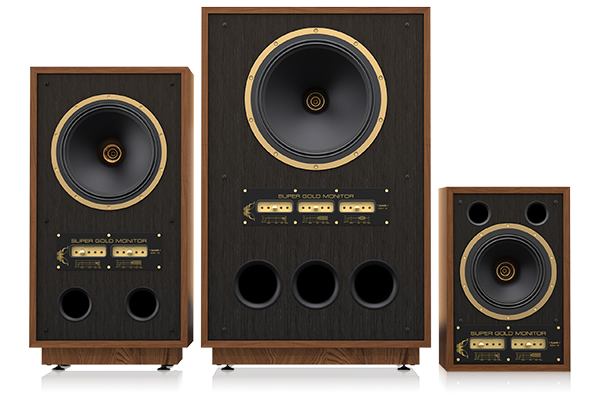
Before looking at the Tannoy Super Gold Monitor SGM12 in detail, it’s worth looking at what advantages Tannoy claims for the dual-concentric driver. As its name suggests, at the centre of its 12-inch paper pulp mid-bass cone sits a 1.3-inch aluminium/magnesium alloy dome tweeter. Having high- and low-frequency sound waves emanating from a single point results in a more coherent and accurate reproduction. This is also said to help rectify the phase and time alignment anomalies that occur when the sound from two separate drivers arrives at the listener’s ears at different times.
When two become one
One of the main benefits, says Tannoy, is that the dual-concentric driver provides better dispersion and a wider ‘sweet spot’, which means the listener does not have to sit dead-centre to get the best experience. A further claimed benefit is that it achieves a smoother frequency response as it minimises interference between separate drive units on the same baffle.
The new Super Gold Monitors have seen certain upgrades over the originals. The cabinet of the Tannoy Super Gold Monitor SGM12 uses thicker 19mm chipboard with MDF inserts and internal plywood bracing. In contrast, the front baffle uses a twin sandwich construction to reduce vibrations. The cabinet also gains a second reflex port to help reduce internal standing waves.
The SGM12’s dual-concentric driver uses a tulip waveguide and modern ferrite-type magnet system with copper demodulation rings and a high-flux magnetic circuit. The original had an Alnico magnet with a pepperpot waveguide. The tulip type, says Tannoy, means that some 10kHz could extend the frequency response to 30kHz.
Hard-wired
The hard-wired crossover uses premium-grade polypropylene capacitors, low-loss inductors and high-power resistors, all hard-wired, to provide a 12dB/octave low-pass filter and a 6dB/octave high-pass filter.
Like its smaller sibling, the Tannoy Super Gold Monitor SGM12 also provides fine-tuning of the treble response using a knurled screw on the front panel that can be shifted from hole to hole to give a Treble Energy adjustment over a range of 1kHz to 30kHz. It comes set to FLAT, but can be adjusted to +1.5dB and +3dB or -1.5dB and -3dB. Similarly, Treble Roll-off from 5kHz to 30kHz can be adjusted in steps of +2dB, -2dB, -4dB and -6dB, or left ‘FLAT’.
In my 19ft x 13ft listening room, the sweet spot for speakers is generally around 18in from the rear wall and 12in from the side walls. It worked for both the SGM10 and the SGM12. Although the SGM12’s low frequency response extended only 2Hz lower (38Hz) than the 10, the larger cabinet audibly produced more bass energy in my room. So whereas I had set both the treble roll-off and treble energy to ‘FLAT’ on the SGM10, the Tannoy Super Gold Monitor SGM12 worked best with treble energy set to +1.5dB, which helped to balance out the sound. This demonstrates the usefulness of these controls, and I strongly advise any owner to experiment for themselves.
The fun factor
I hooked the Tannoy Super Gold Monitor SGM12s up to the same system I used for the SGM10, with an Audio Note TT3 turntable/Arm Two/Io1 and S9 transformer through Audio Note’s Meishu Tonmeister integrated single-ended valve amp. The same company’s CDT-Five transport and DAC Five Special converter took on the CD-spinning role.
As its smaller sibling did before it, the Tannoy Super Gold Monitor SGM12 put a smile on my face from the very start. The sound was dynamic, exciting, detailed and had great impetus and rhythmic integrity while deftly dealing with subtle musical detail and layering.
Starting with ‘Smiles and Smiles To Go’ from guitarist Larry Carlton’s Alone But Never Alone album, I was impressed with the dynamics and control on the drum kit. This is an area where the SGM10 excelled, too. Carlton’s guitar was well voiced, and the Tannoys let me hear the nuances of how each note was played and shaped. The bass line was tight and weighty, moving well. I listened on into the next track and was again impressed how I could hear his fingers moving along the strings, and again the drum sound was tight and dynamic.
Emotion conveyed
Next up was ‘It Didn’t All Come True’ from jazz singer/songwriter/pianist Ben Sidran’s superbly recorded Bop City LP. The Tannoys conveyed the emotion and phrasing in Sidran’s vocals and the speed and dexterity of his piano playing. At the same time, the drums were explosive and snappy. They have a significant impact from the snare, delicacy, and fluidity of the cymbals. That wonderful bass line also had the walk, growl and weight it should. The track is fast-moving, and the Tannoys kept up the impetus and drive, giving it real excitement and energy.
I greatly admire George Benson as a guitarist. I wanted to see how the Tannoy Super Gold Monitor SGM12 would handle the track Johnnie Lee on his That’s Right CD. It’s a gentle and touching tribute to the late John Lee Hooker. Benson’s guitar was beautifully voiced on the Tannoys. The masterful yet understated way he packed emotion into every note, how he bent and shaped it, and the beautiful chord structure, were all laid bare. The bass line was deep and moved well, and the tracked flowed rhythmically. Tannoys can handle a slow track like this as well as they can a raunchy rock number.
Retro-modern
The Tannoy Super Gold Monitor SGM12 may have retro looks, but its sound is thoroughly modern. They took everything I threw at them in their stride. From ZZ Top to beautiful acoustic tracks like singer Sarah Jarosz’s ‘Build Me Up’ from Bones, or raunchy sax of David Sanborn or Eric Marienthal. They are pacey, delicate, and detailed. But when they need to be, they can be wonderfully tight, dynamic, and exciting. And with a sensitivity of 91dB, they are the perfect partner for a low-powered, single-ended valve amp like the Audio Note Meishu Tonmeister.
If you are in the market for some speakers around £8,000, put Tannoy’s Super Gold Monitor SGM12 on your shortlist.
Technical specifications
- Type: Two-way reflex-loaded floorstander
- Driver complement: One dual-concentric driver with 12 12-inch bass/midrange cone and a 1.3-inch dome tweeter
- Frequency response: 38Hz-30kHz ±6dB
- Treble adjustment: shelving ±3dB over 1kHz to 30kHz, +2dB to-6dB slope over 5kHz to 30kHz
- Crossover frequency: 1.2kHz
- Impedance: 8 ohms
- Sensitivity: 91dB/W/m
- Dimensions (HxWxD): 86.3 x 30.8x 44.7cm
- Weight: 29.4kg
- Price: £8,249 per pair
Manufacturer
Tannoy
+44(0)1236 420199
UK distributor
Symphony Distribution
www.symphonydistribution.co.uk
+44(0)7776 511691
Tags: FLOORSTANDING LOUDSPEAKER TANNOY SUPER GOLD MONITOR SGM12
Trending Articles
See all
Acoustic Energy Corinium floorstanding loudspeaker
- Dec 23, 2024
Trending Articles

By Chris Frankland
More articles from this author

Read Next From Review
See all
Reiki Audio SuperSwitch X/Pro X PSU
- Oct 06, 2026

Audiobyte SuperVOX
- Oct 06, 2026
Unitra WSH-805
- Sep 29, 2026

Wilson Audio Sabrina V
- Sep 29, 2026