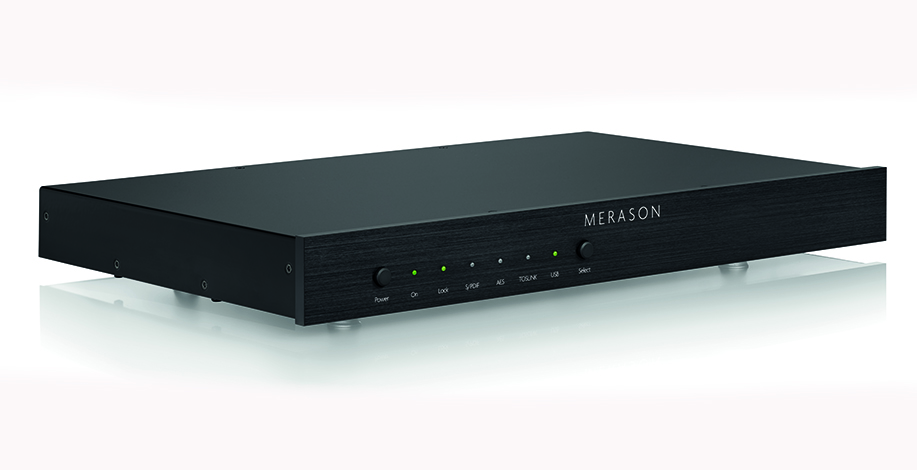
Merason is a small but dedicated Swiss company whose creations (including the Merason Reuss DAC) are all of the digital-to-analogue converter persuasion. Not only that, but it also makes dedicated PCM-only converters, such as the Reuss tested here. That is a niche within a niche that the company has had some success with over its eight years.
Daniel Frauchiger runs Merason. Frauchiger originally trained as a mechanic. He has always been a hi-fi nut (as they probably don’t call them in the Cantons). He spent 30 years doing a ‘proper’ job. Finally, he realised that the meaning of life rests in the sound of great music. So, he dedicated his time to making a digital audio source. A source that could “keep up with analogue when it came to musicality and emotion”. The original Merason DAC1 was a thrilling device. It brought much of the musical reward associated with analogue sources to the digital world. The DAC1 had an acrylic and stainless steel case with minimum frippery in electronic or design terms. It made a strong impression on listeners.
Today, Merason makes three DACs: the DAC1 MkII, Reuss, and Frerot. The latter is the least expensive and offers the option of a power supply upgrade. Reuss (pronounced ‘Royce’) is a slimline beauty that maintains the less-is-more ethos inherent in all Merason converters. The Merason Reuss DAC has all the usual input types, including AES and USB. The latter runs into an Amanero input board that offers low jitter thanks to a pair of crystal clocks. All the other inputs are galvanically isolated and feature jitter-reducing transformers and capacitors.
If it ain’t broke
The Reuss uses two Burr-Brown 1794A converter chips to turn the incoming bitstream into an analogue signal. You will find these hybrid multi-bit/sigma-delta devices in all Merason DACs. Frauchiger considers the 1749A the ‘ne plus ultra’ converter chip. In a world where new is generally considered better, using a DAC that originated in 2004 with the A update in 2015 in a high-end converter is quite a statement. However, Merason is not alone in appreciating the qualities of such chipsets. Many smaller brands prize similar chips, including CAD and several in the tube tech world.
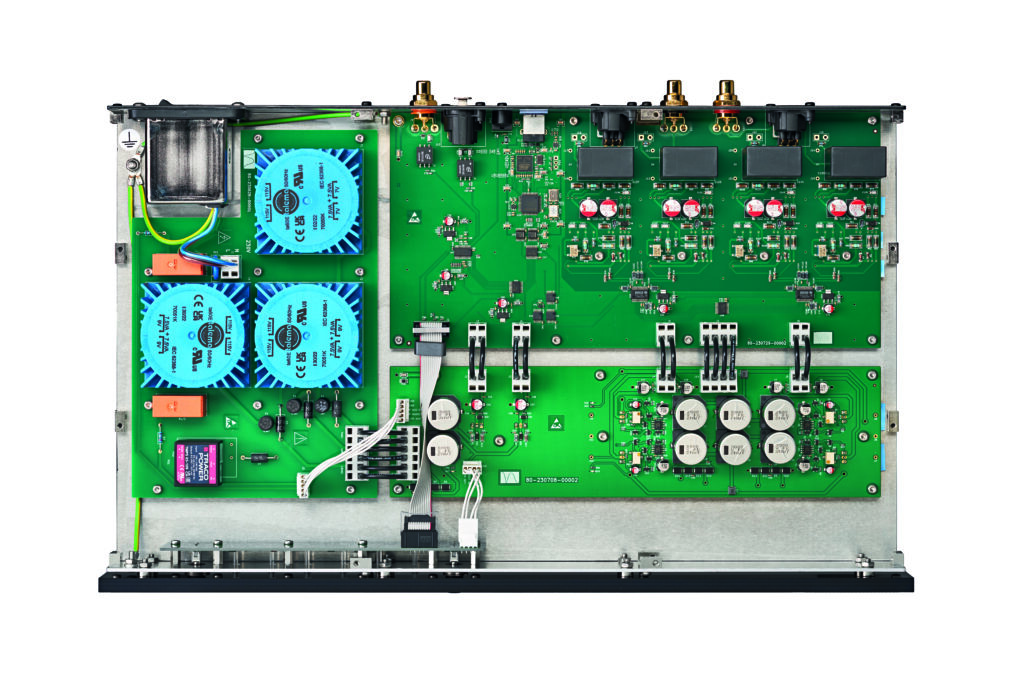
The drawback with the Burr Brown 1794A converters, however, is that they don’t do DSD. This one-bit format is still highly regarded in some quarters of the high-end universe. Although most streamers can convert from DSD to PCM, I suspect that there are enthusiasts for whom only native conversion is acceptable. And don’t even think about MQA. I have always preferred the sound of PCM. I even find DVD-Audio to be a more musically compelling format than SACD. So this is not a hurdle for me. Your mileage may vary.
Less is more
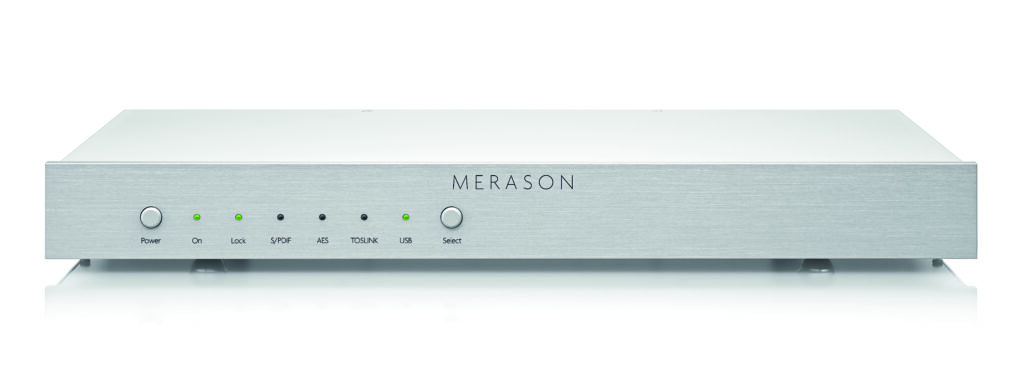
Build quality is very much up to Merason’s Swiss origins. The casework is simple but attractively designed with a row of input buttons, a lock light, power, and input selection buttons. The slim sans serif font and brushed aluminium front panel appeal in simplicity. Meanwhile, the absence of filters, upsampling, and volume control indicates that the designer has made all the choices. The end user can sit back and enjoy the music without worrying that there is a better setting somewhere in the submenus. While having no user adjustments means you can’t tune the Reuss to musical or sonic taste, the absence of such options can often benefit the sound quality produced; fewer switches are usually better.
Controversial opinion time: DACs with volume control are overrated! Volume controls on DACs are great for headphone users and have a place with powered speakers. However, for those in pursuit of the absolute, they are a compromise that’s best avoided/bypassed.
Merason DACs have a quality that sets them apart from many others. The Merason Reuss DAC has a lightness of touch that is very appealing and brings out the musicality in digital sources. I used the Reuss with a Lumin U2 Mini streamer, which had a Network Acoustics power supply upgrade, and connected it to the Reuss using that brand’s muon2 USB cable. A Melco N10 server and the Qobuz streaming service brought the music signal to the party. Amplification was Townshend Allegri Reference preamp and Moor Amps Angel 6 power with loudspeakers including Vivid Kaya S12 and PMC twenty5.26i, a system which went a long way to revealing the qualities of this converter.
Digging deep
It’s a subtle device. The magic in digital music resides in the minutiae, the low-level details that combine with the fundamentals to recreate the sense of acoustic realism. Any smartphone and Bluetooth speaker can do the fundamentals well enough for background listening (well, almost any), but if you want to immerse yourself fully in performance, then the quiet stuff matters. Merason’s Reuss does these with a fluency and coherence that is highly gratifying, pulling out the nuances of phase and timbre that make sounds into something alive and inspiring. It is particularly good at reproducing three-dimensionality where it exists, one modern recording revealing a degree of spatial solidity that was surprising given its almost entirely in-the-box creation.
Acoustic imagery is likewise well reproduced, with reverb unfolding back behind the speakers in a very natural and coherent fashion. I particularly enjoyed the Liv Andrea Hauge Trio’s ‘Istid’ (Ville Blomster). Merason’s Reuss reproduced this piano trio with a solid three-dimensional soundstage, with the instruments being exceptionally full-bodied.
Coherence degree
Reuss’s degree of coherence made this and many other pieces enjoyable. The converter chosen for this DAC is robust in timing. It’s the area where digital usually lags behind its analogue adversary. That lag is tiny with this Merason Reuss DAC. With an excellent recording like this, it’s hair-splitting stuff.
Of course, it can only work with what you give it. King Crimson’s ‘Starless’ sounds thin and aggressive, but likewise, it’s incredibly intense. The compression is evident in the small scale of the audio picture, but that doesn’t get in the way of the musical message. It’s about as good as this record gets without resorting to a plush-sounding turntable. The Reuss has a leaner-than-average balance, but it makes the better recordings, often the more recent ones, sound spectacular.
Some old analogue recordings did not translate to digital all that well, hence the market for remasterings on better studio hardware. The flip side is a visceral impact on transients, such as the drum kit on The God in Hackney’s ‘Interstate 5’. The God in Hackney track is a decent modern recording that uses effects but not to squash or dirty the sound. Instead, it enhances the drum sound, and the Reuss revels in the results, producing large-scale imaging and a strong sense of presence from the vocal.
In spirit
The Merason Reuss DAC did a beautiful job with acoustic recordings, such as Chasing the Dragon’s Locrian Ensemble playing Mendelssohn Octets. The open, melodic presentation flowed easily and drew me into the performance. The Reuss is a refined DAC in all respects. It digs down into the bitstream and reveals the finesse of the playing and the timbre of the instruments in a relaxed and engaging fashion. Likewise, the acoustic guitar and double bass of Baden Powell’s Solitude on Guitar were vibrant and spirited, and the live nature of the recording was immediately apparent alongside the quality of its performance.
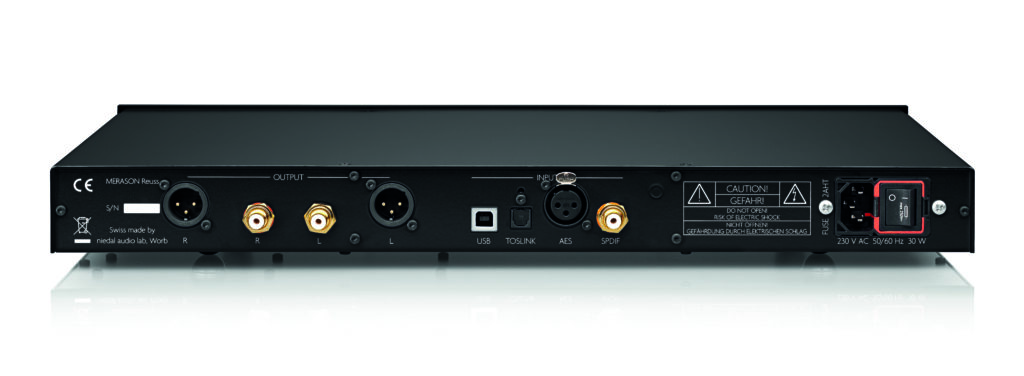
I used the Reuss with and without a Mutec MC3+ USB reclocker, which sits between the server and DAC and delivers an AES signal to the converter. This Mutec reclocker can often sound better than the Lumin streamer, but not on this occasion. One conclusion is that the USB input, with its upgraded input board, produces a better result than the other inputs, but there are other possible explanations.
Narrow the divide
I enjoyed the Merason Reuss DAC. It narrows the divide between analogue and digital sources to the point where one doesn’t need to purchase vinyl copies of great albums discovered through streaming. Well, not every time. The quality of timing and imaging is superb. This DAC is an excellent choice for anyone who enjoys immediacy and realism in their music. Its tonal balance is far from lush but does not emphasise shortcomings in lesser recordings. The music always comes first; I only noticed the tonal balance occasionally. Anyone looking to discover why streaming is the most engaging variation on digital audio for the hi-fi enthusiast should check out the Merason Reuss.
Technical specifications
- Type: Solid-state high-resolution PCM digital-to-analogue converter.
- Digital Inputs: One AES/EBU, one Coaxial, one Toslink, and one USB 2.0.
- Analogue Outputs: One stereo single-ended (via RCA jacks), one balanced (via XLR connectors).
- DAC Resolution/Supported Digital Formats: All PCM from 44.1KS/s to 192KS/s with word lengths up to 24-bit.
- Frequency Response: 20Hz – 20kHz, ± 0.5dB
- Distortion (THD + Noise): <0.015%
- Output Voltage: 3Vrms max via XLR, 1.5Vrms via RCA.
- User Interface: front panel buttons.
- Dimensions (HxWxD): 50 x 450 x 290mm
- Weight: 4.2kg
- Price: £4,950, $5,500, €4,900
Manufacturer
Niedal Audio Lab
UK distributor
Auden Distribution
+44(0)791 768 5759
Tags: DAC MERASON REUSS
Trending Articles
See all
By Jason Kennedy
More articles from this author

Read Next From Review
See all
Reiki Audio SuperSwitch X/Pro X PSU
- Oct 06, 2026
Audiobyte SuperVOX
- Oct 06, 2026
Unitra WSH-805
- Sep 29, 2026

Wilson Audio Sabrina V
- Sep 29, 2026