PMC is as big in the studio world as it is in our slightly larger niche. The company has consistently made active speakers, but as a rule, those models have been large and black. They have often used the amplification and crossover in separate cases—in other words, ‘pro’ models. I was under the impression that PMC makes active versions of its big ‘se’ models. However, I can’t see them on the company’s website. This leaves the PMC Active twenty5.22i from the Active twenty5i range as the only examples produced for the domestic market.
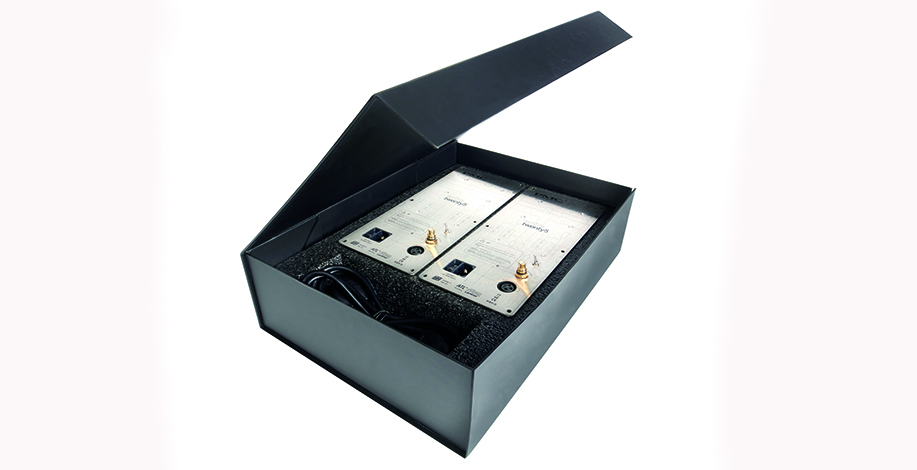
Launched at the Bristol show in February 2024, this line consists of active versions of all the two-way models in the twenty5i range. It starts with the 21i bookshelf and rises to the 24i floorstander. These are four models, including the PMC Active twenty5.22i stand-mount tested here, which share a 6.5-inch woofer. The slimmer 21i and 23i models run a 5.5-inch main driver. They share the same active power pack built into the brushed stainless crossover panel.
This pack upgrades existing passive versions of these models. The pack can also drive the previous twenty-five series (before the i series). Owners of these models can purchase the Active twenty5i upgrade kit for £1,795. To install it, remove the existing back panel and disconnect the driver cables. Next, connect the components to the Active kit, and then replace the panel on the cabinet. Dealers or end-users can do the upgrade, says PMC.
No DSP
This apparent universality suggests that the active crossover is identical for all models, which would certainly facilitate their building. Still, the crossover points are different for each model, as they have different internal volumes or different-sized main drivers. The active kit consists of an electronic analogue crossover and two 100-watt Class D power amplifiers made by ICEpower. The latter was chosen because PMC has extensive experience with these Bang & Olufsen-designed amp modules in its more manageable studio monitors, including the result6. The use of an analogue crossover is what differentiates the PMC Active twenty5.22i from many competitors. The more affordable examples of the breed all use DSP, or digital signal processing, to split up the signal. Results vary significantly depending on how well this is executed. Still, few sound as good as the analogue alternative.

The benefits of active operation are numerous. A key advantage is that the amplifier is connected directly to the drive unit. This allows for significantly more control over the driver compared to passive designs. Oliver Thomas at PMC said, “It improves transient response through increased damping factor and reduces colouration for greater resolution and detail.” Having the crossover before the amplifier also means each amp only deals with frequencies appropriate to a specific driver. This means that in most cases, the amps will have headroom to spare.
Pros and cons
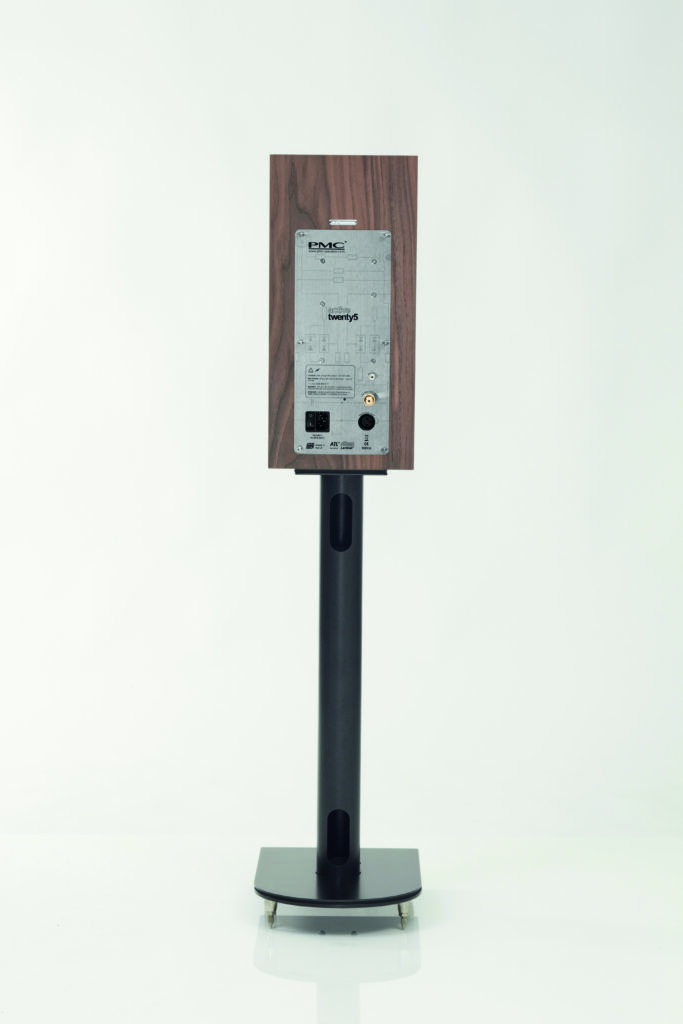
The active pack features balanced and single-ended inputs, a power inlet with a switch, and a gain switch with plus and minus settings. Consequently, connecting the PMC Active twenty5.22i’s up requires the use of long interconnects and suitable mains cables. The latter are supplied in the box, but not the signal cables. Connection can be to any component with a volume control, such as a preamplifier or a one-box streamer/DAC with a variable output.
The beauty of active systems is that they eliminate boxes and offer a matched combination of amplifier and loudspeaker. When you consider that this match is one of the most critical in any system, that’s quite useful. The drawback with them is that you can’t upgrade the amplifier. This has often been a barrier to popularity in the past, especially when dealers look to sell future upgrades.
The Active twenty5.22i is a medium-sized stand-mount loudspeaker. It features PMC’s Advanced Transmission Line loading with a Laminair ‘spoiler’ on the vent underneath the drive units. The tweeter is a 19mm Sonomex soft dome in a 34mm surround. It sports a grille that not only protects the dome but also aids dispersion. Therefore, it’s best not to remove it. The main driver is a 17cm unit with PMC’s preferred woven construction cone in a cast alloy chassis. This driver’s long-throw capability, allied to the ferrofluid cooling in the tweeter, means that those who enjoy a bit of level are unlikely to cause any damage. Ultimately, this is pretty much a pro loudspeaker in fancy attire.
Active all the way
Experience has taught me that active speakers don’t play nicely with passive preamplifiers; they work, but you don’t get the complete active package. For these PMCs, I used an ATC CA2, which is both price-appropriate (£2,150) and comes from a similarly pro-influenced background. I put the PMC Active twenty5.22i on a pair of Hifi Racks wooden stands and connected them up with fancy Ansuz power cables and decidedly unfancy Van-Damme balanced interconnects. My cable armoury is limited when it comes to the 2.5-plus metre runs required for active speakers. However, this decent down-to-earth cable worked well. I found some obscure silver cables to compare and went back to the Van-Damme quickly.
What first made an impression about the PMC Active twenty5.22 is the scale of sound they are capable of. With a decent recording and a bit of level, they throw up a three-dimensional soundstage that surrounds the speakers. They almost seem omnidirectional. I tried the Irresistible Force’s ‘Nepalese Bliss’, which has recently resurfaced in the record collection, and was carried away by its sheer scale and glorious, fulsome juiciness. There are four mixes on the disc, with Amon Tobin’s delivering the crunchiest bass and deepest notes. Let me tell you, these things go very low for such compact boxes.
Monitor-like ability
The PMC Active twenty5.22 also have a monitor-like ability to reveal a lot about each recording, another old 12-inch in The The’s ‘Sweet Bird of Truth’ having a powerful 80s character alongside its apocalyptic forebodings. I also tried some much older vinyl, including Marty Paich, Charles Mingus and Jimmy Giuffre and heard clear and distinct characteristics on each, albeit alongside some very persuasive music; those guys were not making it up as they went along.
Active operation done this well confers clear advantages when it comes to dynamics; the absence of components between the amp and drive unit means that they have a degree of grip that is rare in passive speakers. It means you get muscular, controlled bass and precise level tracking across the board. The PMC Active twenty5.22i’s jump when the signal says ‘jump’. It’s enough to make many passive systems seem limp by comparison, and those looking for the electric energy in their music will find an awful lot to enjoy. Especially if they like to play at higher levels, this is when the sound escapes the box and inhabits the room.
Small trade-off
There is a small trade-off for all this power, and that’s a degree of delicacy. A good amplifier and a pair of passive twenty5.22i’s sound more refined and are better suited to similarly inclined music (but cost more). However, achieving the same level of detail resolution and control as the PMC Active twenty5.22i would be a significant ask, and it cannot be completed within the same budget.
Despite what I said earlier, it’s possible to use a passive preamplifier with active speakers, and that ushers in all of the delicacy you could ask for, albeit not the dynamics, and it’s the latter that makes this such an entertaining system. It delivers the visceral in a way that few amp/speaker combos at this price can approach; there’s no blurring of detail and oodles of speed. Kendrick Lamar’s ‘Alright’ has the iron fist/velvet glove edge that it requires alongside a spaciousness that I didn’t expect. Nils Petter Molvaer’s ‘Quiet Corners’ has become the reference bass track in these parts of late, and it delivered its brooding menace with considerable extension and power.
Filth
Jeff Beck and Jan Hammer’s ‘Freeway Jam’ has mountains of atmosphere but needs a remaster to deliver the bass that it requires. The guitar, however, is pure filth, raw and dirty in the way that only Beck can provide. This was one of a few tracks that required tonal tweaking, and it would be nice if these speakers had a similar feature. However, such adjustments can often compromise transparency, making them better suited for later in the chain.
I had an absolute ball with the PMC Active twenty5.22i. They have a degree of grip and energy that is very hard to achieve in a passive design. They can do refinement, too. However, the combination of transmission line loading and absolute control over the drivers means they deliver thrilling dynamics and bottom-end grunt. Anyone who enjoys playing their music at higher volumes should give them a blast.
Technical specifications
- PMC Active twenty5.22i
- Type: Two-way, two-driver, bookshelf speaker with active drive and transmission line-loaded enclosure.
- Driver complement: One PMC/SEAS, 19mm twenty5i series, SONOMEX fabric soft dome, Ferrofluid cooled, with 34mm surround and dispersion grille tweeter; one PMC 6.5” / 170mm long-throw g-weave cone with cast alloy chassis mid/bass driver.
- Crossover frequency: 1.75kHz
- Frequency response: 39Hz – 25kHz
- Amplifier output: 100W mid/bass, 100W HF.
- Input sensitivity: 1Vrms = 99dB SPL @ 1m (low setting) / 109dB SPL @ 1m (high setting).
- Dimensions (HxWxD): 410 x 192 x 357mm
- Protection: Optional grilles.
- Weight: 10.15kg/each
- Finishes: Walnut, Diamond Black, Oak.
- Price: £5,275, $6,999, €6,695/pair, Active update kit £1,795, $2,499, €2,095
Manufacturer
The Professional Monitor Company
+44(0)1767 686300
Trending Articles
See all
By Jason Kennedy
More articles from this author

Read Next From Review
See all
Reiki Audio SuperSwitch X/Pro X PSU
- Oct 06, 2026
Audiobyte SuperVOX
- Oct 06, 2026
Unitra WSH-805
- Sep 29, 2026

Wilson Audio Sabrina V
- Sep 29, 2026