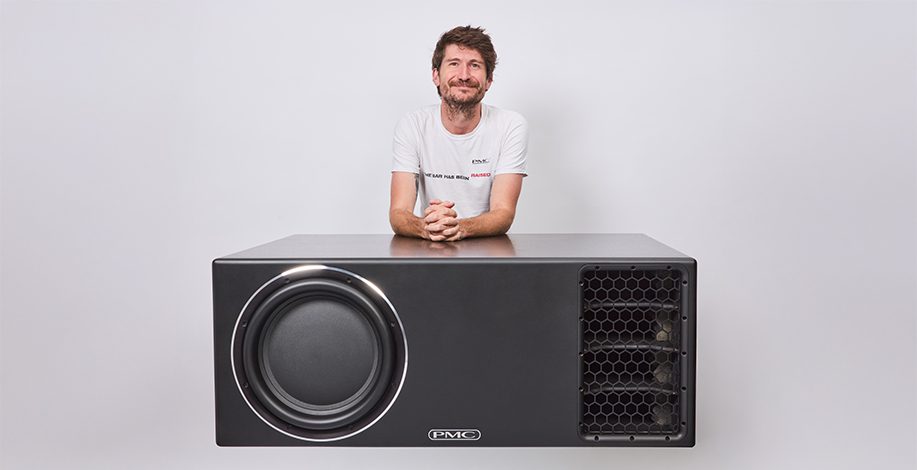
Since its first days as BBC engineers making better monitors for the broadcaster, PMC has long been at the forefront of cutting-edge loudspeaker design. The company adopted the transmission line as an excellent way of exacting a better sound from any size of cabinet from the outset. This has been continually refined to become the Advanced Transmission Line we see today.
These technologies have been joined by developments like Laminair and recently LaminairX. We spoke to the company’s co-CEO Ollie Thomas on how the latest developments apply to loudspeakers like prophecy, and beyond.
With the launch of the prophecy series you’ve also announced several technology innovations, including LaminairX. Can you explain briefly what it is and its history – where did the idea come from.
We’ve just launched this technology with the launch of the new prophecy series of speakers it’s the most significant technological advancement that we’ve worked since the original Laminair. But let’s run through the original first.
We brought Laminair out for the QB1 and the twenty.5 series. It’s visibly identifiable as a number of strokes or fins built into the vent exit of the transmission line so the bit that looks like a port on the front of the box suddenly appeared with these fins in it.
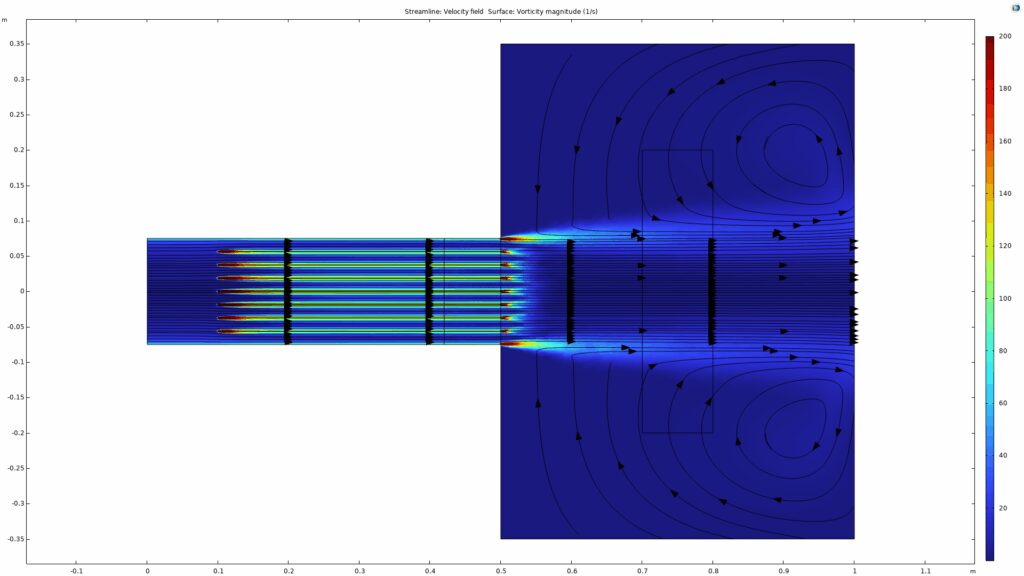
The fins control turbulence, which is what we were targeting in the original Laminair; air flow moving in and out of the transmission line moves at a certain velocity, which depends on how constricting the transmission line is and how much the drive unit is moving.
Above a certain threshold, the turbulence of this air flow moving through a tiny aperture increases to a point which is going to cause problems acoustically. So, having identified that, we set about designing some aerodynamic parts to reduce that turbulence and this is where Laminair came from.
The fins are there to break up that vent exit into multiple smaller channels, which have a larger perimeter and larger surface area within the exit. The benefit of dividing them up is that you can obviously create an infinitely larger area by adding more and more channels. There’s a fine balance between when you put too many channels because it’s too restrictive and you take away all the benefits.
What benefits?
The reason that these fins are channeling the air flow is they bring it back towards laminar airflow conditions (a smooth, unidirectional flow of air, where air moves in parallel layers with minimal disruption or mixing). This is airflow with a low Reynolds number. Air is not moving around in a chaotic manner but it’s a little bit more organised. The best way to think about it is that more of these channels allow more control to build up the air flow. The extra area is slightly more ‘draggy’ but also controlled, albeit in a manner that uses a lot of other aerodynamic principles to measure.
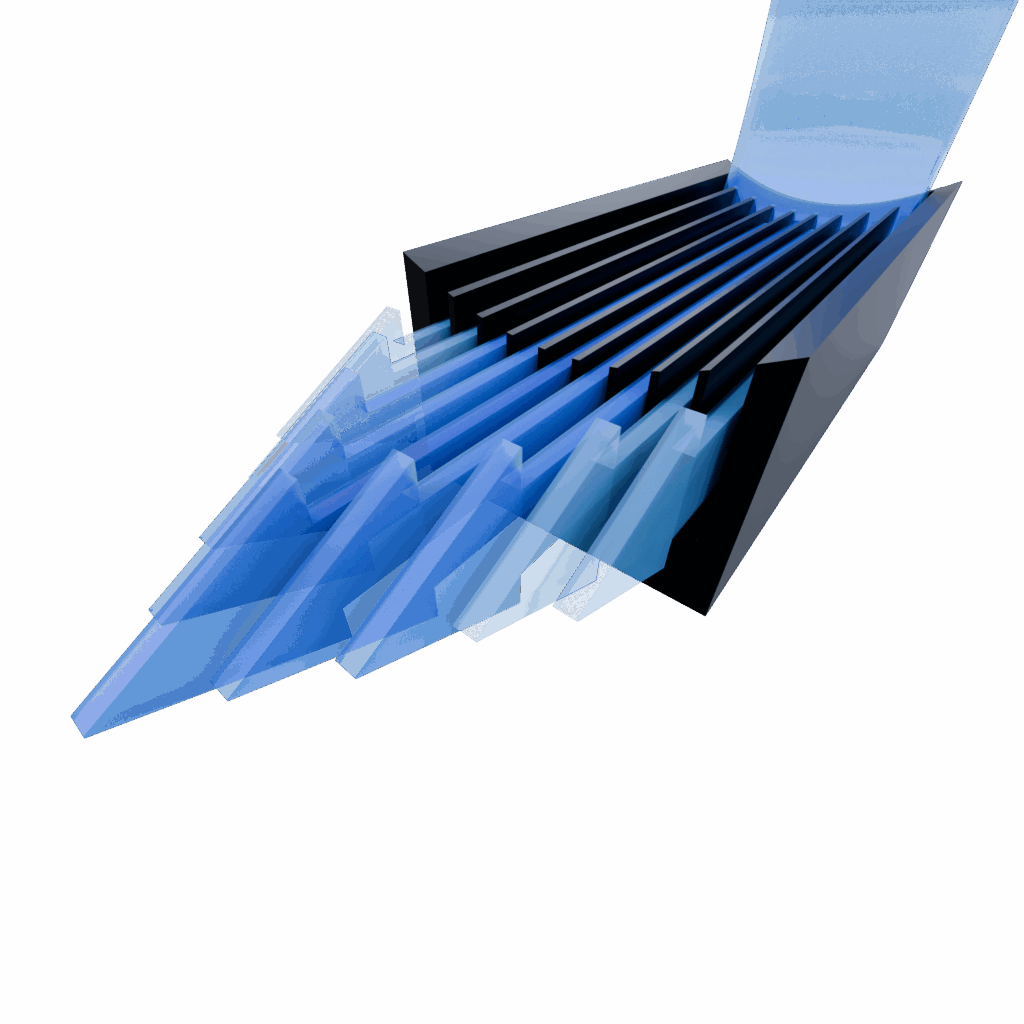
I mentioned the Reynolds number earlier. This is a dimensionless quantity in fluid dynamics that helps predict the flow pattern of a fluid. Essentially, we shoved a load of fins in the twenty.5 and QB1 and we brought the Reynolds number down, which reduced turbulence, noise and harmonic distortion as a result.
Back to LaminairX…
This is probably nine years on since that original release of Laminair. LaminairX describes a more developed version of Laminar. We use a number of simulation software programs to help us visualise that airflow. This give us an idea of what that improvement translates to in terms of reduced distortion and reduce noise. Understanding the principles a little bit better and using these simulation tools we’ve managed to revise Laminair using a parameter called the hydrodynamic entry length. This is a fancy way of saying revising how long those fins are, along with a little bit more development of understanding. For example, the number of channels that you divide in the airflow into plays a much greater role than first expected.
However, the main thing is extending this part without increasing the drag on the airflow allows us to have a fully optimised approach to LaminairX.
Going back to that Reynolds number again, in basic terms, bigger is more turbulent. I think we were floating around 2500 for Laminair, so it pulled the turbulence in the flow down, but it was still behaving quite chaotically. Whereas, if you can get that number below 2000, you feel like you’ve really fully tuned and optimised everything. And that’s where we’re at with LaminairX now.
Is PMC still working with the NPL or is this independent research?
It is purely independent work, all in house at the PMC R&D laboratory. The early work with the National Physical Laboratory was, of course, really useful for testing a proof, and a confirmation of a simulation. You might make a lot of decisions from that simulation, so it’s good to know it is working well.
We still do proof tests where we pull together a simulation. It shows you some stuff, but before you start making design decisions on that, we’ve got to build up some prototypes and actually measure it. Let’s say we run a simulation and what we predict we see, for example a reduction in harmonic distortion. As long as those two figures correlate then you prove the simulation is correct. That was the work we were doing the National Physical Laboratory.
Given the modelling and software technology you’re using, could this project have happened 30 years ago?
We know transmission line theory. It’s a very clever and sophisticated enclosure design that makes PMC speakers so special. Yes, the Laminair function is really focusing on a small part of transmission line design, and it came to us because we are now using higher excursion drive units. With the drive units moving, pressure inside the enclosure translating to faster velocities.
Air at the vent exiting from the enclosure is what made it immediately necessary for us to investigate, because there’s two things that we can prove; the vent noise and harmonic distortion. It’s unlikely we would have been immediately drawn to that being something to do with that air flow through the vent.
However, the vent noise obviously could change. Play like a low organ and that’s much more obvious than measuring a subtle distortion. So for PMC, the application came to us like many engineering things; as a method to solve a problem.
30 years ago, we were seeing greater improvements in the industry by changing materials of drive units and magnet motor assemblies. Tackling an air flow engineering problem 40 years ago, the world of aerodynamics was different. None of the computer simulations existed.
However, it was understood that you could improve flow characteristics with strakes and dividing the channels up. So, we probably would have had a go at it even if we didn’t have computer simulations or the means to accurately model it.
What part did your engineering background before PMC play?
My engineering history (I ‘dabbled’ in aerodynamics ultimately getting involved in cutting-edge racing car design) probably helped us step into this direction.
If you’re developing the aerodynamics of a racing car, there’s three stages of development. You use design simulation, building up a model within a three-dimensional computer generated space. You then prove that that simulation is working correctly by building a model of the car and putting it in a wind tunnel and then using sensors to measure that air flow passing over the body of the car.
Those three stages are the same with speakers; we’ve got our simulation and we then need to measure to make sure the simulation is doing the right thing. We measure those parameters (be that noise or overall speaker distortion) and then put the speaker in an anechoic chamber with a series of measurement microphones in front of it.
The result is we’re getting things like 6dB reduction of the sixth harmonic and 4.5-4dB’s of the fourth and fifth harmonics. So we can measure that and that’s brilliant… but that’s not that third final step. That’s “right, well let’s start the pair of speakers and at home let’s see if that actually sounds like a cleaner bass or mid range.”
Is there a good correlation between what we hear and what we measure?
Yes, but we find there’s a factor that we can’t quite grasp yet. I really like that because that proves that there are other things that we should be figuring out how to measure. Maybe there’s multiple different parameters that we should measure and compare all at the same time.
We could have a series of measurements for whole speaker system and make five different prototypes – one’s got the lowest distortion and the other’s got the smoothest directivity plot – and then you listen to all five of them and you come away thinking, “why does number two sound best when it’s not got the best measurements?” Yeah, that’s exciting.
Is design an iterative process?
If you hear something and you know it doesn’t work but you don’t know why it doesn’t work and then find out why it doesn’t work and fix it… keep going!
Will LaminairX be applied to more loudspeakers?
There’s certain parts of enclosure design and transitional design which we know it probably would not offer the sort of benefits that I’ve been describing and there’s a question mark about whether you need to use it there. But, we are definitely looking at using the technology in a few more new models that we’re working on. This isn’t a technology that is a flash in the pan, it is part of our core PMC technologies that we’re always developing, and at the heart of that is our advanced transmission line theories and now LaminarX, so I think it will be on lots more speakers.
Can you take ATL any further?
It’s a really good question. It would require a simulation of the whole transmission line system… which we’re doing. We’d be using the same simulation software, but there’s far more variables though than just trying to have a look at air flow. You’ve got the air flow moving through the cabinet, you’ve got the cabinet’s mechanical properties, the cabinet’s enclosure materials, the damping factors of those materials and the properties of all of the different absorption material inside the enclosure.
That’s before we look at the moving parts, such as the drive units… so many variables. That sounds incredibly complicated, and our simulations can definitely improve which will lead us to make more creative design decisions.
It also sounds like fun!
Manufacturer
The Professional Monitor Company
+44 (0)870 444 1044
Trending Articles
See all
By hi-fi+ Staff
More articles from this author


Read Next From Blog
See all
Tech Talk: Nigel Bell of Reiki Audio
- Oct 06, 2026
Tech Talk: Nicolae Jitariu of Audiobyte
- Oct 06, 2026
Tech Talk: Wiktor Schulfer of Unitra
- Sep 29, 2026

Tech Talk: Daryl Wilson of Wilson Audio
- Sep 29, 2026