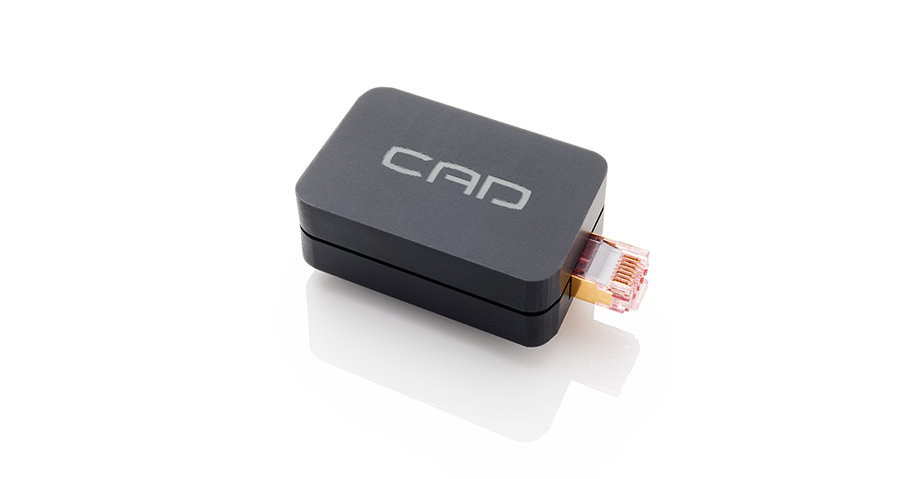
It was perhaps inevitable that the Computer Audio Design company’s focused attention would be directed toward the thorny issue of improving Ethernet connections. Thorny because, as far as most of the world outside the audiophile bubble is concerned, there is absolutely nothing to fix. The CAD Ethernet Control is designed to address this issue.
Digital audio is far from perfect, with opportunities to reduce transmission errors, for example, in bitstreams sent over S/PDIF and even USB audio. However, Ethernet is effectively immune to errors in its bit fidelity. This applies at least when using the most common TCP/IP protocol, which transports data across the internet and within our homes.
Healthy Scepticism
As with my encounters with high-end Ethernet cables, I approached the new CAD Ethernet Control device with a bit of healthy scepticism. This scepticism was tempered by the revelatory experience of hearing previous CAD digital audio products. If anyone could fix what ain’t broke, it would likely be Computer Audio Design.
The CAD Ethernet Control is a small in-line adaptor designed to be inserted preferentially in the final connection at a network streamer’s Ethernet port. Its aim is not to reduce errors or eliminate jitter through some hand-wavy technology. Instead, it aims to reduce unwanted high-frequency noise on the line. In doing so, it improves a system’s overall sound quality. This is not new territory for CAD, of course. Moreover, its Ground Control earthing boxes and USB Control dongle are similarly positioned to provide a passive sink for circulating RF noise.
Larger than thumbs
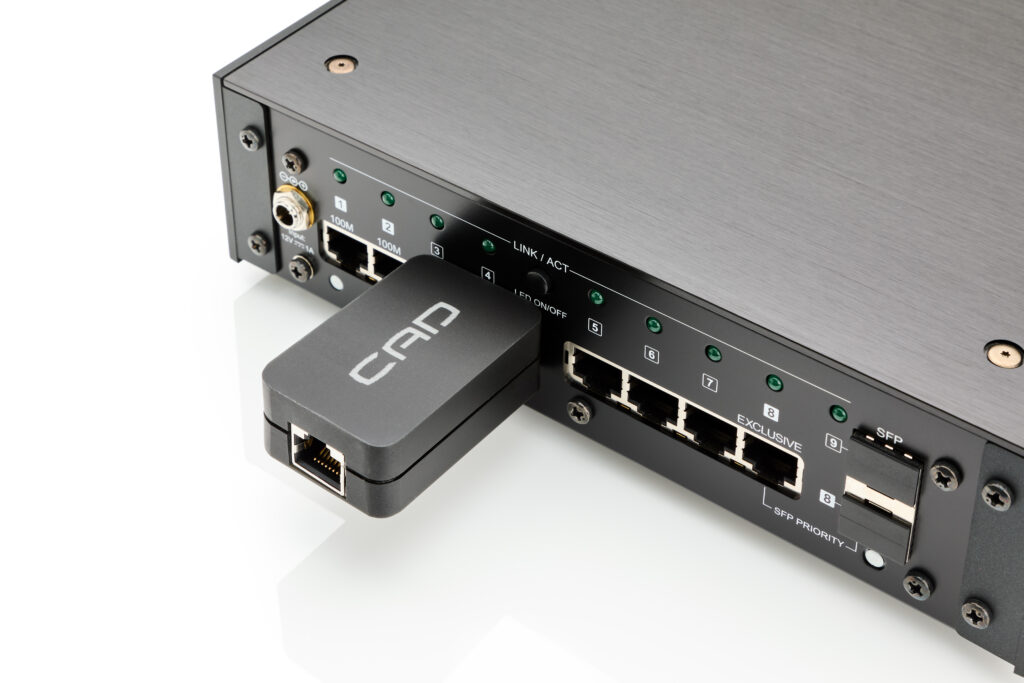
Larger than a familiar USB thumb drive, at approximately 54 mm long, 36 mm wide, and 19 mm high, it may present a problem with some products that have other connections. For example, it wouldn’t fit into my reference Mac mini or Mac Pro without using a small extension cable. Scott Berry of CAD explained that this is not an optimal setup, even using high-quality Cat 6/7 adaptors. These adaptors carry the plug chassis ground from end to end. One workaround is to install the Ethernet Control (EC) on the ‘sending’ side of the cable. This is typically on the router or Ethernet switch.
Another operational issue, at the time of review, is that the CAD Ethernet Control’s plug is 12mm long. This is longer than the minimum length specified in the ANSI standards, which is 11.8618mm. Therefore, it struggles to ‘click’ when mating with some hardware, such as an Apple Airport router. I was assured that this would be addressed during future production.
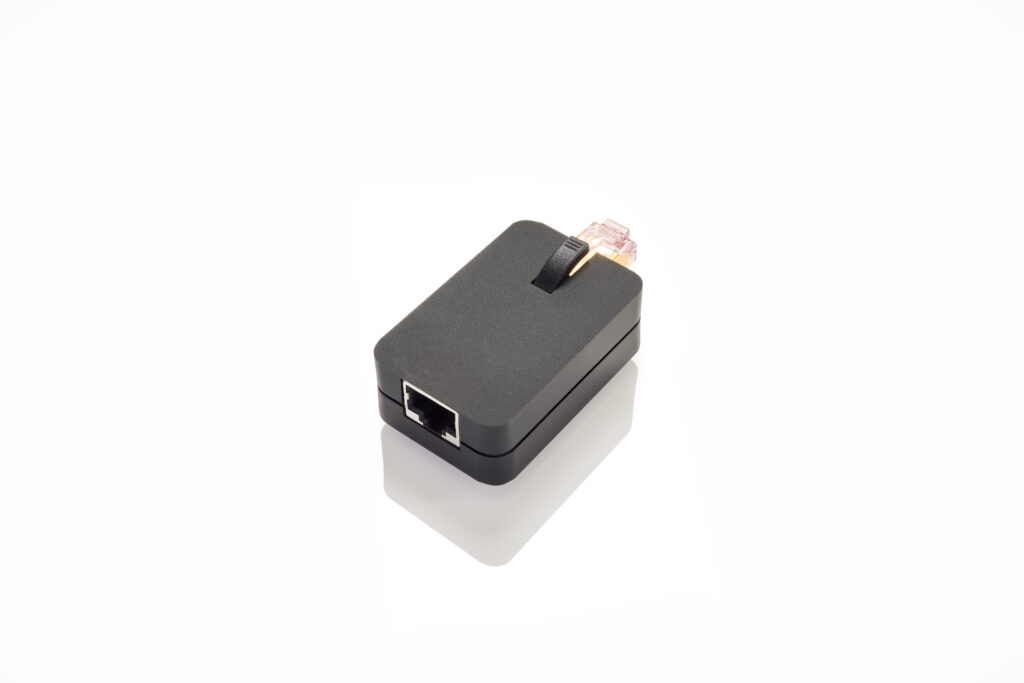
It did fit a Cambridge CXN V2 streamer, which is a relatively budget device. This has sound quality comparable to that of a Mac running Audirvana software. However, to gain a better understanding of the CAD effect with a more representative mid- to high-end streamer, Innuos kindly loaned me a Zen Mini Mk3 with LPSU. Here, the CAD unit would fit one of Zen’s two Ethernet ports, provided that access to the second is blocked.
Sophisticated circuit
The reason for the bulk is a sophisticated circuit board hidden inside the hermetically glued acrylic body. The Ethernet standard already mandates that all transceiver hardware must be galvanically isolated, even the most budget of network switches. However, Scott told me that the Ethernet Control includes several additional custom-made pulse transformers. Each EC device has 127 components per unit. Without divulging much of the circuit for obvious IP reasons, Scott explained that the CAD Ethernet Control employs similar techniques for choke-based noise filtering. This filtering occurs on differential and signal ground lines. It is found in the patented CAD USB Cable, and further refinements have been learned since that original innovation.
Two further technical points are worth noting. While Cat 5, 5e, and even Cat 6 cables are specified to work with unshielded twisted-pair (UTP) wiring, there has been increased use of shielding in modern network cables. This shielding can be individual over pairs or overall over the bundle, or both. Often, these shields are grounded to metal 8P8C (‘RJ45’) plugs. The EC unit appears to lift the plug chassis ground. Accordingly, this may be beneficial in preventing firewall-induced noise. Such noise can originate from the cable shield or an upstream router/switch, consequently reaching the audio product.
Slow and steady wins the race
Secondly, the EC ‘downgrades’ gigabit 1000BASE-T to the 100BASE-TX standard. This is part of the CAD philosophy aimed at reducing RF noise around the audio system. It aims to reduce a PC system’s extremely high clock rates where appropriate. As a result, it reduces other potential sources of high radio-frequency switching noise.
Working with a 100 Mb/s performance is acceptable for high-resolution audio. Stereo 24-bit/384 kHz DXD has a raw data rate of less than 20 Mb/s. However, it may be frustrating if you need to copy terabytes of music files through the device. Fortunately, it can be temporarily removed for such tasks.
The presence of the CAD Ethernet Control was found to bring subtle but tangible changes. It was less obvious than the tonal shading changes that occur when swapping around different cables, for example. However, it presented a more overall relaxing effect on the sound. This can be particularly challenging to pinpoint in any aspect of performance, such as bass weight, dynamics, or timing. Although fine shifts in soundstaging were apparent.
Changes were so pervasively positive yet so elusive that I found myself wondering about the concept of confirmation bias. To objectify the tests, I enlisted the help of an assistant to run single-blind listening tests. With some relief, I found I could spot the presence of the device unsighted in 80% of test runs. This was even when words failed me to explain how I felt, I was experiencing a more natural sound.
Gentle shift
That relaxation can be exemplified by a gentle shift toward a less busy rendering of music. It is a nod toward the creaminess of analogue. More specifically, and without resorting to the ‘darker silences’ trope, it was easier in some cases to hear, for example, the halo of reverberation around a lead vocal.
In continuing to optimise computer audio, CAD has another winner: Ethernet Control. Found to benefit a range of music sources from PCs to dedicated streamers, it’s set to become a highly covetable accessory in the quest to refine high-end digital sound further.
Price and contact details
Price: £1,250, $1,250, €1,450
Manufacturer
Computer Audio Design
+44(0)20 3397 0334
Tags: CAD ETHERNET CONTROL
Trending Articles
See all
By Andrew 'Harry' Harrison
More articles from this author
Read Next From Review
See all
Eversolo T8
- Oct 13, 2026
Acoustic Energy AE Active
- Oct 13, 2026
Reiki Audio SuperSwitch X/Pro X PSU
- Oct 06, 2026
Audiobyte SuperVOX
- Oct 06, 2026