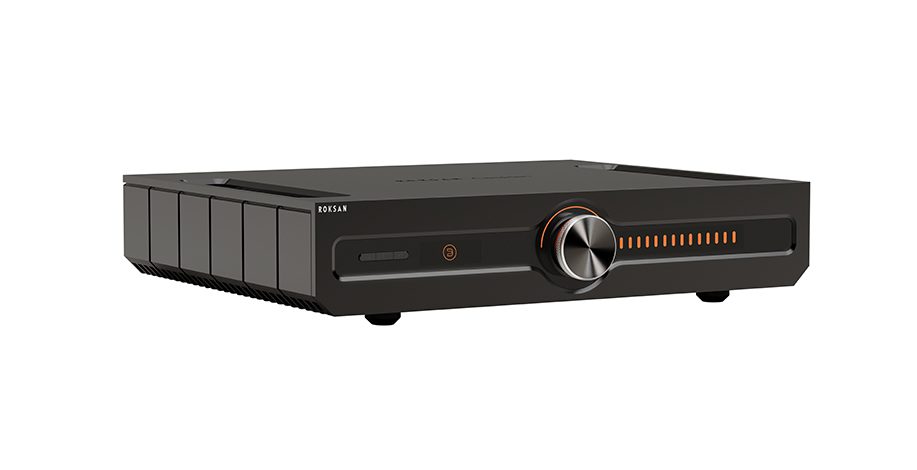
Roksan Audio has been on a journey in recent years. It has been almost a decade since Monitor Audio purchased the company. It has been evolving its product line to support better the range of speakers designed and built alongside their offerings. The key to making Roksan products more accessible (or less unusual, your mileage may vary) was securing a license to use the BluOS platform, developed by Lenbrook Group, as their streaming front end. The result is the Roksan Caspian 4G.
Roksan differs from fellow UK brand Cyrus, which has also adopted the BluOS route, because Roksan has integrated it into its own integrated amplifiers. This effectively turns them into all-in-one systems. This process was first employed in the relatively affordable Attessa amplifier. If this were a proof of concept, it would have been successful because it is the turn of the longstanding Caspian to receive the same treatment. Like the Attessa, you can buy a Caspian integrated amplifier with a selection of analogue and digital inputs for £3,000. However, you can opt for the Streaming Amplifier variant for an extra grand, which effectively requires nothing more than a pair of speakers to function.
Core fitness
BluOS notwithstanding, the Roksan Caspian 4G’s amplifier core is impressive. It’s a class AB device that utilises the company’s Euphoria amplifier system, which employs individual power supplies for the current and voltage amplifiers to target intermodulation distortion. This system can deliver 105 watts into 8 ohms, which almost, but not quite, doubles to 200 watts into 4 ohms. It is controlled via a fully balanced preamp with a single XLR input and a pair of RCA inputs supported by a moving magnet phono stage.
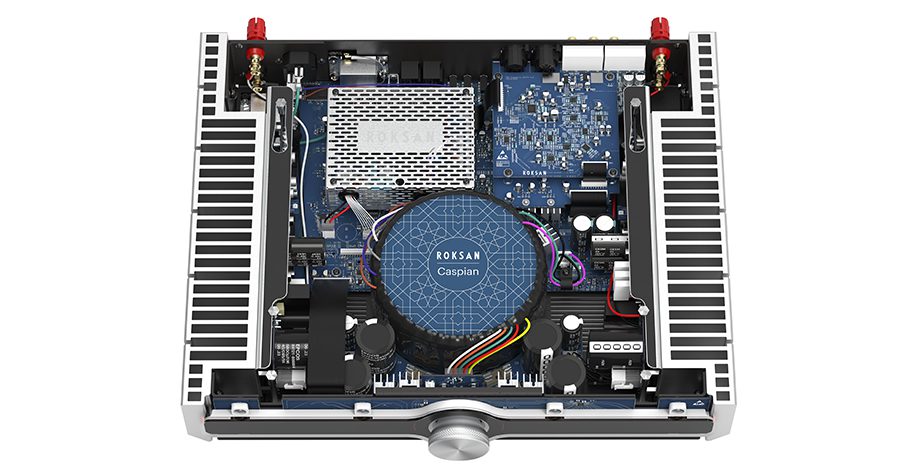
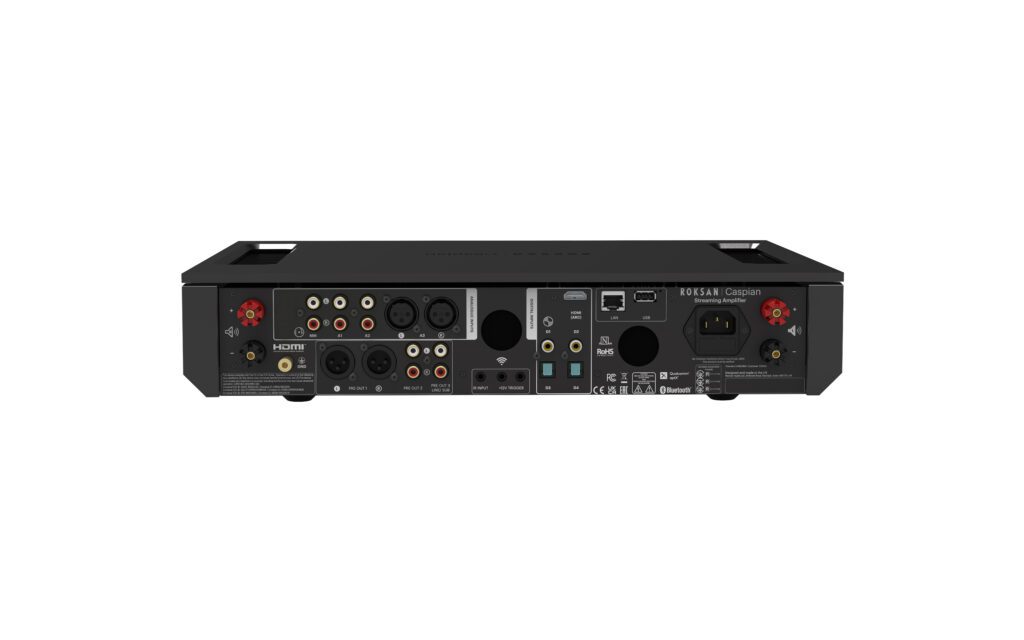
The digital section of the Caspian comprises two optical and two coaxial inputs, supported by both an HDMI ARC connection (not fitted to the ‘normal’ Caspian) and Apt-X capable Bluetooth. This is decoded via the company’s ‘Rapture’ DAC technology, which utilises a differential current-conveyor topology rather than op-amp ICs. Roksan argues that the technology allows for greater detail retrieval.
BluOS
The principal addition to the streaming amp is the BluOS streaming module. This is precisely as you would find it in other BluOS devices, which means it supports PCM up to 24/192kHz (and has the means to convert DSD to PCM in your library so it can be played), along with nearly every music streaming service, except Apple Music. It will happily join a complete household (of up to 63 other devices) and provides a user experience that is one of the most stable and logical out there. As we went to press, the Caspian joined the Attessa in becoming Roon Ready.
Another intriguing feature is the MaestroUnite app. This works independently of the BluOS section, allowing you to set up and configure the Caspian with standby settings, internal tone controls, and bass management, all of which are accessible. While I found this a challenge to get up and running, it has remained stable since then. Roksan is sensible enough to supply a conventional remote handset as well.
Well-finished casework
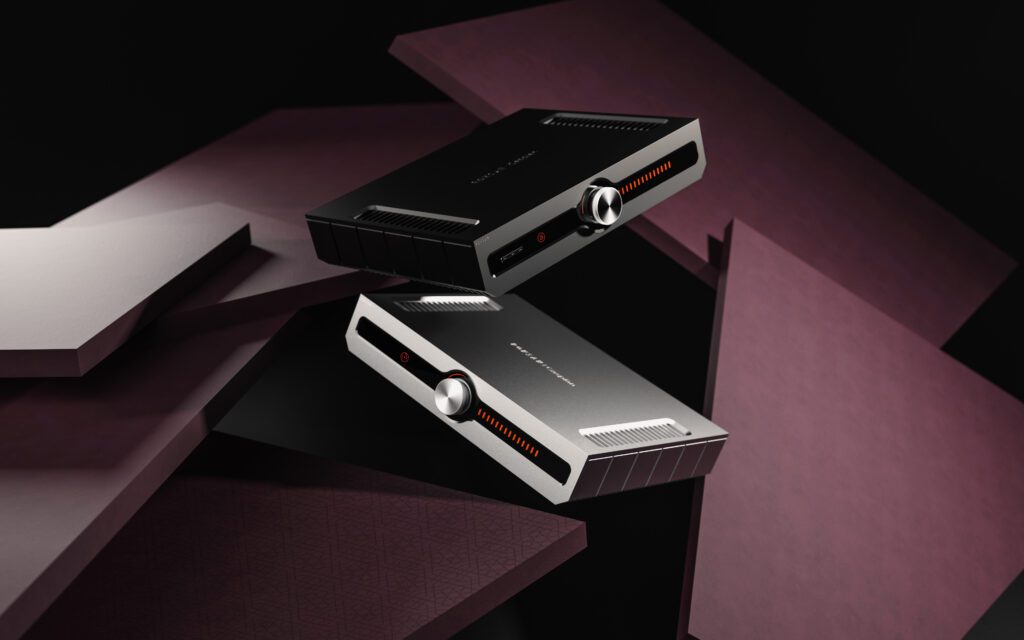
All of this comes in casework that, even judged at four grand, feels solid and highly well-finished. The Roksan Caspian 4G has several touches that would have me running a mile if they weren’t as well implemented as they are. The combined volume control and input selector could have been an absolute disaster were it not for the fact that it works well. I also like the little animated input display (even if I mistook the ‘disc’ emblem of the coax one for the phono stage, which is denoted by ‘MM’, and did a fair amount of troubleshooting to work out why there was no sound). While this amp is a world away from the original Caspian, it manages to maintain a visual identity that is identifiable as Roksan. Black and silver finishes are available, and a matching power amplifier is expected to be released later this year.
I used the Roksan with a pair of Focal Kanta No1 speakers as a rough price comparative option that is usefully revealing. What they demonstrated from the outset was interesting. When I tested the Attessa streaming amp a few years ago, I found much to admire in its functionality. However, it needed to sound more confident to resemble a Roksan product; it could have worn many badges and still been wholly acceptable with all of them.
Novel, yet familiar
Even though the Caspian has some entirely new and novel elements to the design, it sounds like a Roksan and, more importantly, like an amplifier from the Caspian line.
This manifests itself in a sense of consistently unforced music flow that is sufficiently propulsive, so that more exciting and dynamic material doesn’t sound languid or stifled. Listening to the live version of Us on Regina Spektor’s Live in London [Sire], the Caspian is effortlessly able to keep Spektor’s frenzied piano work understandable, and the high-speed changes to her tone and inflexion are easy to follow and utterly convincing. Without ever slowing things down, there is time and space to appreciate a musician giving the piece their all and the space and energy of the venue in which they are performing.
Changing pace
Change the pace and ask for the remarkable Eyelids on Paris Jackson’s Wilted [Dragonflower], and the Roksan never forces the almost funereal pace of the track. It almost revels in Jackson’s duet with Andy Hull, turning both into tangible figures in an open and expansive presentation. The bass on offer is good, too. The Caspian contests a market segment occupied by the Naim Supernait 3 and Rega Aethos. Both deliver seismic low end, which the Roksan doesn’t quite manage, but it still finds more bass shove from the Focal than is often the case.
The good news is that none of the digital cleverness gets in the way of the analogue amp section of the Roksan Caspian 4G being decent. Connecting a Rega Planar 10 with an Nd7 moving magnet cartridge up to the phono stage lets the amp maintain the same admirable qualities as the digital section. It handles Poppy Ackroyd’s Resolve [One Little Indian] with the same flow and fluency as the BluOS module.
Realism
Detail retrieval and tonal realism are genuinely good, and plenty of gain is also on offer. Crucially, it would be good enough to preclude you from using a standalone phono stage for a turntable of roughly equivalent value.
The only blot on the copybook isn’t even Roksan’s fault; the HDMI eARC connection lacks a power on/off function. However, this is a function of BluOS, as it includes commands for volume up and down and mute only, deliberately ignoring the power on/off option. According to BluOS, the power-on/power-off function can be confusing when using multiple sources (not necessarily HDMI-based sources), so the command has been redacted. That said, the jury is still out on whether audiophiles accept HDMI as an audio source. Therefore, turning off a function that few of its core customers will use is no big deal. Everything else on the Caspian is flawlessly implemented; you might feel that Bluetooth has no place on a four-grand amp, but the Roksan Caspian 4G sounds genuinely good via it, and the coax input does a fine job with a Pro-Ject CD Box E acting as a transport.
Dynamic bass
There’s another rather clever technology behind the scenes, too. Lurking in the app is a dynamic bass setting that augments the low end when the amp is used at low levels. You might feel this is artificial (and if you do, it’s easy to turn it off), but it means the Roksan is excellent for use late at night. Similarly, suppose you use a 2.1 speaker configuration for listening. In that case, the bass management (while still using a power amp if you wish) on the Caspian is considerably ahead of most rivals.
What results is indisputably very clever, but no less importantly, very likeable. The Roksan Caspian 4G boasts specifications that compare favourably with both integrated amplifiers and all-in-one systems at its price point. No less importantly, it does this while sounding enough like its ancestors to warrant wearing the Caspian badge. This latest generation of Roksan amplifiers strikes a delicate balance between the brand’s past and the needs of the present, resulting in a very likeable amplifier indeed.
Technical specifications
- Type: Streaming Amplifier
- Analogue Inputs: 2x RCA Stereo 1 x Balanced XLR
- Digital Inputs: 2x Coax 2x Optical Bluetooth Audio, BluOS, HDMI eARC
- Analogue Outputs: 1x Balanced XLR 1x RCA Stereo (1x RCA Stereo
- Amplifier Output: 1x Pair of Speaker binding posts
- Other Inputs / Outputs: Gigabit Ethernet RJ45, W-Fi 5, Wi-Fi 4, BLE, 12V Trigger, Wired IR
- Power Amplifier Technology: Dual Mono Euphoria Amplifier
- Amplifier Class: AB
- Output Power, 8 0hms (235VAC @ 1% THD, both channels driven) 105W
- Output Power, 4 0hms (235VAC @ 1% THD, both channels driven) 200W
- THD+N (1W @ 1kHz Both Channels driven): <0.007%
- Available Finishes: Silver, Black
- Dimensions (H x W x D): 93 x 432 x 378mm
- Weight: 15.5 kg
- Price: £4,000, $5,000, €4,750
Manufacturer
Roksan
+44(0)1268 740580
Trending Articles
See all
Krell Vanguard integrated amplifier
- Apr 07, 2015
Trending Articles

By Ed Selley
More articles from this author

Read Next From Review
See all
Reiki Audio SuperSwitch X/Pro X PSU
- Oct 06, 2026
Audiobyte SuperVOX
- Oct 06, 2026
Unitra WSH-805
- Sep 29, 2026
Wilson Audio Sabrina V
- Sep 29, 2026