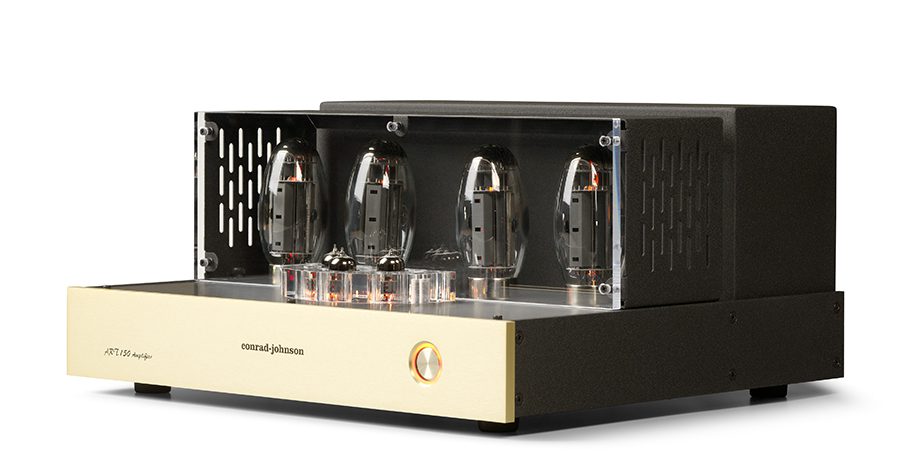
It seems like yesterday, but we reviewed the Conrad-Johnson ART300 mono power amplifiers in issue 173 (published online here). We liked them so much that we awarded them a Highly Commended in our 2019 awards. A follow-up review of the conrad-johnson ART150 stereo power amplifier was planned in 2020, but… well, you know. Other products followed from the brand, but the stereo chassis slipped through the net until now.
The ART150 and ART300 are conceptually very similar. Although the first samples of these amplifiers hit the shelves six years ago, they show no signs of age. Maturity of concept and design, yes. But age? Not a chance.
A good break
Placing a few years between the mono and stereo amplifiers is beneficial because the two designs share many similarities. Looking at one after a few years effectively highlights the other. Those who don’t want to trawl through an issue from six years ago… virtually everything about the conrad-johnson ART150 stereo power amplifier applies to the conrad-johnson ART300 mono power amplifiers. We’ll point out any differences along the way.
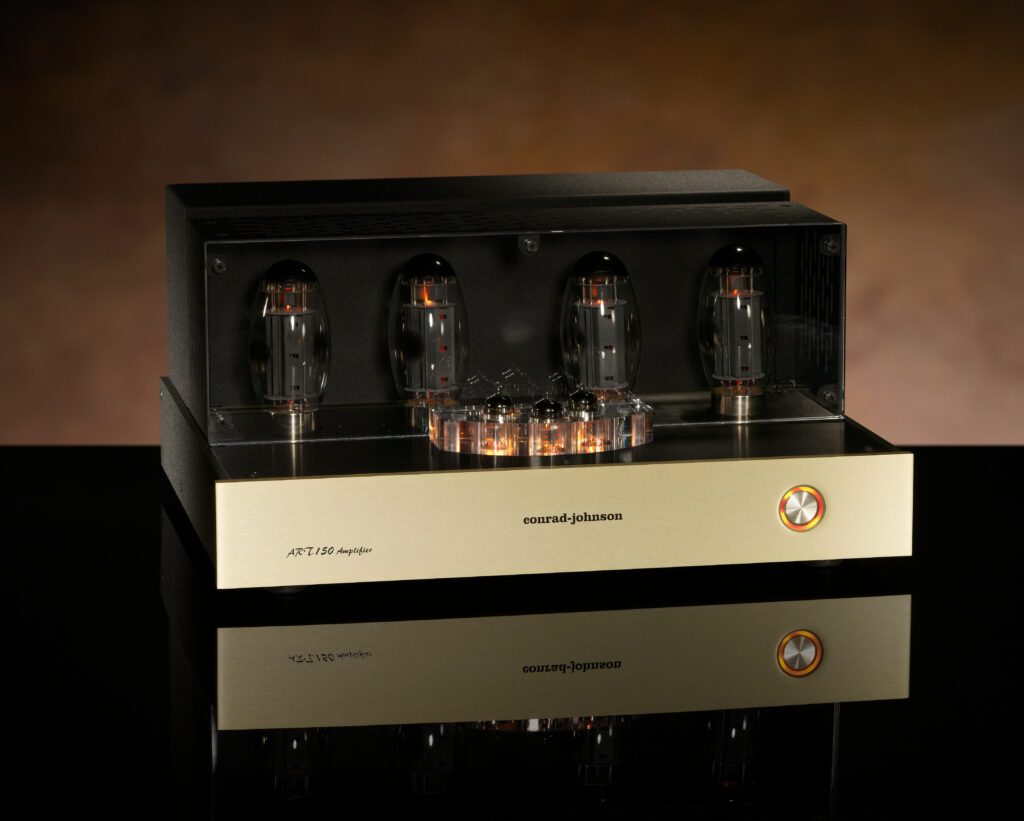
The ART power amp concept is one of the most straightforward concepts. It’s like Occam’s razor of circuit design. It has just a single 6922 double-triode tube as a voltage gain amplifier, a second 6922 per channel acting as a cathode-coupled phase inverter, and then the comparatively new KT150 power tubes. There are two KT150s per channel in the stereo amplifier. There are four per chassis in the mono amp. Aside from the ‘ART150’ on the front panel and the second RCA input and loudspeaker terminal block on the rear, the only visible differentiation between the two is that the ART150 has three 6922 double-triode tubes on the top plate. Meanwhile, the ART300 has two. They have identical-sized chassis, and the ART150 weighs a little over 3kg more than each of the 33kg ART300 mono amps.
Fit and Finish
Everything else, from the fit, finish, and circuit, is the same. Both have a low (about 12dB) amount of loop negative feedback to reduce distortion and increase the damping factor. The two amplifiers bristle with CJD Teflon dielectric capacitors and laser-trimmed metal foil resistors. The design features c-j’s LED bias system because it thinks auto-bias circuits get in the way of the music. CJD Teflons bypass the larger power supply polypropylene capacitors. Separate low-impedance discrete supply regulators isolate the 6922s in each stage to keep the input and phase-inverter clear of the power demands of the output stage.
The single-ended ART150 delivers 150W per channel and has an ideal 100kΩ input impedance. This means that it can use long cable runs. Of course, the preamp must have a suitably low output impedance and gain. While that naturally points the conrad-johnson ART150 toward its ART88 stablemate, it does afford the power amplifier some flexibility in selecting a preamp.
There has been a recent change in the aesthetics of the ART150 over the intervening years; a shift has occurred from an acrylic top plate and grille to a metal top plate with a slatted grille. The images provided are of the older design.
The end of the rose
It’s worth reiterating a finding familiar to all recent c-j reviews. This is not the past! Whenever you mention conrad-johnson to audiophiles, they have a rose-tinted view of a rose-tinted sound. “Aaah,” they enthuse “, I remember that lush, soft sound.” And that lush, soft sound is the c-j sound of two or more generations ago. The ART series has a distinctly different sonic signature. It retains just enough of that tube-like warmth to be appealing. However, it is far faster, more upbeat, and even more forward-sounding than before. No, it’s not a screaming amplifier that barks its music at you, but neither is the over-rich, satiny, soft presentation of the Premier power amps. Yes, they sound lovely… but they sound 20th-century lovely. We’ve moved on, and so has c-j.
I mentioned this in the ART300 review, and because it’s not so much a family resemblance as ‘identical twins’, it’s worth restating here. It’s also worth noting that the findings of the mono amps apply equally here in a more manageable form. Twice the power isn’t quite the ‘flex’ it once was because so few loudspeakers now require a 300W power amplifier.
Like its bigger brother, the conrad-johnson ART150 excels at unforced delivery. It has an effortless sound that is unconstrained by dynamic or soundstaging limitations. The amplifier breathes life into any music it touches. It’s a sublimely transparent amplifier, especially in the midrange and when human voices are involved. Joyce DiDonato’s weapon of a mezzo-soprano is wonderfully rendered with clarity and articulation. It’s not so analytical that you can visualise what she had for breakfast. However, it is detailed enough to render every note, breath, and intonation with great ease.
Expansive
The soundstaging is similarly expansive, with a good balance of image width and depth and great solidity and presence. While c-j amplifiers project into the room well, it never feels artificial. You are simply sitting in the same space as the musicians, and it’s a beguiling experience. The combination of the two – soundstage and midrange detail – leads to a ‘you are there’ sense. It makes you feel as if you could reach out and touch the instruments being played. This is all the truer as you move from the electric to the acoustic.
The ART150’s centre of excellence is its ability to resolve music in a fluid, detailed yet intensely musical manner. Its dynamic range and soundstaging skills all combine to transport you beyond the music and into the minds of the musicians. You even feel connected to the composer. It has all the stability to resolve a single instrument in a three-dimensional space. It has enough in reserve to play huge orchestral pieces in the correct scale. Yes, this is one of the few times you might find the ART300 sounds sweeter, especially when playing a lot of significant orchestral works at ‘gutsy’ levels.
Powerful bass
Bass heads and rhythm nuts have always shied away from c-j tube amps, but that should remain in the past. The conrad-johnson ART150 is no longer that amplifier. Its bass is powerful and profound. It gives an excellent rendition of Trentmøller’s ‘Chameleon’ with great bass force and energy. It also has a great sense of rhythm. Maybe it’s not so fast and frantic to cope with full-on techno or drum ‘n’ bass, but I’m very likely the only person who will ever play such music through a c-j power amp! In fact, the ART150 acquits itself well even with such high-speed bass transients. But, unlike every other performance aspect, a fast, deep, pounding clubby bass line is not c-j’s area of expertise.
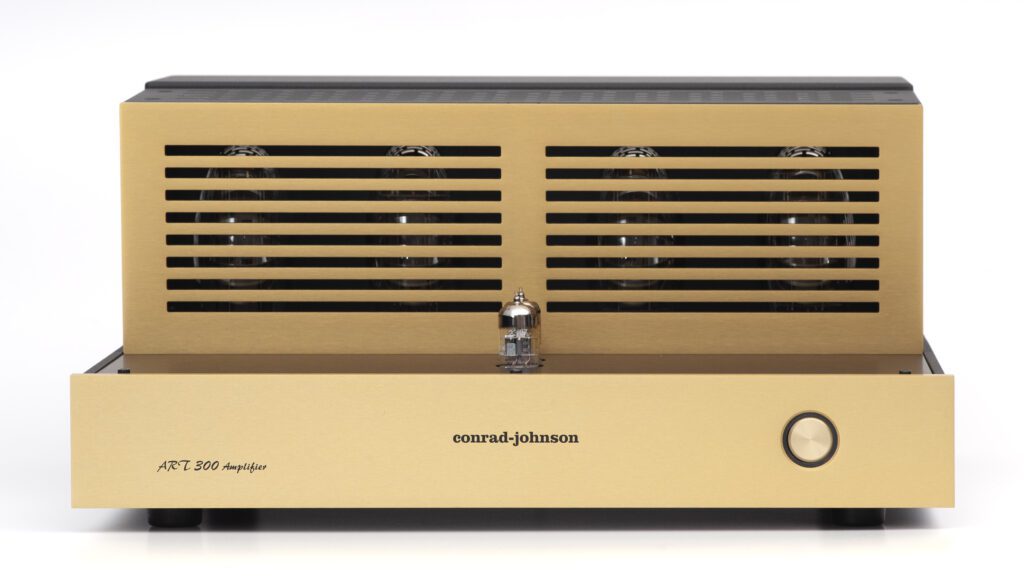
The ART150 is not immune to criticism, but much of that criticism is more about its place in the world than its outright performance. Tonally, it’s not a super-fast, low-power design, but if you want that, conrad-johnson has got you covered with the ART27A tested in issue 190. Due to its lack of balanced circuitry and inputs, the conrad-johnson range probably needs to align more with modern audiophile ideas. However, single-ended has no sonic demerits unless you are trying to cover dozens of metres between preamp and power amp. And some will never be satisfied with anything apart from giant mono amps. However, I’m not even convinced these criticisms hold water; conrad-johnson stands out for the same reasons it has always stood out. It’s iconic, iconoclastic, and sounds excellent.
250 not out!
Conrad-johnson will make just 250 ART150 stereo power amplifiers. Unless you have a loudspeaker that requires a 300W power amplifier or cannot tolerate the idea of not having mono power amps, I don’t see a good reason to buy bigger. This stereo chassis is more than capable of showcasing what the ART88 preamplifier tested in issue 215 can do. It is equally adept with other makes of preamp, as long as they offer sufficient performance.
The sublime grace and charm of the conrad-johnson ART150 stereo power amplifier wins you over. It’s like the ART300 writ smaller. In a world full of silver-fronted amplifiers, maybe it’s time to go for gold!
Technical specifications
- Type: Single-ended tube stereo power amplifier
- Inputs: 1x pair single-ended RCA stereo line-level inputs
- Outputs: 1x pair multi-way loudspeaker terminals
- Tube complement: 3x 6922, 4x KT150
- Power output: 150W rms per channel from 30Hz to 15kHz at no more than 1.5 % THD into 4Ω (also available connected for 16Ω loads)
- Sensitivity: 1.0V rms to rated power
- Frequency Response (at 10 watts): 20Hz-20 kHz, ±0.25 dB
- Hum and Noise: 108 dB below rated power
- Input Impedance: 100kΩ
- Dimensions (WxHxD): 48.3×41.4×22.2cm
- Weight: 36.3kg
- Price: £23,995, $21,000, €22,000 (excl. VAT)
Manufacturer
conrad-johnson design, inc.
UK distributor
Audiofreaks
+44(0)208 948 4153
Trending Articles
See all
By Alan Sircom
More articles from this author
Read Next From Review
See all
Eversolo T8
- Oct 13, 2026
Acoustic Energy AE Active
- Oct 13, 2026
Reiki Audio SuperSwitch X/Pro X PSU
- Oct 06, 2026
Audiobyte SuperVOX
- Oct 06, 2026