Up to 37% in savings when you subscribe to hi-fi+
hifi-logo-footer

Begin typing your search above and press return to search. Press Esc to cancel.

XT-7: a new Italian Soundscape

FIRENZE, Italy: Gold Note – the Italian High-End manufacturer based in Firenze – is introducing XT-7, the new full-range, 3 way speaker with anti-turbulence bass reflex and ribbon tweeter available in Black Glossy, White Glossy, Italian Walnut or Grey Maple.

Link to the webpage: www.goldnote.it/xt-7

With a distinctive curved design based on a reinforced chassis in wooden multilayer panels to control resonances and sound, XT-7 offers state-of-the-art solutions: high quality crossover boards with Mundorf and Clarity components and custom drivers developed with SEAS in ultra-stiff woven polypropylene.

The separated cabinets for bass and mid/highs enhance perfect tuning: the bass drivers cabinet side is vented while the mid/highs is perfectly sealed to reduce internal reflections.
Weighing about 50kg each, these massive speakers are completed by wooden swallow tailed stands that features adjustable spikes to guarantees stability.


Gold Note has recently poured all the technical knowledge gained in over 20 years of OEM collaborations worldwide into the new lines of speakers, created to marry perfectly appearance and substance and provide a fulfilling audio experience.

Garlo Certini, Head of Acoustics, developed a deluxe crossover with state-of-the-art components provided by Mundorf and Clarity. The passive Crossover Low-High Dual-Slope cuts at 280Hz & 3000Hz and features a resistive design to enable ultra-linear load that support the work of the amplifiers minimising the stress on power supplies even at a nominal impedance of 4Ω.

The boards are made of thick audio-grade and anti-resonance glass fibre with 70uM gold plated conductors and power a sophisticated triple crossover network and a summing midrange multi-slope design to perfectly integrate the drivers of the array.

Midranges and Woofers ultra-linear drivers are developed with SEAS and enhanced with proprietary metal chassis produced by MIM [Metal Injection Molding], and refined with radial reinforced low loss rubber surrounds, custom copper phaser and heavy copper rings.


All this technical features are matched by the impeccable finishes and the quality materials used thanks to the skill of one of the most talented Italian carpenters.

Maurizio Aterini, founder of Gold Note, added: “We believe that high end audio equipment should always be executed flawlessly in order to really satisfy all the senses because music is complete experience. That’s the reason why we put so much attention and care inside and outside our speakers.”

XT-7 is available worldwide through Gold Note dealers at a MSRP of 13.500,00€ (pair)

PRESS IMAGES:
https://www.dropbox.com/sh/kecdvikhxyobrcm/AAC5l8RlVDfTl7GM0hQ9qDRZa?dl=0

MORE INFO:
www.goldnote.it/xt-7


FREQUENCY RESPONSE

35 Hz – 30.000 Hz, Dual Slope

NOMINAL IMPEDENCE

4 ohm semi-resistive

SENSITIVITY

90dB SPL (2.83V/1 m)

SUGGESTED MIN. LISTENING POINT

1.5/2.0m

POWER HANDLING

30W – 200W

DIMENSIONS

1110 x 365 x 525 mm (HxWxD) including stand
WEIGHT
100Kg (pair)

About Gold Note: Gold Note (www.goldnote.it) has become one of the leading Italian manufacturers in the Hi-End audio, now with more than 20 years of experience in engineering and designing a complete line of analog equipment, electronics and loudspeakers. Founded in Firenze, Italy, where every product is still hand-built from scratch with high quality materials, its creations are a statement of Italian craftsmanship and innovation appreciated in more than 25 countries worldwide.

Address: Via della Gora, 6 Montespertoli (Firenze) Italy 50025
Phone number: +39 0571 675005
E-mail: [email protected]

AXPONA 2017: Digital Audio and Amplification (Part Two)

Continuing my ‘beat’ covering digital audio and amplification (with an awful lot of loudspeakers, analogue sources, and cables thrown in for good measure), April’s AXPONA event in Chicago is fast becoming one of the main fixtures in the audio world, and is arguably becoming America’s most important audio show in the first half of every year. Given the former significance of CES in January, that’s saying a lot.

The advantage AXPONA holds over the mighty trade event is two-fold; it allows the public to gain access to the latest and greatest audio equipment, and – from a public relations perspective – means new products from audio brands do not get swamped by discussions of wearables, drones, and gadget central.

D Digital’s room was another example of how all-digital rig seems so simple next to the extraordinary analogue rooms. A pair of Mark Levinson No 536 mono’s ($30,000 pr) a Mark Levinson No 519 audio player ($20,000 and on my wish list to review) feeding the mighty Revel Ultima2 Salon2 4-way floor standing speakers ($22,000pr) all connected with a collection of WireWorld Platinum Eclipse and Electra speaker, interconnect and power cables. Simple and high performance. The sound was inspiring!

Superior Audio systems was previewing the new Conrad Johnson Classic 62 KT120 amp. Coming in at £4,750 this tube based beauty offers 60 wpc into 8 Ohms. Feeding the amp was the auranas SRV music server (yes, lower case a). This device has enterprise grade music file protection and can play virtually any bit rate or format of music file. Running off an intel i3-4130T 4th generation Haswell chip is a slim 395mm x 225mm x 40mm. The system was powering a pair of Vandersteen Treo’s so I felt right at home!

The Cardas room featured an all Zesto Audio system driven by the beguiling Eros 300 Monoblocks Class A power amp ($19,900 Pr) and Leto 1.5 Pre-amp ($7,500). Speakers were the Marten Coltrane Tenor’s ($80,000) The Merrill Williams Audio REAL 101.2 turntable ($7,200) with Benz Micro Gullwing SLR MC Cartridge ($3,600) fed the Zesto Andros Tessera tube phono stage ($12,000). Stillpoints Ultra 6 feet ($899 ea), ESS42-26-5 Rack and Cardas Audio cables completed the system. This was one of my top rooms for sound quality at the show. Clear three-dimensional sound with terrific detail made this room a bit of an audio oasis compared to many of the rooms that presented significant sonic challenges to the gear. An excellent job by all parties in this room.

Lars Kristensen of Raidho fame is always one of the friendliest exhibitors. Even on a last day of a show he is in a great mood. Of course, if you get to listen to systems of the quality he does you would likely have a smile all day too. The mighty Aavik C-300 digital pre-amp/DAC ($36,000) fed the Aavik M-300 monoblocks ($48,000 ea) into the Raidho D-1.1 stand mount speakers ($23,000). The system had incredible imaging and instrument placement. The dynamics of these stand mounts was amazing. After a few minutes of the typical audiophile music someone handed him a CD or Rammstein’s Mutter (German heavy metal!) and the system rocked out.

Fidelis Music Systems had a stealthy Digital aspect to their seemingly all analogue room. The Zero-Uno DAC Plus ($9995) is a tube based DAC that could have easily been mistaken for a Phono Pre. Music was sourced from an Aurender N10 server ($8,500 with 8TB) It was feeding files to the VAC Sigma 160i Special Edition 85wpc ($14,000 + $2,200 for MC phono stage). Speakers were the Diapason Adamantes III ($6,599 pr) speaker cables were 3 Meter Tellurium Q Black Diamonds ($4,200 pr) Also featured was the Acoustic Signature Ascona MK2 Turntable ($32,995) and Acoustic Signature 12” TA 9000 Tonearm ($17,995). I was impressed with the Adamantes III’s delivery from the VAC integrated. As a tube fan this was a fun and well-coordinated system.

ExaSound was premiering their e32 DSD 256/DXD 32 bit DAC ($3,499) and e38 Multi channel DAC ($3,849) alongside the high value PlayPoint network audio player ($1,999 with Roon installed). The PlayPoint and e32 were feeding a Parasound A21 power amp ($2,500). Speakers were the Magnepan 3.7i’s ($5,995pr). Talk about bang for your buck. This was a high-performance system for an all in $14,000 USD. If you are looking to go digital ExaSound needs to be on the short list.

Audio Research was being presented by Quintessence Audio on the 12th floor. The Sonus Faber Il’Cremonese speakers were filling the very large room being powered by the Reference 250 Monoblocks and fronted by the Reference line of DAC’s and Pre-amps. The new toys were the VT80 amplifier producing 75wpc running KT120’s ($7,500), the DAC9 ($7500), the LS28 Linestage ($7500) and the PH9 Phonostage ($7,500) making up the new Foundation series. Aesthetics were sharp and very Audio Research.

Another Quintessence room featured Simaudio Moon driving the new Dynaudio 60 speakers ($10,000pr) The 780D DAC/Streamer ($15,000), 850P Pre-amp ($30,000) and the 860A 200WPC amp ($15,000) provided great power and grip on the Dynaudio’s. This was another top room for me. I am a fan of Simaudio Moon gear and Dynaudio has a hit on its hands with the Model60’s.


Any time Pass labs has a new amp it is news. Their new XA25 stereo amp puts out 25wpc and comes in at a more affordable price point ($4,900). Pass Labs amps have a history of producing power beyond their rated specs. The goal of the XA25 is to allow people to buy a Pass Labs amp at a more affordable price point. The design goal was to never compromise on the quality Pass is renowned for. The display was static so I hope to listen to it soon.

George Vatchnazde the Proprietor of Kyomi Audio always has a fun and terrific sounding room. The big Vivid Audio Giya G1 Series II speakers ($68,000) have a unique shape and a wonderful sound. Driving them were the big Jadis JA200 MK II Tube Mono amps ($33,900 pr) Digital audio was handled by the imposing MBL 1621 CD Transport ($28,000). TechDas Air Force, Graham Elite, Koetsu and Ortofon handled analogue. Cables were all from Stealth and stands from Artesania. This was a high-performance room and another top sounding room for me at Axpona!

Vladimir Lamm can build amps. That’s what I have heard. His Model M 1.2 Reference Mono’s run 110 watts in Class A! ($27,590 pr) The 1.2’s and the LP 2.1 Pre-amp ($8890) were driving the Gershman Grande Avant Garde G2 speakers ($12,999) Digital was supplied by the Oracle Paris CD 250 player ($3320). Oracle Tables and a Corinth Reference cartridge were also on hand. All cabling was via Nordost Valhalla. This was my second time listening to the Gershman speakers each time driven by Lamm electronics. It is now a regular stop for me. The sound was full and inviting. This straight forward system was another top room for me.

The Callia DAC/Headphone amp from Prism Sound (£1,795) was reviewed by Hi-Fi+ last fall and it was my first time hear it in the US. Paired with an active pair of ATC speakers via its XLR outputs. Given Prism’s 30+ years of Cambridge based pro audio history it was no shock to hear the clear mixing board honesty coming through the ATC’s. Mark Evans explained that the Callia was first shown in July of 2016 in the UK with 2017 CES as its American debut. Given its flexibility as a Pre-Amp/DAC/Headphone amplifier it can be the digital hub everyone could find some room for in our homes.


Hegel was showcasing their new Mohican Redbook CD Player ($5,000). Named so because it is likely the last CD player they will ever make. It was paired with their highly regarded H160 integrated 160 wpc ($3,500) and the terrific KEF Blade 2’s ($22,000) Cabling was all by Nordost. Comparing the sound of Tidal via streaming the Mohican had far more body and clarity on the same Ray Charles track. A no contest win for the Mohican.

The GamuT Audio room as usual was staffed by GamuT Audio lead designer Benno Baun Meldgaard and US distributer Michael Vamos of Audio Sky’s from LA. There was nothing new in the room but it was the most significant listening experience I enjoyed at the show. Sporting the GamuT RS7i speakers ($39,999) and 250 Monoblocks ($25,500 pr) The D3i Dual Mono Pre-amp ($8,250) Benno hooked up an RS62 Revox Reel to Reel and a new Tape pre-amp card inside the D3i. He put on a tape of Pink Floyd’s The Wall after hours and a group of us sat in candle light for the entire album. The sound was astounding. Having heard the album countless times, it was by far the single best presentation of it I have ever experienced. Opportunities like this are rare and cherished. By virtue of this experience the GamuT room is my top room for this year’s Axpona. Well done GamuT Audio!

Aavik’s more affordable room swapped out the Monoblock/Pre-amp for the Aavik integrated amp ($30,000) and the Raidho’s for Scansonic MB5 speakers ($6,950). With the room price dropping 80% in cost the sound barely diminished at all! The Aavik Integrated crunched out a clean 300wpc and the MB5’s were happy to receive the power. Soundstage and instrument position were spot on and virtually holographic. I expected excellence from Aavik. I was pleasantly surprised by Scansonic. Trickle down tech from Raidho indeed!

Constellation has filled a gap in their lineup with the new Revelation Series. Starting with the 250 wpc Taurus amp ($19,500 or Mono @ $39,000 pr), the Pictor Pre-amp ($18,000) and the Andromeda Phono Pre ($18,000) the new line was paired up with Martin Logan Renaissance speakers ($25,000) MIT Cables and Continuum Audio Labs Turntable with Viper Tone Arm and an Ortofon A95 cartridge rounded out this auspicious debut.

Bel Canto has been working for some time to develop an integrated version of the much-awarded Bel Canto Black system. The new C600 Black Integrated ($25,000) is an Integrated, DAC, Streamer and more. It is a gorgeous Black with Red all in one box bringing 300 wpc into 8 Ohms. Add speakers, in this case the Martin Logan Expression ESL’s ($15,000) and Nordost cables and you are ready to play. The system while simple was a wonder to hear. I am hopeful for a review sample!

A show this large presents a challenge to report on everything. I have touched on many of the personal highlights of this now largest audio show in North America. Hat’s off the Steve Davis and his team for a most successful event and best of luck with the move next year to the new venue, the Renaissance Hotel in Schaumberg, Illinois!

AXPONA 2017: Digital Audio and Amplification (Part One)

The Axpona (Audio Expo of North America) show in Rosemont Illinois has become the largest Audio show in the US. Occupying 8 floors and 140 rooms the show dominates the Westin O’Hare for a three day show the third weekend in April every spring. HiFi+ brought the team together from the US and the UK to bring the show to you in our collective coverage. My assignment was amplifiers and digital front ends with an emphasis on new gear and best sounding rooms. Three days is not enough to cover everything! Some prices were not posted and full rooms make questions a challenge. If I missed something, my apologies. The pen was flying and my camera is now cooling off after the frenzy.

The first room up was the Scaena/PS Audio room feature a full PS audio rig and the new Scaena tower speaker featuring the full force sound of their $116,000 USD flagships coming out of their new $56,000 USD speakers. The Digital front end consisted of the PS Audio DirectStream DAC ($6,000 USD) and the new DirectStream Memory Player ($6,000 USD) which connects to the DAC via an I2S Connection. The output fed into the PS Audio BHK Pre-Amp ($6,000 USD) and then to the PS Audio BHK 300 Monoblock amplifiers. Gear was plugged into PS Audio P10 Power Regenerators ($5,000 USD) The sound was full and musical in the very large room. It was a satisfying start to the show!

The Skogrand cables room featured their Vivaldi speaker cables and interconnects along with the Wagner power cables. They were hooking up the ModWright Instruments KWA 150 Signature Edition amplifier, SWL 9.0 Anniversary Edition Tube Linestage ($2899), Reference PH150 Tube Phono Stage ($7,900) and Oppo Sonica DAC & Network Streamer Tube Modified ($3,300). Speakers were the mighty Daedalus Poseidon V2’s. While I am focusing on Digital front ends Turntables (The new VPI Rosewood Prime Signature) and Reel to Reel (J-Corder 1520) were everywhere at the show. Skogrand, ModWright and Daedalus regularly show together and the room sounded great. The new Sonica DAC ModWright mod makes for a very affordable and high end digital solution

Merrill Audio was showing their Christine reference Pre-amp ($13,000), Jens Reference Phono Pre ($15,449), Veritas Monoblock Class D amps ($12,000 per pair) and their ANAP XLR ($1,049) interconnects and ANAP speaker cables ($1,049). Digital front end was an ESS Labs DAC2x ($15,500) and Aurender N10 music server ($8,500 with 8TB). Music was delivered by the German Physiks Borderland MK IV speakers ($36,500). I am a fan of Merrill amps. Anyone who has preconceived notions of harsh and Class-D need to leave them at the door. This system was clear and tuneful. The Aurender N10 is a digital champion for music serving.

Wells Audio was showing their Majestic integrated amp ($3,499) and Innamorata Signature 150wpc at 8 Ohms amp ($15,000) with Salk Speakers Exotica 3’s ($12,999) and Exogal Comet DAC. Sound was precise and full. The Innamorata is an extraordinary amp with a black background and very low noise floor.

Monitor Audio brought in Pass Labs XA 160 Mono’s and XP 20 Pre-amp along with a Simaudio Moon 650D CD/DAC to pair with their excellent PL300 II speakers. It was a simple but elegant system.


Synergistic Research and Scott Walker Audio brought a host of high end gear to show off their room treatments and other sonic legerdemain. Constellation amps fed by A Berkeley Audio Design Reference DAC were complimented by the Synergistic Research Galileo UEF Cables, Room treatments and PowerCell 12 UEF SE all feeding a pair of Magico S5 mkII speakers. The demo was impressive!

The smaller Paragon Sight and Sound room featured Nick Doshi previewing his new Tube stereo amp featuring a quad of KT150’s for 75wpc into 8 ohms ($15,995). It is expected to be released in September. His Monoblocks were driving a pair of Wilson Audio Yvette’s ($25,500).  The systems digital front end was the dCS Rossini DAC ($23,999) and Clock ($7,499). Transparent Reference speaker cables were also used ($8,745). Nick and Paragon were doing their best to contain some difficult room boom. Despite this I enjoyed the demo and the synergy between components.

The big Paragon room features Wilson’s…The Man, David Wilson and a pair of his son Daryl’s latest creation, the Alexx ($106,000 per pair) While this was displayed last year I had not seen them driven by a QUARTET of D’Agostino momentum monoblocks running 1600 watts at 4 Ohms! Steampunk at full power! The mighty dCS Vivaldi stack ($120,000) drove the digital front end. As expected the sound was full and powerful. For a total system price nearing $400,000 it was as impressive as you would expect.

CH Precision is another high performance Swiss audio company that is beginning to gain a US following. This room featured their I1 Universal Integrated Amplifier (100 wpc into 8 Ohms) factory fitted with a Digital in board, 2 RCA and 1 XLR inputs and an XLR stereo pre-amp output. ($38,000 as configured) the unit has multiple configuration options via a variety of input boards. Their D1 SACD player/DAC ($38,000) was fronting the system that was feeding a pair of Magico S1 mk II ($16,800) speakers. The sound was excellent with full bass and clean clear highs.

Aurender was featuring their new A10 Music server/DAC ($5500) Powering the system was the GamuT Audio DI 150 LE Integrated amplifier with 180 wpc into 8 Ohms ($12,990). Speakers were the highly-regarded stand mount Gamut RS3i’s ($20,990). This is a simple and fantastic sounding system. The A10 has both a high performing DAC as well as a music server that is like their N100 server. It is a serving/streaming one stop shop that takes full advantage of their iPad app for music control. I went back a couple of times to listen in here!

The Vinnie Rossi LIO is a modular triumph in sound and quality. Here is the tricked-out model which includes the Direct Heated Triode front end. Sporting the Phono Pre, DAC and 25wpc amplifier modules this version of the LIO comes in at $11,675. Paired with the 40th anniversary model Harbeth Super HL5Plus at $7495 and Triode Wire Labs cables the sound was truly three dimensional.

I am stretching things with this room as it is really an analogue room and the amp is not new but The Music Direct room had terrific sound courtesy of the Focal Sopra No.3’s ($19,999). Fueled by the Balanced Audio Technology VK-655SE ($16,495) and the Marantz SA-10 SACD player ($6,999) the room really delivered. I suppose the AudioQuest cables, Shunyata power devices and Spiral Groove Revolution TT ($24,000) and Koetsu Blue Lace Onyx Platinum cartridge ($14,995) may have been useful too. Good work by Jonathan Derda and the Music Direct team.


Brian Zolner was demonstrating the new M12 Source Controller ($15,995) and M5 Network Player ($2000) feeding their M28 Monoblocks ($15,000 each). Speakers were the Tidal Piano Diacera’s. The soon to be released M5 can be used by any system to add streaming capabilities. Also on display was their new M15 stereo amp ($18,000) bringing most of the M28’s punch and finesse to a single box stereo solution. Oyaide Cables and Stillpoints isolation gear completed the strong presentation. The sound was precise and musical.

The Kubala Sosna Research room featured Mola Mola’s marvelous Class-D amps and the wonderful YG Acoustics Carmel 2 speakers ($24,300) connected with the Kubala Sosna Research new flagship Realization cables. Another simple room with great sound from an easy high performance system.

The Auralic room featured the recently reviewed Class-D Integrated amp/DAC/Streamer Polaris (£3,499 issue 145) fronting the YG Acoustics Carmel 2’s. The Polaris may be a more affordable device however, as pointed out in the review it is fully capable of driving high performance speakers with aplomb. The soundstage was large and precise. A fun room to be sure!

Wyred 4 Sound, a California based solid state affordable audio form was showcasing their 10th anniversary SX-1000R Class-D monoblocks 625wpc into 8 Ohms ($1,799 each) and their DAC-2v2SE DSD DAC ($4499) feeding the terrific Acoustic Zen Crescendo’s ($22,000). The Crescendo’s are known to be a clean and accurate speaker. The Wyred 4 Sound amps have been gaining recognition for their high performance regardless of amp class. This was, for me, one of the best sounding rooms at the show. With Tony Holt from Wyred 4 Sound and Robert Lee of Acoustic Zen both available to answer questions it I witnessed both responding to the inevitable “Class-D can’t be that good” comments. Hearing was believing!

The Audiophile Direct room featured Wells Audio’s terrific Majestic Reference Integrated amp ($14,000 150wpc at 8 Ohms) and Benchmark DAC2 DX ($1,995) with Music Vault Diamond music server ($4,995 w 16 gb RAM & 500 gb SS hard drive) fronting the excellent Aurum Cantus V3M 2 way stand mount speakers with pure aluminium tweeters ($2,000) all connected with a variety of Dana Cables. Another simple yet outstanding sounding room The Music Vault was a nice find serving up the files for this digital based system.

Who likes a bargain? Who likes one that also sounds terrific. That is the big deal in the ELAC/Audio Alchemy room. Since combining forces last year the synergy between Andrew Jones and Peter Madnick is on a roll. ELAC’s terrific Discovery Music Server ($1099) comes with Roon installed. Paired with the Audio Alchemy DPA-1M Mono’s ($1995), PS-5 Premium power supply ($595), DMP-1 Digital Music Player ($1795) ELAC Adante AS-61 stand mount speakers ($2500pr) AudioQuest cables and Shunyata Denali D6000T Power conditioner ($4995) and power cables the system was affordable, attractive and reasonably compact. I am anxious to see where they go from here!

Magnepan Magneplanar .7 floorstanding loudspeakers

“Hey, come here! You have to hear these things!” So said one of my friends in our early audio days. “These” turned out to be the Magnepan Magneplanar Tympani full-range quasi-ribbon big-as-a-room-divider flat panel speakers from decades ago. Walking into the room at the audio dealer, my first thought was “where are the speakers?” Instead I was looking at something taller than me, thin, and three-panels wide, like I would find splitting up the Sunday school rooms at church, except they were producing an incredible sound. Walking behind them there was still sound. Amazing. They were less than 3cm thick. Driving home that day I knew I needed to get some time with these speakers from Magnepan. I just did not realise it would take 30 years. But that’s the point with Magnepan: the best things come to those who wait.

One of the other things making my unfulfilled long time listening goal so crazy is that I live within three hours of the factory in White Bear Lake, Minnesota, a suburb of Minneapolis. When I got the call that I would be reviewing the .7’s, rather than wait for the delivery van I simply called Wendell Diller, Marketing Manager of Magnepan and asked him if I could come by and collect them. Little did I know I would get a full factory tour from Wendell. Talk about one of the perks of the business! While he was showing me around we went into the production area where they applied the aluminum ribbon to the diaphragms. He broke off a foot-long piece of ribbon and said “Hold out your hand”. I did so and he dropped it into my palm. It weighed basically nothing. I could see it but I could almost not feel it sitting there. It’s 1/10 the thickness of a human hair, and under normal circumstances no ribbon material this thin and light could withstand the pressures of being a speaker driver. However, when applied to a Mylar diaphragm suspended in front of magnets it work wonders with sound. It is this ribbon-based, very low mass, non-boxed approach that imbues the Maggie’s with incredible air and dimensionality. As I discovered when I got them home, I had not heard anything yet.

The last few pairs of speakers moving through my man cave were classic tower or floorstanding box designs. Some weighed in at over 50 kg apiece. Even with stands attached, the Magneplanar .7’s come in at a svelte 12 kg. At a height of nearly 1400mm, this was a change, and a welcome one too as the Maggie’s do require some patience in proper placement. Anyone who has spent a few days fine tuning the positioning of 100kg or more of loudspeaker boxes will relish the idea of a loudspeaker that weighs so little. The Magnepan .7’s tweeter is located on one vertical section of the entire 1400mm height. Sold in mirrored pairs, you can set them up with tweeters on the inside or outside depending on room size and listening preference. You are also recommended not to place Magnepans parallel to the rear wall. Instead, they are to be toed in (angled ‘outside forward, inside to the back’) and away from walls to allow the panel to radiate, using the walls as reflective surfaces. So, a bit of experimentation was in order. My final positioning was with the tweeters to the outside placed about 2.3m apart and my listening chair centre equidistant in front. Rear walls were 1m away from the closest speaker point.

Magnepans are reputed to require lots of power. One dealer I have visited only shows them with large wattage amps. Wendell said to try any amp and see how it went. So I started my listening with my Cary SLI-80 tube integrated in 40-watt triode mode and began with James Taylor’s October Road [2002 Columbia, 16/44.1 AIFF]. The title song is a sweet acoustic guitar-centred ballad in the classic James Taylor style. The .7’s were up to the task; James was in the room and had a substance I do not experience with many speakers. The track, however is not a demanding one for low frequency notes. It was, rather, in the sweet spot for the .7’s whose bass extends to about 45Hz. Larger Magnepans with greater surface area will dip into the mid-30Hz range or even down to 25Hz for the mighty flagship 20.7’s. However, I do not have the room for a speaker that large. With this style of music in a mid-sized room the character of the .7’s was very pleasing and offered a strong first impression.


Moving on to something with more kick in the low end, I chose Steely Dan’s ‘Babylon Sisters’ from Gaucho [1980 MCA HDTracks 24/96 AIFF]. The driving low bass notes throughout the song were there, but without the authority I am accustomed to. I switched the amp into Ultralinear mode at 80 Watts and the solidity improved. Still, I was beginning to understand where music types and genre’s along with amp pairing and room size made a more significant difference with these smaller paneled quasi-ribbon speakers. Moving on then to the PS Audio BHK250, I upped the game to 500 watts into 4 Ohms. Steely Dan was back in a good way with the extra power and current. The .7’s opened up much more, and the crisp and authoritative bass was nearly perfect in my smaller listening room. In addition, I was enjoying an almost holographic listening experience as the famous Magnepan dimensionality appeared right in front of me.

Having found the performance sweet spot of power and placement I went for the classic Magnepan experience; female vocals. Reaching into the depths of the music collection I pulled out Linda Ronstadt’s What’s New with the Nelson Riddle Orchestra. [1983 Elektra/Asylum DVD Audio 202 Warner Strategic Marketing]. The title song is a standard style torch song with massed strings and horns. Whether it is Holly Cole, Lyn Stanley, or Linda, the experience of feeling like you are in the front table at the club sitting a few feet away from the singer is, for me, always a special one. The sense of presence was exceptional. The scale of the backing orchestra was powerful yet properly controlled when placed in a supporting role for a single singer. I seized the opportunity to listen to the entire disc with this chain of excellent audio gear.

Knowing that a high-end Class AB amp paired well with the .7’s I looked around for another amp to try. Sitting in their boxes waiting to be shipped back were the Bel Canto Ref600M Class-D mono’s. 600 Watts into 4 Ohms fit the bill perfectly. I pulled them out of their boxes and put them into the system along with the companion DAC 2.7. If you are a fan of acoustic guitar you must spend time with Tommy Emmanuel. He uses the guitar as a percussion instrument as well creating a sound that is nuanced and unique. His album Center Stage (2008 Favoured Nations CD Rip 16/44.1 AIFF) offers up ‘Mombasa’, a sonic performance that takes the guitar and turns it into a drum kit and seemingly two guitars playing at the same time. I have heard this live, and it it is wonderful. You could not comprehend one person was doing everything you were hearing. However, having it reproduced on the Magnepan .7’s with the Bel Canto gear was a close second, and that makes this an exceptional audio experience.

While this is a single product review I have to comment on the synergy of the two Minnesota based brands; Bel Canto, and Magnepan. For a system that comes in at under £10,000 to sound this fantastic and to be as practical from a living space point of view is terrific. Small home owners need never look with wistfulness on their friends’ ‘Audiophile’ system again. This is not a compromise at any level. It is music.

Tradeoff’s? Magnepans will not blow your neighbours off their porch, and the Magnepan .7 being the smallest of them all is no loudspeaker for a headbanger. Also, large orchestral works will not bloom to their maximum in the lowest registers. Both of these issues can be mitigated with Magnepan’s DWM bass panels. For most music, however, the delivery will have a spaciousness and dimensionality to be savoured, so yes, “Come Here, you have to hear these things!”

The Magnepan .7’s are an exceptional value! Most highly recommended.

TECHNICAL SPECIFICATIONS

Type: Two Way Quasi Ribbon

Frequency Response: 45-22kHz +/- 3dB

Sensitivity: 86dB/500Hz /2.83v

Impedance: 4 Ohms

Dimensions (W×H×D): 387mm × 1378mm× 32mm

Weight: 12 kg each

Price: £1,995 per pair

Manufacturer: Magnepan Incorporated

URL: www.magnepan.com

Distributed in the UK by: Decent Audio

URL: www.decentaudio.co.uk

Tel: +44(0)5602 054669 

Meet Your Maker – Neat Acoustics

250 miles north of London, near where the Yorkshire Dales meet the North Pennines, is the delightful Teesdale town of Barnard Castle. The town’s largest employer is the pharmaceutical giant GlaxoSmithKlein. With a team of just six in its own factory, one of Barnard Castle’s smallest employers is Neat Acoustics. Six people including the boss is fairly typical for mid-sized loudspeaker makers, but Neat is not a typical loudspeaker maker. It may sound like cliché, but Neat is truly born out of sheer music making passion, the kind that is almost unheard of in the audio industry.

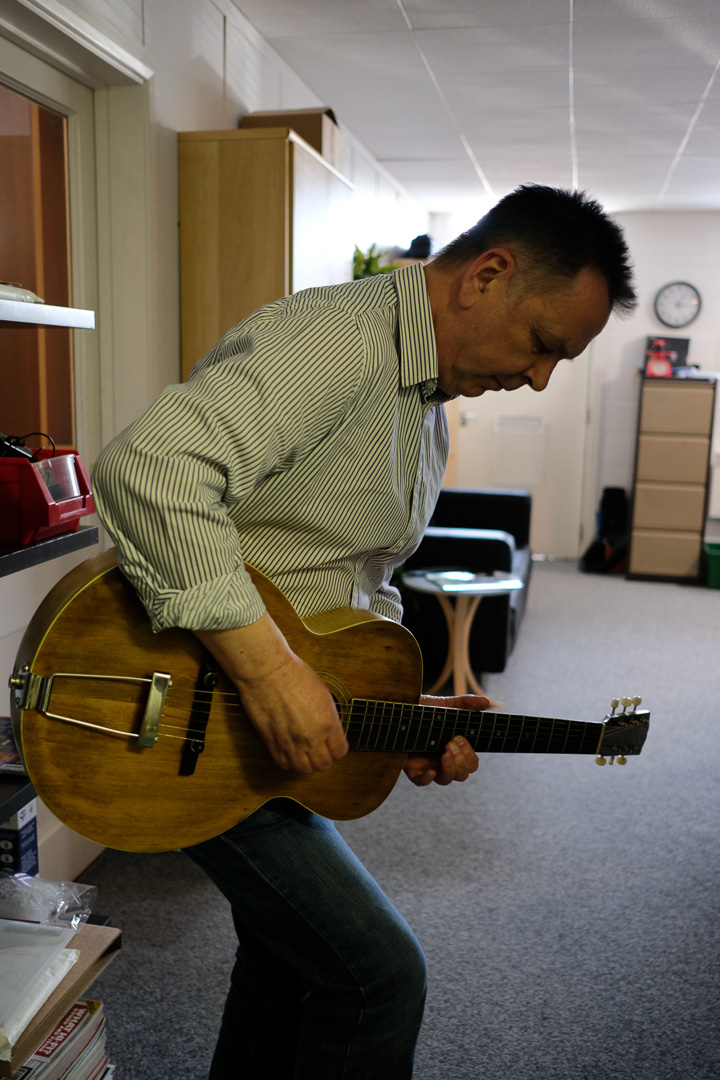
Five of those six workers in Bob Surgeoner’s factory are practicing musicians, and the one exception is Chris, who is learning to play the guitar, at the tender age of 65.  “It was a co-incidence that all of us play. When we went looking for staff, they just happened to be musicians themselves.” Discussion in the factory gets animated whenever music is discussed, music is a constant companion in the factory, and while we were at the factory, almost a third of the workforce clocked in and out early because they were performing at a gig later that evening in Newcastle. This was not an atypical day. The walls of the factory are festooned with musical instruments (not as objet d’art, working instruments used both by Bob in his other life as a folk musician, and in the recording studio used by local artists). Neat even has its own label (Splurge Records) although it currently has just three records to its name.

Music runs like a red thread through every product Neat makes too, from the smallest Iota to the largest Ultimatum; the products are designed more as a result of careful listening tests with a varied musical programme than by the usual cycles of objective testing and measurement. The latter is not dismissed, but the most important consideration in making a good Neat Acoustics loudspeaker is music first, last, and always.

Yet, for a brand so intrinsically linked to music, Bob is the first to question the effectiveness of such a development process. “I’m not really sure if being a musician is a benefit in designing loudspeakers. There’s some research to show musicians fill in fundamental parts of the music in compensation,” he says, “and that’s not a good thing.” But Neat seems to have risen above simply making loudspeakers by musicians, for musicians. “Listen to any of our speakers and there’s something non-hi-fi going on that’s still very musical,” says Bob. “Obviously I would think that, but others comment similarly, even when they don’t know I’m a musician.”

I suspect a lot of this comes down to the evaluation process. “I play a lot of acoustic instruments (guitar, double bass, piano), and some colleagues play electric. There’s a kind of mini-committee here,” meaning they all listen to the latest speaker developments, from a diversity of musical styles. And that rubs off on the loudspeakers themselves.

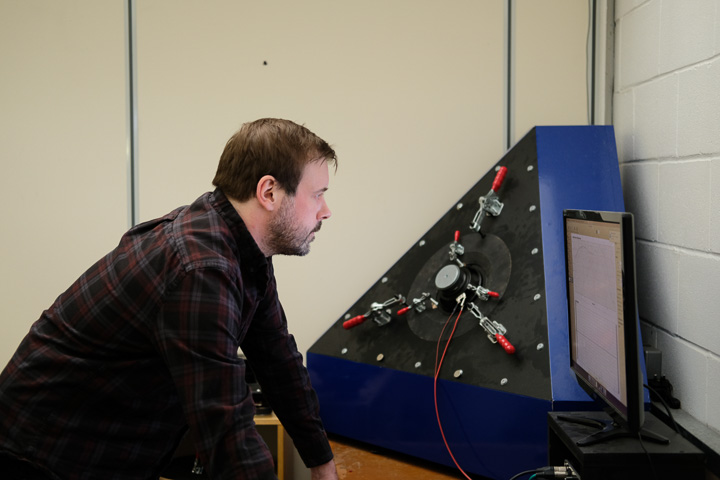
That’s not to say the company is entirely free from technological development. The company uses a specially made corner anechoic chamber for driver testing and development, and works closely with a range of loudspeaker driver manufacturers to deliver custom-made versions of drive units to meet Neat’s exacting specifications. But those specifications are more to do with how the end result sounds musically than how it performs on the test bench. Because, ultimately it reflects what a loudspeaker has to do for a living – make music sound good. “We tend not to work in a theoretical way”, says Bob Surgeoner, “we tend to work intuitively.” “Because we’ve been using the same drive units in combination for some time, design is more of an iterative process.” It’s about finding the right part – the Peerless bass unit we use in Motive wouldn’t work with the Ultimatum, and the custom-made unit in the Ultimatum isn’t as good as the off-the-shelf model for the Peerless when used in the Motive. It’s all about context.

The brand makes four distinct lines, all of which have a combination of music-driven sonic direction and a refreshing sense of Northern British pragmatism, that makes even the most expensive loudspeaker in the range – the Ultimatum XL10 – still cost less than a few metres of the more outré loudspeaker cables. At the other end of the scale, products like the excellent diminutive Iota Alpha floorstanders came about as a result of Bob wanting a loudspeaker that could fit into his small living room. Music is something to be shared and enjoyed by as many people as possible – not simply an elite – and the affordable nature of Neat’s lines reflect this.

The speakers are all hand-assembled at one of three workstations at the centre of the factory. The Iota might be comparatively new, The Motive, Momentum, and Ultimatum lines are refined, latest iterations of designs dating back to the 1990s. Many are deceptively designed: the Momentum SX3i for example looks like just another a rear-ported two-way standmount mini-monitor, but the mid-bass unit is isobarically loaded, with a second midbass unit behind the front bass chamber. This combines to deliver bass that is as fast and as communicative as most two-way standmounts, but as deep as a multi-way floorstanders. With typical understatement, Neat doesn’t shout about this. “All we do is get the speakers to sound like we think they should sound, and working backwards from there.” Says Bob. “It seems to work, so far – we haven’t been caught out massively yet!”

Tucked away in one of the more remote parts of the North of England, Neat Acoustics remains one of the audio world’s best-kept secrets. These are not loudspeakers that sell thanks to elaborate bling, wide baffles, or multiple drive units… they sell because the sound good to people. While Bob is self-effacing to the point of shyness and that is reflected in the looks of the product, the sound itself is first rate. We hope to be evaluating more Neat loudspeakers in the near future.

Questyle Audio Engineering CMA600i headphone amp/preamp/DAC

More than many manufacturers of high-end audio electronics, Questyle is an engineering-driven firm led by the talented audio technologist Wang Fengshuo (whose anglicised name is Jason Wang). Thus far, Mr Wang’s greatest single contribution to music arguably involves his evolutionary development and refinement of ‘Current Mode Amplification’ (as opposed to the far more commonly seen voltage mode amplification)—a circuit topology that Questyle applies in personal audio devices and other audio components both large and small. Two good examples would be the firm’s excellent QP1r digital audio player reviewed in HiFi+ issue 129 and the spectacular, award-winning, four-chassis Gold Series reference stack, reviewed in Hi-Fi+ issue 137.

Many consider Questyle’s ‘Golden Stack’ to be the finest all-around headphone amp/DAC system on the planet, which comes as no surprise in light of its somewhat stratospheric £10,096 price tag. But if the Golden Stack offers ‘ceilings unlimited’ performance at a cost-no-object price it also forces us to ask what high performance alternatives are available to serious music lovers who are constrained by relatively ‘earth-bound’ budgets? Happily, Questyle has an answer in the form of its new CMA600i headphone amp/preamp/DAC, which sells for the reasonable sum of £1,199.

Given the huge price disparity between the Golden Stack and the CMA600i, you might assume the junior model had to drop features or cut corners in order to achieve its more manageable price, but that isn’t the case at all.

First, the CMA600i incorporates a full-featured DAC section based on the excellent 32-bit AKM AK4490 DAC chipset supported by what Questyle terms “a unique 3X clock structure” plus a “newly developed switch capacitor filter ‘OSR Doubler’ that greatly reduces sound degradation from noise shaping, achieving a flat noise floor up to 200kHz.” Questyle further claims that the AKM DAC helps reduce jitter and pre-ringing “to undetectable levels.” In keeping with past Questyle design practice, the CMA600i DAC section not only handles PCM files at resolutions up to 32/384, but also can play DSD64/128/256 files via so-called ‘True DSD’ decoding, meaning the Questyle does not require DoP (DSD over PCM) processing, but rather “accepts the DSD bit-stream directly from your computer.” The DAC provides an optical S/PDIF input, a coaxial S/PDIF input and output, and a USB Type B input.

Second, the CMA600i headphone amplifier section uses Questyle’s patented full balanced, Class A Current Mode Amplification circuit, as patterned after the amplifier section of the firm’s flagship CMA800R headphone amplifier (reviewed in Hi-Fi+ issue 133). The CMA600i headphone amp produces remarkably low distortion figures (<0.00034% distortion) while also offering a generous amount of power (220mW @ 300 ohms or 950mW @ 32 ohms in single-ended mode and twice that or more in balanced mode). The headphone amp provides dual single-ended outputs (via two 6.35mm headphone jacks) and a balanced output (via a 4-pin XLR jack).

Finally, in a rarely seen design touch, the CMA600i incorporates two separate and independent amplifier sections—one designed to power your headphones and the other optimised as a preamplifier circuit to drive power amplifiers or self-powered loudspeakers. Like the headphone amp, the preamp also sports both single-ended outputs (via stereo RCA jacks) and balanced outputs (via stereo 3-pin XLR jacks). Both the preamp and headphone amp share common inputs, including a stereo analogue input, plus the aforementioned combination of S/PDIF and USB digital inputs.

Completing the picture is Questyle’s traditionally very high quality of build, featuring precision CNC-machined chassis panels including 10mm thick aluminium top and bottom chassis plates, with assembly techniques said to yield, “stable heat (dissipation characteristics), excellent control of sympathetic vibration, and excellent shielding from RFI/EMI radiation.” Significantly, Questyle has the chassis of the CMA600i made by Foxconn, the Chinese precision manufacturing house perhaps best known for constructing Apple’s vaunted iPhones. Extremely high-quality parts, such as Nichicon FG and WIMA capacitors, DALE resistors, an ALPS motorised potentiometer, and a Plitron toroidal transformer are found within. Last but not least, the unit ships with a remote control that provides volume up/down, mute, and digital filter switching functions for the CMA600i (the same remote can also control several other Questyle products).

The question many will ask now is just how close the CMA600i is able to come to the sound quality of the Questyle’s upper end models. In fact, the CMA600i does an almost shockingly good job of channelling many of the defining sonic characteristics and much of the sonic performance of the Golden Stack in a very compelling way.

All the expected Questyle sonic virtues are present and accounted for in the CMA600i. There is the firm’s even-handed tonal balance, effortless speed and definition, very high levels of transparency and detail, and above all a quality of ample but always agile power on tap (subjectively speaking, there’s more power on hand than the unit’s output specifications would seem to promise). The result is an amp/DAC that has an uncanny knack for elevating the performance of most any headphone you might care to try.


During my tests, I used the CMA600i with a broad range of top-tier headphones including the ENIGMAcoustics Dharma D1000, the Focal Utopia, the HiFiMAN HE1000 V2 and Edition X V2, and the MrSpeakers ETHER Flow. At every turn the Questyle seemed to form an immediate, symbiotic relationship with each of these top-tier models.

As I listened through the HiFiMAN Edition X V2 to bassist Dean Peer’s gorgeous and multi-layered album Airborne [ILS Music, 16/44.1], for example, I was struck by the way the CMA600i helped tease out the depth, punch, and subtle modulations of lower notes sounded from Peer’s electric bass. Compared to other amp/DACs I’ve heard, the Questyle seemed to offer heightened levels of bass extension, control, and pitch definition coupled with a rich, full-bodied presentation. At the same time, when Peer explored the upper reaches and high harmonics of his bass, the CMA600i played right along, serving up heaping helpings of midrange tonal purity and textural finesse. Finally, in reproducing the sound of accompanying percussionist Bret Mann’s drum kit and cymbals, the Questyle again nudged the Edition X V2 headphones to higher heights, enabling them to capture the beautifully recorded top-end shimmer of the cymbals, the snap and bite of the snare drum, and the taut, ear-popping thwack of the kick drum. Best of all, the Questyle helped the Edition X V2 achieve a wonderfully spacious, outside-the-head rendition of the album’s spatial qualities. Across the board, then, the CMA600i took an already excellent headphone and made it sound even better.

Similar good things happened when I tried the CMA600i with Focal’s revealing flagship Utopia headphone. Listening through the Focal/Questyle pair is like experiencing the sonic equivalent of Superman’s famous X-Ray vision; suddenly, subtle details and nuances in recordings that might ordinarily be lost are instead drawn to the surface and made plain as day. As a result, each listening experience brings new discoveries. For instance, on multi-mic’d studio recordings the Questyle/Focal pair lets you know that, even in well-made recordings, certain instrumental or vocal tracks may be of distinctly higher quality than others. In fact, there’s so much resolution on tap that the Questyle not only helps you hear qualitative differences, but also to understand exactly how and why one track sounds better than another.

It would be tempting to call the CMA600i ‘hyper-revealing’, but for the fact that it so deftly avoids the sorts of cold, sterile, and almost medicinal qualities that afflict some audio components. On the contrary, the Questyle focuses on digging out and delivering the emotional content in recordings. Just try listening to the bluesy track ‘You Don’t Know Me At All’ from R&B artist Bettye Lavette’s comeback album The Scene of the Crime [Anti Records, 16/44.1], and you’ll experience the forceful and at times raw-edged sound of a powerful vocalist who has spent decades overcoming obstacles and setbacks in order to have her music heard. Lavette’s voice combines equal parts frustration and pain tempered by sheer grit and determination, with a skosh of hope thrown in for good measure and the Questyle delivers this heady mixture with full force and with tonal colours intact.


Many would agree that it would be a fine thing to own Questyle’s magnum opus Golden Stack system, if only their wallets were willing. However, for those of us whose fiscal ships have not yet come in, the reality is that the firm’s brilliant CMA600i amp/DAC offers perhaps 85-to-90% of the big system’s performance for about 1/10th the price—an equation that spells unbeatable musical value in any language.

TECHNICAL SPECIFICATIONS

  • Type: Solid-state, balanced output headphone amplifier/preamplifier/DAC featuring patented Current Mode Amplification technology
  • Digital Inputs: One TOSLink optical input (16-24/192), one coaxial S/PDIF input (16-24/192), one USB Type B input (16-32/384 PCM, True DSD64/128/256, DoP64/128)
  • Digital Outputs: One coaxial S/PDIF output
  • Analogue Inputs: One stereo analogue (via RCA jacks)
  • Analogue Outputs:
  • Headphones: Two single-ended (via 6.35mm headphone jacks), one balanced (via 4-pin XLR headphone jack)
  • Preamplifier: One single-ended (via RCA jacks), one balanced (via dual 3-pin XLR connectors)
  • OS Support: Win XP, Vista, win7, Win8, Win 10, and Mac OS
  • Digital Filters: PCM via switchable IIR (MP) and FIR (LP) filters, DSD uses no filters
  • Frequency Response, headphone amp:
  • DC – 100kHz (+0/-0.7dB); DC – 600kHz (+0/-3dB)
  • Distortion: Headphone amp: THD+N: 0.00057% @ 1kHz, with power output of 950mW @ 32 ohms; 0.00034% @ 1kHz, with power output of 50mW @ 32 ohms
  • Preamplifier: THD+N: RCA <0.00082%, XLR <0.00064%
  • SNR: Headphone amp: 113dB
  • Preamplifier: RCA >105dB, XLR >121dB
  • Headphone amplifier output:
  • Single-ended: 220mW@ 300 ohms, 950mW @ 32 ohms
  • Balanced: 630mW @ 300 ohms, 1900mW @ 32 ohms
  • Accessories: Remote control, CD with USB driver support
  • Dimensions (H×W×D): 55 × 330 × 300mm
  • Weight: 3.2kg
  • Price: £1,199 (UK), $1,299 (US)

Manufacturer: Questyle Audio Engineering

URL: www.questyleaudio.com

UK Distribution: SCV Distribution

URL: www.scvdistribution.co.uk

Tel.: +44 (0) 3301 222500

North American Distribution:

Questyle Audio North America

URL: www.questyleaudio.com

Tel: +1-702-751-9978

Back to reviews 

Read more Questyle reviews here


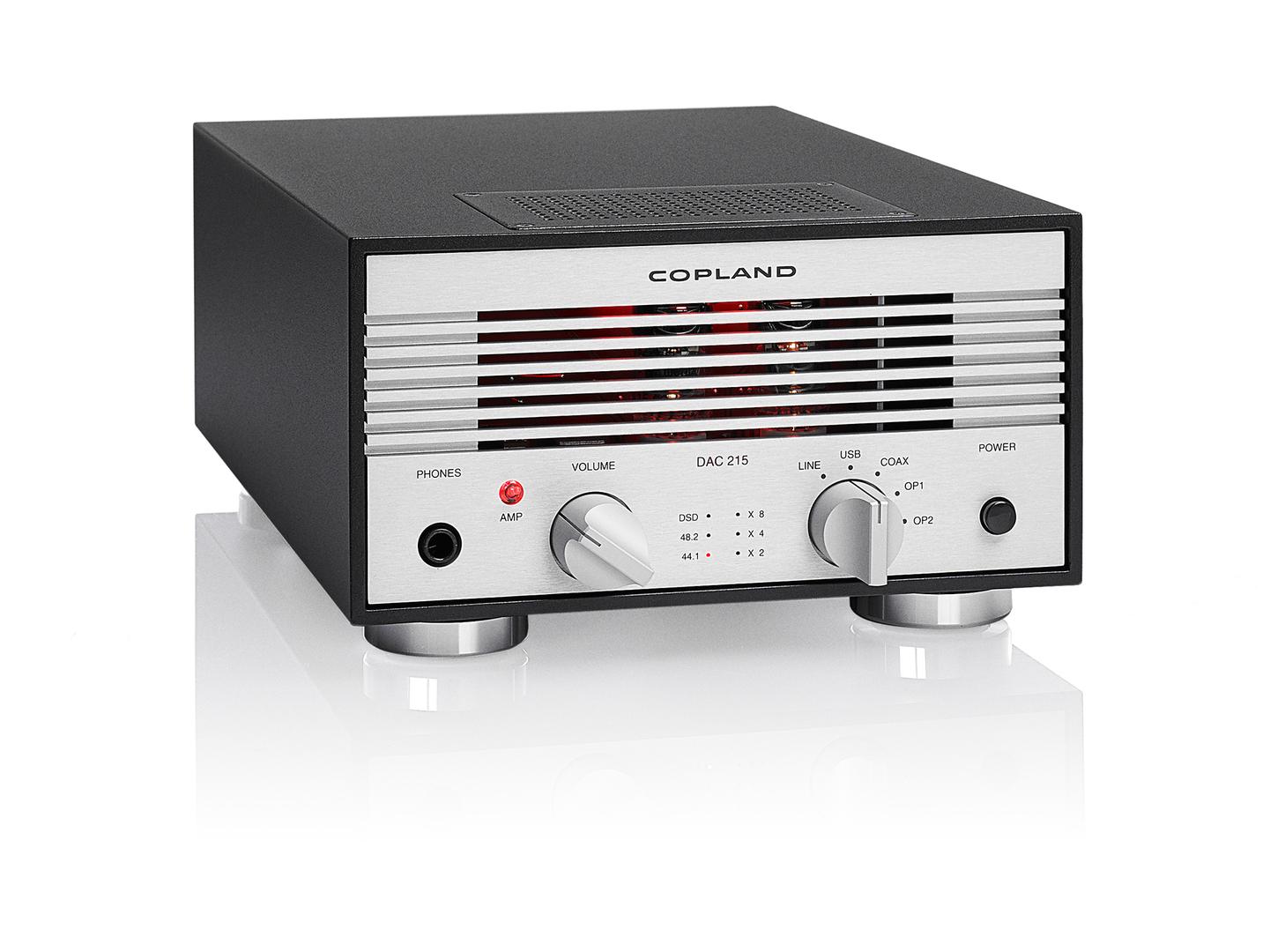
Copland DAC215 headphone DAC/amplifier

There are two distinct avenues for headphone amplification today – either buying a product from a brand with a well-established reputation for making headphone-based products, or from a brand that makes traditional two-channel audio that has ‘branched out’. Until recently, the former option was the more alluring, because it almost seemed as if long-standing audiophile companies were paying lip service to headphones. However, some of the more switched on traditional audio brands (pun – but not oxymoron – intended) have started producing products in the headphone ‘space’ every bit as well designed and fit for purpose as they do for two-channel loudspeaker audio, and every bit as good as their headphone specialist counterparts. Copland – with its DAC215 – is one such company.

The DAC215 is more correctly a product with feet in both camps. The feature set points to a device that sits somewhere between a high-performance digital preamplifier (with a lone line input) and a USB DAC with a built-in headphone amplifier. Both sides of the equation are considered with equal aplomb, with an ESS ES9018 Sabre DAC at the heart of the converter, a pair of ECC88s driving the headphone amplifier and line stage. The digital inputs (alongside USB) might be considered ‘legacy’ devices for those used to a computer-based audio environment, but point to a way for audiophiles with digital players and streamers of all descriptions to move into the headphone world. And, perhaps most importantly in a style-obsessed world, it looks pretty cool in a distinctly retro manner.

The DAC215’s front panel, with its two glowing tubes backlit by a red LED visible through a slotted grille on the front panel, and with a pair of large dials, and a big red or green ‘glow plug’ like LED denoting whether the preamp mode is engaged, give it a look reminiscent of classic audio. The backlighting is also a handy indicator of warm up; the DAC215 takes about 40 seconds to start up, and you know when the process is complete when the backlight comes on. If you don’t like the backlight, it can be turned off using a switch behind the valves, which necessitates opening the top plate. In so doing, you are met with a neat and ordered circuit layout  of DAC at the rear, amplifier to the front, with logic control and USB controller on daughter boards, and a screened off toroidal transformer power supply.


The ESS Sabre DAC used is one of the company’s desktop grade devices (confusingly, the company has the same nomenclature for portable and desktop DAC chips), but when you plug the Copland into a computer, you are met with the name ‘Combo 384 Amanero’ instead of ‘Copland DAC215’ because the converter uses the Amanero USB receiver board. This is only a little thing, but I think Copland should re-write the couple of lines of code required to rename the computer connection.

The DAC is, however, extremely flexible, with a range of PCM and DSD rates, even if the way these are indicated on the front panel needs some explaining. There are two arrays of three vertical LEDs; the left side denotes whether the signal is DSD-derived, or a PCM sampled input at either 44.1kHz or 48kHz, while the ones on the right indicate multiples of these base sampling rates. So, feed the DAC215 a DSD128 signal and the ‘DSD’ and ‘x4’ indicators, and ‘48’ and ‘x8’ denote 384kHz sampling. There is no indicator for the bit-depth of the signal, and there are no upsampling options.

There are basically three tales in one here; the DAC215 as a preamplifier, as a DAC, and as a headphone amplifier. The easiest one to crack is the first, as it’s a good, but relatively limited, preamplifier. The overall transparency of the preamplifier stage is never going to challenge the best of the dedicated preamplifiers even at the price, and the overall lack of additional functions (like a remote control, balanced inputs and outputs, balance control, or more than one line input) might prove more of a frustration over time, but for what is essentially a vestigial line preamplifier, the DAC215 acquits itself well. A good preamplifier should draw no attention to itself and the DAC215 never once commits any sins of commission in its preamplifier duties. Nevertheless, if you think of the DAC215 as an audio Swiss Army Knife, the preamp stage is one of those tools on its underside that seems handy in principle, but you never end up actually using.

The DAC section, on the other hand, is its main blade, and it’s razor sharp. Well, actually it’s not sharp at all, and that’s part of the great joy of using the DAC215. Sounds generated here are enticing, musically satisfying, and easy to listen to for hours at a stretch. I’m conscious of a self-snared trap here, in describing the DAC215 in ‘lovely’ terms, it could be mistaken for something saccharine or slightly dull sounding. It could even be taken as a backhanded compliment, akin to Chekhov’s ‘you have lovely hair’ quote. But the fact is, the DAC215 does sound ‘lovely’, in the fullest, face-value manner.

This is the kind of DAC that makes you aware of the intent behind the music every bit as much as it does of the music itself. In other words, play something bland and well-recorded and you get the whole well-recorded part, but you quickly get as bored as the musicians in the session. On the other hand, play something where the musicians were playing with more passion and excitement, and that energy sizzles. One of my regular tests for this is ‘Memphis Soul Stew’ from King Curtis Live at Fillmore West [ATCO], as it’s both a test of the dynamic range of the system over the slow build of the introduction, and it’s a test to see just how easy it is to spot these are not simply session musicians, but some of the best players you’ll ever hear. If Bernard Purdie’s drums beats, Jerry Jermott’s bass lines, Cornell Dupree’s guitar licks, and especially King Curtis’ sublime sax playing don’t sound like real people riffing off one another, any component can be detailed but dull. Here, each musician comes alive in his own space. ‘Lovely’ here means a combination of that sense of life, without too great an analytical sense.

For the most part, you tend to find yourself drawn to listening to classical and jazz through the Copland, although I’m not altogether sure why that is the case. Music is always expressive, always fluid, always dynamic, and always possessed of good detail and energy when played through the DAC215, and that applies whatever the musical genres being played. However, I found myself continually drifting toward the acoustic rather than the electric or electronic. The Copland didn’t panic staring down ‘Chameleon’ by Trentemøller [The Last Resort, Poker Flat], and the bass was deep and of a suitably malevolent nature through the DAC’s circuits, and the only issue I could detect was a very slight hardness to the sound of grungy guitars played loud and dynamic, with bands like ZZ Top and AC/DC. However, you had to thrash the system to even begin to notice this. Maybe it’s the cool retro looks giving me a distinctly Blue Note vibe!


Last, and in many respects best, comes the headphone amplifier section. This was uniformly excellent, with seemingly endless power in reserve and retaining that detailed, musical, ‘lovely’ vibe. Sounds were well placed in a soundstage as open as the headphones would permit, nothing taxed the amplifier (even ‘beast’ loads passed off uneventfully), and the overall balance of accurate and enjoyable made the DAC215 a great one-box solution. Interestingly, the move away from rock experienced in using only the DAC section of the 215 evaporated, and I was back to playing everything, and spending many hours doing so.

The Copland DAC215 is the gateway between the worlds of personal and traditional audio. Traditionalists who remain slightly dismissive of the personal audio world will see this device as a lovely sounding DAC that can also do ‘that headphone thing’ very well, and personal audio enthusiasts will see a lovely sounding headphone amplifier and DAC that can speak to traditionalists and their audio equipment. If you want a satisfying and musical sound that you can listen to for hours on end (and let’s face it, isn’t that the point?), the Copland DAC215 is an ideal travelling companion in your trek through your musical canon. Recommended.

TECHNICAL SPECIFICATIONS

  • Type: Headphone DAC preamplifier
  • Inputs: Analogue stereo RCA pair, 1× coaxial S/PDIF RCA, 2× Toslink S/PDIF optical inputs, 1× USB Type B audio input (asynchronous transfer)
  • Digital formats: PCM 16bit, 44.1kHz to 32 bit, 384kHz (24 bit, 192kHz on S/PDIF), DSD64, DSD128 (USB only)
  • Outputs: DAC only output stereo RCA pair, preamplifer output stereo RCA pair, 6.35mm headphone output
  • Tube used: 2× ECC88
  • DAC output (RCA): 2.0 V rms. @ 0dBFS
  • Gain: 10dB
  • Output (Headphones): max. 8.5V rms
  • Output Impedance: 5Ω (headphones), 100Ω (line)
  • Frequency response: 20Hz~100 kHz (+/-0.5dB)
  • Signal to Noise ratio: 90dB
  • THD: <0.02%
  • Dimensions (W×H×D): 20 × 28 ×11.5cm
  • Weight: 3.8Kg
  • Price: £1,998

Manufactured by: Copland

URL: www.copland.dk

Distributed by: Absolute Sounds

URL: www.absolutesounds.com

Tel: +44(0)20 8971 3909

Back to reviews

Read more Copland reviews here

Base Audio Reflex G7 headphones

The headphone market is in a constant state of flux. The old-school ‘big guns’ (Beyerdynamic, Sennheiser, Sony) have been challenged, first by Beats, and more recently by smaller start-ups with maybe just one or two products targeted at a very specific market. So it is with Base Audio and its Reflex G7 headphones, one of just two designs (the other being a set of extremely affordable G8 earphones) in the comparatively new brand’s line-up.

Reflex G7 was designed from the outset to be an affordable, well-made, semi-open-backed headphone design, using a lot of polished aluminium in the ear cup and head-band arms, and spring steel in the head-band itself. The grille opening the headphones to the outside world is a well-made convex mesh, akin to the cover on a Shure SM57 stage microphone, and is extremely resilient to knocks and scuffing. I’m sure using the grille as some kind of hammer will damage it, but in day-to-day use it will stand up to workaday mistreatment well. It does make the Reflex G7 quite permeable to the outside world (although classed as a semi-open design, you can hear what’s going on around you when listening to music, and the rest of the world can listen in on your taste in music), but it is small, light, and sensitive enough to be a commuter headphone, just not the first choice for overcrowded and very noisy London Underground trains.

Base Audio’s transducer of choice is a single 40mm dynamic driver; there is no secret sauce to this unit, but Base Audio are not making public the materials and construction of that driver and there is no way of getting access to it without ‘deconstructing’ the headphone in a dramatic way. It’s designed as a 32 ohm impedance design with a rated power input of 40mW and a maximum of 100mW, so Base Audio is very much intending this design to fall into the category of being used with smartphones and low-power DAPs, rather than demanding use with desktop devices.

The supplied headphone cable (a high quality, stiff braided, no-tangle affair) is a 3.5mm TRS Y-cable, meaning it takes a stereo signal and passes it to both left and right ear-cups. The headphone itself determines which is left and right channels, and this is described in the headphone band itself. This is one area that could be improved, as the marking denoting ‘left’ channel is very hard to see (it’s a raised plastic ‘L’ on the underside of the left headband terminator below a hex bolt, written both in roman capital script, and – as is too often overlooked – the raised three vertical dots denoting the letter ‘l’ in Braille). There is no direct instruction on how to find this snippet of information on the instruction manual, so you might spend time scrabbling around to try and find this every time you grab the headphones. A little splash of colour or a more obvious identifier might be useful here (a tiny blob of red Sugru on the inside of the right hand headband terminator would be enough). However, the overall look is elegant, rather like a designer Grado. The headband is made of soft and tough black plastic that is not quite grained enough to be ‘pleather’, but is comfortable and never feels heavy or sweaty. The headphones pivot well on the aluminium arms, allowing flat-pack carry, although they do not fold into the earphones for carrying in a half-moon carry case. From a Euler-angle point of view, the headphone allows adjustment in the Z-axis, but limited X and Y axis adjustment, but the aluminium arms extend well allowing the headphone to be easily accommodated on all bar the most hideous of head-shapes. Those soft foam black donut pads (which are said to be washable in warm water, and are easily replaceable) help here, too. In use, I found them extremely comfortable, even after hours of listening, and the balance of weight vs. solidity of build is just about perfect: they won’t break, and they won’t break your neck in the process!


Although the market for high performance headphones has grown exponentially in recent years, it’s still relatively rare to find headphones designed for the smartphone set that are also aimed at audiophiles. Models by Bowers & Wilkins, Sennheiser, and Grado aside, many of the best enthusiast models are designed for home use and what hits the road is often lumpy and thumpy in the bottom end, thanks in no small part to the success of Beats. This is something of a double-edged sword for the likes of Base Audio, as many of its potential customers may have come from the Beats line, and find the more neutral balance of products like the Reflex G7 too thin for their liking. However, the more they listen, the more they discover this sound is actually more accurate… if they can get past the initial sonic hurdle.

As an enthusiast, minted long before the Beats Generation, the Reflex G7 is easy to like. The headphones go for the refinement option, with an accurate, even-handed, and extended treble, an open midrange, and a taut, precise bass. This comes across well with tracks like ‘Mera Kuchh Saaman’ [Kronos Quartet, A Thousand Thoughts, Nonesuch], where the atmospheric interplay of Middle Eastern and European instruments blend together seamlessly. It’s the midrange where this album is at its most expressive and expansive, with a sophisticated and complex mix that extends into the bass and treble from there. And it’s the midrange of the G7 that is the first thing that strikes you, because it is so effortless and enjoyable. That effortlessless combines well with the open-backed nature of the headphones, placing the music in your environment, rather than isolating you from your surroundings. This is a peculiar, but in fact extremely attractive, aspect of the headphones presentation: sounds around you are not heavily attenuated by the Reflex G7 (it’s no noise canceller, that’s for sure) and the sounds from the headphone appear to fold into the outside environment, and the result is both extremely natural and very relaxing. Of course, this has two side issues: if you want absolute silence in your background, get used to listening in some very quiet environments, and if you listen to music in the family room, be prepared for the family to get a little upset at hearing some of your music, too. That being said, the amount of leaked noise is less than many Stax models and is about as noticeable as the leakage you might get from a pair of similarly priced Grados.

I keep coming back to Grado because in some respects, the Reflex G7 look, sound, and perform like a Grado design, extensively redrawn for the 21st Century. They have the rhythmic ‘bounce’ of classic lower-cost models, but without the distinctive character of some of these designs, and they have the openness and transparency of more upmarket models. That’s virtually a best of all worlds. And yet, for all this, the Reflex G7 is no Grado-clone, as it has its own characteristic sense of mid-range honesty and extension.

OK, let’s be honest, here. The Base Audio Reflex G7 are good headphones, keenly priced. They are not giant-slayers. No‑one who knows their way around a pair of truly top-end headphones is going to think about trading them in for a pair of Base Audio Reflex G7. Focal’s Utopian design team can sleep safe at night, and MrSpeakers isn’t going to become MrOutOfWork any day soon because of the presence of the Reflex G7. I’m sure the Base Audio folks would beg to differ, but the reality is they are very, very good open headphones that go mano e mano with the likes of Grado (an obvious competitor) and walk out of that fight with head held high. If you are in the market for a pair of headphones at anything between about £250-£500 – for both domestic and/or portable use – the Reflex G7s muscled their way into a very contended market on sound quality alone.

Using British-grade understatement, I’m rather fond of the Base Audio Reflex G7 headphones. They tick many of the audio enthusiast boxes of neutrality and bass precision over bass impact, but without incurring the audiophile price magnifier that so often afflicts our world. That makes them more than worth checking out!

TECHNICAL SPECIFICATIONS

  • Design: Semi-Open backed dynamic headphones
  • Transducer: 40 mm dynamic driver
  • Frequency response: 10Hz to 30kHz
  • Sound Pressure Level: 105dB +/- 3dB at 1kHz 0.8v
  • Rated Input Power: 40mV
  • Maximum Input Power: 100mW
  • Impedance: 32 Ω
  • Length and type of cable: 1.2 m, detachable
  • Connector: 3.5 mm jack plug
  • Color: Black – Polished aluminum
  • Weight without cable: 267g
  • Price: $299

Manufactured by: Base Audio

URL: www.base-audio.com

Tel: +1 800-381-1794

Back to reviews

Read more Base Audio reviews here

Music First Audio Classic Headphone Preamplifier

Music First Audio is a British company best known for making a range of high-performance passive magnetic preamplifiers. It has recently branched out to make phono stages with active gain stages. The new Classic Headphone Preamplifier shows the company is adding more powered devices to its line.

The name says it all. This is Music First Audio’s popular Classic Preamplifier (which has been in production for the last 14 years) with the addition of a small, externally powered headphone amplifier. In fact, it’s essentially that long-standing Classic with the addition of Music First Audio’s dinky little Phone Box (available in red, just like British phone boxes, only without the smashed-up phone and the interesting set of aromas), all in one box. The way you access the headphone amp section of the Classic Headphone Preamplifier is a simple toggle switch on the back of the preamplifier, to flip between ‘preamp’ and ‘headphone’ use. And that’s about it. There are the two standard dials on the front, one to change inputs, and one for a 23-step level adjustment, and there is a single 6.35mm headphone socket.

It’s supplied in a good ‘pinch and pluck’ foam-filled aluminium flight case (the kind of thing you might use for an electrical tool kit, or a DJ might have used for transporting CDs), complete with a 12V power supply from RS. The concession to active operation is a little blue LED in the lower right corner of the front panel, which glows when the headphone amp is powered. There is also a ground-lift switch on the underside of the preamp, which you might need to operate should you encounter any earthing hum (more likely through a power amplifier than from an input).

The Classic Headphone preamplifier has six line inputs and two outputs (all RCA single-ended), no balance controls, no tone controls, and – 12V power supply for the headphone amp aside – no active electronics inside. Unlike the traditional passive preamplifier (essentially a potentiometer in a box) Music First Audio started from the outset using a passive magnetic design, which uses a screened attenuation transformer. This has made it easy for Music First Audio to create both single-ended and balanced preamplifiers in its line-up, and has the great advantage of combining all the benefits of a passive preamplifier (great linearity and phase performance, an absence of any kind of background noise or hash from the active preamp stages) with none of the downsides (impedance mis-matches, signal loss at high frequencies, and the need for extremely short cables as a result). The Phone Box is simply a pair of RCA inputs and a 12V power input on one side of its box, a 6.5mm phono jack and a blue LED on the other. The Phone Box takes its cues from the output taps from the transformer volume control.

The overall fit and finish of the Music First Audio Classic is very good, and the Classic Headphone is functionally identical, with an extra LED and a 6.35mm headphone socket. Switching from source to source is met by a positive feel as you move from input ‘A’ through to input ‘F’ (screen printed on the front and rear as such), and an equally positive feel from the click-stops on each of the volume settings. The chrome knobs are a good contrast to the brushed aluminium finish of the preamp, although there is an identifier here at last. Aside from the word ‘headphone’ in italic script along the bottom of the front panel, the case itself is more rounded off and has visible Phillips screws front and rear. The classic, er, Classic preamp is in a more squared-off box. Otherwise, they are identical.

Music First Audio is a brand with a strong reputation in the traditional two-channel world, but how well does it cross over into the personal audio space with the Classic Headphone? Actually, pretty well, with one caveat. The caveat is worth getting out the way first: the headphone amp isn’t the thing to drive difficult headphone loads. It’s capable and sounds great with more down-to-earth headphone systems, but if you are looking to drive some of the older, more demanding planar magnetics, the built-in unit lacks oomph.

That aside (and let’s be honest, most of those ‘beast’ headphone loads are squarely in the past now), the Music First Audio gets a very clean bill of health. Granted, unlike many products in this month’s line-up, this is more of a traditional audio product with an added headphone stage than a designed-from-the-ground-up personal audio project, but it’s such an excellent traditional audio product that it doesn’t really need changing. The advantage to the Music First Audio Classic is it sounds as if a whole swathe of electronics has been removed from the space between the music and your ears… because it has. Where an active line stage may have a signal path that passes through several electronically active solid-state or vacuum tube components on its journey through preamplification, the Music First Audio has just wire. It’s difficult to describe just how significant those gain stages are in the sound of a system until you hear a preamp without them, but it feels like you are just closer to being in the studio. And it’s all the more noticeable when going back to active line stages, which in the main subsequently sound like they are just adding noise and distortion to the sound.

This is not a small difference: it’s like the sound of in your room as compared to the sound of someone else in another room is using an electric razor. Or it’s like the difference between someone playing a Gibson Les Paul and a well-balanced Epiphone version of the same guitar: it’s close, but not the real deal. In a way, this doesn’t need some kind of musical example, because all of music is its own example. If you listen to a piece of music through the Music First Audio after listening to another active line stage, that music comes with its own ‘aha’ moment as you realise at once what was being played by the musicians, what most active preamps are doing to the sound, and what the MFA isn’t doing to the sound at that time. And, unless you are lucky enough to own one of the tiny handful of (usually very expensive) preamps that bring gain and nothing else to the game, you’ll find that active line stage wanting. Yes, this places the onus on the makers of sources and power amplifiers to get things fundamentally right, because the Classic won’t forgive crazy impedance expectations on either device. On the other hand, your well-made source component now sounds like it always wanted to. Couple the Classic to a great DAC that doesn’t include a volume control and a headphone amplifier and it suddenly sounds like the DAC just grew a volume control and a headphone amplifier! That’s how good the Classic sounds in situ.

The great thing about that well-sorted source component is that it doesn’t need to be that deluxe in stature. Music First Audio have made captivating sounds in their demonstrations by running the Classic Headphone off an old Philips CD player and an even older Sony Walkman Pro cassette recorder. OK, so these are both deceptively good sources in their own right, but it shows the potential of the Classic to shine given a source component with suitably low output impedance.


An interesting comparison is to use the Music First Audio Classic Headphone both as a headphone amp, and as a preamp for another headphone amp, in this case the Arcam rHead, with its volume turned up accordingly. In such a test, I preferred the sound of the Music First Audio driving the rHead to both the rHead on its own, or the sound of the on-board headphone amplifier. However, no-one apart from me is probably ever going to do that, and in the real world, I preferred the sound of the Classic Headphone through its own headphone output to the sound of the Arcam rHead on its own. Which shows the importance of the passive preamp stage.

A simple way of looking at the Music First Audio Classic Headphone preamp is you get a fantastic £2,040 preamplifier and a good £420 headphone amp in one box for £2,400, and I feel that’s the order these will be viewed. This is a Classic preamp that has grown a headphone input, and those buyers who want a passive magnetic preamp for their audio system have just found their new box plays headphones too.

TECHNICAL SPECIFICATIONS

  • Type: Passive magnetic preamplifier with built in headphone amplifier
  • Inputs: six RCA stereo line level pairs
  • Outputs: two RCA stereo pairs, 6.5mm headphone socket
  • Switches: Ground plain switch (under chassis), headphone/preamp toggle switch (at rear)
  • Power supply: external 12v (headphone only)
  • Dimensions (WH×D): 29 × 9 × 23cm
  • Weight: 3.5kg
  • Price: £2,400

Manufactured by: Music First Audio

URL: www.mfaudio.co.uk

Tel: +44(0)1424 858260

Back to reviews

Read more Music First Audio reviews here

HiFiMAN HE1000 V2 and Edition X V2 planar magnetic headphones

Long term Hi-Fi+ readers know that we hold several of the top-tier planar magnetic headphones from the Chinese firm HiFiMAN in very high regard—most notably the flagship HE 1000 (reviewed in issue 126 and recipient of last year’s Hi-Fi+ Cost-no-Object Headphone of the Year award) and the second-from-the-top Edition X model (reviewed in issue 137). But great though both models were and are, the fact is that development never ceases in the fast-paced world of high-end headphones so that new and improved ‘V2’ models have now come along to replace the original HE1000 and Edition X headphones. Naturally, these developments raise some questions. First, how do the new V2 models differ from their well-liked original counterparts? Second, do the V2 updates have any significant impact on sound quality and if so is that impact a positive one? Third, do the V2 improvements entail any changes in pricing? We will tackle all three of those questions in this review.

The HE1000 V2 receives several changes that might individually seem small, but whose collective impact is significant. First, the HE1000 V2 features a subtly revised headband that, according to HiFiMAN, “will accommodate a wider ranges of head sizes while applying correct pressures evenly.” The HE1000’s metal headband frame is a CNC-milled, hand polished structure below which is suspended a beautiful stitched suede headband strap supported at each end by polished metal click-stop carriers. To fit the headphone, one positions the strap atop one’s head and then adjusts the carriers upwards or downwards until the headphone ear cups are perfectly positioned.

Next, the HE1000 V2 receives a signal cable upgrade featuring, says HiFIMAN, “further refined conductors (higher grade crystalline copper and crystalline silver) with improved, stronger structure.” Part of this improved structure involves the use of highly pliable, vibration-damping rubber cable jackets that not only resist tangling but also—in my experience—handily suppressed the transmission of mechanical noise through the cable jackets. Moreover, the manufacturer adds, the new cable “delivers better sound quality with wider frequency range and lower signal loss.” In keeping with the HE1000 V2’s role as a flagship model, three separate sets of signal cables are included: one terminated with a 3.55mm mini-plug, one with a 6.35mm headphone plug, and one with a 4-pin XLR balanced connector (for use with balanced output headphone amplifiers).

Third, the HE1000 V2 receives updated bevelled ear pads that have been re-designed, says HiFiMAN, “to become thicker” and to provide a more pronounced “asymmetrical shape that follows the form of the ear cups” (note: when viewed from the side, the HE1000 V2 ear cups are roughly shaped like stylised, oversized human ears). But the changes don’t end there. The original HE1000 ear pads had pleather sides with velour touch surfaces, but in the HE1000 V2 pads the velour has been changed to a polyester fabric material that, according to the manufacturer, yields an audible increase in sonic transparency.

Finally, the HE1000 V2 has gone on a bit of a diet so that its ear cup enclosures are now slimmed down from 14mm to 11mm, with an attendant 12.5% decrease in the headphone’s overall weight from 480g down to 420g. But a further change, though one not highlighted in HiFiMAN product literature, is that the new, slimmer ear cups effectively position the driver diaphragms closer to the wearer’s ears.


Now, let’s take a look at the V2 changes made to the Edition X model.  Like the HE1000 V2, the Edition X V2 also receives an upgrade to its headband frame, one that again promises to accommodate a wider range of head sizes while applying appropriate, just-right clamping forces. In the case of the Edition X V2, though, the frame updates are even more extensive than in the HE1000 V2, as the ear cup support yokes are now upgraded from the previous moulded plastic parts to use new black anodised metal yokes (much like the metal yokes that were always used on the HE1000 model).

Next, the Edition X receives new bevelled ear pads that appear to be identical to those now found on the HE1000 V2. Apart from the changed bevel angle and somewhat revised shapes, the big news once again is that the velour touch surfaces found on the first-generation pads have been changed to incorporate a polyester fabric said to increase sonic transparency.

Finally, the Edition X V2 gets upgraded signals that, while not identical to the HE1000 V2 cables (because the latter feature more complex conductor arrays), nevertheless do look like they use high purity copper and silver conductors and incorporate versions of the flexible rubber vibration-resistant jackets we noted on the HE1000 V2. The Edition X V2 comes with two cables: a 1.5m cable fitted with a 3.5mm mini-plug and a 3m cable fitted with a 6.35mm Neutrik headphone plug. A 3.5mm-to-6.35mm adapter is also included.

Unlike the HE1000 V2, the ear cups of the Edition X V2 have not been modified for weight reduction purposes as the original model, which weighed just 399g, was already very light. One other thing that has not changed is the headphone’s extraordinarily high 103dB sensitivity rating, which is essential to maintaining the Edition X V2’s identity as a true high-end headphone that can be driven from a smartphone or tablet. The only externally visible change is to the finish of the ear cups; the original Edition X’s were done up in a gloss ‘black chrome’ treatment, while the new V2 versions are treated to a subtle, satin-texture metallic black finish that is very handsome indeed.

Now let’s look at how the V2-series changes have influenced the feel and sound of the HE1000 V2 and the Edition X V2.

In the Hi-Fi+ issue 126 review of the original HE1000, we praised the headphone’s “terrific openness, transparency, and very high levels of resolution,” and the HE1000 V2 continues in much the same vein, while demonstrating even greater resolving powers than its predecessor. But here’s the part you might not see coming: even as the resolution of the HE1000 V2 increases, so too does the perceived smoothness of its overall presentation—a rare combination of virtues. Thus, the amount of musical information on offer goes up significantly, but without any attendant increase in brightness, edginess, or stridency; on the contrary, the V2 sounds noticeably more relaxed and so is easier to enjoy for longer periods of time. These sonic improvements are certainly worthwhile, but they are more incremental than transformative in nature, which should come as no surprise given how good the original HE1000 was in the first place.

For a good example of the V2’s new qualities in action listen to the track ‘Something More’ from Sara K’s Hell or High Water [Stockfisch, SACD], carefully noting the textures of both Sara K’s voice and of each of the accompanying instruments. What is striking is the way the HE1000 V2 deftly captures all the transient information from plucked or percussion instruments while also perfectly rendering their upper partials and high harmonics. The original HE1000 always did a great job of conveying a vivid, up-close-and-personal view of the textures and timbres of individual instruments and the HE1000 V2 does an even more convincing job in these respects.


Most importantly, though, the V2 beautifully captures the breathy qualities of Sara K’s voice—and in particular her uncanny ability to sound both ethereal and yet earthy at the same time—without any sort of false high frequency spotlighting or etching. As a result, then, Sara K’s voice sounds by turns self assured, inquisitive, wistful, and evocative, but is never forced or overwrought. As I listened to ‘Something More’ (and other tracks on the same album) I couldn’t help but think to myself, “Now this is how Sara K’s voice really ought to sound on all good hi-fi equipment, but rarely does in practice.”

One other noteworthy point is that the HE1000 V2 retains three of the qualities we liked best in the original HE1000—namely, its ability to tease out the overlapping layers of multi-track studio recordings with zero congestion, its killer bass (replete with exceptional depth, impact, and pitch definition), and its highly expressive dynamics. All three of these qualities are very much in evidence on Hell or High Water, often making the listening experience feel like the sonic equivalent of going on a shopping spree in Aladdin’s cave of many treasures.

The weight reduction of the HE1000 V2 is a welcome improvement that’s noticeable from the moment you first put on the headphones. Personally, the original HE1000 never seemed overly heavy to me, but the new V2 model is now such a featherweight that you can wear it for hours and hours on end without any neck strain or fatigue whatsoever. Even so, I would suggest that listeners take breaks every couple of hours, just to let their ears ‘breathe’ for a bit in the outside air. The revised ear pad’s new polyester fabric touch-surfaces, though less overtly plush than the old pad’s velour surfaces, are quite comfortable and do a good job of wicking away moisture. More to the point, they also appear, as advertised, to have helped improve the headphone’s overall sonic transparency.

In the Hi-Fi+ issue 137 review of the original Edition X we called the product “a very high resolution headphone in its own right, but one that manages to stay just to the right side of the sonic pleasure vs. pain boundary lines.” That same statement could also apply to the Edition X V2, but with one critical distinction: namely, the fact that the V2 model shows across-the-board improvements in terms of overall resolution and openness. The illusion is that there is an imaginary control knob labelled “Be Present with the Music” and that, in switching from the original Edition X to the Edition X V2, that knob has been turned up from about 9 to a solid 11 (or maybe 12).

To appreciate what I mean, try listening to a well-recorded jazz track such as ‘Walter Pigeon’ from percussionist Gene Jackson, bassist Eddie Gomez, and guitarist John Abercrombie’s Structures [Chesky, 24/96], noting carefully how each of the three instruments are brought into play. The track opens with Gomez playing a gentle arco line on his acoustic bass, accompanied by delicate and widely spaced chords softly strummed on Abercrombie’s guitar. Gomez’ lines range way up high into a register most listeners would associate with a cello rather than a bass, but subliminal low frequency details, neatly rendered the Edition X V2, convey the fact that the instrument’s wooden body is much larger than that of any cello. At the same time, Abercrombie’s guitar produces a gorgeous, honey-hued tone that can only be described as sounding ‘liquid’. But then, at about the 1:10 mark, the personality of the song shifts: Gomez begins playing more forcefully and pizzicato-style, Abercrombie moves to play more pointed individual notes, and Jackson joins in with almost indescribably delicate brushwork on his cymbals and the heads of his drums. There’s so much low-level textural and transient information at hand that many transducers turn it into a well-intended blur, but the Edition X V2, with its new-found reservoirs of transparency, instead pulls the listener into closer and more focused contact with the music.


But now let me mention that I’ve saved some of the best news for last—news involving the pricing of the V2 models.

The HE1000 V2 sells at the same price its predecessor did (£2,599 in the UK, or $2,999 in the US); you get a better headphone, but you won’t pay more! Better still, HiFIMAN offers US customers a special HE1000 V1-to-V2 upgrade programme where present owners can trade the original model for the new one for just $650. Meanwhile, the Edition X V2 sells—wait for it—at a significantly lower price than the original Edition X (down from £1,299 to £1,099 in the UK, and from $1,799 to $1,299 in the US); again, listeners get better headphones, while paying less for them!

In both cases, HiFiMAN’s new V2 models take what were already very fine headphones and make them better. Both models benefit from increased transparency, but the HE1000 V2 delivers more information with a newfound sense of relaxed smoothness, while the Edition X V2 leverages its heightened transparency to convey a sense of deeper intimacy and sharper musical focus. Either way, the listener wins.

TECHNICAL SPECIFICATIONS

HiFiMAN HE1000 V2

  • Type: Full-size, circumaural planar magnetic headphone
  • Driver complement: One planar magnetic driver with nanometre-thickness diaphragm, advanced asymmetrical magnetic circuit, and patented ‘Window Shade’ protective grille.
  • Frequency response: 8Hz – 65kHz
  • Sensitivity: 90dB
  • Impedance: 35 ohms
  • Accessories: Padded faux leather-clad presentation case; three sets of 3m signal cables: 3.5mm mini-jack; 6.35mm jack, 4-pin XLR.
  • Weight: 420g
  • Price: £2,599 (UK), or $2,999 (US).
    In the US market, present owners of HE1000 V1 can upgrade to the HE1000 V2 for $650.

HiFiMAN Edition X V2

  • Type: Full-size, circumaural planar magnetic headphone
  • Driver complement: One planar magnetic driver with patented ‘Window Shade’ protective grille.
  • Frequency response: 8Hz – 50kHz
  • Sensitivity: 103dB
  • Impedance: 35 ohms
  • Accessories: Padded flip-open presentation case; two sets of signal cables—1.5m cable terminated with a 3.5mm mini‑plug, and 3M cable terminated with a 6.35mm headphone plug, and 4-pin XLR plug; one 3.5mm-to-6.35mm adapter plug.
  • Weight: 399g
  • Price: £1,099 (UK), or $1,299 (US)

Manufacturer: HiFiMAN

URL: www.hifiman.com

Tel: +1-201-443-4626

Back to reviews

Read more HiFiMAN reviews here

Arcam rHead headphone amplifier

The audio business is a bit creepy: it suffers from mission creep and price creep. Brands start out with good intent and a fine product at a fair price, but then slowly begin to add more devices to the basic design, and the price begins to rise accordingly. In its 40 years, Arcam has resisted these temptations better than most, and its rSeries components typify this pared-down, no-nonsense approach to audio design.

The rHead (pronounced ‘arhead’, not ‘aah… head’, as the latter can get you into trouble in the wrong places) is a standalone headphone amplifier, and an obvious visual match to the irDAC-II from the same brand (not tested). It’s a small, black box with a choice of one XLR and one RCA stereo input. The prevention of mission creep kicks in here, because this is not a two-input headphone amp; the choice of input is selected at the rear of the rHead, using a small toggle switch. The prevention of price creep kicks in at that back panel too, as the rHead draws its power from an external 12V, 1.5A power supply. Even the power switch is on the back panel.

The front of the rHead is equally severe in its ornamentation. A little green light in the centre of the front panel to denote the juice is flowing. From the front, 3.5mm and 6.35mm headphone jacks poke out from a little recess on the left of the  black panel, while a silvery volume control is to the right. The volume control has a standby/mute click to the far left of its travel, and the green LED turns orange as a result of engaging mute. Oh, and the Arcam rHead logo is printed on the top panel. That’s it! No tone stack (mission creep, remember), no balanced output (mission and price creep), no inch-thick aluminium front panel (price creep). In fact, there’s practically nothing on the rHead that gets in the way between music and listener from the outside.

What counts instead is what’s underneath that minimalist exterior. The first clue is the weight of the rHead. You might be forgiven for thinking from the pictures and the price that the Arcam box is some ABS lightweight, but is in fact cast and anodised black aluminium. Although the rHead is not much thicker than a blockbuster paperback book (remember them), the main box weighs more than the hardback first edition of the same. The lone exception is the low resonance rubberised baseplate (Arcam’s no-frills design means it unwittingly channels The Treasure of the Sierra Madre meme to comic effect: “Feet? We don’t need no stinking feet!”).


The internal organs of the rHead receive a fine bill of health, too. The amplifier itself is a discrete and true linear Class A design. This means it’s not a ‘chip amp’, but a classic amplifier design and has absolutely no transistor crossover distortion. Theoretically, when playing a difficult headphone load at high volumes, the rHead will switch into Class B, but ‘difficult’ here seems to be ‘trying to drive ear muffs’; as I value my hearing, I’m not willing to play at 2V or more just to prove a point.

This amplifier design is met by the digitally controlled but ultra-linear analogue Texas Instruments PGA2311A resistive ladder array volume control behind that shiny knob. This means that along with no crossover distortion, you have no tracking errors across gain settings. Tracking is an issue many traditional amp designers now turning their attention to the headphone world completely overlook, because a decibel between left and right channels notionally makes no great odds when you are several paces from your loudspeakers, but quickly becomes an insurmountable obstacle when your ears are a few millimetres from the drive units. In fact, the best conventional stereo amps now have superb tracking (the design here is pulled from Arcam’s own A49 flagship), but many lower cost options default to a simple potentiometer. Rather than a potential cause of price creep, this is money spent in the right places.

The sound of the rHead is almost immediately impressive. The first time you power it up, it might take a few minutes before coming on song, but after that putting it into standby leaves it thermally active, and it sounds great almost the moment you move into the green. In fairness to Arcam, this review was conducted during a wintery cold snap in the UK, and it came out of the box like it had come out of a freezer, so maybe that had an influence on that first half hour or so. In use, the rHead runs warm to the touch (a potential benefit during that wintery cold snap is it’s a desktop hand warmer; a potential downside is it can also become a desktop body warmer for a heat-seeking cat).

After moving the cat aside and the staunching the resulting blood flow, I found the rHead to be a deft and musical performer. The first and most important test of a good headphone amplifier is noise floor, more than adequately checked with the ten-driver Noble Kaiser 10 custom-fit IEMs. These sensitive, ten-way designs are forgiving, but extremely revealing of source and amplification. Aside from a faint hiss at relatively high volumes with no music playing, the Arcam’s background is silent. And let’s be honest here: to discern that faint hiss required after-midnight listening in cloistered silence, so in normal use, even the most sensitive smartphone-chummy earphones or CIEMs will be fine at any level. At the other end of the scale, I backed off the volume control long before the Arcam began to get upset, even with a pair of older heavy load HiFiMAN planar magnetics. Ultimately, within real-world operating parameters between ‘whisper’ and ‘hearing damage’, the rHead is a fine, clean, and consistent performer.

In fact, it’s that consistency that really makes the rHead something special. From the deepest bass you can get from your headphones up to dog-whistle frequencies, the rHead is refined, graceful, temporally on the money, and extremely detailed. One of my regular test tracks is ‘Memphis Soul Stew’ from King Curtis Live at Fillmore West [ATCO] because its slow build is a test of a system’s dynamics, and the Kingpins are about the funkiest group that ever took to a stage, and any discontinuities in timing are immediately apparent. The rHead passed both these tests with flying colours, in a way one might expect from an amplifier costing the other side of £1,000. The detail it reveals in this track, and the atmosphere it finds in ‘The Lover of Beirut’ from Anouar Brahem’s The Astounding Eyes of Rita [ECM], was both captivating and exhilarating. And yet, for all this detail and definition, the rHead never once sounds fatiguing or wearing. As a reviewer, if there’s a downside to the rHead, it’s that it would suspend my critical faculties in headphone reviewing, because most headphones get a free upgrade thanks to the Arcam’s deft, insightful, and attractive sound. From the perspective of a listener, however, that makes it one of the most satisfying headphone amps you can get at anything close to the price.


It’s hard to think how to improve on the rHead without hitting those mission or price creep buffers. A remote might be nice, but not necessary. Swapping out that wall-wart power supply for something more substantial would effectively double the cost, but due to the amount of internal power filtering in the rHead, the amount of actual improvement that might offer is doubtful. Adding balanced output would be great, but the additional requirements would mean a more complicated design and some switching circuitry… thereby undermining the whole ‘mission creep’ thing. By ‘improving’ the rHead beyond its current capabilities, you would likely end up with a box of tricks that would double the cost and likely add ‘ephemera’ rather than ‘features’.

Forty and a bit years ago, A&R Cambridge Ltd (now better known as ‘Arcam’) launched its first product: a no-nonsense amplifier called the A60 that took the two-channel audio world by storm. The Arcam rHead continues that tradition for the headphone generation. I’m going to stick my neck out here and give the rHead the nod as my take on the best value in headphone amplification right now. If you only need one input and look at balanced outputs, balance controls, or any kind of tone or aural processing as a waste of your time and money, then the rHead is your kind of no-nonsense amplifier. Strongly recommended!

TECHNICAL SPECIFICATIONS

  • Frequency response: 10Hz – 20kHz
  • Total Harmonic Distortion + Noise: 0.001% at 2V output, 32Ω load
  • Signal-to-noise ratio (A-weighted): 109dB at 2V output, 32Ω load
  • Power requirements: 12V DC, 1.5A
  • Headphone output power: 2.0W, 16Ω load; 1.1W, 32Ω load; 0.13W, 300Ω load
  • Headphone recommended impedance: 16Ω – 600Ω, 3.5 or 6.35mm plug
  • Output impedance: <0.5Ω
  • Input levels: 0-4V (RCA); 0-8V (XLR)
  • Dimensions (W×H×D): 19.4 × 4.4 × 13.5cm
  • Weight: 0.71kg
  • Price: £395

Manufactured by: A&R Cambridge Ltd

URL: www.arcam.co.uk

Tel: +44(0)1223 203200

Back to reviews

Read more Arcam reviews here

CanJam SoCal 2017 – Part 2

On the weekend before Easter, Hi-Fi+ Associate Publisher Pete Collingwood-Trewin and I took the opportunity to visit CanJam SoCal, which was held at the JW Marriott hotel in the middle of downtown Los Angeles.


The event was popular with manufacturers and with show-goers, it seemed, so that at times there were lines of enthusiasts queuing to hear the enticing products on demonstration.

What follows is the second part of what will ultimately be a four-part report on the event.

Our aim is to present Parts 1 and 2 shortly after Easter and then to add Parts 3 and 4 at a later date.

IMPORTANT: As always, we apologize to any manufacturers we were not able to visit. No slights of any kind are intended. Then again, please note that on more than a few occasions we visited manufacturers only to be turned back by the crowds of people surrounding their demonstration tables (which is, as the old saying goes, a ‘high quality problem to have’).

Bluewave

When it comes to the brave new world of wireless headphones, the Canadian firm Bluewave may well have come up with the proverbial ‘better built mousetrap’ in the form of its ingenious GET wireless hi-fi headphone amplifier. Offer in elegant casework that is about the size of a lipstick case, the GET is a Bluetooth 4.2-compatible, battery powered wireless headphone amplifier that can turn just about any conventional headphone or set of earphones or CIEMs into wireless Bluetooth models.

The little amp not only works, but also works deceptively well—especially in light of its ever-so-reasonable $129 price. Better still, if you pre-order a unit now, the price drops down to just $99. The GET is expected to begin shipping in late May or early June.

Brainwavz Audio

Brainwavz Audio is a subsidiary of the Hong Kong based firm GPGS; Brainwavz’ mission is to provide affordable and highly personalised products for earphone and headphone lovers worldwide. Accordingly, the firm offers an extensive range of passive and Bluetooth-enabled universal-fit earphones and headphones, plus related accessories (though it appears the earphones are a particular area of expertise for the company).

Within the firm’s earphone offerings, a group of three Balanced Armature Series earphones appear to reside at the top of Brainwavz’ sonic ‘food chain’.  I took a brief opportunity to listen to the upcoming flagship Brainwavz BA-400 (price TBC, but projected at $350), which features quad balanced armature-type drivers and that I felt offered a goodly amount of sonic sophistication for the money.

Campfire Audio

Campfire Audio is the acclaimed sister company to ALO Audio and its sole point of focus involves building ultra-high performance universal-fit earphones. Campfire’s range is sub-divided into two product lines, one centred on earphones based on traditional balanced armature drivers and the other centred on earphones based on high-tech dynamic drivers (or hybrid driver combinations anchored by dynamic drivers).

At the pinnacle of the balanced armature range is the Andromeda ($1,099), which features five balanced armature-type drivers per earpiece and which uses a proprietary so-called Tuned Acoustic Expansion Chamber. If all goes according to plan, Hi-Fi+ will review the Andromeda in the not too distant future.

At the top of the dynamic driver range is Campfire’s Vega ($1,299), which features what is said to be the world’s first 8.5mm non-crystalline Diamond dynamic driver housed in the world’s first Liquid Alloy Metal Earphone Housing.


Cardas

Many earphone fans are familiar with Cardas’ excellent original EM5813 Ear Speakers and the firm’s distinctive, bright blue A8 earphones, which arrived about a year and half after the EM5813s as a follow-on model.

For CanJam SoCal, however, Cardas announced a new A8 30th Anniversary model, which forego the A8’s original rubberised blue finish for a much more robust black chrome finish that is very attractive. The 30th Anniversary A8 should arrive on the market within 30-60 days and will be priced at $349.

Cavalli Audio

Austin, TX-based Cavalli Audio has shown its impressive new valve-powered Liquid Tungsten fully balanced headphone amplifier ($6,000) in functional, but naked, circuit board form, but for CanJam SoCal the firm finally showed the amp dressed in what will be its final production chassis (which is a real looker, by the way). The fact that the amp has now been shown in its production livery means that full production release cannot be far off.

However, the Cavalli products that, in a sense, stole the show were prototypes of two upcoming models—both of them valve-powered headphone amplifiers. One design was a single-ended model that carried the working title Liquid Ambience and that sounded superb. Although no hard prices are available at this time, a company spokesman indicated the Liquid Ambience might possibly sell for a tick under $1,000 in finished form.

Alongside the Liquid Ambience prototype was another prototype for a valve powered, fully balanced amp loosely derived for Cavalli’s previous Liquid Crimson amplifier design. The new balanced amp carried the working title of Mini Platinum (which implies that somewhere back at the lab there must surely be a prototype or circuit concept for an as yet unrevealed full-size Platinum amp). Again, no hard prices were available, though hints were offered to the effect that the ‘Mini Platinum’ might conceivably sell for as little as $1,500. Seductive though the Liquid Ambience was, I found myself drawn to the Mini Platinum, which promises (and judging by the prototype, delivers) exceptional sound quality at its proposed price point.

Cayin

The Chinese firm Cayin showed three products that caught our eyes and ears: the solid-state iDAC-6 DAC and its companion iHA-6 solid-state headphone amplifier, plus the exotic-looking valve-powered HA-1A Mk2 headphone amplifier. Interestingly, all three models are priced at $999/each.

We found all three products had much to offer as they produced highly sophisticated sounds that belied their comparatively modest prices. However, if we had to pick just one ‘winner’ in the group, it would likely be the beautiful HA-1A Mk2 amp, which offers real ash wood side cheeks and a front-mounted valve ‘viewing porthole’ that is simply mesmerising. Of course construction details would count for very little if the sound were not also mesmerising, which—as it turns out—it most definitely is.  Both Hi-Fi+ Associate Publisher Pete Collingwood-Trewin and I were quite taken with the valve-powered amp, so that further listening may well be indicated.

Chord Electronics

The British firm Chord Electronics focused primarily on demonstrations of two of the three key new product it had announced back at CES 2017; namely, the Poly add-on streamer ($600 or £499) for use with the firm’s popular Mojo portable headphone amplifiers and the new Hugo II transportable headphone amp/DAC ($2,200 or £1,800). Both units were performing beautifully during the show.

A Chord spokesperson advised that the Hugo II should be released within the next two-to-three weeks, while the Poly release will likely be delayed until July to give the development team additional time to add yet more features and functions to the already very full-featured device.


Cleer

Founded in 2012, Cleer is a US-based manufacturer of personal audio products, including earphones, full-size headphones, and even a compact Bluetooth speaker. But arguably the most ambitious product the firm has ever offered is the upcoming flagship Next headphone (projected price $699), which features an aluminium alloy frame, so-called ‘ironless’ magnesium dynamic drive units, soft-touch headband and ear pads, 4-conductor low-oxygen balanced signal cable fitted with LEM)-type connectors, and an elegant carry case.

Cleer is deliberately taking its time with this intended flagship model as the prevailing wisdom is that it is more important to get the model “just right” than to rush it into production before its time. We couldn’t agree more and look forward to the arrival of the Next headphone either late in the summer or early in the Fall of 2017.

Echobox Audio

Echobox has been showing functioning prototypes of its upcoming Explorer streaming portable digital audio player ($599) for nearly two years and has likewise shown prototypes of its upcoming flagship Nomad earphones ($399) since this past January. Both models are edging ever closer to full production release, which is slated to take place on June 19th of this year.

In the meantime, Hi-Fi+ has been experimenting with a set of Nomad rev2 earphones (the final product-release model will in essence be rev3) fitted with custom-moulded Snugs ear tips. It is still early days, but even now the Nomad/Snugs combination is showing a great deal of sonic promise, though an Echobox spokesman has told us the full-on product version will be even better yet. Stay tuned.

Final

The Japanese firm Final (formerly Final Audio Design) showed most of the elements of its extensive earphone and headphone product range, with telling effect. In fact, Hi-Fi+ Associate Publisher Pete Collingwood-Trewin spent a good long while listening to the firm’s flagship Sonorous X headphone ($4,999) and came away absolutely smitten by their sound (if Pete isn’t careful, there may soon be a $4,999 dent in his credit card balance—gulp!).

I, however, was fascinated by a pair of new entry-level Final earphones that fall at the opposite end of the pricing spectrum. I am speaking, specifically, of the firm’s new E2000 and E3000 universal-fit earphones, which are priced, respectively, at $60 and $70. Both models should arrive on the market in May. 

Part of the fun of a brand such as Final is that the company lavishes the same levels of engineering know-how on hyper-affordable products (such as the E2000 and E3000) as it does on no-holds-barred flagship efforts (such as the Sonorous X).