Up to 37% in savings when you subscribe to hi-fi+
hifi-logo-footer

Begin typing your search above and press return to search. Press Esc to cancel.

Boulder Amplifiers 865 integrated amplifier

Integrated amplifiers are a favourite category of kit for me. For many audiophiles, it is simply not practical to find a home for a huge power amplifier along-side an expensive pre-amp and then outlay a bundle on the requisite cables to string the system together. The process is either a space or a budget buster and let’s not bring up the ‘WAF’. Despite this, integrated amps get a bad rap in some audio circles. No ‘true’ audiophile could claim that title and compromise with ‘just’ an integrated. On the other hand, the discerning audiophile can one up his snobby brethren, buy an integrated, and free up more cash to spend on other gear or, gasp, more music.

That doesn’t apply with Boulder Amplifiers’ 865 integrated amplifier. Not only is this stunning example of audio bliss an integrated, it is a venerable one too. First reaching the market all the way back in 2008, and it has remained unchanged since its release. Our justification for visiting the amp is the brand has only recently returned to UK shores. It also shows how much things have changed in the audio world: when it was first available, the 865 was at the very top of the category price-wise, but is now eclipsed by many larger price tags. The 865’s longevity comes as a refreshing change in these changing times, where products seem to have ever-shorter shelf lives. Finding gear that stands the test of time proudly and without compromise is a rarity and one that is greatly appreciated.

The 865 benefits from both the tech and culture from of America’s most respected manufacturers of ‘bespoke-class’ gear. Boulder Amplifiers was founded in 1984 with a design team steeped in pro audio. All their gear is in-house designed and hand made by their own staff in Boulder, Colorado. Aspects of the 865 are found on other Boulder components costing 15 times the price of the 865!

The 865 is housed in a 25.5kg case of brushed aluminium sculpted in a striking and timeless industrial design. The 865 brings 150 Watts at eight Ohms and 300 Watts into four Ohms, making it suitable for most any speaker you might consider using. The optically connected volume control knob is almost flush with the case and spins with no resistance. Care must be taken not to spin it too vigourously as the volume will ramp up almost instantaneously throughout its two hundred step attenuation range. Eight buttons grace the front; Power, Mute, Balance, Display, and inputs one through four. The two layer LCD panel is clear and easily readable across the room and its brightness is adjustable. The rear panel features 6.35mm speaker binding posts (Spade connectors are highly recommended), four pairs of 3-pin XLR balanced inputs; a pair of balanced outputs for bi-amping, adding a subwoofer, or pre-amp only functionality; and a Master/Slave switch to use with Boulderlink to connect to an additional power amplifier. A handsome aluminium IR remote works flawlessly.


After spending some time with the manual, I hooked up my AudioQuest CastleRock spade-ended speaker cables to my reference Vandersteen Treo CT’s. Additional AudioQuest balanced cabling connected the PS Audio DS DAC and Oppo 105D disc player to inputs one and two. Unbalanced devices such as a turntable and phono pre-amp can be accommodated using a Boulder unbalanced input cable to convert single ended to balanced.

The pre-amp functions of the 865 are simple and elegant. Switching between inputs is one-button action from either the front of the unit of via the remote control. There is no delay. Moving from the PS Audio DS DAC to the Oppo 105D, the 865 had no issues with immediate switching and there was no unpleasant volume mismatch to beware of between these two balanced sources. I did not have a second Boulder amplifier available to check out the Boulderlink. The 865 can also be used in ‘Theater’ mode should you choose to integrate it into a surround sound system.

Great amplifiers imbue a speaker with a sense of ease. Music flows without any strain or hesitation. This feeling of natural immediacy was evident from the beginning of ‘Landslide’ from the eponymous Fleetwood Mac album [Warner Bros.], a classic I have enjoyed for almost forty years. The finesse and clarity of the acoustic guitar propelled the song along framing the electric guitar. Stevie Nicks’ voice had that undefinable ethereal quality that makes it so distinctive. The 865 gave terrific space to this song. The effortless presentation from the 865 matched the song’s intimate nature beautifully. Creating a presence of sophistication is usually the purview of separates. A top flight integrated like the 865 is also able to bring these qualities without compromise.

Another requirement for a top end amp is the ability to provide both power and grip to low end sonics. I am not interested in flabby bass. I want instant response and control. Stygian depth is what I received from the 865. Trent Reznor’s ‘Copy of A’, from Nine Inch Nails’ Hesitation Marks [Columbia/Polydor]is a techno thriller of a song. The low end is almost infrasonic and the combo of the 865 with the Vandersteen Treo CT’s produced the most powerful, but tightly controlled low end I have experienced from my reference speakers. Turned up loud as this song deserves, it was as imposing as my home cinema system with the subwoofer working the room. It was astonishing as it was exceptionally well presented. At no time did I perceive the speakers running loose. The powerful bass was complimented by the specifically placed mid and high sonics. Their crisp tactical placement became more meaningful as they cut through the thundering bass. Once again, the 865 brought the house in a one box solution.

Providing clarity to the complex or subtle is another hallmark of a top-flight amp and pre-amp. Eiji Oue and the Minnesota Orchestra’s interpretation of Jean Sibelius’s ‘Lemminkåinen In Tuonela’, tone poem for orchestra (Lemminkåinen Suite No 2), Op. 22/2 [Reference Recordings] is both delicate and intricate. The use of single and double reed instruments creates a haunting effect amidst the strings. The image of the oboe represents a voice lost in the woods while the double viols presage danger all around. The violin’s cast a warning tone to the reeds as the oboe calls out as a lonely voice in the wilderness. The emotional conveyance is palpable as you sense the danger and the forlorn almost resigned call of the oboe. Orchestra positioning is complete and precise. The spacing between musicians is clear and defined. Massed instruments are conveyed with a coherence of singularity without the sacrifice of their individual contributions to the whole. Any integrated that can encompass the nuance and scope of a recording that can be both delicate and powerful in both delivery and emotion is a worthy audiophile choice. The 865 achieves these aims with an effortless joy.


Bringing these qualities to a silky mid-range centric recording like James Taylor’s October Road album’s first track ‘September Grass’ [Columbia], I can revel in the joy of simple acoustic guitar, bass, and drums in a small group setting. Recordings like this are the audio equivalent to that favourite pair of shoes. They feel right and I can spend hours in them. I want to settle in for the afternoon and let the stress of the day roll away. What I do not want is edge or grain. I do not want coloration. I am seeking that hard to find accurate timbre and have the music create the gestalt of memory triggering the daydream qualities of returning to the moment – good times made possible by the time machine of music. Few pieces of kit make this possible. The 865 is one that does with aplomb.

In the months I have had the 865 in house I have found no style of music where it did not acquit itself masterfully. The amp brings power, finesse, and musicality to every genre and from any quality source available. The 865 is versatile enough to play stand-alone pre-amp or integrate with a home cinema, or maybe it simply needs to be itself as the centrepiece of your no compromise two-channel rig. However you choose to insert it into your home and life it will do the job for years to come. That is what venerable things do! Highly recommended.

TECHNICAL SPECIFICATIONS

Type: Solid State Integrated Amplifier

Analogue Inputs: 4× XLR Balanced

Auxiliary Outputs: 1× XLR Balanced

Power Output: 150 Watts at 8 Ohms, 300 Watts at 4 Ohms

THD at Continuous power: 20Hz to 2kHz: 0.0035% 20kHz 0.018%

Signal to Noise Ratio (re: 150W/8 Ohms): -108 dB, unweighted, 20-22 kHz

Maximum Input Level: 6.0 Vrms

Input Impedance: 100k Ohms Balanced, 50k Ohms Unbalanced

Volume Control Range: 100 dB

Volume Steps: 200 Steps at 0.5 dB, +/ 0.05 dB

Maximum Voltage Gain: 46 dB

Gain at Auxiliary Output: Balanced: +4 dB, Unbalanced: -2 dB

Dimensions: 432mm W × 187.5mm H × 387.35mm D

Weight: 25.5 Kg

Price: £13,900

Manufactured by: Boulder Amplifiers

URL: www.boulderamp.com

Distributed in the UK by: Padood Ltd

URL: www.padood.com

Tel: +44(0)1223 653199

Back to reviews

Read more Boulder Amplifiers reviews here

Munich Preview Exclusive: Gryphon Diablo 120 Amplifier and Mojo S Loudspeaker system

There may well be more than one way to skin a cat but there are only two ways to build a hi-fi system: by far the most common is to mix and match components in the pursuit of a combination that allows each of its various parts to excel. Less common, more purist and definitely more challenging is the creation of a single brand system, one in which all the major elements come from a single designer or design team. The advantages of such an approach appear obvious yet in practice they often prove elusive. The problem is that few designers are universally gifted or even handed when it comes to the very different problems presented by the various components in a system. There’s no law that states that a designer of inspired amplifiers will be equally adept when it comes to creating a digital replay solution or loudspeaker, let alone cabling or mechanical supports. Of course, you can combine talented individuals (à la Constellation) but give them enough rope and pretty soon you are back to mixing disparate components that simply share common casework.

When it comes to sheer presence, you’ll do well to better Flemming Rasmussen of Gryphon Audio. His imposing height, impressive appearance and calm, quiet voice leave you in no doubt that he speaks that way because he doesn’t need to shout. More than almost any other brand in high-end audio, Gryphon has established an instantly recognisable identity and that identity is both defined by and an extension of Flemming’s thinking and personality: the way the products look, sound, and work – everything flows from Flemming. The result is a range that is coherent in thinking, sonic signature and performance – uncannily so. Over the years, if anybody has really exploited the benefits of the one-brand approach to system building then it’s Gryphon – and they’re still at it today.

Despite a price tag that approaches £40K, what we have here is actually the company’s simplest and most affordable system, a three-box source-plus solution that embodies everything the brand stands for, from the striking aesthetics to performance that is both high-end and highly musical – as it darned well should be! But, in spite of the cost and the esoteric approach, long on all the high-end “must haves”, from minimalist facilities to fancy cables, this is pretty much as close to a fit and forget system as I’ve had in-house in a very, very long time.


Gryphon’s Mojo S loudspeaker is an evolution of the Cantata model we reviewed back in Issue 27. Along with the striking, high-coloured cheeks and the fluted stand, the simple D’Appolito design has gained power handling, significant dynamic range and a Mundorf AMT tweeter. What it retains are the low-mass drivers, concave, time-aligned baffle and constant phase crossover of the original. The heavily braced cabinet is resistively ported by a pair of giant apertures on the rear baffle, which also features external precision resistors that allow users to tune the high frequency output to their own acoustic environment. At first glance the Mojo S looks heavy and a little dumpy, but that quickly evolves into solid and substantial as you get used to its looks and the impressive -3dB point at 44Hz, reflecting the fact that the cabinet is actually much larger than it looks. Either way, there’s certainly no escaping the new Mojo’s visual statement – those side cheeks come in a whole host of different colours and finishes.

Alongside the ‘loud’ speakers, the new Diablo 120 looks almost shy. Shorter and more compact than the established (and frighteningly powerful) Diablo 300, beneath the contrasting angles, planes, and surfaces of Gryphon’s familiar touch screen fascia, the company’s smallest amplifier is no shrinking violet. A dual mono design, all the way back to independent secondary windings on the massive toroidal transformer, the Diablo 120 puts out a not exactly surprising 120 Watts into eight Ohms. What is surprising is that it doubles that output into four Ohms and then virtually doubles it again, delivering 440 serious Watts into a two Ohm load. People talk about tube Watts as opposed to solid-state: I’m introducing a third category – Gryphon Watts – ‘cos there’s definitely watts and Watts, but the Gryphon amps deliver WATTS. Of course, all that power is no good unless you feed it a decent signal and here the Diablo excels. You get a choice of one balanced or three single-ended inputs, along with a tape loop – sufficient for most requirements. You also get the choice of adding either an internal DAC or phono-stage. The review sample arrived with the DAC installed, but given that Gryphon’s first ever product was an MC head-amp and the company has maintained a stellar reputation for its record replay components ever since, I have every confidence that the adjustable MM/MC stage will match the impressive performance of the internal DAC.

With four inputs (AES/EBU, USB, S/PDIF on BNC, and a TOSlink) the Diablo 120 DAC will accept most sources and data rates up to 32-bit/192kHz and DSD512. More importantly, this is no simple plug-in board. The 120’s DAC module is built into and encapsulated within a machined aluminium brick, a totally separate entity within the amplifier’s chassis, which goes a long way to explaining why it works so well (and so many internal DAC options patently don’t). I also had in-house, Gryphon’s superb (and supremely cost-effective) Scorpio CD player, the perfect operational and aesthetic match for the Diablo amplifier. Feeding its digital output into the Diablo 120 DAC handily outperformed the player’s own analogue outputs – and that’s saying something. The Diablo 120 also arrived with one of Gryphon’s superb remote controls. I normally take remote handsets out of the box for photography and then toss them back. I don’t like what they do to the sound of a system and I don’t feel the need to hunt amongst myriad identical buttons just to adjust the volume or input. But Gryphon’s remotes are the exception to that rule. Confined to bare necessities (Volume, Mute, Input, and Standby) the buttons are big and positively latched, the handset heavy enough not to lose, small enough and elegant enough to perfectly fit your hand. Still the best remotes in the world, the rest of the industry would do well to sit up and take notice!


The final part of the system equation was a complete set of Gryphon’s silver/gold alloy cables. I highly recommend their inclusion in your budgetry calculations, as they are both surprisingly affordable when compared to the competition and extremely effective when it comes to unleashing the performance potential of the Gryphon components. Past experience with other cables have shown the Gryphon electronics to be particularly cable sensitive, so the availability of a credible in-house solution is particularly welcome. There may be those who might suggest that the Gryphon cables bear more than a passing resemblance to high-end Siltechs, even if Siltech no longer makes cables for Gryphon.

But the biggest surprise with this system was just how easily it all went together. The amp is (just about) light enough to pick up and the loudspeakers were a joy to work with: I can’t recall the last time I got a set of speakers set up and singing so quickly or easily. The bass tuning is self-contained and room friendly, the large adjustable feet on the stand made dialling in attitude and rake angle a matter of moments – and once you’ve paid attention to that, these speakers and this system surely do sing. Just drop that virtuoso slab of instrumental excellence, Sly, Wicked and Slick [Virgin] into the transport to hear the Compass Point all-stars seriously doing their thang. The Gryphons latch onto the rhythm with authority, capturing its lazy yet insistent quality, yet without letting it slip any further behind the beat. There’s no shortage of weight, heft, or attack here, no slowing or rounding, just utter temporal security. Sly’s cascading drum patterns have the dynamics and impact of a cannonade and when he sets the beat with his snare the almost mechanical drive it establishes makes it seem like somebody started a mad professor’s oversized metronome: the perfect precursor to Mikey Chung’s outrageous bass solos. Once again, there’s no missing that tactile sense of diameter and weight to the strings, but the guitarist’s speed and attack give the riff its unique, rasping, explosive quality, the notes almost sucking the air from the room.

From which we can safely deduce that this Gryphon rig ‘does’ dynamics. Play a range of material and you’ll also discover that these speakers like to be shown the stick – a stick that the Diablo 120 is perfectly equipped and only too willing to apply. Just listen to the massive closing crescendo to Sibelius’s Second Symphony; a passage that starts loud, eases back but keeps coming back stronger and louder than before, building and building until you start to wonder how much longer the orchestra can maintain it. Live it’s exhilarating: at home it all too often provokes an undignified lunge for the volume control as either the speakers or the amp fail to stay the course. But not this time: the beauty of a single-brand system like this is that it allows the designer to match the load characteristics of the speaker to the power delivery and headroom of the amp. Listening with the Diablo 120 and Mojo S, it wasn’t the fact that I didn’t have to trim the output level, even as the final crashing climax approached – it was the complete confidence that I wouldn’t have to that matters. Instead I could simply sit back and let the system carry me through this most monumental of musical moments. True shades of Gryphon’s bigger systems, an experience I’ve enjoyed, and one that’s not easily forgotten!

But Sibelius Two also highlights what the smallest Gryphon rig gives away compared to its bigger and (much) more expensive siblings. Listen to the second movement and the extended pizzicato string passage that opens it: now try and pick where the melody passes from basses to celli… Hmmm – not that easy. In fact, even knowing where the baton’s passed, it’s hard to detect the shift in tonality and harmonic signature between the two string instruments. The Diablo 120 (yes, I couldn’t resist firing up the Mojos with some of the other, heavyweight amps I have in house) lacks the uncanny ability to texturally and harmonically separate instruments that comes so effortlessly to Class A designs. Having said that, what it does deliver in combination with the Mojos, is the same sense of unburstable musical enthusiasm, dynamic headroom, and rhythmic authority – in a package that’s easier on the wallet, considerably easier on the running costs, and demands a lot less real estate.

You could be forgiven for assuming that this Gryphon system is better suited to rock, pop, or jazz, rather than classical music: forgiven because, in part you’d be right. The dedicated classical listener would ask for greater tonal range and a greater sense of scale. The Mojo S chooses to deploy its bass weight in a more emphatic and propulsive fashion, one that certainly suits rock and pop, from Edwin Collins to Laura Cantrell, Joe Jackson, to the Jackson Five – with more than a bit of Milt Jackson or Sonny Rollins waiting in the wings. It’s not that it doesn’t do classical – just that it’s going to favour Berglund over Ashkenazy, Amandine Beyer, and Gli Incognito or La Petit Bande over Sir Neville and the Academy. Personally I can easily forgive the subtle tonal homogeneity if the other end of the sonic see-saw is giving me the warm overall balance and absence of edge and glare that deliver real world dynamics, and musical impact from a system this compact and this versatile.


Because this really is a do-it-all system solution. Incredibly impressive with its digital inputs fed from a range of CD transports or my MacBook Pro (but especially with Gryphon’s own CD player), the analogue inputs were equally adept, whether receiving the balanced analogue output of the Wadia S7i, or the signal from my Booplinthed LP12/Wand/Lyra Skala via the TEAD Groove Plus. It has enough input options to satisfy most system requirements and the performance to more than justify ‘main system’ status in a modern, distributed music set up.

For years, serious hi-fi companies have been trying to steal B&O’s crown but, in a very real way, the audiophile’s alternative already exists in the shape of Gryphon’s product line – and, like B&O, it also comes from Denmark. The Diablo 120 and Mojo S is a combination capable of impressing on a musical level as readily as it will impress your non-audio friends. The appearance and operation of the amplifier is seriously classy, oozing understated quality, and isn’t going to date the way so many touch-screens do. This is a system in every sense of the word, delivering all the performance benefits that single-brand systems should – but so rarely do. The fact that it also looks a million dollars (while costing quite a bit less) is a serious bonus – as well as a lesson that most of the audio industry should take on board. Instead the assumption seems to be hi-fi that looks this good can’t possibly be serious. Gryphon has been rewriting that rule for years, but with the Diablo 120 and Mojo S, it just got a whole lot more real!

Prices and contact details

Gryphon Diablo 120 Amplifier: £8,900

Gryphon Mojo S Speakers: £21,000 per pair

Gryphon VIP Reference Cables – From: £1,095

Manufactured and distributed by: Gryphon Audio

URL: www.gryphon-audio.com

UK authorised retailers:

Analogue Seduction Ltd: www.analogueseduction.net

Back to reviews

Read more Gryphon Audio reviews here

CanJam SoCal 2017 – Part 4

On the weekend before Easter, Hi-Fi+ Associate Publisher Pete Collingwood-Trewin and I took the opportunity to visit CanJam SoCal, which was held at the JW Marriott hotel in the middle of downtown Los Angeles.


The event was popular with manufacturers and with show-goers, it seemed, so that at times there were lines of enthusiasts queuing to hear the enticing products on demonstration.

What follows is the fourth and final segment of our four-part report on the event.

IMPORTANT: As always, we apologize to any manufacturers we were not able to visit. No slights of any kind are intended. Then again, please note that on more than a few occasions we visited manufacturers only to be turned back by the crowds of people surrounding their demonstration tables (which is, as the old saying goes, a ‘high quality problem to have’).

Noble Audio

Noble Audio’s CanJam SoCal showpieces mostly focused on the top and bottom of the firm’s product range. At the top was the firm’s new flagship Kaiser Encore model which is based on ten purpose-built and custom spec balanced armature-type drivers sourced from Knowles ($1,850 in universal-fit earphone form, or $2,199 in CIEM form). The Kaiser Encore sounded superb and will soon be the subject of a Hi-Fi+ review.

At the bottom end of the range was a new Noble model developed for sale through Massdrop, which is called the Massdrop by Noble X, which is offered in universal-fit earphone form only, is based on dual balanced armature-type drivers, and sells for the very reasonable sum of $250. The Noble X is derived from Noble’s ‘Classic Line’ series of earphones, meaning it uses a moulded thermoplastic inner earpiece with machined aluminium outer earpiece caps. Based on a brief listen, we felt the Noble X offers huge value for money
 

Onkyo/Pioneer

Somewhat confusingly, Onkyo and its sister company Pioneer have both upgraded their premium, Android-based portable digital audio players from the past, while at the same time releasing now non-Android-based models. So, let’s take things from the top.

Pioneer has upgraded its Android-based XDP-100R digital audio player to create the XDP-300R digital audio player, which features a new audio board, dual DACs, dual amps, both single-ended and balanced outputs, and revised cosmetics, at a price of $699.

Onkyo has upgraded its Android-based DP-X1 digital audio player to create the DP-X1A digital audio player, which features a bump in standard on-board memory from 32GB to 64GB, a new audio board, higher quality parts in the audio signal path, and 3x larger storage capacitors, at a price of $799.

Then, in the interest of achieving lower costs of entry, Pioneer and Onkyo are both offering new non-Android-based players called, respectively, the XDP-30R ($399) and the DP-S1 ($499). Both players feature milled aluminium chassis, 16GB of standard on-board memory, 2x MicroSD cardslots for external add-on memory, and both single-ended and balanced outputs. The amp and DAC sections of the new Pioneer and Onkyo offerings are essentially the same as those used in the XDP-300R (for the Pioneer) and in the DP-X1A (for the Onkyo). One trade off, though, for these non-Android models is that they cannot download apps from the Google Play store, which the higher priced Android-based units can do. On the other hand, there’s no question that the new cost-reduced non-Android models offer an awful lot of sonic ‘bang for the bucks’. One other interesting point is that the non-Android models can support PCM files at 44.1kHz rates, whereas the Android units have to upsample 44.1kHz files to play them at Android’s native 48kHz rates.

Ossic

The new firm Ossic was demonstrating a new headphone said to be capable of creating “immersive 3D audio”. Using proprietary processing techniques, the Ossic headphone is capable of a form of situational awareness, where the user can specify a room location where an external sound source—say, for example, an in-room stereo loudspeaker system—would be, and where the headphone tracks to that location even when the listener’s head is turned. The result is impressive; when facing the ostensible sound source, the stereo image appears directly in front of the listener as it should do, but when the listener rotates his or her head, the sound source stays right where it was, with the sound source seeming to shift to the listener’s right or left, as it also should do.

While I wouldn’t call the Ossic headphone the last word in high fidelity reproduction, its 3D technology really does work, which is very impressive. The Ossic headphone can be pre-ordered for $299, but the MSRP will go up to its normal $499 level later on.


Periodic Audio

Periodic Audio is a new earphone maker that is guided by industry veterans, some of whom have had a hand in designing drive units (behind the scenes) for some of the highest-end brands in the headphone world. The firm’s initial offering consist of three similar-looking models that feature drive units made of magnesium, titanium, and beryllium.

In keeping with the company’s ‘periodic table of the elements’ marketing theme, the earphones are named for the abbreviations used in the periodic table to describe the metals used in their driver diaphragms. Hence, the range presently included the Mg (Magnesium, $99), the Ti (Titanium, $199), and the Be (Beryllium, $299).

Interestingly, the firm reports that each of the various models seems to attract its own distinct niche-group of listeners—with groups often based on listener age and/or specific musical demographics. That said, we found the Be model to have perhaps the broadest overall audiophile appeal (though your mileage may vary…).

Hi-Fi+ staffers have been evaluating pre-production sets of the Be earphones in anticipation of a possible review.

Questyle Audio Engineering

The main focal point for Questyle’s display was the upcoming CMA400i headphone amp/DAC/preamp, which can be thought of as something of a CMA600i ‘Junior’ model. The final selling price of the CMA400i is yet to be determined, but is expected to fall at about $800.

One very interesting design wrinkle in the CMA400i, and a features of which Questyle North America President Bruce Ball is especially proud, is a set of bottom-mounted gain controls that allow the CMA400i to be adapted specifically for use with ultra-sensitive high-end in-ear headphones and CIEM (which tend to be notoriously noise-sensitive). No other desktop headphone amp/DAC offers a feature quite like this.

Sennheiser 

Sennheiser is increasingly fascinated with high performance wireless headphones since the German firm is convinced (perhaps quite rightly so) that this segment is the one where we can expect to see the fastest and most explosive market growth (thanks for that, Apple). With this thought in mind, the Sennheiser display centred on two wireless models: the PXC 550 ($399) and the Momentum wireless ($499).

When asked to compare and contrast the two models a Sennheiser spokesperson said the PXC 550 offers good sound and superior noise cancellation technology, while the Momentum Wireless has its priorities flipped, offering superior sound and good noise cancellation technology. Personally, I found both models had much to offer and were close enough in performance that it would be advisable to listen to both, if possible, before making a final purchase decision.

Editor’s note: we have included an image of the Momentum Wireless taken at Bristol Sound & Vision, due to problems with the image taken at CanJam

Sonoma Acoustics

Sonoma Acoustics is very, very close to the production release of its eagerly awaited Model One electrostatic headphone system ($4995), so that by the time you read this Hi-Fi+ should have its review sample in hand (fingers crossed for good luck).

I use the term “system”, above, because the Model One is not just a headphone, but also a complete system consisting of a relatively lightweight electrostatic headphone with a matching electrostatic headphone amp/high-res DAC/high-res ADC/DSP module—all created specifically for use with the Model One. Interestingly, the Model One represents the first use of HPEL (High Precision Electrostatic Laminate) driver technology—technology created in the UK by a team from the University of Warwick.

The promise of the Model One is to provide an ultra high-end electrostatic headphone system that is pointedly easy and fun to use on a day-to-day basis and that is not at all ‘touchy’ or ‘finicky’, as some electrostatic headphone systems tend to be. Sonically speaking, it’s all gain and essentially no pain (well, except for the $4,995 hole in one’s bank account—but when in search of sonic excellence certain sacrifices do have to be made, don’t they?)
 

Sony 

Sony, as has been its practice at the past several headphone shows I have attended, focused its demonstrations on a trio of complementary products: the MDR-Z1R Signature Series headphones ($2,300), the TA-ZH1ES Signature Series balanced output headphone amp/DAC ($2,199), and the NW-WM1Z Premium Hi-Res Walkman portable digital audio player ($3,199).

All three of these units are strong performers in their own right, but in my view the ‘unsung hero’ of the bunch might well be the MDR-Z1R headphone. I suspect that enthusiasts are so used to thinking of Sony as a provider of low-to-mid-level products of the type that might be sold in airport kiosks and the like that they overlook the firm as a maker of serious top-tier gear. This, let me tell you, is a big mistake since every single time that I have heard the MDR-Z1R in action, I’ve come away thinking, “That headphone is the real deal, period.” Do check them out and see what you think.

Editor’s note: we have included an image of the Sony components taken at CES 2017, due to problems with the image taken at CanJam


Theoretica Applied Physics

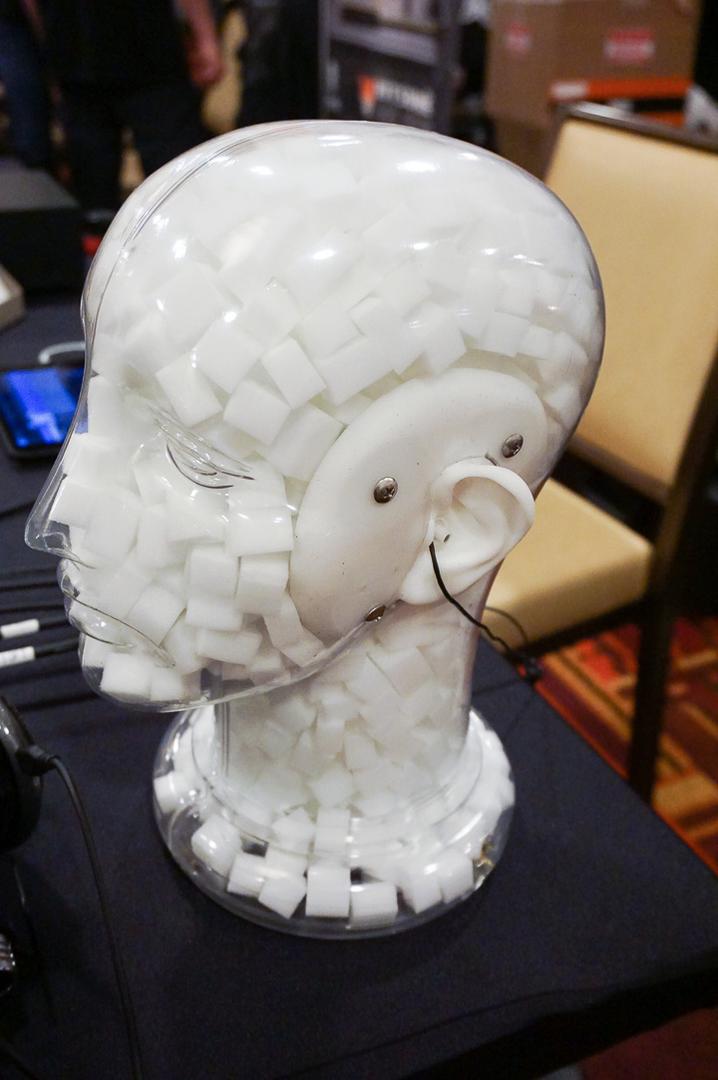
Theoretic Applied Physics, headed by Development Engineer Bayard “Buddy” Gardineer, was showing its ultra high-quality BACCH-BM binaural microphone with precision USB EQ correction, priced at $2,980. Once the requisite EQ is applied, the BACCH-BM mic system delivers impressively even frequency response with a nearly ruler-flat response curve.

The impressively small BACCH-BM mics are so small that individuals seeking to make high quality binaural recordings conceivably could wear them as in-ear devices at live musical events. One obvious drawback, though, is that you can’t wear in-ear monitors and the BACCH-BM mic modules at the same time, so that you would have to record without actually being able to monitor the recording in process.

However, a better solution might be to install the BACCH-BM mic modules in a new recording ‘head’ that Theoretica is working to create. Pricing for the head is yet to be determined, and the status of the potential product is unclear, but when/if the head becomes available it should cost considerably less than the mic modules do.

THX

THX showed a working prototype amplifier based on the firm’s new AAA headphone amplifier modules, which claims to be the quietest and lowest distortion headphone amplifier on the planet. Products that employ THX’s groundbreaking AAA amplifier technology should begin to appear on the market later this year.

Trinity Audio Engineering

Various earphone makers have offered models that offered perhaps two or three voicing tuning filters, but none have taken the concept quite so far as has the British firm Trinity Audio Engineering. You see each of the three earphone models Trinity showed at SoCal CanJam—the Vyrus V2 (£59), the Master (£159), and the Icarus III (£175)—ships with no less than 12 pairs (!) of colour-coded, anodised metal voicing filters, which should give even the most indecisive listeners among us more than enough options to choose from. And did we mention that both the Trinity earphones and their filters offer almost gem-like fit and finish? They do.
 

Ultimate Ears

Apart from demonstrating its digital/optical ear-scanning system (a great alternative to taking traditional in-ear mould impressions), Ultimate Ears focussed its efforts on demonstrating two of it latest CIEM products—the Capitol Recording Studios-approved UE Pro Remastered ($999) and the UE 18+ Pro ($1500). The UE Pro Remastered, which is descended from the famous UE IERM (in-ear reference monitor), feature three proprietary balanced armature-type drives. The UE 18+ Pro, in turn, features six balanced armature-type drivers linked through four passive crossovers.


Ultrasone

At the Ultrasone table I was able to sample three of the German firm’s latest headphones, ranging from the premium-priced Edition 8 EX ($2,199) to the new mid-priced Signature Studio ($599) on down to the also mid-priced 880 ($499).

Not surprisingly, the Edition 8 EX both looked and sounded terrific, representing a continuation of the high performance heritage of Ultrasone’s Edition-series range of headphones. But what surprised me was how much of the Edition ethos managed to find its way into the more affordable Signature Studio and 880 models. For this reason, I think the mid-priced portion of the Ultrasone headphone range deserves further investigation.

Wells Audio

Wells Audio has long been known for its bespoke headphone amplifiers, but for CanJam SoCal the company founder Jeff Wells pulled out all the stops to show his new ultra flagship model called the Headtrip Reference ($15,000), which was being demonstrated in conjunction with the also new Abyss AB-1266 Phi (or AB-1266 Φ, depending on your preference for Greek symbols) planar magnetic headphone, as fed by a Playback Devices source. The result was what many in attendance (including this author) felt was arguably the Best Sound of the Show.

The Headtrip Reference can do it all: power, extension at both high and low frequency frequency extremes, dynamic expression, subtlety, nuance, definition, resolution, and finesse.

Also on demonstration was Wells’ adorable entry-level Milo amp, which gives a taste for what the big Headtrip can do, but at the much more modest price of $1,699. The Milo, with its vertically orientated chassis, also looks just plain cool.

WyWires

WyWires’ bright red Red-series headphone cables have almost become a fixture at CanJam events, with many manufacturers using the cables as their headphone signal wires of choice, but for CanJam the firm showed its even higher performance Platinum-series headphone cables. For comparison purposes, WyWire’s new Platinum cables sell for $599 a set, where the Red-series cables sell for around $349 a set.

CanJam SoCal 2017 –Part 3

On the weekend before Easter, Hi-Fi+ Associate Publisher Pete Collingwood-Trewin and I took the opportunity to visit CanJam SoCal, which was held at the JW Marriott hotel in the middle of downtown Los Angeles.


The event was popular with manufacturers and with show-goers, it seemed, so that at times there were lines of enthusiasts queuing to hear the enticing products on demonstration.

What follows is the third of what will ultimately be a four-part report on the event.

IMPORTANT: As always, we apologize to any manufacturers we were not able to visit. No slights of any kind are intended. Then again, please note that on more than a few occasions we visited manufacturers only to be turned back by the crowds of people surrounding their demonstration tables (which is, as the old saying goes, a ‘high quality problem to have’).
 

FiiO

FiiO’s primary emphasis at SoCal CanJam centred upon its X5 3rd-generation Android-based digital audio player ($399), which features dual AKM AK4490 DAC, uses a Rockchip quad-core RK3188 processor, provides 32 GB of internal storage, capacity for up to 512GB of external storage, offers Bluetooth 4.0 and Wi-Fi support, and provides both single-ended and balanced headphone outputs. The name of the game for FiiO, then, is to offer huge functionality at much less than the going rates expected for such an advanced technology device: mission accomplished.

Focal

Focal did not have a genuinely new headphone model to show for CanJam, but what they did have is arguably the most ostentatious, most blinged-out, and most over-the-top headphone ever in the form of the Utopia Tournaire headphones, which will sell for the eye-watering sum of $120,000/set. What’s more, no self-respecting Tournaire owner would want to go without the matching Tournaire headphone stand, which is offered for a mere $12,000. What’s behind these sky-high prices? Well the Utopia Tournaire is basically a standard Utopia headphone done up with gold (not ‘golden’, but actual gold) trim pieces inset with diamonds (lots of diamonds). The stand, in turn, resembles a mask that might be worn at a formal costume ball and is also treated to gold-plated outer surfaces.

Head Amp

Head Amp did not have any truly new headphone amplifiers on display, but it was showing its famous Blue Hawaii SE electrostatic headphone amp ($5,800 – $6,800 depending on configuration) in conjunction with a set of world-class Stax SR-009 electrostatic headphones. For Hi-Fi+ Associate Publisher Pete Collingwood-Trewin, this represented a first opportunity to hear the Stax flagship headphones at their best and it would be no exaggeration to say that, for Mr Trewin, this quickly proved to be a case of ‘love at first listen’.

Also on demonstration was Head Amp’s GS-X MkII two-chassis headphone amplifier for conventional—that is, non-electrostatic—headphones, which sells for $2,999. The only thing that consistently throws me off about this latter model is that its nomenclature makes me think it must surely be a blisteringly fast sportbike from Suzuki (whose go-fast motorbikes are commonly and collectively known as “Gixxers”).

HiFiMAN

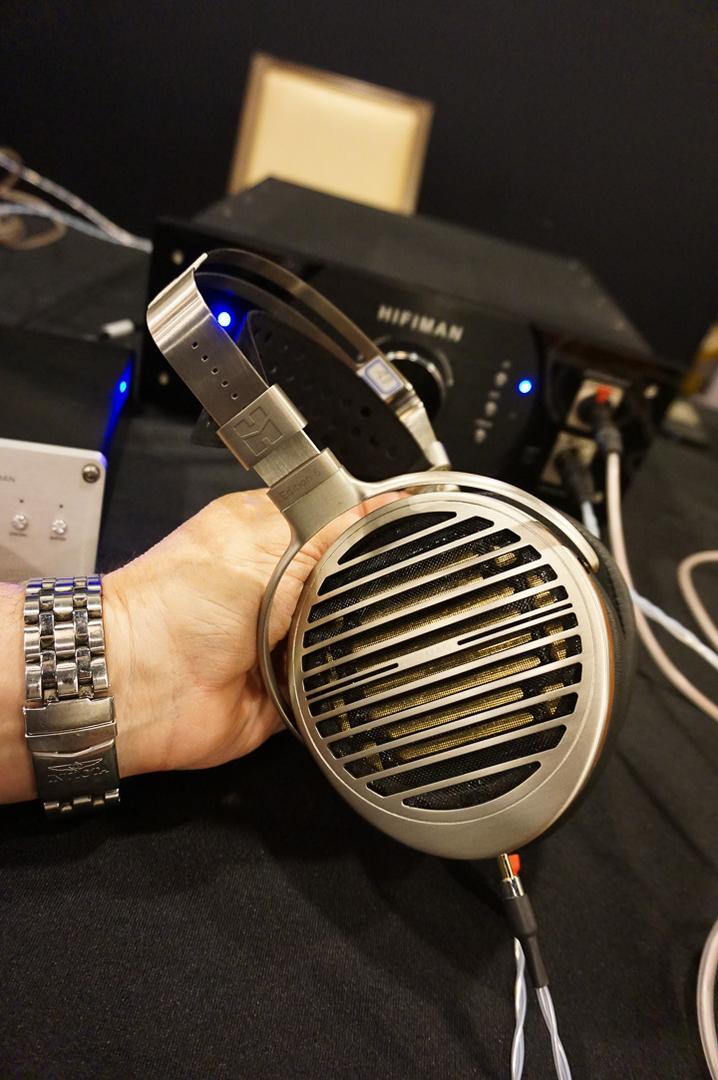
For CanJam SoCal HiFiMAN renamed its upcoming flagship planar magnetic headphone as the Susvara (previous exhibited as the Edition 6). The price: ~$6000. For HiFiMAN, the Susvara is the last stop on the performance ladder before reaching for the stars with the mighty Shangri-La electrostatic headphone system.


Holo Audio USA/Kitsune HiFi

Holo Audio USA and Kitsune HiFi are headed by Tim Connor and the firms operate as two separate but complementary entities together responsible for bringing us the both standard and upgraded Holo Audio components, the most notable of which is the Holo Audio Spring DAC.

To be clear Holo Audio USA imports Holo Audio products to North America, and distributes them there, while Kitsune HiFi provides specialised tweaks and upgrades for those products, if desired.

The standard (or Level 1) Holo Audio Spring DAC sells for $1,699 and is a high-resolution PCM/DSD-capable R2R ‘ladder DAC’ with linear compensation. The component provides, says Holo Audio USA, a dual R2R network for PCM decoding and a dual R2R for DSD decoding. The standard Spring DAC features standard PSU capacitors and standard ‘Red Label’ 6N copper transformers.

For a bit more money Kitsune offers the Holo Audio Spring DAC Level 2 “Rise Ji Edition” ($1,899), which features upgraded Jensen PSU capacitors.

Then, at the top of the line, we have the full-on Holo Audio Spring DAC Level 3 “Kitsune Tuned Edition” ($2,499), which provides both upgraded Jensen PSU capacitors and special “Green Label” 99.99% pure Silver O-type transformers.

Quite frankly, the Spring DAC “Kitsune Tuned Edition” strikes us as being an awful lot of DAC for the money—and one that provides the sorts of advanced R2R technologies typically only found in far more expensive digital audio components.

JDS Labs


In past show reports we’ve talked a bit about JDS Labs’ lovely Element amp/DAC ($349), but now that unit’s industrial design has given rise to an equally beautiful line of separates comprising the Element EL Amp ($279) and the matching Element EL DAC ($249), both of which offer ridiculously superb performance specifications for the money (or even not just or the money).

For example, the amp offers super low distortion (0.0009% THD + Noise @ 1kHz, 150 Ohms), very high power (up to 1.1W AT 32 Ohms), and two switchable gain settings for use with both conventional headphones and sensitive IEMs. The DAC, in turn, offers transformer isolated S/PDIF inputs and self-powered USB inputs,  is based on the successful AKM AK4490EQ DAC device backed by an OPA2227 opamp, offers extremely linear frequency response (20Hz – 20kHz ± 0.15dB), low distortion (0.0011 THD + Noise from 20Hz – 20kHz), low noise (-019dB A-weighted), very low jitter (USB jitter components 11025Hz, -116dB), and support PCM files up 32/384 rates. In short, both these JDS Element models are not only lovely to look at, but also represent screamin’ good deals.


Jerry Harvey

When it comes to ultra-high performance in-ear headphones and CIEMs, Jerry Harvey Audio may well and truly have invented the proverbial ‘better built mousetrap’ in the form of its unspeakably cool new Siren-series Lola model ($1,599 in universal-fit earphone form, or $1,745 and up in CIEM guise). In a sharp departure from previous Jerry Harvey designs, the Lola features a hybrid driver array consisting of a quartet of balanced armature-type high-frequency tweeter drivers, a pair of balanced armature-type bass drivers, and in the middle something truly new—namely, a pair of small dynamic driver built into a miniature, horizontally opposed, vibration-cancelling midrange enclosure. JHA calls this new driver enclosure DOME (which stands for Dual Opposed Midrange Enclosure) and judging by the Lola’s sound DOME really works.

In a brief listening session, I was floored by how open, transparent, free breathing, and above all coherent the Lola sounded. Based purely on first impressions, I would say the Lola might well be one of the greatest (if not the greatest) in-ear transducers on the market today. JHA President Andrew Regan said he felt the Lola represented company founder Jerry Harvey’s finest work to date and I would certainly agree with that assessment.

Linear Tube Audio

Linear Tube Audio showed its David Berning-developed Micro ZOTL 2 valve-powered, output transformer-less headphone amplifier/preamp ($1,895), which seem to have been winning new friends (not to mention critical acclaim) every time it has been on demonstration.


Little Labs

Headed by veteran studio technician Jonathan Little, Little Labs offers a range of useful Pro Audio devices, the most important of which, for headphonistas, is the firm’s excellent Monotor headphone amplifier ($600). The company bills the Monotor as “the only audiophile headphone amp designed for pro audio work.”

The Monotor provides dual sets of independently amplified 6.35mm and 3.5mm headphone output jacks, while supporting a range of stereo (R/L, L/R) and mono (L+R, L, R) output options.  The unit sports an outboard power supply and offers combo balanced XLR/TRS inputs. In a too brief listening session, I was struck by the Monotor’s fast, clean, and almost hyper-neutral sound. It would be interesting to compare the Little Labs Monotor vs. the also Pro Audio-orientated Rupert Neve RNHP headphone amp (I can already see the tagline: “Studio Veterans Battle It Our for Headphone Amp Supremacy”).

Modular Ears

Modular Ears showed prototypes of two earphone product concepts: the ME2 ($299) and the ME4 (price TBA). Both models, however, leverage the same big idea, which is to build earphones that offer rear mounted, plug-in style voicing control modules (or ‘personality modules’, if you will) that allow considerable variation in the overall sonic character of the earphones. Unfortunately, by the time I made it to the Modular Ears table, the ME4 prototype had got damaged, but what I heard from the still-working ME2 prototype was more than enough to pique my curiosity.

Motif/Surf

Motif and Surf are sibling cable brands, but ones designed to cater to different parts of the headphone market.

Surf cables are all about providing high performance at sensible prices and to this end use silver-plated copper conductors with Teflon dielectrics. Typical Surf headphone cables would sell for between $90 and $110 for 4-foot or 5-foot models, respectively, with the same prices applying whether the cables are terminated for full-size headphones or for IEMs.

Motif cables also aim to provide meaningful upgrades from stock headphone/earphone cables, but with a particular emphasis on doing so while looking good if not looking outright posh. With this brief in mind Motif cables feature jackets whose outer surfaces use what looks like the sort of braided metal (or ceramic-coated metal) mesh used in fashion bracelets and necklaces from jewellers such as Charriol. Accordingly, Motif cables are offered in silver or black finishes ($59) or in gold or rose gold finishes ($69) and are billed as “the only headphone cable you can wear as jewelry.”

MrSpeakers

For CanJam SoCal the San Diego, CA-based firm MrSpeakers was showing its new mid-priced ÆON planar magnetic headphone ($799), which is now fully released to production and which will be reviewed in the next issue of Hi-Fi+.

About the only thing that’s changed in the ÆON since it was first shown at the CanJam NYC event earlier this year is that the materials and manufacturing techniques used for the ear cup-mounted driver frames has changed, resulting in a weight loss of several ounces, making an already delightful headphone even more comfortable to wear for longer listening sessions.

A Tale of Two Cities

We’ve been holding out on one of the two recent launches, in part because our counterparts over at The Absolute Sound covered the Sonus faber launch so well. But the recent launch of the new Homage Tradition range from the Italian brand, and more recently the launch of the Moon 888 amplifiers, highlights a recent and important change in the way audio products are presented and marketed, and it’s good for everyone!

These were two high-profile launches, one of a high-end trio of loudspeakers, the second a pair of no quarter given £125,000 power amplifiers. Both were placed in prime location spaces; the first in swanky Central London dealer KJ West One, the second in a private room in Edinburgh’s Scotch Malt Whisky Society, which was then followed by public session in the Loud & Clear Edinburgh store. Both placed an emphasis on a public/private launch, with members of the press given an exclusive preview in advance of the invited public visit. In part, this reflects a change in the dynamic of the audio media itself, and in high-profile launches this now includes mainstream newspapers and appropriate tech bloggers. But the days of a dozen audio journalists from half a dozen countries rocking up at the opening of a crate seem to be over – that’s what shows like Munich are for.

A quick look at the products themselves. The three strong Sonus Faber Homage Tradition loudspeaker range replaces the popular Amati 3.5 way floorstander and two-way Guarneri standmount with similarly named (but very different) models. These are joined by the all-new smaller 3.5 way Serafino, with a Vox centre channel expected later in the year. Serafino follows the other models in the Homage series, in that it’s named after an Italian master violin-maker, this time Santo Serafino. As ever with modern Sonus designs, the lute-shaped design is richly finished in metal, leather, and wood, with a new dark wenge finish joining the ever-popular red walnut. The overall look is reminiscent of classic Riva Ariston launch (in the process, the trio are an unofficial land-lubber’s tribute to yacht designer Carlo Riva himself, who died last month at the age of 95). The loudspeakers feature a number of innovations from previous models, too, including a ‘Stealth Ultraflex’ wave-shaped ducted rear port, clever decoupling, low resonance ‘Silent Spike’ mounting system, and a carbon-fibre stand for the Guarneri. In listening at KJ West One’s base, the Amati and Guarneri were both extremely impressive in terms of producing a sound that retains much of the lush and lovely sound of classic Sonus faber models (including the Guarneri Homage and Amati Futura these new models replace), but with a sense of pace and increased dynamic headroom that makes them appeal to the most modern of audiophiles. Priced at £13,600 per pair for the Guarneri, £18,000 for the Serafino, and £23,500 for the Amati Homage Tradition.

A speaker costing close to £25,000 is one thing. A pair of £125,000 mono power amps is quite another. Moon’s new 888 – first seen at CES in January – is a departure for the brand, more commonly associated with high-performance audio from the attainable to the ‘spendy’. Prior to the 888, the company’s most outré design was the 880M mono amps, and you can buy almost four pairs of 880M for the price of a pair of 888. Designed as a statement of intent at Moon, the 888W per channel monoblocks are designed with an output capacity of 8kW, can run balanced or single-ended, feature 350,000µF of reservoir capacitance, have some of the most innovative and effective heatsinks in audio, and include very clever rhodium-plated speaker cable terminals that lock down on spade lugs more effectively than any kind of termination we’ve seen to date. The result is an amplifier that can effectively drive any loudspeaker effortlessly, with the kind of chassis that dissipates heat and vibration as efficiently as a race-car. Played through a full Moon system into a pair of YG Sonja 1.3 using custom Studio Connections cables and Quadraspire racks made specifically for the huge 888s, this system played with grace and effortless power long into the night, both before, during, and after the consumption of quite a lot of cask-strength whisky.  

So, why does everyone benefit from these kind of events? Frankly, like many in the business, I’ve grown somewhat uncomfortable at the idea of a closed launch to the press. Trade-only events like CES work for some devices, but if manufacturers take the time, trouble, energy, and expense to set-up and install a system, it’s only fair that the demonstration is made to the greatest number of people. OK, so presenting the speakers to a mix of press and actual human beings is probably not a good idea, because (disregarding the musty smell and mild case of rabies inherent to all audio critics) the press will monopolise the event, asking questions and demanding interviews and photo calls. Having sat in on a couple of truly mixed press conferences, there’s a sense of frustration that sets in on the public’s part because of the rounds of questions getting in the way of the audition.


However, the scheme works, if you allocate two sessions for the same event; one for the press, one for the public. And in both launches, this happened, and happened successfully. A select pack of journalists in one session (I’m not convinced ‘pack’ is the correct collective noun for journalists: maybe ‘a bullshit of journalists’ is more accurate) invited and interested music lovers for the next. Of course, this only works if there are a relatively small number of new products launched at the event. If there is a whole range, this is probably best served by a press conference, or a show proper.

More importantly, these kinds of launches both demonstrate positive signs for the audio world. First, these events are professionally produced, in spaces where you might want to visit without fear of catching scabies from the chairs, or rabies from the demonstrator. If we are making products that cost as much as a Mercedes Benz, they should be presented in an environment and by people professional enough to exist in that market. Yes, it’s all about the sound, but if the guy trying to convince you about that sound is wearing last week’s breakfast, and the room has that ‘best before 1973’ look and smell, potential music lovers will go elsewhere (and that doesn’t mean ‘another audio dealer’, it means they will spend it on a better Mercedes, or a holiday, or a nice watch, and so on). Some companies are learning this, making products that deliver the sonic and the visual goods, and many of these companies are also placing their products in suitable environments.

The other good sign is recognition beyond the audio world, and a lot of that falls to the vinyl revival. Listening to music on LP is now so much of a ‘thing’ that it’s used in advertising all kinds of products, and the halo effect of that is benefitting all manner of audio communities. So, we see hi-fi reappearing in the luxury and lifestyle media, and even in the newspapers. Sure, a big part of that relies on headline-grabbing prices (I don’t think the feature about the 888 amps would have appeared in The Scotsman newspaper –  http://www.scotsman.com/business/companies/retail/edinburgh-hi-fi-specialist-makes-big-noise-with-moon-1-4429580 – were it not for that six-figure ticket) but almost any publicity is good publicity after so long in the wilderness.

I hope this is just the start of a more intelligent way of bringing the products we all get excited about to a new audience. Local events like this will never (and should never) replace big events like Munich High-End, but they do supplement the excitement of such shows, and bring that excitement to a more local level, without the dusty store owner and his out-of-date approach to music and audio. I can say this without it being too much of a cliché thanks to Moon using the term, but such events are more an evolution than a revolution, but they are also causing a bit of a revolution, too. Long may it continue.

Markaudio-Sota Tozzi Two standmount loudspeaker

A small loudspeaker has the advantage of being almost a point source. It’s one of the great advantages the UK audio industry exploited to its fullest extent from the 1960s onwards. But there’s a great distinction between ‘almost’ a point source and a true point source, and that’s where the Markaudio-Sota Tozzi Two comes in. This is a genune point-source in its truest sense, because it’s perhaps the simplest loudspeaker Hi-Fi+ has reviewed in years. It shares many basic concepts with loudspeakers from Eclipse, in terms of size and number of drive units per channel, but the two diverge rapidly beyond that point. Of course, the cabinets differ pretty substantially, too.

The Tozzi Two is a small, light, rear-ported box loudspeaker, designed to be used in very near-field applications, such as on the desktop or in a tiny room. Basically, if they are close enough to touch from the listening position, that’s about right. The front baffle is slightly larger than the rear, creating a natural backwards tilt when the Tozzi Two is on that aforementioned desktop, and this angles the loudspeaker cones almost perfectly at seated ear height. Making the Tozzi Two potentially a fine computer speaker.

The rear ported cabinet isn’t breaking new ground (with one notable exception), but the single-wired Tozzi Two is every bit a form-follows-function design. That notable exception is on the baseplate, where at the bottom dead centre of the design is a small hole. This is designed to take a 1/4-20 UNC thread, the kind of screw-thread that is used extensively in photography and musical instrument stand design. In other words, if you have a small lighting stand, photo tripod, or microphone stand, you just got a loudspeaker stand. Given you can buy lightweight lighting stands from Amazon for less than £15, and microphone stands are sometimes even less, you are not going to be spending big on accessories.


But the ‘big’ aspect of the Tozzi Two is the drive unit; a variant of the 75mm Alpair 5 drive unit designed by the ‘Mark’ in Markaudio – Mark Fenlon. This is a crossover-free design (what’s there to cross over, there is just one drive unit?). It’s a free to air design, permeated from the baseline with Fenlon’s engineering smarts. Although he now lives in Hong Kong, Mark Fenlon is every bit the British engineer in the style of Colin Chapman of Lotus Cars. He lives by Chapman’s ‘Simplify, and add lightness!’ maxim, and it shows in the all-range unit. The Alpair 5 drive unit in the Tozzi Two eschews almost all loudspeaker conventions, right down to doing away with the spider at the rear of the unit and instead uses a single front suspension arrangement. The result is an ultra-wide band driver with exceptional linearity, especially when used in the kind of cabinet it was essentially designed for. In a way, if I’m being picky, the Tozzi Two reflects the design criteria of a loudspeaker drive unit engineer building a cabinet to house that unit. Concerns like a gently radiating wide horn taking up the whole of the front baffle, the square front plate. The sort of utilitarian, almost puritanical lack of embellishment on the loudspeaker cabinet… all shout ‘driver guy’. It is something of a tribute to Fenlon that he hasn’t simply sold the Tozzi Two as a cardboard box with a hole for the driver… that’s the kind of single-minded approach he’s taken here, and all the same, the loudspeaker is the better for being designed in an uncompromised manner.

The exciting part of the whole Tozzi Two is its performance. Mark clearly has been getting his sums right, because these loudspeakers behave like a notionally ideal point source, while also possessed of incredible speed of attack and release, extraordinary detail retrieval, and pin-point precise imagery. With the right music, played through the right electronics, in the right room, the Tozzi Two disappears in a way many products strive to achieve. Many are called, few are chosen.

I played Birdy’s cover of Bon Iver’s ‘Skinny Love’ from her eponymous debut album [14th Floor, Atlantic], and I must confess that I’m conflicted on this track. On the one hand, it’s an awesome first outing from someone who’s likely to be a fixture on the indie-folk scene for many years, I’m prepared to forgive her a lot as this was her first album (she was aged just 14 when it was released), and it’s a great track that lofted her to stardom.  On the other hand, it can sound a bit breathy and fey. However, through the Tozzi Two, you don’t get so much of an accent on ‘breathy and fey’, instead you get someone standing in the room singing her young heart out with the kind of unalloyed candor and energy that only a teenager can deliver. The audio system folds away and it’s just her and the piano in the room.

Where this loudspeaker excels is in the playing of one or two instruments in an unamplified setting. Birdy’s voice has tiny reverb tails that you can easily define here, and her voice has a sense of organic body and presence that’s extraordinary at this price. However, scale things up to a larger band, and the same ‘disappearing’ quality is foreshortened. It’s perhaps not unexpected, but this is not the loudspeaker for showing off your latest cut from Mastodon, or playing ‘Du Hast’ from Rammstein’s Sennsucht [Motor Music] at an appropriate lick is not going to put a smile on your face. It’s not painful, but it’s not loud, and nor does it have a powerful enough grip over the bass to make it alluring. Similarly, trying to squeeze a powerful orchestral swell out of the Tozzi Two in anything larger than a box room is going to sound a little bass light.


In a way, we’re criticising a remarkable point source loudspeaker with excellent imagery and detail, for not being a huge tower loudspeaker that does neither of those things well, but comes with a lot of slam and punch. A small single drive unit designed to be as unchallenged by convention and as light as it’s possible to get means some considerations need to be made. This is not an efficient loudspeaker, but in some respects that doesn’t matter because you will be using it up close. Until you don’t. If you use it to fill a large room with plenty of loud sound, you’ll regret the decision. OK, so it’s not fragile, but don’t expect it to sound particularly good when driven hard. Keep it to less than about 20 watts per channel, and don’t expect gut-churning bass in a barn, and you’ll be OK.

The Markaudio-Sota Tozzi Two is a ‘specific task’ loudspeaker, and it achieves that task perfectly. It’s not for headbangers. It’s the kind of loudspeaker you could use on a desktop for hours on end without any stress, and could even be used to play good sounds in a small to medium sized room brilliantly. Not a speaker for the everyman, but loads of fun!

TECHNICAL SPECIFICATIONS

  • Type: One way ported loudspeaker
  • Drive unit: 1x Alpair 5 all-range driver
  • Frequency Response: 90Hz-27kHz anechoic
  • Sensitivity: 84dB/W/m
  • Power handling: 15W nominal, 30W peak
  • Optional finishes: Rose Alloy, Grey peak
  • Dimensions (W×H×D): 20 × 20 × 12.6cm
  • Weight (each): 1.96kg
  • Price: £1,500 per pair

Manufactured by: Markaudio-Sota

URL: www.markaudio-sota.com

Tel: +852 2605 2811

Distributed in the UK by: Dr Scott Lindgren

email: [email protected]

Back to reviews

Read more Markaudio reviews here

Hegel Röst integrated system amplifier

Hegel Music Systems has come up against the Law of Unintended Consequences with its new Röst integrated amplifier. The flexible, easily networkable, white-fronted integrated amplifier came as a result of direct requests from the iChummy North Americans and style-conscious Danes, and it has sold extremely well everywhere in the world… except for North America and Denmark! Give people what they want, it seems, and they always want something else.

Those two countries dismissing Röst (pronounced somewhere between ‘roost’ and ‘rust’ for non-Scandi ears) are missing a trick, because this is a truly outstanding one box, does-almost-everything device. How much of an ‘everything’ largely depends on you. If you have a Control4 multiroom system, Röst is one IP address away from seamlessly joining in a two-way conversation with your home. If you have Apple devices, you can connect using AirPlay, or you can use Röst with any sort of network storage, even Sonos Connect.

The 75W per channel Röst is also a distillation of all the best bits of Hegel’s recent highlights; it has the latest version of the company’s SoundEngine localised feed-forward amplifier design from the H360, and applying that to something very close to the popular H80 amplifier chassis and circuit and running with it. This meets what is basically the DAC and headphone amp stage of the H160, and then mixes its own special sauce into the recipe for connectivity to Ethernet connection for all those next-generation audio sources.

Röst has two potential ‘bonuses’, which can go either way on the ‘bonus’ continuum. Living so much of its life through Ethernet, Röst has no need of any kind of wireless connectivity, as it’s expected that wireless access occurs upstream at the Wi-Fi router point. By not including its own wireless connectivity, Röst is preventing possible wireless clashes on a network. That all being said, the inclusion of some kind of Bluetooth receiver would be useful, for those short-range signals that won’t be transmitted across a network, but are mandatory for all teenagers.

Next, Hegel’s built-in digital converters support 24-bit, 192kHz PCM audio files through coaxial, optical, and Ethernet connections, and only 24/94 through its USB input. Unlike the company’s standalone HD12 and HD30 DACs, Röst and the other Hegel integrated amps do not support DSD. This, however, fits well into an Ethernet view of the world, as the ability to stream DSD files across a LAN is not entirely robust. The fact USB is capped at 96kHz probably also fits in with the intended customer base for Röst: this is an audiophile-grade product for people who would never consider themselves audiophiles, rather than those who are prepared to faff around with dedicated drivers for higher resolution audio. In other words, it’s the high-performance sounding amplifier for system integrators and the multiroom systems they provide, and it’s the one visible box in a more comprehensive system hidden away in a plant room somewhere. That is not to say Röst cannot be used in a more conventional audio setting, but those self-evident strengths are as much about its ease of integration into a larger network as they are as a great sounding amplifier.


Hegel doesn’t use what it refers to as ‘asynchronous upsampling’ in any of its digital processing. Everyone else calls this ‘SRC’ or ‘Sample Rate Conversion’. Hegel avoids this because it folds jitter errors into the ‘to analogue’ part of a DAC. Instead, Hegel developed its ‘syncroDAC’ system that works in lock-step with the master clock.

Nevertheless, there are going to be people who view products as a simple numbers game, and will skip over Röst because they see figures like ‘24/96’ and ‘75W’. This is perhaps something Hegel has always had to deal with, however; as those who listen, not those who obsess over numbers, buy the H80. I can already see the comments section of our website boiling over with the self-righteous purchase avoiders puffing up their chests to tell the world, “No DSD… I’m out!” once again. But here’s the thing: even if Röst did support DSD, they would still be ‘out’ because it wouldn’t be the right grade of DSD, it doesn’t support MQA, isn’t Roon Ready, on any one of a rolling series of ‘next gen’ options that help them limit the field to precisely no products on the market. Yes, in fairness, I would like to see Röst have some kind of Roon and TIDAL integration, and maybe have the option of greater than 24/96 through its USB input. But I’m the kind of audio nerd that Röst is only tangentially aimed toward.

Physically, the two big differences between Röst and previous integrated amps by Hegel are the display and the finish. The display is an OLED design and an order of magnitude more sophisticated than the big blue LED read-out of previous Hegel designs (in fairness, previous Hegel designs didn’t need as sophisticated a display, as source and volume were all that was needed).

The white finish was tougher to implement than it looks. Hegel wanted Röst to have a modern and elegant appeal, but not something that will quickly turn to that kind of dirty yellow when white plastic meets heat, sun, and age. It also wanted to create something that didn’t have the texture of old orange peel. Ultimately, Hegel went ol’ school and used thick white paint over the aluminium and steel chassis. This created its own set of idiosyncrasies to resolve, but resolved they were, and the overall look is actually really sophisticated and a world away from the black or silver finishes common to most audio electronics. I’m not going to play the ‘battle of the sexes’ card here, but it’s fair to say that the relatively limited set of amp colour options available to most amp makers does make a lot of audio electronics hidden from view, and Röst is one of the rare exceptions.


This could be a review of two amplifiers in one. The first is the conventional audio amplifier. The second is the amplifier designed to sit at the sharp end of a network connected and possibly multi-room concept designed by system integrators. But, in reality, the integration part extends well into Röst’s core, and as a result, it behaves like a Hegel amplifier, with benefits.

In fact, it behaves like a Hegel amplifier with all the latest technology in place. This is more profound than you might first think, because it makes plugging an Ethernet-connected audio system no more threatening than hooking up a CD player. The advantage – to real-world users and system integrators alike – is it’s not the kind of network-connected device that requires a lot of cross-referencing of the manual. Control4 installers simply look to the website for the relevant IP control codes for toggling power, operating source control, volume level, mute, and – if need be – resetting Röst. There is also a YouTube video showing how to connect it into a Control4 network. It can be controlled with the supplied remote, runs on conventional IR codes for those wanting a more customised one-controller system… and in all other ways acts like an amplifier with a DAC. Like the best in consumer electronics, Röst can never be ‘future proofed’ (because we don’t know what the future will bring – smart lawns and interactive e-socks notwithstanding), but it is about as ‘now-proofed’ as it’s possible to get.

All this would be as nothing for the audiophile if it didn’t sound good, but fortunately Hegel has a reputation for making fine-sounding amplifiers, and Röst does not undermine that reputation. In fact, if anything, Röst is currently the best sounding of all Hegel amps, unless you need the power of the H360 and beyond. More to the point, the knee-jerk need for extra power might not be as important as you think, unless you use a specifically current-hungry loudspeaker design, because I have heard Röst effortlessly drive loudspeakers it has absolutely no right being able to drive, like Magicos. And it drives them well. Of course, more real-world system partners exist (Hegel often demonstrates with KEF, and anything from LS50 to Blade 2 would be a fine combination). I went with the more extreme test and used Röst with the Wilson Audio Duette Series 2; a speaker worth roughly 10x the cost of the amplifier. While I wouldn’t recommend such a combination on price-balance grounds, in terms of performance it sang sweetly. I also used Hegel’s own excellent Mohican CD player, Airplay, and connected it to my Naim UnitiServe-fronted UPnP network: nothing phased Röst at all.

The joy of Röst – and perhaps what marks it out best as a ‘now-proofed’ product – is that it is exceptionally forgiving of signal, yet doesn’t do this at the expense of excellent performance; it all comes down to the file quality. Airplay is the great arbiter, here – the ‘Mastered for iTunes’ version of the title track of Rennen by producer Christopher Taylor’s alter band ego SOHN [4AD] is fairly typical of the kind of material this might play – because it can so easily sound thin, nasal, bright, and reedy. But through Röst, these elements are held at bay to let the music out.

When it comes to playing fine recordings – say, the ripped-to-WAV CD of Joni Mitchell’s ‘Court And Spark’, played by Herbie Hancock and Norah Jones on Hancock’s 2007 album River: The Joni Letters [Verve] – Röst gives the music its chance to shine, with outstandingly open dynamics and imaging, and a tonality that is entirely free from artifice.

Hegel’s signature detailed, slightly forward presentation, with very tight, deep, and ordered bass is still in full effect, but placed side-by-side with the H80, there is slightly more refinement and order to the sound. Not a massive step forward – the H80 already scores highly on the ‘refinement’ and ‘order’ stakes – but there is a small, but distinct improvement upon what came before. Again staying with the good recordings, playing several Contrapunctus by J.S. Bach from Bach: The Art of Fugue played by the Emerson Quartet [DG] through CD, there is a greater authority and sense of ‘in the room’ presence through Röst, which – like the H80 before it – accounts for the ‘fighting above its weight class’ performance.


There’s one last aspect of Hegel’s Röst that deserves a lot of credit: that headphone socket is no afterthought. It’s a fine expression of the Hegel sound, remastered for in-head use. It drives surprisingly difficult loads extremely well, doesn’t scream ‘leading edge detail’ at the listener, is refined, sophisticated, and makes a sound that you might expect from a more esoteric dedicated headphone amplifier. Granted, if you are a true headphonista, the filigree resolution and absolute detail you get from a top-class standalone system out-performs Röst, but for the long game of just sitting down and listening to music, the overall balance of the Hegel’s headphone output is easier to live with.

I confess I was struggling to find a way of describing Hegel’s Röst without using the ‘audio Swiss Army Knife’ phrase already well in circulation. Jet lag helped and I found the answer at about 4am as I jolted awake in a hotel room in Las Vegas: MacGyver! And I apologise profusely to the people in the adjacent room for shouting ‘MacGyver!’ out loud at 4am (I think they might have thought it was my safe word). But, the Hegel Röst fits that ‘MacGyver’ concept well, although fortunately it’s mercifully free from the late-1980s fashon sense of the original. It really is a ‘do anything’ kind of amplifier that – armed with little more than the tools it comes with out of the box – can work easily with absolutely any music source, and integrates with surprisingly sophisticated home network or home automation systems with equally surprising ease. If you think audio deserves to break free of the Man Cave, or even if you don’t and simply want a damn good amplifier with network benefits, the Hegel Röst is highly recommended.

TECHNICAL SPECIFICATIONS

  • Type: Integrated amplifier with network connected DAC
  • Power output: 2 × 75 W into 8 Ohms
  • Minimum load: 2 Ohms
  • Analogue inputs: 1 × balanced (XLR), 2 × unbalanced (RCA)
  • Digital inputs: 1 × coaxial S/PDIF, 3× optical S/PDIF, 1 × USB, 1 × Network
  • Line level output: 1 × unbalanced variable (RCA)
  • Frequency response: 5 Hz–100 kHz
  • Signal-to-noise ratio: More than 100 dB
  • Crosstalk: Less than -100 dB
  • Distortion: Less than 0.01% @ 50 W 8 Ohms 1kHz
  • Intermodulation: Less than 0.01% (19 kHz + 20 kHz)
  • Damping factor: More than 2000 (main power output stage)
  • Dimensions (H×W×D): 8cm (10cm w/feet) × 43cm × 31cm
  • Weight: 12kg
  • Price: £2,200

Manufactured by: Hegel Music Systems

URL: www.hegel.com

Tel: +47 22 60 56 60

Back to reviews

Read more Hegel Music Systems reviews here

WIN! Two chances to win fantastic Vertere Pulse Cables, worth over £2,500!!

We have teamed up with the innovative people from Vertere Acoustics to bring you our latest superb competition.

Vertere comes from the Latin meaning ‘to turn’ and Vertere founder Touraj Moghaddam has long been turning the engine of innovation within the Audio industry.

In Hi-Fi+ Issue 146, Alan Sircom reviewed the MG-1 turntable, SG-1 arm, and PHONO-1 phono stage. He wrote, “The dynamic range on this turntable is phenomenal, bettered only by a few, and two of those in the Vertere range. This is one of the most confident vinyl front-ends you can buy, and not just ‘at the price’. The MG-1 turntable delivers much of what the better and best Vertere turntables can produce, the SG-1 arm is already a known good ‘un, and the PHONO-1 is one of the most naturally sounding phono stages I’ve heard in a long time.”

Even before it made fine turntables and tonearms, Vertere was best known for its outstanding cables. Our fIrst lucky winner will receive a 1.5 m Pulse-HB Digital USB Cable, worth £1,650. Our runner up will receive a 1.65m Pulse-B Analogue Interconnect Cable worth £945. 

Simply answer the question below to be in with a chance to win.

Competition Question

What does the word “Vertere” mean?

A. To turn

B. To listen

C. To silence

To answer, please visit Vertere’s dedicated competition page at

https://vertereacoustics.com/vertere-hifi-may-july-2017-competition/ 

Alternatively, send your answer on a postcard (including your name, address, and contact

details) to: 

Vertere Competition,

5 Oliver Business Park,

Oliver Road,

London,

NW10 7JB,

UK.

Competition Rules

The competition will run from May 4th, 2017 until July 10th, 2017. The competition is open to everyone, but multiple, automated or bulk entries will be disqualified. The winnerwill be chosen at random from all valid entries, will be contacted via email (where possible) and their name will be published in the magazine. The Editor’s decision is final andno correspondence will be entered into. Absolute Multimedia (UK) Ltd. is compliant with the Data Protection Act and UK laws apply. Our policy is such that we will not pass on yourdetails to any third party without your prior consent.

XT-7: a new Italian Soundscape

FIRENZE, Italy: Gold Note – the Italian High-End manufacturer based in Firenze – is introducing XT-7, the new full-range, 3 way speaker with anti-turbulence bass reflex and ribbon tweeter available in Black Glossy, White Glossy, Italian Walnut or Grey Maple.

Link to the webpage: www.goldnote.it/xt-7

With a distinctive curved design based on a reinforced chassis in wooden multilayer panels to control resonances and sound, XT-7 offers state-of-the-art solutions: high quality crossover boards with Mundorf and Clarity components and custom drivers developed with SEAS in ultra-stiff woven polypropylene.

The separated cabinets for bass and mid/highs enhance perfect tuning: the bass drivers cabinet side is vented while the mid/highs is perfectly sealed to reduce internal reflections.
Weighing about 50kg each, these massive speakers are completed by wooden swallow tailed stands that features adjustable spikes to guarantees stability.


Gold Note has recently poured all the technical knowledge gained in over 20 years of OEM collaborations worldwide into the new lines of speakers, created to marry perfectly appearance and substance and provide a fulfilling audio experience.

Garlo Certini, Head of Acoustics, developed a deluxe crossover with state-of-the-art components provided by Mundorf and Clarity. The passive Crossover Low-High Dual-Slope cuts at 280Hz & 3000Hz and features a resistive design to enable ultra-linear load that support the work of the amplifiers minimising the stress on power supplies even at a nominal impedance of 4Ω.

The boards are made of thick audio-grade and anti-resonance glass fibre with 70uM gold plated conductors and power a sophisticated triple crossover network and a summing midrange multi-slope design to perfectly integrate the drivers of the array.

Midranges and Woofers ultra-linear drivers are developed with SEAS and enhanced with proprietary metal chassis produced by MIM [Metal Injection Molding], and refined with radial reinforced low loss rubber surrounds, custom copper phaser and heavy copper rings.


All this technical features are matched by the impeccable finishes and the quality materials used thanks to the skill of one of the most talented Italian carpenters.

Maurizio Aterini, founder of Gold Note, added: “We believe that high end audio equipment should always be executed flawlessly in order to really satisfy all the senses because music is complete experience. That’s the reason why we put so much attention and care inside and outside our speakers.”

XT-7 is available worldwide through Gold Note dealers at a MSRP of 13.500,00€ (pair)

PRESS IMAGES:
https://www.dropbox.com/sh/kecdvikhxyobrcm/AAC5l8RlVDfTl7GM0hQ9qDRZa?dl=0

MORE INFO:
www.goldnote.it/xt-7


FREQUENCY RESPONSE

35 Hz – 30.000 Hz, Dual Slope

NOMINAL IMPEDENCE

4 ohm semi-resistive

SENSITIVITY

90dB SPL (2.83V/1 m)

SUGGESTED MIN. LISTENING POINT

1.5/2.0m

POWER HANDLING

30W – 200W

DIMENSIONS

1110 x 365 x 525 mm (HxWxD) including stand
WEIGHT
100Kg (pair)

About Gold Note: Gold Note (www.goldnote.it) has become one of the leading Italian manufacturers in the Hi-End audio, now with more than 20 years of experience in engineering and designing a complete line of analog equipment, electronics and loudspeakers. Founded in Firenze, Italy, where every product is still hand-built from scratch with high quality materials, its creations are a statement of Italian craftsmanship and innovation appreciated in more than 25 countries worldwide.

Address: Via della Gora, 6 Montespertoli (Firenze) Italy 50025
Phone number: +39 0571 675005
E-mail: [email protected]

AXPONA 2017: Digital Audio and Amplification (Part Two)

Continuing my ‘beat’ covering digital audio and amplification (with an awful lot of loudspeakers, analogue sources, and cables thrown in for good measure), April’s AXPONA event in Chicago is fast becoming one of the main fixtures in the audio world, and is arguably becoming America’s most important audio show in the first half of every year. Given the former significance of CES in January, that’s saying a lot.

The advantage AXPONA holds over the mighty trade event is two-fold; it allows the public to gain access to the latest and greatest audio equipment, and – from a public relations perspective – means new products from audio brands do not get swamped by discussions of wearables, drones, and gadget central.

D Digital’s room was another example of how all-digital rig seems so simple next to the extraordinary analogue rooms. A pair of Mark Levinson No 536 mono’s ($30,000 pr) a Mark Levinson No 519 audio player ($20,000 and on my wish list to review) feeding the mighty Revel Ultima2 Salon2 4-way floor standing speakers ($22,000pr) all connected with a collection of WireWorld Platinum Eclipse and Electra speaker, interconnect and power cables. Simple and high performance. The sound was inspiring!

Superior Audio systems was previewing the new Conrad Johnson Classic 62 KT120 amp. Coming in at £4,750 this tube based beauty offers 60 wpc into 8 Ohms. Feeding the amp was the auranas SRV music server (yes, lower case a). This device has enterprise grade music file protection and can play virtually any bit rate or format of music file. Running off an intel i3-4130T 4th generation Haswell chip is a slim 395mm x 225mm x 40mm. The system was powering a pair of Vandersteen Treo’s so I felt right at home!

The Cardas room featured an all Zesto Audio system driven by the beguiling Eros 300 Monoblocks Class A power amp ($19,900 Pr) and Leto 1.5 Pre-amp ($7,500). Speakers were the Marten Coltrane Tenor’s ($80,000) The Merrill Williams Audio REAL 101.2 turntable ($7,200) with Benz Micro Gullwing SLR MC Cartridge ($3,600) fed the Zesto Andros Tessera tube phono stage ($12,000). Stillpoints Ultra 6 feet ($899 ea), ESS42-26-5 Rack and Cardas Audio cables completed the system. This was one of my top rooms for sound quality at the show. Clear three-dimensional sound with terrific detail made this room a bit of an audio oasis compared to many of the rooms that presented significant sonic challenges to the gear. An excellent job by all parties in this room.

Lars Kristensen of Raidho fame is always one of the friendliest exhibitors. Even on a last day of a show he is in a great mood. Of course, if you get to listen to systems of the quality he does you would likely have a smile all day too. The mighty Aavik C-300 digital pre-amp/DAC ($36,000) fed the Aavik M-300 monoblocks ($48,000 ea) into the Raidho D-1.1 stand mount speakers ($23,000). The system had incredible imaging and instrument placement. The dynamics of these stand mounts was amazing. After a few minutes of the typical audiophile music someone handed him a CD or Rammstein’s Mutter (German heavy metal!) and the system rocked out.

Fidelis Music Systems had a stealthy Digital aspect to their seemingly all analogue room. The Zero-Uno DAC Plus ($9995) is a tube based DAC that could have easily been mistaken for a Phono Pre. Music was sourced from an Aurender N10 server ($8,500 with 8TB) It was feeding files to the VAC Sigma 160i Special Edition 85wpc ($14,000 + $2,200 for MC phono stage). Speakers were the Diapason Adamantes III ($6,599 pr) speaker cables were 3 Meter Tellurium Q Black Diamonds ($4,200 pr) Also featured was the Acoustic Signature Ascona MK2 Turntable ($32,995) and Acoustic Signature 12” TA 9000 Tonearm ($17,995). I was impressed with the Adamantes III’s delivery from the VAC integrated. As a tube fan this was a fun and well-coordinated system.

ExaSound was premiering their e32 DSD 256/DXD 32 bit DAC ($3,499) and e38 Multi channel DAC ($3,849) alongside the high value PlayPoint network audio player ($1,999 with Roon installed). The PlayPoint and e32 were feeding a Parasound A21 power amp ($2,500). Speakers were the Magnepan 3.7i’s ($5,995pr). Talk about bang for your buck. This was a high-performance system for an all in $14,000 USD. If you are looking to go digital ExaSound needs to be on the short list.

Audio Research was being presented by Quintessence Audio on the 12th floor. The Sonus Faber Il’Cremonese speakers were filling the very large room being powered by the Reference 250 Monoblocks and fronted by the Reference line of DAC’s and Pre-amps. The new toys were the VT80 amplifier producing 75wpc running KT120’s ($7,500), the DAC9 ($7500), the LS28 Linestage ($7500) and the PH9 Phonostage ($7,500) making up the new Foundation series. Aesthetics were sharp and very Audio Research.

Another Quintessence room featured Simaudio Moon driving the new Dynaudio 60 speakers ($10,000pr) The 780D DAC/Streamer ($15,000), 850P Pre-amp ($30,000) and the 860A 200WPC amp ($15,000) provided great power and grip on the Dynaudio’s. This was another top room for me. I am a fan of Simaudio Moon gear and Dynaudio has a hit on its hands with the Model60’s.


Any time Pass labs has a new amp it is news. Their new XA25 stereo amp puts out 25wpc and comes in at a more affordable price point ($4,900). Pass Labs amps have a history of producing power beyond their rated specs. The goal of the XA25 is to allow people to buy a Pass Labs amp at a more affordable price point. The design goal was to never compromise on the quality Pass is renowned for. The display was static so I hope to listen to it soon.

George Vatchnazde the Proprietor of Kyomi Audio always has a fun and terrific sounding room. The big Vivid Audio Giya G1 Series II speakers ($68,000) have a unique shape and a wonderful sound. Driving them were the big Jadis JA200 MK II Tube Mono amps ($33,900 pr) Digital audio was handled by the imposing MBL 1621 CD Transport ($28,000). TechDas Air Force, Graham Elite, Koetsu and Ortofon handled analogue. Cables were all from Stealth and stands from Artesania. This was a high-performance room and another top sounding room for me at Axpona!

Vladimir Lamm can build amps. That’s what I have heard. His Model M 1.2 Reference Mono’s run 110 watts in Class A! ($27,590 pr) The 1.2’s and the LP 2.1 Pre-amp ($8890) were driving the Gershman Grande Avant Garde G2 speakers ($12,999) Digital was supplied by the Oracle Paris CD 250 player ($3320). Oracle Tables and a Corinth Reference cartridge were also on hand. All cabling was via Nordost Valhalla. This was my second time listening to the Gershman speakers each time driven by Lamm electronics. It is now a regular stop for me. The sound was full and inviting. This straight forward system was another top room for me.

The Callia DAC/Headphone amp from Prism Sound (£1,795) was reviewed by Hi-Fi+ last fall and it was my first time hear it in the US. Paired with an active pair of ATC speakers via its XLR outputs. Given Prism’s 30+ years of Cambridge based pro audio history it was no shock to hear the clear mixing board honesty coming through the ATC’s. Mark Evans explained that the Callia was first shown in July of 2016 in the UK with 2017 CES as its American debut. Given its flexibility as a Pre-Amp/DAC/Headphone amplifier it can be the digital hub everyone could find some room for in our homes.


Hegel was showcasing their new Mohican Redbook CD Player ($5,000). Named so because it is likely the last CD player they will ever make. It was paired with their highly regarded H160 integrated 160 wpc ($3,500) and the terrific KEF Blade 2’s ($22,000) Cabling was all by Nordost. Comparing the sound of Tidal via streaming the Mohican had far more body and clarity on the same Ray Charles track. A no contest win for the Mohican.

The GamuT Audio room as usual was staffed by GamuT Audio lead designer Benno Baun Meldgaard and US distributer Michael Vamos of Audio Sky’s from LA. There was nothing new in the room but it was the most significant listening experience I enjoyed at the show. Sporting the GamuT RS7i speakers ($39,999) and 250 Monoblocks ($25,500 pr) The D3i Dual Mono Pre-amp ($8,250) Benno hooked up an RS62 Revox Reel to Reel and a new Tape pre-amp card inside the D3i. He put on a tape of Pink Floyd’s The Wall after hours and a group of us sat in candle light for the entire album. The sound was astounding. Having heard the album countless times, it was by far the single best presentation of it I have ever experienced. Opportunities like this are rare and cherished. By virtue of this experience the GamuT room is my top room for this year’s Axpona. Well done GamuT Audio!

Aavik’s more affordable room swapped out the Monoblock/Pre-amp for the Aavik integrated amp ($30,000) and the Raidho’s for Scansonic MB5 speakers ($6,950). With the room price dropping 80% in cost the sound barely diminished at all! The Aavik Integrated crunched out a clean 300wpc and the MB5’s were happy to receive the power. Soundstage and instrument position were spot on and virtually holographic. I expected excellence from Aavik. I was pleasantly surprised by Scansonic. Trickle down tech from Raidho indeed!

Constellation has filled a gap in their lineup with the new Revelation Series. Starting with the 250 wpc Taurus amp ($19,500 or Mono @ $39,000 pr), the Pictor Pre-amp ($18,000) and the Andromeda Phono Pre ($18,000) the new line was paired up with Martin Logan Renaissance speakers ($25,000) MIT Cables and Continuum Audio Labs Turntable with Viper Tone Arm and an Ortofon A95 cartridge rounded out this auspicious debut.

Bel Canto has been working for some time to develop an integrated version of the much-awarded Bel Canto Black system. The new C600 Black Integrated ($25,000) is an Integrated, DAC, Streamer and more. It is a gorgeous Black with Red all in one box bringing 300 wpc into 8 Ohms. Add speakers, in this case the Martin Logan Expression ESL’s ($15,000) and Nordost cables and you are ready to play. The system while simple was a wonder to hear. I am hopeful for a review sample!

A show this large presents a challenge to report on everything. I have touched on many of the personal highlights of this now largest audio show in North America. Hat’s off the Steve Davis and his team for a most successful event and best of luck with the move next year to the new venue, the Renaissance Hotel in Schaumberg, Illinois!

AXPONA 2017: Digital Audio and Amplification (Part One)

The Axpona (Audio Expo of North America) show in Rosemont Illinois has become the largest Audio show in the US. Occupying 8 floors and 140 rooms the show dominates the Westin O’Hare for a three day show the third weekend in April every spring. HiFi+ brought the team together from the US and the UK to bring the show to you in our collective coverage. My assignment was amplifiers and digital front ends with an emphasis on new gear and best sounding rooms. Three days is not enough to cover everything! Some prices were not posted and full rooms make questions a challenge. If I missed something, my apologies. The pen was flying and my camera is now cooling off after the frenzy.

The first room up was the Scaena/PS Audio room feature a full PS audio rig and the new Scaena tower speaker featuring the full force sound of their $116,000 USD flagships coming out of their new $56,000 USD speakers. The Digital front end consisted of the PS Audio DirectStream DAC ($6,000 USD) and the new DirectStream Memory Player ($6,000 USD) which connects to the DAC via an I2S Connection. The output fed into the PS Audio BHK Pre-Amp ($6,000 USD) and then to the PS Audio BHK 300 Monoblock amplifiers. Gear was plugged into PS Audio P10 Power Regenerators ($5,000 USD) The sound was full and musical in the very large room. It was a satisfying start to the show!

The Skogrand cables room featured their Vivaldi speaker cables and interconnects along with the Wagner power cables. They were hooking up the ModWright Instruments KWA 150 Signature Edition amplifier, SWL 9.0 Anniversary Edition Tube Linestage ($2899), Reference PH150 Tube Phono Stage ($7,900) and Oppo Sonica DAC & Network Streamer Tube Modified ($3,300). Speakers were the mighty Daedalus Poseidon V2’s. While I am focusing on Digital front ends Turntables (The new VPI Rosewood Prime Signature) and Reel to Reel (J-Corder 1520) were everywhere at the show. Skogrand, ModWright and Daedalus regularly show together and the room sounded great. The new Sonica DAC ModWright mod makes for a very affordable and high end digital solution

Merrill Audio was showing their Christine reference Pre-amp ($13,000), Jens Reference Phono Pre ($15,449), Veritas Monoblock Class D amps ($12,000 per pair) and their ANAP XLR ($1,049) interconnects and ANAP speaker cables ($1,049). Digital front end was an ESS Labs DAC2x ($15,500) and Aurender N10 music server ($8,500 with 8TB). Music was delivered by the German Physiks Borderland MK IV speakers ($36,500). I am a fan of Merrill amps. Anyone who has preconceived notions of harsh and Class-D need to leave them at the door. This system was clear and tuneful. The Aurender N10 is a digital champion for music serving.

Wells Audio was showing their Majestic integrated amp ($3,499) and Innamorata Signature 150wpc at 8 Ohms amp ($15,000) with Salk Speakers Exotica 3’s ($12,999) and Exogal Comet DAC. Sound was precise and full. The Innamorata is an extraordinary amp with a black background and very low noise floor.

Monitor Audio brought in Pass Labs XA 160 Mono’s and XP 20 Pre-amp along with a Simaudio Moon 650D CD/DAC to pair with their excellent PL300 II speakers. It was a simple but elegant system.


Synergistic Research and Scott Walker Audio brought a host of high end gear to show off their room treatments and other sonic legerdemain. Constellation amps fed by A Berkeley Audio Design Reference DAC were complimented by the Synergistic Research Galileo UEF Cables, Room treatments and PowerCell 12 UEF SE all feeding a pair of Magico S5 mkII speakers. The demo was impressive!

The smaller Paragon Sight and Sound room featured Nick Doshi previewing his new Tube stereo amp featuring a quad of KT150’s for 75wpc into 8 ohms ($15,995). It is expected to be released in September. His Monoblocks were driving a pair of Wilson Audio Yvette’s ($25,500).  The systems digital front end was the dCS Rossini DAC ($23,999) and Clock ($7,499). Transparent Reference speaker cables were also used ($8,745). Nick and Paragon were doing their best to contain some difficult room boom. Despite this I enjoyed the demo and the synergy between components.

The big Paragon room features Wilson’s…The Man, David Wilson and a pair of his son Daryl’s latest creation, the Alexx ($106,000 per pair) While this was displayed last year I had not seen them driven by a QUARTET of D’Agostino momentum monoblocks running 1600 watts at 4 Ohms! Steampunk at full power! The mighty dCS Vivaldi stack ($120,000) drove the digital front end. As expected the sound was full and powerful. For a total system price nearing $400,000 it was as impressive as you would expect.

CH Precision is another high performance Swiss audio company that is beginning to gain a US following. This room featured their I1 Universal Integrated Amplifier (100 wpc into 8 Ohms) factory fitted with a Digital in board, 2 RCA and 1 XLR inputs and an XLR stereo pre-amp output. ($38,000 as configured) the unit has multiple configuration options via a variety of input boards. Their D1 SACD player/DAC ($38,000) was fronting the system that was feeding a pair of Magico S1 mk II ($16,800) speakers. The sound was excellent with full bass and clean clear highs.

Aurender was featuring their new A10 Music server/DAC ($5500) Powering the system was the GamuT Audio DI 150 LE Integrated amplifier with 180 wpc into 8 Ohms ($12,990). Speakers were the highly-regarded stand mount Gamut RS3i’s ($20,990). This is a simple and fantastic sounding system. The A10 has both a high performing DAC as well as a music server that is like their N100 server. It is a serving/streaming one stop shop that takes full advantage of their iPad app for music control. I went back a couple of times to listen in here!

The Vinnie Rossi LIO is a modular triumph in sound and quality. Here is the tricked-out model which includes the Direct Heated Triode front end. Sporting the Phono Pre, DAC and 25wpc amplifier modules this version of the LIO comes in at $11,675. Paired with the 40th anniversary model Harbeth Super HL5Plus at $7495 and Triode Wire Labs cables the sound was truly three dimensional.

I am stretching things with this room as it is really an analogue room and the amp is not new but The Music Direct room had terrific sound courtesy of the Focal Sopra No.3’s ($19,999). Fueled by the Balanced Audio Technology VK-655SE ($16,495) and the Marantz SA-10 SACD player ($6,999) the room really delivered. I suppose the AudioQuest cables, Shunyata power devices and Spiral Groove Revolution TT ($24,000) and Koetsu Blue Lace Onyx Platinum cartridge ($14,995) may have been useful too. Good work by Jonathan Derda and the Music Direct team.


Brian Zolner was demonstrating the new M12 Source Controller ($15,995) and M5 Network Player ($2000) feeding their M28 Monoblocks ($15,000 each). Speakers were the Tidal Piano Diacera’s. The soon to be released M5 can be used by any system to add streaming capabilities. Also on display was their new M15 stereo amp ($18,000) bringing most of the M28’s punch and finesse to a single box stereo solution. Oyaide Cables and Stillpoints isolation gear completed the strong presentation. The sound was precise and musical.

The Kubala Sosna Research room featured Mola Mola’s marvelous Class-D amps and the wonderful YG Acoustics Carmel 2 speakers ($24,300) connected with the Kubala Sosna Research new flagship Realization cables. Another simple room with great sound from an easy high performance system.

The Auralic room featured the recently reviewed Class-D Integrated amp/DAC/Streamer Polaris (£3,499 issue 145) fronting the YG Acoustics Carmel 2’s. The Polaris may be a more affordable device however, as pointed out in the review it is fully capable of driving high performance speakers with aplomb. The soundstage was large and precise. A fun room to be sure!

Wyred 4 Sound, a California based solid state affordable audio form was showcasing their 10th anniversary SX-1000R Class-D monoblocks 625wpc into 8 Ohms ($1,799 each) and their DAC-2v2SE DSD DAC ($4499) feeding the terrific Acoustic Zen Crescendo’s ($22,000). The Crescendo’s are known to be a clean and accurate speaker. The Wyred 4 Sound amps have been gaining recognition for their high performance regardless of amp class. This was, for me, one of the best sounding rooms at the show. With Tony Holt from Wyred 4 Sound and Robert Lee of Acoustic Zen both available to answer questions it I witnessed both responding to the inevitable “Class-D can’t be that good” comments. Hearing was believing!

The Audiophile Direct room featured Wells Audio’s terrific Majestic Reference Integrated amp ($14,000 150wpc at 8 Ohms) and Benchmark DAC2 DX ($1,995) with Music Vault Diamond music server ($4,995 w 16 gb RAM & 500 gb SS hard drive) fronting the excellent Aurum Cantus V3M 2 way stand mount speakers with pure aluminium tweeters ($2,000) all connected with a variety of Dana Cables. Another simple yet outstanding sounding room The Music Vault was a nice find serving up the files for this digital based system.

Who likes a bargain? Who likes one that also sounds terrific. That is the big deal in the ELAC/Audio Alchemy room. Since combining forces last year the synergy between Andrew Jones and Peter Madnick is on a roll. ELAC’s terrific Discovery Music Server ($1099) comes with Roon installed. Paired with the Audio Alchemy DPA-1M Mono’s ($1995), PS-5 Premium power supply ($595), DMP-1 Digital Music Player ($1795) ELAC Adante AS-61 stand mount speakers ($2500pr) AudioQuest cables and Shunyata Denali D6000T Power conditioner ($4995) and power cables the system was affordable, attractive and reasonably compact. I am anxious to see where they go from here!

Magnepan Magneplanar .7 floorstanding loudspeakers

“Hey, come here! You have to hear these things!” So said one of my friends in our early audio days. “These” turned out to be the Magnepan Magneplanar Tympani full-range quasi-ribbon big-as-a-room-divider flat panel speakers from decades ago. Walking into the room at the audio dealer, my first thought was “where are the speakers?” Instead I was looking at something taller than me, thin, and three-panels wide, like I would find splitting up the Sunday school rooms at church, except they were producing an incredible sound. Walking behind them there was still sound. Amazing. They were less than 3cm thick. Driving home that day I knew I needed to get some time with these speakers from Magnepan. I just did not realise it would take 30 years. But that’s the point with Magnepan: the best things come to those who wait.

One of the other things making my unfulfilled long time listening goal so crazy is that I live within three hours of the factory in White Bear Lake, Minnesota, a suburb of Minneapolis. When I got the call that I would be reviewing the .7’s, rather than wait for the delivery van I simply called Wendell Diller, Marketing Manager of Magnepan and asked him if I could come by and collect them. Little did I know I would get a full factory tour from Wendell. Talk about one of the perks of the business! While he was showing me around we went into the production area where they applied the aluminum ribbon to the diaphragms. He broke off a foot-long piece of ribbon and said “Hold out your hand”. I did so and he dropped it into my palm. It weighed basically nothing. I could see it but I could almost not feel it sitting there. It’s 1/10 the thickness of a human hair, and under normal circumstances no ribbon material this thin and light could withstand the pressures of being a speaker driver. However, when applied to a Mylar diaphragm suspended in front of magnets it work wonders with sound. It is this ribbon-based, very low mass, non-boxed approach that imbues the Maggie’s with incredible air and dimensionality. As I discovered when I got them home, I had not heard anything yet.

The last few pairs of speakers moving through my man cave were classic tower or floorstanding box designs. Some weighed in at over 50 kg apiece. Even with stands attached, the Magneplanar .7’s come in at a svelte 12 kg. At a height of nearly 1400mm, this was a change, and a welcome one too as the Maggie’s do require some patience in proper placement. Anyone who has spent a few days fine tuning the positioning of 100kg or more of loudspeaker boxes will relish the idea of a loudspeaker that weighs so little. The Magnepan .7’s tweeter is located on one vertical section of the entire 1400mm height. Sold in mirrored pairs, you can set them up with tweeters on the inside or outside depending on room size and listening preference. You are also recommended not to place Magnepans parallel to the rear wall. Instead, they are to be toed in (angled ‘outside forward, inside to the back’) and away from walls to allow the panel to radiate, using the walls as reflective surfaces. So, a bit of experimentation was in order. My final positioning was with the tweeters to the outside placed about 2.3m apart and my listening chair centre equidistant in front. Rear walls were 1m away from the closest speaker point.

Magnepans are reputed to require lots of power. One dealer I have visited only shows them with large wattage amps. Wendell said to try any amp and see how it went. So I started my listening with my Cary SLI-80 tube integrated in 40-watt triode mode and began with James Taylor’s October Road [2002 Columbia, 16/44.1 AIFF]. The title song is a sweet acoustic guitar-centred ballad in the classic James Taylor style. The .7’s were up to the task; James was in the room and had a substance I do not experience with many speakers. The track, however is not a demanding one for low frequency notes. It was, rather, in the sweet spot for the .7’s whose bass extends to about 45Hz. Larger Magnepans with greater surface area will dip into the mid-30Hz range or even down to 25Hz for the mighty flagship 20.7’s. However, I do not have the room for a speaker that large. With this style of music in a mid-sized room the character of the .7’s was very pleasing and offered a strong first impression.


Moving on to something with more kick in the low end, I chose Steely Dan’s ‘Babylon Sisters’ from Gaucho [1980 MCA HDTracks 24/96 AIFF]. The driving low bass notes throughout the song were there, but without the authority I am accustomed to. I switched the amp into Ultralinear mode at 80 Watts and the solidity improved. Still, I was beginning to understand where music types and genre’s along with amp pairing and room size made a more significant difference with these smaller paneled quasi-ribbon speakers. Moving on then to the PS Audio BHK250, I upped the game to 500 watts into 4 Ohms. Steely Dan was back in a good way with the extra power and current. The .7’s opened up much more, and the crisp and authoritative bass was nearly perfect in my smaller listening room. In addition, I was enjoying an almost holographic listening experience as the famous Magnepan dimensionality appeared right in front of me.

Having found the performance sweet spot of power and placement I went for the classic Magnepan experience; female vocals. Reaching into the depths of the music collection I pulled out Linda Ronstadt’s What’s New with the Nelson Riddle Orchestra. [1983 Elektra/Asylum DVD Audio 202 Warner Strategic Marketing]. The title song is a standard style torch song with massed strings and horns. Whether it is Holly Cole, Lyn Stanley, or Linda, the experience of feeling like you are in the front table at the club sitting a few feet away from the singer is, for me, always a special one. The sense of presence was exceptional. The scale of the backing orchestra was powerful yet properly controlled when placed in a supporting role for a single singer. I seized the opportunity to listen to the entire disc with this chain of excellent audio gear.

Knowing that a high-end Class AB amp paired well with the .7’s I looked around for another amp to try. Sitting in their boxes waiting to be shipped back were the Bel Canto Ref600M Class-D mono’s. 600 Watts into 4 Ohms fit the bill perfectly. I pulled them out of their boxes and put them into the system along with the companion DAC 2.7. If you are a fan of acoustic guitar you must spend time with Tommy Emmanuel. He uses the guitar as a percussion instrument as well creating a sound that is nuanced and unique. His album Center Stage (2008 Favoured Nations CD Rip 16/44.1 AIFF) offers up ‘Mombasa’, a sonic performance that takes the guitar and turns it into a drum kit and seemingly two guitars playing at the same time. I have heard this live, and it it is wonderful. You could not comprehend one person was doing everything you were hearing. However, having it reproduced on the Magnepan .7’s with the Bel Canto gear was a close second, and that makes this an exceptional audio experience.

While this is a single product review I have to comment on the synergy of the two Minnesota based brands; Bel Canto, and Magnepan. For a system that comes in at under £10,000 to sound this fantastic and to be as practical from a living space point of view is terrific. Small home owners need never look with wistfulness on their friends’ ‘Audiophile’ system again. This is not a compromise at any level. It is music.

Tradeoff’s? Magnepans will not blow your neighbours off their porch, and the Magnepan .7 being the smallest of them all is no loudspeaker for a headbanger. Also, large orchestral works will not bloom to their maximum in the lowest registers. Both of these issues can be mitigated with Magnepan’s DWM bass panels. For most music, however, the delivery will have a spaciousness and dimensionality to be savoured, so yes, “Come Here, you have to hear these things!”

The Magnepan .7’s are an exceptional value! Most highly recommended.

TECHNICAL SPECIFICATIONS

Type: Two Way Quasi Ribbon

Frequency Response: 45-22kHz +/- 3dB

Sensitivity: 86dB/500Hz /2.83v

Impedance: 4 Ohms

Dimensions (W×H×D): 387mm × 1378mm× 32mm

Weight: 12 kg each

Price: £1,995 per pair

Manufacturer: Magnepan Incorporated

URL: www.magnepan.com

Distributed in the UK by: Decent Audio

URL: www.decentaudio.co.uk

Tel: +44(0)5602 054669