Up to 37% in savings when you subscribe to hi-fi+
hifi-logo-footer

Begin typing your search above and press return to search. Press Esc to cancel.

Onix DNA-50 integrated amplifier

Cast your mind back to the heady days of the 1980s, an era of bright clothes, dubious haircuts, and even worse synth-driven pop. However, the 1980s also saw the birth of the indestructible compact disc format (ha!) and a subsequent revival in the hi-fi industry. One of the brands that made an impression at the time was Onix, an electronics company from Brighton on England’s South Coast, whose products were distinguished by half width black cases sporting a pair of very large knobs and little else; a bit like a minimalist version of Cyrus amps at the time, and very much like the Cyrus ONE that you’ll find elsewhere in this issue. Together with audio salesman Craig Hill, two Thorn EMI engineers – Adam Worsfold and Tony Brady – started Onix in the early 1980s. While two of the three partners soon left to pursue other interests, Adam stayed true to the cause, and made some well-loved products of the time in the process, such as the OA-21 integrated amplifier with its optional SOAP power supply. A Chinese company decided to promote and use the brand without authorisation for several years, but now Adam Worsfold has revived the Onix name (with the suffix DNA to distinguish it from those Chinese products) in an operation based on the South Coast near Southampton.

The first British-built Onix product to see the light of day in many years is the DNA-50 integrated amplifier, an unusually slimline and artfully executed piece of kit. The low profile might suggest a switching power supply, but under the lid is a very slim toroidal transformer that forms the heart of a linear PSU to drive the conventional analogue circuit. The slim, anodised, and well made cabinet is deceptively clever, as it’s not only designed to effectively ‘disappear’, but also acts as a heatsink because the output transistors are connected directly to the case. All that metal means that the DNA-50 runs cool and can be kept in enclosed spaces with no danger of overheating. However as the remote is an infra-red type, it needs to be able to ‘see’ the amp in order to ‘control’ it.

The fascia is one of the most minimalist in the integrated amp business. There is a green light on the volume control and a selection of tiny, coloured LEDs on the other side that indicate input. This assumes, of course, that you can remember which colour relates to which input, but it’s probably as good a system as numbered inputs, and better than arbitrary input names. The sockets on the back have single letter identifiers: ‘G’ for green, ‘O’ for orange, and so on. There are plenty of sockets, too; six pairs of inputs and two sets of outputs. One set of inputs, ‘B’ for blue, connect to a moving magnet phono stage; the option of an MC stage (and, for that matter, an onboard DAC) is in the pipeline. Speakers connect to the relatively uncommon ‘BFA’ type socket that features a unique (and electrically safe) shrouded plug, but can also take a 4mm banana plug. However, this precludes the use of bare wires or spade connectors without some form of adaptor.


Volume and input can be changed with a rather attractive remote handset that is machined in aluminium and anodised to match the amp, which is something of a luxury on an amplifier at this price. Once you’ve figured out which end to point at the amp (not as obvious as you might expect) you can scroll through inputs or adjust volume, albeit not in very small steps. You’ll have noticed that there is no on/off switch on the front panel (presumably to discourage powering it down) but it can be put into standby by holding the input selector button for four seconds. This apparently allows it to work in a Sonos-based multiroom set up, despite the DNA-50 not being white or plastic!

You might be mistaken for thinking the DNA-50 is so called because it delivers 50 watts per channel. In fact, it’s so called because the amp is ‘locally grown’ as the majority of the parts are sourced from within 50 miles of the company’s base in Hampshire. The DNA-50 is actually specified to produce 100 Watts per channel from one pair of transistors, in a circuit that makes no claims to novelty, but from a company that is very keen to promote UK design and manufacture.

With the Onix in the system and driving a pair of ATC SCM11 standmounts, the sound has an even balance and a taut, but neutral, demeanour. The presentation is slightly ‘relaxed’ sounding, but not in a bad way; it sounds pretty natural in fact. The DNA-50 unveils plenty of detail and lets you know what’s going on without making you think about the sound: in other words, the emphasis is on the music. It works very nicely with string quartets [Engegårdkvartetten, ‘Haydn String Quartet In D, Op. 76, No. 5 – Finale’, 2L], delivering the nimbleness of the playing and charm of the piece with ease. Moving onto an analogue source in the form of a Rega RP8 with Transfiguration Proteus cartridge and Tom Evans Microgroove+ phono stage, things got more appealing still. Onix states that “we still have analogue ears” on its site and that statement is not wrong. Playing Patricia Barber’s ‘Constantinople’ [Modern Cool, Premonition] through this combination, you get the full texture of the bowed double bass alongside the blast of the trumpet, and the cool, clear projection of the voice. The tension of the piece is well delivered and I like the power in the low frequencies; it lets that bowed bass remain audible right through the track, where in other systems, it can so easily be masked by other sounds. The DNA-50 clearly suits the smooth but detailed balance of the Microgroove+ phono stage rather better than the brighter balance of products like the Mytek Brooklyn DAC.

Moving over to a more revealing speaker in the form of the svelte PMC Fact.8, it becomes clear that the Onix is more than capable of projecting a decent stereo image, the speaker revealing a lot more fine detail and drama in ‘Postmodern Blues’ from the aforementioned Patricia Barber album. It makes for compelling listening, a state of affairs that remained true when I played Burnt Friedmann and Jaki Leibzeit’s Just Landed [Nonplace], a slab of heavyweight deutsche dub that has enough power to upset some amps… but not this one. The Onix DNA-50 remains in control enough to keep the focus on the music rather than the slabs of bass. I’ve heard more effortless renditions, but not very often at this price, and rarely without significant downsides elsewhere in the performance. With digital to analogue conversion services provided by a Primare DAC30, the Onix enabled Brendel’s The Complete Beethoven Sonatas [Philips] to combine excellent flow with spirit and control, making it very easy to become absorbed in the music thanks to good timing and plenty of image depth. The somewhat more muscular beats of Deadmau5’s ‘Seeya’ [while(1<2), Astralwerks] go deep and are delivered with most of their pulsating breadth intact, the amp remaining in control of the speaker if kept the right side of loud party levels.

I have been ripping my old Esbjörn Svensson Trio (e.s.t.) albums of late and through the DNA-50 it’s easy to rediscover just why they were so influential. From Gagarin’s Point of View [ACT] has a great track on it called ‘The Chapel’ with some pacy syncopation and serious low end. In truth, I’ve heard this more open and relaxed, but the Onix did a good job of putting across what made the band so engaging in its heyday.

I also tried the built-in MM phono input with a Rega P2 and Carbon cartridge, and the result sounded very much like it usually does with this record player: effusive and detailed sound, with nice bass weight. It’s again a little bit more relaxed than some, but capable of revealing the intrinsic appeal of most of what I played. It’s only when things get a bit denser does the Onix lose a little composure: a state of affairs that is true of the line inputs as well as the phono stage.


It’s always nice to see a fondly remembered brand back in the fold. A lot of people enjoyed the original Onix OA21 and may well be pleased to see that the circuit behind that model lives on in the DNA-50. I especially liked is its ‘back in the UK’ stance, as the quality of finish is particularly good, and it’s great to see that we can still make such well-executed products in this country. The appeal of this amp will, to a large extent, depend on whether its slimline looks do it for you; there is an awful lot of well-established competition at the price point but little of it is as discreet as the DNA-50.

TECHNICAL SPECIFICATIONS

Type: Integrated amplifier with built-in phono stage.

Analogue inputs: One MM phono input (via RCA jacks), six single-ended line-level inputs (via RCA jacks)

Analogue outputs: One switched line output, one permanent line output (standby)

 Input impedance: Not specified

Power Output: 100Wpc RMS

Bandwidth: Not specified

Distortion: Not specified

Signal to Noise Ratio: Not specified

Dimensions (H×W×D): 45 × 435 × 285mm

Weight: 8.2kg

Price: £1,980

Manufacturer: Onix DNA

URL: www.onixdna.com

UK Distributor: UKD Limited

Tel: +44 (0)1425 460760

URL: www.ukd.co.uk

Munich High End 2017 – Amplifiers

The usual parade of vast extravagances in audio electronics seemed more subdued than usual this year, and – while there were a few experiments in pushing the frontiers of price-tag technology – this year, the audio industry almost collectively moved toward the middle sections of their product portfolios. The great part of this trend is that many of these more attainable products are designed without compromise in user functionality or compatibility. These are products that might shave half an inch from a front panel, or step back from kilowatt power delivery, and provide a product for a fraction of the price of the flagship.

No round-up of more than 500 exhibitors can ever – or perhaps should ever – be definitive and complete, but here is our personal list of some of the best in show:

Most Promising New Products/New Brands

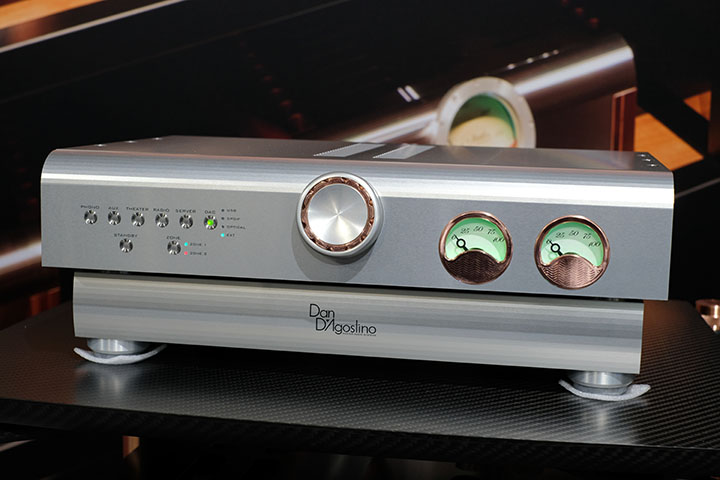
D’Agostino has finally added a preamplifier to its Progression range. Like the Momentum preamplifer, the new $22,000 preamplifier is a two-box-in-one design, with the lower power supply stage including an additional power supply feed for an upcoming phono stage. Available as a line only design, or with an optional on-board DAC for an additional $4,500, the Progression has pseudo-single-ended and balanced inputs, and balanced-only outputs, and will be available from July. The preamp is perfect for the colour versions of the Progression mono amplifiers, which looked striking in vivid red (shoe fetishists rather than Ferrari fans may recognise the shade).

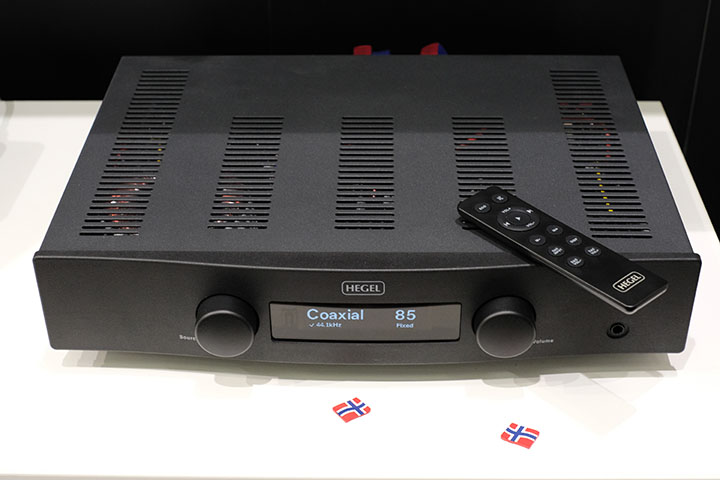
Hegel’s ever popular H80 entry-level integrated amplifier has come to the end of its life. Its replacement – the H90 – offers better SoundEngine2 performance, a composite front panel, Röst-like functionality (without Control 4 multiroom connectivity) and on-board Ethernet network connections, and even Apple AirPlay, all for exactly the same €1,685 price tag of its predecessor. Although out on an open stand, the new 60W amplifier has the same ‘fighting beyond its weight class’ qualities of its predecessor and comfortably drove a pair of KEF Reference towers, perhaps thanks to a damping factor of more than 2000!

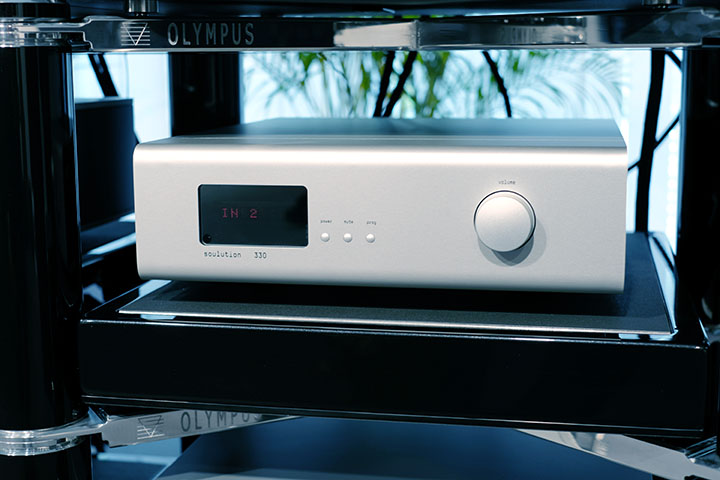
Soulution’s new 3 Series, shown for the first time at Munich, moves the brand from the ‘aspirational’ into the ‘almost attainable’ level. First product in production is the €17,500 330 integrated, a 100W design that works predominantly in Class A, doubles its load into four and two ohms, and can be supplied with optional phono stage and/or DAC at €3,000 per module. Playing in a system culminating in a pair of Rockport Cygnus loudspeakers, many mistook its performance for that of the 7 Series! The €9,500 325 preamplifier and €14,000 311 power amplifier will follow later in the year.

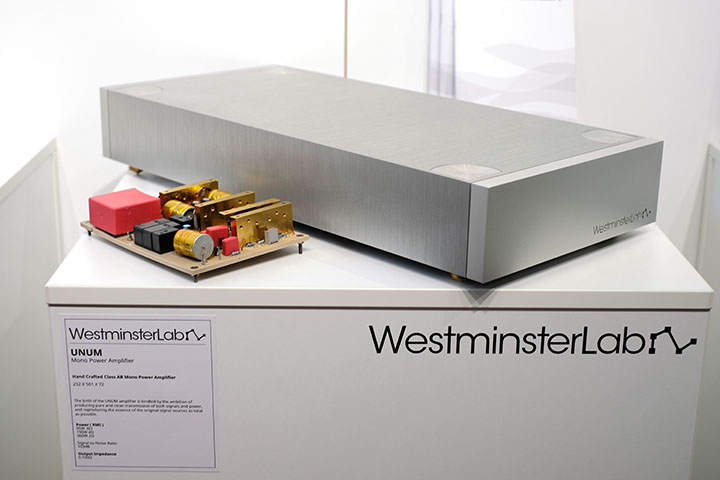
Westminster Lab had its official debut at Munich this year, and its first product is the £34,000 per pair Unum (as in ‘E Pluribus…’) mono amps. Built around a svelte 30kg block of 6082 aluminium milled down to form an 8kg unibody core, the amplifier eschews conventional circuit boards for blocks of PEEK, with point-to-point wiring instead of circuit tracks, and high-grade discreet components in place of integrated circuits. The company has also replaced heatsinks with what it calls ‘unified thermal cores’. The resultant 19kg, 95W power amp is said to double its power into four and two ohms. Impressive!


Best/Least bad sound

Neodio has shown prototypes of the A2 before, but in its final guise, the €39,000 integrated amplifier is more than just a visual match for the company’s excellent S2 digital player. In one of the booths in the main halls, Neodio was fighting a battle against an ever-present noise-floor, but it was one of the rare brands that won that battle; presenting a sound that was capable of playing loud, dynamic, and without strain. This was no mean feat under the circumstances. The company also showed its range of anti-vibration support feet and cables, priced between €990 and €1,590.

It was supposed to be little more than a design exercise, complete with powered horizontal tone controls straight out of a high-grade mixing desk, but PMC’s all-analogue Class AB integrated amplifier proved so popular around the PMC factory that the loudspeaker company decided to test the waters at Munich. Judging by the reception and the sound it made through a pair of the company’s Twenty5 series floorstanders, the amp will be a resounding hit. Cor blimey, the 140W design sounded remarkably uncoloured and enjoyable compared to much of the opposition, and should tip the scales at less than £5,000!.

Worthy of note/Mentioned in Dispatches

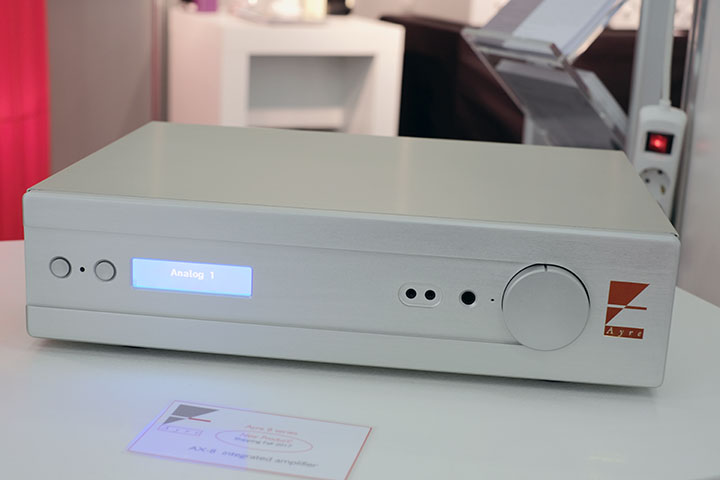
Ayre Acoustics showed two samples of its upcoming entry-level range, including the prototype of the new AX-8 integrated amplifier.

BMC Audio improved its high power and even higher value integrated with the latest CS3 model.

Add a phono stage to Mark Levinson’s excellent 525 integrated amplifier and you get the 585.5.

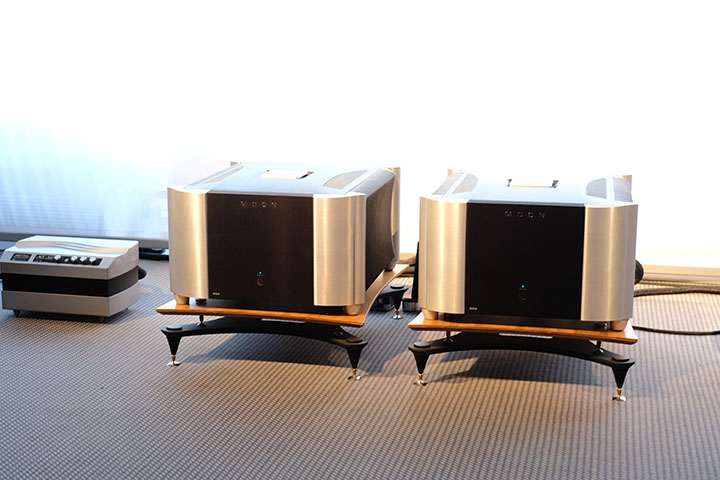
Moon’s mighty 888 monoblocks got their first formal European public outing on a full Moon-meets-Wilson-ALEXX system.

Octave’s new V-16 amplifier is a tall tube design that can drive headphones or be used in a high-efficacy speaker system.

Pathos InPol Heritage shown in prototype form last year looked and sounded promising.

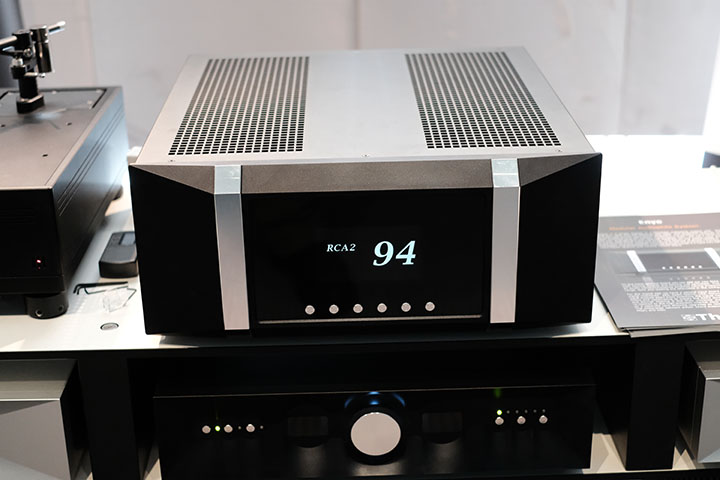
Thrax Audio’s Enyo modular system can be configured how you like and can drive practically everything.

And amplifier maker Bryston nailed the perfect sentiment to the show with its coffee shop menu…

Burmester 099 line preamplifier

There are two current schools of thought when it comes to high-end audio. The first is a series of regular changes to the line (the Mk I becomes the Mk II and so on), and the other is the Burmester way. This 099 preamplifier is a perfect example of that Burmester way of thinking, as the preamp has remained virtually unchanged since its launch in 2009, although refinements to the built-in DAC have filtered through.

The 099 is one of five preamplifiers in the Burmester range, and one of two in the company’s core Classic Line. It’s very much the first product in the new generation of Burmester designs, marking a shift in the tectonic plates of audio as we collectively move toward a more integrated digital approach. That doesn’t mean the company has abandoned CD replay or even vinyl replay, but that the 099 includes coaxial and Toslink digital inputs and a USB connection alongside its range of balanced analogue inputs. Single-ended users are not left out in the cold, because there are four input adaptors supplied (enough for two inputs).

Burmester is a company with an eye firmly set to longevity rather than ‘future-proofing’. As a result, the specification sheet can seem conservative, and on the 099 the lack of options like DSD, higher rate PCM, or even something like MQA might seem too conservative to some enthusiasts. But those enthusiasts also have a habit of flitting from product to product at regular intervals and have constant demands for novelty: Burmester, on the other hand, makes products that people keep for decades, and a device that supports 24-bit, 192kHz PCM files will still be useful and called for long after less well supported formats have come and gone. It would be nice to have something like DSD or MQA support on the Burmester 099, but whether it’s a deal-breaker or not largely depends on the end user: I think most people who are potential 099 owners wouldn’t care either way.

Back in 2009, this was an extremely complex proposition, and such is the relatively slow-moving preamplifier market that a design with built-in DAC is still rare, even if they are becoming more commonplace in the integrated amplifier world. Regardless, what I think Burmester got so right about the 099 from the outset is the lack of fuss to the overall design: viewed from the front from left to right, just an input selector, a volume control and an on/off/standby toggle switch. There are two arrays of LEDs accompanying the big chromed knobs; one set to indicate source with a single green LED, the other an array of green LEDs to denote volume level. Between these is a remote eye and a pair of LEDs to mark 192kHz replay and to highlight phase status (0° or 180°).

The phase inversion option is an interesting one. The 099 is not the first preamp to allow the listener to invert phase, but it shows the quality of the product in that absolute phase remains both preserved and audible when adjusted. As there is no benchmark for absolute phase in recordings, and it’s a bit of a lottery whether the files you receive (however you receive them) are in absolute phase, adjusting it on the fly can make a small, but significant, difference to the end result. It’s often subtle – subtle enough that many have proclaimed it to be a non-issue – but in a truly well-optimised system, it’s just a subtle re-aligning of the whole recording that makes it seem just slightly more integrated. As I’ve used the words ‘small’, ‘subtle’, and ‘slightly’ a lot in this paragraph as absolute phase adjustments rarely bring a monumental change to the sound, but if you are attuned to phase and the rest of your system is resolving enough to catch this difference, the 099 makes this an easy adjustment, that comes free with the preamp.


Perhaps more than ever today, the 099 is the gateway into Burmester’s long-standing ethos. This is the single device that might be introduced as an upgrade for a pre/power system or even an add-on to turn a good integrated amplifier into a pre/power system in its own right. And, once someone gets just how intrinsically ‘right’ the 099 really is, the next steps will likely all be Burmester-flavoured.

There are also a series of adjustments that can be made to the 099 (start-up volume, input level trimming, output gain, etc.) and these can all be controlled by pressing the Setup button on the remote. You don’t need to do anything in most cases, but it’s good to have the option. You can also control it through RS232 in a custom install setting.

The 099 is a refined performer, capable of being sat in front of for hours on end without fatigue. This is not code for ‘dull’; it’s detailed and dynamic, and – coupled to the right power amplifier – can handle the loud end of the volume control without introducing any kind of compression or distortion. In fact, were it not for the refinement, the effortless ability for this preamp to push any amplifier to its limits could make it a brute force design. As it is, the 099 is the archetypal ‘mail’d fist in a velvet glove’ design, with that combination of beefy grip over the rest of the system coupled with a sense of grace and charm as it stays in complete control.

This is a whisper-quiet preamp, to the point where you’ll struggle to hear a background noise from the 099, over and above noise further along the chain. This comes through in surprising places, like the ‘spaces’ between the notes when Brendel is playing the ‘Pathétique’ [Alfred Brendel, Beethoven: Favourite Piano Sonatas, Philips]. And, this, coupled with a coherent and cogent portrayal of instrument tone from every key on the keyboard, and a sense of authority that borders on the stentorian (yet, never once seems too imposing), makes for a preamp with huge staying power.

Above all, however, there is a sense of grace and deportment that the Burmester 099 imposes on music, as if it went to finishing school. This doesn’t act in a heavy handed manner, so if you were to play ‘Basket Case’ from Green Day’s Dookie album [Reprise], you’ll still end up bouncing round the room, but if you then move over to something more cool and level headed – ‘Shhh/Peaceful’ from Miles Davis’ In A Silent Way [Columbia] for example – that deportment gives the sound a gravitas and sophistication it so deserves. Everything here is rooted in the back line; the slow rhythm of the Fender Rhodes and double bass, that insistent hi-hat percussion, with Joe Zawinul’s organ and Miles Davis’ trumpet rising out of that subtle, clever riffing. All of which is played with consummate detail and effortless dynamic shading, but more importantly, as a cogent piece of music hanging together despite the copious amount of drugs being taken during the recording.

The only critical concern regarding the 099, and possibly the one that most points to its first decade of the 21st Century design, is the headphone socket. The 099 has an extremely competent, noise-free, and dynamic headphone amplifier, one that will comfortably drive anything in current production (that isn’t an electrostatic, of course) and even make a fair fist of driving impossible headphone loads. But, for no particular reason, the ¼” headphone jack is mounted at the back of the preamp. We’d prefer it up-front, but it allows permanent attachment of headphones, switching the 099 from ‘preamp’ to ‘headphone amp’ via remote.

Judging the brand by the 099, it’s little wonder Burmester got the account for adding in-car entertainment systems for Bugatti, Porsche, and Mercedes Benz. Actually, you could say that of any of Burmester’s products, but the 099 stands out as a design of sophistication, elegance, and fundamental reliability that acts like a magnet for top car marques. The 099 is not the preamp for those still in their ‘hungry ghost’ phase, who seem to burn through a product every few months. The Burmester 099 is a preamp for people who think that buying more than one product per decade is moving at break-neck speed, for people who know that ‘you buy cheap, you buy twice’ and understand that the best is worth paying for, and for people who appreciate the finer things in life and all the rewards those things bestow upon the owner. These are elements found in Bugatti, Porsche, and Mercedes Benz automobiles, and they are elements that Burmester’s 099 expresses perfectly.


The Burmester 099 is a recommendation I could have made eight years ago when the 099 first hit the streets, and it is a recommendation I could still make in eight years time when the 099 will still be a preamp worth considering. In other words, this is a preamp for keeps!

TECHNICAL SPECIFICATIONS

  • Type: Balanced preamplifier with built-in DAC
  • Analogue inputs: 3× XLR balanced stereo pair (single‑ended RCA adaptors supplied)
  • Digital inputs: 2× Coaxial RCA, 3× optical, 1× USB
  • Analogue outputs: 1x RCA single-ended stereo pair, 1× XLR balanced stereo pair, 1× ¼” TRS headphone jack
  • Digital outputs: 1x Coaxial RCA (via SRC to 96kHz /192kHz), 1× optical: (direct to 96kHz)
  • Dimensions (W×H×D): 48.2×9.5×34.5cm
  • Weight: 8.5kg
  • Price: £6,440

Manufactured by: Burmester GmbH

URL: www.burmester.de 

Back to reviews

Read more Burmester reviews here

Munich High End 2017 – Introduction and trends

With the changes in dynamic at CES, Munich High End has become the main event on the audio calendar. The show – running this year from the 18th to the 21st of May at the M.O.C. exhibition centre on the outskirts of Munich – continually goes from strength to strength, occupying all four halls of the centre, as well as two large atria and all the side rooms available on two floors of the fourth atrium. With 21,412 visitors and 8,002 trade visitors seeing 538 exhibitors from 44 countries, Munich High End is proving such a resounding success that there is almost no more space left, and manufacturers are often left taking on side-car shows at nearby hotels.

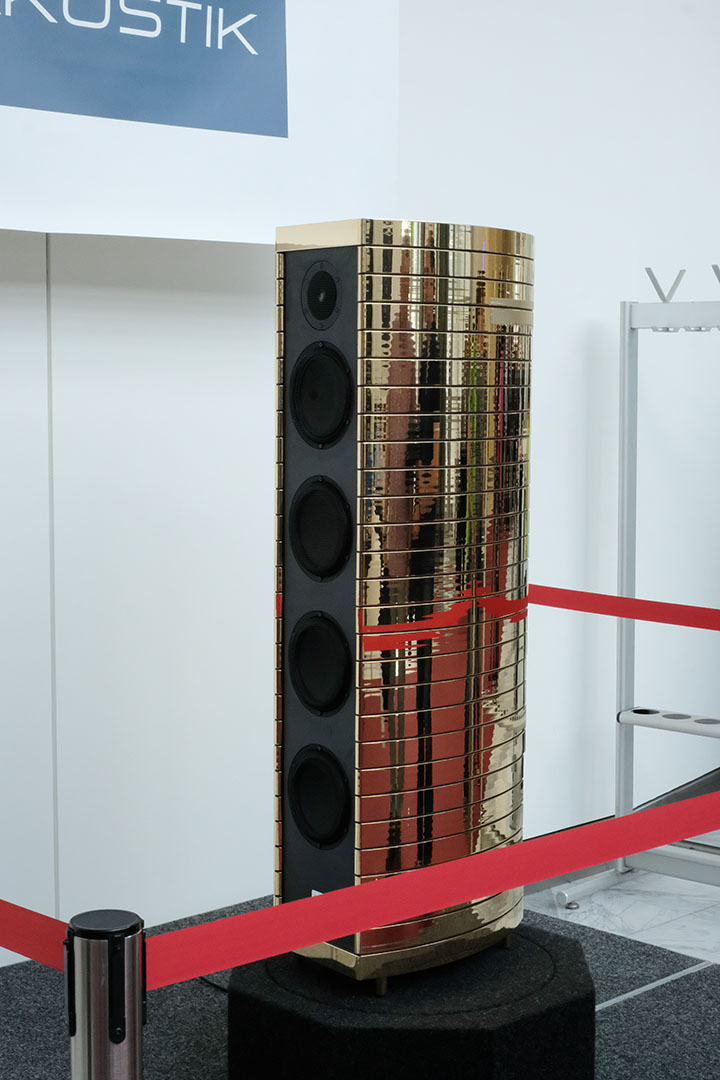
Calling it ‘High End’ is perhaps wrong. Munich High End is more than just high-end audio. Granted the high-end brands still hold dominion over the demonstration rooms surrounding that fourth atrium, and many of the atrium regulars (such as Audio Research, Avantgarde, Burmester, D’Agostino, Gryphon, and Meridian) are firmly embedded in audio’s upper echelon. However, the point of Munich High End is to encompass all things audio, whether it is a Canton-equipped Skoda or a 24-carat gold loudspeaker from Gauder Akustik, and all points in between, the show has really become a broad-based audio show.

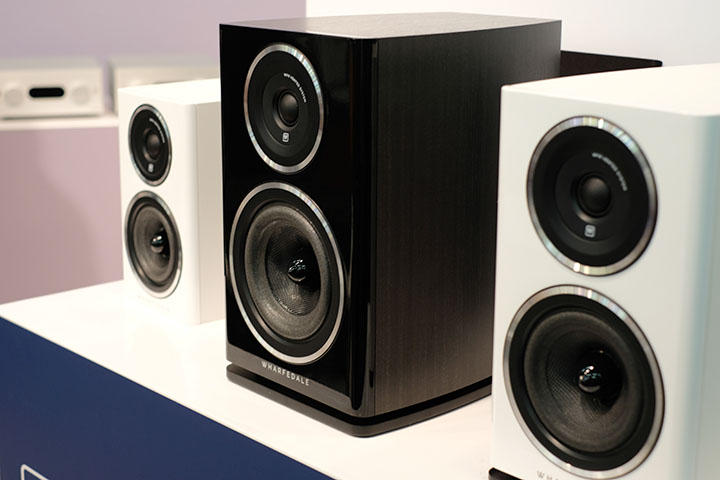
In fact, if anything this was a show dominated by the more affordable end. Not only in relative terms (a €10,000 amplifier seems more affordable in the company of amplifiers costing €80,000 or more), but also in absolute terms. This was the show of the latest Wharfedale Diamond range and Primare’s new Prisma electronics, or the new replacement to Hegel’s evergreen H80 integrated amp that brings more to the party, except a bigger asking price. But we’ll address more of these things later.

This was a show of concepts finally coming together. In digital audio, for example, there was a sense of common goals, with so many companies focussing on MQA, Roon integration, and even RAVENNA for their upcoming devices. A few years ago, companies might turn their attention to one; now it’s more like all or nothing. This does tend to differentiate companies between those that have enough of an infrastructure to cope with parallel design concepts, and those that cannot.

There also seems to have been something of an MQA tipping point at Munich, where even many of those not presently supporting MQA are working in the back room to include the format, and I confess that my own stance on the matter has become less ambivalent, too. In an ideal world, we’d all gain access to the original master file or master tape, but failing that, the closest most of us can get are DSD, high-resolution PCM, or first-generation copies of master tapes. These are usually unwieldy (either in handling, or storage and download) and often leave a very limited music choice. By having an increasing number of mainstream music companies sign up to MQA, and provide files through services like TIDAL, MQA not only raises the game for all, but provides more of an impetus for others like Apple and Spotify to upgrade their own services. Even the proprietary aspect of how MQA folds and unfolds its data no longer concerns me as a result; it’s ultimately as important to the end user as knowing what makes up ‘Merchandise 7X’ is to a guy swigging from a bottle of Coca-Cola. If it sounds good, is freely available enough to bring more people to the sounds good table, and is backwards compatible with FLAC, I am OK with that.  

The strange thing about this year’s Munich High End, however, was that so few were able to make a good sound. Even those who have historically had a very high success rate were wide of the mark this year. Whether it was the overall heat in those glass rooms, atmospheric conditions (it was hot and humid, and there was a thunderstorm at least once during the event), or just that there were too many brands competing for the juice, but any attempt to extract a ‘best sound at the show’ were – with very few exceptions – closer to ‘less awful sound at the show’.

We are also aware that this show comes hot on the heels of AXPONA and CanJam SoCal, and that the LA Audio Show follows soon after. Not only does this make for a lot of similar show reports with repeats of the same products, but makes for a lot of reader fatigue in reading yet another travelogue with price tags and specifications. So, going forward, we have adopted a more editorial tone, finding the most significant new products or newcomer brands in a given category, alongside some of the best or best-presented existing products, and a short ‘mentioned in dispatches’ list of those deserving of note. Know that for every product mentioned there are dozens of products that are similarly note-worthy, but an eye-watering 20,000 word round-up of hundreds of products supplemented by thousands of images does no-one any favours.

Finally, an apology. We concentrated on the main show at the MOC, but did intend to visit the Hi-Fi Deluxe show on the Saturday afternoon at the Munich Marriott Hotel in Schwabing. That idea was sadly made impossible by the sheer number of extremely drunk FC Bayern Munich fans whose league-winning team beat SC Freiburg 4:1 in the final match of the soccer season at the Allianz Arena on the outskirts of Munich. Buses, taxis, Uber, and the S-Bahn all ground to a halt as hundreds of thousands of red-shirted revellers turned the city into a giant biergarten for most of the evening and even a four kilometre trip between the two halls turned into a potential nine kilometre detour. The Hi-Fi Deluxe show has become an important overspill for demonstrating audio companies, because the MOC has reached capacity, and we will check soccer fixtures more accurately next year!

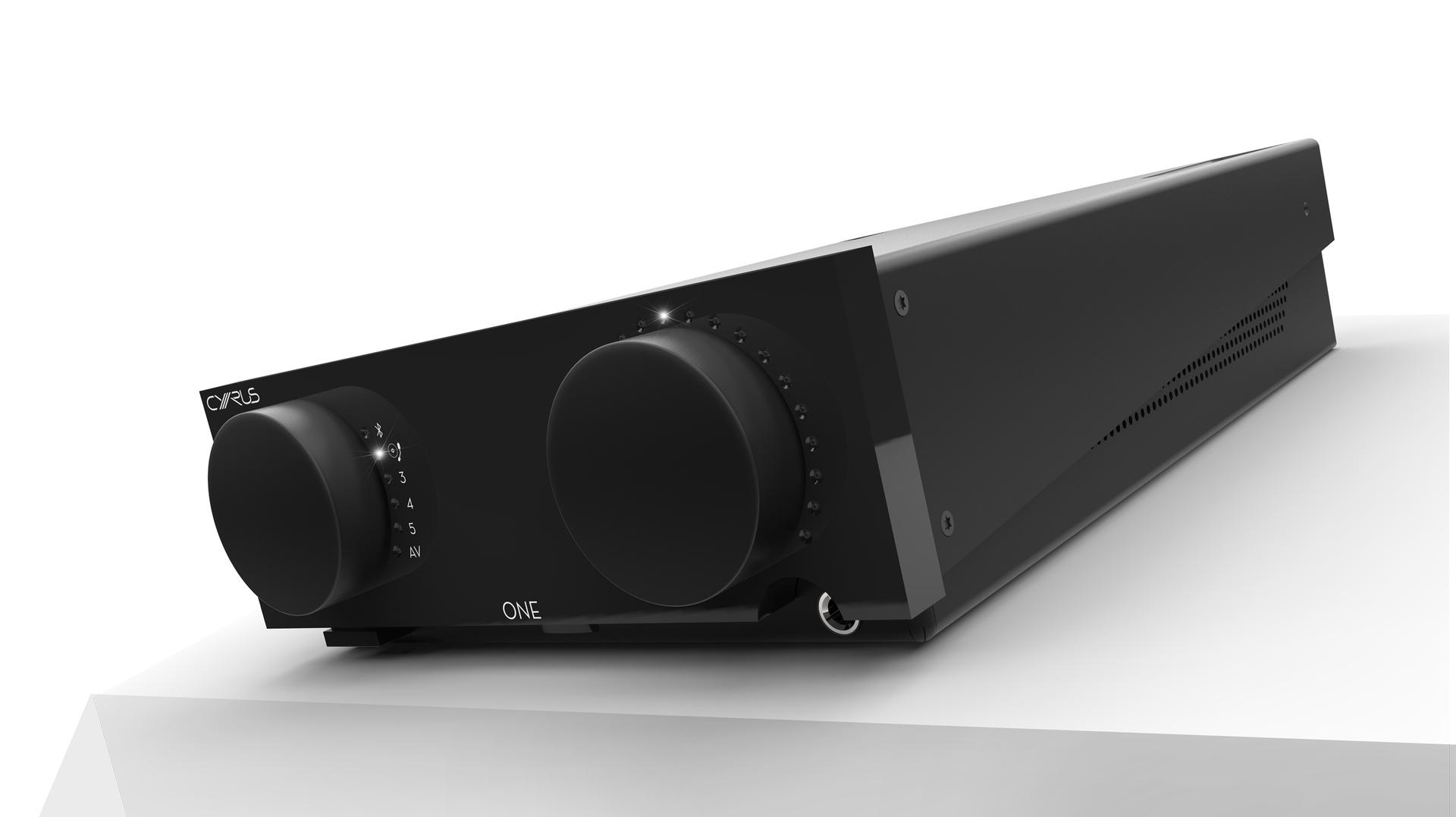
Cyrus Audio One integrated amplifier

This Cyrus has been a long time coming. When Cyrus launched its flagship X300 power amplifiers, I recall mentioning that the cast alloy case – one that has adorned virtually all Cyrus products since the year dot – was not perhaps shiny enough for a product with high end aspirations. But that was around five years ago; the company has since changed hands, launched the Lyric one box system, and now, finally, come up with a new case. It’s still a half width design in the Cyrus style, but it has a shiny black fascia, big knobs, and a clamshell steel chassis. It looks great, especially when the bright white LEDs illuminate the input and volume level. It doesn’t look quite as robust as its forebears, but it’s a heck of a lot slicker, and feature rich to boot. In essence an integrated amplifier, the Cyrus One has four line level inputs, an MM phono stage, and a serious headphone output. There is also an aptX standard Bluetooth receiver: aptX, you may recall, being the best quality Bluetooth standard available and notably better sounding than the standard variety. Oh, and the Cyrus One is remote controllable, although the card-sized handset is so small that it will escape into the sofa at the first opportunity. A more attractive and less easy to lose alternative showed up halfway through the review in the form of an App for iOS or Android devices that offers the same volume and input functions as the credit card remote. This uses the Bluetooth receiver to connect with your tablet or phone; cunning, and no pairing required either.

The headphone amplifier is described as being a Class AB type with the ability to “drive almost all headphones” according to the blurb. Connections include both preamplifier outputs and AV direct, the latter effectively acting as a power amp input for either surround duties or in a bi-amping situation with another One. Despite the size, there are two sets of speaker terminals per channel on the back of this amp. This somewhat unusual feature is one that Cyrus engineer Chris Clifton says is important for their customer base.

Cyrus has been experimenting with Class D amplification for some time (both in standalone power amps like the Stereo 200, and in its Lyric series), which explains the One’s high specified output power (100 Watts/6 Ohms) in relation to the size and price. There are many that suspect the EU will do its best (worst) to outlaw low-efficiency linear power supplies in audio electronics in the future, which will make the switching power supplies associated with Class D the only option for those wanting to sell into the single market. Marantz recently launched a reference level amplifier, PM-10, that it describes as having an “analogue switched-mode power supply” but this is nonetheless a Class D design, a first for that brand too. Something is afoot, and let’s hope it can be made to work. In this instance, the power supply is actually linear, there’s a conventional power transformer in the middle of the box. Chris also mentioned the SID or Speaker Impedance Detection system that Cyrus has used to make the One compatible with a wide variety of loudspeakers. One reason why Class D has yet to be widely used in amplifiers is that it is very sensitive to impedance, the frequency response of the amplifier varies with speaker impedance (which itself is not constant), so some speakers will work beautifully but others sound pretty painful, especially at high frequencies. SID measures the 18kHz impedance of the combined loudspeaker and cable at turn on and adjusts its output to produce an overall response that doesn’t vary with frequency.


I tried the Cyrus One with two pairs of PMC speakers that are currently under assessment, the twenty5.22 standmount and twenty5.23 floorstanding loudspeaker. They have slightly different characters with the standmount being a bit faster than the relatively relaxed floorstander. With the former this amplifier sounded forward and bright and was not a happy match, but in many respects it worked nicely with the twenty5.23, so long, that was, as I selected a reasonably warm sounding source (a Mytek Brooklyn DAC was not a good choice while an AURALiC ARIES Mini and a Primare DAC30 proved happier companions). I also tried a Rega Planar 2 and Carbon MM cartridge that produced a wide, solid, and dynamic sound with good leading edge definition and quiet backgrounds. All in all a terrific result for what is a very modest cartridge.

With digital sources, there is plenty of speed and sparkle, and no shortage of filigree detail that’s good for resolving reverb tails. Leading edges are very much a strong-point, which translates to a strong sense of timing, but a presentation that is a little ‘edge of seat’. And this with a speaker that had seemed pretty relaxed, yet is obviously capable of delivering detail. I had a Rega Elex-R on hand for comparison. The Elex-R costs £200 more, but the extra depth, atmosphere, and effortlessness it delivers make it an easier amp to enjoy. But speaker matching is always the key with amplifiers, and while Cyrus has its impedance matching system, that doesn’t necessarily equate to total tonal balancing.

On the Talking Heads’ ‘Crosseyed and Painless’ [Remain in Light, Sire] the One comes across with juicy bass and ‘get your freak on’ timing that proved hard to sit still to. David Byrne’s voice was also very clear,  and it was possible to hear exactly what he was singing thanks to the transparency and the detail that the One delivers. When Joni Mitchell’s sings ‘The Man I Love’ [Gershwin’s World, Herbie Hancock, Verve], there is plenty of warmth and weight in the bass, albeit not as much control as one might expect from a 100 Watt design: I tried pulling the speakers out a little further, but that didn’t change matters significantly. Another speaker was clearly needed. This took the form of ATC’s SCM11 standmount; not the easiest of loads with its sealed box configuration, but one that is extremely tight in the bass.

At this point I updated the amp with a firmware upgrade that allows it to be used with the Cyrus One app and refines the speaker impedance matching system. I don’t know whether it was this or the fact that the amplifier had been on for a few more hours, but it started to sound rather better thereafter.

With the ATCs the amplifier’s immediacy was obvious, but it didn’t sound bright, and the bass was powerful and extended. The pairing makes familiar pieces more interesting and engaging without the edge of seat balance found earlier. The melodic nature of Haydn’s ‘String Quartet In D, Op. 76’ [Engegårdkvartetten, 2L] is obvious alongside the inspired playing. Tone could be richer, but this speaker is not known for its rich tone, anyway. The other amplifier I tested in this issue, the Onix DNA-50, brings out more warmth in the lower mids, but doesn’t have the speed that the Cyrus does. The One encouraged me to bring in my regular reference speakers, PMC Fact.8, which are a bit pricey for the amp but seemed to work rather well. Both have the ability to stop and start on the proverbial dime, which makes ZZ Top’s brand of blues rock particularly gratifying. Things got interesting with the first track from Tres Hombres [London], ‘Waitin’ for the Bus’ and moved up to blinding on ‘Jesus Just Left Chicago’ that follows it, the guitar playing presented in all its grungy glory. Reference Recordings’ latest release is Fiona Boyes’ Professin’ the Blues, and it is as ever superb. The scale and character of the kick drum is just perfect, it’s softness a great contrast to the gravelly vocals and gritty steel string guitar. It proved that the Cyrus can do acoustic expanse as well as it does immediacy, which is a lovely combination if you can get it.


The fact that Cyrus updated the firmware several months after the One’s late summer launch implies that the company plans ongoing improvement, which is great. But more significantly, few brands have succeeded with Class D amplification as Cyrus has in making the One such an entertaining and well equipped amplifier at a reasonable price. The remote may be small enough to lose in minutes, but the app is a free upgrade that makes the One much more ergonomic. Add this to scorching sound and you have a product that should put this brand back at the top of the value for money tree.

TECHNICAL SPECIFICATIONS

  • Type: Solid-state, 2-channel integrated amplifier with Bluetooth aptX, phono stage, and headphone amplifier
  • Analogue inputs: One MM phono input (via RCA jacks), four single-ended line-level inputs including AV bypass (via RCA jacks)
  • Digital inputs: none
  • Analogue outputs: One pre-out pair (via RCA jacks)
  • Supported sample rates: N/A
  • Input impedance: not specified
  • Output impedance (preamp): not specified
  • Headphone Loads: not specified
  • Power Output: 100Wpc @ 6 Ohms
  • Bandwidth: Not specified
  • Distortion: not specified
  • Signal to Noise Ratio: Not specified
  • Dimensions (H×W×D): 85 × 220 × 390mm
  • Weight: 5.6kg
  • Price: £699

Manufacturer: Cyrus Audio

Tel: +44(0)1480 435577

URL: www.cyrusaudio.com

Back to reviews

Read more Cyrus Audio reviews here

PS Audio BHK 250 hybrid power amplifier

I am always curious how a great piece of gear comes to be. Was it a singular vision of a talented engineer? Perhaps a group effort guided by an experienced team leader. In this case, it was indeed a visionary designer: Bascom H. King (hence the ‘BHK’ acronym). However, he had help in the form of a couple of long time industry veterans. Paul McGowan of PS Audio was looking to upgrade PS Audio’s amp and pre-amp offerings and was assisted in the effort by Arnie Nudell, of Infinity loudspeaker fame. Provided with an opportunity to create a signature set of electronics as a capstone to his illustrious career, Bascom King laboured alongside his long-time friends McGowan and Nudell and has succeeded brilliantly.

The BHK 250 stereo amplifier’s circuit design first appeared in 1979, when Bascom King created the HCA hybrid amp for Infinity. Harkening back to that original concept the BHK 250 has a tube input stage utilising a matched pair of Genalex Golden Lion 6922’s (a personal favorite of mine), allowing for no loss of musical information. The output uses only N-Channel MOSFETs to create a “near perfect balanced waveform without the degradation inherent in a complementary design” according to psaudio.com. Coming in at a hefty 38kg’s, the BHK 250 uses separate input and output power supplies keeping each part independent inside the single monolithic amplifier box design. PS Audio also offers the amp in monoblock form as the BHK 300. That version doubles the output current using only half of the impedance found in the BHK 250. Damping factor is also doubled in the mono amp, albeit at twice the price.

My first introduction to the BHK 250 was last year at Rocky Mountain Audio Fest in Denver. PS Audio’s room is always a must-hear treat, and the new amp was driving an imposing pair of YG Acoustics Sonja 1.3’s to great effect. The terrific musical presentation was made even more impressive when I found out the price of the amp was £8,000. This was very interesting as Bascom’s last collaboration was the creation of the extraordinary Constellation Audio Hercules amp, which costs more than ten times as much in its current version II guise! This more price aware approach was one of the design goals for the new PS Audio BHK lineup: to offer true world-class performance at a significant discount to the prodigious prices found in ultra high-end audio today. It took a few months but I was able to procure a BHK 250 for review along with the BHK Pre-amp. They would join my PS Audio DirectStream DSD DAC to join up with my Vandersteen Treo CT’s. Moving the BHK 250 onto its stand between the Treo CT’s I hooked up the AudioQuest CastleRock speaker cables and AudioQuest MacKenzie XLR interconnects. Burn-in time is recommended at 200 hours before critical listening should commence.


It’s a personal thing, but what I seek in an amplifier is ample power for the speakers being used with a solid grip on the low end. I would also like it to be as neutral as possible and allow the signal to pass through it as undisturbed as possible. In other words, I am not looking for it to add character. I do give extra consideration to a visceral sense of dimensionality, which is something I experienced early in my listening when I played ‘Take Five (Take another Five)’ from Grover Washington Jr’s SACD Prime Cuts [Sony Music], played on the Oppo 105D. This creative version of the jazz classic offered space and dimensionality. The depth of the soundstage was breathtaking. Spatial cues were present in abundance. In the centre of it all were the pure saxophone tones of the master, Grover Washington Jr. It was a clinic on musicality and a joy to experience. While I was enjoying the rest of the SACD, I came over all alpha-nerd and perused the parts list of the BHK 250. PRP Resistors matched up with film and foil Rel Caps all hand soldered through the circuit board without surface mount components. An approach found primarily on gear running well beyond £10,000. Sonic quality with sound (no pun intended) value. The BHK 250 was ticking many of my ‘need to have’ audio boxes.

Moving on to something more intimate I selected the SACD of Nick Drake, A Treasury [Universal – Island Records]. ‘River Man’ is a haunting guitar and strings melody with deceptively ‘simple’ chord changes. Once again, the character of the dimensionality of the presentation created an in-the-room sense. The violins’ tonality had that lovely blend of pure sound married with the physicality of bow on strings. Finger work on the guitar was sure and crisp. Drake’s vocals were centred as they should be, conveying his haunting fragility. This is where one really begins to appreciate the tube input and the capabilities of the 6922’s to preserve the sense of body and wholeness of the recording. In fact, I attribute these qualities not only to the valves chosen for the design, but also to King’s decision to use independent power supplies for the amp’s input and output stages.

Given that we have valves in the amp that means you can tube-roll to tailor your sound. Swapping tubes is very easy with the BHK 250. Simply loosen the two Philips head screws holding the back plate covering the tubes and replace the installed 6922’s with any 6 or 7 series dual triode variant. Make sure to follow the steps in the manual to avoid damage to the amp or the tubes. I had a matched pair of broken-in Tungsram PCC88’s that have been commented on favorably in the PS Audio forums on the manufacturer’s website. My experience with these tubes showed an increase in midrange focus and some extended treble beyond the Genalex 6922’s. After installing the Tungsram’s it was time to return to more listening.

I recently received a copy of Pink Floyd’s Dark Side of the Moon on 180-gram vinyl [Pink Floyd Records]. Placing it on my VPI Scout 1.1, with its Dynavector 10X5 cartridge, and ALO Audio phono stage, I sat down to enjoy an all-time great. First impressions were black as in zero background noise during the opening of ‘Breathe (In the Air)’. The clock and chimes came from nowhere to spread out across the room. The heartbeat reverberated from the front to the back of the room with solid force. Roger Waters’ bass notes were solid and deep, but well controlled. It was an exceptional delivery – one that led to my playing the entire record and letting out my inner hipster as I got up and turned over the record half way through. Actually, in my mind, vinyl never left: it has always been a great way to experience music. Paired with the BHK 250, I could enjoy the best of analogue in all its organic three-dimensional glory. The nuance of Dave Gilmour’s guitar work was on full display. It was the best I had ever experienced this long time classic.


Bascom King and PS Audio’s stated goal when designing the BHK 250 (and its brothers the BHK 300 Mono’s) was to create one of the top five amplifiers in the world and to spare no expense while doing it. Yet they also strove to make them much more affordable than the statement amps found throughout high-end audio. On the PS Audio website page for the BHK 250 and 300 amps under the “Want more product details” tab are nearly an hour and a half of video featuring Paul, Arnie, and – of course – Bascom describing in detail their goals and aspirations for the project. This extraordinary level of manufacturer transparency gives the prospective owner both a high level of understanding and confidence in the product they are purchasing. Bascom, Paul, and Arnie’s combined 150 years of audio excellence has led to a design of classic physical beauty and sonic excellence that easily achieves the goal of competing with über-level amplifiers, but at a fraction of the retail price. As audiophiles, we sometimes fall into the ‘price equals performance’ trap. We fear being the emperor with no clothes when our friends ask how much we paid and it was, gasp! LESS than what flagship gear is supposed to cost. Naturally it must not be that good. This amp is that that rare Holy Grail whose sensible price belies its astounding performance. Hand built in America, it may well be your final amplifier purchase.

Enthusiastically recommended!

TECHNICAL SPECIFICATIONS

  • Type: Hybrid stereo power amplifier
  • Inputs: 1Pr. XLR, 1Pr. RCA
  • Outputs: 2 Pr. Per channel. 5-way gold plated copper binding posts
  • Power Output: 250 Watts at 8 Ohms, 500 Watts at 4 Ohms
  • Frequency Response: @2.8VRMS 10Hz – 20KHz +/- 0.1dB: 10Hz – 200KHz +/-0.1/-.3.0dB
  • THD: 1KHz, 1W/8 Ohms <0.01%, 20-20KHz, 1W/8 Ohms < 0.1%
  • Noise: 100-20KHz <-85dBV
  • Input Impedance: Unbalanced 100K Ohms, Balanced 200k Ohms
  • Output Impedance: 50Hz, 2.8VRMS < 0.1 Ohms
  • Gain: 30.5dB +/-0.5dB
  • Dimensions: 17.1” W × 8.7”H × 14” D
  • Weight: 38kg
  • Price: £8,000

Manufactured by: PS Audio

URL: www.psaudio.com

Distributed by: Signature Systems

URL: www.signaturesystems.co.uk

Tel: +44(0)7738 007776

Back to reviews

Read more PS Audio reviews here

Roksan Audio Blak integrated amplifier

2016 was a tumultuous year. Musicians fell like flies and voters confounded pollsters on both sides of the Atlantic. Meanwhile for Roksan, it closed the year in the hands of Monitor Audio. Roksan co-founder and owner Tufan Hashemi stepped down to ‘spend more time with his humidor’, while the well-established loudspeaker brand gains an audio electronics division with a great reputation. It’s not the first time that the creator of the iconic Xerxes turntable as been sold: the company was bought in the 1990s by the Verity Group, then-owners of Mission, Quad, and Wharfedale, but was quickly bought back by co-founders Tufan Hashimi and Touraj Moghaddam (now of Vertere). But this will be the first time in the company’s 32 year history that Roksan will be run without the involvement of its original founders. There are no other changes to Roksan’s infrastructure and the company’s full range of turntables, electronics, and – for the time being, at least – two models of loudspeaker will continue to built in London.

The Blak range was the last to be developed under Hashemi’s direction. It comprises a CD player and this amplifier, both sitting at the top of the Roksan sound quality tree. Blak is not as pretty as the Oxygene range, but one suspects that results in fewer compromises in amp design. The Blak integrated is a beefy 150 Watt model with a built in USB DAC and aptX Bluetooth receiver that sit in a fairly conventional chassis, but one with an attractively distressed fascia available in a range of colours. It has a large, clear LED display and the minimum of obvious controls, I say ‘obvious’ because there are two hidden under the front panel: one switches it on and off while the other selects amplifier or headphone output. It’s a good justification for the ‘RTFM’ acronym because if you don’t read the manual, you might not figure out that your ‘silent’ amp is in headphone mode!

The capacious back panel hosts a nice set of WBT speaker cable terminals, three sets of RCA inputs and an XLR input, alongside sockets for a moving magnet equipped turntable. It’s not clear why there are no other digital inputs for the onboard DAC apart from USB and Bluetooth, as space is certainly not the issue. The DAC itself is good for PCM up to 24-bit/192kHz and DSD128, so it’s more than adequate for the majority of the music you might actually want to listen to.

The front panel controls you can see extend to volume, go-forward/go backward input selection, plus an ‘OK’ button. This last has to be pressed after you have selected the input. Another foible is that the displayed volume level changes in twos, so you can have ‘14’ or ‘16’ but not ‘15’. It’s the same on the remote handset, and the volume steps are quite big, at around 2dB depending on speaker. It’s not a problem, but seems odd in a time of 0.1dB increments.


Listening commenced with a Melco N1Z digital transport connected directly to the Roksan’s USB input, and a pair of PMC Fact.8 loudspeakers hooked up to its outputs. The result was rather enjoyable thanks to a good sense of timing, an even-handed tonal balance, and evident – but not overt – power. It coped with the dense interplay of Van Morrison’s ‘The Way Young Lovers Do’ [Astral Weeks, Warner Bros], avoiding a tendency to brightness by dint of giving full body to the double bass that, just about, keeps things together. This suggests that the bass is a little warmer and fuller than average, a characteristic that came through once or twice, but is pretty subtle overall. With Vivaldi’s ‘Belleza Crudel’ [Tone Wik, Alexandra Opsahl, 2L], the sound was vivid and open, with lots of space around the period instruments, and plenty of timbre to enjoy. Moving to solo piano changed the image completely, revealing that Roksan’s Blak is highly capable of exposing the nature of each recording. The piano remained tightly focused while delivering a good deal of the spirit of the playing.

Moving to an external converter in the shape of a Primare DAC30 did improve matters quite considerably; essentially, a veil is removed and you can hear a lot more fine detail. I guess it’s a bit much to expect an onboard DAC to perform as well as one that has it’s own dedicated power supply and considerably more space to make itself at home. It did reveal the Roksan Blak to be a better amp than initially thought, which is no bad thing. The sense of dynamics, transparency, and presence it delivered made a very good case for using this amp in elevated company when it comes to source and speakers. By this point, I was enjoying Henry Threadgill Sextett’s ‘Bermuda Blues’ [You Know The Number, Novus], which has lots of fine detail for an amp to dig up, and this was something that the Roksan did with ease. It excelled at delivering the snap of the snare drum, the power of double bass playing, and the intense joy of the horns. In some systems the sheer energy and density of the piece can result in a cacophony, but this amp has the power and coherence to deliver it in thrilling form without any danger of ear ache!

Going back to the Van Morrison track, it was apparent that much of the warmth in the bass was related to the DAC rather than the amp itself, because the result with an external converter had a far stronger sense of presence, the vintage of the recording being much more apparent, and the genius of its composition even more so. Astral Weeks has been described as ‘the best album in the world (ever)’, and when everything falls into place – as it does here – it’s hard to disagree. A newer recording of older music, Haydn’s ‘String Quartet In D, Op. 76, No. 5’ [Engegårdkvartetten, 2L], displayed its light and shade in subtle graduation; the playing nicely defined without any hint of grain, yet with all the immediacy of the spirited playing in full effect. Bass is well defined, too; there isn’t the sense of grip you get with more powerful amplifiers, but in many ways you don’t want that unless you live and die for bone-crunching bass. Rather, you want extension as well as shape, and the ability to stop and start precisely, such as with the double bass and electronically sourced bass drum on Bugge Wesseltoft’s interpretation of ‘Round About Midnight’ [Trialogue, Jazzland].This expands out to fill the room, but remains focused and engaging, the amplifier responding well to being driven a little harder than usual and losing no composure in the process.

Next to an original Leema Tucana integrated, which is a more expensive amplifier, Blak doesn’t look as fancy and nor does it have the Leema’s plethora of features, but Blak’s rounder and warmer sound may well be preferable to many. The Leema sounds more realistic and powerful – there is more of the original acoustic and greater transparency – but there is also a clear sense of power that paradoxically seems less natural. The highs from Roksan’s Blak are a bit sweeter and the sense of musical flow is stronger, but if you want an authoritative sound the Leema will have more appeal.


I tried the phono input using a Rega P3 with an Elys 2 moving magnet. Upon playing a record from a victim of 2016’s war on musicians (Mose Allison, and his LP Run for the Hills  on Pure Pleasure/Epic), Roksan’s Blak revealed the soft and rounded – but jazz hipster sharp – vibe of the recording. It lost none of the snap that Allison brought to classics like ‘Hey Good Looking’: this can sometimes sound softened through on-board phono stages. I also gave the Bluetooth a spin (albeit with an iPad, which doesn’t support aptX), and it sounded tolerable with a replay of Gilles Peterson’s 6Music radio show; at least until I streamed the same thing over USB from another source, which added significantly to the experience. Both versions, however, served to reveal that Blak’s balance is kind enough to let lesser quality sources sound good enough even through revealing speakers.

Roksan’s Blak could perhaps have a better DAC and it would be nice if MC cartridges were accommodated, but in terms of features and sound quality this is a well-rounded amplifier in all senses of the word. How much more Blak could it be? The answer (as revealed in the movie, This Is Spinal Tap) is: none, none more Blak. Recommended!

TECHNICAL SPECIFICATIONS

  • Type: Solid-state, 2-channel integrated amplifier with built-in DAC, phonostage, and headphone amplifier
  • Analogue inputs: One MM phono input (via RCA jacks), three single-ended line-level inputs (via RCA jacks), one balanced input (via XLR connectors)
  • Digital inputs: One USB port, one Bluetooth aptX receiver
  • Analogue outputs: None
  • Supported sample rates: 16-bit, 24-bit — 32kHz – 192kHz, DSD64, DSD128
  • Input impedance:
    High-level: 24k Ohm XLR, 40k Ohm RCA
    Phono: 47kOhms, 150pF
  • Output impedance (preamp): N/A
  • Headphone Loads: Not specified
  • Power Output: 150Wpc @ 8 Ohms
  • Bandwidth: < 20Hz to more than 80kHz
  • Distortion: @ 1W, 8ohm, 5kHz < 0.02% @ 12W, 8ohm, 5kHz < 0.035%
  • Signal to Noise Ratio: @ 1kHz, 8ohm, 1W > 76dB
  • Dimensions (H×W×D): 140 × 440 × 400mm
  • Weight: 14kg
  • Price: £2,800

Manufacturer:: Roksan Audio

Tel: +44 (0)20 8900 6801

URL: www.roksan.co.uk

Back to reviews here

Read more Roksan Audio reviews here

Lavardin Model ISx integrated amplifier

One of my last real jobs in audio was to let down what would become Lavardin. I was working in a well-known audio retailer at the time, and we already had more than our fair share of amplifiers. Although we were always interested in new designs, the chances of the store taking on a new brand (both new to the store and new to audio) were limited. I had become very good at saying ‘no’ to companies, but this prototype French integrated amplifier sang so sweetly on anything we hooked it to, ‘no’ was not in the vocabulary. Sadly, we still had no choice but to turn down Lavardin, but in fairness, it was still very much a work in progress.

Fast-forward to the present, and Lavardin has built a small, but loyal, following in the audiophile community. Its Model IT, the entry Model IS, and IS Reference integrated amps are popular choices among those who listen judiciously. The preamps and power amps are excellent too, but it’s the integrated amps that justly get a lot of the credit. So, when the opportunity arose to test the latest Model ISx integrated from the brand, we jumped at the chance.

The ‘x’ circuit upgrade is the first change to the Lavardin Model IS (or the Model IT) this century. This isn’t ‘lazy designer syndrome’: Lavardin has often polled its customers regarding changes to the existing line, and the phrase “don’t change a thing!” kept coming back, and in careful listening tests, many innovations on circuit design were tried, and rejected, because no matter how good the new tech might look on paper, it didn’t live up to the hype in listening tests. The ‘x’ developments are the result of that painstaking listening protocol; they are the ones that made it.

Lavardin remains suitably gnomic about the new models, having made no announcement on its site and having virtually no information about the new product made available to the public as yet. As a result, it’s also unclear whether the ISx will push the IS Reference out of the catalogue. Given it’s taken the company decades to revise the Model IS, these points should all be addressed sometime in the next four or five years, if they do it as a rush job!

All we can glean about the new ‘x’ circuit is that the company reworked the existing Lavardin design for greater linearity, which improves overall transparency and micro-dynamic resolution. This goal has taken some time to roll out, because the original design so focuses its attention on ‘memory distortion’. This is an attempt to overcome the memory effect inherent to semiconductors, where a large signal leaves a small after-effect that can influence the following signal. This, Lavardin has long postulated, is one of the reasons why people like products that sound like single-ended triode amps; the memory effect is gone, and the sound is more immediate. This is a stance – unique to Lavardin – that stands very much at odds with current (no pun intended) thinking, and methods of investigating the effect on audio circuitry stand outside the normal corpus of audio measurement. So, improving linearity without falling foul of memory effect issues is the reason Lavardin has taken so long to come out with a replacement to its integrated amps. I do applaud Lavardin for taking this ‘trickle up’ instead of ‘trickle down’ approach, as the ‘x’ circuit improvements started with the integrated amps and are working their way up through the company’s pre/power range, instead of the other way round.


The other headline improvement, however, is the inclusion of a remote control. OK, so it’s not much of a remote control; the thin bar only adds volume up and down, but in Lavardin-land, that’s equivalent to the Manhattan Project! What’s more, in a move to differentiate the ISx from the Model IS, the newcomer has a small brushed aluminium front panel. The other aspects of the design – a four input, 35 Watt per channel line-level integrated amp with optional phono stage – remain the same.

The build quality remains the same, too. Where the Model IT and beyond are built ‘chunky’, the Model ISx is a lightweight. The top-plate is relatively thin and undamped. The front panel and two chromed knobs are more substantial, but if you view audio electronics by heft and weight, look elsewhere. Lavardin is dismissive of a lot of modern audio ‘flummery’, however: while I’d normally recommend adding some kind of resonance control pad or block to stop that top plate from clanging like a cracked bell, the company recommends not to experiment with such things, and this is confirmed in the listening. Similarly, the company is unconvinced by audiophile power cords or ‘active’ loudspeaker cables, and recommends the ground-breaking approach of plugging the amplifier to the wall with a normal power cord, avoiding a power conditioner, placing the amp on a wooden shelf, and using good quality multi-strand copper speaker cables.

Aside from having one of the least accommodating IEC sockets out there, the ISx behaved faultlessly. It had already seen a little action in the field, so presumably arrived run in (Lavardin is unconvinced by the need for burning in, as it says all that has been done in the factory anyway). Instead, power it up and within five to 10 minutes, it’s sounding its best. The only precautionary tale here is if you power it down, give the ISx 10 seconds before restarting it (this is good general practice anyway).

If the Model ISx takes ten minutes to come on song, then it may take you ten and a half minutes to realise why this brand has a loyal following. The liquid way it plays music is captivating, and that accent on ‘memory distortion’ really does make the amplifier seem inherently more temporally precise and less ‘edgy’ sounding than most solid-state amplifiers. In fact, the Lavardin sound is reminiscent of classic conrad-johnson valve amps, and maybe the closest parallel in the solid-state world is something like Jeff Rowland or even Constellation Audio. So, for a small and relatively low-cost 35W French amplifier to already be up there with some of audio’s best loved models shows its doing something very right indeed.

I don’t want to give the impression that the Model ISx is somehow ‘lush’ or ‘soft’ sounding, though. It is far more balanced and sophisticated than that. What it does instead is provide a very even, rather than forward balance, but does it with the kind of rare temporal precision and focus that only the very best in audio electronics can muster. I’m almost loathe to point to specific musical examples here because the shock effect of being that little bit closer to the musical experience is best discovered at random. So, it wasn’t just the ‘audiophile approved’ rhythmically strong tracks – ‘Georgio by Moroder’ from Daft Punk’s Random Access Memories [Columbia], for example – but on more delicate, unexpected musical interludes like ‘Sleep The Clock Around’ from Belle & Sebastian’s The Boy With The Arab Strap [Matador], the ISx portrays that insistent, if sometimes inconsistent, drum shuffle and Stuart Murdoch’s light, almost fey vocals with a combination of accuracy, focus, and charm that makes you listen to the whole not-that-well-recorded album.

Of course, when you move on to the audiophile-grade material, the Lavardin shines, but it also shows up just how so much of the audio world is cheating in its demonstrations. Play something wonderfully recorded, but really clichéd like Cantate Domino [Proprius], and it sounds truly fantastic, but no more fantastic than it does on every other high-end audio system. Or, indeed, a well-rounded car radio. Because the recording is truly fantastic to begin with, which was why I was using it to demonstrate audio more than a quarter of a century ago, and it had already been in use for a decade by the time I got to it. Play something less sublime, though, and the Lavardin still shines, where others begin to dull.


That’s the joy of the Lavardin in sum. It’s not about the wide imaging, or the detail resolution, the dynamic range, the coherence, vocal articulation, solidity, or any of those other aspects we call upon to describe audio equipment. The amp does all of those things (and does them rather well), but you don’t tend to care when it makes the music sound this real. These seemingly all-important audiophile aspects become mere trivialities next to the way it makes music sound like music!

In a way, this is an amplifier that audiophiles shouldn’t like. It’s not that powerful, it’s not made from inch-thick aluminium plating that might be better placed on a tank, it doesn’t bristle with extra features, and eschews all the normal add-ons we commonly add to audio gear. Now that xenophobia’s back in fashion, there will even be some who have a problem with it coming from France. The trouble is, you won’t be able to stop yourself from thoroughly enjoying the Lavardin Model ISx. It’s a great sounding amplifier that really changes your perceptions of what’s important in good sound, and questions the need to keep pushing the audiophile price envelope. Our highest possible recommendation today, and judging at the rate Lavardin changes its products, this will still retain our highest possible reputation a dozen years from today!

TECHNICAL SPECIFICATIONS

  • Type: Integrated amplifier
  • Inputs: Four stereo RCA single-ended inputs
  • Input impedance: 10Kohms
  • Input sensibility: 330 millivolts
  • Line output: factory option
  • MM phono input: factory option
  • Input selection: sealed relays
  • Relay contact: gold, silver, palladium alloy
  • Output power: 2×45 W RMS on 8 Ohms
  • Output impedance: nominal 8 Ohms
  • Harmonic distortion: 0.005% @ max output
  • Finish: Black anodised and painted non magnetic high-grade aluminium
  • Size (WxHxD): 43x8x38cm
  • Weight: 6.5 Kg
  • Price: £3,350 (as tested), £3,999 (with MM phono)

Manufactured by: Lavardin Technologies

URL: www.lavardin.com

Distributed in the UK by: Midland Audio X-Change

URL: www.midlandaudiox-change.co.uk

Tel: +44(0)1562 731100

Back to reviews

Read more Lavardin reviews here

dCS announce Vivaldi One digital player

Editor’s Note: The UK press were given an exclusive preview of the dCS Vivaldi One, in the run-up to the Munich High End show, but were under strict embargo not to divulge details until the morning of the show. The new £55,000 Vivaldi One is essentially like folding the transport, DAC, and upsampler of the dCS Vivaldi into a single box that stands just over an inch higher than the existing transport. It delivers comparable performance to the three separate boxes, and the new finishes look outstanding in the flesh. We hope to look at one soon.

From the dCS press release:

CAMBRIDGE, UK: dCS proudly announces Vivaldi One – a limited edition digital music player specially designed to mark the company’s thirtieth anniversary. Limited to just 250 uniquely numbered pieces, it puts an integral CD/SACD transport alongside the latest dCS Ring DAC in a single box, together with state-of-the-art network streaming functionality.

Vivaldi is the dCS flagship line, and the culmination of three decades of the company’s legendary expertise in music recording and playback. Having pioneered high resolution digital audio in both professional and consumer fields, championed the benefits of upsampling and clocking, and originated asynchronous USB for computer audio, dCS has an exceptional and proven track record. To commemorate this, the new Vivaldi One offers state-of-the-art technology inside, and superlative style outside…

Wholly designed and manufactured in Great Britain, Vivaldi One’s aerospace-grade aluminum casework comes in a choice of three exquisite finishes, never before seen on dCS products. The Gloss White and Piano Black versions are finished by HQ Lacquer, a family-owned British business of over three decades’ standing, famed for its high quality finishes.

After meticulous paintwork, multiple lacquer coats are applied and then heat-cured for days, for glass-like smoothness. Alternatively, Vivaldi One can be supplied plated in Decoplate™ 24K Gold or other precious metal by FH Lambert Ltd., the world-renowned specialist in decorative metal plating. This highest grade of gold plate confers a lavish, opulent feel and accentuates the fascia’s subtle curves.

Vivaldi One features the Esoteric VRDS Neo™ SACD-capable transport, allied to the latest generation dCS Ring DAC. It first appeared in high end dCS studio equipment nearly three decades ago, and has been continually refined and improved since then. Effectively a digital signal processing computer, the dCS Ring DAC and Digital Processing Platform runs PCM up to 24-bit, 384kS/s, DSD up to DSD128 and DSD in DOP format. Vivaldi One also supports all major lossless codecs including MQA. Driven by custom-designed software running on Field Programmable Gate Array (FPGA) chips, Digital Signal Processing (DSP) chips and a microcontroller system. Offering twice the logic capacity of previous generations, Vivaldi One houses the latest 2.0 Ring DAC with double speed mapper, making it the highest expression of the dCS art. The result is an extraordinarily translucent sound, giving an exceptionally realistic window on the music being played.

Reflecting the unique nature of Vivaldi One, each piece is personally supplied to the customer by an expert dCS engineer, who will configure it to get the best possible sound. Its extensive networking capabilities – including its ability to stream music from NAS drives and online services such as TIDAL™ and Spotify Connect™ over Ethernet, from Apple devices via Airplay™, and audio via industry-standard USB, AES and S/PDIF digital inputs – will be carefully configured to the customer’s needs.

Commemorating the company’s thirtieth anniversary, Vivaldi One also comes supplied with a specially curated music collection, reflecting the musical passions of the dCS designers, engineers and technicians who created Vivaldi One – plus an engraved plate showing its individual serial number.

Handmade in the United Kingdom, Vivaldi One embodies all that’s best about dCS in one beautifully crafted box. It is built to last, and perform to the very highest standard for many decades to come. This timeless piece retails from £55,000, and is available from June 2017.

Summary:

• dCS Vivaldi One (£55,000); limited numbered edition of 250 pieces

• Integral Esoteric VRDS NEO transport for CD and SACD playback

• Latest generation dCS Ring DAC 2.0 and digital processing platform in one box

• choice of superlative Gloss White, Piano Black and 24-carat gold finishes

• Digital inputs include Gigabit network, asynchronous USB, AES, BNC and S/PDIF

• Built-in Roon Ready, TIDAL, Apple Airplay and Spotify Connect functionality.

• Vivaldi One’s control app lets listeners manage their playback from any source.

• Network streaming section runs at up to 24-bit, 384kS/s and DSD128, supporting all major lossless codecs (including MQA), plus DSD in DoP format and native DSD.

• multi-stage power regulation and twin mains transformers

• firmware-upgradeable for future functionality and performance upgrades

• specially installed for the customer by dCS engineers

• Specially curated dCS celebratory music collection

Availability: June 2017

Manufactured by dCS: www.dcsltd.co.uk

Distributed in the UK by absolute sounds: www.absolutesounds.com

Avantgarde Acoustics Zero – Teil Aktiv loudspeaker

We collectively missed the boat when it comes to the clever Avantgarde Acoustics Zero XD, a fully active, complete system built into two loudspeakers. We missed the boat on this because when it was launched, Avantgarde Acoustics was between distributors in the UK. That all changed at the tail end of last year, as Convert (the company behind the excellent Plato media player) took over distribution, just in time for the Zero – Teil Aktiv.

If your German is as rusty as mine (I once asked to try a different kind of beer, and instead got the same beer… with a slice of pineapple) then let me put you out of your misery: ‘Teil’ means ‘Part’ because the Avantgarde Zero uses an active bass driver, but lets you select the ideal amplifier for the midrange and treble. We’ll call it the ‘Zero – TA’ from here on in to keep life simple.

There was a significant hiatus between the launch of the original Zero XD, but this tells you more about Avantgarde’s devotion to the audiophile cause than it does about product launches. The company could have simply made a passive or part-active version of the original Zero XD, but in listening tests, the active system always sounded better. It could have compensated for the imbalance the easy way, just by tweaking the DSP, but that wasn’t right, either.

Instead, although looking on paper virtually identical to the original Zero XD, the Zero – TA started with an almost entirely blank slate, and as a consequence there are important differences in nearly every aspect of the later loudspeaker. Obviously, replacing wired and wireless digital links with a pair of speaker terminals demands a radical rethink of how the system works, in particular the way the its active bass section and DSP interact with the horn-loaded mid and top. The best way of thinking about the Zero concept is that it’s like an advanced jet like the Eurofighter or the F-22 Raptor; it’s impossible to do its job without the computing power in place.

Avantgarde didn’t reinvent the wheel for its own sake – the basic cabinet design remains the same and that constrained the designer to using similar Avantgarde designed and built 25mm and 125mm dome drivers (sitting in their respective 77x130mm treble and 190x400mm mid-bass horns), and a long-throw 300mm pistonic drivers for the bass. These are not the same drivers throughout, however, as they feature ferrite magnets, in part to enable a greater than 104dB efficiency and a very untroubling eight Ohm load.


The ‘TA’ part is a custom-designed 500W amplifier, complete with user-configurable DSP, to control the subwoofer module. You can control gain, delay time, high pass and low pass filtration, and parametric equalisation from the comfort of your laptop screen. ‘You’ is very probably a code-word for ‘a skilled installer’, because the propensity to play loudspeaker designer and develop your own bass crossover is only matched by how much of a complete low-frequency hash you could make of things by mashing these controls at random. The installation is fairly comprehensive – not in a ‘move two microns to the right and the sound falls apart’ way, but in a step-by-step series of placement and signal-processing steps that optimise the loudspeaker to the room. The whole DSP and amplifier section can be turned off at the flick of a 12V trigger, but it’s not a good idea unless you like your music bass-free.

The net result of the ‘TA’ development spells two distinct benefits. First, it opens the Avantgarde name out to a larger number of audiophiles with existing systems, as the Zero – TA is arguably more usable across a wider range of homes than the company’s more traditional models and these are the people who would not sacrifice their existing sources and amps for the original Zero XD. But also, the reworking has meant the subwoofer section now potentially goes deeper than the 30Hz of the original, and now reaches down to 18Hz in room. At least notionally.

I really shouldn’t be the person to review these loudspeakers, because I’m the guy who doesn’t like horn loudspeakers that much. But Avantgarde is different. Unlike many horn makers (who have their watch permanently set to 1950s time), Avantgarde Acoustics has constantly applied modern materials science and acoustics theory to the horn loudspeaker and – as a consequence – these are the horns for people who don’t like horns. The ‘cupped hands’ effect and that unique horn ‘quack’ are gone (or, at least, reduced to inaudible levels), and yet they retain the room-loading and effortlessness of classic horn designs of old. It’s kind of a win-win for everyone, except possibly for those who love the sound of old Quad 57s and want that combination of seemingly complete transparency and cuddliness they bring to the party. Traditionally, of course, the Avantgarde sound came at a cost, both financially and in terms of sheer room size. The Zero XD changed all that thanks to some very clever DSP and the goal of the Zero – TA is to repeat the process, but this time without applying the DSP quite so universally. Put simply, it works… and works wonderfully.

What you get is a sense of sheer effortless as the loudspeaker loads the room. It’s that ‘first watt’ aspect of audio performance – the best part of an amplifier’s performance is usually contained within that first watt of power output, and it’s downhill all the way from there. And you would have to play the Zero – TA at truly insane volume and dynamic range levels to get past that first watt. So, the amplifier is singing at its sweetest, and the loudspeaker responds accordingly.

But, beyond this effortless, what really marks the Zero – TA out for greatness is the speed of delivery and sheer dynamic range, replicating the ‘wow!’ factor of Avantgarde’s bigger designs on a more domestically universal scale. Music seems less ‘interrupted’ by the loudspeakers in terms of transient speed. Brush strokes on a cymbal, the sound of applause, castanets… all those ‘all attack and release’ sounds that ruffle the feathers of MP3 encoding are exquisitely resolved here. This is especially clever because what tends to upset MP3 also tends to be problematic for DSP systems (critical listeners often complain of something like ‘spaces inserted between the notes’ on most DSP systems), but here the bass control software is so carefully balanced, it effectively disappears – unless you try to use brute-force on the installation.

Two of the audio aspects I find less attractive about horn loudspeakers are their coloration and their relative lack of fine imagery – they generally don’t so much produce a three-dimensional space as ‘push’ sounds at you, in my opinion. However, this last is not entirely incorrect, as anyone who attends live, unamplified concerts will attest. Avantgarde is unique in designing modern horns (thereby overcoming enough of their inherent colorations to satisfy all bar the most resolute box or panel owner), but ones that – thanks in part to their very wide front baffles – also image extremely well. This is a kind of all round ‘win’ because the Zero – TA retains the visceral projection of musicians that horns do so well, with the sort of imaging that box and panel lovers crave.

Briefly, at the end of the listening session, I had a quick comparison session with the original Zero XD design. This is not an easy comparison to do in practice, because level matching between an amplifier and a built-in amplifier is kind of like an induction exam for a migraine. But, in so doing, it becomes clear that the years of development were not wasted, and the TA is every bit as good a performer


These are some of the most entertaining loudspeakers I’ve heard at this or any other price: not entertaining in a comedy way, but simply entertaining to sit in front of and enjoy music through. I suspect this might not be the ideal design for a reviewer (high sensitivity and an active bass unit makes them undemanding for analysing what an amp is trying to do for a living), but the very thing that recuses them from reviewing use is the very thing that makes them wonderful for real people. They are effortless sounding, and removing the stress from the amplifier makes it shine. Were I not doing the reviewing thing on a daily basis, I’d happily buy a pair of Avantgarde Acoustics Zero – TA and enjoy them for the longest time. I will be suggesting them heavily to anyone who asks, too – in original or new Teil Aktiv form. Strongly recommended!

TECHNICAL SPECIFICATIONS

  • Type: part active horn loudspeaker
  • Drivers: 25mm tweeter in 77×130mm horn, 125mm midrange in 130×400mm horn, 300mm bass unit
  • Frequency response: 250Hz-20kHz (main unit), 18-350Hz (active bass module)
  • Sensitivity: >104dB
  • Crossover frequencies: 300Hz, 4kHz
  • Nominal impedance: 8 Ohms
  • Subwoofer amplifier power: 500W
  • Subwoofer amplifier THD+N: 0.05%
  • Subwoofer amplifier SNR: 102dB (A)
  • DSP section
  • Delay: adjustable in 0.01ms steps
  • High/Low pass filters: Bessel, Butterworth, Linkwitz-Riley filters
  • Parametric EQ: 10× available
  • Compressor: programmable
  • Limiter: programmable
  • Dimensions (W×D×H): 49×32×104cm
  • Weight: 39kg
  • Price: £10,000 per pair

Manufactured by: Avantgarde Acoustics

URL: www.avantgarde-acoustic.de

Distributed by: Convert Technologies

URL: www.convert-av.com

Tel: +44(0)1332 291 972

Back to reviews

Read more Avantgarde Acoustics reviews here

Westone Laboratories W80 universal-fit earphone

Long-term Hi-Fi+ readers will know that Westone Laboratories, a Colorado Springs, Colorado-based firm, is a quiet giant in the world of hearing and music-related in-ear devices and technologies. With good reason the company’s slogan is, “Westone: The In-Ear Experts.” Unlike the many small ‘boutique’ firms common in the high-end audio industry, Westone is a large company with five distinct divisions focusing on custom ear-mould products; audiology supply products; digital, industrial, and personal hearing protection products; military earpieces; and—last but certainly not least, professional and personal music earphones.

One key point to note is that each of these five divisions has developed specialised information databases and specific types of technical know-how that can be shared with any of the firm’s sibling divisions. If, for example, the custom earmould division learns something important and new about making custom earpieces for the hearing aid industry, that new knowledge is also available to help the earphone division make better music products. In short, there are deep and powerful synergies at work within Westone so that when new music products are created their designs are not purely the result of careful measurements and good musical intuition, but also are the result of a wealth of data on how human ears really work and on the requirements in-ear devices must meet.

Many Westone products (musical and otherwise) draw upon the wealth of experience brought to the table by twin brothers Kris and Karl Cartwright, who together have helped develop more world-class earphones and CIEMs than any other two-person team in the industry. The general pattern is that Karl takes the lead role in designing new earphones and monitors, while Kris figures out the ways and means necessary to build them. Then, working together with members of an ad hoc expert listening panel, the brothers carefully verify the sonic capabilities of each new design before releasing it for full production.

The latest product to go through this process is Westone’s new flagship universal-fit earphone: the Signature Series W80, which sells for £1,199.99 in the UK, or $1,499.99 in the US. The Signature Series W80 is the first Westone model so labelled and for this reason principal designer Karl Cartwright’s signature is embossed on the outside of the box. Westone doesn’t launch new flagship products very often, so the W80 is a special model indeed and one the Cartwright brothers approached with all the care and commitment to excellence that a top-of-the-range effort demands. Naturally, a big question for Karl Cartwright was to ask how, if at all, the basic voicing of the W80 ought to differ from the baseline sound of the firm’s already excellent W60 earphone and its sibling ES60 CIEM model.


When I reviewed the ES60 in Hi-Fi+ 139 I praised its admirably neutral, monitoring-orientated voicing, but offered the minor criticism that the ES60 did not provide, “quite as much upper midrange/treble ‘air’ and transient information as some other accuracy minded CIEMs I have heard.” Apparently Karl Cartwright had similar observations so that in tackling the W80 design he sought to preserve the neutrality of the W60 while deftly dialing in just a touch more upper midrange/treble ‘air’, extension, definition, and speed. The trickiest part of this balancing act, however, was to implement the desired voicing changes without making the W80 either overtly bright-sounding or overly midrange/treble forward in its presentation—something easier said than done. Having now heard the W80 in action, however, my sense is that Westone has threaded the voicing ‘needle’ perfectly to create one of the most accomplished universal-fit earphones I’ve yet heard.

The W80 uses eight balanced armature-type drivers configured as a three-way array (consisting of dual bass, dual mid, and quad high frequency drivers), with drivers housed within a compact, lozenge-shaped moulded thermoplastic earpiece. Every detail, curve, and dimension of the earpieces was evaluated in light of Westone’s extensive database on human ear sizes and shapes—all with an eye toward making the W80, “the most comfortable, ergonomically designed earphone on the market.”

For stylistic purposes, each earpiece incorporates a small, user replaceable, wraparound faceplate that bears the ‘W80’ name. The earphones come with extra faceplates finished in four matt-metallic hues: blue-grey, silver-grey, red, or champagne gold. The earpieces in turn are fitted with MMCX signal cable sockets, which allow the use of a variety of MMCX-compatible cables. Importantly, MMCX sockets allow simple but reliable push-to-connect/pull-to-disconnect cable fitments, while also allowing cables (especially those with over-the-ear hooks) to swivel to accommodate wearers’ comfort preferences.

The W80 ships with two sets of signal cables: a Westone MFi cable fitted with an inline three-button mic/remote module, plus a more audiophile-orientated ALO Audio Reference 8 Westone Edition IEM signal cable featuring eight braided silver-plated copper and OCC copper wires, said to “deliver intense musical resolution and fine inner detail.” The W80 package also includes extensive sets of ear tips including five colour-coded sizes of patented silicone Star™ tips and five similarly colour-coded sizes of Westone’s True-Fit™ compressible foam tips.

Completing the accessories kit is a large, ballistic nylon-covered premium deluxe carry case (with chambers for the earphones plus all of their accessories and manuals), a mesh storage pouch for whichever of the two signal cables is not presently in use, an ear wax removal/cleaning tool, a microfibre cleaning cloth, a tool for installing the aforementioned earpiece faceplates, and a ballistic nylon-covered premium small carry case that is about the size of a deck of playing cards.

Westone specifies the frequency response of the W80 as 5Hz-22kHz (as compared to 20 Hz to 20kHz for the W60 model), with sensitivity of 111dB SPL @ 1mW (as compared to 117dB SPL @ 1mW for the W60). Perhaps of even greater significance is that the W80’s rated impedance is an extremely low 5 Ohms (as compared to 25 Ohms for the W60). The upshot of these specifications, I think, is that the W80 offers more extended high and low frequency response than any other Westone earphone, but is also somewhat more demanding to drive (meaning the W80s really want to be driven by high quality digital audio players or portable amp/DACs). In a pinch, you could drive the W80s from smartphones or tablets, but my listening tests suggested that such devices really could not reveal all that the W80s can do.


During my listening tests, I drove the W80s from two reference-quality DAPs (the Questyle QP1r and the Lotoo Pro Gold) and from my reference Chord Hugo and Mojo portable amp/DACs. Other high-quality earphones and CIEMs I had on hand for comparison included the JH Audio Layla and Roxanne CIEMs; the Noble Audio Katana, Kaiser 10, and Savant CIEMs; and the Westone W60 earphones and ES60 CIEMs.

From the outset, the W80s impressed me with their deep and solid (though never unduly enriched) bass, their wide-open midrange, and their profoundly extended and almost ethereally delicate highs. To be candid, my experience with typical high-end in-ear transducers is that they can do many things right, but that they have some difficulty in achieving the highest levels of midrange and treble openness and transparency of which today’s best loudspeakers and full-size over-the-ear headphones are capable.

But the W80 is different; from the first track to the last, the W80 consistently reproduces spatial cues in recordings so effectively that the listener experiences a greatly heightened sense of three-dimensionality—a sense of the free-flowing ‘air’ and ‘space’ surrounding instruments and voices—that is terrifically gratifying. On a conscious level, the listener of course realises he or she is listening to an in-ear device, but the W80’s sonic presentation convincingly pulls one’s attention out of a purely ‘in-head’ experience and into a much broader and more expansive listening environment. This, first and foremost, is what the W80 does better than any other Westone model to date and better than most other high-end earphones on the market.

For a good concrete example of the W80’s sonic spaciousness and three-dimensionality in action, try listening to ‘Zapateados’ from Pepe Romero’s Flamenco [Philips/K2HD CD]—an FIM remastered-from-master-tape reissue of an acknowledged audiophile classic. ‘Zapateados’ not only captures Romero’s evocative, articulate, and blazingly fast flamenco guitar work, but also the accompanying sounds of an expert flamenco dancer performing within the same highly reverberant recording space. Through the W80s the overall effect was spellbinding. Frankly, Romero’s fleet fingerings on the guitar would have been more than enough to hold my attention, producing a flow of notes that combined, in roughly equal parts, elements of tonal purity, moments of dynamic expression by turns bold and delicate, and almost incomprehensible speed and agility. But then, add to the mix the forceful hand claps, heel/toe taps, and occasional fiery foot stamps of an adept flamenco dancer and the track explodes with energy. Through it all, one essential ingredient turns out to be the reverberant acoustic of the recording space itself, which contributes a wealth of ambient spatial cues and also gives the harmonics of Romero’s guitar and the dancer’s footfalls plenty of room to expand and to ‘breathe’. Naturally, results like these can only be achieved if the earphone is up to the task, and the W80s gave a masterful performance.

But even though midrange transparency, high-frequency extension, and detail are the W80’s sonic ‘calling cards’, the factor that really makes this earphone ‘click’ is its beautifully judged top-to-bottom tonal balance. Karl Cartwright laboured long and hard to give the W80 a response curve that is for the most part admirably neutral, but that adds just the lightest touch of both upper midrange/treble lift coupled with a just right touch of subtle mid bass emphasis (and, to a limited degree, lower bass emphasis). The key is that these characteristics are extremely subtle so that the listener hears neutrality overall, but at the same time enjoys newfound midrange/treble openness balanced by mid-bass weight and warmth and lower bass clarity, power, and gravitas. It’s one of those magic combinations of frequency response characteristics that serve virtually all types of music well.

To appreciate how these characteristics work out in actual practice, try listening to the track ‘Lil’ Victa’ from Stanley Clarke, Marcus Miller, and Victor Wooten’s album Thunder [Heads Up, 16/44.1]. The track reflects the skills, playing styles, and voicing preferences of three master bass guitarists, some of whom prefer to use 5-string basses capable of extremely low fundamentals, but all of whom possess a dizzying array of slapping, popping, tapping, and harmonic techniques that exploit the astonishing high frequency capabilities of the electric bass. The result is a rich, varied, and simultaneous exploration not only of the sonic ‘lowlands’, but also of the much higher frequency ‘mountaintops’ nearby. When players chose to sound the low B-strings of 5-string basses, the W80 responded with potent but well-controlled low-end thunder, yet when chime-like harmonics and fiercely percussive thumb slaps and pull-offs presented themselves, the Westones responded with appropriate upper midrange/treble clarity, definition, and dynamic energy. The overarching sense is of an earphone that is well balanced, but also powerful and very articulate at both frequency extremes.


There is very little to criticise in Westone’s W80. Perhaps the only ‘downsides’ involve the fact that the earphone is (not surprisingly) extremely sensitive to the quality of associated amplifiers and source components and is noticeably harder to drive than Westone’s W60/ES60 models. The only other minor critique I would offer is that the ALO Reference 8 Westone Edition cables (which sound very good, by the way), use jackets that are relatively stiff and therefore transmit a fair amount of mechanical noise when they brush against garments or desktop objects. Apart from those minor points, though, the W80 is a world-class winner, pure and simple.

I’m tempted to say that with the W80 Westone’s talented Cartwright brothers may well have painted their sonic ‘masterpiece’. Then again, if you know Westone and the Cartwrights, there’s every reason to think they will keep right on pushing the limits of earphone performance for many years to come. Either way, I encourage listeners to go hear the W80, even if they are not presently in the market for such transducers, simply to hear how powerful, expressive, and refined one of today’s finest top-tier earphones can truly be.

TECHNICAL SPECIFICATIONS

  • Type: Multi-driver universal-fit earphone
  • Driver complement: Eight balanced armature-type drivers grouped as two bass drivers, two midrange drivers, and four high frequency drivers. A miniature passive 3-way crossover network is used.
  • Frequency response: 5 Hz – 22 kHz
  • Impedance: 5 Ohms @ 1kHz
  • Sensitivity: 111 dB SPL @ 1mW
  • Weight: Not specified
  • Accessories: Exchangeable silver, gold, red, and new blue color faceplates are included with secure attachment. Five sizes of patented STAR™ silicone ear tips and five sizes of premium True‑Fit™ comfort foam ear tips, MFi three button cable, an ALO Audio Reference 8 Westone Edition signal cable, Premium Deluxe Carrying Case, Premium Small Carrying Case, cleaning tool, and cleaning cloth.
  • Prices: £1,199.99 UK, $1,499.99 US
  • Warranty: two years

Manufacturer: Westone Laboratories
Tel: (800) 525-5071

URL: www.westone.com

Distributor: Custom IEM Company
Tel: +44(0)33 772 0007

URL: www.custom-inearmonitors.co.uk

(The Custom IEM Company also has additional London and regional UK offices)

Back to reviews

Read more Westone reviews here

Exclusive Munich Preview: Nordost QKORE grounding system

Sometimes we as journalists are privy to items way prior to their launch. Such is the case with Nordost’s QKORE trio of ground units. I was told about these at CES this year, but was so sworn to secrecy that they appeared as ‘Nordost stuff’ and later ‘Nordost Q Project’ on our internal planning documents. Even Nordost’s distributors will only learn of this product line by reading this review as the devices are released into the wild at Munich High End in the middle of May.

The popularity, efficacy, and use of ground units appears to be a comparatively recent phenomenon. In fact, back in the 1980s, dedicated audiophiles used to create an additional ground to the domestic AC ‘earth terminal’, by running a thick conductor from the system to an earth spike or ground rod buried deep in soil. This requires access to said soil (you need to water this ground rod periodically), and is often impractical to implement. A more recent development has been standalone units that replicate the benefits of an independent ground rod and line.

Thirty years ago, the demand for a separate grounding system was as an attempt to counter the results of noisy power supplies on the same local power circuit (such as the refrigerator) undermining the performance of the audio system. Today, that problem is magnified as ever more products chuck even more high frequency nasties onto the AC line ground in the (otherwise laudable) goal of energy efficiency. Power cords and active purifiers can work to limit these effects on the live and neutral lines, but grounding is a tougher nut to crack. Grounding units and their like leave the electrical ground well alone, creating instead an unpolluted parallel ground.

QKORE is built around three products, all in an almost identical case to the one that houses the company’s Qx power purifiers. The three comprise a QKORE1 with a single binding post designed to connect to the power before the electronics (ideally connecting to something like a Qbase), QKORE3 that includes three binding posts to connect to the electronics (plugging into a spare RCA socket), and QKORE6 that combines the QKORE1 and QKORE3, adding a supplementary set of mono ground connectors, for an all-in-one package or for users of mono power amps. Each one comes with an appropriate green QKORE connector (two in the case of the QKORE6) but additional QKORE cables would be a good idea to include every device in the chain. The QKORE1 with its 4mm banana plug to 4mm banana plug does imply use with a distribution block with an earthing terminal, and Nordost’s QBase range is one of the obvious choices.


The change QKORE brought about was instant, obvious, and profound. No need to spend weeks listening (although removing the QKORE products after a few weeks of listening highlighted what they are doing still further). It was easy to hear and applied to any music you might play, irrespective of genre. The main effect was in the bass, which sounded significantly tighter, deeper, and more authoritative. More significantly, QKORE was like a quick lesson in ‘time coherence’, giving any sound (even speech) a more accurate sense of rhythmic beat and metre (we often just lump this together into saying it ‘times’ well). There are other benefits, too; the almost clichéd ‘darker backgrounds’ and wider soundstage with better separation of images applied here, too. The treble seemed to integrate slightly better with the midrange and bass as well, but it’s that bass and temporal correctness that wins you over. It’s like your system no longer has to apologise for itself, even if it had little to apologise for before you QKORED it!

For those who have already have a collection of Norodst cable, Sort, and Quantum products in their system, the QKORE line is your next step. Indeed, if you are considering taking a jump in cable grade, I’d argue that QKORE is a useful step to make before that cable upgrade. Note, not ‘instead’, but ‘before’, or at least ‘in addition to’. If you are less deep down the Nordost rabbit hole, this is the step between Sort products and investigating the Quantum line.

The QKORE is not simply there for Nordost users, though. This plays to a broader church. There are many people whose systems could benefit from an independent ground. Alongside trying the QKORE products in a plug-socket-to-speaker-terminal-and-beyond all-Nordost system, I ripped everything Nordost-shaped out and used QKORE as the sole upgrade in an otherwise fully ‘untweaked’ Hegel and Graham Audio system, the same system with Cardas cable in place, and a ‘mullet’ system of a pair of Wilson Duette II loudspeakers with a Naim NAC A5 speaker cable and a Naim SuperUniti as the sole electronics component this side of the Ethernet switch. And in all three cases, the upgrade in performance was consistent with that of the Nordost-to-the-bone system described above.

The idea of an independent ground was very popular with Naim’s hardcore back in the 1980s, as it moved the performance on rhythmically from the limits of what you could do with star-earthing. The QKORE provides the same benefits without having to bury bits of metal deep in your garden. For medium to large sized Naim systems, even if no other Nordost products make it into your system, QKORE makes a lot of sense.

Finally, I experimented with different combinations of QKORE. The three play to different systems, but perform the task so similarly as to make them near identical. If you have a system with no easy way to add grounding to the power input, go with QKORE3. If you do, either go with a separate QKORE1 and QKORE3, or go with the QKORE6 for one-box convenience. It’s only if you have separate mono amps that the QKORE6 makes a case for its own unique inclusion.

Nordost isn’t the first – and probably won’t be the last – company to address the concept of an independent grounding system. But it has jumped out of the starting gates with an extremely cogent set of products that fit the widest variety of systems. And the benefits are immediate, easy to hear, and extremely consistent from system to system, even in systems that may never use another Nordost product. Very highly recommended.

Price and contact details

QKORE1 (with 2m 4mm-4mm QKORE cable): £2,450

QKORE3 (with 2m RCA-4mm QKORE cable): £3,425

QKORE6 (with 2m 4mm-4mm and 2m RCA-4mm QKORE cables): £4,900

Additional QKORE cables: £240 (2m). Additional lengths at £120 per metre

Manufactured by: Nordost

URL: www.nordost.com

Distributed in the UK by: Atacama Audio

URL: www.nordost-cables.co.uk

Tel: +44 (0)1455 283251

Back to reviews

Read more Nordost reviews here