Up to 37% in savings when you subscribe to hi-fi+
hifi-logo-footer

Begin typing your search above and press return to search. Press Esc to cancel.

RHA MA650 earphones

From the RHA press release:

GLASGOW, UK: RHA have launched a new headphone geared towards Android device users. Using a custom dynamic driver (model 380.1) to deliver RHA’s signature sound quality with intuitive functionality for Android™ devices, the MA650 is engineered for clarity and control.

The MA650 has an impressive range with increased power in the lower end of the soundscape, catering to those who favour a well-rounded listening experience.

Aerophonic™ housings use their celebrated design to channel sound to the listener without distortion, and a wide selection of tips allow the best in-ear fit for comfortable listening. The MA650 is made using high-grade 6063 aluminium for durability and detailed audio reproduction.

The three-button remote and microphone provide volume, track and call control for Android™ devices and full compatibility with digital assistants. The MA650 integrates effortlessly with smartphones, laptops and tablets, allowing hands-free, portable control and interaction with the latest in smart-living apps and technology.

Speaking about the new MA650 headphone, Lyndsey James-Williams, Head of Marketing and Business Development for RHA, said, “Android operating systems are used in a growing portion of the global personal device market. We feel that many people who clearly value technology and are currently being underserved by most headphones on the market.”

“We are very excited to take our expertise and make an RHA product specifically for those who use Android™ devices.”

·      Available from today, the RHA MA650 is engineered to work best with Android™ operating systems

·      The unique RHA Aerophonic™ design and powerful driver deliver quality and clarity

·      Priced at £49.95, the new MA650 offers the valuable combination of high-resolution audio and high-quality materials, assured by the RHA three-year guarantee

TECHNICAL INFORMATION

MA650

Weight

15g

Metal

6063 aluminium

Cable

1.35m, dual material

Sensitivity

102dB

Impedance

16 ohms

Connections

3.5mm, gold plated

Rated/Max Power

1/5mW

Frequency   Range

16 – 40,000Hz

Driver

Dynamic (380.1)

dCS launches MQA support across product ranges

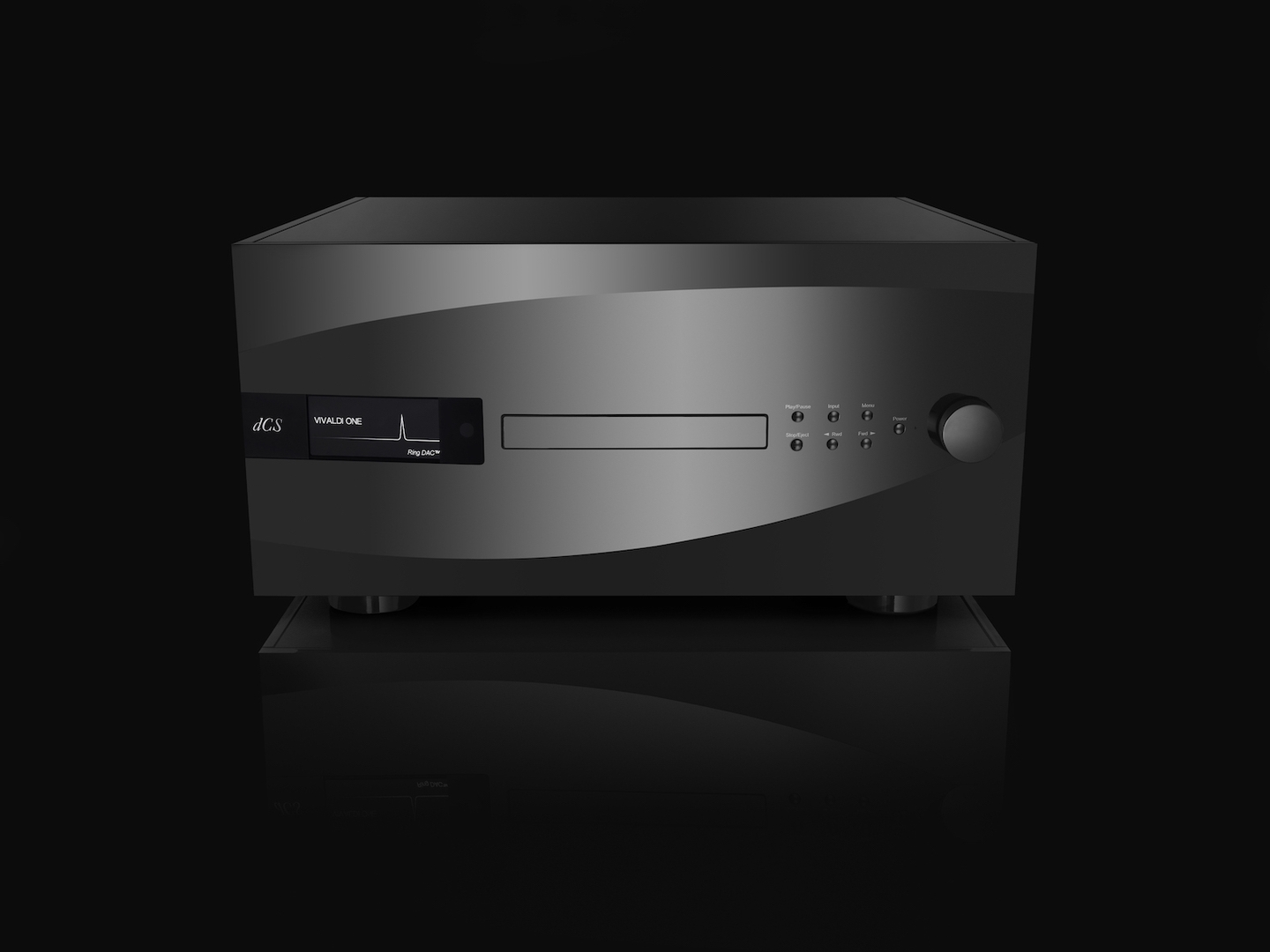
From the dCS/MQA press release: dCS announces the release of a software update that provides MQA compatibility to all current product ranges –  bringing the MQA experience into what many regard as the best digital music source in the world. 

MQA, Master Quality Authenticated, provides a means to efficiently encode and transmit high resolution audio. MQA is based on the axiom that, in audio, high resolution can be more accurately defined in the analogue domain in terms of temporal fine structure and lack of modulation noise, than by any description in the digital domain, particularly one that relies on sample rate or bit depth numbers. 

MQA works by converting the analogue music to digital and back to analogue again. The conceptual framework models analogue as an infinite sample rate representation, which can be approximated by a hierarchical chain of downward and upward splines. The MQA encoder takes account of and corrects aspects of the original analogue-to-digital and studio preparation chain. 

Although a listener can enjoy the encoded stream at CD quality without a decoder, the best result comes with an MQA Decoder, or a combination of MQA Core Decoder and Renderer, which reconstructs exactly what was heard in the studio.

The MQA Renderer performs sampling reconstruction under song-by-song instruction from the encoder, while at the same time matching and optimising the attached DAC to deliver an authenticated analogue output.

MQA Decoders include a Renderer which is customised for each built-in digital-to-analogue converter. Generally, the converter includes an integrated DAC which is not wholly configurable and may have some performance limitations. For this reason, most MQA decoders include pre-compensation for the built-in converter. 

dCS does not use IC converters in its DACs; instead the process of reconstructing analogue from the digital stream is entirely custom, using specific software and discrete hardware to make a DAC. However, unlike other non-integrated DACs, the dCS is still modelled on reconstruction using oversampling, filtering and high-speed conversion.

David Steven, Managing Director, dCS states:

“The dCS and MQA teams have been in discussion, development and testing for almost a year. This is a unique and exciting implementation made possible by the flexibility and capability of our platform, as well as the fact that both companies have aligned philosophies, strong mutual respect and trust.”

Bob Stuart, Founder & CTO, MQA adds:

“In the case of the dCS Rossini, the MQA and dCS teams were able to work together to develop code which accurately matched the MQA hierarchical ideal reconstruction to analogue. This MQA implementation is unique, as it is the first opportunity to enable a DAC which, by providing exact rendering to beyond 16x (768 kHz), matches the desired temporal response with very low modulation noise.”

For owners of dCS, firmware can be easily updated via the internet download and update functionality.

Availability: 

dCS Rossini – October 2017 
dCS Vivaldi One – November 2017

dCS Network Bridge – November 2017

dCS Vivaldi DAC & Upsampler – December 2017


About dCS
Since 1987 dCS has been at the forefront of digital audio, creating world-beating, life-enhancing products that are a unique synthesis of exact science and creative imagination. Each of our award-winning product ranges sets the standard within its class for technical excellence and musical performance. As a result, dCS digital playback systems are unrivalled in their ability to make music. 

All dCS products are designed and manufactured in the United Kingdom using proprietary technology, and materials and components of the highest quality. A carefully judged balance of our unique heritage and world-class engineering ensures there is a rich history of ground-breaking innovation inside every dCS system.

News Round Up 31 October 2017

CanJam at Rocky Mountain Audio Fest 2017 – Part 4, Personal Audio Cables & Accessories, Best of Show

What follows is Part 4 in a four-part series of snapshot-style reports on new (or at least new-ish) personal audio products seen at CanJam RMAF 2017.

For the sake of clarity, we have broken out coverage into four segments:

·      Part 1 – Full-size Headphones

·      Part 2 – Earphones & CIEMs

·      Part 3 – Personal Audio Electronics

·      Part 4 – Personal Audio Cables & Accessories, Best of Show

o   Best Cost-no-object System

o   Best Value-minded System

o   Coolest Innovation

Personal Audio Cables & Accessories

Astell&Kern CD ripper

Astell & Kern showed a new CD ripper that is compatible with Ethernet-enabled and recording-capable Astell&Kern personal digital audio players. The CD ripper rips CDs directly to the players, which gathers and stores metadata for ripped content via Gracenote. The ripper is priced at $399.

Audeze Cipher cable for LCD-i4

Readers familiar with Audeze’s excellent iSINE10 and iSINE20 planar magnetic earphones will likely know that one of the best ways to hear those models is through their optional, Lightning-compatible Audeze Cipher cables, which provide an inline headphone amp/DAC/DSP module complete with pre-programmed DSP-driven EQ corrections that significantly improve the frequency response of the iSINE models, giving them audibly more neutral voicing.

Audeze recognized that some though not all LCD-i4 owners might welcome the convenience of having an LCD-i4-specific Cipher cable and so the firm has developed one. However, Audeze’s flagship LCD-i4 planar magnetic earphones have much more neutral voicing than the iSINE models do and therefore need little if any DSP-driven EQ correction, so the LCD-i4 CIPHER cable is designed accordingly (that is, with minimal built-in EQ as contrasted to the iSINE Cipher cable, which has considerably more EQ dialed-in). Interestingly, the LCD-i4 Cipher cable isn’t something Audeze will sell, but rather is a gift the company will make available to LCD-i4 owners upon request and free of charge. Because the LCD-i4 is considerably less sensitive than the iSINE models, the LCD-i4 CIPHER cable is a balanced output design with about 6dB more output than the iSINE-version CIPHER cable.

Dana Cable Lazuli and Lazuli Reference headphone cables

Dana Cables are marketed worldwide by Gingko Audio and two of the firm’s specialties are its very high performance Lazuli and Lazuli Reference headphone cable sets. The Lazuli cable is a 500-strand design targeted toward upper-tier headphones such as the HiFiMAN HE 1000 v2, while the Lazuli Reference cables is a 1200-strand design geared for use with cost-no-object headphones such as the Abyss AB-1266 Phi edition. Lazuli cable sets start at $549, while Lazuli Reference cable sets start at $1199. Both cable sets offer more expansive soundstages with an increase in resolution for ambient information in the music—benefits that are particularly noticeable with the Lazuli Reference cables used on appropriately high quality headphones.

Dekoni ear pads for Sennheiser HD 6xx and HD 800 headphones

Dekoni offers luxury-grade alternative ear pads for many popular headphones and two offerings that were drawing a lot of attention at CanJam were the firm’s beautiful ear pads for the Sennheiser HD 800 ($99.99) and pads purposely developed for Sennheiser’s HD 600-family headphones (e.g., the HD 580, HD 600, HD 650, and the new Massdrop x Sennheiser HD 6xx; priced at $59.99). The HD 800 pads sets will become available in 6-8 weeks, while the HD 6xx pads should appear on the market within a month.

Note: There is real synergy between Dekoni’s ear pad offerings and Sennheiser’s Massdrop x Sennheiser HD 6xx headphone, which a Massdrop spokesperson indicated was one of Massdrop’s post popular headphone ‘Drops’ to date. Apparently, many enthusiasts feel an optimal combination will be the HD 6xx headphone fitted with a set of Dekoni pads.


Effect Audio Horus earphone cables

The personal audio cable specialists at Effect Audio were showing a new flagship earphone cable called the Horus, whose conductors are made of pure OCC silver with gold external plating. The cables are expensive at $1599/set, but arguably worth the effort for those who own true top-tier earphones.

iFi Audio Ear Buddy

Have you ever found yourself on a long plane flight and thought it might be nice to listen to music or watch film through the aircraft’s entertainment system using your own high-quality earphones or CIEMs?. We have and the results typically are not pretty, largely because the lowest volume setting on the plane’s A/V system will typically be so loud as to fry your ears when you listen through high quality and high-sensitivity earphone and CIEMs. What’s to be done?

iFi offers two answers in the form of its original iEMatch device (which is very full-features but perhaps a bit pricey for some users) or the brand new Ear Buddy device, which sells for just $20. In essence, the Ear Buddy is a high fidelity, sensitivity compensation device that lets you use top-tier earphones with in-flight A/V system, but at sensible and pleasurable volume levels. As a result, in-flight entertainment goes from “Meh” quality levels (‘cause freebie airline earphones sound, let’s face it, pretty darned awful) to “Wow!” quality levels.

Speaking as an enthusiast iFi iEMatch user (I never go on long flights without an iEMatch device tucked in my earphone case), I’m glad to see iFi offer the scaled back (but equally high quality) Ear Buddy at a price almost anyone can afford.

iFi Audio Gemini 3.0 cable

The iFi Audio Gemini 3.0 cable is the finest quality USB cable the firm knows how to make provided that your source device absolutely must at least two USB ports. The reason this is so is that the Gemini 3.0 deliberately separates out USB power lines from USB digital audio data lines, with heavy-duty shielding/isolation in between the two. Accordingly, on the source end, the Gemini 3.0 cable provides dual USB connectors—one for the power lines and the other for the signal lines. Pricing for the iFi Audio Gemini 3.0 cables starts at $379.

iFi Audio Mercury 3.0 cable

If the Gemini 3.0 is iFi’s finest USB cable for use with multi-USB port-equipped digital audio sources, the Mercury 3.0 cable is the firm’s best USB cable for applications where only a single USB data output port is available.

The Mercury uses very high quality shield conductors, iFi’s new Final USB audiophile connectors, and the firm’s RF3 custom-made metal oxide ceramic noise silencers. Pricing for the iFi Audio Mercury 3.0 cables starts at $209.

Schiit Audio The Gadget real-time music processor

See “Coolest Innovation”, below

Wireworld Pulse, Nano Eclipse, Nano Silver Eclipse, and Nano Platinum Eclipse

Wireworld offered an eye-opening demonstration, which it dubbed the “Audio Cable Polygraph Test’. The test is designed so that listeners can compare the sound of high quality headphones fed from an extremely short (and cable free) mini-jack to mini jack adapter vs. the sound of four different grades of Wireworld headphone cables. The concept is that the cable-free adapter should sound best of all (because no cabling is involved) while the various grades of headphone cables should, in theory at least, come progressively closer to matching the sound of the cable-free adapter.

In fact, these are precisely the results I observed while listening through four grades of 1-metre headphone cables: Wireworld Pulse (OFC conductors, $58/metre), Wireworld Nano Eclipse (OCC copper conductors, ~$150/metre), Wireworld Nano Silver Eclipse (OCC silver-clad copper conductors, ~$200/metre), and Wireworld Nana Platinum Silver Eclipse (OCC solid silver conductors, ~450/metre).

The beauty of the demonstration was that it offered a useful standard for comparison (the adapter with no cable at all) and showed how that both cable materials and geometry do have a tangible impact on sound quality.


Best Sound of Show, Cost No Object:

Vandersteen/VTL/Brinkmann/AudioQuest room

For me, some of the most beautiful, refined, and accomplished sounds to be heard at RMAF came from the Audio Alternative room, which used a Brinkmann Balance turntable fitted with a Lyra Atlas phono cartridge; a VTL electronics suite consisting of a TP-6.5 phonostage, a TL-7.5 Series III linestage preamplifier, and a pair of Siegfried Series II monoblock amplifiers; a speaker system consisting of Vandersteen Model Seven MkII loudspeakers supplemented by Dual Vandersteen Sub Nine subwoofers; and a complete loom of AudioQuest cables and power conditioning components.

As so often happens with VTL-driven systems, the sheer excellence of this system didn’t bowl the listener over with bombast, but rather won the listener over in a gentle and elegant but very persistent way with its unfailing mastery of textures, details, dynamics, and of realistic image and soundstage scale. Listening to this system was kind of like falling in love in slow motion: musical ecstasy at its best.

Best Sound of Show, Value-Minded:

ELAC Adante/Audio Alchemy room

Andrew Jones has been on a role of late and never has this been more obvious than with his new Adante-series loudspeakers. To answer a question many have posed, yes, the ELAC Adante loudspeakers—and in particular the Andante AF61 floorstanders—are now in full production and shipping. (Indeed, Jones had air freighted one of the first production line pairs to RMAF specifically to show that the speakers were indeed finished).

But complementing Jones’ Adante speakers were the also excellent and also value minded ELAC (formerly Audio Alchemy) audio electronics from Peter Madnick.One of the main ELAC demonstration rooms featured the ELAC Adante AF61 floorstanding loudspeakers (~$4998/pair) as driven by a suite of ELAC/Audio Alchemy components including an Alchemy DMP-1 digital media player ($1795), DDP-1 preamp/DAC ($1995 with PS-5 power supply ($495), and a pair of DPA-1 mono power amplifiers ($1995 each), and an ELAC Discovery music server ($1099). The result was a roughly $14,400 system—not including cables or power conditioning—whose tightly focused, beautifully balanced, and essentially full-range sound could quite easily have passed for something anywhere from two to perhaps five times its price. This system offers a value benchmark that will not easily be beaten.

Coolest Innovation:

Schiit Audio The Gadget (C = 256 vs. A = 440)

The Schiit Audio Gadget is one of those components that hardcore audio purists are likely to dismiss on sight—right up until the point they give it an open-minded listen. What is the Gadget and what does it do? Schiit describes it as a DSP-driven, real-time ‘Music Processor’ whose purpose is to allow users to alter the tuning of their favourite pieces of music without altering the tempo of the music in any way.

“Why,” purists will surely ask, “would anyone want to do that?” The answer, says Schiit’s chief digital audio architect Mike Moffat, is that standard contemporary musical tuning, where A = 440Hz, is a comparatively recent development. According to Moffat, many musicians (and instrument makers in the 19th and early 20th century used somewhat diffent tuning where C = 256Hz (which roughly equates to A = 430.2Hz, give or take a bit). Moffat made this discovery while try to ascertain why pre-WWII mandolins somehow sounded sweeter and more musically ‘right’ than modern mandolins seem to do. It turns out the answer is that many of those older mandolins were set up for C = 256Hz tuning. This led Moffat to wonder if all music might benefit from retuning to the C = 256 standard.

Many DSP-driven designs, tons of PhD-grade mathematics, and about a gazillion lines of DSP programming code later, the idea for the Gadget became a reality. The small processor accepts digital music files and processes them in real-time while allowing users to continuously vary pitch tuning from standard A = 400Hz tuning down to C=256Hz tuning, and than further down to C= 24z tuning. The challenge for the listener is to play a favourite piece of music and then to turn the tuning adjustment knob until—on a subjective level—the music and instruments sound as if they are properly in tune.

Having tried this test myself, and having watched 10 or so other listeners try it, I can report that few if any listeners thought A = 440Hz tuning sounded right. On the contrary, when listening with their eyes closed, almost all listeners chose a setting at or pretty close to the C = 256Hz mark. And let me add that, if you flip the Gadget’s provided bypass switch, so that you abruptly go back to A = 440Hz tuning, standard tuning suddenly sound sharp, shrill, edgy, and stressful by comparison. Interesting, no?

The Gadget will sell for about $200, which will be money well spent—if only because it affords an alternate view into how recorded music could sound, if we had made different tuning choice in the middle of the last ce

CanJam at Rocky Mountain Audio Fest 2017 – Part 3 Personal Audio Electronics

What follows is a Part 3 in a four=part series of snapshot-style reports on new (or at least new-ish) personal audio products seen at CanJam RMAF 2017.

For the sake of clarity, we have broken out coverage into four segments:

·      Part 1 – Full-size Headphones

·      Part 2 – Earphones & CIEMs

·      Part 3 – Personal Audio

·      Part 4 – Personal Audio Cables & Accessories, Best of Show

o   Best Cost-no-object System

o   Value-minded Systems

o   Coolest New Innovation

Personal Audio Electronics

Acoustic Research (AR) M200 portable digital audio player

AR’s newest portable hi-res music player and Bluetooth streamer is the M200, priced at $399. The M200 features an AKM AK4490 DAC device, a built-in Class A headphone amplifier, and an aptX HD Bluetooth streaming interface. The M200 provides a Pentaconn balanced headphone output as well as a conventional 3.5mm single-ended output, plus a USB type-C port for charging. The player supports PCM files up to 192kHz and DSD files up to DSD128 (although DSD digital audio data is converted to PCM format before playback). The M200 offers 32GB of on-board storage with a slot for a single Micro SD card with capacity up to 256 GB. The M200 appears to offer an awful lot of functionality for the money. To help hold pricing down, the M200 is deliberately not an Android device, but rather is controlled by a proprietary RTOS (real-time operating system).

Astell&Kern AK70 MkII personal digital audio player
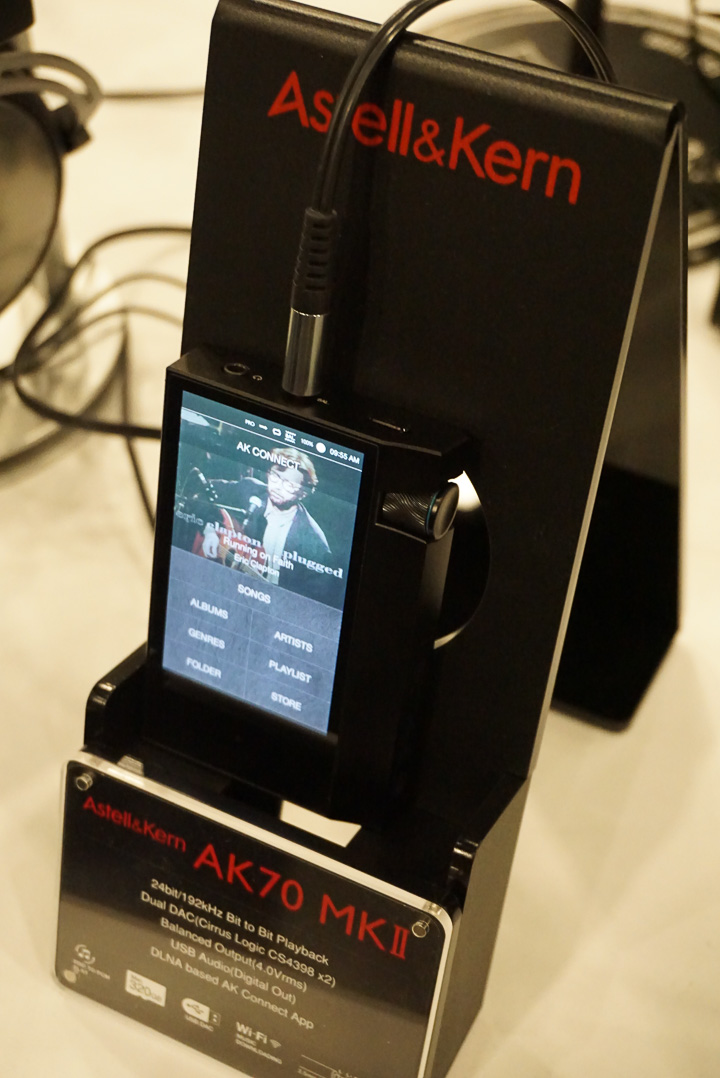
Showing a renewed emphasis on the more affordable entries in its product range Astell&Kern demonstrated its new AK70 MkII personal digital audio player, priced at $699. Compared to the original AK70, the new AK70 MkII features a dual DAC architecture (with separate left and right channel Cirrus Logic DACs) and a single-ended/balanced output amplifier where maximum balanced output is increased from 2.3V to 4V. The AK70 MkII supports PCM files at up to 24/192 and DSD files at up to DSD 128 (though DSD files are converted to PCM format prior to playback). Astell&Kern points out that the AK70 Mk II is its first model to offer dual-DAC architecture with a selling price below $1000.

Astell&Kern Acro 4000 desktop headphone amplifier/DAC

Astell&Kern previewed its visually stunning (and very angular-looking) Acro 4000 desktop headphone amp/DAC, which is expected to sell for just under $1000. The Acro 4000 uses an AKM K4490 DAC device and provides both single-ended and balanced amplifier outputs (the amp/DAC sports 3.5mm and 6.35mm single-ended outputs and a 2.5mm balanced output jack). Maximum power output is said to be 20 watts/channel at 4 ohms. The amplifier provides three switch selectable modes labelled ‘AK’, ‘Hi Gain’, and ‘Bass Boost’.

Audeze Cipher cable for the LCD-i4 planar magnet earphones
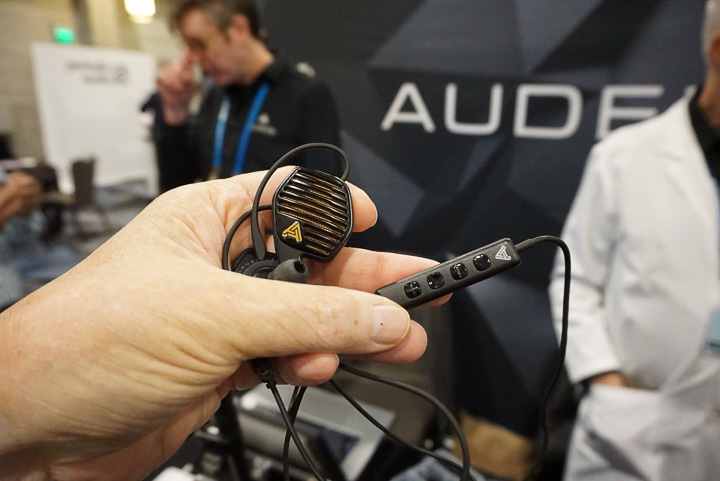
Many listeners are familiar with Audeze’s iSINE-series planar magnetic earphones, which can be driven as passive earphones, but which sound better using iSINE-specific active CIPHER cables that incorporate a compact in-line DAC/Amp/DSP module, with the latter providing a measure of iSINE-specific voicing correction.

By comparison, Audeze’s flagship LCD-i4 planar magnetic earphone offer much more linear frequency response than the iSINE models do, so that it is typically run as a passive device that can be powered from DAPs, small portable amp/DACs, or even directly from smartphones and tablets. Still, Audeze was aware that many LCD-i4 owners and prospective customers were interested in driving their earphones from Apple iDevices equipped with Lightning connectors. With this thought in mind, Audeze has created an LCD-i4-specific, Lightning Cipher cable that will be offered upon request at no charge for current or future LCD-i4 owners. Cool, no?

Beyerdynamic Impacto Essential & Impacto Universal portable headphone amp/DACs

Beyerdynamics’ Impacto Essential and Impacto Universal portable headphone amp/DACs are essentially two almost identical variations on a common theme, the only difference being that the Impacto Universal ($379) comes with cables allowing connectivity both for Apple and Android devices, while Impacto Essential ($329) is geared for use with Android devices only.

Either way, the Impacto models represent what the German firm term “high-res cable DACs” that serve as effective portable amp/DACs for popular Beyerdynamics headphones such as the second-generation T1 Tesla or T5p, or the new Amiron Home headphone.

The Impacto amp/DACs are based on ESS Sabre9018Q2 Sabre32 Reference DAC and offer decoding for PCM files up to 32/384 or for DSD64 files. Power output is 50mW at 32 ohms or 7mW at 600 ohms. 

CEntrance Blue DAC portable headphone amp/DAC

The Illinois-based firm CEntrance showed its promising new Blue DAC, which can be used as a wired or wireless Bluetooth compact, portable, USB headphone amp/DAC that provides both single-ended and balanced outputs and that offers both hi and low gain settings. Playing time for the Blue DAC is about 12 hours in Bluetooth mode or 8 hours in USB mode. The price: $399.

Chord Electronics Poly streaming module for use with the Mojo portable headphone amp/DAC

By the time you read this Chord’s brilliant clip-on streaming module for the Mojo portable amplifier will have, at long last, been released, with a price of £499. The Poly adds extensive Bluetooth and Wi-Fi streaming capabilities for the Mojo and is, by design pretty playback app ‘agnostic’—meaning users are emphatically not locked in to any one specific music playback app. Hi-Fi+ Editor Alan Sircom is already in possession of a product sample of the Poly, so readers can expect a review of the so-called ‘Mojopoly’ combo in the near future.


Echobox Audio Explorer streaming personal digital audio player
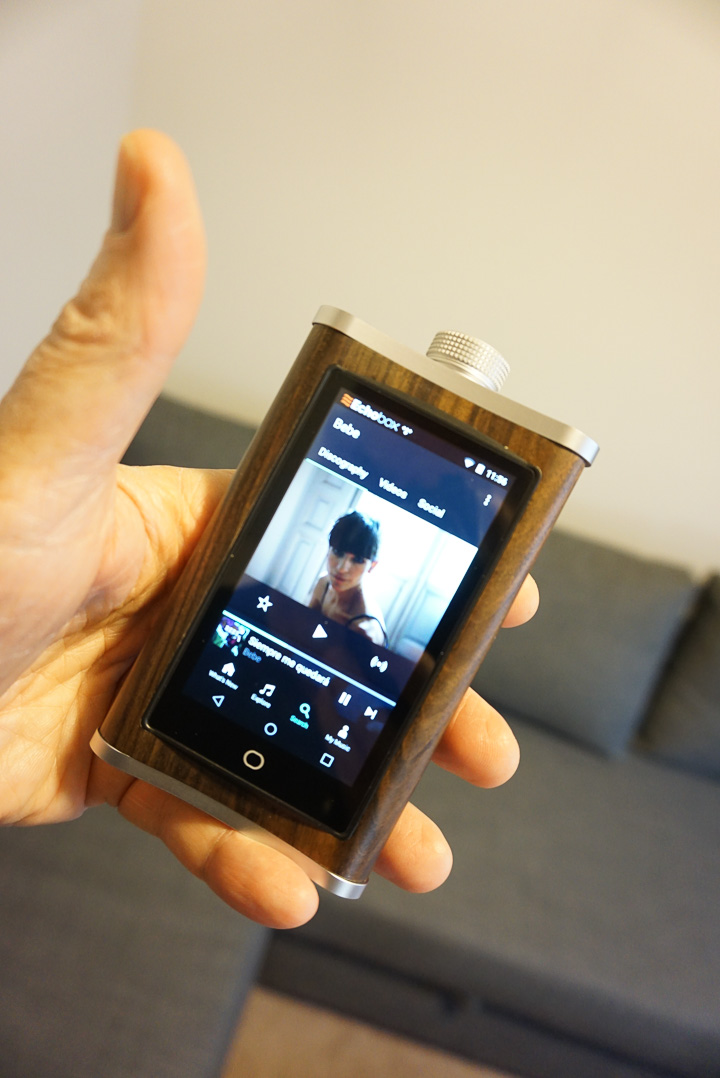
We are pleased to tell you that after a very long gestation period the long-awaited Echobox Explorer streaming personal digital audio player is finally here and priced at an eminently affordable $599 (an option dock/stand is available for an extra $75).  The distinctive hip flask-shaped, wood-bodied streaming DAP features a Texas Instruments/Burr Brown PCM 1792 DAC device that supports PCM files to 12/192 rates and DSD64 (via conversion to PCM format). The player also uses Texas Instruments TPA6120A2 op amp that delivers 300mW/channel at 32 Ohms.

The player is Android-based (using Android 6.0 Marshmallow) and runs under a Rockchip RK3128 quad core processor backed by 1GB of DDR3 memory.  For music storage, the player provides 64GB of internal memory plus a single Micro SD cardslot for cards with up to 256GB capacity. Connectivity includes 2.4GHx Wi-Fit and aptX Bluetooth 4.0. Happily, the player comes pre-loaded with both the USB Audio PR and Tidal apps and comes with a complimentary starter Tidal membership.

Watch for a Hi-Fi+ review of the Explorer in the coming year.

FiiO X7 MkII portable digital audio player

The personal audio specialists at FiiO were proudly showing the firm’s newest and most accomplished high-res digital audio player, the Android-based X7 MkII, priced at $649.99. Technical highlights of the X7 Mk II include 2.45GHz Wi-Fi connectivity, an aptX Bluetooth 4.1 interface, an ESS9028 PRO DAC that provides native support for both PCM up to 32/384 and DSD up to DSD256, built-in single-ended and balanced output headphone amplifiers, 64 GB of internal storage, and slots for two Micro SD cards at up to 256GB/each. The X7 Mk II may well be the leading contender in the maximum-bang-for-the-bucks sweepstakes amongst high-res portable DAPs.

iFi Audio Nano iDSD Black Label portable headphone amp/DAC
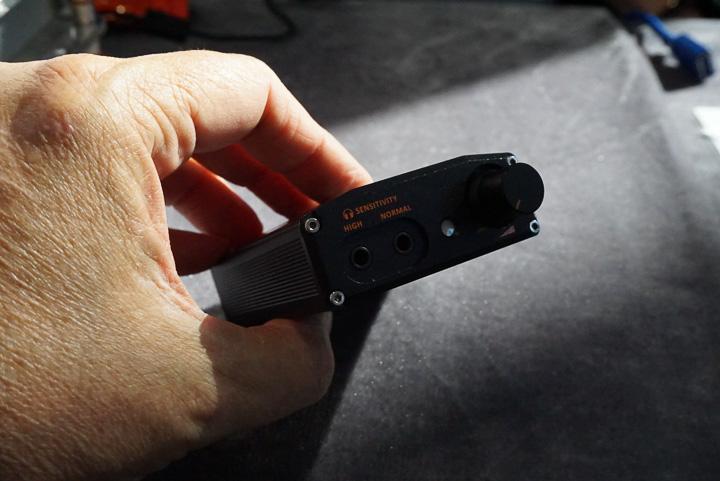
iFi Audio’s Nano iDSD Black Label portable headphone amp/DAC can be viewed as an attempt, many of the features and much of the sonic goodness of the firm’s superb though considerably larger Micro iDSD Black Label headphone amp/preamp/DAC, but in a much smaller and less costly package. The Nano iDSD Black Label sells for an extremely reasonable $199.  The Nano iDSD Black Label can handle PCM files at resolutions up to 32/384, DSD files up to DSD256, and DXD files (384kHz)—all in native formats. The Nano iDSD is also MQA compatible.

Naturally, the Nano iDSD foregoes a few features the larger Micro IDSD provides such as variable level pre-amp outs and a power charging mode for smartphones and the like, and the Nano also provides simplified iEMatch and filter options vis-à-vis its bigger brother, and output is of course lower as well. But in light of its small size and very modest price, the Nano iDSD Black Label looks to be every inch the class leader that the Micro iDSD Black Label has proven to be. 


McIntosh MHA150 headphone amp/integrated amp/DAC

Though not, strictly speaking, a brand new model, McIntosh’s MHA150 is a product whose many virtues we are only just now beginning to fully appreciate. Specifically, the MHA150 provides a transformer coupled headphone amplifier that can deliver a minimum of 1 watt/channel at any impedance, meaning the MHA150 can easily be optimized for virtually any headphone load. Next, the MHA150 provides a highly capable, PCM 32/384 and DSD256 compatible DAC, complete with an MCT specific interface that enables the MHA150 to receive and play PCM or DSD digital audio files directly from any of several available McIntosh MCT-series disk transports. (There is a new McIntosh MCT 80 SACD/CD transport that sells for $3500 and that exactly matches the size and industrial styling of the MHA150.) Finally, as something of a piece de resistance, the MHA150 can serve as a direct coupled 50 watt/channel integrated amplifier more than capable of powering any number of full-size loudspeakers. The price: $4,500.

Modwright HA300 desktop valve-powered headphone amp
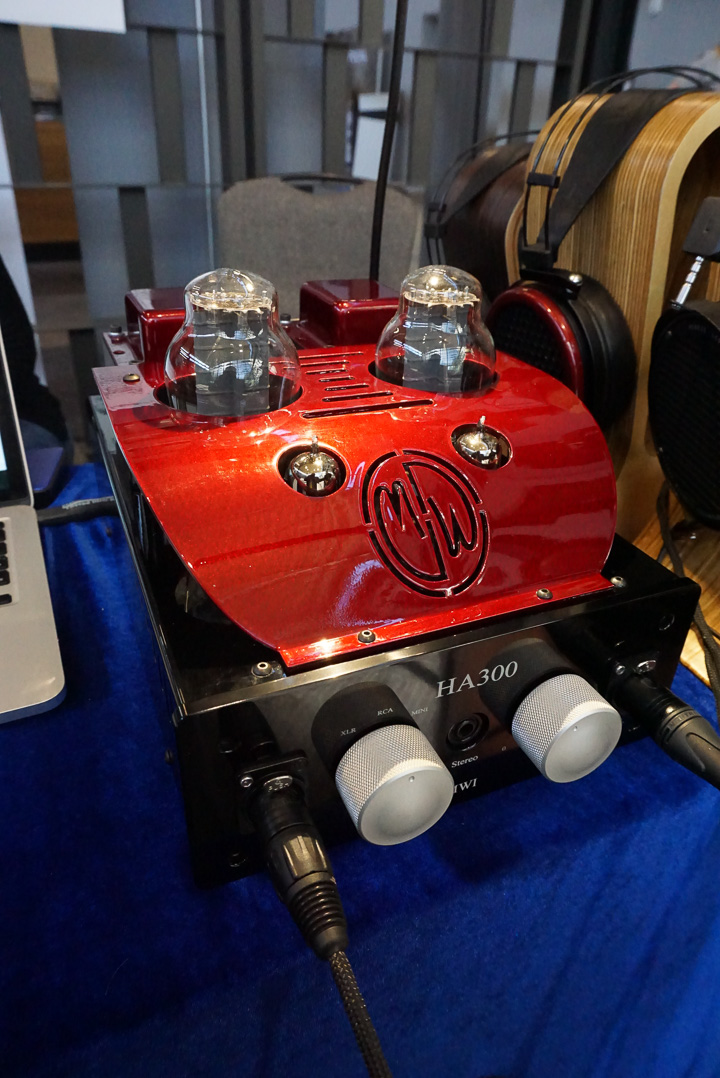
Modwright showed its most ambitious headphone amplifier to date in the form of its valve-powered, two-chassis HA300 amp, which sells for $8000. The HA300 is driven by 300B valves and comes complete with a beefy, outboard PS300 power supply module. The amp provides one balanced and two single-ended inputs and is also able to serve as an integrated amplifier capable of driving relatively high-sensitivity loudspeakers. It’s quite beautiful to look at as well.

Periodic Nickel headphone amp prototype
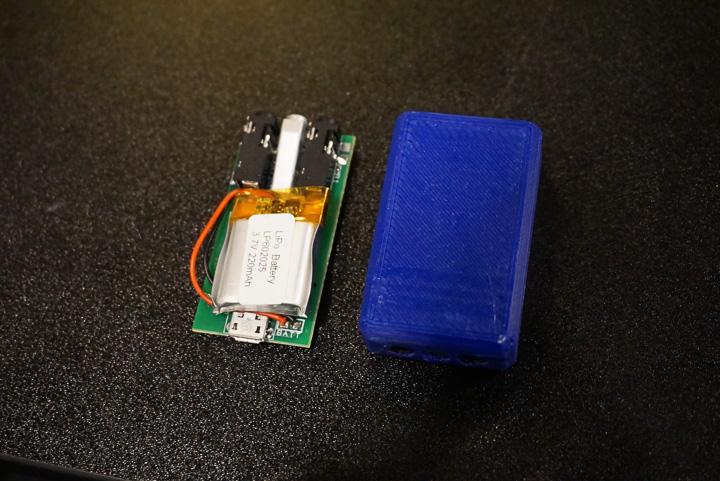
Periodic showed a rough prototype and also the raw circuit board for its upcoming, matchbox-sized Nickel portable headphone amp. The Nickel is still under development, but its projected price will be $299.

Pro-Ject DAC Box DS2 UltraDAC and Head Box DS2 headphone amplifier

Pro-Ject showed two closely related ‘Box-series’ personal audio components in the form of its DAC Box DS2 Ultra DAC ($699 in plain black or $799 with wood chassis case) and the Head Box DS2 balanced headphone amplifier ($599 in plain black or $699 with wood chassis case). The DAC Box DSD Ultra is a PCM 24/392-capable and DSD 256-capable DAC with easy-to-master user controls, while the Head Box DS2 is a balanced output amp with moderate (550mW @30 ohms) output capabilities. There is a lot of value and subtle sophistication in this two-chassis component stack, and the wood encased version look terrific.

Schiit Magni 3 headphone amp/Loki Mini EQ system, and Modi 2 DAC entry-level mini-stack
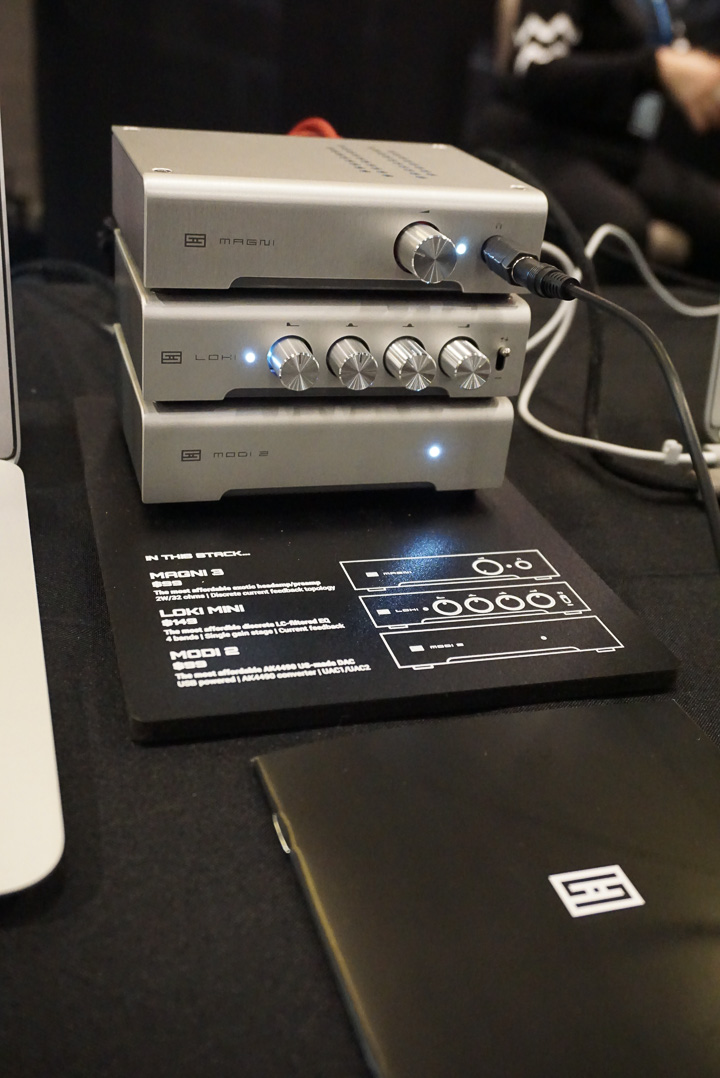
The value-minded folks at Schiit Audio proudly showed a new three-component mini-stack of personal audio components that collectively sell for less than most enthusiasts would expect to pay for a single component. The mini-stack consists of the surprisingly powerful (3000mW at 16 ohms) solid-state Magni 3 headphone amp/preamp ($99), the 24/192-capable Modi 2 DAC ($99), and the remarkably versatile Loki Mini 4-band EQ module ($149), which provides EQ for very low bass (in the 20Hz region), mid-bass (400Hz region), midrange (2kHz region), and treble (8kHz region). The bottom line: $347 dollars buys users an awful lot of personal audio performance potential for not a lot of money.


Schiit Vali 2 valve-powered headphone am/preamp and Modi 2 Multibit (Closed-Form filter) DAC

For those with just a little more money to spend (but still not an awful lot in the grand scheme of things), Schiit offers a sub-$400 two-component personal audio stack that ups the performance ante by a substantial margin. The stack consist of the moderately powerful (1300mW @ 16 ohms), valve-driven Vali 2 headphone amp/preamp ($149) and the 24/192-capable Modi 2 Multibit DAC ($249), which features a version of the distinctive multibit, closed-form digital filter that Schiit Audio first pioneered in its critically-acclaimed, top-tier Yggdrasil DAC. Even though the stack serves up a seriously sophisticated and refined sound that belies its modest $398 price.

Sennheiser HDV820 desktop headphone amp/DAC
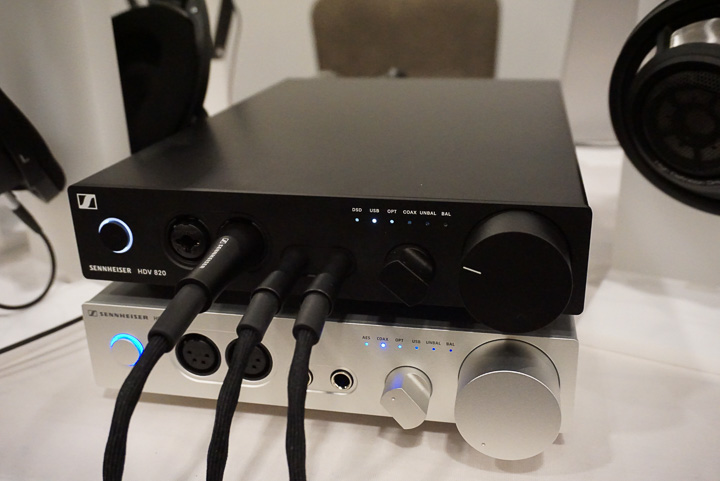
The Sennheiser HDV820 is the German firm’s next-generation, reference quality fully balanced headphone amp/DAC that improves upon its predecessors in several ways.  Specifically, the DAC section of the HDV820 now uses an ESS Sabre DAC that is said to sound considerably better than the DAC used in previous Sennheiser amp/DACs. Moreover, the new model now features variable-level pre-amp outputs, meaning the HDV820 can be used as a digital preamp to drive full-size hi-fi systems, if desired. Finally, the balanced output headphone amplifier now offer the option of Sony-developed Pentaconn connectors, which will soon begin to appear on balanced cables that will ship with certain higher-end Sennheiser headphone models. The price: $2,400.

SPL Phonitor SE and Phonitor E desktop headphone amplifiers

The world-famous German pro audio company SPL showed two desktop headphone amplifiers that are, in a sense, variations on a common theme. The flagship of the pair is the Phonitor SE headphone amplifier/preamp, which uses proprietary VOLTAIR technology to provide both balanced and single-ended drive capabilities for headphone or for driving power amplifiers in full-size audio systems. The Phonitor SE provides high power output (2 x 3.7 watts at 120 ohms), wide bandwidth (frequency response of 4HZ – 300kHz), low distortion  (0.00085% in preamp mode), and high dynamic range (136.3 dB in preamp mode). Moreover, the Phonitor SE incorporates SPL’s Phonitor Matrix system, which promises “speaker equivalent playback” from headphones complete with elaborate controls crossfeed settings and perceived speaker angle adjustments. The SE also provides a so-called Laterality control, which is in essence a “super-fine balance control”. Finally, the SE is offered either with or without an optional 24/192 capable DAC with USB, coaxial, and optical digital inputs. Pricing for the SE ranges from $2499 to $2799.

The significantly smaller and less expensive Phonitor E is a minimalist version of the SE, but that is set up purely as a headphone amp (meaning there are no preamp functions). But in most crucial respects the E offers essentially the same core performance capabilities as the SE, but with stripped-down Phonitor Matrix setting and no dedicated Laterality controls. Like the SE, the Phonitor E can be ordered with or without SPL’s 24/192 DAC module. Pricing for the Phonitor E ranges from $1499 to $1799, making it a bit of a bargain in light of the performance on offer.

Stax SRM-T8000 electrostatic headphone amplifier
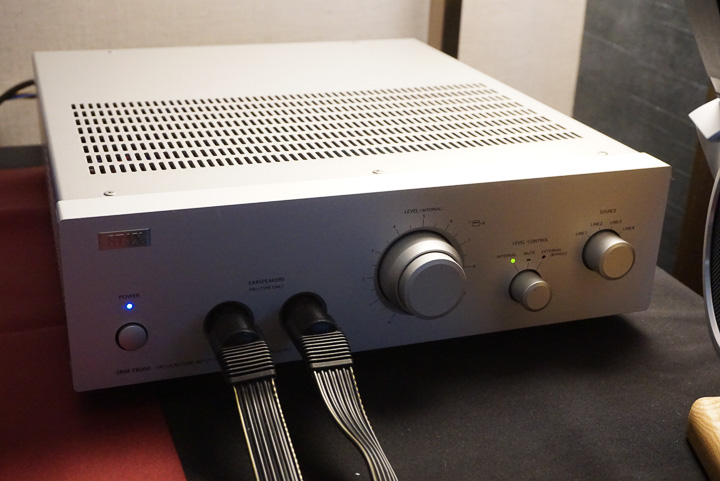
Stax has finally taken the welcome step of releasing a new electrostatic headphone amplifier (or ‘Energizer’ in Stax-speak) that is said to offer performance on a par with that of the Stax flagship SR-009 electrostatic headphone. The SRM-T8000 uses dual 6922 valves in its input stage, which in turn drive a pure Class-A solid-state output stage. Stax has worked extensively on internal vibration isolation and damping to eliminate vibration-borne sources of distortion in the SRM-T8000. The amp also features a power supply based on large toroidal transformers and uses extremely high-quality parts throughout. The price: $6,000.


Swan Song Audio desktop headphone amp/DAC prototype

Swan Song is a boutique manufacturer of two ranges of very high quality audio electronics products—White Swan products, which are mid-to-high priced, and Black Swan products, with use ultra premium parts throughout and are accordingly premium priced.

For RMAF the firm was showing a work-in-progress prototype of an upcoming White Swan-series (we think) headphone amp/preamp/DAC that will sell for about $3,750.

What caught our eye was that the firm had sets of demo stations that invited listeners to compare and then offer comments on three different output device configurations that are being contemplated for the final design. This is a great example of seeking out the ‘wisdom of the crowd’ in a distinctly audiophile context. 

Westone BT cable
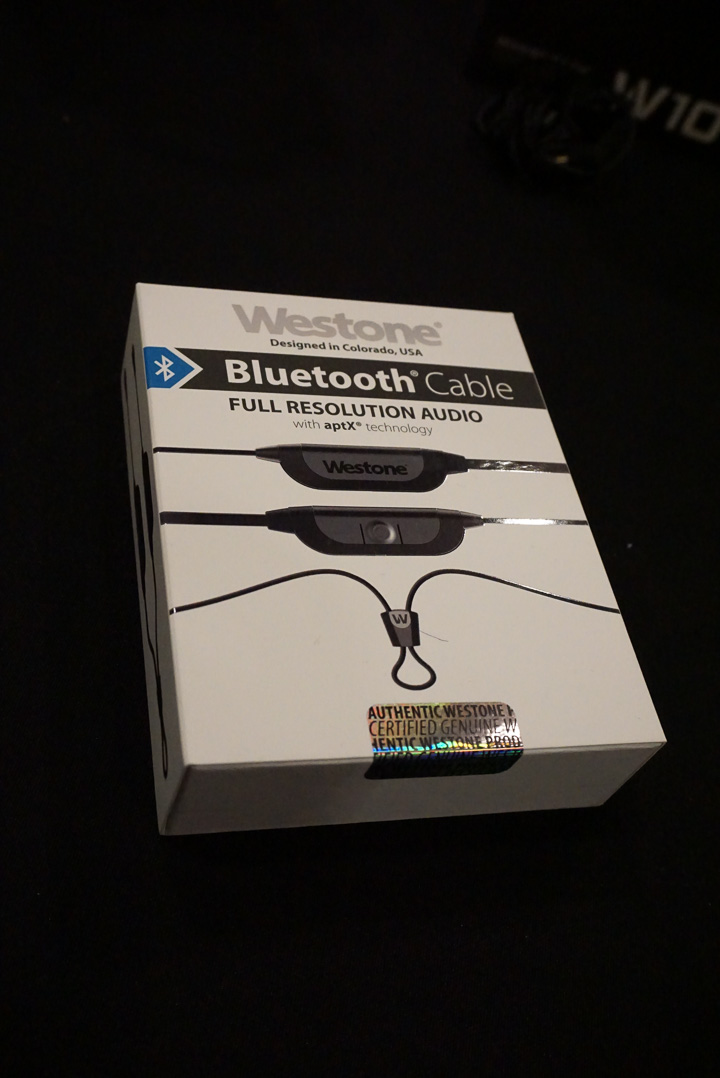
Westone’s new Bluetooth 4.0/aptX cable sports MMCX-type connectors and will fit any of the firm’s MMCX-compatible earphones or CIEM’s, in essence giving users BT connectivity on demand. The BT cable comes with a USB charging cable and affords about 8 hours of playing time per charge. The price: $99.99. (But note: Westone offers its very desirable and specially-priced WX1 product bundle for $149.99, which gets you the BT cable plus a high quality single balanced armature earphone thrown into the bargain.

Woo Audio WA33 standard & elite headphone amplifiers

Woo Audio’s flagship headphone amplifier for use with dynamic and planar magnetic-type headphones is its two-chassis WA33 model, which is offered in two basic forms: the WA33 Standard model (priced at $7,999) and the WA33 Elite edition (priced at $15,000). Like most Woo amplifiers, the WA33 is valve powered so that you might infer that the differences between the WA33 Standard and Elite would involve valve upgrades, but that isn’t the case.  Instead, all of the Elite upgrades involve very significant steps up in quality for absolutely all internal parts used in the amplifier (this represents a step up from the already good parts used in the Standard to what might be termed boutique, ‘unobtanium-class’ parts as used in the Elite version).

Interestingly, both the Standard and Elite models can be further improved by going ‘full fat’ on the ordering list and thus specifying all of Woo’s available exotic valve options for the amplifiers—a step that, says company founder Jack Wu, could add another $5,000+ to the amplifier’s price. The end result, though, is one of the best-sound headphone amplifiers on the market today.

XI Audio Formula S headphone amp

XI Audio (Eleven Audio) showed its Formula S high output, dual mono, solid-state, balanced output headphone amp, which sells for $3500. The Formula S is capable of 2.1 watts of output at 46 ohms and claims extremely low distortion: <0.006% THD @ 300mW of output, with distortion said to be “character compensated for high-end music playback.”

Roksan Blak CD player

Many people have written off CD today. However, reports of the death of the polycarbonate disc are greatly exaggerated. True, it’s getting ever harder to find players, especially new players, and increasingly the audiophile zeitgeist is moving toward online and LP as the music collections of choice, but there are still many enthusiasts who prefer a good bit of disc spinning. Indeed, there are many (incuding several writers for this magazine) who prefer the sound of compact disc over the same files stored on a hard drive.

So, Roksan announcing the Blak CD player last year came as something of a pleasant surprise. Especially as it is so uncompromisingly CD oriented: most players today are almost apologetic about playing discs, and come with a set of functions that open the player up to next-generation formats (most notably, USB inputs). The Blak makes no such excuses for CD replay, and it gives the user the choice of the spinning disc, or the door. In fairness, 21st Century digital inputs are a function of the built-in DAC within the matching Blak integrated amplifier, tested in issue 148.

Like the Blak amplifier, the CD player is built to the industry standard 440mm width, but taller than most players (at 140mm, it’s almost twice the height of other disc players in the Roksan range), with a choice of three front panel finishes – Anthracite, Charcoal, and Opium, also known as silver, black, and a sort of rich metallic brown colour that looks a lot nicer in the flesh than it reads in print. The range is intended to sit at the top of Roksan’s expanding electronics line, and at launch there were discussions of these being simply the first two designs in a range of products, but no future products have been announced to date.

Also like the Blak amplifier, the on/off switch is under the left of the front panel. In the ‘manuals are for wimps’ stance common to most men, I confidently mashed all the buttons on the remote and front panel to no effect until I found this hidden little power button. When depressed, however, the Blak springs to life, with a huge yellow LED read-out above the central CD draw. When not telling you that you just bought a Roksan in big letters, it can rack through different variations on track and time elapsed options, but any kind of CD-Text options (like artist or album or track) elude the Blak.

The display options are controlled from the lone silver button on the left side of the front panel. An array of five similar-sized silver buttons control almost all track-handling functions (except repeat), and in a time of a return to minimalism, it’s good to see a player that can be driven without a remote.

The large back panel houses a pair of high-quality gold RCA single-ended line-level sockets, a pair of equally decent XLR line level outputs, and digital coaxial and TOSlink S/PDIF connections and – somewhat overlooked in many modern players – an AES/EBU XLR connection. The sheer size of the rear panel means each of these connections is easy to reach and no-one will ever have much in the way of problems hooking the Blak to a system. The matching amplifier offers both single-ended and XLR inputs, so feel free to experiment, but I preferred the single-ended input.


Where every other company proudly shows off what DAC chip is used in their digital devices, Roksan is one of the few that keeps quiet about the inner workings of its products. I’m not sure why Roksan is so shy – peering under the covers reveals a perfectly serviceable Texas PCM1798 chip, and a solid – if unnamed – transport mechanism.

This somewhat cagey approach to digital audio design,  coupled with a minimalist exterior, does make for a review that focuses on the performance rather than the specifications and features. Which is no bad thing, because the Roksan Blak delivers a very well-rounded performance. There seems to be no need for elaborate set-up rituals, fancy cabling schemes, magic cones or boxes of tricks, and no need to wait weeks to run in the Blak. It works out of the box, and doesn’t need pampering. This also extends to its playing of discs, especially those not in their most pristine, straight out of the jewel case, condition. Some of my CD collection – the part that was ripped years ago and now resides in the attic – has seen better days and a few are almost test discs to see whether a player skips. And the Blak aced this test, except for one very old disc of Jessye Norman singing Strauss’ Four Last Songs [Philips], which looks as if it has been in a sandstorm and in fairness has skipped on every player for the last 10 years. All others – including a recording of ‘Telemusik by Karlheinz Stockhausen that I bought when in a particularly opaque mood (but before his infamous 9/11 comment) and that sounds like it’s skipping even when it isn’t – played perfectly.

Most CD players today (at least, most CD players today that don’t cost as much as a new car) seem to either go for a euphonic approach to sonic replay, or a version of ‘neutral’ that is stark and emotionless. To my mind, these are two different kinds of wrong, but without dCS-grade money to hand, usually the only other way to correct this is to buy second-hand and hope the transport mechanism isn’t on its last legs. The Blak is one of those rare players that sits between these two extremes, and reminds me of some of the great well-balanced CD players of the past (like the TEAC VRDS-10, the Marantz CD-17, and the Meridian 508.24).

How this presents itself in musical terms is it creates a sound that is writ large – the soundstage in particular is extremely wide and deep, but the instruments within that soundstage rarely appear oversized. This is incredibly important when playing Panufnik’s ‘Sinfonia Votiva’ [Boston SO, Seiji Ozawa, Hyperion], which is a 1981 recording of great energy and fine recording quality, as it can so easily move from modern religious passion to blurred and overblown arpeggios. The Blak comfortably teases out the themes from the ornament. This track also needs an excellent sense of scale and solidity to give the recording the power Ozawa is so good at releasing, and once again the Blak excels in this respect. But perhaps the most important aspect of the player’s performance revealed in this (and other recordings) is that trade-off between euphonic richness and stark clarity that is so commonly a function of modern CD players. Too much in one direction and this sounds like badly-edited plainsong, too much in another and it sounds like an orchestra rehearsing for the soundtrack for a Soviet-era cartoon about the perils of tractor production. Here, however, it simply sounds like Panufnik’s religious works.

Roksan has made an exceptionally clean and precise sounding player. It has a fine, tidy, and well-structured sense of rhythm. The secret to this is not to simply play something with a simple 4/4 time signature, but something that throws your foot-tapping way off balance, such as Dave Brubeck’s 5/4 time ‘Take Five’ or the alternating 9/8 and 4/4 time signatures on ‘Blue Rondo à la Turk’ [both from Time Out, Columbia]. The ability to tap your foot to such a difficult rhythmic concept is to no small degree dictated by the timing precision of the player, and the Roksan has no problems at all here. And yet, it’s not so bound by its rhythmic concerns to be incapable of anything apart from foot-tapping. A lot of my music doesn’t follow formal tempo structures, and a Schoenberg piece is arguably more about its timbral and tonal qualities, rather than merely tonal – elements at which the Black is equally adept.


A problem with picking out aspects of a performance, is they often look to micromanaging the discussion of sound quality, instead of looking at the player’s performance as a gestalt. But, with the Blak it’s hard not to look at music in any other way because the sound is holistic in intent. You aren’t drawn to the microdynamics of a piece, for example, because they aren’t highlighted or accented on the Blak, rather than they simply aren’t that well covered.

I suspect many Roksan Blak CD players will be sold as matching components to the Roksan Blak amplifiers. This is a shame, as the player is a fine standalone product in its own right. It offers a balance of CD playing properties that were lost at this price point. In fact, the word ‘balance’ perhaps best sums up the Blak’s musical performance. There are other players at this price (or even lower) that can deliver a more exciting sound, but at the expense of the accuracy. There are also others that can return a more accurate sound, but at the expense of the musical excitement. The Blak is one of the few today at the money that can offer both. Is this the start of CD’s comeback? Maybe, and it comes strongly recommended.

TECHNICAL SPECIFICATIONS

  • Type: Red Book CD player
  • Analogue outputs: One pair RCA single-ended stereo line-level outputs, one pair XLR balanced stereo line-leve outputs
  • Digital outputs: 1x TOSlink S/PDIF, 1x coaxial S/PDIF (on RCA socket), 1x AES/EBU (on single three-pin XLR).
  • Supported disc formats: 16-bit, 44.1kHz Red Book LPCM only
  • Peak Output: 2.5V
  • THD @ 1kHz, 0dB: less than 0.001%
  • Linearity @ 1kHz: >89dB
  • Jittert: < 135ps
  • Signal to Noise Ratio: > 108dB
  • Stopband Rejection: > 100dB
  • Finish: Anthracite, Charcoal, Opium
  • Dimensions (H×W×D): 140 × 440 × 309mm
  • Weight: 8kg
  • Price: £2,500

Manufacturer: Roksan Audio

Tel: +44 (0)20 8900 6801

URL: www.roksan.co.uk

Back to reviews

Read more Roksan Audio reviews here

PMC twenty5.26 floorstanding loudspeaker

Formula One is, on the one hand, a magnificent waste of money and resources, but on the other, it’s a hot-bed of technological advances, which trickle down into the vehicles that we mere mortals drive. Even my VW Passat has paddles to change gear! But F1 doesn’t just benefit cars: its influence extends to loudspeakers as well, as the fins in the mouth of the vent of a PMC twenty5 series model were put there as a result of lessons learned on the track. Put fins or ‘strakes’ as they call them into an aerofoil and they allow air to flow more easily. That seems like a paradox, as how can putting something in the way of air improve the flow of that air? That comes down to turbulence; the fins reduce the turbulence at the point where the air escapes the vent. This does two things; it allows more of the energy coming from the back of the driver to be heard as sound, and critically means that the driver can have higher excursion and thus deliver higher sound pressure levels. It was PMC’s desire to give the twenty5 series greater sound pressure level/volume capabilities that led to the development of the Laminair vent as it has been dubbed, that and the need for a stiffer cone material of which more anon. The fact that it becomes more efficient, and can convert more energy into sound at low frequencies, is the icing on the cake.

The twenty5.26 is the largest model in the range and the only one with a midrange driver. It’s a proper three-way in fact, with similarities to the mighty Fact.12. It stands just over a metre tall before you add a pair of stainless steel plinth bars that are spaced from the cabinet with cork isolators. These extend the footprint of the fairly slim cabinet and add stability when combined with the rather nice custom made stainless spikes.

The cabinet itself has the same back-swept lean that PMC developed for the twenty series and would seem to have become a bit of a signature for the brand. It houses a 3.3m transmission line with twin Laminair vents at the front and a single pair of cable terminals on the back. The move away from bi-wirability is a controversial one, but has been practiced by certain successful brands for some time. It also minimises the distance between input and crossover and means that single-wirers like myself don’t need to use the bridging plates that undermine many bi-wirable designs. The terminals themselves are particularly nice custom made examples in rhodium-plated copper, they accept spade, banana, and bare wire connections.


The driver array on this model consists of a 27mm dome tweeter that PMC co-engineered with driver specialist SEAS and a 50mm dome midrange from the same source. The big driver change in the twenty5 series is the mid/bass or in this case bass driver where PMC have moved away from coated paper to a woven glass fibre material they are calling g-weave; there is a distinct aversion to capital letters at the company’s Biggleswade offices it seems. The reason for the change in materials is the extra stiffness it brings, which as mentioned above allows it greater excursion and thus greater power handling.

As with most transmission lines, sensitivity on paper is lower than average; this one gives you 86dB for your first watt if you are a metre away, and is specced as an eight-ohm nominal load. So it needs a bit of current, but as PMC has shown with its new Core integrated amplifier, not a huge amount of Watts. Core is a 90 Watt design but you can bet that it can shift a reasonable amount of current when required. I used the ATC P1 150W power amp that forms a reference point in my system as well as one of AVM’s all in one amplifier/CD/streamer/tuners that PMC is distributing in the UK: that being the CS 8.2, a 500W Class D design with a rather different character to the ATC.

With the AVM at the helm, coupled with the rather fabulous combination of Rega RP10 turntable with an Audio Technica ART1000 moving coil cartridge and Tom Evans Groove+ SRX MkII phono stage, things got very entertaining indeed. The already impressive dynamics of Chasing the Dragon’s España with the National Symphony Orchestra recording reached a new high when the full heft of the kettle drums kicked in and I leapt for the volume control, which may have crept a little high by that stage. But this is a speaker that is so effortless and clean that you are very much inclined to wind up the wick, especially with great recordings. Yet at the same time it becomes apparent that nearly all the music I played was well recorded, the engineers may have used a bit more compression on some, but this speaker doesn’t let that get in the way of the music in the way that some can. There are two schools of thought on what a good sound systems should do; one camp expects certain recordings to sound vastly superior to all the others to the extent that many of the others become unlistenable. Alternately there’s the view that a system should make all of your music sound good and encourage you to listen to it. I imagine that you will have guessed that the second option is the one I prefer. It’s partly because the first approach usually achieves its goal without too much concern for tonal accuracy. It’s very easy to make a system that emphasises certain parts of the spectrum and thus benefits certain recordings, but much harder to deliver detail, dynamics, and bandwidth in the context of a linear response. This is the combination of the two that PMC aims for and, in my experience, gets it right more often than most.

Oh… and timing, that most crucial and elusive of qualities. The twenty5.26 is supremely coherent and this means that the music it reproduces is easier to understand and enjoy because your brain isn’t having to make any effort to hear through time smear. It’s arguably the most important aspect of sound reproduction, as your ear/brain can easily accommodate variations in tonal balance and limitations of bandwidth (that’s why you can recognise people on the phone), but when the timing is wrong so is the music. I was recently reviewing Kraftwerk’s latest revision of their preferred works [3D: The Catalogue, Parlophone] and was able to enjoy not only a soundstage that stretched out to both side walls and the ceiling with low level detail right down to the quietest sounds, but also the musical appeal of a band that often leaves me cold. I put this down to the coherence of this loudspeaker, which is undoubtedly in the first league.

This PMC is very nicely balanced, too. It has excellent bass extension and power, clear, clean highs, and an effortlessly revealing midband. Put all these together and you have an unusually low-coloration loudspeaker, one whose evenness doesn’t initially strike you as being all that revealing because there are no little peaks in the upper mid to add that ‘transparent’ sound. But a few familiar tracks lets you hear that the degree of resolution on offer is remarkable. I use PMC Fact.8s as a reference and they have a shade more transparency but are less extended in the bass, and after a few comparisons I started to think that an upgrade might be in order.


The twenty5.26 is a subtle and revealing loudspeaker; every tweak you make to the system is audible and this means that all the fine details of recordings can be enjoyed. With Javier Perianes’ piano playing [Manuel Blasco de Nebra Piano Sonatas 1-6 Op.1, Harmonia Mundi], the sense of deliberation in his timing is palpable and the precision of decay and micro dynamics totally absorbing. It’s almost like the quieter the notes the more you are drawn into them. Yet, more energetic material is equally enthralling; in fact when I dropped the needle on ‘16 Shells from a Thirty-ought-six’ [Tom Waits, Swordfishtrombones, Island] it was all but impossible to sit still, so compelling was the lop-sided rhythm. If Waits isn’t a Captain Beefheart fan, I’ll eat my hat.

The biggest model in the twenty5 series retains the timing brilliance of the twenty5.22 that I reviewed earlier, but adds bandwidth, dynamic capability and resolution, not to mention power handling to the mix. It is a consistently revealing and musically engaging loudspeaker that makes certain well-regarded competitors seem incoherent and coloured. In other words it’s really rather good indeed. Highly recommended!

TECHNICAL SPECIFICATIONS

  • Type: 3-way, three-driver, floorstanding speaker with PMC ATL (Advanced Transmission Line) enclosure
  • Driver complement: One 27mm SONOLEX soft dome, ferro-fluid cooled tweeter; one PMC 50mm soft dome, midrange driver; one PMC 170mm long throw g-weave bass drivers.
  • Crossover frequencies: 400Hz, 4kHz
  • Frequency response: 27Hz–25kHz
  • Impedance: 8 Ohms
  • Sensitivity: 86dB/W/m
  • Dimensions (H×W×D): 1040 (+20mm spikes) × 192 (275mm inc plinth bars) × 439mm (+15mm grille)
  • Weight: 25kg/each
  • Finishes: oak, walnut, Amarone, Diamond Black
  • Price: £7,350/pair

Manufacturer: The Professional Monitor Company

Tel: +44 (0)870 444 1044

URL: pmc-speakers.com

Back to reviews

Read more PMC reviews here

Loud and Clear Open New Premises in Edinburgh

John Carroll, Managing Director, is delighted that his vision for a new type of hi-fi shop has been realised. John explains how he has created a new retail experience for his customers: 

‘Looking at retailing as a whole has told us that consumers in all market areas want an experience whilst shopping. Before setting up Loud & Clear in Edinburgh 18 years ago, I was fortunate enough to work in high street retailing with the likes of Ravel and Next as a retail trainer. I also ran an outdoor driving experience and activity company. In both of these roles the customer experience was my main mantra. 

Fast forward 18 years and we have decided that the audio and video experiences we offer, whilst amazing, are just not enough. With that in mind the new showroom for Loud & Clear at Commercial Quay in Edinburgh has been designed and built by ourselves to challenge our customers’ senses. Using the finest materials, beautiful wood and metal work, our coffee bar is at the heart of our new events space. Yes, an events space, and not a Hi-Fi shop, because we aim to make music an event. We have cleverly interwoven tactile materials, artwork and great industrial design to challenge the finest of minds during their purchase. Venture deeper into our space and you will discover our media room. Lined with huge douglas fir timbers we have built in invisible loudspeakers from Amina Technologies to create a full Dolby Atmos home cinema. At the touch of a button, our lovely lounge is transformed into a stunning movie theatre. 

We encourage anyone with a passion for music and design to join us for a great coffee or herbal tea and discuss how Loud & Clear can help awaken their senses within their own home.’ 

FOR MORE INFORMATION: http://loud-clear.co.uk/edinburgh/

Gold Note IS-1000: a fully integrated amplifier with built-in Streamer, Phono Stage & DAC

FIRENZE, Italy: Gold Note – the Italian High-End manufacturer based in Firenze – is introducing IS-1000, an innovative all-in-one source designed to deliver high quality audio combining analogue and digital technology, available at a MSRP of 4200,00€ (5000,00$) worldwide through Gold Note retailers in October 2017.

IS-1000 is an advanced fully integrated amplifier that redefines the way music playback is experienced, seamlessly merging a Preamplifier, a Power Amplifier, a Phono Stage, a DAC and a Streamer in a unique and complete source.

Gold Note IS-1000 is a Roon Ready device, fully compatible with multi-room systems and with a quick plug & play installation: simply connect IS-1000 to the network (Wi-Fi or Ethernet) and to the speakers, then explore the endless possibilities of music, streaming from Tidal & MQA via Tidal, Qobuz, Spotify & Spotify Connect and Deezer with Roon or the Gold Note dedicated App [available for iOS and Android] or browsing your collection of digital music stored on NAS, HDD and USB sticks – including DSD64 format.


The new Class A/B amplifier with 125W @ 8Ω per channel (and 250W @ 4Ω) per channel developed exclusively for IS-1000 guarantees vivid dynamics, the pure sound and finest detail while also offering a wide range of digital and analogue inputs (including A/V and Phono MM/MC) to assure total control and the freedom to upgrade, expand or connect more devices to the IS-1000.

With the knowledge and the experience developed in over 20 years of research across the whole spectrum of audio reproduction and recording, Gold Note is finally able to offer an all-in-one solution powered by technology and audio grade components to achieve audiophile sound.

“Imagine a complete High-End stereo system enclosed in a beautiful aluminum chassis carved in bold Italian style: this is the best way to describe IS-1000.” explained Maurizio Aterini, founder of Gold Note.


Maurizio also stated: “The refined innovations made for IS-1000 come directly from the experience made with our flagship models, like the preamplifier P-1000 and the power amplifier PA-1175, which inspired us to create a new all-in-one source that would integrate the analogue components of a high quality amplifier and phono stage with the digital technologies of a streamer and a DAC in order to deliver outstanding performances while minimizing the effort and the gear needed: we have designed IS-1000 to achieve the best audio quality and to offer a huge number of features in. And if you are in love with vinyl (like me) connect your turntable directly to IS-1000 and spin the record, you’ll find that we have put great care into the phono stage.”
 

IS-1000 features 6 digital inputs (PCM up to 24/192):

– 3 optical (TOS)

– 1 Coaxial (COAX)

– 1 USB type A (DSD 64 native and via DoP)

– 1 LAN & Wi-Fi (DSD 64 native and via DoP)

3 analogue inputs:

– 1 XLR balanced

– 2 RCA (Line or A/V processor or Phono MM/MC)

Featuring also 1 RCA variable and 1 RCA fixed outputs to use IS-1000 as a Streamer/DAC or as a Preamp or with active speakers.

MORE INFORMATION ON:
www.goldnote.it/is-1000


IS-1000 FEATURES:

– Full connectivity: Roon Ready, Tidal & MQA via Tidal, Qobuz, Spotify & Spotify Connect, Deezer, Airplay and V-Tuner for internet radio

– Controlled via iOS and Android App

– Gold Note Class A/B Integrated amplifier with 125W @ 8Ω per channel (and 250W @ 4Ω), 100% designed and manufactured in Italy

– 3 analogue inputs: 1 balanced XLR, 2 RCA both convertible (1 Line or Phono MM/MC & 1 Line or AV-In)

– 6 digital inputs (PCM up to 24/192): 3 Optical-TOS, 1 Coax, 1 USB A (DSD 64 native and via DoP), 1 LAN & Wi-Fi (DSD 64 native and via DoP)

– 2 Analogue RCA outputs: 1 Fixed, 1 Variable to use IS-1000 as a source, as a preamp or with active speakers

– DSD 64 native files and via DoP

– Display & SKF for easy access and control

– Improved chassis in solid brushed aluminium designed by Arch. Stefano Bonifazi

About Gold Note: Gold Note (www.goldnote.it) has become one of the leading Italian manufacturers in the Hi-End audio, now with more than 20 years of experience in engineering and designing a complete line of electronics, analog equipment and loudspeakers. Founded in Firenze, Italy, where every product is still hand-built from scratch with high quality materials, its creations are a statement of Italian craftsmanship and innovation appreciated in more than 25 countries worldwide.

Address: Via della Gora, 6 Montespertoli (Firenze) Italy 50025
Phone/Fax number: +39 0571 675005 / +39 0571 675013

E-mail: [email protected]

CanJam at Rocky Mountain Audio Fest 2017 – Part 2, Earphones & CIEMs

What follows is Part 2 in a four-part series of snapshot-style reports on new (or at least new-ish) personal audio products seen at CanJam RMAF 2017.

For the sake of clarity, we have broken out coverage into four segments:

·      Part 1 – Full-size Headphones

·      Part 2 – Earphones & CIEMs

·      Part 3 – Personal Audio Electronics & Accessories

·      Part 4 – Best of Show

o   Cost-no-object Systems

o   Value-minded Systems

o   Coolest New Innovation

Earphones & CIEMs

1More Dual-Driver Lightning-compatible, automatic noise cancelling earphone

1More has been on a roll of late and for CanJam RMAF 2017 their big new product reveal involved an all-new Dual-Driver, Lightning-compatible automatic noise cancelling earphone that will sell for $149.99. Unlike many ANC-type products, the 1More is all about preserving sound quality while still offering meaningful levels of noise cancellation. Accordingly, the new headphone provides ANC function on a separately grounded cable independent of audio signal lines and uses what 1More terms ‘gentle ANC’ to preserve sound quality and eliminate some of the more audible and undesirable side-effects of noise cancellation as implement in other earphones.

Acoustic Research (AR) E10 earphone

The E10 is AR’s flagship earphone and as such it is powered by the hybrid combination of a single balanced armature-type driver, plus a Beryllium dynamic driver. The earphone comes with a 3.5mm signal cable fitted with 2-pin connectors on the earphone end, a BT cable, and a balanced cable fitted with the impressive new Sony-developed Pentaconn connector. The price: $249.99.

Acoustic Research (AR) E100 earphone

AR’s E100 earphone could be seen as a ‘junior’ version of the firm’s flagship E10 earphone, but one that features a single Beryllium dynamic driver.  The E100 ships with a 3.5mm signal cable fitted with 2-pin connectors on the earphone end, plus a Bluetooth cable, and sells for $149.99.

Campfire Audio (ALO) Polaris earphone

As many Hi-Fi+ readers may already know, Campfire Audio is both a spin-off from and sister to the Oregon-based brand ALO (Analogue Line Out) Audio, where Campfire’s sole focus is on manufacturing extremely high quality universal-fit earphones. Debuting at CanJam RMAF 2017 was a new mid-priced offering from the firm called the Polaris, priced at $599. The Polaris uses the hybrid combination of a dynamic mid-bass driver and two balanced armature-type midrange/tweeter drivers. Like almost all Campfire designs, the Polaris features machined aluminium earpiece enclosures; in the Polaris, the main enclosure is treated to a bright blue anodised finish while the outer caps or lids are finished in Cerakote black.

The dynamic driver portion of the enclosure uses what Campfire calls a ‘Polarity Tuned Chamber’, while the balanced armature drivers use a so-called ‘Tuned Acoustic Expansion Chamber.” The earpieces are fitted with beryllium copper MMCX jacks, while the earphones feature 3D-printed sound outlet ‘spouts’ sporting dual sound outlet ports. Finally, the Polaris earphones come with high quality Litz wire signal cables terminated with MMCX connectors on the earphone end and a 3.5mm plug on the source end. A high quality case and an excellent and versatile set of accessories and ear tips are included. 

Astell&Kern Michelle Ltd. earphone

Astell&Kern’s new Michelle Ltd. is a universal-fit earphone co-developed with Jerry Harvey Audio and that essentially provides an updated and cost-reduced version of the Michelle earphone. The Michelle Ltd. is based on three balanced armature-type drivers (one low-frequency, one midrange, and one high-frequency driver) and will sell for $399.

Beyerdynamic Xelento Wireless earphone

Beyerdynamics’ new Xelento Wireless earphone is a variation on the firm’s superb Xelento passive earphones, which use the firm’s signature Tesla-type driver technology, but in this instance one that comes both with passive MMCX-type signal cables and with a high-quality AAC, aptX, aptX HD, and SBC-compatible Bluetooth module complete with 3-button universal remote control.  Users enjoy all the benefits of a true top-tier passive earphone, but with the add-on capabilities only a high-quality Bluetooth module can provide. The Xelento Wireless should arrive in December of this year and will sell for $1199.

Cardas A8 40th anniversary earphone

We have covered the advent of Cardas’ new 40th anniversary version of the A8 earphone in past show reports, but are pleased to report that it is now fully released and shipping. The price of the 40th anniversary A8 is $349.

EarSonics ES5 earphone

The French firm EarSonics demonstrated its newest model, which is the upper mid-tier ES5 universal-fit earphone, which is based on five balanced armature-type drivers (one bass driver, two midrange drivers, and two high frequency drivers). Based on a brief listen, our perception was that the ES5 offers a very subtly ‘V-shaped” frequency response curve with solid bass, ample mid-to-high frequency response, and very gently recessed or ‘scooped’ lower mids. The price of the ES5 is $1,099.

Echobox T1 22 BT earphone

Echobox Audio preview an upcoming Bluetooth earphone that is based on the firm’s new Traveler earphone, but now given an expanded role via an included Bluetooth module. The Traveler features Titanium earpieces and a dynamic driver fitted with a PEEK (Polyether Ether Ketone) diaphragm—a material used in several other Echobox earphones and in the upcoming Vanguard headphone. The working title for the new Bluetooth model is the T1 22 BT, which is projected to sell for $129.


Final E2000 earphone

Final showed the second member of its hyper-affordable E-series earphone range: namely, the E2000 model, which sells for just $44.90 (or $45 in round numbers). The E2000 is conceptually similar to the E3000 as recently reviewed in Hi-Fi+, but is deliberately given slightly warmer and more bass-enriched voicing, which will certainly be pleasing to listeners who prefer earphones with a moderate touch of bass lift. As with the E3000, build quality for the E2000 is very high, especially in light of the modest selling prices. This is an earphone that is inexpensive, but by no means ‘cheap’.

FiiO F9 earphone

The value-minded team at FiiO proudly showed its new F9 earphone, which features the hybrid combination of a single dynamic bass/mid-bass driver plus two balanced armature-type drivers. The dynamic driver uses a light but very strong PEK (polyether ketone) diaphragm. Claimed frequency response is 15Hz to 40kHz. The F9 comes with an extensive set of accessories and is set-up for use with user replaceable MMCX-connector-equipped signal cables. The F9 ships with both a balanced signal cable and a single-ended cable fitted with an inline mic/remote module. The price: $99.95.

Noble 3x balanced armature driver earphone prototype and dynamic driver earphone prototype.

Noble co-founder Dr John ‘The Wizard’ Moulton put in a rare appearance at CanJam RMAF (Pictured above, left, with Noble’s Brannon Mason pictured right) and he took time to speak with Hi-Fi+ about three upcoming Noble models he has under development (we got to hear the prototype versions, but at Noble’s request we did not photograph them as their appearance is expected to change considerably en route to production).

The first new model will be part of Noble’s universal-fit earphone range and will feature triple balanced armature-type drivers.  This model will likely take its place somewhere in the range between Noble’s present Trident model ($399) and the recently released Sage model ($599). In fact, we would not be surprised to see the new earphone presented as an updated variation on the Trident theme.

Then, the next two models are what Moulton characterizes as EDC or Every Day Carry models that will—for the first time in Noble history—be based on all-new single dynamic drivers. The dynamic models will come in two versions: an entry-level model with an aluminium earpiece/driver enclosure that should sell for about $120, and an upscale model with brass earpiece/driver enclosures and that will come with a higher quality signal cable. The upscale model will sell for about $299.

The aluminium model should appear around November of 2017, while the brass model will follow later on. Based on a brief listen to the prototypes, we were impressed by the levels of performance Noble’s new dynamic drivers were able to achieve (their sound is reminiscent of that produced by Noble’s more costly balanced armature-equipped earphones).

RHA MA390 Universal earphone

The MA390U ($29.95/£19.95) is the entry-level earphone in the RHA line-up, yet it provides some of the same core ingredients as found in the Scottish firm’s more upscale offerings such as solid aluminium earpiece enclosures and dedicated RHA type 130.8 dynamic drive units. What is more, the earphone comes with an inline universal remote/mic module.

RHA S500 Universal earphone

The ultra-compact S500U ($39.95/£29.95) is the latest iteration of RHA’s popular S500 earphone that again features aluminium earpiece enclosures, a purpose built RHA type 140.1 dynamic drive units, and an inline universal remote/mic module. Like virtually all RHA earphones, the S500U comes with a broad and useful set of ear tips.

RHA MA650 Wireless earphone

The MA650 Wireless is RHA’s new entry-level Bluetooth earphones that features earpieces fashioned from 6063 aluminium, a custom RHA model 308.1 dynamic driver, and a necklace-type AAC, aptX, and SBC-compatible Bluetooth receiver amplifier module with built-in 3-button universal remote. The earphone offers 12 hours of battery life per charge. Voicing is reasonably neutral but with a touch of bass lift and somewhat pronounced bump in the upper midrange/lower treble ‘presence’ region.

RHA MA750 Wireless

The MA750 Wireless ($169.95/£149.95) is in essence a wireless/Bluetooth adaptation of RHA’s classic MA750i passive earphone.  In fact, the MA750 Wireless is essentially what happens if you were to take a set of MA750i earphones and to marry them with RHA’s necklace-type wireless/Bluetooth module. The earphones proper feature 303F stainless steel earpiece enclosures, RHA’s precision =-made 560.1 dynamic drivers, and come with a very broad range of ear tips. The Bluetooth module is essentially identical to the one used in the MA650 Wireless earphone and supports AAC, aptX, SBC Codecs. Voicing is admirably neutral.


Sennheiser AmbioSmart earphone/binaural microphone

For people who not only enjoy listening to music but recording it as well, Sennheiser has just the thing in the form of its AmbioSmart earphones, which also double as surprisingly high quality binaural microphones. The AmbioSmart earpieces provide conventional transducers for audio playback, while the outer shells of the earpieces contain embedded high-quality microphones. This opens up a whole world of possibilities in that users can capture videos on their smartphones while using the AmbioSmart to record high-quality binaural soundtracks for the those videos. The AmbioSmart comes with a Lightning compatible cable incorporating a building in earphone amp/DAC plus an ADC module for recording purposes and an associated control app. The price: $250.

Westone UM1 earphone

Westone’s UM1 is a single balanced armature-equipped earphone with user-replaceable MMCX-type signal cables that represents a concerted effort on the Colorado Springs, CO-based firm to bring out a genuinely high-quality earphone that neatly slips below the $100 price barrier. The UM-1 sells for $99.99 and is the least expensive earphone to bear the Westone name.

Westone WX1 earphone & BT cable bundle

The WX1 is essentially what you get if you bundle Westone’s new UM1 earphone with the firm’s new Bluetooth 4.0/aptX earphone cable to create a nice, neat, turnkey Bluetooth earphone system. The WX 1 package sells for $149.99.

CanJam at Rocky Mountain Audio Fest 2017 – Part 1, Headphones

By tradition, CanJam at Rocky Mountain Audio Fest is one of the largest and most vibrant CanJam events of the year and CanJam RMAF 2017, held on October 6 – 8, certainly did not disappoint. The show was held both in the Denver Marriott Tech Center hotel’s large Events Center space as well as in an adjoining Atrium-area space in the newly renovated hotel. Foot traffic seemed good for all three days of the show and, as we have come to expect, there was a very positive, upbeat vibe about the show throughout.

Indeed, one manufacturer exhibiting at CanJam for the first time candidly observed to Hi-Fi+, “What struck me about CanJam was both the enthusiasm and youthfulness of the attendees; they really listen to equipment very carefully and they take such obvious joy in hearing music reproduced well. It’s quite different to traditional audio shows—in a very good way.” We concur and couldn’t have said it any better than that.

What follows is Part 1 of a four-part series of snapshot-style reports on new (or at least new-ish) personal audio products seen at CanJam RMAF 2017.

For the sake of clarity, we have broken out coverage into four segments:

·      Part 1 – Full-size Headphones

·      Part 2 – Earphones & CIEMs

·      Part 3 – Personal Audio Electronics

·      Part 4 – Personal Audio Cables & Accessories, Best of Show

o   Best Cost-No-Object System

o   Best Value-Minded System

o   Coolest New Innovation

Full Size Headphones

Abyss Diana

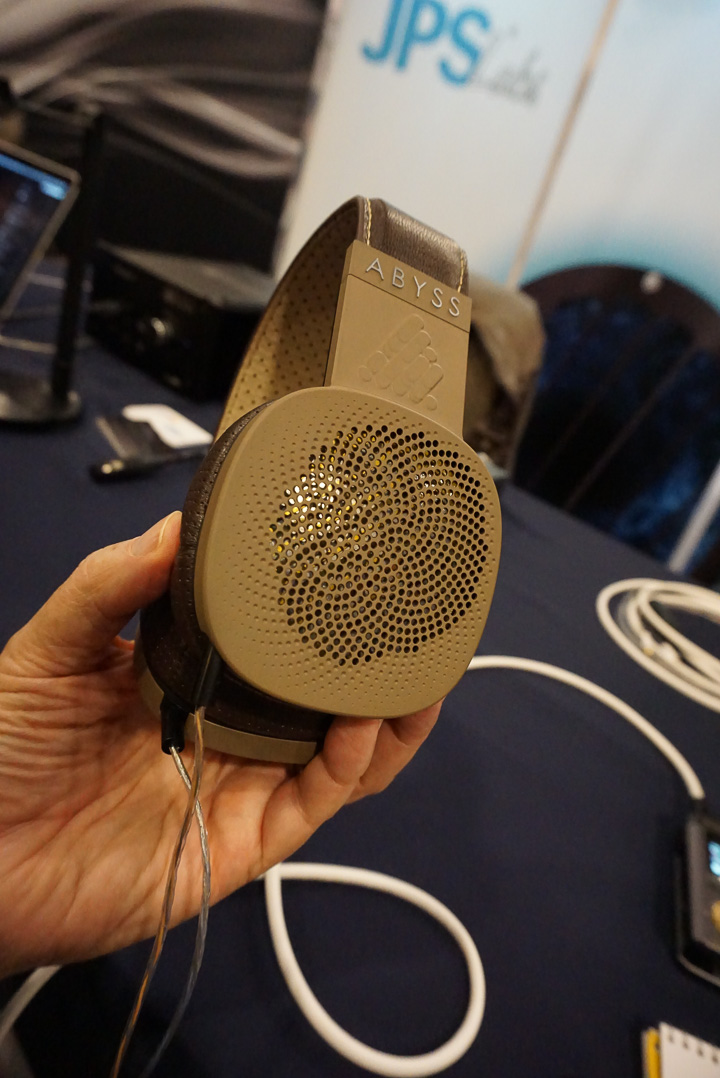
Abyss’ long awaited Diana headphone, which is a much lighter-weight and more conventional planar magnetic headphone than the firm’s famous (and famously unorthodox) flagship AB-1266 model, is finally released and will be offered in three suave colours: charcoal grey, cream, and chocolate brown. On first listen, it appears there is a decent measure of sonic DNA carried forward from the AB-1266 into the Diana, but key differences involve the Diana’s markedly lower weight and far more conventional appearance. The Diana will sell for $3,000.

Abyss AB-1266 Phi Edition

Never content to let an already good product rest on its laurels, Abyss has significantly revised its original AB-1266 to create the updated AB-1266 Phi edition, which is sonically better than its predecessor in every way. Noteworthy changes include a general smoothing of the original model’s frequency response curve to yield more linear bass, slightly more forward and more neutrally balanced mids, upper mids, and highs; and a notable increase in resolution of low-level details. While the ergonomics of the AB-1266 Phi remain a love-it-or-hate-it proposition, the sound quality places the Phi edition at or near the pinnacle of modern planar magnetic design. Pricing ranges from $4,500 (for a basic version) to $7,495 for a version with an elaborate set of accessories plus upper tier JPS Labs signal cables.
 

Acoustic Research (AR) H1

The H1 is AR’s new entry into the hotly contested planar magnetic headphone market and it will sell for $599 – $699, depending on cabling options. One option will be a version that comes with a balanced cable featuring a Sony-developed Pentaconn connector. The H1 sport an 86mm planar magnetic driver with rated sensitivity of 100dB, meaning the H1 should be quite easy to drive. It’s a looker, too.

Audeze LCD-MX4

Top-tier Audeze headphones have been praised for many things, but light weight has not been one of them—until now. For CanJam RMAF Audeze rolled out a new top tier LCD-series model that is lighter (by far) than any of its predecessors and that represent a hybrid combination of design elements drawn from Audeze’s flagship LCD-4 headphone and from the popular LCD-X headphone. The new model is called the LCD-MX4 and will sell for $2995.

Basically, the LCD-MX4 combines the magnet array from the LCD-4 with diaphragm assembly of the LCD-X while positioning both elements within an all-new, open-back, lightweight Magnesium frame and yoke assembly. The design is sleek, light, and very comfortable while the sound—based on a too brief listen—shows not just a little but a lot of LCD-4 DNA shining through.

Audeze LCD-2 Classic

Many headphonistas consider Audeze’s original LCD-2 to be the headphone that put the company on the audiophile map. What makes the firm’s new LCD-2 Classic so special, then, is that it is an exact replica of that original model, yet one that will sell for less than the original did: namely, for a very reasonable $599. In the name of authenticity, the LCD-2 Classic deliberately foregoes more recent Audeze technical features such as the firm’s Fluxor magnetic system and Phazor waveguide system, so that the LCD-2 Classic stands as a pleasurable trip back in time to the moment when Audeze first burst upon the high-end headphone scene.

Audio-Technica ATH-ADX5000

The ATH-ADX5000 is arguably Audio-Technica’s most ambitious full-size headphone to date. The ADX5000 is an open-back design with dynamic drivers whose diaphragms are tungsten-coated. The frame of the earphone is made of very lightweight magnesium. The ATH-ADX5000 should launch in December of this year and will be priced at $1999.

Beyerdynamics Aventho

The Beyerdynamics Aventho is a self-powered, Apple and Android-compatible, Bluetooth on-ear headphone that effectively replaces the German firm’s well-respected T5Li headphone. The Aventho offers playing time of about 20 hours per charge and comes with an app that allows listeners to use the headphone to test their own hearing and then to create wearer-specific voicing profile curves. The price: $449.

Cleer Next headphone

Almost. The Cleer Next headphone is almost but not quite ready for release so that its launch date has now been pushed back to Q1, 2018. The Next prototypes we have seen and heard look and sound quite promising indeed, so that we eagerly await the launch of the finished product. Changes to be made prior to launch include some driver revisions and a few other configurations changes as well. Once it arrives, the Next will sell for $699.


Dekoni ‘Blue’ headphone

Dekoni is best known for it’s high quality aftermarket ear tips and ear pads, which are available for many popular earphones and headphones, but at CanJam RMAF 2017 the firm previewed a new headphone of its own. The headphone is called the Dekoni ‘Blue’ and is a hybrid Fostex/Dekoni design loosely based on the former’s popular T50P headphone, but with numerous Dekoni-developed modifications. The price will be $199 with availability projected for March 2018.

Echobox Audio Vanguard (prototype)

Echobox showed an early prototype of its upcoming Vanguard full size headphone that uses dynamic drivers featuring PEEK (Polyether Ether Ketone) diaphragms. PEEK is a light, strong material that is potentially ideal for use in driver diaphragms, although our practical experience has been that PEEK diaphragms tend to require a considerable amount of run-in time before their full performance potential can be realised. It is still early days, but the Vanguard prototype sounded promising to us. The project price: ~$349.

Final D8000

Final previewed it’s first-ever planar magnetic headphone, now called the D8000, at Munich 2017, but for CanJam RMAF 2017 the very good news is that the D9000 design has been finalised and put into full production. The D8000 will sell for $3000.

A big part of the excitement surrounding the release of the D8000 centre’s on the fact that the headphone’s distinctive planar magnetic driver uses an industry-first air film damping system whose technology owes much to Sony consulting technologists who assisted Final with the D2000 design and who had deep expertise in using air film damping systems for ultra-high-end microphones. As a result, the D8000 seems to strike a nearly ideal balance between a sound that is highly expressive, yet always beautifully controlled.

Expect a Hi-Fi+ review in the not too distant future.

Focal Clear

Focal added a new middle-model headphone called the Clear ($1,495) to round off its top-tier range, which now comprises the Elear, Clear, and Utopia headphones. The Clear’s design owes much to that of the Elear, but with several key changes including a switch in voice-coil material (from aluminium in the Elear to copper in the Clear), a shift in overall impedance from 80 ohms in the Elear to 55 ohms in the Clear, inclusion of both single-ended and balanced signal cables (where the Elear ships with single-ended cables only), and revised ear pads that—on a visual level—appear more similar to the pads used on the Utopia. The Clear’s dome-shaped driver diaphragm and suspension system are identical to those found in the Elear. Last but not least, the Clear gets a distinctive soft grey colour that helps differentiate it from the all-black Elear and Utopia models.

Most listeners who tried the Elear and Clear side by side noticed sonic differences, but the perceived magnitude of those differences varied quite a bit from listener to listeners. On the whole, our take was that the Clear sounded more like ‘an Elear on steroids’ than like a Utopia, meaning the Utopia’s status as the top performer in the Focal line-up remains unchallenged.

HiFiMAN Sundara

HiFiMAN has been focusing on launching a series of upper tier products of late so that it was refreshing to see the Chinese manufacturer launch a new value-minded model at CanJam RMAF: namely, the new Sundara planar magnetic headphone, whose price is yet to be determined but is projected to come in below $500.

Basic specifications for the Sundara include claimed frequency response of 6Hz – 75kHz, nominal impedance of 37 ohms, sensitivity of 94dB, and weight of 372g. The Sundara will replace HiFiMAN’s very well liked HE-400i and HE-400s models, meaning it will have some big shoes to fill. In a brief conversation with HiFiMAN founder Dr Fang Bian we learned that Bian regards the Sundara as a direct descendant of the his firm’s critically acclaimed HE-560 headphone, but one deliberately made easier to drive.

Klipsch Heritage HP-3

Klipsch showed its first-ever entry in the upper-tier headphone marketplace with its lovely new Heritage HP-3 headphone, priced at $1199. The relatively high-sensitivity features 52mm dynamic drivers with bio-cellulose drivers mounted in the triple-vented ear-cups. Other construction details include an aluminium frame, a cowhide headband pad, and sheepskin ear pads. Watch for the HP-3 to launch around the end of October.


LB Acoustics Mysphere 3.1

The Austrian firm LB Acoustics demonstrated one of the most fascinating headphones at the show in the form of its new Mysphere 3.1 ‘near ear’, dynamic driver-equipped headphone. Herr Ryner and Herr Renner, the same men that developed the legendary AKG K1000 headphone, also designed the Mysphere 3.1, which can be viewed as a radically updated re-think of the AKG classic. In practice this means the headphone uses an overarching frame from which swivelling left and right driver ‘pods’ are suspended. By design, the driver pads float free of the listener’s ears, just barely skimming the ears’ outer surfaces in most cases, although the driver pods can be adjusted upwards or downwards and swivelled outwards, if desired, to suit listener preferences. Tilting the pods outward gives a more spacious and three-dimensional sound with some reduction in bass output, while tilting the pods inward (so that they are nearly flat against the ears) yields a more intense and focussed presentation.

The Mysphere 3.1 uses a square-shaped dynamic driver with a hemispheric centre-section and a diaphragm featuring a ‘glass foam membrane and a cobweb structure’. The headphone presents a very low 15-ohm load with sensitivity of 95 dB, meaning the Mysphere 3.1 is fairly easy to drive for amps capable of handling the low impedance load. Based on a brief listen, we felt the Mysphere showed a lot of potential, with an uncommonly open and transparent sound. The price: $4,000 or €3,500.
 

MrSpeakers AEON Flow Open

Following hot on the heels of the closed-back AEON Flow headphone, which is a mid-priced favourite among Hi-Fi+ staff members, comes the identically priced open-back AEON Flow Open, selling for $799.  In a twist on the usual order of things it turns out that the closed back AEON Flow places a greater emphasis on perceived openness, definition, and neutral voicing, where the AEON Flow Open has a slightly warmer and more relaxed presentation with a greater emphasis on perceived tonal richness. Both versions have merit, so that it could be desirable—budget permitting—to own one of each.

MrSpeakers ETHER ES

MrSpeakers has shown various iteration of its upcoming ETHER ES open-back electrostatic headphone for over a year now, but CanJam RMAF 2017 marked the point where designer and company president Dan Clark declared development work on the headphone to be complete. The final ETHER ES version we heard at CanJam RMAF is by far the best-sounding of any of the variants we have heard to date, offering a beautiful blend of openness, transparency, transient speed, and an effortlessly natural presentation that avoids the sometime sterile, treble-enriched sound that some electrostats produce.

PSB M4U8/NAD HP70 Bluetooth/automatic noise cancelling headphones

One of our all-time favourite mid-priced headphones is the Paul Barton-designed PSB M4U2, but for CanJam RMAF 2107 the Canadian firm announced the release of something arguably better: namely, PSB’s new M4U8 priced at $399 (and a similarly-priced companion model from sister brand NAD called the HP70). Significantly, the M4U8 is offered at the same price as the original PSB M4U2, so that users will get more features at the same price.

The PSB M4U8 and NAD HP70 headphones both feature Barton’s signature ‘RoomFeel’ voicing and offer three operating modes: a passive mode, an active/BT mode, and an active/BT/noise cancellation mode.  Both the M4U8 and HP70 feature aptX HD Bluetooth 5.0 implementations and are configured with USB charging ports that can also accept digital audio data directly from computers at rates up to 24/48 (meaning that the M4U8 and HP70 appear as sound cards from the computers’ frame of reference).

Based on a very brief listen, I felt the M4U8 and HP70 sounded similar, but not identical—possibly owing to slightly different automatic noise cancelling profiles for the two models. Both headphones, however, offer extraordinary value for money, which has long been a hallmark of Barton designs. These new models will begin shipping in November 2018.

Ultrasone Edition 8 EX

The Edition 8 EX is Ultrasone’s reigning flagship, full-size, dynamic driver-equipped headphone, which sells for $2199. Internally, the Edition 8 EX features the most advanced form of Ultrasone’s proprietary S-LOGIC system, known as S-LOGIC EX, which is said to project “the sound produced bye the decentralised sound transducer by means of an elaborate funnel structure and targets this towards the unique structure of the ear muscle that is responsible for spatial sound”. The result, says Ultrasone, “is the perception of a perfect, three-dimensional sound…”

Ultrasone Pro 480i, 580i, and 780i

Ultrasone rolled out three new and affordably priced Pro-series models called the Pro 480i ($149 or €119), the Pro 580i (~$249 or €159), and the Pro 780i ($299 or €199). All three models can be used simply for personal music listening or as monitoring tools for working musicians. There is something of a ‘good/better/best’ relationship between the three models, all of which are closed back designs. The Pro 480i features a 40mm dynamic driver with a Mylar diaphragm and claims frequency response of 20Hz – 20kHz. The Pro 580i promises more bass and also the ability to play very loudly if desired: it features a 50mm Mylar diaphragm, claims frequency response of 10Hz – 22kHz, and specifies very high sensitivity rated at 101dB. At the top of the range, the Pro 780i returns to neutral voicing and to a 400m Mylar diaphragm described as having a ‘gold membrane’ coating. The 780i claims frequency response of 10Hz – 26kHz with rated sensitivity of 96dB.  All three models use Ultrasone’s proprietary S-Logic Plus system and ULE magnetic shielding.

ZMF Auteur headphone

The headphone maker ZMF is perhaps best known for its rear-vented closed-back headphones such as the Atticus and Eikon, but for CanJam RMAF the firm rolled out its new bio-cellulose driver-equipped open-back Auteur model, which can in a sense be regarded as an open-back version of the Eikon. During an initial pre-order period (which will continue until 30 November 2017) the Auteur can be had for $1399, though after the pre-order period the price will rise to its normal level of $1599.

ZMF says the Auteur “combines the signature ZMF musicality and combines it with the resolve and spaciousness that comes from an open design”. The Auteur can fit either the ear pads of the Atticus or of the Eikon, giving listeners some degree of control over the earphone’s voicing.

Rocky Mountain Audio Fest (Part One of Two)

Hi-Fi+ dispatched a team of reviewers to Denver to cover this year’s Rocky Mountain Audio Fest. The show, bigger than ever, falls into two distinct camps; the original audio show and CanJam – the headphone event. Both represent arguably the most important and highly-respected events in the American West. This year, in the wake of the postponement of this year’s T.H.E. Show in Anaheim, and the relatively poor showing of the Los Angeles Audio Show earlier in the year, RMAF was perhaps even more eagerly anticipated than usual.

In addition, unlike 2016’s event, the Denver Marriott Tech Center had completed its full renovation, and many were keen to see the end result. This has a good and bad effect on rooms, because the remodel effectively changes the room acoustics of the hotel rooms and what worked two years ago might not work so well now. Typically, audio experts learn from the first year in a show to make a better sound in subsequent years. By extensively reworking the hotel, Marriott effectively reset the RMAF sonic clock. There were still many making good sounds, but there will be a lot better next year, too!

Regardless, it’s great to see a snowy Denver re-instigated its important place in the audio calendar, and we hope for many more years of RMAF! The show is so large, that one person alone cannot hope to cover it, so I was tasked with looking to the best in analogue and amplification, Roy Gregory was to investigated the latest in digital audio and loudspeakers, and Chris Martens chose to cover the CanJam in full effect. These reports will appear across this week and next.  

SIGNIFICANT NEW ANALOGUE COMPONENTS

The abundance of new turntables gave pause to think of the biblical song made famous by the Byrd’s—“Turn! Turn! Turn! (To Everything There is a Season”.  Not only was the Rocky Mountain Fest sandwiched between hurricanes on the East Coast and devastating fires on the West Coast of the US, the event itself opened to spring weather and closed with snowfall. 

That didn’t seem to dampen attendance, especially on the first day, when ticket lines seemed longer than usual.  And many of those in attendance were there to see an abundance of new turntables, many turning to the more affordable end of the spectrum.

ProJect Classic SB

ProJect was featuring The Classic SB Superpack, an improved version of the Classic turntable.  For $1,499 the US version comes fitted with a Sumiko Blue Point No.  2 cartridge, and a wood plinth in walnut, rosenut or eucalyptus.  Looking ever so much like a Linn clone, or as ProJect calls it, an homage, the table departs from Linn in that the chassis is suspended on TPE rather than springs and the platter is TPE dampened.  The European model substitutes an Ortofon Quintet Red and costs £1399.

VPI

The VPI Avenger Reference turntable was standing duty in the digital free Classic Album Sunday room, where the CAS program of listening to full albums straight through packed in audiophiles hungry for music throughout the show.  The Avenger Reference ($20,000) was outfitted with a JMW 12” 3D Reference arm ($4,400) along with a spare JMW 12” 3D Reference arm top ($3,200) to allow swapping out cartridges during an analog set-up seminar offered by Roy Gregory and set-up guru Stirling Trayle.   The feet of the Avenger presented a footprint a wee bit large for the HRS rack, so they were swapped out for some very handsome and slightly smaller feet from Wilson Benesch.  Before the doors opened to the crowds, Stirling Trayle spent countless hours setting up the turntable and installing his personal copy of a Fuuga Moving Coil Cartridge.

In the Mod Wright room, VPI’s perhaps most handsome turntable, the Prime Signature Rosewood ($6,800), sat on a Stillpoints rack and traced the grooves with a Soundsmith Hyperion cartridge.  For a lot less money than an Avenger, you still get that great JMW 3D arm, a 10” wand in this case.  The new thing is the gorgeous finish, with the Rosewood accounting for an $800 upcharge from the standard Prime Signature.

VPI’s new Cliffwood table seems determined to capture the low-priced turntable sweepstakes.  At $900 I see little to compete competition in that category.  Including a cartridge joint made by Grado Labs to VPI’s specifications, the Cliffwood is now available only in the US market, crossing the pond in the unspecified future.

Fern & Roby

Fern & Roby Audio, of Richmond, Virginia, is a relatively new concern that has been developing turntables over the last couple years.  A close look at the two decks on display at RMAF suggests the designer has a fine eye for design and detail.  Like the new food movement, Fern & Roby stresses use of local and domestic sourcing, including recycled materials.  The tables are made of Richlite, a composite of recycled paper and resin.  The Montrose Heirloom Turntable has a bronze platter with bronze and stainless steel details.  The Heirloom is $8,500 with their own unipivot arm or $12,050 with a Schröder CB Tonearm by Thrax.  The lighter Montrose Turntable table runs $4,950 substitutes a lighter platter but retains the stunning good looks.

Eat Team B

European Audio Team’s newest turntable, the Team B-Sharp Turntable comes with an Ortofon 2M Blue Cartridge, a carbon fiber alloy B-Note Tonearm and a dustcover for $1,595.  While you might be tempted to add a bumper sticker claiming “my other turntable is a Thales”, EAT turntables are so good that tonearm envy should not intrude.  The B-Sharp is a trickle down version of the more expensive C-Major turntable.

Rega P6

Rega’s new Planar 6 turntable was featured in the Fort Collins Audio room, the sensibly priced room I found most appealing.  The Planar 6 or P6 is not to be confused with the older RP6.  The base price is $1595 or $1995 with an Exact MM cartridge.  The plinth is composed of a Tancast aerospace polyurethane foam core inside a Polaris laminate, with the edges finished with a gloss black polymer, and the resulting two toned contrast is quite attractive.  The RB330 tonearm, two-layer glass platter, outboard power supply and adjustable speed add up to a lot of turntable for the money.

XX turntable/Schröder arm

Steve Dobbins of Xact Audio was showing his new turntable developed in cooperation with Paul Wakkeen of /Stillpoints.  The XX MagDrive turntable is a direct drive model, filled with Stillpoints technology, retails for $19,900 US.  It features a uniquely shaped plinth design and was fitted with Frank Schröder’s Linear Tracker tonearm that has been updated with a magnesium armwand and is priced at $12,500.

Acoustic Signature Triple X Turntable

Not to be outdone by the XX turntable, Acoustic Signature showed its Triple X Turntable in Makassa ($5795) with the 9” TA 2000 tonearm, a TA 1000 on steroids with more rigid and massive bearing housing. 

Thales

The Thales Statement Silver tonearm was mounted in a Thales TTT Compact II, a temporary base until the arrival of a new and larger turntable coming to better accommodate the Statement.  Thales products are always a work of art, and the Statement is no exception.  With on the fly VTA adjustment, azimuth adjustment, and correction-mechanism for tangential pivoted tracking claiming zero tracking error, the beauty is not skin deep.  The silver version on display costs $21,500, more than twice of the Thales Simplicity. 


SIGNIFICANT NEW AMPLIFICATION AND POWER COMPONENTS

Electronics to deliver electrical signal along the path to its conversion to musical sound, with one exception, were evolutions of well-developed technologies.  That new development may cause some confusion in the long-standing debate over the supremacy of tubes over solid state, or is it sold state over tubes?  In addition, power treatment solutions continue to move toward boxes and cables that promise to cleanse power line noise without current limiting, long the bugaboo of filtration products.

Zesto

Zesto Audio’s new Andros Allaso, joins the small number of step up transformers currently available.  The diminutive 5-pound unit provides 40 adjustments, in both stereo and mono modes, on the “fly”.  It includes 4 step up ratios/gain settings (1:4, 1:6, 1:8 and 1:12) and 10 moving coil load positions.  It includes two ground binding posts to avoid hum.  Priced at $2,995 US, the Allaso is distributed worldwide.

Muritani Box

Tucked away in the ELAC room was an interesting power conditioning unit developed by Scott Rust of 512 Engineering for Tim Murutani, the Symmetrical Power Source.  The 140-pound unit clearly contains some very large transformers.  The product literature seems to reject the filtering approach taken by other power conditioners, suggesting that it rejects power grid noise purely through the use of balancing the phase of the AC signal, claiming that line filtering limits current delivery.  Pricing is to be determined but the distributor indicated a price would be about $22,000.

Nagra Preamp

Nagra’s only “new” product (first shown in Munich but now in production) was its HD Preamp, a dual mono, tube preamplifier fitted into two boxes bearing the classic Nagra Swiss crafted look, meter and switches.  At $59,500 US or £54,900, it won’t be for everybody.  Nagra is working on an HD phono preamplifier to fill out its HD line.

Parasound Halo JC-3 Jr.

The Parasound room featured the Halo JC 3 Jr. phono preamplifier, due to ship soon after the show.  With a manufacturer’s suggest price of $1,495, Parasound is bringing John Curl’s legendary phono design skills to a its most affordable level yet.  The front panel is simplicity itself, with only an on/off and mono buttons.  The back panel sports high quality XLR and RCA outputs and RCA inputs, a switch for Moving Coil or Moving Magnet, a continuously variable MC impedance control and a switch allowing three gain choices.

Constellation

Constellation was showing two upgraded products.  It’s Audio Centaur II mono amps ($80,000 the pair) are said to offer tighter bass than the original model.  The Cygus Media Player/DAC  ($38,000) has now added Roon.  The all Constellation set-up was feeding a pair of Wilson Audio Alexia Series II speakers ($58,000) with an analog front end by Continuum Audio Labs, producing some of the finest sound at the show.

Korg NuTube Technology

Korg, best known for its professional gear, was some newly developed technology, a chipset called the NuTube.  Like a vacuum tube, the chip has an anode grid filament structure and is said to operate the same as a triode vacuum tube.  Korg packaged several NuTubes into a prototype phono equalizer.  The unit ticked some fascinating boxes—battery power and equalization curves.  Korg also displayed a prototype preamplifier developed by Nelson Pass using NuTubes.

Audioquest power cables

Audioquest’s power products were in line in several rooms throughout the show, nowhere to better effect than in The Audio Alternative room featuring VTL electronics and Vandersteen Audio Model Seven MKII loudspeakers and Sub Nine Subwoofers.  Nothing says “power” like a pair of VTL Siegfried Series II monoblock power amplifiers.  Standing between the Siegrfrieds and the wall was Audioquest’s Niagara 5000 (a Niagara 7000 isolated the front end) and a number of runs of its top of the line Dragon Hi Current Power cords and Hurricane Power Cords.


COOLEST NEW INNOVATION

The NuTech technology, discussed above, was far and away the coolest new innovation, in a year a bit short on innovation.

BEST SOUND OF SHOW, SENSIBLY PRICED

While the show again featured several “entry level” rooms, none of them impressed me as giant killers, and one of them (the $5,000 room) was locked every time I stopped by.  Climbing from entry to sensibly price, however, the system in the Fort Collins Audio room was an oasis of excellent sound.  Two Spendor models, the A4 for $3,195 and D7 for $5,950, worked brilliantly in the small space of a hotel room.  Digital sound was underperforming, but spinning records on the Rega P6 turntable ($1595) fitted up with an Ortofon Quintet Black ($995) brought the performance up to something I could easily live with.  The system was driven by Quicksilver electronics, including the Mono 120 amplifier with the KT150 tube upgrade ($4,3945 the pair); Line stage ($995); and Phono Preamplifier ($1,595).  Cables were Cardas, including the new Clear Beyond XL speaker cables (price TBD) and Cygnus cables.