Up to 37% in savings when you subscribe to hi-fi+
hifi-logo-footer

Begin typing your search above and press return to search. Press Esc to cancel.

Sennheiser Momentum In-Ear Wireless earphones

There has been a profound change in the portable audio market, thanks to Apple abandoning the headphone jack in the iPhone 7. The result is – understandably – sales of wired headphones have fallen away. What’s perhaps less understandable is sales of wired headphones have fallen away even to people who use smartphones with a headphone jack. This drop is not an insignificant one: it is estimated that by the end of this year, sales of wired headphones to smartphone users will have shrunk by somewhere between 60%-75% compared to the pre-iPhone 7 level. These sales are going to wireless Bluetooth headphones and earphones… and the Sennheiser Momentum In-Ear Wireless represents one of the best examples of the breed at this time.

It’s probably best to think of the Sennheiser Momentum In-Ear Wireless as the original Momentum In-Ear, with a wireless collar in place of the original wire. The earphone is a single-driver, dynamic design, with a metal sound tube ending in a 4mm nozzle, with a pair of red/black rubberised cables leading to the collar. The most visible outer part of the earphone is a highly polished metal disc with the Sennheiser logo, the rest of the outer body being plastic. There is absolutely no change to the specification and design of these earphones between the Momentum In-Ear and Wireless.

The collar has a rear covered in sheepskin nappa leather, with an elegant red thread stitching it to the frame, and two polycarbonate ‘business’ ends. The red thread marks ‘up’. This is a rigid collar with limited flexibility, but is large enough for even the broadest of neck: I’m a relatively neck-free individual thanks to a combination of birth defect, years of rugby, and a propensity to ‘winter well’ all year round, and I had no problems, so unless you make Mike Tyson look swan-necked, the Sennheiser Momentum In-Ear Wireless will fit well. The neckband is not the lightest example of the wireless breed, but not too heavy either. The earphones themselves are light, curved to fit many a ‘lug hole’, and the cable and strain relief are kept far out of the ear thanks to that long sound tube, so they are comfortable for most users. I wouldn’t recommend using the Sennheiser Momentum In-Ear Wireless for the full ten hours of battery life at a stretch (I tried using the unit as my computer headset for a day and after a while, the joy of having the strain relief away from the ear is countered by having them lever themselves loose over time), but they are more than fine for commutes and daily use.

The collar itself has two key sections. The one that falls to your left hand houses the track handling, volume, power, and the USB charge connection. The other side features the aerial connections for Bluetooth and NFC connections, and pairing is very quick and easy (if you are using Bluetooth, it comes up ‘M2 IEBT’ on your pairing list). The controls also operate basic call functions as well as track and volume handling. These are fairly comprehensive, given that most of the time, they are operated by touch alone. The centre button and the power button can be clearly felt under your fingers, although the ‘+’ and ‘-‘ keys feel functionally identical. The cables for the earphones exit through the bottom of the collar, and the whole package neatly folds away into a small travel case. Medium, translucent, single flange, soft silicone ear tips are pre-fitted, with with replacement tips in three additional sizes (XS, S, and L) supplied in the case. There is also a charging USB cable provided, and a handful of quick start and health and safety manuals in a range of languages in the box. The one potential omission is any kind of Velcro cable tie for the USB cable once the cardboard insert is removed, but the rest of the Sennheiser Momentum In-Ear Wireless sits comfortably in its case. Fortunately, you don’t need that USB cable too often; 1.5 hours of charging will return a good 10 hours of normal use.


One of the clever, but overlooked, aspects of the Sennheiser Momentum In-Ear Wireless is that its USB charger cable can also act as a signal cable, when connected to a computer. Turn off Bluetooth, set your computer’s output to the appropriate channel, and it acts as a wired headset while it is charging. This also gives one a chance to compare the sound of the built-in DAC with its Bluetooth component, and Sennheiser has done a good job here on both counts. The sound through the wired USB is slightly louder, and the Bluetooth sound is very slightly ‘spitchy’ in the presence region (around 2kHz), but not enough to cause irritation – a difference that is only really noticeable in comparison. If you use your computer as a true workstation, and feed Skype or FaceTime Audio calls through your desktop rather than a phone, the Sennheiser Momentum In-Ear Wireless is a really useful wireless headset. If you are a ‘pacer’ while making such calls, it’s worth noting the audio quality of the microphone seems to fade faster than the received call sound; it fails in a speech-retaining way, so that the person on the other end of the phone can still make out your voice, but it sounds like you have just walked into a cutlery store in the middle of a hurricane. I’d say the range is about 5-10m in practical terms (my late Victorian house seems to harbour a secret faraday cage and wireless signals of all kinds are severely curtailed), so for most smartphone usage, the Sennheiser Momentum In-Ear Wireless is a perfect telephonic partner.

These are every bit the commuter headphone, with a fun zing in the top end, a nice sense of energy in the bass, and a touch laid-back in between. The excessive treble ‘zing’ of the wired version is more tamed in the Wireless edition; they are still bright and energetic, just not as brisk-sounding as before. This is perhaps most noticeable in playing the extended remix of ‘Back Stabbers’ by the O’Jays [Philadelphia International Classics: The Tom Moulton Remixes, Harmless], where the constant ‘tssk, tssk’ of the hi-hat coupled with the drive of the bass drum effectively define the mix more than usual. This is, however, useful for cutting through the sound of commuting, and the midrange is not dark or recessed sounding.

A combination of judicial adjustment of the sound and moving from AAC versions of compressed 1970s soul music to more natural recordings showed the Sennheiser Momentum In-Ear Wireless to be a detailed and focused performer, with some extremely good imaging. In a way, this follows closely to the likes of the HD800 or IE800 models, just without the striking, ear-opening detail of the top-end Sennheisers. Playing ‘The New Cobweb Summer’ by Lambchop [Is A Woman, City Slang] showed the headset to have a wide, precise stage and a great deal of vocal articulation, alongside that insightful top end and rich – but not flabby – bass.

The Sennheiser Captune app is clever and useful, too. It takes over play of music files, has TIDAL integration, and allows pre-set and custom EQ settings. This last is a little like an aural equivalent of being fitted for glasses, as you rack through A/B or normal (‘better’, ‘worse’ or ‘about the same’?) settings for a series of parametric EQ tweaks until you find your perfect custom curve. This is a slow, painstaking process that can end up with some anomalous settings, and I suspect many will simply ignore it. Nevertheless, the pre-sets, coupled with the overall take over of music replay is mostly a force for good (DRM keeps downloaded iTunes files penned away, and a lacklustre TIDAL search facility notwithstanding).


There are three observations that need making. First, the Momentum In-Ear Wireless is not designed for exercise use… I’ve been told. It’s fine for someone who might take a daily constitutional, but if you are intending using it for jogging, there are better options available. The second is related, in that the Sennheiser Momentum In-Ear Wireless is not water resistant, and there are several points where the ingress of water could meet delicate electronic circuitry. Finally, there is no wired minijack component at all.

However, true consideration of the Sennheiser Momentum In-Ear Wireless revolves around what they are designed to do, rather than what they aren’t. These are the headset companion for a commuter or someone at a workstation who doesn’t want to be tied to the desk. In that respect they are excellent, and come highly recommended.

TECHNICAL SPECIFICATIONS

  • Type: Bluetooth wireless earphones
  • Ear coupling: ear canal
  • Frequency response: 15Hz–22kHz
  • Transducer principle: dynamic
  • Sound pressure level (SPL): 112dB (passive: 1kHz/ 0 dBFS)
  • Impedance: 18Ω
  • THD (1kHz, 100dB): < 0.5 %
  • Pick-up pattern (speech audio): omni-directional
  • Input power: 3.7VDC, 17 mAh: built-in rechargeable lithium-polymer battery 5VDC, 500mA: USB charging
  • Operating time: approx.10hrs (A2DP)
  • Charging time: approx. 1.5hrs

Bluetooth 

  • Version: 4.1, Class 1
  • Transmission frequency: 2402MHz to 2480MHz
  • Modulation type: GFSK, π/4 DQPSK, 8DPSK
  • Profiles: HFP, AVRCP, A2DP
  • RF Output power: 10mW (max)
  • Supported codec: SBC, AAC, aptX

NFC 

Frequency: 13.56MHz

Modulation type: ASK

Weight: 53g

Price: £169.99

Manufactured by: Sennheiser Electronic GmbH & Co. KG

URL: en-uk.sennheiser.com

Back to reviews

Read more Sennheiser reviews here

Pathos InPol Ear headphone amplifier

Pathos and its innovative InPol amplifier circuit has been around for some time – in fact, the Inseguitore Pompa Lineare circuit was patented by Pathos back when the company was founded in 1994 – but its use has mainly been in integrated amplifiers and power amplifiers for the traditional two-channel loudspeaker world. The InPol Ear represents the first time this unique hybrid circuit crosses over into the headphone world – and the results are outstanding!

The term Inseguitore Pompa Lineare translates to ‘Linear Pump Follower’, and the amplifier uses a triode valve to amplify the input signal voltage, and a discrete fully-balanced Class A solid-state follower circuit designed to deliver high current and unity voltage gain to the loudspeakers. Effectively, it means the performance of that input signal and the valve driving it entirely defines the output characteristics of the solid-state amplifier powering the loudspeakers or, in the case of the InPol Ear, headphones. In theory, this should increase the efficiency of a Class A amplifier while also delivering power with optimally low output impedance. A recent innovation by Pathos is the ‘double InPol’ circuit, which is pretty much self-descriptive, and balanced operation throughout is handy for both input and output for any headphone amplifier.

In essence, Pathos has built an amplifier designed for loudspeakers in headphone-sized form. This means the InPol Ear has some extremely impressive specifications, like the ability to deliver up to 10W into a 32Ω headphone load. Put another way, if you could attach a headband to a pair of bricks, the InPol Ear would get a tune out of them. Whether in balanced or single-ended output, the amplifier is simply not going to be phased by any headphone load in existence. On paper at least, this is extremely impressive.

The rest of the circuit design is no less significant. That volume control, for example, is actually a digital volume controller, a Burr-Brown PGA3210, to give far greater precision over channel accuracy and volume setting (it has a range of 180 half-decibel steps). The base of the front of the InPol Ear forms the basic controls, as well as a large red LED volume display, a ¼” jack and two four-pin XLRs for balanced operation. There are four single-ended, and one XLR line inputs, as well as a XLR and single-ended stereo output for those wanting to use the InPol Ear as a preamplifier. I would suggest this last option is relatively limited in reality, because its function as a headphone amplifier (with optional DAC) is paramount, and its secondary function is almost legacy by comparison.

Alongside clever circuitry, Pathos is known for its extremely elegant industrial design, and the InPol Ear is no exception. Italian companies – be it audio brands, car marques, watch-makers, furniture designers, or practically anything else – build their products with style, and Pathos more than lives up to the reputation. The company has an innovative way of dealing with the necessity of heatsinks, by making them the company logo; the name is written along the sides of the amplifier in a stylish, almost Art Deco font. The front and top plates are finished in one of four finishes (three solid colours, one tree-related). At the top of the amplifier are two exposed EH 6922 double-triodes, recessed and shock-mounted in a trio of aluminium plates, and the large volume control is similarly recessed into the front of the InPol EAR. This not only looks great, but is stylistically reminiscent of Pathos designs both current and classic, and the InPol Ear is very much part of a family in look, and sound.


Our version came fitted with the optional Hi-DAC EVO digital circuit. DAC is a relatively simple way of describing this, because usually when one thinks of a ‘DAC board’ added to an amplifier, one thinks of a simple, single USB input or similar. This, instead, is a fully functioning, app-controlled, wired or wireless Ethernet streaming device complete with regular S/PDIF and USB functions. It’s built around the popular ESS Sabre 9018K2M DAC chip, so it is capable of 32bit, 384kHz resolution in PCM, and up to DSD128 through DoP connectivity over USB. The Ethernet streaming facility is driven by the InPol Ear app for Android or iOS devices, however, this is more designed for local play from a network attached storage device. Pulling in tunes from internet radio or some kind of online streaming service is limited to sending it from your iDevice to the InPol Ear via AirPlay. The same does not apply to Android, and there is no Bluetooth protocol.

Sonically, the two underlying themes to the InPol Ear are ‘authority’ and ‘integrity’. The ‘authority’ part comes from that seemingly endless ability to drive more or less anything in the headphone realm (aside from electrostatics of course). There is an effortless sense of power reserves, and freedom from strain that makes the headphones just get on with the job. It’s like cruising in a car with a big V8 engine; there’s so much power and torque to be had, there’s a sense of untroubled calm emanating from every pore. You know that if the going gets tougher, those reserves are there to call upon, and in musical terms, this means the InPol Ear not only ticks the ‘drive everything’ box, but has enough energy in reserve that if you move from breathy singer-songwriter to The Full Monty (or in this case, The Full Mahler – the final movement of Solti’s version of the Eighth Symphony on Decca), nothing gets flustered or troubled.

What I don’t want to overstate here, however, is that the InPol Ear is merely a big lever, for heavy lifting of difficult headphone loads. Or that the amplifier never shifts out of first gear and always sounds a little like there is more to give. It’s more that the sense of having so much in reserve gives the listener a powerful sense of confidence in their music and their replay system. In fact, a lot of my listening took place through the AudioQuest NightOwl Carbon headphones, and even a pair of Sennheiser HD25 II. The contrasts between the two – the mellow tones of the AQ headphone and the hyper-analytical nature of the designed for news-gathering Sennheisers – were demonstrated perfectly through the InPol EAR, but both also gave a sense of being controlled by a benign guiding hand, not in a character-altering way, more in the sense of ‘you can do this’ encouragement to show what both are capable of. The reason I single out these two is the convergence was most marked here: the NightOwls showed those upper frequencies are not rolled off, but designed for lengthy listening sessions, while the HD25 II proved they had more than detail retrieval, and showed that dynamic range is important, too. This applied irrespective of music played – even ‘Lucky’ by Kat Edmonson [Way Down Low, Spinnerette] showed that convergence and this is not a tough track to play.

This leads to that second big InPol Ear theme, integrity. The InPol Ear doesn’t impose its own stamp on the music. It’s characterless, but in a good way. Nothing is out of place here, no sense of emphasis on one aspect of the frequency response, or one aspect of the sonic performance at the expense of others. It works from a quiet background, delivers fine dynamics, great vocal articulation, terrific detail, excellent soundstaging with good solidity of instruments within that stage, and an accurate frequency response. The InPol Ear lends itself to more up-scale headphones because it works at their level, but shows what it can do by dragging more down-to-earth headphones up a notch or two. And as to the simplistic notion that ‘valves = warmth’, this shows that to be a lie. This is not a ‘warm’ (or, for that matter, ‘cool’) sounding headphone amp. It is just a great sounding headphone amp.


Finally… the DAC section. I’d suggest the DAC in the InPol Ear should be a mandatory recommendation as it works exceptionally well, and matches the performance of the rest of the amplifier. It’s aimed more at sheer detail retrieval, and that works well with the overall InPol Ear performance. If I am being picky, I’d prefer more of an on-board streaming solution, so that aspects like Internet radio, TIDAL, and maybe even Roon were functions of the InPol Ear with the built in DAC, but for the most part, I suspect the InPol Ear will sit next to a laptop, and both the Ethernet streaming option and app control are more of a nice add-on than a useful function of the device. Judging by my own use, I used the Ethernet connection to evaluate the Ethernet connection, and listened through USB.

The Pathos InPol Ear is a delight to use. It makes good headphones sound great and makes great headphones sound fantastic. It does this without adding or subtracting to the music played. It merely does the music justice, whatever the music, and comes highly recommended as a result.

TECHNICAL SPECIFICATIONS

  • Type: Pure Class A hybrid headphone amplifier with optional DAC
  • Analogue inputs: 1× balanced XLR line, 4× single-ended RCA line
  • Optional Digital inputs: 1× USB port type B, 1× S/PDIF coaxial, 1× S/PDIF optical, 1× Ethernet RJ45, 2× USB port type A
  • Outputs: 1× Pre out stereo line RCA (pre-output phase can be selected), 1× Pre out stereo line Balanced XLR, 1× 6.3mm headphone jack, 2× 4-pin XLR balanced headphone connectors
  • Output impedance: 0.9Ω (XLR), 0.45Ω (single-ended)
  • Output power: 3W (balanced), 10W (single-ended) at 32Ω, 1.9W (balanced), 6.4W (single-ended) at 50Ω, 800mW (balanced), 2.7W (single-ended) at 120Ω, 320mW (balanced), 1W (single-ended) at 300Ω, 160mW (balanced), 533mW (single-ended) at 600Ω
  • THD: 0.1% at 11W
  • Signal/Noise ratio: >100dB
  • Finish: red, black, white, walnut
  • Dimensions (H×W×D): 18 × 28 × 37cm
  • Weight: 12.5kg
  • Price: £5,395 as tested (£3,449 without Hi-DAC EVO converter)

Manufactured by: Pathos Acoustics

URL: www.pathosacoustics.com

Distributed in the UK by:
UK Distribution Ltd

URL: www.ukd.co.uk

Tel: +44(0)1425 460760

Back to reviews

Read more Pathos Acoustics reviews here

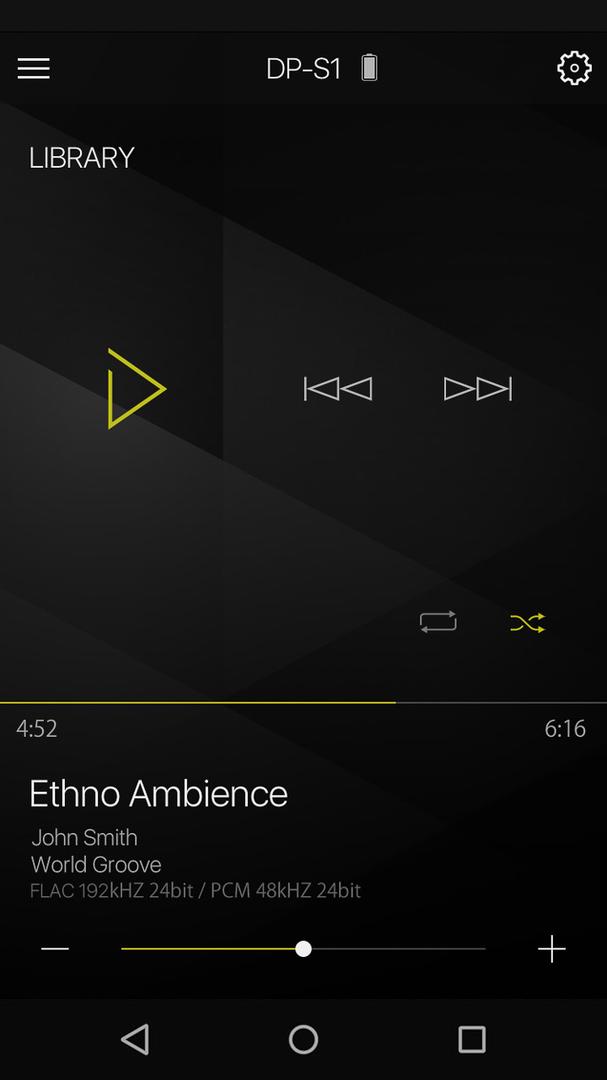
Onkyo DP-S1 digital audio player

The Onkyo DP-S1 is the second of two collaborative digital audio players between the brand and its stablemate Pioneer. The first pairing – the Onkyo DP-X1 and Pioneer XDP-100R – were larger, Android-based players originally introduced about 18 months ago. The new Onkyo DP-S1 shares its platform with Pioneer’s XDP-30R.

The difference between the generations is simple. The first generation models were larger, more expensive, and Android-based. The new models are smaller, cheaper, and use the company’s new custom-designed Linux operating system. The differences between the Pioneer and Onkyo models are the same, too: in both cases, the Onkyo model sports uprated components (like thin-film capacitors) in the signal path and its voicing is said to be less ‘peaky’ and more in line with audiophile requirements. In addition, the slightly cheaper Pioneer is destined to be sold through more mass-market vendors, where the Onkyo is available from more specialist audio retailers. There is also a very slight stylistic difference (the bottom right corner is lopped off in the Pioneer model).

In many parts of the world, the Onkyo DP-S1 is also known as the DP‑S1 Rubato (the Pioneer has its own suffix – the XDP-30R Private – which sounds either militaristic or a bit pervy). The word ‘Rubato’ is a musical term for the expressive rhythmic freedom within passages of a composition, without changing the strict tempo or even pace of the whole composition. It’s derived from the Italian word rubare or ‘to rob’, which might not be the best choice of words when faced with an extremely attractive, small, light, portable, and inherently ‘nickable’ piece of equipment. So, we’ll stick with DP-S1, thanks.

The core of the Onkyo DP-S1 is a twin-DAC arrangement of ESS9018C2M SABRE DACs coupled with twin ES9601K amplifier chips, laid out symmetrically and each served by its own power feed from separate capacitors. To take full advantage of this twin converter arrangement, you need to use the DP-S1 in balanced mode, eschewing the regular 3.5mm headphone jack for a 2.5mm four-pole balanced audio mini-jack connector. You can’t use both at the same time. In balanced mode, you can run as standard with a slightly higher output, or what the manual refers to as ‘ACG’ mode, where the grounding is more forcibly fixed. This leaves the output level identical to that of single-ended. You can also turn the 3.5mm jack into a line-level output. There is 16GB of onboard storage, supplemented by up to almost half a terabyte if you bulk up with large capacity cards in both micro-SD card slots, and a micro USB connector for connection to a computer or for charging. Software updates can be sent down the USB connector, or loaded to micro-SD.

Operation is by a combination of hard buttons for power, basic track handling, a thumb-wheel volume control, a button to prevent accidentally using the DP-S1 while in pocket, and a touch-screen for everything else. The touch-screen is small (2.4in), straightforward in use, the overall user interface is a classic (as in ‘it’s easy to use, but the combination of hierarchical menu structure and its overall looks make it seem like it was designed a dozen years ago’), and ‘gives good haptics’ in that operation is largely intuitive, and the screen is relatively responsive. The overall feel of the DAP is good, too, although the DP-S1 cries out to be used with one of its cases because the crackle-finish back panel is perhaps the only part of the DAP that looks and feels a little cheap.


Battery life is good, although the claimed maximum of 15 hours between charges requires a lot of hoop-jumping to achieve. The battery indicator, however, seems to have a bit of a life of its own. It will happily show a full battery for the longest time, only to run out of juice almost when you least expect it. I’ve had this problem before (with previous generation Fuji cameras in particular) and it can be a pain discovering your battery just went from full to empty in the space of about two frames. The Onkyo is a lot better than that, but accurate assessment of the battery isn’t possible here, and as battery life drops when you are processing DSD files.

The Onkyo speaks most digital formats, from ALAC and FLAC, up to uncompressed WAV and AIFF, right up to DSD 64 and DSD 128. For PCM files, it supports up to 32-bit, 192kHz, and MQA is a firmware upgrade away. There are dual clocks for PCM multiples of 44.1kHz and 48kHz sampled files, and a good two-level upsampler and a Hi Bit 32 up-rez option. There’s a choice of three filter settings, and these can be adjusted on the fly (I generally preferred the slow, over sharp and short). There is also a 10-band EQ and a five-level bass boost, which can be disabled for purists.

In addition to internally stored music, the DP-S1 includes dual-band Wi-Fi, and accesses TIDAL, TuneIn radio, and (presently) Deezer, with other online services intended for later downloads. It also includes Bluetooth wireless connectivity, to allow your DP-S1 to be played through in-car system, and desktop DACs. The one notable ‘absence’ is a wired digital output, although you can cheat the DP-S1 into delivering a USB output by powering it off, connecting it to the DAC, and restarting it.

Moving tracks from computer to DAP can be done using the company’s own X-DAP Link program for PC and Mac, although a good media player might prove better. The player has good sort functions and can build playlists on the fly. Search functions and entering Wi-Fi passwords can be a laborious process as it uses a variant of the phone keypad form of alphanumeric entry.

The move from Android to Linux operating system probably accounts for the DP-S1’s biggest feather in its cap. It is fast to use. Power it up from cold and it’s up and running in a few seconds. Scan a library on an SD card and it will do it rapidly. Point it at a track and it will find it and play it with the least delay. I had prototype software to play MQA and loading up these files took a little longer, but we’re only talking a second or two, and even that might be ironed out in the firmware proper. Where this really comes good is in playing back-to-back tracks. Gapless playback is currently not available to the DP-S1 platform; however, the speed the next track arrives makes the player ‘almost’ gapless. I’ve not heard a player move from track to track faster.

I’ve had unpublished hands-on experience of some of the better DAPs at the price and size of the DP-S1, most notably models from FiiO and Astell&Kern. In my opinion, the sound of the DP-S1 – even in standard single-ended mode – is the best of them. It has a lot of the dynamic range properties of more expensive players (not quite AK380 level, but pretty damn good), there is good soundstaging, and fine detail. I played ‘Cloudbusting’ by Kate Bush [Hounds of Love, EMI] and the DP-S1’s ability to separate orchestra from percussion and Fairlight synth, yet being able to pick out individual themes in the music, and her slightly batty vocals is reminiscent of a good two-channel audio system, yet with the precision of great personal audio. And best of all, the better the source material, the better the performance – those MQA sampler tracks like the Beethoven Emperor Piano Concerto [Kyoko Tabe, Denon] are just sumptuous and delightful.


The only notable downside is one that cannot be solved by Onkyo directly, as there is no provision for playing TIDAL offline in anything apart from TIDAL’s own iOS or Android apps. That aside, the size of the screen relative to the bezel does make the player look a bit old-fashioned compared to the AK70, but in terms of performance, track access, and almost all track-handling facilities, the Onkyo wins the day.

The DAP market is an odd one. Its heyday was in the time before iPhones, but then it was all about the iPod. It’s an inherently audiophile device now, as everyone else uses their phone. This probably limits the pool and the number of sales, but this is a shame because what they do is make music sound very, very good, indeed. Couple the Onkyo DP-S1 with a good pair of Custom fit In-Ear Monitors (especially if you swap the cable for a balanced one) and you are in for a musical treat. Beg, borrow, or Rubato one today!

TECHNICAL SPECIFICATIONS

  • Type: portable Digital Audio Player
  • Formats supported: MQA, DSD 5.6 MHz/2.8 MHz, DSD-IFF, FLAC, ALAC, WAV, AIFF (Maximum 192 kHz/32-bit), AAC, and MP3
  • Inputs: micro USB, 2x micro SD slots, dual-band 5GHz/2.5GHz Wi-Fi
  • Outputs: 3.5mm headphone/line jack, 2.5mm balanced headphone/line jack, A2DP/AVRCP Bluetooth transmitter
  • Balanced output options: Bridge-Tied Load (BTL) and Active Control Ground (ACG) Modes
  • Display: 2.4in, 320×240pixel touchscreen
  • DACs: 2× ESS SABRE ES9018C2M
  • Amplifier chips: 2× ESS SABRE ES9601K
  • Clocks: dual auto-detect 44.1kHz, 48kHz
  • Storage: 16GB internal memory, expandable to 416GB with micro SD
  • Upsampling: 32-bit Upsampling Modes for 88.2 kHz/176.4 kHz
    (44.1 kHz Signals) and
    96 kHz/192 kHz (48 kHz Signals)
  • Filters: Three (Sharp/Short/Slow)
  • Equaliser: 10-band, six factory presets, three user presets
  • Gain options: three-step
    (low, normal, high)
  • Dimensions (W×HxD): 6.3 × 9.4 × 1.5cm
  • Weight: 130g
  • Price: £399.99

Manufactured by: Onkyo

URL: www.onkyo.com

UK URL: uk.onkyo.com

Back to reviews

Read more Onkyo reviews here

Stax SRS-3100 electrostatic ‘earspeaker’ system

Stax holds a special place in the music lover’s heart. It’s the high-performance electrostatic headphone that even those who don’t like headphones enjoy. But, goes the logic, only a select few can get to enjoy them, because they are very expensive. The rest of us have to make do with high performance dynamic designs because we don’t have thousands to blow on headphones.

This argument, however, suffers from being complete nonsense, as evidenced by the SRS-3100 system. You see, the SRS-3100 is the Stax entry point, made up of the SR-L300 Earspeakers, and the SRM-252S energiser, at an extremely competitive package price.

The SR-L300 Earspeakers are based on the popular Lambda design, the classic rectangular over-ear speaker-shaped models similar to ones Stax designed back in the 1970s. In order to keep them price competitive, the heavier grade ABS design of the more up-market models from the same Lambda line is slimmed down considerably.

This makes the SR-L300 lighter on the ear than previous designs (by a few grams), but it also makes the overall headphone/earspeaker feel flimsier than bigger models in the Stax range. That being said, the new slide-type adjustment for the headband is a boon, and should be seen on later iterations of the more upmarket designs in my opinion.

The SRM-252S also shows its inexpensiveness, thanks to a wall-wart power supply and a very small form factor indeed. Where most Stax energisers look like someone cut an integrated amplifier in half, the SRM-252S is small enough to be hidden by a decent sized paperback book. Nevertheless, for all its ‘CD box set’ size, it hides a small, solid-state Class A amplifier. This isn’t the kind of amplifier that could greatly benefit from the ‘Kimik’ mods found in more upscale Stax energisers (and in fairness, the SR-L300 isn’t the kind of earspeaker that would be improved by a significant upgrade in energiser).

The two are designed to act as amp and headphone as a complete package, and there is no provision for a DAC. Just the one input, in fact. Power and volume are combined in the single volume pot, and a little green LED tells you when the power is being fed to the headphones. There isn’t much in the way of run-in required here. They just work out of the box without fuss. I used them hanging off the end of the Hegel Mohican CD player and the Weiss DAC501 tested elsewhere in this issue.


Back when my own experience of wine was limited to cheap ‘plonk’, I had dinner with a friend who was exceptionally knowledgeable about wine. He – naturally – chose the wine. Until this time, I thought the florid descriptions of wine tasting sessions were the result of pretentious nonsense and hacks being paid by the word, but this bottle of wine changed all that for me. I discovered a complexity of nose, palette, and ‘mouth feel’ that made me view that flowery prose of wine writers with greater respect. It was, quite simply, the best glass of wine I’d ever tasted. To my fellow diner, however, it was an OK wine, but nothing special.

The point of this little tale is that how you view the SRS-3100 system is somewhat governed by your viewpoint. And this speaks to a potential problem for reviewers, professional and especially amateur: if you view the SRS-3100 in the light of My First Electrostatic, then for many the reaction will be “Oh my God! Where have you been all my life!” But, if you look at this from the point of someone who has tried several seriously up-scale electrostatic designs, you’ll think it a fine and inexpensive unit with some understandable limitations in absolute clarity and the bass due to the structural design of the earspeaker itself. In fact, both aspects of the SRS-3100 performance are true, but I’m coming down on the side of the newbie, here.

The fascinating thing about the SRS-3100 from that newbie’s position is just how good it is. I mean, really, ear-openingly, oh-now-I-get-it good. If you are used to dynamic headphones – even really good ones that cost a lot more than the SRS-3100 system – the first time you hear this Stax sound, it’s a revelation. Yes, there will be people who hear that revelatory midrange and treble and conclude that they still need that powerful grip and weighty physicality of the sounds from a dyamic, but equally there are more who will be reaching for their credit card within minutes. For many, the SRS-3100 will be their first time with electrostatic headphones, or ‘earspeakers’ in Staxlish, and for some it will be the gateway to a world of electrostatics, and for others it will be the beginning and end point for that electrostatic musical exploration.

OK, so recent advances at the top end of dynamic and planar magnetic headphone design have levelled the playing field, so that the best of dynamic designs (like the HD800S from Sennheiser, or the Focal Utopia) and the best of planar dynamic designs (such as the HiFiMAN Susvara, the Audeze LCD-4 or the MrSpeakers Ether Flow) now provide much of what the electrostatic user craves, but none are as affordable as the Stax SRS-3100.

What the SRS-3100 does is define the electrostatic earspeaker experience for the user, and while the only way from here is ‘up’ that initial exposure is something you will never forget. In essence what that initial experience does is make is make it seem like you have music in the space around you, only slightly attenuated by the device you wear over your ears.

Perhaps the most telling part of the SRS-3100 performance is what happens when you take them off and try a dynamic headphone you are very used to. For most new-to-electrostatics listeners, suddenly what used to be acceptable now sounds arch and uneven. A sound you thought expressive and natural will sound blurred and false. Vocals you thought understandable now sound like they are being sung through cloth. That’s a no going back moment, and even if you don’t buy the SRS-3100 there and then, its conversion process has begun, like a sonic reprogramming.

The thrill of hearing a pair of electrostatic ‘earspeakers’ for the first time really should not be attenuated, and if the SRS-3100 is your first time you drink from the cup of Stax, get ready for a heady brew. I’m not even going to call out musical examples here because it may make you reach for the same and that might spoil the experience. Choose your own weapons here; play music, and enjoy what could be the start of a serious Stax addiction.

The more critical faculties kick in when you have a few more miles on the odometer, and know what good electrostatics (Stax and others) are capable of. The SRS-3100 tries hard – and let’s be honest, at the price, that trying hard is more than admirable… it’s astounding – but the limitations made to bring this system down to a manageable price take an audible toll.

The SR-L300 is only some 17g lighter than the next Lambda model in the range, but it feels both lighter and less substantial than its stablemate. And that relates to control over bass and depth of bass. Hopefully no one expects SR-009 bass slam and drive at this price level, but what you get on playing ‘Surfin’’ by Ernest Ranglin [Below The Bassline, Island] and Ira Coleman’s solid, yet almost louche bass underpinning has more of an accent on the ‘louche’ than the ‘solid’. It also lacks some of the absolute depth needed to give this beautifully recorded slice of reggae-meets-jazz a foundation of bass and drums. Dynamic drivers will show up this difference all too readily, but here even the lithe and live beauty of Monty Alexander’s piano playing may not win everyone over.


This time in closer scrutiny with more upscale electrostatic headphone systems, there is a very mild veiling across the midrange. Again I need to stress this is from above down; looking at the SRS-3100 in absolute terms set against headphone systems that cost many times more than this. Nevertheless, plying the first Contrapunctus Bach: The Art of Fugue played by the Emerson Quartet [DG] there is a mild sense of restriction of recording space and tonality of instrument, but this feels picky at the price.

The Stax SRS-3100 system is all about getting new people to experience electrostatic headphone (sorry, ‘earspeaker’) sound, and it achieves that goal brilliantly! People erroneously discount electrostatic headphone systems because ‘they are too expensive’, and then spend thousands on their dynamic headphone system. This deserves to be better known, because so many of those people would never look back. This really is ‘My First Electrostatic’ and if that fits your place in listening, the SRS-3100 is a joy to try.

TECHNICAL SPECIFICATIONS

SR-L300

  • Type: push-pull electrostatic, oval sound element, rear open-air type earspeaker
  • Frequency response: 7–41,000Hz
  • Electrostatic capacitance: 110pF (including attached cable)
  • Impedance: 145kΩ (including attached cable, at 10kHz)
  • Sound pressure sensitivity: 101dB / input 100Vr.m.s. / 1kHz
  • Maximum sound pressure level: 118dB / 400Hz
  • Bias voltage: 580V DC
  • Ear pad: high-quality artificial leather
  • Cable: parallel 6-strand, 2.5m full length, low-capacity special wide HiFC cable Weight : 448g (including attached cable), 322g (without cable)

SRM-252S

  • Type: energiser/amplifier for electrostatic headphone
  • Frequency response: DC – 35kHz
  • Rated input level: 125mV (at 100V output)
  • Gain: 58dB
  • Harmonic distortion: 0.01% or less (100Vr.m.s. / 1kHz output)
  • Input impedance: 50kΩ(RCA)
  • Input terminal: RCA × 1
  • Maximum output voltage: 280Vr.m.s. / 1kHz
  • Standard bias voltage: DC580V
  • Power consumption: 4V
  • Operasting temperature/humidity: 0-35°C/less than 90%
  • Dimensions (W×D×H): 13.2 × 13.2 × 3.8cm
  • Weight: 540g
  • SRS-3100 system price: £795

Manufactured by: Stax

URL: www.stax.co.jp

Distributed in the UK by: Symmetry

URL: www.symmetry-systems.co.uk

Tel: +44(0)1727 865488

Back to reviews

Read more Stax reviews here

iFi Audio Micro iDSD Black Label portable headphone amp, preamp, and DAC

iFi Audio is a spin-off from the well-respected British high-end audio company Abbingdon Music Research (or AMR for short). Leveraging design know-how drawn from AMR, the iFi team has set as its mission the creation of compact, beautifully made, and decidedly affordable audio components that in most ways capture the essence of the AMR sound, but at Everyman prices. Thus far, iFi Audio’s efforts have succeeded brilliantly.

When Hi-Fi+ reviewed iFi Audio’s original Micro iDSD headphone amp, preamp, and DAC back in 2014 we said it was “possessed of more clever, creative, and forward-looking features than just about any other product of its size, type, or price.” That’s still true today, but now the Micro iDSD has evolved into a significantly improved new Micro iDSD Black Label Edition (£549/$549), which sports uprated parts on the inside and a distinctive satin-finished, “none more black” chassis exterior. Like its predecessor, the Black Label seems the very definition of what a ‘do-it-all’ product should be, which means reviewers face the daunting task of describing the device’s many features, functions, and capabilities within the tight confines of a print review. I’ll do my best, but please bear in mind I’ve got a lot of ground to cover.

As our review title suggests, the Micro iDSD Black Label serves as an accomplished high-resolution/multi-format DAC, and as a powerful headphone amp/preamp. Let’s begin by looking at the Black Label’s DAC functions.

At the centre of the Black Label are its dual-core Burr‑Brown DSD512/PCM768/2xDXD True Native® DACs. According to iFi, the True Native device was, “one of the last chipsets from Burr Brown Japan,” and was, “Burr-Brown’s ‘swansong’ and embodied all their converter technology. It is unrivalled in terms of subjective musicality…” To support the Burr-Brown chipset, the iDSD Black Label incorporates upgraded digital signal and digital power sections, plus an Abbingdon Music Research Global Master Timing femto-precision clock system said to offer extremely low phase-noise and jitter. Reflecting iFi’s depth of digital audio experience, the Black Label also incorporates a side-mounted digital filter switch with options labeled Standard, Minimum Phase, and Bit-Perfect. When the DAC plays DSD files, those three settings instead stand for Standard, Extended, and Extreme filters, while DXD files automatically default to the Bit-Perfect setting.

The headphone/preamp section of the Black Label is based on special German OV-series (‘Operationsverstärker’) op-amps that, says iFi, “use HCOFC copper lead-frames and 4N Gold bond-wires, which are streets ahead of mainstream commercial chips that use inexpensive aluminium bond‑wire, and low-grade/low-cost copper in the lead-frames.” Supporting these op-amps are very high quality signal path parts sourced from MELF, COG, Sanyo/Panasonic, and others. In particular, iFi is proud of the Black Label’s Sanyo/Panasonic OS-CON capacitors—devices typically found only in far more costly full-size components, such as AMR’s CD‑77 Reference CD Processor. Finally, the Black Label features revised analogue signal and power sections.

iFi’s goal is for the Micro iDSD Black Label to be powerful enough to drive even extremely power-hungry full-size headphones, but also quiet and revealing enough for use with ultra-sensitivity custom-fit in-ear monitors, and everything in between. To this end, the Black Label features a side-mounted Power Mode switch offering Eco (low power), Normal (medium power), and Turbo (high power) output modes. Then, to provide even finer gradations of output control, the Black Label sports a bottom-mounted iEMatch switch that comes into play only when the main Power Mode switch is set in the Eco position. Then, iEMatch offers users three fine-tuning settings labeled Off (the default setting), High Sensitivity, and Ultra Sensitivity. In this way, users can make subtle adjustments to match the amp’s gain and output characteristics to fit the requirements of whatever headphones, earphones, or CIEMs are at hand.

As a further sonically important touch, the Black Label provides a side-mounted Polarity switch that controls the absolute phase of the amp’s outputs. The effects of this switch aren’t always obvious on all recordings, but on some the right polarity setting can make for a big leap in perceived realism. Last but not least, the iFi offers a bottom mounted output switch with settings for Direct fixed DAC-level outputs or for preamplifier variable-level outputs.


The Micro iDSD Black Label features revised versions of the firm’s signature 3D and XBass functions—now called the 3D+ and XBass+ circuits. The 3D+ function provides two separate circuits, one optimized for headphones and the other for loudspeakers; there is context sensitive auto-switching to invoke the appropriate circuit depending on whether the Black Label is being used as a headphone amp or as a preamp/DAC. The XBass+ function in turn provides a judicious touch of bass enhancement that gives more deeply extended and also tighter bass response. Having worked with iFi’s earlier iterations of the 3D and XBass circuits, I can confirm that the 3D+ and XBass+ versions are audibly subtler and more refined than their predecessors, meaning they have become features even finicky audiophiles might now wish to use.

The Black Label sports an intelligent combination optical/coaxial S/PDIF input/output jack (rear panel), a USB 2.0 ‘OTG’ port (also on the rear panel), and 3.5mm stereo analogue input (front panel). It also offers the aforementioned combo S/PDIF coaxial/optical input/output jack, set of stereo analogue output via RCA jack (rear panel), and a 6.35mm headphone output jack (front panel). As a convenience touch, the Black Label provides a side-mounted USB fast charging port (1.2–5V @ 1.5A) for topping off the charge on smartphones, etc. The Black Label’s user controls are simple and elegant, comprising on/off toggle switches for the aforementioned 3D+ and XBass+ circuits plus a rotary on/off switch and precision analogue volume control (both found on the front panel). Finally, there is a small, top-mounted, multi-function/multi-colour pilot light that indicates battery charge status when the unit is hooked up to a USB charger, but that indicates digital audio formats and resolution levels when the Black Label plays music from digital sources.

To put the Micro iDSD Black Label through its paces in my listening tests, I connected it to a Windows/jRiver Media Center-based music server loaded with a mix of standard and high-res PCM, DXD, and DSD files. To test the amp’s versatility, I used it with three sets of transducers: the very low-sensitivity HiFiMAN Susvara planar magnetic headphones, the moderately sensitive MrSpeakers ETHER Flow planar magnetic headphones, and the extremely sensitive JH Audio Lola custom-fit in-ear monitors.

From the outset, the Black Label offered the smooth, engaging, and highly musical presentation we’ve come to expect from iFi and AMR components, but with a significant twist. Specifically, the Black Label offered audibly enhanced transient speed, definition, clarity, and resolution vis-à-vis the iFi models that preceded it. As a result the Black Label breaks with past iFi tradition in a good way, offering a sound that finds the just-right balance point between natural warmth and inviting musicality on the one hand, coupled with dramatic levels of focus, detail, and transient agility on the other. Musically speaking, this combination of sonic virtues is simply intoxicating.

Let me cite two tracks that showed the level of performance of which the Micro iDSD Black Label is capable. The first is ‘No Apology’ from composer/guitarist Janet Feder’s album THIS CLOSE [Blue Coast, DSD64], primarily featuring Feder’s guitar accompanied by simple percussion, and captured in a rich, reverberant space. On all my test headphones, but especially the HiFiMAN Susvara, the Black Label unlocked the intricate transient sounds and rich harmonics of Feder’s guitar along with the dry, soulful ‘skin sounds’ of the percussion accompaniment, both presented with the oh-so-rare combination of crystalline clarity and natural organic warmth. Moreover, the recording conveyed an uncanny sense of space while neatly overcoming the tendency headphones sometimes have of trapping the sound ‘inside the listener’s head’. Best of all, the Black Label’s Power Mode and iEMatch switches let me tune the amp’s output to take full advantage of all three of my test transducers.

Next let me reference the track ‘Celestial Echo’ from Malia and Boris Blank’s album Convergence [Verve, 16/44.1], which highlights Malia’s airy and breathy-sounding vocals as set against the almost brooding backdrop of atmospheric synth passages interspersed with periodic very low frequency bass passages. What struck me was the Black Label’s ability to ‘float’ Malia’s voice in the open air, while at same time delivering the sometimes very sharp attack of synth notes plus the deep-plunging low bass comments, which were supplied with terrific pitch definition and satisfying weight and gravitas. Candidly, I have heard this track played through full-size desktop headphone amp/DAC with four-figure price tags, and I can say with absolute confidence that the portable Micros iDSD Black Label can and does stand tall in their company, which is pretty remarkable.


I’m often asked by headphone newcomers to recommend headphone amp/DACs that are ‘not too expensive’, but that also offer very serious high performance. Judging by the performance I observed from iFi’s Micro iDSD Black Label, it perfectly fits that bill—and then some.

TECHNICAL SPECIFICATIONS

  • Type: Battery/USB-powered headphone amplifier, preamplifier, and high-res DSD and DXD-capable DAC
  • Inputs: Combination coaxial/optical S/PDIF input/output jack, USB-2.0 ‘OTG’ port with built-in iFi iPurifier technology, and One 3.5mm stereo analogue input.
  • Outputs: Coaxial S/PDIF jack (uses ‘Intelligent S/PDIF jack for input and output), 6.35mm analogue headphone output jack, One stereo analogue output (via RCA jack) with switch selectable fixed or variable-level outputs, and One USB-type ‘Smart Power’ socket suitable for charging iPhones
  • Digital formats and data rates supported (all native):
  • DSD: 512/256/128/64 at rates of 24.6/22.6/12.4/11.2/6.2/5.6/3.1/2.8 kbps
  • DXD: 2×/1× at rates of 768/705.6/384/352.8 kHz
  • PCM: Supports rates of 768/705.6/384/352.8/192/176.4/96/88.2/48/44.1kHz
  • Filters:
  • DSD: three switch-selectable analogue filters (Extreme/Extended/Standard Range)
  • DXD: fixed analogue filter (Bit-Perfect Processing)
  • PCM: three switch-selectable digital filters (Bit-Perfect Processing/Minimum Phase/Standard)
  • DAC Dynamic Range: >117 dB
  • DAC Distortion: < 0.003% THD + Noise
  • Jitter: Below AP2 test set limit
  • Headphone Amp Power Output: three switch selectable modes, as below.
  • Turbo Mode: 1560 mW @ 64 Ohms, continuous
    166mW @ 600 Ohms, continuous
    10V/4000 mW @ 16 Ohms, peak
  • Normal Mode: 950 mW @ 64 Ohms, continuous
    100mW @ 300 Ohms, continuous
    5.5V/1900 mW @ 16 Ohms, peak
  • Eco Mode: 250 mW@ 16 Ohms, continuous
    2V/500 mW @ 8 Ohms, peak
  • Headphone Amp Dynamic Range: >115dB
  • Headphone Amp Distortion: <0.008% THD + Noise
  • Dimensions (H×W×D): 28 × 67 × 177mm
  • Weight: 310 gams
  • Price: £549

Manufacturer Information: iFi Audio

URL: www.ifi-audio.com

Distributed by: Select Audio

URL: www.selectaudio.co.uk

Tel: +44(0)1900 601954

Back to reviews

Read more iFi Audio reviews here

Weiss Engineering DAC501 digital converter and renderer

In a way, this is not a review of one Weiss device, but two. You see, the Weiss Audio DAC50x platform is made up of two almost identical products; this one, the half-sized DAC501 streaming DAC, and the full sized, but half the height DAC502 streaming DAC. The difference between them is the latter adds a rear-mounted four-pin headphone XLR socket. Everything else, from the interface to the connections right down to the colour of the front panel, is functionally identical. We went for the more conventional audio-sized DAC501 box, complete with a standard 6.3mm stereo headphone jack on the front (which turns out to be a bit of a star).

Daniel Weiss’ concept behind both is to create a new category in audio. “With the DAC50x we are creating a new paradigm for what used to be a black box device”, he says. “A typical D/A Converter is a “set and forget” device. Not so with the DAC50x. It adds a number of interesting signal processing features and sports a variety of digital inputs.” To this end, the DAC501 and 502 both include an extensive range of novel DSP settings.

On the hardware side of both DACs, there are a total of five inputs: AES/EBU or S/PDIF via XLR, Toslink, and RCA sockets, UPnP/DLNA via Ethernet, and USB. There is also a USB A connector used ‘for various applications’ (although these are not described anywhere, I’m suspecting international espionage or juggling are probably not on the list of potential applications). Additionally, both DACs have single-ended line out on a pair of RCA connectors, balanced line-out on a pair of XLR connectors, and a headphone output on a 1/4” stereo headphone jack.

Where most DAC-first audio products consider the headphone amplifier as an afterthought, the Weiss uses discrete output stages for both line and headphone outputs. The output levels of both can be set to adapt for the headphones or amplifier in the chain, using a coarse four-step adjustment. These levels can be set independently for line- and headphone outputs, and there are no sound-degrading servo mechanisms used anywhere in the Weiss DAC50x models.

Common to Weiss Engineering models of past and present, Daniel Weiss is reluctant to discuss the make and model of the DAC chips used inside his devices, and the DAC501 is no exception, preferring instead to describe the digital conversion as using two 32 bit D/A Converter chips, with two D/A conversion channels used for each audio channel. This chipset is governed by an internal high precision, low jitter clock generator. Uniquely, the sampling frequency of that generator is fixed at 195kHz, not 192kHz or 176kHz. The input signals are converted to the 195kHz sampling frequency because Weiss claims this gives optimal signal quality, reducing any jitter related effects in the process. All standard PCM sampling frequencies from 44.1kHz up to 384kHz plus DSD x64 and x128 are supported.

Weiss opted for a linear power supply in the DAC501, with separate regulators for left and right channels and two separate toroidal mains transformers and automatic selection of mains voltage from country to country, measuring the voltage before power up, so your fine DAC is not blown apart by mistake. Even the power switch is different from most, as it activates a semiconductor relay which only switches on or off at the zero crossing of the mains voltage. This means glitch free power switching.


This on its own would make the Weiss DAC501 interesting in its own right, but where it really moves into a league of its own is when you look to the software and DSP engines. The DAC501 has a digital signal processing chip built in, which supports a range of clever algorithms, including the following:

Room Equaliser – to suppress room modes for a decent bass reproduction.

Creative Equaliser – a tone control with low boost/cut, high boost/cut and mid boost/cut.

De-Essing – the automatic removal of overly bright sibilance from human voices. The sibilance effect can be more or less pronounced depending on your speakers or room acoustics.

Constant Volume – adjusts the audio volume (loudness) to a constant value across all tracks played. Useful for ‘party mode’ when the volume control should stay untouched.

Vinyl Emulation – Designed to give a vinyl-like performance from digital. This is seemingly developed in tandem with the DMM-CD emulation procedure offered by the Stockfisch label. More on this later

Crosstalk Cancelling (XTC) – for the playback of dummy head recordings or live recordings via speakers for an incredible live sensation. Dummy head recordings usually are listened to via headphones because they only work properly if the left channel goes to the left ear only and the right channel to the right ear only. With speakers this is difficult to achieve as the left channel goes to the left and the right ear. But with some clever signal processing of the speaker channels it is possible to suppress the crosstalk: i.e., the audio going from the left speaker to the right ear and vice versa. If that works properly then the recording sounds as if one would be in the space where the recording has taken place. All the reverberation and 3D representation of the sound sources is there. Naturally this is for speaker based playback only.

Out Of Head Localisation algorithm – an attempt to get the music ‘out of your head’ when listening via headphones. The goal is to achieve a similar listening sensation as one gets when listening via speakers. Naturally, this only applies or headphone based playback.

In addition, Weiss is at the consideration phase for implementing Roon, MQA, and Apple’s Airplay. Future formats such as these can be accommodated for via software updates; in fact, midway through the review the vinyl emulation algorithm was effectively unlocked through software update.

Both DSP and updates are driven through the DAC501’s web interface, which is configured via a web browser. This controls volume and balance controls, input selection, output type, DSP configuration, and snapshots of your DSP configuration. There is also an infra-red remote, which controls the input selected for conversion, the output type, level, muting, absolute polarity, the choice of DSP preset, and power handling. Then there is also the rotary encoder knob and colour front panel LCD touchscreen, that can also navigate these functions, albeit in a slightly more modal way than the web interface.

Put simply – phew!

With so much on offer, you might be thinking the DAC501 is difficult to use, and you’d be part right. Like any advanced digital device, much of the complexity is front-loaded, meaning you spend a lot of time configuring the device at first, and then day-to-day navigation and driving is relatively straightforward. That is mostly the case here, but the sheer diversity of DSP options open to the listener does make the learning curve steep and long lasting. If you are the kind of person who gets lost trying to operate a toaster, this is not the product for you. Instead, if you are the kind of person who loves to tinker, to play with their music just for the hell of it, who wants to know how it can sound different, and is prepared to experiment without prejudice, the Weiss DAC50x models are a sustaining and continued interest.


Yes, you can used the Weiss DAC501 as a DAC on its own, and it’s a good one in its own right, but it’s using a tiny fraction of the DAC501’s performance potential. In fact, I’d go so far as to say if you were looking for just a DAC, there are ones that deliver the performance of the Weiss DAC501 for a fraction of its price and not find that an aggressively negative statement. The desktop version of the Chord Hugo, for example, has a musical performance that is on a par with the Weiss DAC501, and if all you want is a device that converts digital data into analogue music, go down that route.

Instead, the Weiss DAC501 takes that basic performance and runs with it. Not all of the DSP options are fully unlocked at this time, but those that are prove surprisingly effective, and that inspires confidence that the rest will work when they are finally released to the public. Take lateralisation, for example; some are perfectly comfortable with the sensation as if there is a tiny orchestra or band living in the space between your ears, but a system that offers a modicum of reduction of these lateralisation effects and makes it seem like you are listening in a room with some musicians is gratefully received. To date, this has been of mixed success, in that the best remove musicians from inside my head to an echoic, bathroom-like environment wrapped just around my head. Different… but nothing like reality.

Given Weiss actually makes those instruments seem to live outside the space between my ears even without DSP, iI am expecting very good things when this lateralisation system is unlocked. The Weiss presently shows this best with either really large-scale music (Mahler’s Eighth Symphony, Solti [Decca]) or paradoxically really simple music (‘Because He Was a Bonny Lad’ from Here’s the Tender Coming by The Unthanks [Rabble Rouser]), where the stability of the generated image is best portrayed. Medium-sized bands can still get slightly ‘in-head’ in their image solidity.

Vinyl emulation is fascinating, and I’m still in two minds as to what it does, and whether or not I like it. It seems to be generating a small amount of low-level crosstalk (mixing a small amount of left channel output in the right channel and vice versa) and possibly some harmonic enrichment, and even a slight high frequency roll-off, but in the process it seems to create that kind of natural-sounding deep soundstage and a sort of effortless ‘listenability’ that typifies good vinyl. One of my current regular tracks at the moment is ‘The Ghetto’ from Everything is Everything by Donny Hathaway [Atco]. This started life as an LP back in 1970, and while it’s a good transfer, you are always wishing it was the LP playing (my vinyl copy is so scratched, it appears to have been used to clean ice skates at one time). Weiss’ emulation is good here. Not perfect – there’s no noticeable processing effects, but it’s not as vinyl as I’d like, but it’s a good stab at making obviously digital systems less digital. These were my two go-to DSP settings.

There’s one other setting that I found myself using a lot; if I’m honest, more than the vinyl emulation described above. The Creative Equaliser, which sounds like a late 1980s TV show. In fact, used carefully, a judicious bit of tone shaping can help out a lot of recordings. Not all of us own a well-manicured, carefully managed record collection. Some of us have great but badly recorded music in our collections. The equaliser is what a good tone control always should have been: a first-do-no-harm modifier of the tonal balance of a signal, making those bright and compressed recordings of the last 20 or so years less bright. Which means I can listen to Oasis records at last. I’m not sure that’s a good thing, but the equaliser is a very good thing.


Not all the DSP systems are fully beneficial, but in many cases they are going to work better or worse in different systems. This is kind of giving them the benefit of the doubt, but often that’s the way it is with DSP systems. I feel this only scratches the surface of what this excellent device is capable of. The hardware platform is excellent, with extremely fine, very detailed, and extraordinarily even-handed sound quality (as befits a company with 30 years of pro-audio engineering under its belt), and the headphone amplifier in particular is extremely detailed and capable of driving even difficult headphones. But the performance of the Weiss DAC502 transcends mere sound quality. It’s truly a digital device for the future!

TECHNICAL SPECIFICATIONS

  • Type: Streaming DAC/headphone amp
  • Digital inputs: XLR connector, S/PDIF RCA connector, TOSLINK connector (optical), USB type B connector, RJ45 Ethernet connector
  • Analogue outputs: 2x RCA single-ended, 2x XLR balanced, 1x 1/4” headphone jack socket
  • D/A Converter chip: Over-sampling multi-bit sigma-delta converter. Two converters per audio channel
  • Sampling frequencies supported: 44.1 kHz, 48 kHz, 88.2 kHz, 96 kHz, 176.4 kHz, 192 kHz, 352.8 kHz, 384 kHz, DSD64, DSD128
  • Linearity: At 0 dBFS to -120 dBFS input level: less than ±0.4 dB deviation from ideal
  • Crosstalk: Better than 110 dB, 20 Hz-20 kHz
  • Total Harmonic Distortion plus Noise (THD+N):116 dBr (0.00016 %) at -3 dBFS input level
    125 dBr (0.000056 %) at -40 dBFS input level
    125 dBr (0.000056 %) at -70 dBFS input level
  • Headphone Output options: 5.2 Vrms +16.53 dBu,
    2.7 Vrms +10.84 dBu
    0.9 Vrms +1.30 dBu
    0.2 Vrms -11.77 dBu
  • Headphone output (THD+N):-115 dBr (0.00016 %) at -3 dBFS input level
    -122 dBr (0.0000795 %) at -40 dBFS input level
    -122 dBr (0.0000795 %) at -70 dBFS input level
  • Dimensions (W×H×D): 18.8 × 6.6 × 30cm
  • Weight: 6kg
  • Price: £7,200

Manufactured by: Weiss Engineering Ltd

URL: www.weiss.ch

Distributed by: Padood

URL: www.padood.com

Tel: +44(0)1223 653199

Back to reviews

Read more Weiss reviews here

Fostex TH610 headphones and HPA4BL DAC/Headphone amplifier

Fostex is a name which conjures up professional audio, and, in my particular audio experience, Reel-to-Reel machines! In fact, Fostex was formed as an offshoot of the Foster Electric company in 1973, the parent company having been founded in 1949, specialising in OEM and speaker transducer products.

Distributed by SCV in the UK, Fostex has a domestic offering that has been growing recently. There has historically been a split between domestic and professional audio, as arguably domestic audio seeks to provide the best in audio enjoyment, whereas Pro Audio seeks to be as neutral and revealing as possible – a bit like the old ‘monitor versus speaker’ debate. Two different functions for two different markets. For Fostex today, though, domestic dominates.

These days, that distinction is becoming more blurred –Apogee, ATC, JBL, and PMC all have feet in both camps, for example. When domestic sales prove to be a large multiple of the Pro sector, you can see why there is temptation is to score in both sections of the market.

The Fostex TH610 headphones more domestic than pro, thanks to an organic, almost retro look and feel, with walnut cheeks, and artificial leather cups. They sit comfortably on my head without undue pressure, and make for fatigue-free listening. The headband, a synthetic leather padded affair, houses the metallic rails that click reassuringly to adjust the headband size. The cable can be removed revealing the similar (but not the same!) type of pins that Sennheiser use in the HD650’s: gold plated with a rhodium coating. At the other end is a 1/4 inch aluminium-barrelled, gold-plated jack.

The drivers are 50mm units with neodymium magnets, sporting a field strength of one Tesla. The ‘bio-dyna’ diaphragms contain bio-cellulose fibres, which are said to respond faster than conventional plastic drivers.

Splaying the headphone on my chest, there is precious little sound leakage when the cups are fully engaged, which may make them suitable for plane and train journeys.

Listening to the Raymond Leppard recording of Bach’s 4th Brandenburg Concerto [Philips], using an Astell & Kern AK300, I’m struck by just how good this combination sounds. The thing that these headphones are doing well is tracking and exposing the bass line, tightly and with great coherence. In fact, it’s in this area that the headphones really excel; many other favourites of mine at this price range can do other things well, but have difficulty putting together this tightness of bass. The soundstage created by the headphones is reasonable, although the image is a little near-field and lacks the ultimate openness and airiness that, say, a good pair of Stax’s Electrostatics Headphones can create, but this is no show-stopper.

Moving to Ray Gelato’s Full Flavour [Linn], and in particular ‘Basin Street Blues’, the instrumental solos show up some interesting results. The trumpet solo lacks a bit of top sparkle; it sounds less ‘brassy’ than I’d like. Ray Gelato’s voice doesn’t quite seem as credible as I’ve head before, and the headphones aren’t disappearing, meaning that I’m not being transported to a smoky jazz club. It’s as if there is a barrier in the way, so that his voice seems a little shut-in, and some of the exuberance is missing. It’s perfectly decent, but lacks the magic dust that helps me to suspend disbelief that I’m there!

Turning to Shostakovich’s The Jazz Album [Decca], Chailly and the Concertgebouw Orchestra, (Suite no 1), there is a brilliance missing to the violin solo; it sounds a bit rolled off at the top, and this is costing the overall feeling of ‘rightness’ that is missing. The instruments also seem too tightly packed in the soundstage, albeit compared to more expensive headphones. There is also a sense that each of the principal soloists have their own area on the stage. This is sounding too spatially compressed for my taste.


So moving away from the Astell & Kern AK300 as a digital transport and a headphone amplifier, where the alchemy and synergy was wanting, I turn to the provided accompanying Fostex HP-A4BL, a headphone amplifier and DAC, which is based on the current Fostex HP-A4, and is a competitively priced unit offering balanced connections for headphone via a four-pin output. This of course necessitates a special cable, and I appreciate having what looks like a DIN connector to fulfil this function, as one of the widely used alternatives is to use a mini headphone jack with an extra ring. This means that a high-quality cable will struggle to fit into the jack, and its life expectancy is measured in minutes! For review purposes, a Fostex cable was supplied.

The recent development over the previous model HPA4 is an external power supply via a wall wart, rather than being bus powered, and consequently the power output has tripled. There is a switch on the front panel which adds 10db of extra gain for harder-to-drive headphones.

The chipset employed is a Burr-Brown PCM1792A, capable of 192/24-bit PCM and DSD 11.2Mhz (DSD256/Quad). It is designed to be used with the Fostex Audio player to decode FLAC, ALAC, DSD, WAV, AIFF, and most other popular audio formats, and there is a choice of two different digital filters to suit taste.

The unit is diminutive in size, and its front panel includes an unbalanced headphone output, volume on/off switch, and input selection to add to the previously recounted features. Rather surprisingly, there is no S/PDIF input at the rear: There is USB, Optical in and out, and RCA output. I can see that in a unit of this size, space is limited, and I’m sure Fostex have their reasons, but from my point-of-view this is an oversight. A curious micro SD slot is for firmware updates.

Listening to the unit as a stand-alone DAC, optically fed with a glass cable, and an Esoteric K-05 transport, with Dvorak’s New World Symphony, by Solti [Decca], the DAC acquits itself remarkably well. Against the mighty Chord DAVE, its space is contracted, it lacks some of the low-end grunt, but tonally the two are surprisingly similar. Of course the Chord DAVE is a shade under twenty times the price, so I think the Fostex is really excelling in the value-for money department.

There is a real coherence to its presentation, and possibly a little lightness in the bass, with a sweet midrange, that makes for a good listen all things considered.

So how do the two products work together? Are the synergy levels better than with the Astell & Kern?

If you will permit me, I will use a piece of Operetta as a musical illustration; namely, Lehar’s ‘Merry Widow’, John-Elliot Gardener conducting the Vienna Philharmonic Orchestra [DG]. In the hustle and bustle of the Overture, listening through the balanced headphone connection, there is real energy and punch to this manic beginning. The bass interestingly no longer dominates. The tightness of the bass of the headphones which is overstated, and the quiet but accurate contribution of the Headphone/DAC seem to compliment each other really surprisingly well. This Deus ex machina is welcome, as it shows some method in Fostex’s thought processes. The sound errs on the close, but without a doubt, the two products help to potentiate each other. Mutually dependent dysfunctionality, I think a shrink would say!

Swapping over to the unbalanced (standard) connection yields some distinctly less engaging results. The bass is much less purposeful, even rather saggy. Some of the enthusiastic sparkle of the opening scene is obfuscated, and separation is diminished. This comes as a surprise to me, as I’ve not had the opportunity to investigate balanced headphones, and the differences are certainly an avenue worth pursuing.


For those looking for a beautifully made pair of headphones, which can do bass like the best of them, you should definitely audition these headphones. However, for me, they are a much more attractive proposition teamed up with the HBA4BL as a partner, which is not only an excellent Headphone/DAC amplifier for the money, but also is a match made-in-heaven for the headphones.

Sometimes it’s good to break up the band: The Yardbirds gave us Beck, Clapton, and Page. But this time you could end up with two Ringos, so they should stay together!

TECHNICAL SPECIFICATIONS

Fostex TH610 Headphones 

  • Type: Over-ear closed- back headphone
  • Driver: complement Bio-dynamic 50mm diaphragm
  • Accessories: Detachable 3m cable with 6.35mm jack
  • Frequency response: 5Hz–45kHz
  • Impedance: 25 Ohm
  • Sensitivity: 98dB/mW
  • Weight: 375g
  • Price: £549

Fostex HPA4BL DAC/Headphone amplifier

  • Type: High-resolution DAC/Headphone amplifier
  • Digital Inputs: One USB terminal Interface Hi Speed, compatible with 192kHz, DSD 2.8MHz, 5.6MHz, 11.2MHz, One Toslink Optical S/PDIF 192kHz
  • Analogue Outputs: One 4-pin balanced output, One 1/4” stereo jack, RCA
  • Device drivers: Windows XP SP2 (XP 64-bit is not supported), Vista, 7.8, and MacOS X 10.6.1 or later
  • Digital filters: choice of 2 selecting roll-off characteristics and cut-off frequencies
  • Controls: Power on/off and volume control
  • Power output: RCA 2Vrms (0 dBFS), unbalanced 300mW, balanced 300mW or more (32 ohm)
  • Distortion: less than 0.01% (at 1kHz)
  • Dynamic range: NA
  • Output impedance: RCA less than 10k ohm, balanced/unbalanced 16–600 ohm
  • Accessories: Rubber foot (×4), USB cable, AC adapter
  • Dimensions (H×W×D): 34 × 150 × 157mm including protrusion
  • Weight: 630g
  • Price: £399

Manufacturer and information: Fostex

URL: www.fostexinternational.com

Distributor: SCV Distribution

Tel: +44 (0)3301 222500

URL: www.scvdistribution.co.uk

Back to reviews 

Read more Fostex reviews here

The Hi-Fi Show Live 2017, Windsor

In hindsight, attempting to cover an audio show while recovering from (albeit mild) pneumonia was possibly not my best move. As a result, what should have been a complete report of a whole event quickly turned into a morning of gasping for air. Nevertheless, in spite of the occasional paroxysm of coughing, the inability to walk more than 10 paces without having to grab hold of something, and ruining a few demonstrations by making a sound not dissimilar to throwing a bull walrus through a jet engine, the exercise was more than worth it, because there were several rooms that made a fantastic sound, and some outstanding new products.

Naturally, because of my limited capacity at the time, this is a somewhat truncated report, and because of the need to actually recover properly, this report arrives ‘somewhat’ after the event, but this in no way undermines what is proving to be an outstanding show and the only true high-end event on the UK calendar now. That this show is organised by one of our rivals – Hi-Fi News & Record Review – is immaterial, and credit where credit is due; this fine show is a result of the dedication and tireless energy of the magazine’s Editor, Paul Miller. If I had more lung function at the time, this report would be three times as long, and still full of exciting new products. My apologies to those who I should have seen, but for whom I just (literally) ran out of puff.

Decent Audio

Decent Audio showed that a big system doesn’t need to be big all over. With the epic Kronos front-end (complete with Transfiguration cartridge) and a pair of awesome Raidho D-2.1 floorstanders, you might expect something very high-end in-between. In fact the company used the latest £7,000 Anniversary edition of the Audio Analogue Maestro integrated amplifier, complete with the £1,600 AA Phono from the same brand to keep it company.

KEF

The KEF LS50 Wireless was demonstrated, in part to show off its new Roon capabilities, part to showcase the new ‘Nocturne’ finish by Dutch designer Marcel Wanders. Given a musical notation theme, the design is finished in elements that glow under UV blue light. Depending on your viewpoint, this looks elegant and refined, or it had “a face like a painter’s radio!” as one wag was heard to utter. At least, I think he was talking about the LS50 Wireless Nocturne… The Nocturne commands a £300 premium over the standard model.

Magico

The S3 Mk II is perhaps the ultimate Magico loudspeaker for most European houses. Large enough to deliver the goods, but not so large as to make them impossible to install in all bar the largest houses. Couple this three-way design with Constellation’s Centaur Stereo 500 from the Performance series, with the Andromeda line preamp and Pictor Phono stage from the Revelation series, and both a Kalista digital and TecDAS analogue front ends, and this was a system with grace, space, and pace… and a lot of power.


Mola Mola

Mola Mola’s reputation is built around high-quality Class D amplifiers. The Tambaqui is the company’s new DAC, and is essentially the discrete DAC from the Makua preamplifier in a standalone case. Featuring a total of three SHARC chips, and separate PCBs for left and right channel analogue conversion, the Tambaqui also the full gamut of digital inputs and a balanced analogue output. It supports PCM up to 32/384 and quad-speed DSD. Price is to be confirmed.

Padood

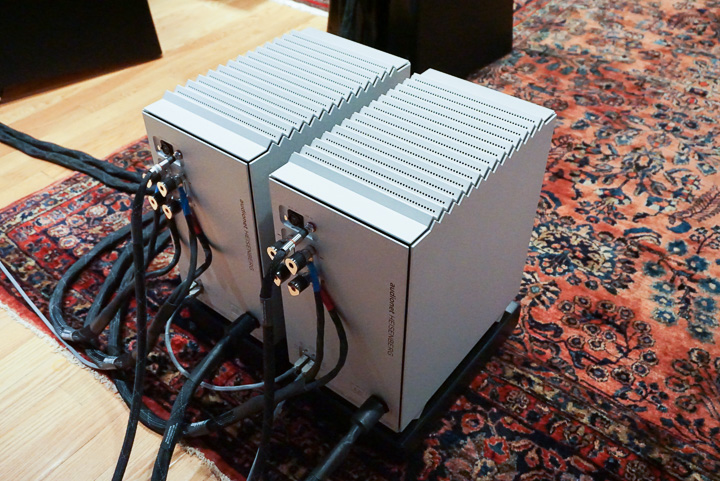
I had been notionally invited as a guest of Padood because the company said it had ‘something special’ lined up. They weren’t wrong. The main system, comprising an SME 30/12 turntable, with a SME V-12 tonearm, and the new Shelter Harmony cartridge, running into a Nagra VPS on the analogue side, a Nagra CDT CD transport and Aurender N10 music server running into the Nagra HD DAC. Amplification was the brand new Nagra HD Preamp, with a pair of Nagra HD power amplifiers, into the new YG Acoustics Sonja XV Jnr system. Cabling throughout was Elation! by Kubala Sosna. The total cost for this bespoke system was about one and a half Savile Row suits shy of £500,000! This system sounded remarkably good; good enough in fact that they had a guitarist called Joncan Kavlakoglu effectively accompany himself live vs. recorded and the two were indistinguishable.

Padood also ran a more ‘modest’ system comprising SME Model 15 turntable, 309 tonearm, EMT S75 Black cartridge, and the new Bel Canto e.One phono stage on the analogue side, the Bel Canto e.One CD3t CD transport, Weiss MAN301 network player, and Weiss Medus DAC digital converter on the digital side, the all new Boulder 1110 line preamp and matching 1160 power amp for amplification and the popular YG Acoustics Carmel 2 floorstanders, all playing through Analysis+ Silver Oval cable. OK, so ‘modest’ still weighs in at well over £125,000, but this too was capable of much. Coming after the outstanding larger system, it was a tough act to follow, but it did follow exceptionally well.


Primare/Karma AV

After a long gestation period, we are finally getting to see the new Prisma range of electronics from Scandinavian audio electronics experts, Primare. Here we got to see and hear two sets of products from the new range, in two system levels: A prototype of the new CD15 and £1,500 I15 models from the entry-level of the brand and the more up-market £2,750 CD35 and £3,900 I35. These were also streaming music from a NAS and making some very fine sounds into a pair of mid-level Revel Concerta M16 loudspeakers.

Puritan Audio

The UK-based power experts Puritan announced a new £1,450 PSM156 Studio Master Mains Purifier. Building on the strengths of its already highly prized PSM136, the new 156 takes the six individually fused 8A outputs of its older brother, and by effectively doubling much of its internal architecture allows for six unfused 13A outputs, in the process increasing the cumulative purification.

Trilogy Audio Systems

UK based electronics brand Trilogy is expanding its top-end line of amplification, as seen in the Symmetry room. Extending its flagship 900 series, the company showed late model prototypes of its 995 hybrid mono power amplifier, and an early prototype of the upcoming 913R two-box phono stage. The prices on both are to be confirmed, but they are likely to be in the thousands rather than hundreds, or hundreds of thousands!

Wilson Audio

The Hi-Fi Show was the European Launchpad for the Wilson Audio Alexia II floorstanders, in a sublime system comprising D’Agostino Progression preamp and mono power amplifiers, all being fed from a dCS Vivaldi One. The new speaker design builds on Wilson’s ‘most successful speaker’, with a new tweeter, more amp-friendly crossover network, increased internal volume of both the midrange and bass cabinet, and the results were impressive!

ARTNOVION LAUNCHES NEW IMPULSO ARCHITECT APP – FOR ARCHITECTS AND SOUNDAHOLICS

Artnovion specialises in creating beautiful acoustic panels for use in domestic and commercial environments. Artnovion has developed the new high-accuracy Impulso Architect App to help create the perfect sound performance. 

The dimensions of a room have a great influence on the acoustic design. The Impulso Architect App has been engineered to allow architects to choose the most suitable acoustic panels for their project. 

Enter the room’s measurements into the app, state the function of the room, and then choose between an internally generated sweep or an external impulse (loudspeaker, microphone, hand clap). Impulso will then process the readings and correlate any background noise to deliver an accurate acoustic analysis and provide the reverberation time of the room. Lastly, select from a choice of acoustic panels in Artnovion’s extensive range and Impulso will display how they will perform.


 To help create the perfect audio setting, architects can share their data with Artnovion’s project department. The team will give further advice on the suitability of their products for the room.

The Impulso Architect App is Artnovion’s third acoustic analysis app and allows the detailed analysis which is required by architects. Artnovion’s two other apps, Impulso and Impulso Pro, are also available to download from the App Store.

‘Sound is an audacious and powerful living element. An element that shapes the perception of our universe and embraces our senses. Curious about this elegant interaction I have nurtured a passion for sound ever since I can remember. 

Driven by the challenges of unravelling the mysteries of sound, I have been travelling through an extraordinary life journey of studying, imagining and creating acoustic innovation. 

Artnovion has become my life’s mission, the canvas I created to share this journey with you.’ – Jorge Castro, CEO 

Contact: [email protected] 

HiFiMAN Shangri-La electrostatic headphone system

I first met Fang Bian (now Dr Fang Bian), the founder and President of HiFiMAN, a number of years ago and our interactions at the time centred on the firm’s early-generation HE-5LE planar magnetic headphones. In the course of our talk, I learned that Bian had, earlier on, created an impressive electrostatic headphone called the Jade, which was no longer in production. My sense was that while Bian thoroughly enjoyed and embraced the technical challenge of creating high-performance planar magnetic headphone designs, his ‘first love’—so to speak—remained with his electrostatic designs. Over the years, Bian completed his doctorate in Nano-chemistry and the HiFiMAN product line continued to unfold, but occasionally I would ask, “Do you think you’ll ever do something like a HiFiMAN ‘Jade II’ electrostatic headphone?” Dr Bian would often respond with a thoughtful expression and a wry smile and say something like this: “I’ve thought about it a lot and I have many ideas I would like to try in such a design, but the timing is not right yet.” This pattern continued for quite a while until—about a year and a half ago—HiFiMAN began showing prototypes of what was at first called the Jade II electrostatic headphone and that now has evolved to become the full-fledged Shangri-La electrostatic headphone system.

Let’s make one point clear right up front: HiFiMAN’s Shangri-La system is an all-out, cost-no-object assault on the state of the art in headphone performance and as such Shangri-La is one of the two most expensive headphone systems in the world (the Shangri-La system is priced at a breath-taking $50,000). The system consists of a set of exquisite Shangri‑La electrostatic headphones, a matching Shangri-La valve-powered electrostatic headphone amplifier, plus various necessary accessories such as a high-quality power cord and a beautifully weighted desktop cradle for the headphones. Buyers of the Shangri-La system will be pleased to note that each one is built to order and takes around 120 days to build, and that after the system ships, a HiFiMAN representative will arrive at the customer’s home to install and set-up the system to ensure that everything is in perfect working order.

The comfortable Shangri-La headphones are very light (374g) and they fairly bristle with cutting edge technologies. For example, the headphone uses what HiFiMAN calls a ‘Nanotech’ driver whose Nano-material diaphragm is just 0.001mm thick (and no, that figure is not a typographical error). In turn, the diaphragm is coated with conductive Nano-particles arranged in a precise, lattice-like pattern on the diaphragm surface. Then, HiFiMAN developed thin, micro-mesh metal stators formed from wires just 50µm thick and where the stators are held in place by a frame made of a “specialized metallic alloy, specially chosen to ensure sonic stability and to minimise distortion.” HiFiMAN takes particular pride in the fact that the openings in the stator mesh are so fine that “sound waves lower than 1MHz can pass through without distortion…” Nanometre-thick dust covers on the front and rear sides of the driver complete the picture.

The upshot of these technical efforts is a driver whose moving mass is vanishingly low, whose transparency—both in terms of its free-flowing stators and its ultra-thin dust covers—is exceptionally high, and that is said to deliver “lightning-fast response with virtually zero distortion.” Claimed frequency response for the driver is a remarkable 7Hz to 120kHz.


In terms of external design, the Shangri‑La headphone looks much like a lightweight, upscale version of HiFiMAN’s critically acclaimed HE 1000 v2 headphone, but one where the satin silver metalwork of the HE 1000 v2 is—for the Shangri‑La—instead treated to a rich-looking black anodised finish. As on the HE 1000 v2’s, the sides of the Shangri-La ear cups are covered with tasteful exotic wood veneers. Touch surfaces (that is, ear pads and the adjustable headband strap) are done in soft, sumptuous-feeling black leather.

Complementing the Shangri-La electrostatic headphone is a matching, purpose-built electrostatic amplifier that is based on a quartet of 6SN7 valves that drive a set of four, custom-designed and custom made 300B output valves. The valves for our review sample Shangri-La amplifier were sourced from the specialist audio valve manufacturer TJ Full Music whose 300B’s are, according to HiFiMAN, “the finest available to ensure perfect transparency.” Importantly, the topology of the amplifier allows the 300B tubes to drive the headphones directly so that, as HiFiMAN puts it, “There are neither capacitors nor transformers between the tubes (valves) and headphones…”

As you might expect, the amplifier uses ultra high-quality parts throughout and provides a 24-step relay-based attenuator-type volume control using a total of 23 separate low-noise resistors. The industrial design of the amplifier is special too, featuring a modern, swept-back design aesthetic that makes the Shangri-La amp look a like a large, futuristic, all-black valve-powered aircraft carrier. The ‘flight deck’ of the amplifier features a black glass top plate through which protrude an elegant, rear-illuminated volume control knob, openings for the requisite valve sockets, and positioning holes for the also swept back valve ‘cage’ surrounding the valves. The rear panel of the amp provides single-ended and balanced analogue inputs with an input selector switch, while the recessed front panel provides two 5-pin electrostatic headphone jacks and an on/off switch with colour-coded illumination (flashing red indicates the amp is warming up, while continuous white means the amp is ready for use). Visually, the amp’s sharply angled design is striking in a good way and is executed with self-evident attention to build quality and detail.

For my listening tests, I ran the Shangri-La system from the best-sounding DAC presently in my ‘stable’, which is a PS Audio DirectStream DAC using the firm’s very latest Huron firmware. The DAC, in turn, was fed from a Windows/jRiver/Lenovo-based music server loaded with a mix of standard and high resolution PCM, DXD, and DSD music files. An AudioQuest Diamond USB cable was used between the server and the DAC, while Furutech Line-Flux interconnects were used between the DAC and the Shangri-La amplifier. At the risk of getting ahead of myself, let me tell you at the outset that, through all my listening tests, the Shangri-La system delivered sound quality of such resounding excellence that it has pretty much recalibrated my notion of what headphone systems (or for that matter, hi-fi systems of any kind) can do. Here’s why.

From the minute you first power up the Shangri-La system it delivers two closely allied sonic qualities that together help bring your favourite music alive in eye-opening ways: namely, extraordinary levels of transparency coupled with also extraordinary levels of dynamic expressiveness.


To appreciate how these qualities work in support of one another, it helps to think about how we experience live, unamplified music in natural acoustic spaces. When I hear symphony orchestras perform, one thing that has always fascinated me is that certain sections of the orchestra may be playing vigorous, dynamically forceful musical lines, while at the same time other sections might be supplying softer, subtler textural or rhythmic commentary that—in its way—is every bit as important to the musical whole as the bigger and bolder lines are. The interesting part is that, in a live context, listeners can follow and attend to whatever individual musical threads they choose, or they can simply take in the musical tapestry as a whole. With hi-fi and headphone systems this is typically much harder to do, because it is so difficult for transducers and electronics alike to ‘play big’ and ‘play small’ simultaneously. But not so with the Shangri-La system; amazingly, it can reproduce big (even explosive) passages with full dynamic force even as it manages to serve up low-level information with extreme resolution and finesse.

One evening as I listened to the Shangri-La system, I put on the famous Bakels/Bournemouth recording of Vaughan-Williams Sinfonia antartica [Naxos, 16/44.1] and was floored by what I heard. First, I was stunned to hear just how much very low-level musical information the Shangri-La system was able to retrieve from the recording (for example, the subtle wind machine Vaughan-Williams uses to suggest the icy, penetrating grip of Antartic winds). The eerie sound of that wind machine was so subtle and yet so evocative that it almost made me shiver (even though this review in being prepared in the midst of very hot Texas summer). Second, I was struck by the forceful and full-blooded manner in which the Shangri-La handled the piece’s bigger dynamic moments, including forceful brass and tympani sections or passages where powerful low-frequency organ pedal notes are presented at full throttle. In short, the Shangri-La system gave a tour de force display of power, delicacy, and finesse in action, all at once.

As you might expect, the Shangri-La system works wonders with well-made vocal recordings, such as Lyn Stanley’s rendition of the jazz standard ‘My Funny Valentine’ from her album The Moonlight Sessions, Volume One [ A.T. Music, SACD ]. On that track, the Shangri-La system allows you to dig deep to savour the purity, the natural warmth, and the finely shaded textures of Stanley’s soulful alto voice, while also appreciating the sheer subtlety and craft with which she shapes each musical phrase. The effect is not unlike the sonic equivalent of looking at music through a magnifying glass, the better to appreciate its sheer richness and the intricate and at times intoxicating interplay of its constituent parts.

The Shangri-La system offers neutral tonal balance and remarkable freedom from the ‘highs-covered-in-plastic-wrap’ colourations to which some electrostatic headphones are prone. The top end of the Shangri-La headphones is as linear, detailed, and extended as anyone could possibly wish, yet at the same time they consistently manage to sound smooth and clear—never adding or in any way exaggerating high-frequency energy that isn’t actually present in the recording. This achievement is greatly to HiFiMAN’s credit.

Similarly, HiFiMAN seems to have found a way to address what has traditionally been the ‘Achilles’ Heel’ of many electrostatic headphone designs, which is the problem of temporary bass overload when reproducing abrupt, loud, low-frequency information that may be present in the music. One such low-frequency torture test is the track ‘O Vazio’ as performed by the Jim Brock Ensemble on Jazz Kaleidoscope [Reference Recordings, HDCD]. Early on in the track a very loud, low frequency percussion note is sounded, with the result that many otherwise very fine headphones and loudspeakers stumble badly, emitting unpleasant flatulent noises (or worse). But when I tried this test with the Shangri-La system it passed with flying colours, serving up the low percussion note with sufficient force to make me think my eardrums might implode (my ears might have overloaded, but the headphones did not).


Finally, the Shangri-La system remained completely unfazed by increasing levels of textural complexity and/or dynamics in the music I played. On tracks many systems find challenging, such as the more bombastic passages in Silvestre Revueltas’ ‘Sensemaya’ [Chicago Symphony Brass Live, CSO Resound, SACD], the Shangri-La system remained cool, calm, collected and very, very expressive. Again and again the Shangri-La kept its composure when playing passages that give lesser systems fits.

The Shangri-La electrostatic headphone system is one of the two most transparent, revealing, complete, and accomplished music systems I’ve every heard (the other is the $500,000+ super-system, through which I reviewed the YG Acoustics Sonja XV loudspeakers earlier this year). For obvious reasons, the Shangri-La system is an exceptionally useful tool for purposes of evaluating the quality of recordings and the source components used to play them, but what’s more important is the way in which it enhances our enjoyment of music. If your reactions are anything like mine, you might find that when you listen to music through the Shangri-La system your favourite recordings will suddenly seem richer, subtler, deeper, and more expressive than you ever thought possible. In simple terms the system unlocks a clearer intellectual understanding of the music at hand, while at the same time fostering a more profound emotional connection to it, which is exactly what state-of-the-art components ought to do.

TECHNICAL SPECIFICATIONS

  • Amplifier: Valve-powered electrostatic headphone amplifier
  • Headphone: Open-back electrostatic headphone
  • Valve Complement: Four 6SN7 valves and four custom-designed and custom mad 300B output valves.
  • Driver Complement: Single full-range electrostatic driver with 0.001mm thick diaphragm and Nano‑material coatings, ultra-thin metal mesh stators, and Nano‑material dust covers.
  • System Frequency Response: 7Hz–120kHz
  • Amplifier Bias Voltage: 550–650V
  • Headphone Weight: 374g
  • Amplifier Weight: 16kg
  • Amplifier Dimensions (H×W×D):
    335.8 × 458.9 × 437.8mm
  • System Warranty: 5 years, all hardware elements; 1 year, valves
  • Price: $50,000

Manufacturer information:
HiFiMAN Corporation

Tel: +1 (201) 443-4626

URL: www.hifiman.com

Back to reviews 

Read more HiFiMAN reviews here

Rocky Mountain Audio Fest (Part Two of Two)

In our final part of our round-up of Rocky Mountain Audio Fest (Editor’s note: delayed on the part of the Editor due to illness of the Editor), Roy Gregory trawls Denver in search of the best loudspeakers and digital devices. He also goes looking for the best of the best.

LOUDSPEAKERS

Magico M6

Magico’s new M6 floorstander is both an evolution of and a departure from the company’s existing models. The carbon nano-tech cone material has now extended to the three 10.5” bass units as well as the midrange, but the really big news is the move to a monocoque enclosure constructed from ½” thick carbon composite, including integral bracing and mated to a constrained layer aluminium baffle. If the performance comes close to justifying the claims in the press release, it should be impressive indeed – as it should be at the projected $172K asking price.

B&O Beolab 50

If the Munich launch of the Beolab 90 speaker system revealed much about B&O’s reading of the audio market, the smaller and more affordable Beolab 50 marks a serious statement of intent. A seven-way interactive, digital ready design, it uses DSP filtering to alter dispersion and balance for sweet-spot or wider audience listening (read audiophile or A/V). The funky motorized tweeter housing (all lift and separate) and smooth lines are unmistakably B&O, while their traditional customer base will find the $40K price tag reassuringly exclusive.

Revel Performa F228 Be

Revel’s latest assault on the almost affordable but genuinely high-end speaker market takes the attractive shape of the new F228 Be three-way floor-stander. It’s svelte lines and flawless finish were as attractive as its musical performance – the latter the result of extensive refinement of the driver motors and a continuing quest for ever-lower system distortion. Price is still to be determined but seems likely to be in the $20K region, with availability early next year.

Focal Kanta

Perhaps the most distinctive loudspeaker introduction at RMAF was Focal’s Kanta, a speaker that shares so much with the company’s existing products that the difference in visual identity seems all the more apparent. Essentially combining the tweeter and motor technologies of the Sopras with the now established flax cones from the Aria series, the Kanta features a massive, moulded polymer baffle coupled to a moulded wood enclosure, creating a compact and striking cabinet. Focal describe the appearance as “Obviously Made In France”: or as at least one US observer was heard to remark, “No kiddin’!” 

Audio Physic Step Plus

Audio Physic’s diminutive two-way Step has always delivered remarkable soundstaging and transparency – and the latest Step Plus iteration ($2,595) is no different. Driven by an entry-level Moon integrated amp, it delivered sound that was both expansive and engaging at a price that was almost as attractive as the music it produced.


Raidho XT5

Raidho’s new XT5 represents the first fruits of a seriously beefed up design team at the Danish manufacturer. The design itself is beefed up too, the elegant, aerofoil enclosure offering twice the power handling of previous models and a noticeably more weighty, substantial balance. Even in the optional but beautiful Birdseye Maple Burl veneer, the price is a surprisingly affordable $40K. For those who have trouble with the use of that number and the term “affordable” in the same sentence, consider this: the XT5 is Raidho’s most musically convincing, best balanced and complete design to date, yet it weighs in at around a sixth of the price of the flagship D5!

Wilson Alexia Series Two

Wilson’s Alexia is the latest of the established speaker range to be updated to Mark II status, bringing it into line with Sasha 2 and the newer Alexx. The results are impressive, with the revised model displaying impressive spatial, tonal and dynamic coherence and far better overall integration. Its pairing with Constellation electronics and the Continuum turntable was notably successful, creating a seamless acoustic space and equally seamless dynamics along with natural tonal colour and texture.

Neat Iota Xplorer

Neat extended its Iota series with the squat, floorstanding, three-way Xplorer (£3,500). This interesting speaker combines the legendary Hiel AMT tweeter with their super-fast 170mm paper-coned bass-mid unit, housed in an upper, sealed chamber.  Below that (in every sense), a pair of downward firing bass drivers is arranged in an isobaric loading, the “rear” unit in a ported enclosure. The sound was relaxed, open and inviting, with good rhythmic coherence and no obvious discontinuity between the mid and treble – itself quite an achievement. Available from November, the Iota Xplorer should be well worth seeking out.

Verity

Sometimes it’s not the new products that are the story, but simply the latest version of the established ones that continue to impress. Verity Audio’s flagship Lohengrin speaker system might be sixteen years young, but in its latest IIS guise (a new mid-treble crossover and inter-cabinet isolation plate, both retrofitable to existing models) it turned in a remarkable musical performance. Driven by a full set of Verity electronics and a TW Acoustics ‘table, its expansive soundstage, impressive dimensionality and fluid phrasing showed more than a few of the younger pretenders just how serious high-end should be done.

JERN14 DS Loudspeaker

Danish industrial casting company Skalform have introduced the JERN speaker brand, built around two-way weeble speakers with cast iron cabinets, available with a range of different quality drivers that spread the price from $499 to $5,300 each, as well as subs, stands and other accessories. Appearance and performance were both extremely interesting, but what really attracted my attention was the fascinating rack, based on cast conical uprights. Customers supply their own woodwork or other supporting surface, with the conical spacers offering three height options, levelling and a serious dose of Scandi styling.

Pure Audio Project Quintet 15 Horn 1

Pure Audio Project showed their largest model, the Quintet 15 to considerable effect. The curved array, open baffle speakers are both attractive and imposing. Customers assemble the speakers themselves and have various tweeter choices, ranging from Hiel or Voxativ units to fully horn-loaded compression drivers. Those eight 15” woofers certainly let the music breathe while the PAP-based horns on the show set-up were also beautifully integrated. High-performance, high-value DIY is alive and (in this case) definitely kicking.

MarkAudio-SOTA Viotti One

Driven from a modest Marantz/PS Audio system, MarkAudio-SOTA’s Viotti One standmount offered an interesting take on the standard two-way theme, running a 11cm alloy cone up to 2.4kHz, with a second, 5cm alloy cone taking over above that. An attractive but largish box, stable stand and gentle crossover made for quick, lucid sound that was impressive for the $2,495 asking price.

Thrax Lyra/Basus speakers

Every show has its crazy products and most of them are speakers, but even so the Thrax Lyra/Basus speaker system deserves a special mention. The Lyra ($19,600) has been around for a while, its horn loaded compression tweeter making it stand out from the crowd. But nest it with the $40,600 Basus subwoofers (the two elements quite literally interlocking) and you have something that, given the solid aluminium cabinetry, is almost certainly as immovable as it is visually imposing!


DIGITAL PRODUCT

Micromega M One 100/150

Micromega did a Devialet, only to rather more impressive musical effect and in a rather more stylish package (at least to these eyes and ears). The single aluminium chassis accepts multiple analogue and digital inputs, is compatible with all popular streaming services, is network capable, can be disposed horizontally or vertically and can be specified in any RAL paint finish. The junior model ($5,000) delivers 100 Watts of Class A/B power and offers optional room EQ, the MARS system, which comes as standard on the more powerful 150 ($7,500). The musical results when teamed with a colour-matched pair of Focal Scala Utopias suggest that this is a lot more than just a pretty face.

Sonore Signature Rendu SE

Sonore made their name with a range of affordable, high-performance computer audio peripherals. The Signature Rendu SE signals a move up market, although at $3,295 the price-tag is still hardly stratospheric. Designed to accept a network streamed digital signal and convert it to a high-quality USB output, the Rendu features an EI transformer, a substantial power supply with heavy regulation and a Femto oscillator, all in an effort to deliver a ripple free, jitter free signal.

Esoteric N-01 Network Audio Player

Showing that streamed audio sources are not only the preserve of budget boxes sold over the interweb, Esoteric launched their $20K N-01 network player. Featuring the DAC chip and digital circuitry from the Grandioso CD player, in what is becoming an increasingly familiar theme, the unit also employs multiple, independent power supplies and massive reservoir capacitance, naturally all of which is housed in Esoteric’s substantial aluminium case work.

AURALiC Aries G2/VegaG2 Streaming Solution

With file replay systems apparently in every room, their ubiquity served mainly to demonstrate just how far they’ve still got to come if they are going to prove a credible high-end source. Of the exceptions to that rule the best was the AURALiC room, where their latest Aries G2 Wireless Streaming Transporter (server) and Vega G2 DAC fed a pair of their Merak amplifiers and YG Acoustics Carmel 2 loudspeakers, producing unexpectedly sweet, lucid and engaging sound. Throw in the neat styling and beautiful finish and AURALiC could carve themselves a serious niche in this crucial market.

Korg DS-DAC-10R

The diminutive Korg DS-DAC-10R may be small but it’s definitely mighty, offering full DSD 2.8 and 5.6MHz A-to-D and D-to-A encoding/decoding as well as PCM to 24/192, all for a paltry £500. But throw in the included moving-magnet input and DSP implementation of phono EQ (RIAA, NAB, Columbia, FFRR-Decca, AES) and this could just be the ultimate affordable vinyl archiving device.

Wavelength Audio Europa V2

Gordon Rankin, the man behind AudioQuest’s remarkable DragonFly and other portable DACs, showed a new addition to his own, Wavelength range. Based on micro triode devices, the Europa v2 (to the left of the flagship Crimson DAC) is a modular DAC preamp, with both an optically isolated 32/348 capable USB and analogue inputs. There’s also a 24/96 TosLink and you can expect uprated digital and optical inputs in the future, as well as network connectivity, all remotely controllable of course. Wavelength, in association with Vaughn loudspeakers are one of the few exhibitors to deliver consistently excellent sound from file-replay, making this a particularly interesting introduction.  


OTHER STUFF

PS Audio P20 Powerplant

PS Audio launched their most powerful regenerator to date, in the substantial shape of the P20. Boasting an 1850VA output and a range of AC optimization tools to ensure that you get the voltage you want and nothing but the voltage you want, this looks like a serious step up on the established P10, although at what price only time will tell.

Mark Levinson No. 585.5 Integrated Amp

When the Levinson 585 arrived, it had big shoes to fill and plenty of competition, but it didn’t just better the wonderful 383 that preceded it, it pretty much crushed all-comers in the high-end integrated market, combining a superb DAC with plenty of genuine Levinson power. The .5 suffix denotes the inclusion of the promised phono section, the same as used in the 523 and 526 pre-amps, making the 585 an even more versatile device. The non-phono 585 continues at $12,000, while the 585.5 will cost $16,000. Owners of existing units will be able to upgrade, but it will necessitate a trip back to the manufacturer or distributor, as it involves a new rear panel as well as the internal work.

Cambridge Audio

Cambridge Audio showed a pair of artfully disguised “prototypes” – an ambitious pre/power combination set to sell at £4K per box. The pre-amp will feature a sophisticated digital input section as well as balanced and single-ended analogue circuitry. The power amp is a warm-running 200 watt, DC coupled design with a clever servo arrangement, serious power supply and twin contra-wound toroidal transformers. Both units are much nearer to completion than appearances might suggest, with delivery scheduled for early next year. “Levinson performance at real world prices” burbled the irrepressible Dominic Baker: time will tell, but it certainly looks like it could be fun finding out.

BEST SOUND

Tidal Audio Presencio/Ferios amplifiers and Akira loudspeakers with TW-Acustic Raven turntable

The Voice That Is showed what was arguably the most expensive system at RMAF: fortunately it was also the best sounding. The Akira speakers that so impressed in a large room at the Munich show two years ago were this time deployed to equally impressive musical effect in a hotel bedroom. This might have been a single seat, single source set up, but sit in that hot seat, play a record and the system, the room and the end wall simply disappeared. If you ever wondered what a time and space machine might cost, the answer is around half a million dollars!

Raising the Bar (a preview): AudioNet Stern preamplifier and Heisenberg monoblock power amplifiers

Early in 2017 I took two opportunities to hear a very special audio system located in the large listening room at the GTT Audio facility in Long Valley, New Jersey, USA. The system was comprised of YG Acoustics’ flagship Sonja XV loudspeakers; an Audionet preamp, phono stage, and Planck CD player with appropriate outboard power supplies, plus a quartet of Audionet Max monoblock power amps; Kronos Audio’s Kronos Pro turntable and Black Beauty tonearm fitted with an Airtight phono cartridge; and a mix of Kubala-Sosna Elation and Realization cables. It was, hands down, the finest audio system I had ever heard up to that point so it goes without saying that it left an indelible impression upon me. Honestly, in every aspect of performance one might care to name, that remarkable YG/Audionet-based system set performance benchmarks that seemed very likely to stand the test of time—until now.

This fall, Bill Parish, the owner of GTT Audio, invited me to attend a roll-out event for Audionet’s new flagship Stern preamplifier ($45,000) and a quartet of the firm’s new flagship Heisenberg monoblock power amplifiers ($105,000/pair or $210,000 for the set). The event featured the exact same YG Sonja XV-based system I had heard before, but with the Stern and four Heisenberg amps replacing the Audionet Pre G2 and Max power amps that had previously powered the system, and with a full set of Kubala-Sosna Realization cables replacing the partial Realization loom that had originally been in place.

Coming in, Bill told me, “I think the Stern/Heisenberg combination takes the system to a whole new level of performance, but you be the judge.” I accepted Bill’s assessment at face value but also with—if I am candid—a fairly major grain of salt. Bill is, after all, the Audionet distributor for North America and it would only be natural for him to assess the firm’s latest and greatest offerings in a favourable light. Even so, the fact was that the system in its prior configuration (with the previous Audionet flagship components) had been the best I’d ever heard and by a not subtle margin. Realistically, how much better could it possibly get?

The answer, as it turns out, is that the system got quite a lot better and in ways that left me scrambling for suitable descriptors as I contemplated sketching out the sonic improvements I heard. What floored me was that the improvements weren’t the sort of things one had to concentrate or struggle to hear; on the contrary, they were so obvious that within just 20 or 30 minutes of listening it was plain as day that the Stern/Heisenberg electronics had shattered performance boundaries in a major, “there’s no turning back now” kind of way.  What changed? Many things.


First, the overall system noise floor had gone way, way down (and it had been very low to begin with) and with it the amounts of low-level sonic information revealed were increased in a manner that was just plain breath taking. The musical implications of this change alone were highly significant in that low-level reverberant information was reproduced much more clearly, which in turn made the system sound far more three-dimensional than before (an area where the original system had been excellent, but where it now seemed markedly more expansive and realistic—especially on really good recordings). What is more, low-level textural, transient, and timbral details were rendered in a more complete and holistic way and with a heightened sense of focus and nuance. As a result, the voices of instruments and human singers became at once more natural sounding, more pure, and more focused. On massed choral pieces in particular it became much simpler to hear clearly the lyrics being sung and to follow them without needing a libretto in hand. The sheer effortless clarity I heard was unlike anything I had heard from any hi-fi system in the past, and as a result, large-scale choral and orchestral works took a quantum leap forward in overall intelligibility and lucidity.

Second, the bass qualities of the Stern/Heisenberg electronics ensemble proved astonishingly good. If you charted out all the various performance parameters that together make for great bass—depth and extension, grip and control, power and impact, transient speed and textural detail, and so forth—the Audionet electronics simply raised the stakes (across the board) in a way I had not really thought possible. Understand, please, that the original YG Sonja XV/Audionet Pre G2/Max system offered extremely impressive bass depth and focus in its own right, so that I was not really prepared to hear even more depth, more focus, and much more bass detail, yet that is exactly what the Stern/Heisenberg electronics delivered.

Third, (and perhaps this come as no surprise) the extremely powerful Heisenberg amplifiers (1,050 watts @ 4 ohms) gave the system a certain “ceilings unlimited” quality in terms of dynamics. No moment seemed too big or too complicated for the Stern/Heisenberg electronics to handle, so that when big orchestral swells arrived the system simply played them—at full song—and with not so much as a hint of distress. When you lift performance constraints from an already superb system, moments of sonic greatness can and do ensue. And lifting performance constraints is, at the end of the day, what Audionet’s Stern and Heisenberg are all about.

Now those raised in the ‘smaller-is-better’ ethos of hi-fi amplification might well wonder if blockbuster amps such as the Heisenbergs could be anything but muscle-bound, but that isn’t the case at all. In fact, I suspect the Heisenberg might just be the most fleet-footed and agile audio amplifier I’ve ever experienced–regardless of size, price, or circuit topology, which is saying a mouthful. As a consequence, one benefit is that, with the Audionet flagships in place, the listener isn’t really conscious of individual performance attributes in isolation, but rather experiences them as an interwoven, organic whole. The end result is, where recordings permit, a huge, panoramic presentation where the music leads a life of its own, as if set free from the boundaries of the room and the constraints (what constraints?) of the system.

Two major benefits of the Stern/Heisenberg package are these: first, the strengths of ancillary components seem greatly magnified by the Audionet electronics, and second, with the Audionet components in play recordings can be explored in much greater depth and with more insight than listeners might have thought possible. For example, with Stern and Heisenberg in play GTT Audio’s Kronos/Airtight analogue rig sounded far more nuanced and accomplished than it had with the earlier-generation Audionet electronics in the system. The same was true for the Audionet Planck CD player/DAC that served as the digital front-end for the system. Finally, the mighty YG Acoustics Sonja XV speakers themselves sounded even mightier—more nuanced, more revealing, more powerful, and more full of dynamic energy and life.

At one point during my listening session, Joe Kubala (of Kubala-Sosna fame), Bill Parish, and I decided to do a ‘listen-off’ to compare the concluding two passages of three recordings of Mahler’s Symphony No. 8 (the versions we compared were the Tilson Thomas/SFO version, the Kubelik/Bavarian Orchestra version, and the Solti/Chicago version). As we listened, the system became for us a wise music mentor, letting us hear and grasp in great detail (and I am speaking of both intellectual and emotional detail) the different decisions and performance choices the conductors, orchestras, vocal soloists, and choirs had made. When the comparison was finished, I found myself almost overwhelmed by a sense both of enlightenment (inasmuch as I knew more about the performances than I had before the session began) and of deep, almost-on-the-verge-of-tears emotional engagement. (For me, as for so many others, there is nothing quite like the conclusion of Mahler’s 8th to stir the soul, and the Stern/Heisenberg combination amp elevated that listening experience to the level of—how shall I put this? —the musical equivalent of Close Encounters of the Third Kind).


As you might expect, Stern and Heisenberg both offer exemplary performance specifications and incredibly beautiful industrial designs. Key performance metrics for the Stern include:

·      Frequency response: 0Hz – 2.2MHz (-3dB)

·      THD + N: < -104dB @ 20kHz, < -116dB @ 1kHz

·      SNR: > 123dB, 4Vrms

·      Channel separation: > 144dB, 20Hz – 20kHz

Performance metrics for the Heisenberg include:
 

·      Power output: 530W @ 8 ohms; 1,050W @ 4 ohms; 2,100W @ 2 ohms

·      Frequency response: 0Hz – 700kHz (-3dB)

·      Damping factor: > 1,800 @ 10Hz; >10,000 @ 100Hz

·      Harmonic distortion:

o   k2 typ. -117dB for 25W @ 4 ohms

o   k3 typ. -123dB for 25W @ 4 ohms

·      Intermodulation distortion: < -110dB SMPTE 100Hz: 20kHZ, 4: 1, 50w @ 4 ohms

·      THD + N: > -106dB @ 1kHz, 25W to 700W @ 4 ohms

·       SNR> 125dB

Hartmut Esslinger, founder of Frogdesign and creator of the designs for several of Apple’s most iconic products, personally developed the striking industrial designs for both Stern and Heisenberg. The look of both components is visually striking and highly thought-provoking, thanks in part to a patented design technique that gives the illusion that the side and top panels of the preamp and amplifier chassis ‘float’ in close proximity to one another, but without actually touching! Both designs combine rectilinear shapes with ridged cooling vents that are triangular in cross section, as are the support bars that serve as the ‘feet’ of the components.  In case you’re wondering, I’m not the only one who finds these components beautiful; in fact, the Stern is now on display as part of the Smithsonian’s National Gallery. Both the Stern and Heisenberg are offered in two colours (silver and black) and in two chassis formats (vertical and horizontal). Candidly, the vertical models have (to my eyes) a more striking visual presence, but the horizontal models are much easier to place on typical audio racks, so that simple pragmatism way wind up carrying the day for many prospective buyers.

The bottom line is that Stern and Heisenberg have, in my opinion, raised the performance bar for high-end audio electronics, and I say this having heard top-tier components from Audio Research, Constellation, Dan D’Agostino Master Audio Systems, Naim Audio, Pass Labs, Soulution, and others). They also serve admirably as audio objets d’arts that are, in a very literal sense, of museum quality. Therefore, I would encourage listeners to go hear and see the Audionet components, if only for a glimpse of what’s possible when performance constraints are removed.

For more information visit Audionet at www.en.audionet.de or GTT Audio & Video at www.gttaudio.com.