Up to 37% in savings when you subscribe to hi-fi+
hifi-logo-footer

Begin typing your search above and press return to search. Press Esc to cancel.

Music Interview: The Hanging Stars

London country-psych-folk-rock band The Hanging Stars are in a good place – and I’m not just talking about the traditional East End pub that we’ve agreed to meet in.

The five-piece – singer and guitarist Richard Olson, bassist Sam Ferman, drummer Paulie Cobra, Patrick Ralla on guitars, keys and vocals and pedal steel guitarist Joe Harvey-Whyte – have just released their third album, A New Kind Of Sky, and it’s their best, most cohesive and sonically adventurous record to date.

From the hypnotic opening track, the shimmering, magical and other-wordly ‘Choir of Criers’, which features a Marxophone – a type of fretless zither played by a system of hammers – you know that this is going to be a truly special and richly rewarding album.

There are several cinematic songs: ‘Three Rolling Hills’ has Mariachi horns and a Spaghetti Western vibe; the trippy ‘Lonely Rivers’ has an electric piano-led groove and echoes of Pink Floyd, while the spiritual and hymn-like ‘I Was A Stone’ opens with a church organ and has a brass arrangement reminiscent of a New Orleans funeral.

‘I Will Please You’ is a catchy, glam-rock-tinged sing-along; the stripped-down, acoustic ballad ‘Song For Fred Neil’ is a paean to the ‘60s and early ‘70s singer-songwriter; ‘Heavy Blue’ is classic-sounding country rock and first single, ‘(I’ve Seen) The Summer In Her Eyes’ is pastoral, Byrdsian jangle-pop.

The bulk of A New Kind Of Sky was recorded live at Echozoo studio in the Sussex seaside town of Eastbourne. The sessions were produced by Dave Lynch and took place shortly after The Hanging Stars had returned from a tour of Germany – Lynch has really captured the energy of the band.

On the night I interview Richard and Sam – a few weeks before their new album is due out – Richard is almost ‘expectant father’ excited, as his own vinyl copy of his own album should be waiting for him at home when he gets back from the pub.

“I’m still trying to come to terms with it all,” he says. “It usually comes together when I get the vinyl…”

SH: You’re very prolific, aren’t you? This is your third album since 2016.

Richard Olson: We don’t stop recording – it’s the only way we can do it, as we can’t afford to take two weeks off to go and make a record in the country. It’s an ongoing situation – that’s one of the reasons it’s so much fun to play with this group.

So how did you approach this record?

Sam Ferman: When we started The Hanging Stars, we had a definite idea of what we wanted our first record to be like – cosmic, psychedelic, spacey country music.

With our second album, other influences came in and it was a bit of a transitional period, as our original keyboardist and pedal steel player had both left. I love the last record for its variety.

The new one could’ve been a completely different album – we talked about what type of band we were and what the core of the record should be. There was the potential for it to be more of an acoustic country rock album.

When we did the recording sessions in Echozoo, we’d just come back from a tour of Germany – we were playing the new songs in our set and by the last date of the tour something magical happened, because we were so synced-in with playing with each other.

We wanted to capture that energy from the tour, so we recorded most of the songs live at Echozoo in three days, playing as a full band.

It’s a big studio, so we had plenty of space to play live – the live thing is who we are. Dave Lynch’s production and engineering were brilliant – he coached us through the whole process.

RO: We had a lot of songs for the new album, but we decided to make a 10-track record – it is a very coherent album. I think we’ve got something really special – I can’t wait to play the new songs live. It’s amazing to be in a band that’s made up of five arrangers – everyone has great ideas.

SF: One of the great things about being in The Hanging Stars is that Rich brings us beautiful melodies and choruses and then we jam and work out the arrangements.

How was it recording in Eastbourne?

SF: It was nice being by the sea and feeling a little more detached from the vagaries of modern life. Eastbourne is a beautiful town.

Let’s talk about some of the new songs. ‘Choir of Criers’, the opening track, is majestic, and it has a groove to it…

RO: It caresses your ears, but, lyrically, it’s also a bit of a protest song. I’m really pleased with it – it was fun to do. That was one of the songs that we hadn’t played live.

SF: I can remember Rich coming over to mine and showing me the idea for ‘Choir of Criers’. It sounded like something off David Crosby’s If I Could Only Remember My Name – that kind of vibe. We jammed it and worked it up over three or four days.

Both ‘Three Rolling Hills’ and ‘I Was A Stone’ have brass arrangements by Sean Read, who has worked with Dexy’s Midnight Runners, Edwyn Collins and The Rockingbirds. How was it working with Sean?

RO: Sean is great – he’s part of the team. I don’t see ‘Three Rolling Hills’ as a Spaghetti Western song – it’s more Bolero. I think ‘I Was A Stone’ sounds like Spacemen 3.

‘Lonely Rivers’ reminds me of Pink Floyd…

SF: Yes, but I think it’s closer to Neil Young’s On The Beach.


‘Three Rolling Hills’ was inspired by a trip to Marin County, in California, to hang out with friends from the band Asteroid No. 4. Can you tell me what happened?

RO: I can’t tell you anything that’s printable! It was awesome, but we ended up getting into a weird situation.

What’s influenced a lot of our records is us hanging out with other bands that are good pals of ours – like The Brian Jonestown Massacre.

There are recurring lyrical themes on the album – the idea of escaping and getting away to a better place. On the title track, you sing: “had enough of today – of the grey skies and rain – think I’ll pack all my bags and start walking away…” There’s a lyric on ‘I Was A Stone’ which says: “When the world is cruel and mean, I’ll show you the way to your dreams…”

RO: I wrote ‘I Was A Stone’ about my children – it’s about how much light they shine into my soul.

‘A New Kind Of Sky’ is about Brexit – it was one of those songs that wrote itself.

‘I Will Please You’, which was the third single from the album, has some pounding piano on it and is a bit glam and very poppy – it has some ‘bah-bah-bah’ backing vocals. It’s a different kind of song for you…

SF: Patrick came up with the piano riff during one of the interludes in our rehearsal sessions – I started singing the backing vocals and Rich started humming a melody.

RO: I think it’s quite British and a bit Small Faces – I’m a massive fan of the Small Faces, but I hate the way that the mods have hijacked that band. As far as I’m concerned, the Small Faces should be spoken about in the same breath as Love. Look at Ronnie Lane – there was so much folk and country music in the Small Faces…

The lyric for ‘I Will Please You’, is written from the point of view of someone who’s joined a cult. What inspired it?

RO: I think I was watching Wild Wild Country at the time…

What can you tell me about ‘Heavy Blue’ – which has a drinking theme – and the very personal ballad ‘Song For Fred Neil?’

RO: ‘Heavy Blue’ is about finding yourself in a place where you wouldn’t normally be – and it’s not necessarily a good thing.

I’m really fond of ‘Song For Fred Neil’ – I like self-confessional songs. It’s a love song to music – how it can genuinely touch you – but it doesn’t sound anything like Fred Neil. His music means so much to me, but it took me a long time to get into him.

SF: Rich and Patrick recorded ‘Song For Fred Neil’ in a studio in Nashville. When I heard it, it was clear that nothing needed to be added to it – it’s so beautiful.

With a new album out and some live dates coming up over the next few months, how are you feeling about 2020?

Editor’s Note: This interview was made before COVID-19 and the lockdowns hit!

SF: We’re really looking forward to playing gigs around the UK – we’re doing quite a few dates. This record feels like a long time in gestation, but I’m super-proud of it. I’m really looking forward to people hearing it.

RO: When you release a record, you can feel like a lost ship on the ocean, but there are a lot of people who suddenly give a s*** about us, which is really nice. We’ve got a lovely fan base.

Would you like to get bigger and go to the next level?

SF: If McDonald’s suddenly wants psychedelic-country-space-rock…

Would you do it?

SF: Yes. We have worked so hard to put the stuff out that we have, so if someone comes along and says, ‘here’s a bit of money…’

Ninety or 95 per cent of people who get big record deals are those who’ve been to places like The BRIT School – you have to have come from quite a comfortable background, rather than a working class one. I find it depressing that they’re the only people who get a shot.

Rich and I aren’t from comfortable backgrounds. I wouldn’t classify myself as poor working class, but, when I was a kid, my parents sacrificed a lot to get me a guitar. You shouldn’t knock people who come from a poorer background who take the money when they’re offered it.

In the past, when you made a deal with a record label, even if the money was low, you got a good proportion of what you were owed – that’s now disappeared completely.

RO: Things have changed so much – it’s now a completely different game. I have friends who can sell out Shepherd’s Bush Empire but they still have to have day jobs.

Bring on the next level whenever you f***ing want, because I’ll deal with it.

A New Kind Of Sky by The Hanging Stars is out now on Crimson Crow.
thehangingstars.com

Hegel H190 integrated amplifier and Amphion Argon 7LS floorstanding loudspeakers

We’ve put together a pairing for this review of the substantial yet understated Amphion Argon 7LS, floorstanding loudspeakers and the Hegel H190 integrated amplifier which, with its built-in DAC and generous 150W output offers pretty much all the connectivity, networking and system driving ability you could reasonably want. We’ve done it because Amphion and Hegel is a combination we’ve quite often seen at shows, or in dealer dem rooms, so we wondered why. Partly, it might be because both are available in a subtle soft white finish, so they tick that blond wood and white linen Scandi aesthetic box, but is there more to it than that? Is this a marriage of convenience, or a match made in heaven?

The H190 chosen here is the mid-point of the Hegel integrated amp range. It needs no introduction to Hi-Fi+ regulars, having been reviewed by JK in issue 156, so the interest here is in how it fares when partnered with the Amphion Argon 7LS, a middling-to-large sized floorstander at the top of Amphion’s Argon range. The Scandi-chic is more than skin deep: Amphion is Finnish, while Hegel is Norwegian. But it’s a different Norwegian to its compatriot, Electrocompaniet. While Electrocompaniet delivers on the hygge, Hegel is more about that image of clean-limbed freshness and vitality, as if Norway were a spotless toothpaste ad.

Amphion, by contrast, is a little harder to get to know. I suspect it suffers in a short dealer dem when put up against the typical reflex-ported loudspeakers we’re all familiar with. Amphion, perhaps because of its strong presence in the pro audio community, eschews ports and the Argon 7LS has instead a pair of ABRs on the rear, mirroring the d’Appolito configuration of the main drivers on the front panel. Initial impressions can be misleading, the Amphions sounding almost diffident, compared directly against a ported speaker with its free-breathing characteristics, but give them an hour or so, and they start to get under your skin. And once there, they’re not easy to forget.

And the reason for that is partly down to that lack of ports. Amphion contend that while ports may extend bass depth they also mess with its timing, and their thoughts are borne out by the listening experience. The Amphions exhibit a quite remarkable degree of bass control: deep, fast and tuneful, and gratifyingly tolerant of room placement. But the Amphions’ subtle beguilement is also probably down to the uncomplicated crossover design and its operating range which, at 1.6KHz, keeps the crossover point well below the frequencies the human ear is most sensitive to. The tweeter sits back from the front baffle, deep in a specially contoured waveguide for optimum dispersion. The net result is remarkably solid and stable imaging, and a somewhat wider than usual sweet spot. Coupled with the tolerance to room placement, this is a loudspeaker that probably deserves serious audition if you have a difficult or awkwardly-shaped listening room.


So, in combination the sound is precise, clean and tight, with ample deep bass which underpins without overwhelming. Imaging is quite extraordinary, placement, whether singers, soloists or string sections is approaching holographic levels of precision; the Hegel/Amphion combination quickly starts to feel comfortable and confidence-inspiring. Pink Martini’s ‘Hey Eugene’ from Hey Eugene [Wrasse Records] is a good example. The solo vocals are firmly anchored front and centre, while the rest of the 18-piece ensemble is arrayed behind and to the sides and it’s easy to pick out the individual contributors, pretty much at will. And that’s not merely a party trick, it shows how strong this combination is with timing. Pink Martini, for all its size, always gives a tight and often surprisingly intimate performance, they’re always ‘on it’ and here you see exactly how good the individual musicians are, and how well they contribute to the whole.

The Hegel 190 wears its power lightly, almost deliberately so it would appear, because realistic levels require a volume setting somewhere north of 60 (it tops out at 100); the Amphions are pretty efficient, so this seems to be a design choice, perhaps to allow greater discrimination at lower levels. Consequently, venturing into the top third of the volume range became normal enough and the amp never exhibited any signs of stress; no harshness, shoutiness or grossly oversized, misshapen instruments. Indeed, composure under pressure is one of the hallmarks of the Amphion/Hegel combination. Yes, even with The Bad Plus’ ‘1979 Semi-Finalist’ from Give [Colombia] was powerful, with deep, tight, tuneful and very well controlled bass. The track starts with a simple, subtle piano motif, then explodes with a hammering drum riff. This was indisputably emphatic, but sometimes there was an impression that the overall presentation of the track was less energetic than I’ve heard it elsewhere. I don’t think that was the issue though, it’s quite likely to be an illusion due to the clean and fuss-free delivery. Sometimes that sense of energy is the sound of your system losing the plot. There was some slight impression of bass notes pressurising the room, a subtle ‘pumping’ sensation that isn’t apparent with my normal ported loudspeakers; I suspect this is partly indicative of the different way the Amphions seem to drive the room.

And different they definitely are, but not in the sense of being coloured or less than transparent. Understated, yet communicative in an almost subversive way, they speak clearly and emphatically, like a statesman, rather than bellowing in your face, like a drill sergeant. The opening percussion riff to Peter Gabriel’s ‘Red Rain’ from So[Realworld] is perhaps best described as ‘neat’: tight, fast, neither splashy nor over-emphasised, just in its place. ‘Here Comes the Flood’ from Shaking the Tree [Realworld] was poignant and affecting, underpinned powerfully by the superb tunefulness and harmonic impact of the deceptively simple piano part. The piano was a particular strength, invariably powerful but not overblown. Roberto Fonseca’s ‘Mi Negra Ave Maria’ from Yo [Jazz Village] is a case in point. This track can sound a bit bombastic and there’s clearly a huge and impressive piano here; Fonseca makes full use of its capabilities but his phrasing and range of expression is clearly heard, and the tunefulness of the lower registers underpins the harmonies, bringing out the thoughtfulness that’s clearly behind the musicianship.

Visiting the LSO Tchaikovsky ‘Capriccio Italien’ [Decca], the nicely focussed imagery helped lay out the different sections of the orchestra as the thematic material passed between them in the opening section. The system maintained its composure with a sense of the – sometimes exuberant – energy levels being carefully yet sensitively managed. Big, ebullient jazz, Abdullah Ibrahim with the NDR Big Band was presented with insight, clear and lucid. Sometimes Ibrahim’s piano can get a bit lost in the melee but here his expressive and sensitive phrasing came through clearly. In ‘Black and Brown Cherries’ from Ekapa Lodumo [Enja] the energy of the band was clearly apparent, well expressed but controlled. It was easy to hear into the complexity, and the tunefulness of the lower registers – in particular the trombones – was again a particular joy.

Of the pairing, I have to say it is the Amphions which impressed me the most. I briefly reinstalled my regular Albarry pre-power combination for a point of familiar reference. Despite conceding, on paper at least, some 40 Watts to the Hegel, the Albarry-Amphion pairing did deliver more vigour. There was a slightly diminished sense of order compared to the Hegel however, the individual parts perhaps not quite so clearly delineated. Given my bond with the Albarry amps runs very deep, that it didn’t simply ‘blow away’ the Hegel integrated says much for the Scandinavian integrated.


So, to answer the question in the first paragraph, the Hegel H190/Amphion Argon 7LS combination is clearly more than merely a marriage of convenience. Splitting the pairing up shows they are both very fine products in their own rights. Speaking for myself (not in the more dispassionate tones of the reviewer) I think the Amphions are the better part of the pairing, but I can see why many would say the opposite, and that is at best nit-picking and both are capable of delivering a very musical experience in combination and in other systems. It’s easy to hear why people are excited about the products of both brands, and it’d be interesting to hear the bigger (£4,900) H390 amplifier in place of the H190. Whether that might be closer to a match made in heaven will have to wait for another day (and the successful pitch to the Editor for a follow-up review), the combination of Hegel electronics and Amphion loudspeakers is clearly one of those partnerships which has settled into long-term, happy contentment.

TECHNICAL SPECIFICATIONS

Hegel H190

  • Type: Solid-state two-channel integrated amplifier with onboard DAC
  • Analogue inputs: 1 balanced via XLR connector, 2 unbalanced line level via RCA jacks
  • Digital inputs: 1 coaxial (BNC connector); 1 coaxial (RCA connector); 3 optical; 1 USB; 1 network (RJ55)
  • Analogue outputs: One unbalanced (RCA); one pre-amp (variable) (RCA), one pair multi-way loudspeaker binding posts
  • Rated power into 8Ω:150 Watts, both channels working
  • Damping factor: >4000 (main power output stage)
  • Signal to Noise Ratio: >100dB
  • Frequency response: 5Hz–100kHz
  • Intermodulation: <0.01% (19KHz & 20KHz)
  • Crosstalk: <-100dB
  • Distortion: < 0.01% @25 Watts, 8Ω, 1KHz
  • Minimum load: 2Ω
  • Finishes: White; Black
  • Dimensions (HxWxD): 12 × 43 × 41cm
  • Gross Weight (packed): 19kgs
  • Price: £3,200

Manufacturer:  Hegel Music System AS

URL: hegel.com

  • Amphion Argon 7LS
  • Type: Two way, floorstanding loudspeaker with passive radiators
  • Driver complement: 1 × 25mm titanium tweeter; 2x 165mm aluminium woofer
  • Crossover frequencies: 1600 Hz
  • Frequency response: 28 Hz–25lHz (+/-3dB)
  • Impedance: 4Ω
  • Sensitivity: 91 dB
  • Finishes: White (grill accent colour options available for driver grilles); walnut
  • Dimensions (H×W×D): 116 × 19.1 × 30.5cm
  • Weight: 30Kg
  • Price:£3,600 (white); £3,840 (walnut)
  • Manufacturer: Amphion Loudspeakers Ltd

URL: amphion.fi

UK distributor: Auden Distribution

URL: audendistribution.co.uk

Tel: +44(0)7917 685759

https://hifiplus.com/reviews/

Meze Rai Penta universal-fit in-ear monitors

Romanian personal audio experts Meze are known for making headphones. For good reason, as the excellent original 99 Classics and the no-compromise Empyrean are highly prized and extremely well-loved by personal audio enthusiasts. Now, it faces that ‘difficult third album’ phase, and the expectation (based upon the actions of most personal audio makers) would be to make a third pair of headphones, possibly somewhere between the 99 Classics and Empyrean price and performance points. Instead, Meze produced the RAI range of universal-fit in-ear monitors, encompassing the value-driven single-driver RAI Solo and – the model tested here – the RAI Penta.

The clue is in the name. If the Solo has a single driver in its elegant raw aluminium body, the Penta features five drivers in its equally elegant anodised aluminium body. The Penta is a hybrid design, too, featuring four balanced armature drivers with one dynamic driver. In effect, that means the dynamic driver does the heavy lifting, with the balanced armatures filling in key points in the upper registers. The result is either a seamless way to combine the depth and range of dynamic drivers with the frequency precision of balanced armatures, or a way to make an inconsistent-sounding earphone that manages to make the worst of both possible worlds. In truth, we’ve heard both options in the past, and the potential worry is that a company used to dealing with headphones would simply fail to bring the same skills to the in-ear world. In fact, Meze knocked the RAI Penta out of the park, as we shall see.

Before that, it’s worth looking at the whole package. Literally… the packaging is extremely good. The RAI Penta ships in a sturdy cardboard box with a charcoal-coloured stiff foam insert. It comes with one of the largest arrays of eartips I’ve seen as standard (and including extra small as well as small, medium and large softies, double flanged tips, deep insertion double flange tips and Comply tips). In all there are eight pairs of tips and if you can’t find a match after all that, consider a new hobby!


There is also a grained hard ‘pleather’ clam-shaped zip case, which ships containing the high purity silver-plated copper signal cable. This uses 20 Litz strands in a twisted quartet of wires, terminating in a pair of MMCX plugs for the earphones and a small jack for the amp. There is an adaptor for a 6.35mm jack and the all-but-forgotten two-pin in-flight adaptor. Meze also supply custom cables for balanced systems, and we opted for 2.5mm TRRS balanced jack for a DAP. Couple all this with a very rich dark shade of anodised grey with a contrasting Meze Lyre-shaped logo picked out in natural aluminium (which someone on the London Underground seemed convinced was a Warhammer faction symbol), and the RAI Penta tops the elegance charts.

In fitting, the RAI Penta does sit a little proud of the concha, but is nonetheless extremely comfortable and needs to do so because the MMCX connector and the two ports, one of which is called the Pressure Equalization System (PES). PES is drilled in a distinct, tiny Y-shaped pattern to control the airflow and hence the internal pressure around the drivers. This is flanked by three even smaller holes that act as ports for the driver sound tube/dampening system. In most earphones, these sound tubes are made entirely of plastic, but here they are machined aluminium. The whole package (this time including the electronics and the box) exudes quality and solidity of build. I’d like to say it has that kind of James Bond chic to it, but when you see some of those Bond ‘props’ up close, they don’t look as well made as the RAI Penta.

I’m going to say this now; this review contains adult themes. No, that doesn’t mean anyone is going to utter  “I’ve come to fix your heating” in a heavy Scandinavian accent, or even the rest of the review is going to be heavy on four-letter words with artistically-placed asterisks. No, the ‘adult themes’ here is just how ‘grown up’ the sound of the RAI Penta is compared to many in-ear monitor systems. Typically, when I’ve heard multiple balanced armature or hybrid dynamic/BA systems, they have invariably been detailed and exciting, but so edge of your seat, the sound teetered on brightness. And by ‘teetered’, sometimes that meant so damn bright you could use it as a head-torch! While initially impressive and good for cutting through the background noise of commuting, this brightness isn’t sustainable for long-term listening.

The RAI Penta isn’t that sort of hybrid, and instead delivers a sound that makes you hungry when you write about it; rich, warm and satisfying. Not so rich and warm and satisfying as to make a meal of things (stomach rumbling now), but enough to make you hungry (!) for more. In other, more low-calorie words, the Meze RAI Penta is perfect for whiling away the hours listening to music, and both the ergonomics and sound of the in-ear monitor do nothing to attenuate that desire.

In listening to the RAI Penta (both direct out from a computer and an AudioQuest DragonFly Cobalt and a Chord Mojo DAC, and from the balanced output of an Onkyo DAP), I realised my standard listening ways for personal audio and domestic audio were subtly – and unnecessarily – different. Most of the music used for personal audio was rock and electronica, with only token listening made on jazz, acoustic, folk or classical. I had fallen into the mindset that places personal audio on a different pedestal to domestic audio. Domestic audio plays to an older, more audiophile crowd, so it gets more audiophile music. This is wrong-headed; music is universal, and the RAI Penta plays all genres of music with similar full-bodied aplomb. It wasn’t a case of ‘goodbye deadmau5, hello Delius’ but more universal listening, where deadmau5, Delius and Miles Davis are equally celebrated. Plus, you can work through the back catalogue of all three easily, even if ‘Sofi Needs A Ladder’ by deadmau5 [4×4+12, Virgin] is never going to be the start of a long listening session regardless of system. In fact, this raucous track from deadmau5’s best years is an almost perfect musical example of material that shouldn’t suit the RAI Penta’s sound, but does: an in-ear monitor that is all about tone and retrieval of melody and timbre rather than edgy detail shouldn’t sound good when playing music that is all about edgy detail over tone. And yet, it works and works well, thanks in part to a deep, powerful, and well integrated bass.

Despite the hit with deadmau5, if you want music laid bare, this isn’t the in-ear monitor for you. On the other hand, if you like that more neutral and natural frequency response that is reminiscent of the some of the more classic two-channel audio, the lithe sound of the RAI Penta is likely much more to your tastes. The RAI Penta is an outstanding integrator, making the sound a bastion of mid-range clarity and vocal articulation, even on patter songs like ‘The Major-General’s Song’ from Gilbert & Sullivan’s The Pirates of Penzance [Decca]. This wry bit of Victorian operetta replayed with astounding staging and depth in the late 1950s is a test of just how articulate a system can be, and in the RAI Pentas lines like “I quote in elegiacs all the crimes of Heliogabalus” are distinct and easy to follow, even if few of us could repeat at the same pace. The soundstaging on this classic Decca recording is flawless, and the RAI Penta makes a good attempt at reproducing it, although there is a degree of in-head ‘lateralisation’. The staging is extremely natural and the RAI Penta delivers that kind of staging better than the more unnaturally defined, more modern ‘echo and pan’ imaging. This is especially impressive given the hybrid nature of the design, as the combination of dynamic and BAs can too readily make the image disjointed.


The more I listened to the Meze RAI Penta, the more I wanted to listen to music, which is perhaps the best praise you can make of an audio component. If there is a criticism, even that’s a positive one; it doesn’t draw attention to itself sonically, which might weigh against it next to more immediate-sounding in-ear monitors. But, in the long run, that easy, unforced accuracy, coupled with excellent bass and imaging that is more out of the head than it is inside, all add up to an in-ear monitor that’s hard to beat for the long game of listening.

TECHNICAL SPECIFICATIONS

  • Type: ‘penta-hybrid’ universal-fit in-ear monitor
  • Drive units: four customised balanced armatures, one dynamic driver
  • Frequency range: 4Hz–45kHz
  • Impedance: 200Ω
  • Sensitivity: 110dB SPL/1mW
  • Max input power: 30mW
  • Distortion: <1%
  • Cables: Rhodium-plated MMCX-3.5mm as standard. MMCX-2.5mm TRRS balanced and TRRS-4.4mm balanced optional accessories
  • Price: £949

Manufacturer: Meze

URL: mezeaudio.eu

UK Distributor: SCV Distribution

URL: scvdistribution.co.uk

Tel: +44(0)3301 222500

https://hifiplus.com/reviews/

The Chord Company. A Clearway for better sound: new ClearwayX

14th July 2020, Wiltshire, England: One of Chord Company’s most decorated speaker cables, Clearway, (What Hi-Fi? Best Speaker cable 2015, 2016 and 2017), has been made even better, thanks to an upgrade to the A/V cable specialist’s recently launched XLPE insulation technology. The new ClearwayX (available from today) is a direct replacement for Clearway and introduces a number of sound quality benefits over the original design. 

Chord Company has been hand-building high-performance A/V cables in Great Britain since 1985 and the new ClearwayX builds upon the original time-proven Clearway construction, making improvements to the critical dielectric (insulation) by upgrading to XLPE. Cross-Linked Polyethylene (XLPE) introduces benefits in phase stability over previously used materials, bringing noticeable sound quality improvements during the company’s testing. 

ClearwayX’s XLPE-insulated conductors are built from multi-strand oxygen-free copper and are arranged in a twisted-pair configuration to reduce interference. The two conductors are further protected with a layer of soft PVC in order to correctly space the shielding in relation to the conductors and to minimise any mechanically induced noise. 


To increase performance further, high-performance shielding is specified: ClearwayX features two contra-wound high-density foil shields that, combined with the twisted-pair configuration, provide a level of shielding that is effective to high frequencies.

Doug Maxwell, Chord Company’s Sales Director said, ‘We’re delighted to make our multi-award-winning Clearway speaker cable even better for 2020 with our XLPE technology. The new ClearwayX has qualities that would normally be associated with considerably more expensive cables, and priced at just £15 p/m, it is both an affordable and highly effective upgrade for music lovers wanting to get the best from the equipment they already own.’ 

ClearwayX is the latest in a line of high-performance Chord Company speaker cables to benefit from the introduction of XLPE technology. The move to XLPE follows the company’s successful implementation of Taylon® (its proprietary phase-stable insulation material) in the flagship Sarum T and ChordMusic speaker cables. XLPE has since rolled out to several products across a wide range of price points. 

Price and availability 

ClearwayX is available now priced at £15 p/m. Review samples now.

The Chord Company contacts for publication

Tel: 01980 625700
Email: [email protected]  
Web: chord.co.uk

Press contact

For further information on The Chord Company, images and review requests, please contact Dan George: +44 (0)7899 808918 or [email protected]


About Chord Company

Chord Company is the UK’s leading high-performance A/V cable manufacturer. The company has been painstakingly designing and hand-building superior audio cables in Britain, for discerning customers in over 50 countries, for more than 30 years.

Chord Company is driven by an uncompromising desire to make music ‘live’, regardless of source. The Chord team takes enormous pride in delivering this goal, resulting in class-leading cable products, whether standard or bespoke. In-house design and manufacturing provide complete control of the production process, guaranteeing consistency and creating a family of cable products that thousands of music lovers choose to enable their audio systems to perform at their very best. 

RENAISSANCE REINFORCES SUPPLY CHAIN

Performance audio equipment distributor, Renaissance, has reinforced its supply chain to ensure that it continues to provide superior products and premium levels of customer service across its network. 

Renaissance offers reliable, secure and swift delivery throughout the U.K. It has strong stock levels in its Edinburgh HQ and can also arrange quick turnaround of products which it does not hold. As Renaissance primarily distributes North American brands, it has strengthened its pan-Atlantic courier network to ensure it can access new models as soon as they come off the production line. 

The second half of 2020 promises to be an exciting time for Renaissance’s customers as two of its brands are planning major new product launches. New Jersey turntable creator, VPI, is preparing a stunning new deck and Canadian audio manufacturer, MOON, will shortly release its extraordinary 40th Anniversary limited edition system. Both products can be enhanced by Nordost’s award-winning audio cables.

Renaissance MD, John Carroll, said, ‘’I am delighted that our retailers’ stores are open for business again and we are able to continue to supply them with our outstanding products and extensive service and support. I am certain that the new models we have on the way will thrill them and their customers.’ 

Contact: 

+44(0)131 555 3922 

[email protected]

www.renaissanceaudio.co.uk

Gold Note PSU-10 EVO

From the Gold Note Press Release

Firenze, Italy: Gold Note is pleased to announce the launch of the PSU-10 EVO, the new external power supply designed for the DS-10 and DS-10 PLUS streaming DACs, available worldwide at authorised Gold Note dealers at a suggested retail price of 1100€ (approximately $1240).


Part of the awarded Series 10, the power supply follows in the same innovative footsteps of the PSU-10 (which is dedicated to the acclaimed phono stage PH-10) and has been inspired by the same principle – to allow the most demanding audiophiles to enhance the absolute performance of their DS-10 and DS-10 PLUS even further. 


The PSU-10 EVO is available in Black, Silver and Gold, and uses massive panels of finely machined aluminium as a shield to avoid RFI and EMI. The chassis shows the iconic air vent design and the same size and finishes of the rest of the Series 10, that is 200mm W x 80mm H x 260mm D, for a weight of 4kg.

The PSU-10 EVO follows that unique and coherent design concept that belongs to all Gold Note products, designed, made and assembled by hand at the Gold Note facility in Tuscany using locally sourced materials.


Moving to the specs, the PSU-10 EVO features a 4-transformer power supply stage enhanced with ultra-low-noise voltage regulators. The power supply stage takes advantage of a 4-transformer layout with 3 transformers entirely dedicated to the power supply and 1 for the inductive filter. The Dual Choke Hybrid design features an inductive filter on the analogue stage and is powered by a double inductor, driving both the negative and positive stages.


The technology developed for the PSU-10 EVO filters the current to eliminate interference and electrical noise from the AC power system achieving the ideal insulation from electrical noise and providing ultra-clean power.


Powered by the PSU-10 EVO, the DS-10 delivers even greater dynamics, higher resolution and refined details resulting in improved stunning realism and musicality.


Please note: the PSU-10 EVO is compatible exclusively with the Gold Note DS-10 and DS-10 PLUS while the PSU-10 is dedicated to the PH-10 Phono Stage.


Read more on www.goldnote.it/psu-10-evo

https://www.youtube.com/watch?v=rb31IzJkp8A

TECHNICAL SPECIFICATIONS

MAIN FEATURES


Four rail audio grade power supply 


Four ultra-low noise voltage regulator
 

+12V, +5V for logic 


+/- 15V for analogue with inductive noise remover


Maximum variation of output voltage: 0,05%


Line noise rejection >80dB


Common mode noise rejection >80dB


Full power response time <2,5µsec


AURALiC SIRIUS G2 Universal Upsampling Processor

Reproduced from Issue 180


We’ve blown more than a few column inches on AURALiC’s G2 system, and for good reason; the ARIES G2 Wireless Streaming Transporter, VEGA G2 Streaming DAC and LEO GX Master Reference Clock work together to deliver one of the finest streamed digital sounds you can get, irrespective of price. The system is completed, however, in the AURALiC SIRIUS G2 Universal Upsampling Processor.

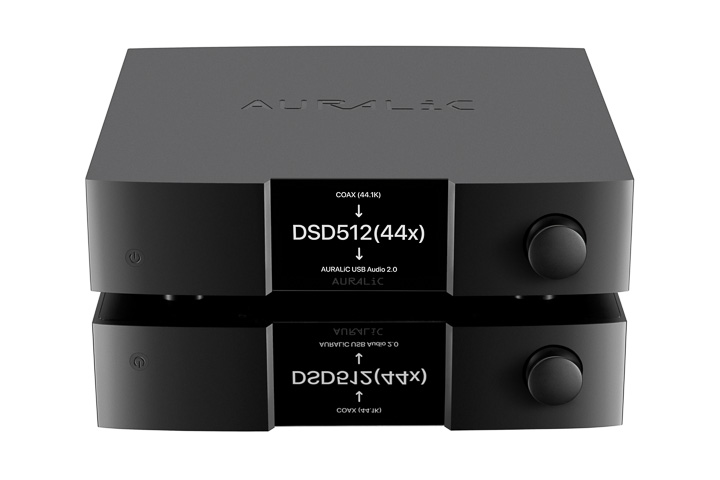
The nature of the SIRIUS G2 does create a bit of a conundrum for the reviewer. Do you review it as the last part in the big AURALiC jigsaw, as a standalone upsampler for equally high-grade systems, or both in and out of AURALiC’s matching products? I went predominantly for context rather than comparison, but in reality, what applies in the AURALiC stack holds equally well elsewhere. So, it sits in the now four-tier stack of AURALiC – with the ARIES G2 at the head of the table, the VEGA G2 connecting the whole caboodle to the next device in the chain, and the LEO GX and now the SIRIUS G2 making each component give its best possible performance in that system.

Of course, this means a lot of potential ways to configure the system, as you will be looking at something like an Ethernet connection on every box, and inputs like coax or USB on three out of the four boxes. Which goes where for the best sound? The reality is there is a lot of redundancy or upgradability (depending on viewpoint) here. Taking the slow route to full AURALiCOSITY, you will likely start with the VEGA G2 DAC, amassing all your source components to play them through that device on its own. From here, most will likely go with the ARIES G2. This Streaming Transporter acts as a bridge product, collecting all the digital inputs in one dedicated place and controlled by the Lightning DS app. Just one Lightning Link cable connects all those sources to the DAC, and instead of taking some kind of proprietary route to create this high-speed digital connection, the company uses HDMI connectors (even if the connection itself is not run as part of the HDMI protocols). This makes adding in the additional products a breeze; the next in line is the SIRIUS G2 tested here, which requires a single Lightning DS connection to hook all three devices together, and then the LEO GX requires three cables to link all four devices together.


This relative simplicity of connection between the devices (once explained) not only makes sense but works out cheaper than many of its rivals. A full dCS Vivaldi stack – for example – requires five AES/EBU and five BNC connectors; twice as many connectors and twice as many types of connector. While you can still spend big on cables in the AURALiC stack, the company has taken a shine to AudioQuest’s Diamond HDMI.  Depending on whether you use them for the digital audio pathway only or both digital and clock pathways, that’s anywhere between £2,000-£5,000 on inter-AURALiC cabling, which compares favourably with the £35,000+ worth of Transparent XL cables used in many dCS Vivaldi demonstrations. Granted, the four-box dCS includes a CD/SACD transport, and the comparisons begin to run out of puff when comparing hardware as well as connections, but it is worth noting that the commonly-used connections for the dCS Vivaldi (commonly top-end Nordost and Transparent) routinely cost more than the AURALiC stack and all its own cables!

The SIRIUS G2 itself is substantially built and relies on AURALiC’s digital smarts as well as its best modules to make it a step up on run-of-the-mill devices.

Some of the more outlandish products in this sector act like beachheads; they force you to change direction. You start out with one brand of DAC, but pretty soon the sheer weight of electronics means the DAC you started with gets the boot. The AURALiC concept – although more than good enough to make such changes extremely valid – is different; instead of forcing you to view everything digital through an AURALiC-shaped filter, the SIRIUS G2 simply brings out the best in your existing products. Granted, its abilities gently coax you into exploring more in the AURALiC line, but the idea here is that you already made an informed decision buying that good DAC and streamer and you don’t need to remake that decision in the light of an upsampler, no matter how good. In fairness, I suspect those who have already gone far down one of the many alternate rabbit holes (CH Precision, Chord Electronics, dCS, Esoteric, Wadax, etc) will have a matching upsampling and clock solution, or have one in their sights, but it’s good to keep the options open.

A new and key term in the AURALiC SIRIUS G2 is ‘Universal’. The AURALiC-based pathway that uses HDMI cables to run Lightning communications between the devices is fine, but it’s an AURALiC-only gig; you don’t get the upsampling benefits if you use another brand’s devices. If you aren’t using AURALiC components, the SIRIUS G2 is still entirely relevant. It includes inputs and outputs for S/PDIF coaxial and optical, AES/EBU 110v balanced XLR connectors, and one USB in and two out. There is also a single RJ45 network connector. How this works is as a go-between, connecting between your source and your digital converter, neither of which need to be made by AURALiC. This doesn’t just have an advantage to network streaming; so-called ‘legacy’ devices get buffed up by the SIRIUS G2 too. Connect it between a CD player and a DAC, and suddenly your humble 16/44 LPCM files get given upsampling power-ups like a boss.

More importantly, how you configure the SIRIUS G2 should depend on what kind of DAC you are using. For example, R2R (a.k.a. ladder) DACs respond best to signals that have the highest possible PCM sampling rate, and the SIRIUS G2 will convert the incoming signal to 32bit, 352.8kHz, by-passing the internal interpolation and filtering, regardless of whether the incoming signal is a PCM or DSD-flavoured datastream. On the other hand, the SIRIUS G2 can upsample PCM data to DSD for a Sigma-Delta DAC, but depending on the chip, this need not be the highest sampling frequency. In both cases, the SIRIUS G2 delivers an upsampled datastream with crazily low distortion and noise floor levels. This is one of the secrets of why the SIRIUS G2 is so useful in a system; feeding a Sigma-Delta DAC the appropriate higher bit rate DSD signal allows the chip to operate at a higher frequency, reducing modulation noise, but this only works if the upstream signal is of sufficiently low noise. With THD+N figures when upsampling PCM to DSD as low as -158dB, the SIRIUS G2 feed, it means distortion figures at or lower than those generated by the DAC’s own chipset.


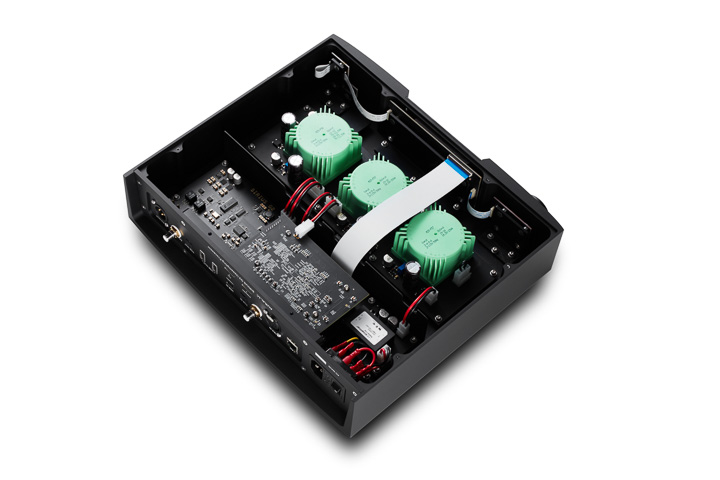
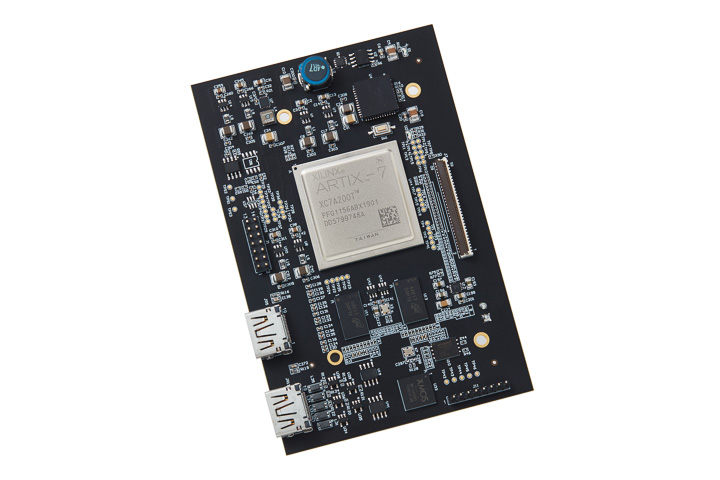
Internally, SIRIUS G2’s hardware is controlled by AURALiC’s own TESLA G1 platform (used throughout AURALiC’s product line). This is met by what the company calls the Proteus G2 Co-Processing Platform, which comprises 512MB of DDR3 memory and custom code on a Xilinx FPGA chip, which delivers 740 DSP slices across more than 200,000 logic blocks. Factor in three power supplies, a flexible filter, dual galvanic isolation and femto clocks, all in AURALiC’s own Unity chassis used in across the G2/GX range, and it becomes clear why the AURALiC ARIES G2 is no simple upsampler.

I used the SIRIUS G2 with both a Melco N10 and a Naim UnitiCore as streaming front-ends, using the USB output from the Melco and the S/PDIF BNC digital output of the Naim. I output these to both the AURALiC VEGA G2 DAC and direct into the digital inputs of a Devialet Expert 240 and an old Wadia 121 Decoding Computer on its last legs. I also used it in the full AURALiC stack as described previously. Unfortunately, AURALiC came in as the Totaldac d1 went back, so I didn’t have a ladder DAC to play with.

In fact, the choice of DAC was immaterial, the improvements were universal, and compelling. They were universal in terms of music choice and in terms of decoders. It made music uniformly more analogue sounding; not in a ‘fake LP’ way, it just made music sound more visceral and real, with greater solidity, image separation, soundstage width, depth and even height and even more coherence, both in terms of frequency and timing. I mildly preferred keeping DSD as DSD and PCM as PCM, however.

Using SIRIUS G2 in a system means playing more music. That’s something of an audio reviewer cliché, but here it holds because music sounds more harmonious through the SIRIUS G2. Whatever the genre and wherever the source. I found a lot of good in boosting ripped CDs to higher-rate PCM. Whether it was beautifully-recorded audiophile fluff (River: The Joni Letters by Herbie Hancock on Verve) or angular Polish nu jazz ‘1958’ from the eponymous Skalpel album [Ninja Tune], the sound was just more approachable and understandable. Or, in the case of the title track of Conditions of My Parole by Puscifer [Puscifer Entertainment, via Tidal], more direct and frightening.

The traditional digital brightness and thinness that people associate with streaming begins to go away here. Interestingly, the more components you build into the AURALiC G2 stack, the more those criticisms of streaming became outdated and unfair. The graunch of guitars in the Puscifer track showed this in stark relief; the tone of the track takes on a truly malevolent disposition here, something it rarely does through Tidal.

Is there a downside? Sonically, I don’t think so. However, to get the best from the SIRIUS G2 does involve some fairly complex app-wrangling, matching the upsampler to your DAC’s performance and if you get technofear, terms like ‘Parallelize Sigma-Delta Modulator’ might send chills along your heatsinks. Everything is explained in multiple places, however, but you might feel the need to hand setting up over to an expert. That being said, it’s not complexity for its own sake, but digital matchmaking… almost like Tinder for DACs.


The above highlights aspects of the full AURALiC stack that don’t quite unwrap at first thought but unwrap a whole lot faster with the SIRIUS G2 in situ. When you hear this system, you almost automatically place it in the same standing as the likes of Esoteric, CH Precision and their ilk. At first, you do this simply because there are four boxes staring back at you, rather than just one. Then you hear what it does and the full stack meets the same criteria, even though the cost of all four AURALiC boxes is considerably less than its peer group. OK, very close investigation shows where the top systems are better, if only fractionally better. But upsetting the apple-cart is not the point; this four-box system goes toe-to-toe with some of the gods of modern digital audio and not only doesn’t come away bruised, but gives them a bit of a bruising too.

All of which means the SIRIUS G2 gets a real seal of approval. Whether used to start, finish, or flesh out an AURALiC stack or simply to buff another brand’s DAC, it works and works surprisingly well. If you are sceptical (rather than a cynic) and take a listen, what it does to a digital signal is surprising in a good way. What’s more, I’ve tried hard to hear where there is a downside to this kind of upsampling and for the most part I’m still trying. While the SIRIUS G2 shows listeners why AURALiC is so good by virtue of doing an exceptionally good job, it doesn’t force you into an AURALiC-shaped future. That being said, if you have a very good DAC and hear what the SIRIUS G2 does for it, don’t be surprised if you start asking questions about those other boxes in the line-up.


TECHNICAL SPECIFICATIONS

  • Type: Streaming Upsampler
  • Input channel: Lightning Link (Up to 384K/32bit, DSD512), USB Audio (Up to 384K/32bit, DSD512), AES/EBU (Up to 192K/24bit, DoP DSD64), Coaxial (Up to 192K/24Bit, DoP DSD64), TOSLINK (Up to 192K/24Bit, DoP DSD64)
  • Output channel: Lightning Link (Up to 384K/32bit, DSD512), 2x USB Host (Up to 384K/32bit, DSD512), AES/EBU (Up to 192K/24Bit, DoP DSD64), Coaxial (Up to 192K/24Bit, DoP DSD64), TOSLINK (Up to 192K/24Bit, DoP DSD64)
  • Sampling rate: PCM in 44.1K – 384K (16 to 32Bit), DSD64 – DSD 512 (Both 44x and 48x)
  • THD+N: <-150dB (Upsampling to any PCM or DSD64)
  • THD+N: <-155dB (Upsampling to DSD128-DSD512)
  • THD+N: <-130dB (Downsampling to 44.1K/48K) Digital
  • Dimensions W×H×D: 340 × 80 × 320mm
  • Weight: 7kg
  • PRICE:  £5,499

Manufacturer: AURALiC LIMITED

Distributor: AURALiC Europe

Tel: +44(0) 7590 106105

URL: auralic.com

Reproduced from Issue 180

REL Acoustics S/510 subwoofer

We’ve taken a little bit of a hiatus with subwoofers of late, for an odd reason. Of recent years, our reviews have tended to be mostly of REL subwoofers (and a few notable exceptions like Eclipse). This seems partisan, but the reality is we’ve struggled to find subwoofers that integrate with music as well as REL: Eclipse being one of the rare exceptions. The problem then becomes do we hold back on REL reviews because they are the only brand that consistently makes musically-credible subwoofers (thereby punishing REL for being good at its job and the rest of us for missing out on good subwoofers), or do we lower our standards? After much soul searching, we went for – rather than hid from – quality, and the new S/510 from REL is every bit the ‘quality’ option.

The S/510 manages to achieve the seemingly impossible task of squeezing a quart into a pint pot, without either shattering the glass or making the outcome not worth the effort. It uses a 10” front firing long-throw continuous cast alloy cone bass driver, with a second passive radiator firing into the floor. It also uses the NextGen3 version of REL’s evergreen 500W powerpack. It fits all of this into a relatively small and deceptively heavy box.

We have somehow got into our respective heads that high-quality bass performance requires big subwoofers with large bass drivers. It’s the old motoring adage, “there’s no replacement for displacement” in action. The trouble is that when you bring the big bass guns to bear, sometimes what you get is big and slow bass. Bass should be deep when needed, underpinning the sound when not directly called for, and in both cases… it needs to be fast. While ‘moving air’ is all about displacement, if that air is moved even a 256th note behind the beat, it sounds ‘off’ and if the transient speed of a large driver means the bass note is even a 256th note behind the beat at the attack and release phase, it makes the musical performance sound ‘slow’ and ‘ponderous’. By delivering bass through a faster, harder working smaller bass driver, it can keep pace with the rest of the musical delivery and therefore lets the music be a little freer.


You can hear the difference between ‘musically integrated’ subwoofers and their more cinematic brethren by playing a simple piece of music with a bass line. It’s perhaps no wonder that REL uses ‘The Ballad of the Runaway Horse’ by Jennifer Warnes and the late bassist Rob Wasserman, either from the 20th Anniversary version of Famous Blue Raincoat by Warnes [Private Music, BMG] or from Wasserman’s Duets [MCA]. The recording is simple (effectively a voice and a bass), but tells you all about a sub. Switching a correctly set-up subwoofer in and out adds some depth and ‘shape’ to the bass notes, of course, but what it does when set properly is lock Warnes’ voice in the centre of the soundstage. The better the sub, the more precisely that voice is solidly rooted between the speakers and with the S/510, if her voice was any more rooted, she’d need watering.

Expanding that out to more complex music, what makes the sound so well focused and precise with voice and bass extends to a complete band or a whole orchestra. Of course, the call of the bass is impossible to resist, so out came ‘Mein Teil’ from the Rammstein album Reise, Reise [Universal], followed closely by the title track of Infected Mushroom’s IM The Supervisor [YoYo]. First we used these on the affordable yet excellent Swisstone by Graham Audio LS3 loudspeaker on its own stands. This two-way has a lot to offer, but its bass – though good – is constrained by the size of the cabinet. The S/510 is like swapping the LS3 for a bigger, and in many respects better loudspeaker. Obviously these two tracks gave the subwoofer something meaty to get its teeth into, and didn’t disappoint. Bass lines were thicker, faster and with more of a fuller ‘thrack’ to each bass note. On the other hand, in both cases what you also got was more separation around the rest of the instruments, more of a sense of scale to the sound and size to the soundstage, and a greater sense of lyrical articulation. On the Rammstein track it felt that my sub-schoolboy German suddenly passed an exam, as I could sort of understand the lyrics slightly more. Curiously, the same benefits were bestowed on big speakers too.

There is almost a generational improvement with REL subwoofers. Last year’s best model is often eclipsed by this year’s second from the top, and so on. The REL S/510 is a fine example of this generational evolution. The late Richard Lord who first came up with the original concepts for REL loudspeakers would likely have approved of the S/510, because he loved his bass, but he also loved his bass controlling the sound of the rest of the system with an benign, yet, iron authority. That’s precisely what you get here, and those who think they don’t need a subwoofer because they have big speakers or a small room are wrong, and the REL S/510 is waiting to show you how wrong.

TECHNICAL SPECIFICATIONS

  • Type: Front-firing active woofer, down-firing passive radiator
  • Inputs: Hi Level Neutrik Speakon, Lo Level single phono, LFE phono
  • Active drive unit: 300mm alloy driver with aluminium chassis
  • Passive radiator unit: 300mm carbon-fibre
  • Power output: 500w (RMS)
  • Lower frequency response: 21Hz at -6dB
  • Gain control range: 80dB
  • Dimensions (W×H×D): 39 × 45 × 44cm
  • Weight: 26.3kg
  • Price: £1,899

Manufactured by: REL Acoustics

URL: rel.net

Tel: +44(0)1656 768777

https://hifiplus.com/reviews/

Nordost Valhalla V2 tonearm cable

Anyone familiar with Nordost’s bottom-up cable hierarchy could be forgiven for wondering why we should invest heavily in a tonearm cable. Nordost, like most cable specialists, started by promoting the primacy of quality loudspeaker and interconnect cables. And then the Valhalla power cable joined the range, when the sanctity of the mains power link became indisputable. The company’s interconnects and speaker cabling are all justly praised, but if one is upgrading piecemeal, the power cable is demonstrably the place to start.

Several months’ experience with the Valhalla v2 Tonearm Cable + has convinced this listener though that there’s plenty of mileage remaining in nurturing the audio signal at the other end of the system, where voltage levels dwindle from 240 down to microvolts. The care with which Nordost has wrought an extremely well-shielded, low capacitance conduit to pass pick-up cartridge signals from tonearm to phono amplifier ultimately reaped dividends well beyond expectation.

The V2 tonearm cable was relaunched this year with some mild revisions, and is now marked out by an additional ‘+’ sign. Like the rest of the V2 overhaul, the first V2 tonearm cable saw substantial improvements designed to uprate performance, making the V2 series in general a serious performance threat to the original Odin series. In place of the trademark Micro Mono-Filament layout came a dual-filament principle of applying two twisted strands of FEP dielectric, further reducing contact area around the conductor; and likely responsible for the lowered capacitance, from around 72 pF/m to 56 pF/m. Terminating each end of V2 were brand-new plugs, Nordost Holo:Plugs that replaced a generic right-angle DIN plug at one end and locking WBT NextGen phono plugs on the other.

The new ‘plus’ edition builds on all this, and takes a new layout internally, with the left and right channels wound individually as a twisted pair inside their own shield, in place of four insulated conductors all wound loosely together. The new approach is said to minimise any crosstalk and electromagnetic radiation between channels, although conducting copper had to be reduced slightly in cross section from 22 to 24AWG in order to maintain flexibility. That was probably a wise move: some compliance is essential in a tonearm cable that must be carefully ‘dressed’ in a sub-chassis turntable, to avoid unwanted mechanical loading on the delicately tuned suspension bounce. Perhaps tellingly, Nordost no longer trumpets the specification of V2+ capacitance, so this has likely increased in the new twisted-pair configuration.

Also new to this year’s plus-rated cable is a clever new earthing arrangement that allows more options when grounding the arm and turntable. Unusually, the earth lead, or ‘Bond Ground Wire’ does not connect to any part of the DIN plug. It runs parallel to the left and right channels, straight through to the other side (completely isolated in its own FEP extrusion and shielding). In my setup this resulted in the turntable chassis and arm mount being effectively earthed, and in practice was found to be enough to provide totally hum-free operation. There are two whip leads or “Detachable Ground Wires”; one that plugs into the amplifier end, and the other the tonearm end. On the amplifier end, when it is plugged in, this whip connects to the main shield of the cable. On the SME tonearm at least, this could enable the armtube plus cartridge body to be earthed independently of the turntable chassis, such that one earth line could be bonded to phono stage ground and the other to mains distribution ground, for example. For the most part though, the single default ground wire was sufficient and preferred.

Many plug configurations are offered, with prices starting at £4,470 for the simplest 1.25 m length with phono plugs both ends, for those turntables that include RCA outputs. A 90º DIN plug that befits many popular tonearms adds £100, while each subsequent half metre in length is £575. For the holy grail in cartridge wiring, connected to a fully-balanced phono stage, XLR terminations are available at the same price as RCA.

When measuring up for installation, bear in mind Nordost’s ‘over-delivery’ in cable lengths, which are described as mechanically tuned to optimise performance. In the case of the tested 1.25 m cable, this was 110 cm from DIN plug to the metal barrel that marks the stereo cable split, then a further 30 cm to RCA Holo:Plugs, a total of 1.4 m.

Listening tests were with a Michell Orbe SE and SME 309 arm, connected by the Nordost cable to MFA step-up transformer and Longdog Audio Reference Phono amplifier, the latter combination a perfect partner to witness the extreme resolution and low-noise potential of the cable.

Shortly after installation it became evident that my reference vdH Grasshopper III SLA cartridge was showing the early signs of advancing age – now plain to hear through the new cable – so was away for service in the Netherlands for part of the testing. A search through the cartridge spares box turned into a marathon spree to hear every pickup again and afresh, as it quickly became evident how much this augmented front-end was telling me about each cartridge for the first time.

Setting up a cartridge can be considered a chore – that’s certainly been my view at various times – or conversely an odyssey into what’s musically attainable, as more and more fine fettling brings greater rewards. Time spent with this cable reawakened the eternal tweaker in me. Half a dozen cartridges later I realised what an exceptional tool the tonearm cable had become in cartridge setup, as literally microscopic changes in VTA and azimuth were laid bare between (and all around) the loudspeakers. When the sweet spot in alignment is near, the increasing cohesion in sound is usually recognisable as ‘getting better’; here it was simply and unmistakably either close, or bang on.


So how does this piece of wire sound? In line with the revised Valhalla 2 series, the ‘plus’ tonearm cable follows a lean and mellow voicing, in contrast to original Valhalla interconnects which were sometimes found bearing a sin of commission through their spotlit treble.

There’s no such over-exposure here, just guileless revelation from bottom to top. The comparatively darker shading is nonetheless entirely natural in character, refusing to draw unwanted attention to the upper registers, instead allowing more relaxed attention equitably throughout the musical spectrum.

Listening through the Valhalla 2 Tonearm Cable + was more like unlocking the back door to the recording studio, or blagging the best concert seats in the house. Once the deck/arm/cartridge are perfectly tuned, which as discussed becomes a whole lot easier with an effectively transparent conduit carrying tiny signals from deck to amp, an LP side becomes a personal musical event.

Barenboim is at the seat of the piano, a grumbling monster of lacquered wood, cast iron and steel from which he coaxes these tender melodies as his right hand ripples back and forth, while the left punctuates with heavy yet deft low groans of bass in the opening of the Waldstein [EMI SLS 794/12].

The fine patina of tape hiss from the 50 year-old recording is part of the event and easily ignored, and instead I’m always captivated – in turn for instance by the incredibly soft vibration of barely touched keys in Der Sturm’s first movement. With the Nordost cable, I was hearing deeply into the incredibly long sustained open chords that drift through the piece, seemingly lost to the faint hiss but no, still there and ringing on and gently on.

A recently acquired box of the cycle by Alfred Brendel [Philips 6768 004] shows the Czech pianist’s touch with wider dynamic shifts but similarly thoughtful musical timing. Beethoven sonatas have never sounded so conversational, ranging from somnolent to downright scary but always uncannily expressive.

King Crimson’s debut album has just seen its anniversary reissue, replete with ruinous digital mastering, but a pink-rim Island pressing sounded the fresher after the cable upgrade, and crucially with correct on-the-beat timing. With the aid of a supporting cast of the LCR phono stage and a transformer volume control, surface noise melts away to inconsequence, another unexpected dividend of V2+. Somehow, more mortal tonearm cables seem to accentuate impulsive clicks where the Nordost ushers them through without emphasis.

A final word must go to bass replay, as the cable truly opens this area up being variously lean and fast, but rich and thunderous when demanded. Low-octave content comes across as staggeringly honest, whether delivering tuneful bass figures from an accomplished player, or the incidental effects of distant train and road traffic rumble, inadvertently captured at the edge of perception in 1960s recordings of chamber music. It may come as a surprise how much the stylus is reading when a tonearm cable is finally able to retell the whole story it receives. It’s only natural that one of the most sensitive cables in the whole audio pantheon should garner big differences in performance, but even so… wow!

The V2+ tonearm cable follows the house V2 sound of exceptional transparency and stunning transient playback, without ever falling to the temptation of over-sharing the treble content. The midband and top are deliciously open and see-through, seamless and nearly organic in naturalness, while bass is disarmingly honest and musical in its flow. This is a staggeringly insightful wiring upgrade to hear what’s hiding in the groove.

TECHNICAL SPECIFICATIONS

  • Type: Tonearm cable
  • Insulation: High purity 1.1 extruded Fluorinated Ethylene Propylene (FEP)
  • Conductors: 4× solid-core, Dual Mono-Filament design
  • Construction: 2× twisted pairs, individually shielded
  • Mechanically tuned lay and lengths
  • Material: 24AWG silver-plated, 99.999999% Oxygen‑Free Copper solid core conductors, 24 AWG silver‑plated, stranded Oxygen-Free Copper, Micro Mono-Filament design for bornd and grounding whips
  • Velocity of propagation: 87%
  • Termination: HOLO:PLUG® Straight or 90º low-mass 5-pin Din, RCA, or XLR connectors. Whips and bond wire terminated with gold-plated 5mm spades
  • Price: from £4,470

Manufactured by: Nordost

URL: nordost.com

Distributed in the UK by: Renaissance Audio

URL: renaissanceaudio.co.uk

Tel: +44(0)131 555 3922

https://hifiplus.com/reviews/

Meet Your Maker: CH Precision

This has been a long time coming. I visited CH Precision’s small, efficient manufacturing and design facility in the middle of last year. CH Precision was named after the first letters of the surnames of founders Florian Cossy and Thierry Heeb, although ‘CH’ also just happens to be the data-code for Switzerland (‘Confoederatio Helvetica’, meaning in theory that CH Precision’s website could have been ‘ch.ch’ instead of ‘ch-precision.com’). The two cut their audio teeth at Goldmund before founding the OEM company Anagram Technologies in the 2000s. We spoke to Florian Cossy (above, centre).

CH Precision has two sites within metres of one another in a business park in the small Swiss town of Préverenges, just west of Lausanne. The ground-level site combines a manufacturing facility, an upgrades and repairs section, and warehousing. The second is across the way and up two levels, and sports prototyping, R&D, sales, marketing and other admin, and a dedicated listening room. This last is used in part for listening to new components during development, and for dealer and distributor demonstrations and training. Put together, the whole CH Precision workforce combined could just about field a soccer team, so long as it was unisex and there weren’t too many substitutions.

That places significant demands on the workforce; with over half the personnel dedicated to design, there’s no room for an “I just make the power amp” team member. However, to ensure quality and consistency, that workforce is extremely well-trained and highly self-motivated. The company also relies on exacting documentation in its build-up plans and flexible work-benches/assembly lines. The products are typically constructed in batches of up to six at a time. The workforce is divided between those who prepare for assembly, and those who actually assemble the products, with sub-assemblies and modules built, tested, and stocked. Final assembly itself is more of a ‘Lego Brick’ process than ‘board stuffing’; true to the atelier tradition that supports the Swiss-watch industry, the boards themselves are built by a third-party also in Switzerland, however testing, additional processes and tuning, and final assembly is all performed in house. Having someone potentially building a CD transport one day and a power amp the next helps prevent worker boredom (there is no excuse for a ‘Friday afternoon car’ in high-end audio, but CH Precision’s manufacturing schema practically guarantees a happier work-place environment, and more satisfied workers means better built components).


However, CH Precision is not about making custom products for the sake of it; “We design from scratch,” says Cossy. “But we use off-the-shelf products whenever we can. There is no point designing a new op-amp if there is a perfectly good op-amp already in production.”

Alongside a flexible construction environment, another big element in CH Precision’s ethos is the upgradable nature of its components. Since making its first products in 2009, the only ‘legacy’ components that are no longer available are the company’s two ranges of interconnect and speaker cables. All other products, save the A1 amplifier, made over the last 11 years are still on CH Precision’s order books. Of course, there have been periodic upgrades to these products, with the aforementioned A1 power amp being extensively redesigned to create the A1.5 and the M1 upgraded to create the M1.1. However, these upgrades are available to existing CH Precision owners, A1s being traded in at advantageous terms and M1s being upgradeable in situ – which given the weight of the unit and the cost of shipping is no small thing. Often, when it comes to upgrading a CH system it’s more about additions to the system itself rather than swapping out one product for another (as highlighted in our Issue 175 test that turned a single-box stereo L1 line preamplifier into a full-blown, four-box mono L1 preamp with twin X1 power supplies, or in adding a more advanced streaming input card to an existing DAC). They might also come in the shape of repairs, but as is often the paradox; those companies with the best repairs departments are also the companies with the least need for a repairs department. As CH Precision started from the outset thinking of ‘the long game’ in terms of product supply, the products are built – and the components are chosen – in terms of longevity and performance. Although these are claims common to manufacturers in the audio world, surprisingly few ‘walk the walk’, but with a product range that remains effectively unchanged in more than a decade, CH Precision lives by this ethos.

CH Precision strives to break down boundaries, in an industry that loves to pigeonhole. This hasn’t always been easy, “We were long considered as a maker of digital sources (because we manufacture a drive and a DA converter)” says Cossy, “but we fought against this. Now, thankfully I think that fight is over and people recognise us as a designer of amplifiers as well.” Similarly, and perhaps more importantly, the same line-blurring applies to the products too. “We have enough expertise in both digital and analogue domains to create products that ‘have enough digital in them’ to counteract the inherent drawbacks of an analogue circuit, but in the digital domain. The other way round is happening too; we take something like the external clock and treat it like it is producing an analogue signal.”


Nevertheless, in a large range of electronics, there are products that designers feel best highlight their outlook. For Cossy, there are two products that demonstrate that; “The power amps, for the ability to adjust the ratio of global to local feedback circuit. This controls the damping factor and allows better loudspeaker and room matching. But also the P1 phono stage and its current mode inputs: These moving coil inputs remove the need for impedance matching and make for superior signal to noise ratio when compared to voltage inputs.” Demonstrating understated Swiss reserve, it’s clear that while all CH’s products are important to Cossy, these two design blocks best demonstrate what the company stands for.

I visited CH Precision at the time of one of its biggest changes in years; it announced and showed in early prototype form, the L10 and M10 amplifiers destined to sit atop the already mountainous peaks of CH Precision’s amplifier hierarchy. Alongside these ‘concept’ amplifiers came the substantial updates to the A1 stereo and M1 mono power amplifiers and – as seen in pre-release form – a Roon-Ready Ethernet streaming HD board for the C1 and C1 mono digital controllers and the I1 integrated amplifier. For a company as deliberately compact as CH Precision, this is a lot of heavy lifting for the R&D team in the company’s 10th anniversary year.

The longevity of each product – both in terms of the length of time it remains on sale and potential time it stays in a system – does impose unique disciplines on the brand. In 11-years of audio manufacturing, a company that has only ever discontinued one product that places severe strictures on both its designers and their designs; you don’t want the next model to be the first one that only stays around for a few years. That eradicates any complacency in product development, even if it does make for unchanging industrial design. This can make the brand a victim of its own success in terms of visibility; owners tend to upgrade or add more CH Precision products, and that means there are more unicorn horns on sale than second-hand CH kit. Also, a company that doesn’t launch a new product every six months doesn’t get the exposure of a brand that panders to the ‘yes, but what have you done for me lately?’ cabal of high-end audio buyers (and reviewers). Instead, CH Precision appears to sell its products on the revolutionary idea of making products that sound good, knowing their investment will still be current a decade or more from now. As such, distributors, retailers, reviewers, and listeners alike who have matured past the ‘flavour of the month’ club find themselves in lock-step with CH Precision’s approach.

The CH Precision concept posits that an owner of their products need not change their electronics, ever. The products are kept up to date through their modular nature and periodic and optional upgrades. Should you wish to improve the system, there’s a whole extended family tree of additional power supply and dual-mono options, a structure that applies to almost every core component and that can be worked through before you run out of CH Precision road. Should you decide to change your cartridge or loudspeakers, the electronics have unique flexibility to adapt. And with every component wearing a CH Precision logo still closely related to (or upgradable to) a current model, listeners aren’t likely to find themselves left with a discontinued ‘white elephant’.

It’s an approach that imposes its own rigour but creates its own opportunities too. Longevity brings long product cycles and modular design allows both future proofing and upgradability. But just as importantly, the design and technology remains common and complementary, the company agile and true to those original goals. 

ch-precision.com

LOUD & CLEAR REOPENS – SAFE & SOUND

Scotland’s leading hi-fi and home cinema specialist, Loud & Clear, has welcomed its first post-lockdown customers. Complete with an outdoor greeting area and an indoor reception desk offering hand sanitisers plus complimentary gloves and masks, the Edinburgh store offered a safe and sound welcome to its visitors. 

The customers were able to enjoy some of the world’s finest hi-fi equipment on display in the spacious store. Amplifiers, streamers, turntables, DACs and loudspeakers combined in a selection of stunning systems to produce inspiring performances. Particularly popular was the multi-award winning VPI Prime Signature deck which customers had recently read about in the hi-fi press and were keen to give an audition to. 

The Loud & Clear team is pleased to now be back on the path to offering their industry-renowned levels of hospitality and, as soon as conditions allow, hopes to be able to serve refreshments once again. In the meantime, many of the first customers brought in their own drinks (purchased from one of the many cafes on the historic Leith Waterfront) to enjoy whilst listening to the fine products on demo. 

Loud & Clear’s Glasgow store has also reopened and the team there was pleased to be able to welcome many old friends back into its experience centre. 

John Carroll, managing director, said, ‘We are delighted to welcome our first customers back into Loud & Clear. Our Edinburgh store was carefully designed to be the U.K.’s finest hi-fi experience showroom and over the last few months we have missed the social side of the business. I am particularly happy that on our first day back we have had both existing and new customers join us for a (safe) listen to some of the world’s finest audio equipment.’

Initially, Loud & Clear is running shorter opening hours: 

Thursday: 12:00 – 20:00. Friday: 12:00 – 19:00. Saturday: 09:30 – 17:30. 

Tuesday and Wednesday: by appointment only. 

A new online facility allows customers to save time and reduce one-to-one contact when purchasing products or booking one of the many services at: www.loud-clear-edinburgh.myshopify.com

 For more information: www.loud-clear.co.uk

Accuphase E-650 Integrated Amplifier

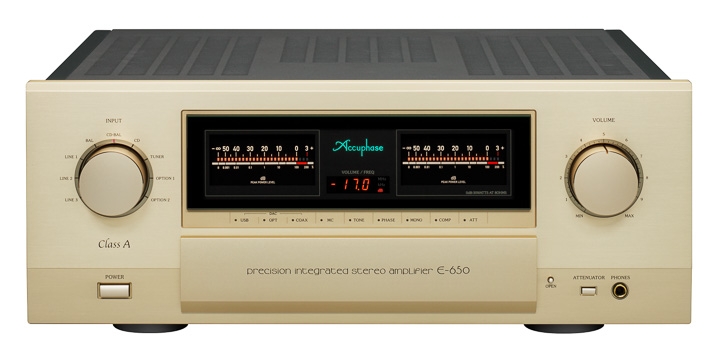
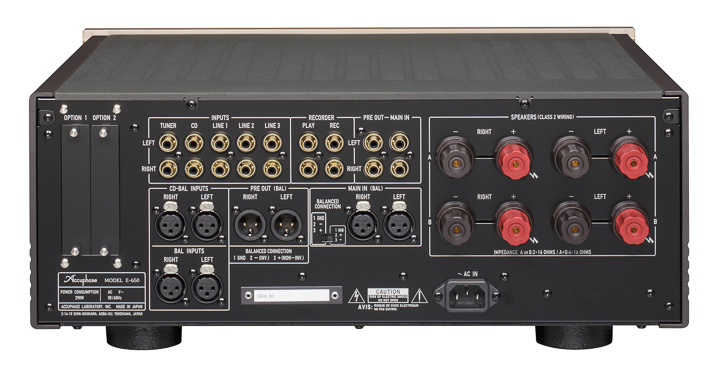
Having recently spent several happy weeks with Accuphase’s E-370 integrated amplifier for issue 178, the prospect of spending yet more quality time with one of its bigger siblings, the 30W Class A E-650 was too good to pass up. It duly arrived, right in the middle of the global pandemic lockdown, which meant its delivery and receipt had more overtones of Bridge of Spies than is usual for such matters. Still, once here, duly disinfected and installed, one obvious benefit to lockdown is somewhat more time stuck at home and available for music listening.

Accuphase offers two amplifier technologies, Class A/B and Class A, with the Class A models positioned at the upper end of the product range in terms of performance and price. Until the recent introduction of the 50W E-800, the E-650 was the flagship integrated amplifier, offering a conservatively-rated 30W per channel into an 8Ω load, doubling into 4Ω and 2Ω loads respectively. The E-650 uses Accuphase’s proprietary AAVA preamp circuitry, here in dual balanced mode, and the power amplifier employs their ‘instrumentation amplifier’ topology, for fully balanced operation from source input to speaker output terminals.


One rule with Accuphase power seems to be ‘don’t get hung up on the numbers’; the company states ‘guaranteed’ performance specifications, and the real-world performance usually comfortably exceeds these. So Accuphase Watts tend to be beefier than regular Watts, and Accuphase Class A Watts are beefier still. In terms of ability to deliver a satisfyingly visceral musical experience, the 30 Class A Watts of the E-650 easily bested the 100 Class A/B Watts of the E-370. I suspect this is partly down to the fact that Class A is ‘always on’, the power supply delivers the same output regardless of the music demands, so there’s no additional strain in the hot and heavy bits. I’ve heard other Class A amplifiers in the notional 25-30 Watt range, and they all do this to a degree but the Accuphase is definitely one that makes it possible to simply ignore the numbers as, frankly, rather irrelevant.

And that’s as it should be, really. We’re here to enjoy our music, the numbers are for those who have a use for them. Taken together with the low output impedance and high damping factor it all seems more than sufficient, and unless you listen at stadium levels in a room the size of a squash court, the E-650 feels entirely likely to be able to rise to the occasion. It doesn’t seem to run particularly hot, either, which is great when you’re tied to the house and the weather turns warm…


The more I listen, the more I’m becoming undecided about whether there’s a definite ‘house sound’ to Accuphase. Conventional wisdom often describes it as tending to ‘warm’ rather than ‘lean’, though I think that’s a mis-characterisation. I can see where it comes from: take ‘After the Gold Rush’ on Hymns of the 49th parallel [Nonesuch], the bass has real texture, strings are full and lush, the piano has power, a richly sonorous presence, and kd lang’s voice is creamy and full of character. But these are just reflections of the true sounds of the instruments, it’s not any kind of euphonic coloration. I think, rather, that it’s less of a ‘house’ sound, and more about the form of experience. When you listen to live musicians perform, there’s no tendency to analyse the sound as warm, bright, lean, or any of the other adjectives we fumble around with, it just is what it is. And that’s where I find myself with the Accuphase E-650: it’s easy to forget about the sound and just experience the music. Any perceived warmth is the natural warmth of real live musicians, the sort of warmth you experience in a concert hall with a live orchestra: living, breathing souls playing real physical instruments in your presence. The music as rendered by the E-650 simply has more shape, solidity and definition; it is what it is.

The Jacques Loussier Trio’s Theme and Variations on Beethoven Allegretto from Symphony No. 7 [Telarc] is a case in point, it’s not simply that the trio’s phrasing and timing is absolutely on the money, it’s that the whole musical envelope is more natural and convincing. The instruments are richly coloured and three-dimensional, and dynamics and timing are so effortless you don’t even notice. The overall effect is to refresh the music and show it in a new light; old and familiar tracks are newly interesting, but the music is brought out, rather than forensically examined. I didn’t find myself marvelling at the Renaud Garcia Fons trio’s timing on ’40-Dias’ from Arcoluz [Enja], because I was too busy enjoying it’s ‘rightness’ and the renewed sense of intrigue that gave it, right from the opening bars. Listening to Keith Jarrett, ‘Hymn of Remembrance’ from Hymns and Spheres [ECM], it was suddenly apparent that he wasn’t just improvising at the organ, but also making use of the vast and reverberant acoustic space to contribute to the music. These are not subtle musical experiences, but they derive from something being ‘right’ rather than ‘good enough’.


Talking of subtlety, there’s as much fine detail as you could wish for, including those vital ambience cues. It’s not a smooth, airbrushed presentation – any beauty is entirely down to the music. Unlike some more analytical amplifiers, detail isn’t pushed at you for its own sake; it is layered but not separated or highlighted, so the Accuphase seems to trigger the ‘music appreciation’ part of my brain more than the ‘music analytical’ part. You perceive the music as a gestalt rather than as a collection of elements, which is closer to what happens in a live experience. It’s that ‘rightness’ thing again. Key musical touch points: timing, pitch, tonal colour, dynamics, and no doubt a myriad of other parameters such as phase relationships, all rendered just a little bit more convincingly, so the brain has less work to do in maintaining a ‘willing suspension of disbelief’. So, I now find I have the capacity to notice that when Tord Gustavsen plays piano on ‘At Home’ from Being There [ECM], while this is unquestionably jazz, his precision of touch has much in common with classical technique, for example V.kingur .lafsson’s exquisite rendering of Philip Glass Piano Pieces [DG]. And that’s not me getting all analytical again, it’s just the sort of thing I’d notice in a live gig, when I’m engrossed and not having to process the signal just to make sense of it. Dave Brubeck, ‘Unsquare Dance’ from Time Further Out [Columbia] and the little miracle of how everything comes to an end ‘just so’, is even more miraculous when you can hear how the quartet plays with the timing without ever letting it get away from them.

And on the subject of detail, I’ve already mentioned Keith Jarrett’s use of acoustic space, but live albums are also a particular pleasure. The audience appreciation in ‘Hotel California’ from Hell Freezes Over [Geffen], or the applause on Arcoluz [Enja] is not just window dressing, it contributes to the feeling of presence, of an event. And have you ever been to a live gig, then bought the CD and been disappointed?I remember being astonished by a set by a Joshua Redman quartet a year or two ago, but the CD of some of the same music, Compass [Nonesuch], sits largely unplayed. I dug it out again, and the music now makes more sense and I’m starting to remember why they blew me away when I was there.


It helps, of course, if you have the right speakers. I started with the Amphion Argon 7LS floorstanders, and the Accuphase amplifier seems to have the knack of bringing out their considerable talents. Solid, weighty, tight, tuneful bass underpinning a subtly expressive musical message. Happily though, and again thanks probably to a certain global pandemic, I still had the Fyne Audio F702s on hand, which worked so well with the E-370. Twice the price of the Amphions, but fed by the E-650 they were simply captivating. I suspect it’s a feature of Accuphase’s AAVA preamp architecture, but the performance is much less leveldependent than with many amplifiers, too. It’s possible to get this immersive effect even at modest volume. Edvard Grieg, ‘Varen’ [Chandos] had an almost tangible sense of presence even at late night listening levels.

Sometimes you encounter a product that makes you reassess what you expect from your system. That’s just happened to me with the Accuphase E-650. It is transparent, not in the sense that the signal is preserved (though it surely must be), but in the sense that it makes it easy just to forget that it is there at all. There’s just you, and the music. It’s not so much transparent as invisible


TECHNICAL SPECIFICATIONS

  • Type: Solid-state 2-channel, Class A integrated amplifier
  • Analogue inputs: 5 single-ended line level only via RCA
  • jacks; 2 balanced via BNC connectors; 1 power
  • amp input (for external preamp); Optional mm/mc
  • phono stage board
  • Digital inputs: Optional DAC board: co‑axial, optical,
  • USB inputs
  • Analogue outputs: 1 tape loop; 1 pre-amp output
  • 2 pairs multi-way loudspeaker binding posts
  • Input sensitivity: (line level input) 77mV for rated output
  • Input impedance: 20kΩ
  • Signal to Noise Ratio: 102dB (at max. gain)
  • Frequency response: +0 / -0.5dB 20Hz–20kHz
  • Bandwidth: (@1W output) 3Hz–150kHz +0/-3.0dB
  • Distortion:THD 0.03%, 20-20,000 Hz, 4–16Ω load
  • IMD: 0.01%
  • Rated power into 8Ω: 30 Watts, both channels working
  • Rated power into in 4Ω: 60 Watts, both channels working
  • Rated power into in 2Ω: 120 Watts, both channels working
  • Damping Factor: 800 (8Ω load; 50Hz)
  • Gross Weight: 25.3kgs
  • Dimensions: 191 Å~ 465 Å~ 428mm (hwd)
  • Price: £10,600.00
  • £1,250.00 (optional DAC board)
  • £1,000.00 (optional MM/MC board)

Manufactured by: Accuphase Laboratory, Inc.

Yokohama, Japan

URL: accuphase.com

Distributed in the UK by:Music Works (UK) Ltd

Tel:+44 (0)161 491 2932

URL:musicworks-hifi.com

Dealers

https://hifiplus.com/reviews/